Search

Showing posts with label European Overseas Empires. Show all posts

11 February 2021

SYMPOSIUM: Legal Histories of Empire (5 March 2021, ONLINE)

We learned of an online symposium on legal histories of empire in March.

Join us for the second of several symposia planned for 2020 and 2021 for Legal Histories of Empire.

Our speakers:

Lisa Ford: ‘The King’s Colonial Peace: Variable subjecthood and the transformation of empire’

This paper is drawn from my forthcoming book, The King’s Peace: Empire and Order in the British Empire. The book uses colonial peacekeeping as a lens through which to examine the shifting parameters of crown prerogative in Empire in the Age of Revolutions. This paper will argue that the legal vulnerability of (and often threats to order posed by) a diverse array of subjects – formerly French Catholics in Quebec, Caribbean slaves and NSW convicts – both prompted and justified the unravelling of the very idea of the freeborn Englishman that had been mobilised by protestant Britons in pre-revolutionary America.

Lisa Ford is Professor of History at the University of New South Wales, Australia. Her major publications include Settler Sovereignty: Jurisdiction and Indigenous People in America and Australia, 1788-1836 (2010) which won the Littleton-Griswold Prize (American Historical Association); the Thomas J. Wilson Prize (Harvard University Press); and the Premiers History Award (NSW). She is also co-author of Rage for Order: The British Empire and the Origins of International Law, 1800-1850 (co-authored with Lauren Benton, 2016) and author of The King’s Peace, which will be published by Harvard later this year. Ford is currently leading a collaborative project funded by the Australian Research Council exploring the role of commissions of inquiry sent throughout the British Empire in the 1820s on which subject she hopes to lead author a book manuscript this year. She also holds a four-year ARC Future Fellowship, during which she will explore the changing use of martial law in the British Empire from the late eighteenth century until 1865.

Jessica Hinchy: ‘Child Removal and the Colonial Governance of the Family: Hijra and “Criminal Tribe” Households in North India, c. 1865-1900’

Historians have primarily examined colonial child removal projects in settler colonial contexts. Yet from 1865, the colonial government in north India forcibly removed children from criminalised communities. Child separation began in the households of gender non-conforming people labelled ‘eunuchs,’ particularly Hijras, and eventually extended to socially marginalised people designated as ‘criminal tribes,’ especially Sansiyas. First, what does a comparison of these child removal schemes tell us about the colonial governance of the family? Patrilineal, conjugal and reproductive household models marginalised Hijras and Sansiyas in differing ways, while the category of ‘child’ was contingently defined. Child separation was attempted to varying ends, including both elimination and assimilation. Yet often, the colonial state could not sustain such intensified forms of intimate governance in the face of resistance from households. Nor could officials simply determine removed children’s futures. Second, what does child removal suggest about the making of colonial law? When children were initially removed from Hijra and Sansiya households, officials admitted that ‘the law may have been somewhat strained,’ since existing laws did not provide police or magistrates with legal powers to separate these children. The Sansiya child removal project, for instance, prompted debates about colonial legal exceptions and the ‘legality’ of the colonial state’s practices among colonial officials and Indian and European non-officials.

Jessica Hinchy is an Assistant Professor of History at Nanyang Technological University in Singapore. She researches the history of gender, sexuality, households and family in colonial north India. In 2019, Cambridge University Press published her first monograph, Governing Gender and Sexuality in Colonial India: The Hijra, c. 1850-1900. Her research has also appeared in Modern Asian Studies, Gender & History and Asian Studies Review, among other journals.

The event will take place by zoom on Friday 5 March (or Thursday 4 March, depending on your timezone – see below). Please register here (via Eventbrite) to attend.

Timezones:

Sydney @ 12.30 pm on 5 March

Singapore @ 9.30 am on 5 March

Auckland @ 2.30 pm on 5 March

New Delhi @ 7.00 am on 5 March

London/Dublin @ 1.30 am on 5 March

Nairobi @ 4.30 am on 5 March

Vancouver @ 5.30 pm on 4 March

New Haven/Toronto @ 8.30 pm on 4 March

03 July 2020

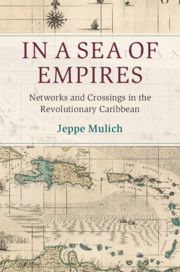
BOOK: Jeppe MULICH, In a Sea of Empires: Networks and Crossings in the Revolutionary Caribbean (Cambridge: Cambridge University Press, 2020). ISBN 9781108489720, $ 99.99


(Source: CUP)

Cambridge University Press is publishing a new book on the interconnected nature of imperial politics and colonial law in the maritime borderlands of the Leeward Islands in the early 19th century.

ABOUT THE BOOK

At the turn of the nineteenth century, the Caribbean was rife with revolutionary fervor and political turmoil. Yet, with such upheaval came unparalleled opportunities. In this innovative and richly detailed study, Jeppe Mulich explores the interconnected nature of imperial politics and colonial law in the maritime borderlands of the Leeward Islands, where British, Danish, Dutch, French, Spanish, and Swedish colonies both competed and cooperated with one another. By exploring the transnational networks involved in trade, slavery, smuggling, privateering, and marronage, he offers a new account of the age of revolutions in the Caribbean, emphasizing the border-crossing nature of life in the region. By approaching major shifts in politics, economy, and law from the bottom-up, a new story of early nineteenth-century globalization emerges – one that emphasizes regional integration and a multiplicity of intersecting networks.

ABOUT THE AUTHOR

Jeppe MulichLondon School of Economics and Political Science

Jeppe Mulich is Teaching Associate in Global History at the University of Cambridge and St John's College.

TABLE OF CONTENTS

1. Introduction
2. Free ports and black markets
3. Imperial warfare, colonial violence
4. Prize courts and privateers
5. Slave laws and free communities
6. Abolition and the illegal slave trade
Conclusion.

More info here

09 June 2020

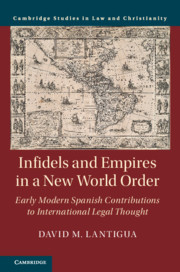
BOOK: David M. LANTIGUA, Infidels and Empires in a New World Order Early Modern Spanish Contributions to International Legal Thought (Cambridge: Cambridge University Press, 2020). ISBN 9781108498265, £ 85.00


(Source: CUP)

Cambridge University Press is publishing a new book on Early Modern Spanish contributions to international legal thought.

ABOUT THE BOOK

Before international relations in the West, there were Christian-infidel relations. Infidels and Empires in a New World Order decenters the dominant story of international relations beginning with Westphalia in 1648 by looking a century earlier to the Spanish imperial debate at Valladolid addressing the conversion of native peoples of the Americas. In addition to telling this crucial yet overlooked story from the colonial margins of Western Europe, this book examines the Anglo-Iberian Atlantic to consider how the ambivalent status of the infidel other under natural law and the law of nations culminating at Valladolid shaped subsequent international relations in explicit but mostly obscure ways. From Hernán Cortés to Samuel Purchas, and Bartolomé de las Casas to New England Puritans, a host of unconventional colonial figures enter into conversation with Francisco de Vitoria, Hugo Grotius, and John Locke to reveal astonishing religious continuities and dissonances in early modern international legal thought with important implications for contemporary global society.

ABOUT THE AUTHOR

David M. LantiguaUniversity of Notre Dame, Indiana

David M. Lantigua is Assistant Professor of Moral Theology and Christian Ethics at the University of Notre Dame, Indiana. He was previously a faculty member at The Catholic University of America and was a former graduate fellow at the Notre Dame Institute for Advanced Study. He co-authored, with Darrell Fasching and Dell deChant, Comparative Religious Ethics: A Narrative Approach to Global Ethics, 2nd edition (2011). He is also co-editor of Bartolomé de las Casas and the Defense of Amerindian Rights: A Brief History with Documents (2020), part of the Atlantic Crossings series.

TABLE OF CONTENTS

1. Introduction. International relations beyond Westphalia
Part I. The New World Crucible of Infidel Rights:
2. Theocratic world order and religious wars
3. Spanish Dominicans and the 'affair of the Indies'
4. The politics of natural law at Valladolid, 1550–1551
Part II. God, Empires, and International Society:
5. From infidels to savages: empires of commerce and natural rights
6. The scholastic law of nations, native occupation, and human solidarity.

More info here

16 April 2020

BOOK: Thomas DUVE and Otto DANWERTH, eds., Knowledge of the Pragmatici Legal and Moral Theological Literature and the Formation of Early Modern Ibero-America (Leiden-New York: Brill, 2020). ISBN 978-90-04-42162-2, OPEN ACCESS


(Source: Brill)

.
The Max Planck Institute for European Legal History has a new publications series: Max Planck Studies in Global Legal History of the Iberian Worlds (MPIW) will present legal historical research on the Iberian worlds of the early modern and modern periods. Its volumes will cover not only regions that were part of the Spanish and Portuguese empires or stood in direct contact with them, but also examine the globalisation and localisation of normative knowledge throughout Europe, America, Asia and Africa. A particular emphasis lies on the investigation of cultural translation processes and phenomena of multinormativity. The series, edited by Thomas Duve, is published in Open Access, and in print as a hardcover edition by Brill.

ABOUT THE BOOK

The first volume now published – Knowledge of the Pragmatici: Legal and Moral Theological Literature and the Formation of Early Modern Ibero-America – is devoted to a long underestimated genre of normative literature that was of great significance for the formation of normative orders in early modern Ibero-America: small handbooks written for practical use. These could contain legal texts, but moral theological works and confession manuals were also among these widely used media, which were particularly important for the everyday practices of norm production.

The definition of this genre, as well as its function, dissemination and use from the 16th to the 18th century are the focus of the eleven contributions to this volume, which brings together the results of a collaborative research project (SFB 1095). A number of contributions focus on the methods of norm generation in the early modern period, in particular the role of pragmatic literature in these processes and the practices of epitomisation characteristic of this genre. The volume also includes studies on important authors (such as Martín de Azpilcueta) and on the circulation of books and knowledge. Further chapters analyse the presence and use of pragmatic literature in regional contexts from Mexico to South America.

The authors, almost all of whom are members of the MPIeR, come from Argentina, Brazil, Colombia, Germany, Italy, Peru and Spain. The volume, edited by Thomas Duve and Otto Danwerth, has just been published in Open Access; the hardcover version will become available at the end of April.


ABOUT THE EDITORS

Thomas Duve is Director at the Max Planck Institute for European Legal History (Frankfurt am Main) and Professor for Comparative Legal History at the Goethe University Frankfurt. His research focuses on the legal history of the early modern age and the modern era. 

Otto Danwerth is Head of the editorial department at the Max Planck Institute for European Legal History (Frankfurt am Main). His research areas are early modern Spain and Ibero-America until the eighteenth century, with a focus on the Andean region.

More info here

20 March 2020

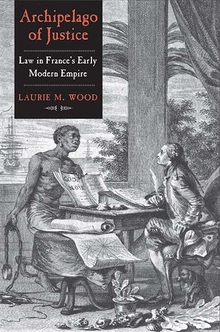
BOOK: Laurie M. WOOD, Archipelago of Justice. Law in France’s Early Modern Empire (New Haven: Yale University Press, 2020). ISBN 9780300244007, $65.00


Yale University Press is publishing a new book on law in France’s first empire (ca. 1680-1780).

ABOUT THE BOOK

An examination of France’s Atlantic and Indian Ocean empires through the stories of the little-known people who built it

This book is a groundbreaking evaluation of the interwoven trajectories of the people, such as itinerant ship-workers and colonial magistrates, who built France’s first empire between 1680 and 1780 in the Atlantic and Indian Oceans. These imperial subjects sought political and legal influence via law courts, with strategies that reflected local and regional priorities, particularly regarding slavery, war, and trade. Through court records and legal documents, Wood reveals how courts became liaisons between France and new colonial possessions.

ABOUT THE AUTHOR

Laurie M. Wood is assistant professor of history at Florida State University, where she is affiliated with the Institute on Napoleon and the French Revolution.

More info here

08 January 2020

BOOK: Emily WHEWELL, Law Across Imperial Borders : British Consuls and Colonial Connections on China’s Western Frontiers, 1880-1943 (Manchester: Manchester University Press, 2020). ISBN 9781526140029, 105,43 €


(Source: Bookdepository)

Manchester University Press is publishing a new book on law across the imperial borders (focused on Britain and its presence in Western China, Burma and India)

ABOUT THE BOOK

Law across imperial borders offers new perspectives on the complex legal connections between Britain's presence in Western China in the western frontier regions of Yunnan and Xinjiang, and the British colonies of Burma and India. Bringing together a transnational methodology with a social-legal focus, it demonstrates how inter-Asian mobility across frontiers shaped British authority in contested frontier regions of China. It examines the role of a range of actors who helped create, constitute and contest legal practice on the frontier-including consuls, indigenous elites and cultural mediators. The book will be of interest to historians of China, the British Empire in Asia and legal history. -- .

ABOUT THE AUTHOR

Emily Whewell is a Senior Researcher at the Max Planck Institute for European Legal History, Frankfurt

TABLE OF CONTENTS

Introduction

Part I: The Burma-China frontier
1 Treaty-making and treaty-breaking: transfrontier salt and opium, 1904-1911
2 On the move: people crossing the frontier, 1911-25
3 Consuls and Frontier Meetings, 1909-31

Part II: Through the mountains and across the desert: Xinjiang
4 Isolation and connection: law between semicolonial China and the Raj
5 Administering justice and mediating local custom
6 The British end game in Xinjiang: the decline of consular rights, 1917-39

Conclusion

Key terms
Select bibliography

More information here

30 October 2019

LECTURE SERIES: Norms and Empires (Max Planck Institute for European Legal History, November-December 2019)


We learned of a lecture series on Norms and Empires at the MPI in Frankfurt.

Norms and Empires Lecture Series

In the course of the 16th century, religion, empire, and trade built up networks that made the world more interconnected than at any previous point in history. The world’s oceans began taking over traditional land routes in their importance for moving goods, peoples, and communications. The Iberian empires, Portugal and Spain, played an important role in this process, connecting Europe, Africa, Asia, and the Americas through the Atlantic, the Indian, and the Pacific oceans, constructing between them a vast territorial reach. In these interconnected spaces, the normative representations of settlers, missionaries, and imperial agents collided with local normativities, forming a process of normative production and reconfiguration that took on different paths in different places. Drawing on the complexities in normative construction involved in this process, the Glocalising Normativities project seeks to combine a global perspective on legal history with local case studies based on detailed analysis of archival sources to understand how norms produced in the different spaces that were part of the sphere of influence of one of the Iberian Empires. The Norms and Empires Lecture Series invites leading historians in the field of imperial history to reflect on the issue of normative production in light of their own research experience.

Tuesday, October 8, 2019, 17:00-19:00
Federica Morelli (University of Turin)
Between Citizenship and Foreignness. Free People of Color during the Age of Atlantic Revolutions
Tuesday, November 5, 2019, 17:00-19:00
Chouki El Hamel (Arizona State University)
The Justification of Concubinage as an Institution of Slavery and Arab Genealogical Turn in Islam
Tuesday, December 3, 2019, 17:00-19:00
Ângela Barreto Xavier (Universidade de Lisboa)
Local normativity and the Portuguese imperial order. The case of Goa in the 16th and 17th centuries


13 February 2019

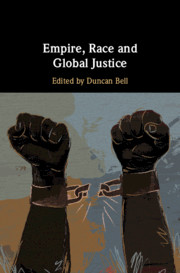
BOOK: Duncan BELL (ed.), Empire, Race and Global Justice, (Cambridge: Cambridge University Press, 2019). ISBN 9781108427791, £ 75.00


(Source: CUP)

Cambridge University Press is publishing a new book on the role of race and empire in debates over global justice.

ABOUT THE BOOK

The status of boundaries and borders, questions of global poverty and inequality, criteria for the legitimate uses of force, the value of international law, human rights, nationality, sovereignty, migration, territory, and citizenship: debates over these critical issues are central to contemporary understandings of world politics. Bringing together an interdisciplinary range of contributors, including historians, political theorists, lawyers, and international relations scholars, this is the first volume of its kind to explore the racial and imperial dimensions of normative debates over global justice.

ABOUT THE EDITOR

Duncan BellUniversity of Cambridge
Duncan Bell is a Reader in Political Thought and International Relations at the University of Cambridge, and a Fellow of Christ's College, Cambridge.

TABLE OF CONTENTS

Introduction: empire, race, and global justice Duncan Bell
1. Reparations, history, and the origins of global justice Katrina Forrester
2. The doctor's plot: the origins of the philosophy of human rights Samuel Moyn
3. Corporations, universalism and the domestication of race in international law Sundhya Pahuja
4. Race and global justice Charles W. Mills
5. Association, reciprocity and emancipation: a transnational account of the politics of global justice Inés Valdez
6. Global justice: just another modernisation theory? Anne Phillips
7. Globalizing global justice Margaret Kohn
8. Challenging liberal belief: Edward said and the critical practice of history Jeanne Morefield
9. Cosmopolitan just war and coloniality Kimberley Hutchings
10. Indigenous peoples, settler colonialism, and global justice in Anglo-America Robert Nichols
11. Decolonizing borders, self-determination, and global justice Catherine Lu.

More information here

13 September 2018

BOOK: Conor O’REILLY, Colonial Policing and the Transnational Legacy : the Global Dynamics of Policing Across the Lusophone Community (London: Routledge, 2017). ISBN 9781409465300, £115.00


(Source: Routledge)

Last year, Routledge published a new book on colonial policing in the Portuguese Empire

ABOUT THE BOOK

This compilation represents the first study to examine the historical evolution and shifting global dynamics of policing across the Lusophone community. With contributions from a multi-disciplinary range of experts, it traces the role of policing within and across settings that are connected by the shared legacy of Portuguese colonialism. Previously neglected within studies of the globalisation of policing, the Lusophone experience brings novel insights to established analyses of colonial, post-colonial and transnational policing. This compilation draws research attention to the policing peculiarities of the Lusophone community. It proposes new cultural settings within which to test dominant theories of policing research. It uncovers an important piece of the jigsaw that is policing across the globe. Key research questions that it addresses include:

• What were the patterns of policing, and policing transfers, across Portuguese colonial settings?
• How did Portugal’s dual status as both fascist regime and imperial power shape its late colonial policing?
• What have been the different experiences of post-colonial and transitional policing across the former Portuguese colonies?
• In what ways are Lusophone nations contributing to, and indeed shaping, patterns of transnational policing?
• What comparative lessons can be drawn from the Lusophone policing experience?

ABOUT THE EDITOR

Conor O’Reilly is Associate Professor in Transnational Crime and Security at the School of Law, University of Leeds. His research interests focus upon the transnational dynamics of crime, policing and security. He has published widely on these and related research themes in leading journals, including: British Journal of CriminologyCrime, Law and Social ChangeInternational Political SociologyPolice Quarterly; and Theoretical Criminology. He is also author of the forthcoming monograph, Policing Global Risks: The Transnational Security Consultancy Industry. He has worked on a range of international research projects, including the COPP-LAB project on Lusophone policing, and is currently leading a three-year project on kidnapping in Mexico.

TABLE OF CONTENTS

SUMMARY OF CONTENTS
Introduction: Policing and the Lusophone Community Across Time and Space
Conor O’Reilly (University of Leeds)
PART ONE: THE COLONIAL POLICING MISSION
1. Colonial Policing and the Portuguese Empire (c.1870-1961)
Gonçalo Rocha Gonçalves (University Institute of Lisbon) and Rita Ávila Cachado (University Institute of Lisbon)
2. The Military and the (Colonial) Policing of Mainland Portugal (1850–1910)
Diego Palacios Cerezales (University of Stirling)
3. Militarism in the São Paulo Police Force (1868-1924)
André Rosemberg (Universidade Estadual Paulista ‘Júlio de Mesquita Filho’)
Comment: The Portuguese Colonial Policing Mission in Comparative Perspective
Richard S. Hill (Victoria University of Wellington)
PART TWO: POLICING AT THE END OF EMPIRE
 
4. PIDE’s Racial Strategy in Angola (1957-1961)
Fernando Tavares Pimenta (New University of Lisbon)
5. Knowing ‘Mozambican Islam’: The Confidential Questionnaire on Islam and Colonial Governance during the Liberation War
Sandra Araújo (New University of Lisbon)
6. Intelligence-centric Counterinsurgency as Late Colonial Policing: Comparing Portugal with Britain and France
Bruno Cardoso Reis (University of Lisbon)
Comment: Reflections on Portuguese Late Colonial Policing
Martin Thomas (University of Exeter)
PART THREE: POSTCOLONIAL, TRANSITIONAL AND TRANSNATIONAL POLICING DYNAMICS
7. Post-War Police Reform in Mozambique: The Case of Community Policing
Helene Maria Kyed (Danish Institute for International Studies)
8. Transformation of Macau Policing: From a Portuguese Colony to China’s SAR
Lawrence K.K. Ho (The Hong Kong Institute of Education) and Agnes I.F. Lam (University of Macau)
9. Faint Echoes of Portugal but Strong Accents of Indonesia: Hidden Influences on Police Development in Timor-Leste
Gordon Peake (Australian National University)
10. Branding Rio de Janeiro’s Pacification Model: A Silver Bullet for the ‘Planet of Slums’?
Conor O’Reilly (University of Leeds)
Comment: "Never Mind the Similarities, Focus on the Differences": Imposition, Imitation and Intransigence in Post-colonial Global Policing Reform
Andrew Goldsmith (Flinders University)

More information here

10 September 2018

CONFERENCE: “Arguing for the Rule of Law: Using the Hebrew Bible and Caricatures of Foreigners in British and Spanish America.” (Chicago, 26 October 2018)


Via H-Announce, we learned of a conference on “Arguing for the Rule of Law: Using the Hebrew Bible and Caricatures of Foreigners in British and Spanish America”.

On Friday, October 26, 2018, at the Newberry Library in Chicago, the Symposium on Comparative Early Modern Legal History will be presenting a conference on “Arguing for the Rule of Law: Using the Hebrew Bible and Caricatures of Foreigners in British and Spanish America.” 

How did settlers, imperial officials, indigenous peoples, and Africans in the New World seek to demonstrate, or disprove, that a polity respected the rule of law?  (The phrase “rule of law” is modern; but the core of the idea is not).  Colonial rule invited accusations of arbitrary government and systematic lawlessness.  This conference will focus on two common techniques used to assess whether a polity respected the supremacy of law.  First, controversialists asked whether governance accorded with God’s expectations of justice as laid out in Scripture, particularly the Hebrew Bible.  Second, caricatures of other societies could be held up to make one’s own appear lawful and just, or the reverse.  British American settlers applauded the civility of their law by reference to the presumed barbarism of the Irish and Amerindians.  They saw liberty in their exploitive legal order by opposing it to the supposed absolutism of the Spanish and French empires.  Spanish settlers justified their rule and derecho by contrasting them to the law of indigenous polities and of their New World rivals.  The conference will bring together historians, law professors, and social scientists to think about the complex debates about the rule of law in the English and Iberian Atlantic.  

Attendance at the Symposium is free and open to the public.  Those who wish to attend should preregister by sending an email to Richard Ross at Rjross@illinois.edu.  Papers will be circulated electronically to all registrants several weeks before the conference.

For information about the conference, please consult our website at https://law.illinois.edu/faculty-research/specialty-programs/legal-history/ or contact Richard Ross at Rjross@illinois.edu or at 217-244-7890. 

Contact Info: 
Richard Ross, University of Illinois College of Law and History Department.  Rjross@illinois.edu
217-244-7890
Contact Email: 
(Source: H-Announce)

21 August 2018

PODCAST: HistoryHub – Kingdom, Empire and Plus Ultra


(Source: History Hub)

We learned of a Podcast series by HistoryHub on the domestic and overseas histories of Portugal and Spain. The latest podcast deals with the topic of Spanish imperial bureaucracy and is called “Petition and Response: Spanish America and the Council of the Indies in the 16th Century”:

History Hub is delighted to present Kingdom, Empire and Plus Ultra: conversations on the history of Portugal and Spain, 1415-1898. This new podcast series features interviews with experts in the areas of Portuguese and Spanish history, from the beginning of the Portuguese discoveries in 1415 to the end of Spanish dominion in America in 1898.

The interviews, conducted by historian Dr. Edward Collins, will cover a range of topics on the domestic and overseas histories of both nations, which include, among others: the Portuguese explorations of Africa and Asia, Spanish navigation and settlement in America, the church in Portugal and Spain, monarchy and intermarriage in the Iberian kingdoms, natural science and mapping in America, the role of nautical science, Irish historical relations with Portugal and Spain, and imperial competition in Europe and overseas.

The interviewees comprise a number of established and renowned academics, as well as up-and-coming researchers from universities and institutions worldwide. This History Hub series is funded by UCD Seed Funding and supported by UCD School of History. The series editor is Mike Liffey (Real Smart Media).

Kingdom, Empire and Plus Ultra is available via iTunes and Soundcloud.

The latest Podcast can be found here

05 April 2014

CFP: " Property Rights, Land and Territory in the European Overseas Empires", (Lisbon, 26-27 June 2014)


What: Property Rights, Land and Territory in the European Overseas Empires, Call for papers

Where: ISCTE-IUL University Institute of Lisbon, Lisbon, Portugal

When: 26-27 June 2014

All information here
Deadline for proposals submission: 20 April 2014

The occupation of territories, the rule over land and the definition of property rights, either de jure or de facto, were major concerns in the making and long-term development of almost every European overseas empire. They were also deeply interrelated with other key aspects of the empire-building process, including sovereignty claims, territorial expansion, settlement, taxation, power relations, social mobility, economic development, and the relationship with indigenous peoples. Therefore, those issues were of interest to all parts involved in the colonial venture - imperial governments, colonial authorities, first and later generations of settlers, native peoples and their elites - who dealt with them through complex and dynamic processes of negotiation and conflict.

The solutions adopted to regulate property rights and other territorial and land-related issues had their roots in legal norms, political concepts, institutions, ideologies and social practices transposed from each European metropole, then reframed and accommodated to each colonial context. Developing from different backgrounds in Europe, these theories and practices combined in a variety of ways with different conditions in the colonies, producing both contrasting and similar outcomes across time and space. 

The research on these topics has already achieved a huge body of results, but, for the most part, it has been pursued in a piecemeal fashion, either by disciplinary fields, empires or regions of the world, thus overlooking their interconnections. How can we compare the way issues of land, territory and property rights were dealt with across a variety of empires (e.g. Portuguese, Spanish, British, Dutch, French) and their different geographies? What can different branches of scholarship (from legal, economic, political, social and cultural history) offer each other? This conference aims to provide answers to these questions, by bringing these previously separate studies together into a common forum and setting them in comparative perspective.