Search

Showing posts with label slavery and the law. Show all posts

10 February 2023

BOOK: Nandini BOODIA-CANOO, Slavery, Indenture and the Law: Assembling a Nation in Colonial Mauritius (Abingdon: Routledge, 2023), 220 pp., ISBN 9781032322018, £120


(image courtesy: Routledge)

Book description: 
This book addresses historical issues of colonialism and race, which influenced the formation of multicultural society in Mauritius. During the 19th century, Mauritius was Britain’s prime sugar-producing colony, yet, unlike the West Indies, its history has remained significantly under-researched. The modern demographic of multi-ethnic Mauritius is unusual as, in the absence of an indigenous people, descendants of colonists, slaves and indentured labourers constitute the majority of the island’s population today. Thus, it may be said that the Mauritian nation was "assembled" during the period in question. This work draws on an in-depth examination of the two labour systems through which the island came to be populated: slavery and indenture. In studying the relevant laws, four legal events of historical importance within the context of these two labour systems are identified: the abolition of the slave trade, the abolition of slavery, private indentured labour migration and state-regulated indenture. This book is notable in that it presents a legal analysis of core historical events, thus straddling the line between two disciplines, and covers both slavery and indentured labour in Mauritian history. Mauritius, as an originally uninhabited island, presents a rare case study for inquiries into colonial legacies, multiculturalism and race consciousness. The book will be a valuable resource to scholars worldwide in the fields of slavery, indenture and the legal apparatus of forced labour.
Table of contents: 
Acknowledgements
List of Figures and Tables
Preface
Chapter 1: Introduction
Chapter 2: Historical Background
Part I: Slavery
Chapter 3: The Abolition of the Slave Trade
Chapter 4: The Abolition of Slavery
Part II: Indentured Labour
Chapter 5: Informal Indenture and Apprenticeships
Chapter 6: State-Regulated Indenture and The Emergence of an Indian Peasantry
Chapter 7: Conclusion
Bibliography
About the author: 
Nandini Boodia-Canoo is a lawyer and an academic, currently teaching at Bloomsbury Institute London. Her scholarship is interdisciplinary, covering law, history, international relations and sociology.
More information can be found here. 

03 October 2022

SEMINAR : Martineau on ‘Du droit de la guerre à la liberté contractuelle : l’évolution des justifications de l’esclavage africain au cours du XVIe siècle’ (Brussels, 5 October 2022)


(Source: CDI)

Professor Anne-Charlotte Martineau is presenting on ‘Du droit de la guerre à la liberté contractuelle : l’évolution des justifications de l’esclavage africain au cours du XVIe siècle’ at the Université Libre de Bruxelles this Wednesday.

Le Centre de Droit International a le plaisir de vous annoncer la reprise des Midis du Centre. Le premier Midi du Centre de cette nouvelle année académique se tiendra le mercredi 5 octobre 2022, à 12h15 et aura pour thème :  « Du droit de la guerre à la liberté contractuelle : l’évolution des justifications de l’esclavage africain au cours du XVIe siècle ». Il sera animé par Anne-Charlotte Martineau, chargée de recherche au CNRS, rattachée au Centre de théorie et analyse du droit dont elle est co-directrice.

Pour rappel, les Midis du Centre de Droit International se déroulent à la salle de réunion du Centre de Droit International (6, Av. Paul Héger, 1050 Bruxelles, Bâtiment H, 5ème étage, local H5.159). L’inscription est obligatoire via ce formulaire. 

Des sandwiches seront offerts aux participant·es sous réserve d’inscription avant 12h00 le jour ouvrable précédant l’événement. En cas d’inscription, nous vous remercions de venir effectivement à la séance ou, en cas d’empêchement impromptu, de nous prévenir aussitôt que possible. 

14 May 2021

BOOK: Alessandra BASSIONI, Beatrice DEL BO. Schiave e schiavi: riflessioni storiche e giuridiche. (Milano: Giuffrè, 2020). ISBN 9788828820932. 35 EUR.


(Source: https://shop.giuffre.it/024209652-schiave-e-schiavi-riflessioni-storiche-e-giuridiche.html)

Tema purtroppo di straordinaria attualità, la schiavitù ha percorso tutte le epoche storiche ed è stata analizzata con ottiche di ricerca che privilegiavano la razza e la condizione di mancanza di libertà degli uomini neri, molto poco delle donne, con una attenzione particolare per l'età moderna. Schiavitù femminile è un concetto che nel tempo resta strettamente legato ad altri: emigrazione, servizio domestico, sfruttamento sessuale, prostituzione, determinando nei secoli il manifestarsi di una domanda di schiave connotata da specifiche esigenze. Di fronte all'orrore di questo fenomeno, una lettura di genere offre spunti di riflessione e spazi al dibattito che scaturiscono dalle dinamiche sul lungo periodo e dai protagonisti storici: storie di uomini e donne, schiave e liberi, libere e schiavi, giustificazioni etiche, dilemmi religiosi, ragioni economiche, distinzione di status, occasioni di progresso sociale. Questo libro guarda alla schiavitù femminile nella storia da prospettive disciplinari diverse alla ricerca della female agency e al contempo dei diritti negati.

Table of contents: https://shop.giuffre.it/pub/media/Indice/INDICE_024209652.pdf#search=%22%22


10 May 2021

BOOK: Claudia STORTI. Economia e politica vs libertà Questioni di diritto sulla tratta atlantica degli schiavi nel XIX secolo. (Torino: Giappichelli, 2020). ISBN 9788892129726. EUR 20.


(Source: https://www.giappichelli.it/economia-e-politica-vs-liberta)

We have learned of the new book of Claudia Storti on international law and slave traffic in the Atlantic.

Prologo 
QUALE DIRITTO PER L’ABOLIZIONE DELLA TRATTA E DEL COMMERCIO DI ESSERI UMANI? 

Capitolo 1 LA TRATTA ‘ATLANTICA’ DEGLI SCHIAVI TRA XVI E XIX SECOLO 

Capitolo 2 IL DIRITTO DELLE GENTI NEL MEDIOEVO

Capitolo 3 LA SCHIAVITÙ NEL DIBATTITO SUL TRATTAMENTO E SULLA DEPORTAZIONE DEGLI INDIGENI AGLI INIZI DELL’ETÀ MODERNA

Capitolo 4 SCHIAVITÙ DEI CORPI E LIBERTÀ DELLE MENTI. LA SCHIAVITÙ TRA DIRITTO DELLE GENTI E DIRITTO NATURALE 


Parte II TRATTA ATLANTICA E SCHIAVITÙ NELLA LEGISLAZIONE E NELLA PRASSI DI ETÀ MODERNA  

Capitolo 5 UOMINI O COSE? LA CONDIZIONE GIURIDICA DEGLI UOMINI AFRICANI NELLA TRATTA ATLANTICA E NELLA SCHIAVITÙ DEL NUOVO MONDO

Capitolo 6 TRATTA E SCHIAVITÙ NELLA LEGISLAZIONE E NELLA PRASSI DELL’EUROPA TRA SEI E SETTECENTO 

Capitolo 7 PROPOSTE E TENTATIVI DI ABOLIZIONE DELLA TRATTA DEGLI SCHIAVI 


Parte III POLITICA, GIUSTIZIA, DIPLOMAZIA E DIRITTO INTERNAZIONALE TRA OTTOCENTO E NOVECENTO  

Capitolo 8 GLI EFFETTI DELLE LEGGI ABOLITIVE STATUNITENSE E INGLESE DEL 1807 NEL CONTESTO INTERNAZIONALE

Capitolo 9 FONTI E RUOLO DEL DIRITTO INTERNAZIONALE IN CONTROVERSIE SULLE NAVI NEGRIERE NELLE CORTI DEGLI STATI UNITI 

Capitolo 10 GIUSTIZIA, UMANITÀ E CONFLITTO TRA LEGGI: JOSEPH STORY E IL CASO DELLA JEUNE EUGÉNIE

Capitolo 11 LIBERTÀ DELLE NAZIONI E SCHIAVITÙ DEGLI UOMINI: IL CASO ANTELOPE 

Capitolo 12 GIUSTIZIA, POLITICA E DIPLOMAZIA. L’ULTIMA FATICA DI JOHN QUINCY ADAMS SUL CASO AMISTAD

Capitolo 13 IL RUOLO DELLA DIPLOMAZIA TRA 1842 E 1888

Capitolo 14 IL COMMERCIO DI ESSERI UMANI TRA DIRITTO CONVENZIONALE E AFFERMAZIONE DEI DIRITTI UMANI


Claudia Storti is full professor of History of Medieval and Modern Law at the Università degli Studi di Milano. 


More information: https://www.giappichelli.it/economia-e-politica-vs-liberta  

29 April 2021

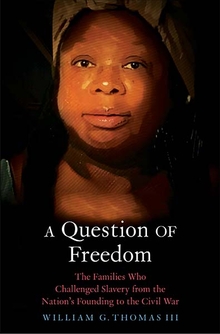
BOOK: William G. THOMAS III, A Question of Freedom - The Families Who Challenged Slavery from the Nation’s Founding to the Civil War (New Haven: Yale University Press, 2021). ISBN 9780300234121, 35.00 USD


(Source: YUP)

Yale University Press has published a new book on legal challenges to slavery from US independence to the Civil War.

ABOUT THE BOOK

For over seventy years and five generations, the enslaved families of Prince George’s County, Maryland, filed hundreds of suits for their freedom against a powerful circle of slaveholders, taking their cause all the way to the Supreme Court. Between 1787 and 1861, these lawsuits challenged the legitimacy of slavery in American law and put slavery on trial in the nation’s capital.

Piecing together evidence once dismissed in court and buried in the archives, William Thomas tells an intricate and intensely human story of the enslaved families (the Butlers, Queens, Mahoneys, and others), their lawyers (among them a young Francis Scott Key), and the slaveholders who fought to defend slavery, beginning with the Jesuit priests who held some of the largest plantations in the nation and founded a college at Georgetown. A Question of Freedom asks us to reckon with the moral problem of slavery and its legacies in the present day.

ABOUT THE AUTHOR

William G. Thomas III is the John and Catherine Angle Chair in the Humanities and Professor of History at the University of Nebraska. He is co-founder and was director of the Virginia Center for Digital History at the University of Virginia.


More info here

22 December 2020

ARTICLES: Direito, Estado e Sociedade, nº 57, 2/2020, OPEN ACCESS


(Source: http://direitoestadosociedade.jur.puc-rio.br/cgi/cgilua.exe/sys/start.htm?tpl=home)

The Brazilian journal Direito, Estado e Sociedade has recently published some articles of legal historical interest:


“Saberei ensinar aos desgraçados a vereda do desespero” – Entre o crime de insurreição e o direito à resistência: o abolicionismo radical de Luiz Gama

Por: Júlio César de Oliveira Vellozo e Silvio Luiz de Almeida


Um Direito Administrativo de Transição: o conceito de direito administrativo na cultura jurídica da Primeira República Brasileira (1889-1930)

Walter Guandalini Junior, Lívia Solana Pfuetzenreiter de Lima Teixeira


25 November 2020

JOURNAL: Sehepunkte 20 (2020), Nr. 11


(Source: Sehepunkte)

The journal Sehepunkte has a special forum on “Neueren Forschungen zur Sklaverei und zu anderen Formen starker asymmetrischer Abhängigkeit“ in its latest issue.

FORUM

Neuere Forschungen zur Sklaverei und zu anderen Formen starker asymmetrischer Abhängigkeit III

Einführung

Stephan Conermann

Marcel M. van der Linden / Magaly Rodríguez García (eds.): On Coerced Labor. Work and Compulsion after Chattel Slavery, Leiden / Boston: Brill 2016

Rezensiert von Michael Zeuske

Nitin Varma: Coolies of Capitalism. Assam Tea and the Making of Coolie Labour, Berlin: de Gruyter 2017

Rezensiert von Stephan Conermann

Rana P. Behal: One Hundred Years of Servitude. Political Economy of Tea Plantations in Colonial Assam, New Delhi: Tulika Books 2014

Rezensiert von Veruschka Wagner

John Donoghue / Evelyn P. Jennings (eds.): Building the Atlantic Empires. Unfree Labor and Imperial States in the Political Economy of Capitalism, ca. 1500-1914, Leiden / Boston: Brill 2016

Rezensiert von Michael Zeuske

Alessandro Stanziani: Labor on the Fringes of Empire. Voice, Exit and the Law, Basingstoke: Palgrave Macmillan 2018

Rezensiert von Hanne Østhus

Hsieh Bao Hua: Concubinage and Servitude in Late Imperial China, Lanham, MD: Lexington Books 2014

Rezensiert von Christian Schwermann

Caroline Norma: The Japanese Comfort Women and Sexual Slavery During the China and Pacific Wars, London: Bloomsbury 2016

Rezensiert von Reinhard Zöllner


The full issue can be found here

31 August 2020

BOOK: Marvin MESSINETTI, Diritto e schiavitù. Il paradigma dell'uomo merce nel secolo XVIII tra Regno di Napoli e colonie spagnole (Napoli: Editoriale Scientifica, 2020). ISBN: 9788893917551, pp. 168, € 14,00


ABOUT THE BOOK

Collana: IusRegni. Collana di Storia del diritto medievale, moderno e contemporaneo

Il volume esamina la fisionomia e la disciplina della schiavitù nel corso del XVIII secolo evidenziando le diverse declinazioni che tale istituto assunse. La schiavitù legata al fenomeno della tratta per foraggiare l’economia da piantagione nelle colonie d’oltreoceano, da una parte, e le c.d. schiavitù mediterranee, dall’altra, vengono qui analizzate attraverso un esame sincronico delle scelte politico-normative che caratterizzarono rispettivamente le colonie spagnole dell’Atlantico e il Regno di Napoli. Lo studio, che si avvale di documenti inediti rinvenuti presso l’Archivio General de Indias di Siviglia, ricostruisce anche il dibattito illuministico sul tema della schiavitù, soffermandosi sulle posizioni volte a giustificare o negare la legittimità del traffico e dello sfruttamento degli uomini-merce.

 ABOUT THE AUTHOR

Marvin Messinetti è assegnista di ricerca, nonché docente a contratto di Storia del diritto europeo presso l’Università degli studi di Camerino.


More information with the publisher.

03 July 2020

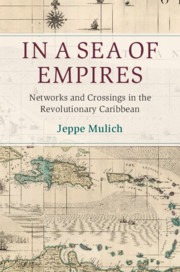
BOOK: Jeppe MULICH, In a Sea of Empires: Networks and Crossings in the Revolutionary Caribbean (Cambridge: Cambridge University Press, 2020). ISBN 9781108489720, $ 99.99


(Source: CUP)

Cambridge University Press is publishing a new book on the interconnected nature of imperial politics and colonial law in the maritime borderlands of the Leeward Islands in the early 19th century.

ABOUT THE BOOK

At the turn of the nineteenth century, the Caribbean was rife with revolutionary fervor and political turmoil. Yet, with such upheaval came unparalleled opportunities. In this innovative and richly detailed study, Jeppe Mulich explores the interconnected nature of imperial politics and colonial law in the maritime borderlands of the Leeward Islands, where British, Danish, Dutch, French, Spanish, and Swedish colonies both competed and cooperated with one another. By exploring the transnational networks involved in trade, slavery, smuggling, privateering, and marronage, he offers a new account of the age of revolutions in the Caribbean, emphasizing the border-crossing nature of life in the region. By approaching major shifts in politics, economy, and law from the bottom-up, a new story of early nineteenth-century globalization emerges – one that emphasizes regional integration and a multiplicity of intersecting networks.

ABOUT THE AUTHOR

Jeppe Mulich, London School of Economics and Political Science

Jeppe Mulich is Teaching Associate in Global History at the University of Cambridge and St John's College.

TABLE OF CONTENTS

1. Introduction
2. Free ports and black markets
3. Imperial warfare, colonial violence
4. Prize courts and privateers
5. Slave laws and free communities
6. Abolition and the illegal slave trade
Conclusion.

More info here

15 May 2020

BOOK: Daniel de CARVALHO OLIVEIRA. O Juízo dos Libertos – Escravidão e Campo Jurídico no Brasil Imperial (1850-1871). (Belo Horizonte: Editora Lafayette, 2020). R$ 24.)


“Por razões de mera clareza na exposição, eu subdividiria os contributos da pesquisa de Daniel Carvalho Ferreira em dois grandes filões: o primeiro, da história do direito civil; o segundo, da história da figura do bacharel. Alforrias, condição jurídica do escravo e do liberto, statuliber, ações de liberdade, eis alguns dos temas de direito civil que permeiam a história contada pelas páginas de Ferreira: leitura indispensável para qualquer um que se interesse pela história de tais conceitos e institutos. Mas, talvez, eu tenha sido inclusive reducionista na minha classificação, pois estamos diante de uma história marcada, ainda, pelo problema – de ordem também constitucional – da abolição da escravidão, por “razões de Estado”, pelo crime de reduzir pessoa livre à escravidão, e assim por diante. O segundo filão evoca o conhecido “bacharelismo imperial”, tema que Ferreira retoma com argúcia: o papel do Instituto dos Advogados Brasileiros, as curvas do mercado advocatício no século XIX, os critérios de distinção entre os advogados e entre os advogados e rábulas, o liberalismo, deontologia advocatícia, a atuação dos bacharéis da Corte em ações envolvendo escravos e libertos, os complexos vínculos entre bacharéis e Estado: com todos esses elementos, Daniel Carvalho Ferreira consegue ampliar sobremaneira as perspectivas – mas, também, questionar algumas delas – até então disponíveis na historiografia sobre o campo jurídico no Brasil imperial”.

(da Apresentação, de Ricardo Sontag)

25 March 2020

BOOK: Marco FIORAVANTI, La schiavitù (Roma: Ediesse, 2017). ISBN: 9788823020498, pp. 216, € 14.00

(Source: Ediesse)


ABOUT THE BOOK

Il libro si propone di indagare la storia della schiavitù da una prospettiva giuridica che, rispetto agli aspetti sociali, politici ed economici, è rimasta maggiormente nell’ombra. Eppure, il rapporto che permetteva di considerare un individuo proprietà di un altro e pertanto privo di ogni diritto o limitato nel suo esercizio era il frutto di una costruzione eminentemente giuridica. Sia il commercio degli schiavi che la loro condizione si basarono su un’attenta disciplina consuetudinaria e legislativa che, dietro le parvenze della neutralità e del rispetto, seppur minimale, dei diritti degli schiavi, manteneva e perpetuava una situazione di dominio di un uomo su un altro uomo. Il volume dunque, partendo dall’epoca classica, attraverso le servitù medievali, la schiavitù mediterranea e lo sviluppo del commercio atlantico, arriva fino alle nuove forme di schiavitù, che in maniera più subdola, ma non meno drammatica, caratterizzano la realtà contemporanea.

ABOUT THE AUTHOR

Marco Fioravanti è ricercatore confermato in storia del diritto moderno italiano e francese presso il Dipartimento di Giurisprudenza dell'Università degli Studi di Roma Tor Vergata. Settore scientifico disciplinare IUS/19 - Storia del diritto medievale e moderno.


More information here


28 November 2019

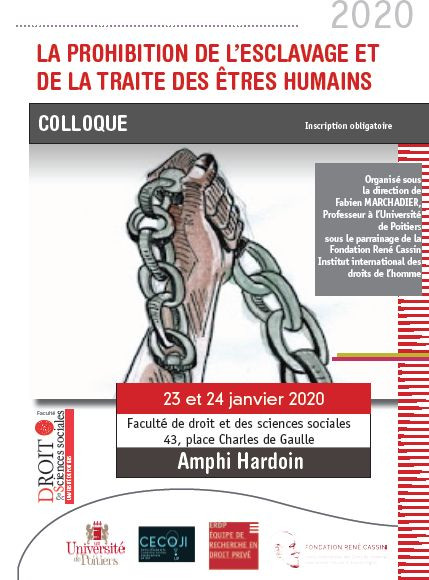
COLLOQUIUM: La prohibition de l’esclavage et de la traite des êtres humains (23-24 January 2020, Paris)


We learned of an international colloquium on the abolition of slavery and the slave trade in Paris coming January.

Particulièrement attentatoire à la dignité de l’homme, au même titre que la torture, l’esclavage fait l’objet d’une prohibition relativement ancienne et d’une grande fermeté. Énoncée dans la convention de Genève relative à l’esclavage du 25 septembre 1926, la prohibition absolue de l’esclavage, quelles que soient les circonstances, est reprise dans l’ensemble des déclarations et conventions protectrices des droits de l’homme. Au sein des États, l’abolition est progressive.

Le Pakistan clôt, en 1992, un processus engagé deux siècles auparavant en 1777 (abolition de l’esclavage dans le Vermont). La réduction en esclavage, autrefois rouage de l’économie (traite négrière), est devenue un crime contre l’humanité (art. 7 Statut CPI).

L’esclavage institutionnel n’existe plus, mais il doit désormais être saisi dans sa réalité factuelle afin de lutter efficacement contre tous les trafics et toutes les formes d’exploitation ayant pour objet des êtres humains, hommes, femmes et enfants. Il perdure dans toutes les régions du monde y compris dans ses manifestations les plus archaïques comme en attestent les marchés aux esclaves en Libye et le traitement réservé aux femmes Yézidies par l’État islamique.

L’esclavage est non seulement une réalité contemporaine, mais il est également un amer souvenir de la conquête du monde et de la colonisation par les européens.

Quelles réponses juridiques, quels recours offrir aux victimes de cette pratique odieuse ? Quelle signification revêt ou devrait revêtir l’esclavage sans pour autant diluer la notion en l’appliquant à des situations licites dans certains États (notamment la gestation pour autrui) ? Quelle distinction opérer entre esclavage, servitude, travail forcé et traite ? Quelle valeur possède le consentement de la victime à son exploitation ? Comment affronter l’esclavage dans ses multiples modalités ainsi que dans ses dimensions spatiales et temporelles ?

L’esclavage est une pratique d’hier et d’aujourd’hui. Les plaies du passé peinent à cicatriser ; le ressentiment des descendants d’esclaves demeure vivace. Entre devoir de mémoire et réparation, comment assumer le passé ? Au présent, la lutte contre l’esclavage associe tant les États que les opérateurs privés, en particulier à travers le devoir de vigilance imposé à certaines entreprises multinationales afin d’éviter qu’elles n’entretiennent indirectement le phénomène par leurs filiales ou sous-traitants établis à l’étranger. Le colloque a pour ambition de réfléchir à ces différentes questions et aux réponses qu’elles sont susceptibles de recevoir.

The full conference program can be found here