
(Source: Routledge)
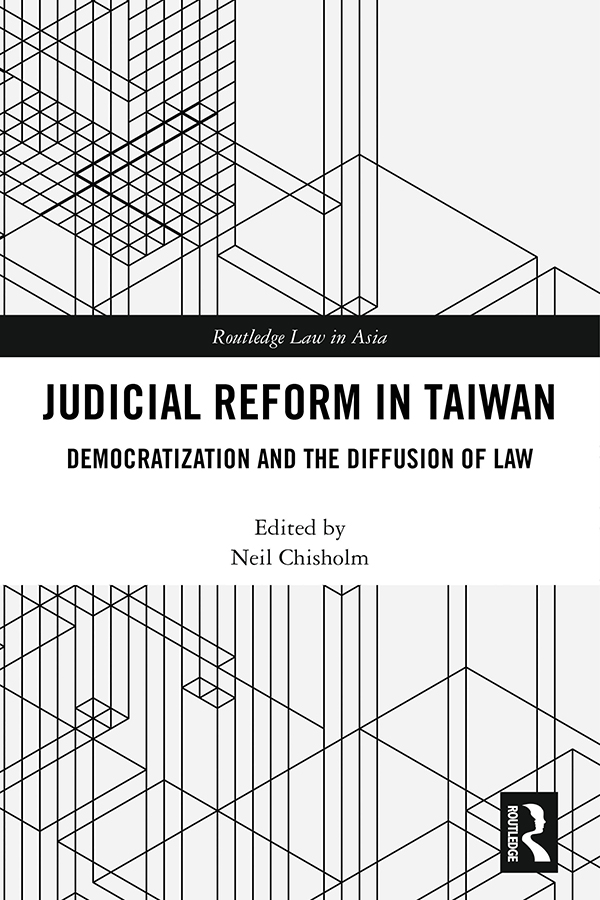
Routledge has published a book
dealing with the Taiwanese judicial reforms of 1999 and following years, and
which includes legal historical contributions.
ABOUT THE BOOK
This book examines Taiwan’s
judicial reform process, which began three years after the 1996 transition to
democracy, in 1999, when Taiwanese legal and political leaders began discussing
how to reform Taiwan’s judicial system to meet the needs of the new social and
political conditions. Covering different areas of the law in a comprehensive
way, the book considers, for each legal area, problems related to rights and
democracy in that field, the debates over reform, how foreign systems inspired
reform proposals, the political process of change, and the substantive legal
changes that ultimately emerged. The book also sets Taiwan’s legal reforms in
their historical and comparative context, and discusses how the reform process
continues to evolve.
ABOUT THE EDITOR
Neil Chisholm is a
Visiting Scholar at the Academy of East Asian Studies at Sungkyunkwan
University, South Korea.
TABLE OF CONTENTS
Foreword; Weng Yue-Sheng; Part 1
Taiwan’s Judicial Reforms in Comparative and Historical Context; 1 Taiwan’s
Judicial Reform Process: East Asian Context, Democratization, and Diffusion,
Neil Chisholm; 2 The Long Century of Taiwan’s Westernized Justice System:
Historicizing the Dynamics of Her Judicial Reform of 1999, Tzung-Mou Wu; 3 The
Development and Reform of Taiwan’s Prosecutorial System: 1945-2014, Heng-da
Hsu; Part 2 Institutional Transformations; 4 Separation of the Judiciary and
the Public Prosecution: The Cornerstone of Judicial Reform in Taiwan, Yue-Sheng
Weng & Chien-Liang Lee; 5 Regime Unchanged: The Organization and Failed
Reorganization of Taiwan’s Judicial Yuan, Yen-tu Su; 6 Reform and Resistance:
Restructuring Taiwan’s Appeals Process and the Internal Culture of Taiwan’s
Supreme Court, Puma Shen; 7 Adopting a Lay Participation System in Taiwan: The
Trial Observer Reform Attempt, Mong-Hwa Chin; 8 Transformation from the
Top-down or Bottom-up? Legal Education Reform as a Microcosm of Taiwan’s
Inconclusive Judicial Reform Process, Neil Chisholm & Hwei-Syin Chen; Part
3 The Procedural Revolution; 9 Conscience and Convenience: Taiwan’s Rocky Road
to Adopting the Adversarial System in Criminal Procedure, Chia-Wen Lee; 10 The
Evolution of the Right to Counsel in Taiwan, Rong-Geng Li; 11 A Leap Forward
Not Yet Achieved: Civil Procedure Reform in Taiwan, Jing-Huey Shao; 12
Administrative Law Reform in Taiwan, Ching-Hui Chen; Afterword: President
Tsai’s 2017 National Conference on Judicial Reform, Neil Chisholm
More info here


