Search

Showing posts with label cold war. Show all posts

29 August 2025

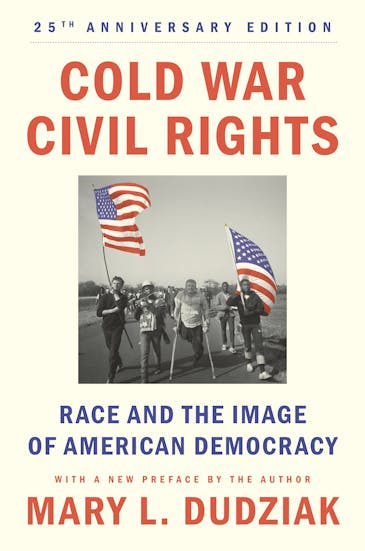
BOOK: Mary L. DUDZIAK, Cold War Civil Rights: Race and the Image of American Democracy (Princeton: Princeton University Press, 2025), 360 p. ISBN 9780691274324, 32 USD


(image source: Princeton)

Abstract:

In 1958, an African American handyman named Jimmy Wilson was sentenced to die in Alabama for stealing less than two dollars. Shocking as this sentence was, it was overturned only after intense international attention and the interference of Secretary of State John Foster Dulles. Soon after World War II, American racism became a major concern of US allies, a chief Soviet propaganda theme, and an obstacle to American Cold War goals throughout Africa, Asia, and Latin America. Racial segregation undermined the American image, harming foreign relations in every administration from Truman to Johnson. Mary Dudziak shows how the Cold War helped to facilitate desegregation and other key social reforms at home as the United States sought to polish its image abroad, yet how a focus on appearances over substance limited the nature and extent of progress. Cold War Civil Rights situates the Cold War in civil rights history while giving an international perspective to the fight for racial justice in America.

On the author:

Mary L. Dudziak is the Asa Griggs Candler Professor of Law at Emory University. Her books include War Time: An Idea, Its History, Its Consequences and Exporting American Dreams: Thurgood Marshall’s African Journey.

Read more here. 

(source: Legal History Blog)

19 December 2024

BOOK: Raluca GROSESCU & Ned RICHARDSON-LITTLE (eds.), Socialism and International Law. The Cold War and Its Legacies [The History and Theory of International Law, eds. Nehal BHUTA, Francesca IURLARO, Anthony PAGDEN & Benjamin STRAUMANN] (Oxford: OUP, 2024), 288 p. ISBN 9780198920175, GBP 100


(image source: OUP)

Abstract:

The contributions of socialist thinkers and states to the development of international law often go unrecognized. Socialism and International Law: The Cold War and Its Legacies explores how socialist individuals and governments from Eastern Europe, Africa, and Asia made vital contributions to international law as it is practiced today, and also brought ideas and initiatives that constituted important disruptive moments in its history. The socialist world of the 20th century was an ambiguous and fragile construct: there were clear divisions between the Soviet-led Eastern Bloc, which kept one foot in Western Eurocentric traditions, and the positions of the radical Third World, primarily post-colonial Afro-Asian states, which mounted a more fundamental challenge to the international order. Far from a monolith, the socialist world was an intricate and dynamic space, which still had many shared common understandings of global affairs and the meaning of the law within them. By examining how different state socialist ideologies, legal principles, and realpolitik affected contemporary international law frameworks, this book contests existing linear and Western-dominated histories. It considers these state socialist engagements in conversation with liberal and Western approaches and underlines the divisions that existed between versions of socialism from different regions and across the North-South divide. The legacies of socialist international law are still with us today, as are the consequences of its failure. With a focus on the Cold War and its aftermath, Socialist International Law features astute commentary on the history and present-day effects of socialist principles applied to international law, provided by an esteemed and diverse group of contributors from around the world.

 Table of contents:

1:Socialism and International Law: Legacies of Innovation, Contradiction, and Failure, Raluca Grosescu and Ned Richardson-Little
2:A Socialist Legal Universalism? Cold War Struggles Over International Law, Sebastian Gehrig
3:Socialism and Self-Determination: Lenin, International Law, and National Liberation, Brad Simpson
4:Soviet Lawyers and Concepts of Aggression in International Law, Michelle Penn
5:Decentring Marxism: The Poznań School and Socialist International Law in Eastern Europe after 1945, Jakub Szumski
6:How China Came to Embrace International Institutions, Ryan Martínez Mitchell
7:Health as a Human Right and Eastern European Anticolonialism, Bogdan C. Iacob
8:Protecting Culture Through International Law in the Postwar World, Nelly Bekus
9:Socialist Internationalism and Decolonizing Moralities in the UN Anti-Trafficking Regime, 1947-54, Sonja Dolinsek and Philippa Hetherington
10:State Socialist Contributions to the Criminalization of Apartheid, Raluca Grosescu
11:Terrorists, Revolutionaries, and Migrants: Cold War Conflicts and Convergences over International Air Hijacking Law, Ned Richardson-Little
12:Socialisms and International Law: Epilogue, Paul Betts

Read more here. 

30 October 2020

NEWS: New Entry „Cold War International Law” – Oxfordbibliographies


Oxfordbibliographies has a new bibliography for “Cold War International Law” by Martin Clark, Gerry Simpson, Sundhya Pahuja and Matthew Craven.

“Cold War International Law has conventionally been structured around a historiography of hiatus. A “gap” is posited as inhering in international law sometime between 1948 and 1989. In this gap, there is very little international law—or there is an international law of suspension or crisis or deferral. Some of the present editors (Craven, Pahuja, Simpson) are constructing an alternative vision of Cold War international law as law of improvisation, of committed nonalignment, of ideational power, of responsibility, of complicity, of imagination, and of co-constitution. The Cold War needed international law, and the international law we have now is a product of the Cold War. Given all this, compiling a bibliography of Cold War international law raises some difficulties. […]”

The full entry can be found here

BOOK: Ville ERKKILA and Hans-Peter HAFERKAMP, eds., Socialism and Legal History The Histories and Historians of Law in Socialist East Central Europe (London: Routledge, 2020). ISBN 9780367414757, GBP 120.00


(Source: Routledge)

Routledge is publishing a new book on legal historians and legal histories written in Eastern European countries during the socialist era after the Second World War.

ABOUT THE BOOK

This book focuses on the way in which legal historians and legal scientists used the past to legitimize, challenge, explain and familiarize the socialist legal orders, which were backed by dictatorial governments.

The volume studies legal historians and legal histories written in Eastern European countries during the socialist era after the Second World War. The book investigates whether there was a unified form of socialist legal historiography, and if so, what can be said of its common features. The individual chapters of this volume concentrate on the regimes that situate between the Russian, and later Soviet, legal culture and the area covered by the German Civil Code. Hence, the geographical focus of the book is on East Germany, Russia, the Baltic states, Poland and Hungary. The approach is transnational, focusing on the interaction and intertwinement of the then hegemonic communist ideology and the ideas of law and justice, as they appeared in the writings of legal historians of the socialist legal orders. Such an angle enables concentration on the dynamics between politics and law as well as identities and legal history.

Studying the socialist interpretations of legal history reveals the ways in which the 20th century legal scholars, situated between legal renewal and political guidance gave legitimacy to, struggled to come to terms with, and sketched the future of the socialist legal orders.

The book will be a valuable resource for academics and researchers working in the areas of Legal History, Jurisprudence and Philosophy of Law and European Studies.

ABOUT THE EDITORS

Ville Erkkilä is a Postdoctoral Researcher at the Center for European Studies, University of Helsinki, Finland.

Hans-Peter Haferkamp is Full Professor of Private Law and History of German Law. He is the Director of the Institute of Modern History of Private Law, German and Rhenish Legal History, University of Cologne

TABLE OF CONTENTS

Introduction: Socialist interpretations of legal history
Ville Erkkilä
PART I Framing the socialist legal historiography
1 The transformations of some classical principles in socialist Hungarian civil law: The metamorphosis of ‘bona fides’ and ‘boni mores’ in the Hungarian Civil Code of 1959
András Földi
2 We few, we happy few? Legal history in the GDR
Martin Otto
3 Roman law studies in the USSR: An abiding debate on slaves, economy and the process of history
Anton Rudokvas and Ville Erkkilä
4 Strategies of covert resistance: Teaching and studying legal history at the University of Tartu in the Soviet era
Marju Luts-Sootak
5 The Western legal tradition and Soviet Russia: The genesis of H. J. Berman’s Law and Revolution
Adolfo Giuliani
PART II Legal historians of socialist regimes
6 Juliusz Bardach and the agenda of socialist history of law in Poland
Marta Bucholc
7 Valdemārs Kalniņš (1907–1981): The founder of Soviet legal history in Latvia
Sanita Osipova
8 Getaway into the Middle Ages?: On topics, methods and results of ‘socialist’ legal historiography at the University of Jena
Adrian Schmidt-Recla and Zara Luisa Gries
9 Roman law and socialism: Life and work of a Hungarian scholar, Elemér Pólay
Éva Jakab


More info here

05 August 2020

CALL FOR PAPERS: Mapping South-South Connections: Networks, Alliances and New Actors on the International Scene during the Decolonization Process and Cold War in Latin America, Asia and Africa (1810-1990) (21-22 November 2020, Teheran) (DEADLINE: 10 September 2020)


We learned of a call for papers for an international conference in Teheran on connections between Latin America, Asia and Africa during the decolonization process and the Cold War from an interdisciplinary perspective. Here the call:

This conference aims to explore historical, political and cultural connections between Latin America, Asia and Africa during the decolonization process and the Cold War from an interdisciplinary perspective. Traditionally, the history of the ‘international’ has been presented from the perspective of major Western European and North American powers, based on their specific experience of the events and according to their imperial expansion, geostrategic and economic interests, the challenges they faced and the strategies they developed to counter them, and more generally the political and cultural or ideological climate and circumstances prevalent in the Europe and North America. Little attention has been paid to works developed taking into account or written from the perspective of the territories that were the object of the Western European and North American powers’ projection and interests. Networks, connections and alliances that were put into place by state and non-state actors coming from the so-called Global South that did not serve or follow those projections and interests were overlooked by historians. Although in the last two decades some works have appeared in the fields of Political Science and Economy, these are limited in number and moreover do not offer an adequate historical perspective. In addition, fields such as Diplomacy, Visual Studies or the Arts remain largely understudied if not unexplored. This is due to several reasons, among them the difficulty to access primary sources, instability or insecurity in different Global South countries, long distances among them and language diversity. The aim of the conference is to fill this gap by fostering the mapping of South-South connections between Latin America, Asia and Africa.

More info on the conference website.

29 May 2020

BOOK: Lori CLUNE, Executing the Rosenbergs. Death and Diplomacy in a Cold War World (Oxdord: University Press, 2019). ISBN: 9780190055592, pp. 282, £16.99

Cover for 

Executing the Rosenbergs
(Source: OUP)

ABOUT THE BOOK

In 1950, Julius and Ethel Rosenberg were arrested for allegedly passing information about the atomic bomb to the Soviet Union, an affair FBI Director J. Edgar Hoover labeled the "crime of the century." Their case became an international sensation, inspiring petitions, letters of support, newspaper editorials, and protests in countries around the world. Nevertheless, the Rosenbergs were executed after years of appeals, making them the only civilians ever put to death for conspiracy-related activities. Yet even after their executions, protests continued. The Rosenberg case quickly transformed into legend, while the media spotlight shifted to their two orphaned sons.
In Executing the Rosenbergs, Lori Clune demonstrates that the Rosenberg case played a pivotal role in the world's perception of the United States. Based on newly discovered documents from the State Department, Clune narrates the widespread dissent against the Rosenberg decision in 80 cities and 48 countries. Even as the Truman and Eisenhower administrations attempted to turn the case into pro-democracy propaganda, U.S. allies and potential allies questioned whether the United States had the moral authority to win the Cold War. Meanwhile, the death of Stalin in 1953 also raised the stakes of the executions; without a clear hero and villain, the struggle between democracy and communism shifted into morally ambiguous terrain.
Transcending questions of guilt or innocence, Clune weaves the case -and its aftermath -into the fabric of the Cold War, revealing its far-reaching global effects. An original approach to one of the most fascinating episodes in Cold War history, Executing the Rosenbergs broadens a quintessentially American story into a global one.

ABOUT THE AUTHOR

Lori Clune is associate professor of History, California State University, Fresno

TABLE OF CONTENTS

Preface
Acknowledgments
Introduction
Ch 1: Truman
Ch 2: Transition
Ch 3: Eisenhower
Ch 4: Execution
Ch 5: Reverberations
Conclusion
Notes
Abbreviations
Bibliography
Index

More information available here

24 April 2020

BOOK: Michael POZNANSKY, In the Shadow of International Law Secrecy and Regime Change in the Postwar World (Oxford: Oxford University Press, 2020). ISBN 9780190096595, $49.95


(Source: OUP)

Oxford University Press is publishing a new book on the role of secrecy in the postwar international order.

ABOUT THE BOOK

Secrecy is a staple of world politics and a pervasive feature of political life. Leaders keep secrets as they conduct sensitive diplomatic missions, convince reluctant publics to throw their support behind costly wars, and collect sensitive intelligence about sworn enemies.

In the Shadow of International Law explores one of the most controversial forms of secret statecraft: the use of covert action to change or overthrow foreign regimes. Drawing from a broad range of cases of US-backed regime change during the Cold War, Michael Poznansky develops a legal theory of covert action to explain why leaders sometimes turn to covert action when conducting regime change, rather than using force to accomplish the same objective. He highlights the surprising role international law plays in these decisions and finds that once the nonintervention principle-which proscribes unwanted violations of another state's sovereignty-was codified in international law in the mid-twentieth century, states became more reluctant to pursue overt regime change without proper cause. Further, absent a legal exemption to nonintervention such as a credible self-defense claim or authorization from an international body, states were more likely to pursue regime change covertly and concealing brazen violations of international law.

Shining a light on the secret underpinnings of the liberal international order, the conduct of foreign-imposed regime change, and the impact of international law on state behavior, Poznansky speaks to the potential consequences of America abandoning its role as the steward of the postwar order, as well as the promise and peril of promoting new rules and norms in cyberspace.

ABOUT THE AUTHOR

Michael Poznansky is Assistant Professor of International Affairs and Intelligence Studies in the Graduate School of Public and International Affairs at the University of Pittsburgh with a secondary appointment in the Department of Political Science. He is also a Non-Resident Fellow with the Modern War Institute at the United States Military Academy at West Point during the 2019-2020 academic year. Before arriving at the University of Pittsburgh, Dr. Poznansky was a predoctoral research fellow with the Belfer Center for Science and International Affairs at the Harvard Kennedy School. He received his Ph.D. in Foreign Affairs from the University of Virginia. Dr. Poznansky has published in a wide range of scholarly journals, including American Journal of Political Science, European Journal of International Relations, International Studies Quarterly, Journal of Global Security Studies, and Journal of Peace Research. He has also published in a variety of policy-oriented outlets, including the Council on Foreign Relations' Net Politics Blog, Political Violence at a Glance, War on the Rocks, and The Washington Post.

TABLE OF CONTENTS

Chapter 1. Introduction

PART I: Background and Theory
Chapter 2. The Evolution of Nonintervention
Chapter 3. The Politics of Secret Interventions

PART II: Covert Regime Change
Chapter 4. Operation ZAPATA: Cuba
Chapter 5. Project FUBELT and Track II: Chile

PART III: Overt Regime Change
Chapter 6. Operation Power Pack: Dominican Republic
Chapter 7. Operation Urgent Fury: Grenada

PART IV: Conclusions and Implications
Chapter 8. The Future of Covert Regime Change

More info here

03 February 2020

CALL FOR PAPERS: “Divided Together?” International Organizations and the Cold War” (Vienna, 3-4 June 2020) (DEADLINE: 15 May 2020)


(Source: H/Soz/Kult)

Via H-Soz-Kult, we learned of a call for papers on international organizations and the Cold War.

“Since the beginning of the 21st century, both Cold War studies and histories of internationalism have seen a tremendous renewal. It is now widely acknowledged that the Cold War cannot be reduced to a mere confrontation between the two superpowers and the ideologies that they have promoted. Small and mid-sized European powers, and neutral as well as recently decolonized countries pursued specific goals that escaped Cold War oppositions. Various actors worldwide promoted exchanges between the two blocs and offered challenging and rich alternatives to the ideological dichotomy between state socialism and liberal capitalism. Internationalism, moreover, reached its peak as both an ideological value and a political practice in the decades that followed the Second World War.
[…]”

The full call can be found here

06 November 2019

BOOK: International Law and the Cold War, ed. Matthew CRAVEN, Sundhya PAHUJA, and Gerry SIMPSON (Cambridge: Cambridge University Press, 2019). ISBN 9781108499187, £ 120.00


(Source: CUP)

Cambridge University Press is publishing a new book on international law and the cold war.

ABOUT THE BOOK

International Law and the Cold War is the first book dedicated to examining the relationship between the Cold War and International Law. The authors adopt a variety of creative approaches - in relation to events and fields such as nuclear war, environmental protection, the Suez crisis and the Lumumba assassination - in order to demonstrate the many ways in which international law acted upon the Cold War and in turn show how contemporary international law is an inheritance of the Cold War. Their innovative research traces the connections between the Cold War and contemporary legal constructions of the nation-state, the environment, the third world, and the refugee; and between law, technology, science, history, literature, art, and politics.

ABOUT THE EDITORS

Matthew Craven, School of Oriental and African Studies, University of London

Matthew Craven is a Professor of International Law at School of Oriental and African Studies, University of London, and Chair of the Centre for the Study of Colonialism, Empire and International Law. He is also a Senior Fellow at Melbourne Law School and a member of the Advisory Council for the Institute for Global Law and Policy at Harvard Law School. He is author of The Decolonization of International Law: State Succession and the Law of Treaties (2007) and The International Covenant on Economic, Social and Cultural Rights (1995).

Sundhya Pahuja, University of Melbourne

Sundhya Pahuja is a Professor of International Law and Director of the Institute for International Law and the Humanities at the University of Melbourne. She is a leading scholar of postcolonial international law, and author of Decolonising International Law (Cambridge, 2011).

Gerry Simpson, London School of Economics and Political Science

Gerry Simpson is a Professor of International Law at London School of Economics and Political Science. He held the Sir Kenneth Bailey Chair of Law at the University of Melbourne Law. He is the author of Great Powers and Outlaw States (Cambridge, 2004) and Law, War and Crime: War Crimes Trials and the Reinvention of International Law (2007).

TABLE OF CONTENTS

Dedication
About the editors
About the authors
List of figures
Acknowledgements
1. Reading and unreading a historiography of hiatus Matthew Craven, Sundhya Pahuja and Gerry Simpson
Part I. The Anti-Linear Cold War:
2. International law and the Cold War: reflections on the concept of history Richard Joyce
3. The elusive peace of Panmunjom Dino Kritsiotis
Part II. The Generative/Productive Cold War:
4. Accounting for the ENMOD convention: Cold War influences on the origins and development of the 1976 Convention on Environmental Modification techniques Emily Crawford
5. Nuclear weapons law and the Cold War and post-Cold War worlds: a story of co-production Anna Hood
6. Parallel worlds: Cold War division space Scott Newton
7. Shadowboxing: the data shadows of Cold War international law Fleur Johns
8. Contesting the right to leave in international law: The Berlin Wall, the third world brain drain and the politics of emigration in the 1960s Sara Dehm
9. Bridging ideologies: Julian Huxley, Détente, and the emergence of international environmental law Aaron Wu
10. More than a 'parlour game': international law in Australian public debate, 1965–1966 Madelaine Chiam
11. Environmental justice, the Cold War and US human rights exceptionalism Carmen G. Gonzalez
12. The Cold War and its impact on Soviet legal doctrine Anna Isaeva
13. Forced labour Anne-Charlotte Martineau
14. Rupture and continuity: North–South struggles over debt and economic co-operation at the end of the Cold War Julia Dehm
15. The Cold War history of the landmines convention Treasa Dunworth
Part III. The Parochial/Plural Cold War:
16. The Cold War in Soviet international legal discourse Boris N. Mamlyuk
17. The Dao of Mao: Sinocentric socialism and the politics of international legal theory Teemu Ruskola
18. 'The dust of Empire': the dialectic of self-determination and re-colonisation in the first phase of the Cold War Upendra Baxi
19. The 'Bihar Famine' and the authorisation of the green revolution in India: developmental futures and disaster imaginaries Adil Hasan Khan
20. Pakistan's Cold War(s) and international law Vanja Hamzić
21. International law, Cold War juridical theatre, and the making of the Suez Crisis Charlie Peevers
22. To seek with beauty to set the world right: Cold War international law and the radical 'imaginative geography' of Pan-Africanism Christopher Gevers
23. John Le Carré, international law and the Cold War Tony Carty
24. Postcolonial hauntings and Cold War continuities: Congolese sovereignty and the murder of Patrice Lumumba Sara Kendall
25. End times in the Antipodes: propaganda and critique in On the Beach Ruth Buchanan.

More information here

15 February 2019

WORKSHOP: Socialist interpretations of legal history. The histories and historians of law and justice in the GDR, Poland and the Baltic states under the reign of communism (22-23 MAR 2019)

(image source: helsinki)

The aim of the workshop at hand is to concentrate on the interaction between historians and communist regimes, but rather than investigating the control exercised by the communist states, we focus on the position of legal historians and their representations of history. How did the historians see the recent past, and how did that affect their vision on the future? What elements remained from the era preceding communism, and with what means did the scholars find leeway between strict ideological preconditions and their scholarly identity? 

After the Second World War, the Soviet occupied Eastern part of Germany, Poland and Baltic States all experienced – in a varying thoroughness – a drastic reorganization of higher education, which was purported to root socialist worldview to their respective academia. Consequently, in the following years also legal scholars advertised the anti-fascist, peaceable and democratizing characteristics of socialist law as an antidote to all what the western legal system supposedly encouraged and embodied. At the same time western continental legal science concentrated on the long lines of legal history, constructing its view as an exact opposite to what started to take shape as the socialist legal science. 

Rather than treating legal history and jurisprudence as mere political tools of the communist regimes, our workshop at hand focuses on the history of the scholarly representations of legal history and jurisprudence. We presume that writing the history of a community or a legal system left free space for scholars to express themselves as scientists, citizens and temporal subjects, even in communist regimes. Furthermore, we argue that this space for personal interpretation becomes evident in the works of the legal historians and legal scientists. The workshop is being arranged in a cooperation by the Centre of Excellence 'Law, Identity and the European Narratives' at the University of Helsinki and The Institut für neuere Privatrechtsgeschichte, University of Cologne. The workshop attempts to bring together scholars and approaches from variety of disciplines and fields of study. Our confirmed key-note speakers are Michal Kopecek (Jena/Prague), Marianna Muravyeva (Helsinki) and Lauri Mälksoo (Tartu). In order to analyze the ‘socialist interpretations of legal history’ in different times and regions across the Eastern Central Europe and former USSR, our workshop concentrates on (but is not restricted to) the following characteristics of socialist legal science and historiography. 

The Past, the Present and the Future in socialist legal history. What kind of narratives did the scholars reconstruct to their respected legal orders, or in general to European legal culture? How did they posit their narratives vis-à-vis the western story of European legal history, or which parts they rebuked in that narrative of the West? What were the foundational periods or agents in the socialist reconstructions and why so? 

Concepts and tropes. Where there key-concepts, tropes and metaphors in socialist legal history, and if so, where they transnational in nature or did they remain as local inventions of a national legal discipline? By whom and when they were introduced? 

The Networks and Schools in the jurisprudence of the GDR, Poland and Baltic states of the former USSR. How did the legal scholars of the former communist regimes organized themselves? Where there competing approaches to and paradigm shifts within the discipline of legal history? 

Continuities and discontinuities in socialist legal historiography. In what ways did the legal historical scholarship “started from the scratch” after 1945, distinct from bourgeois worldview and previous historical narratives? What stayed over from the inter-war period and what was rejected? How the further change in political and social conditions of the communist regimes affected legal historiography?

March 22, 2019
13.45–14.00 Ville Erkkilä, Hans-Peter Haferkamp: Opening remarks
14.00–15.00 Keynote speech, Michal Kopecek (Jena/Prague): The Socialist Conception of Human Rights and its Dissident Critique. East Central Europe 1960s-1980s.
15.00–15.30 Martin Otto (Hagen): We few, we happy few? Legal History in the GDR
15.30–16.00 Adolfo Giuliani (Helsinki): Eastern Europe and the legal historian. Changing images of the Eastern legal tradition: Roman law, canon law, Pandektism and anti-Pandektism.
16.15–17.15 Keynote speech, Marianna Muravyeva (Helsinki): TBA
17.15–17.45 Marju Luts–Sootak (Tallinn): Strategies of covert resistance in teaching and studying legal history at the University of Tartu in the Soviet era.
March 23, 2019
10.30–11.30 Keynote speech, Lauri Mälksoo (Tartu): The Concept of Human Rights in the Soviet Legal and Political Thinking.
11.30–12.00 Sanita Osipova (Riga): Valdemars Kalnins (1907-1981) – the founder of the Soviet legal history in Latvia.
13.30–14.00 Adrian Schmidt-Recla (Jena): Getaway into the Middle Ages? Topics, methods and results of socialist legal historiography in Jena
14.00–14.30 Martha Bucholc (Bonn): TBA
14.30–15.00 Anton Rudokvas (St.Petersburg): Roman law studies in the USSR
15.15–15.45 Diana Kudaibergenova (Lund): TBA
15.45–16.15 Ville Erkkilä (Helsinki): Law, Land and Community. Historicizing the socialist land reform in East Germany
(more information here)