Search

Showing posts with label French revolutionary period. Show all posts

07 July 2025

BOOK: Michael P. FITZSIMMONS, The Forgotten Constitution. The Origins, Realization, and Legacy of the French Constitution of 1791 (Oxford: Oxford University Press, 2025), 304 p. ISBN 9780197793947, 86 GBP


(image source: OUP)

Abstract:

The French Constitution of 1791 has a major legacy that overturned many centuries of historical tradition but remains little known outside of France. It ratified the unprecedented transformation of a society based on monarchy-centered government and legal privilege to one based on a sovereign citizenry and legal equality. Its powerful impact served as the inspiration for the wave of constitution-making that engulfed Europe during the nineteenth century and expanded globally thereafter. Furthermore, with the Declaration of the Rights of Man and Citizen as its original preamble, the Constitution of 1791 is associated with the concept of human rights proclaimed by the United Nations in the Universal Declaration of Human Rights in 1948. Drawing on wide-ranging and long-overlooked manuscript sources, The Forgotten Constitution highlights the Constitution of 1791's underappreciated importance and influence in the world. The constitution was the product of a long-term crisis of the Bourbon monarchy grounded in fears of despotism. The idea of a constitution took hold during the 1780s as the means to stabilize the kingdom through a more equitable distribution of power while attempting to accommodate a king. By making a constitution a compact between monarch and people, by its written assurance of civic and natural rights, and by its assertion of legal equality as an essential element of political legitimacy, the Constitution of 1791 codified the principles of the French Revolution. This book shows how it was the French constitutional tradition, inspired by the Constitution of 1791, that drove the Western constitutional ideal, especially in the revolutions of 1848.

Table of contents:

Introduction PART I. THE CREATION OF A BOURBON STYLE OF GOVERNMENT 1. The Rebuilding of Royal Authority 2. Louis XV: Transition and Discord over Monarchy-Centered Government PART II. THE TERMINAL CRISIS OF THE OLD REGIME 3. The Descent into Crisis 4. The Erosion of Monarchy-Centered Government 5. Toward the Estates-General PART III. THE REALIZATION OF THE CONSTITUTION 6. The Pledge of a Constitution 7. The Collapse of Monarchy-Centered Government 8. The Expansion of the Constitution 9. The Completion and Consolidation of the Constitution Conclusion Bibliography Index

On the author:

Michael P. Fitzsimmons is Professor of History Emeritus at Auburn University at Montgomery. His previous books include The Place of Words: The Académie Française and Its Dictionary during an Age of Revolution, The Night the Old Regime Ended: August 4, 1789 and The French Revolution, and The Parisian Order of Barristers and the French Revolution. 

Read more here. 


21 May 2024

ARTICLE: Carla A. HESSE, "Law, suspicion and social hermeneutics at the inception of the Terror, April 1793" (French History XXXVIII (2024), No. 1, 83-95 [OPEN ACCESS]


(image source: OUP)

Abstract:

This article revisits the genesis of the Law of Suspects of 17 September 1793, locating it in the longer durée of community and police surveillance, and the semantic field of ‘suspicion’ from the early eighteenth century to April 1793. It argues that the hermeneutics of suspicion, deployed by both citizens and the police as a means to ensure public safety, was a practice of keeping a watch out for suspicious social types (vagabonds, demobilized soldiers, foreigners, religious minorities etc.): people out of place or without occupation. With the Revolution of 1789, the social valences of suspicion underwent a carnivalesque inversion: the idle were now aristocrats rather than the poor; the drifter was now an émigré rather than a vagabond, immigrant, or solider; the religious outsider was now the recusant priest. But as the crisis of 1793–94 deepened, fear corroded all efforts to classify the social world. The Law of Suspects was an effort to rein in popular violence by offering a new way of reading social life through speech, comportment and behaviours rather than fixed categories of identity. ‘The suspect’—an identity defined only by transgression—incarnated the evil-doppelgänger of ‘the citizen’, whose legal parameters were yet to be defined.

Read the full article here (DOI 10.1093/fh/crad066). 

21 March 2024

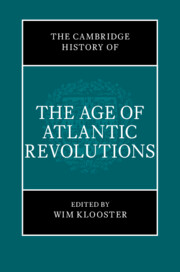
BOOK: Wim KLOOSTER (Ed.), The Cambridge History of the Age of Atlantic Revolutions (Cambridge: Cambridge University Press, 2023), 2400 p. 9781108567817, 3 vol. 320 GBP


(image source: CUP)

Abstract:

In three volumes, The Cambridge History of the Age of Atlantic Revolutions brings together experts on all corners of the Atlantic World who reveal the age in all its complexity. The Age of Atlantic Revolutions formed the transition from an era marked by monarchical rule, privileges, and colonialism to an age that stood out for republican rule, legal equality, and the sovereignty of American nations. The seventy-one chapters included reflect the latest trends and discussions on this transformative part of history, highlighting not only the causes, key events, and consequences of the revolutions, but stressing the political experimentation, contingency, and survival of colonial institutions. The volumes also examine the attempts of enslaved and indigenous people, and free people of color, to change their plight, offering a much-needed revision to R.R. Palmer's first synthesis of this era sixty years ago.

Table of contents:

Volume I. The Enlightenment and the British Colonies Volume II. France, Europe, and Haiti Volume III. The Iberian Empires. 

See here for the hardback and here for the digital version. 

12 February 2024

BOOK: Eric SCHNAKENBOURG, La quasi-guerre. Le conflit entre la France et les États-Unis. 1796-1800 (Paris: Tallandier, 2024), 320 p. ISBN 9791021051300, € 22,5

(image source: Tallandier)

Abstract:

Qui sait que la France et les États-Unis se sont affrontés ? Dans la seconde moitié des années 1790, ces deux puissances pourtant alliées entrent ouvertement en conflit. Bien que la guerre ne soit jamais officiellement déclarée, Français et Américains s’opposent lors de combats navals de part et d’autre de l’Atlantique et multiplient les captures de bâtiments, provoquant plusieurs milliers de morts et de blessés. Cet épisode, passé à la postérité sous le nom de Quasi-Guerre, naît de contentieux commerciaux et diplomatiques entre les deux pays. Il vient aussi, et peut-être surtout, d’un sentiment de trahison ressenti par la France quand les États-Unis semblent se rapprocher de leur ancien ennemi commun : la Grande-Bretagne. Les historiens américains ont accordé une grande attention à ce moment singulier car il s’agit du premier conflit de leur pays depuis son indépendance avec une grande puissance européenne. Éric Schnakenbourg propose une histoire totale de cette guerre en français, en s’appuyant sur des archives inédites. Ses recherches nous permettent de découvrir cet épisode méconnu de la France révolutionnaire.

On the author:

Éric Schnakenbourg est professeur d’histoire moderne à Nantes Université et directeur du Centre de recherche en histoire internationale et atlantique (CRHIA). Il a notamment publié Entre la guerre et la paix. Neutralité et relations internationales, XVIIe-XVIIIe siècles (2013) et Le Monde atlantique. Un espace en mouvement, XVe-XVIIIe siècle (2021).

More information here. 


11 January 2024

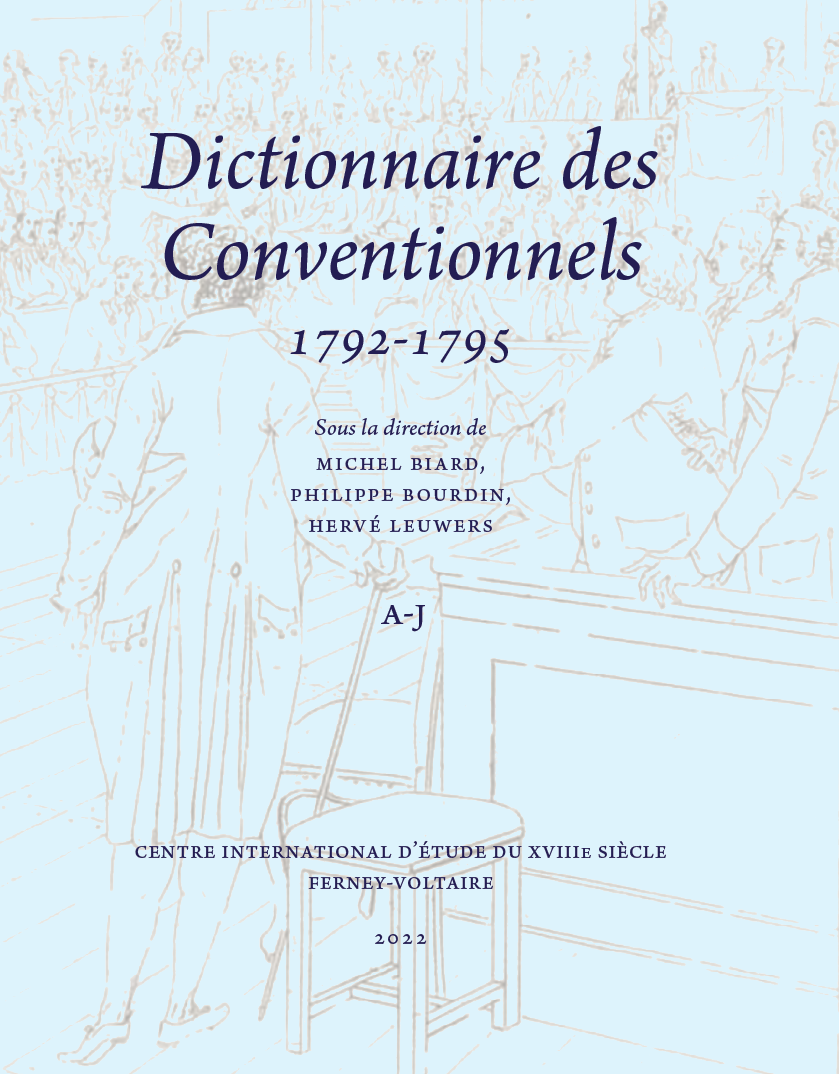
BOOK: Michel BIARD, Philippe BOURDIN & Hervé LEUWERS (dir.), Dictionnaire des Conventionnels 1792-1795 (Ferney-Voltaire: Centre international d'étude du XVIIIe siècle), XXXIV + 1310 p. ISBN 978-2-84559-153-0, 2022, €220


(image source: Etudes Robespierristes)

Abstract:
De l’entrée en république, le 21 septembre 1792, jusqu’à l’amnistie qui espérait une nouvelle fois clore la Révolution, le 4 brumaire an IV (26 octobre 1795), quelque neuf cents hommes ont siégé sur les bancs de la Convention nationale. Ensemble, non sans de profondes divisions, ils ont élaboré les bases d’une constitution démocratique mort-née (juin 1793), établi un «gouvernement révolutionnaire» destiné à «fonder» la république en période de guerre extérieure et intérieure (octobre 1793), puis inventé une république des «meilleurs», celle du Directoire, par la Constitution de l’an III (août 1795). Les hommes qui ont écrit l’histoire de ces trois années majeures demeuraient pour une partie d’entre eux méconnus. Depuis le Dictionnaire des Conventionnels de Kuscinski (1916), œuvre remarquable, mais inachevée et posthume, aucun travail d’ampleur n’avait permis d’examiner leurs parcours. Ces dernières années, les publications du Dictionnaire des Constituants (1991), puis du Dictionnaire des Législateurs (2007), sous la direction d’Edna Lemay, rendaient cette lacune plus visible encore. C’est pour la combler que ce Dictionnaire des Conventionnels, élaboré par une cinquantaine d’auteurs, a été conçu dans le cadre d’un projet financé par l’Agence nationale de la recherche; il retrace le parcours politique de ces fondateurs de la Première République, leurs missions dans les départements ou auprès des armées, leur travail dans les comités, leurs prises de position, leurs conflits et parfois leurs décès tragiques, en mettant les années 1792-1795 en perspective, par la présentation de leur cheminement, avant et après la Convention.
Table of contents:

Tome I

   Auteurs

   Principales abréviations

   Introduction

   Repères chronologiques

   Conventionnels Alard-Izoard

Tome II

   Principales abréviations

   Conventionnels Jac-Zangiacomi

   Cartes

– 1. Les départements à l’époque de la Convention (Michel Biard et François Delisle)

– 2. Nombre de représentants attribués aux départements (Michel Biard et François Delisle)

– 3. Nombre de représentants ayant siégé (Michel Biard et François Delisle)

– 4. Conventionnels présents aux appels nominaux du 20 septembre 1792 (Hervé Leuwers et François Delisle)

– 5. Conventionnels arrivés au 30 septembre 1792 (Hervé Leuwers et François Delisle)

– 6. Conventionnels arrivés au 31 octobre 1792 (Hervé Leuwers et François Delisle)

– 7. Adresses parisiennes des Conventionnels, carte 1 (Michel Biard et François Delisle)

– 8. Adresses parisiennes des Conventionnels, carte 2 (Michel Biard et François Delisle)

– 9. Nombre d’interventions par Conventionnel (Philippe Bourdin et François Delisle)

– 10. Conventionnels ayant déclaré leur fortune (Philippe Bourdin et François Delisle)

– 11. Nombre de missions par département (Michel Biard et François Delisle)

– 12. Représentants en mission aux armées (Michel Biard et François Delisle)

– 13. Les Conventionnels décédés de mort non naturelle (Michel Biard et François Delisle)

   Annexes

– 1. Les Conventionnels ayant siégé (Michel Biard)

– 2. Les présidents de la Convention nationale (Hervé Leuwers)

– 3. Les comités de la Convention nationale (Philippe Bourdin)

– 4. Girondins et Montagnards (Hervé Leuwers)

– 5. Les 426 représentants du peuple en mission (mars 1793-brumaire an IV) (Michel Biard)

– 6. Assemblées dans lesquelles ont siégé les Conventionnels (1789-1815) (Philippe Bourdin)

– 7. Âge des Conventionnels en 1793 (Philippe Bourdin)

– 8. Professions et fonctions des Conventionnels en 1789 et en 1800 (Philippe Bourdin)

– 9. Adresses parisiennes des Conventionnels (Michel Biard)

– 10. Les principaux orateurs (Philippe Bourdin)

– 11. Les 96 Conventionnels décédés de mort non naturelle (1793-1799) (Michel Biard)

– 12. Réintégrer au sein de la Convention les proscrits encore vivants (Michel Biard)

– 13. Le devenir des Conventionnels atteints par l’ordonnance du 24 juillet 1815 et la loi du 12 janvier 1816 (Hervé Leuwers)

– 14. Dates de décès des Conventionnels (Michel Biard)

Contributors:

Serge Aberdam, chercheur retraité au Département des sciences sociales de l’INRA Nathalie Alzas, docteure de l’université de Provence Gaid Andro, maîtresse de conférences à INSPE, université de Nantes Jean Bart, professeur émérite d’histoire du droit, université de Bourgogne Cyril Belmonte, docteur de l’université de Provence Mathias Berton, docteur de l’université Paris 1 Panthéon-Sorbonne Serge Bianchi, professeur émérite d’histoire moderne, université Rennes II Michel Biard, professeur d’histoire moderne, université de Rouen Normandie Bernard Bodinier, professeur honoraire d’histoire moderne, université de Rouen Justine Bodnar, master 2, université de Rouen Normandie Alexiane Boudaut, master 2, université de Rouen Normandie Philippe Bourdin, professeur d’histoire moderne, université Clermont-Auvergne, IUF Laurent Brassart, maître de conférences, université de Lille Patrice Bret, chercheur honoraire au Centre Alexandre Koyré, Paris Emilie Cadio, master 2, université Paris 1 Panthéon-Sorbonne Matthieu Carlot, professeur certifié Jean-Luc Chappey, professeur d’histoire des sciences, université Paris 1 Panthéon-Sorbonne Paul Chopelin, maître de conférences, université Jean Moulin Lyon 3 Guillaume Colot, docteur de l’université de Clermont-Ferrand Michel Combet, maître de conférences, université de Bordeaux Annie Crépin, maîtresse de conférences honoraire, université d’Artois Lorenzo Cuccoli, docteur des universités de Paris 1 et de Bologne Vincent Cuvilliers, docteur de l’université d’Artois Bernard Dailly, professeur certifié Hubert Delpont, docteur de l’université Bordeaux Montaigne Robert Demeude, docteur de l’université Paris 1 Panthéon-Sorbonne Jean-Étienne Dubois, docteur de l’université Clermont-Auvergne Anne-Marie Duport, docteure de l’université Paris 1 Panthéon-Sorbonne Annie Duprat, professeure honoraire d’histoire moderne, université de Cergy-Pontoise Pascal Dupuy, maître de conférences, université de Rouen Normandie Alain Duran, docteur de l’université Paris 1 Panthéon-Sorbonne Matthieu Fontaine, docteur de l’université d’Artois Bernard Gainot, maître de conférences honoraire HDR, université Paris 1 Panthéon-Sorbonne Daniel Galloyer, professeur agrégé Charlotte Goetz-Nothomb, chercheuse de l’équipe Pôlenordgroup, Bruxelles André Goudeau, docteur de l’université de Rouen René Grevet, professeur honoraire d’histoire moderne, université de Lille Samuel Guicheteau, formateur à l’INSPE, université de Nantes Jean-Pierre Harbulot, docteur de l’université de Lorraine Philippe Jarnoux, professeur d’histoire moderne, université de Bretagne occidentale, Brest Jean-Pierre Jessenne, professeur honoraire d’histoire moderne, université de Lille Anne Jollet, maîtresse de conférences, université de Poitiers Daniel Jouteux, président de la Société des Amis de la Révolution française – Club René Levasseur de la Sarthe Maxime Kaci, maître de conférences, université de Franche-Comté Isabelle Laboulais, professeure d’histoire moderne, université de Strasbourg Christine Lamarre, professeur honoraire d’histoire moderne, université de Bourgogne-Franche-Comté Christine Le Bozec, maîtresse de conférences honoraire, université de Rouen Normandie Jean-Baptiste Legoff, archiviste-paléographe, archives départementales d’Indre-et-Loire Éric Lem, ambassadeur Stefan Lemny, Bibliothèque nationale de France Hervé Leuwers, professeur d’histoire moderne, université de Lille Guillaume Lévêque, professeur agrégé Suzanne Levin, docteure de l’université Paris Nanterre Aurélien Lignereux, professeur d’histoire contemporaine, Sciences Po Grenoble – université Grenoble Alpes, IUF Nicolas Lumbroso, magistrat, doctorant à l’université de Lille Hugues Marquis, docteur en histoire, professeur agrégé à l’INSPE, université de Poitiers Jean-Claude Martin, attaché de conservation du patrimoine, Archives départementales de l’Orne Alain Massalsky, docteur de l’université Paris 1 Panthéon-Sorbonne Anne de Mathan, professeure d’histoire moderne, université de Caen Normandie Guillaume Mazeau, maître de conférences, université Paris 1 Panthéon-Sorbonne Raymonde Monnier, ingénieur de recherche honoraire au CNRS Philippe Moulis, docteur de l’université d’Artois Matthieu de Oliveira, maître de conférences, université de Lille Danièle Pingué, maîtresse de conférences honoraire, université de Franche-Comté Frédérique Pitou, professeure honoraire d’histoire moderne, université du Maine au Mans Anne Quennedey, docteure de l’université Paris-Sorbonne Anne Rolland-Boulestreau, professeure d’histoire moderne, université catholique de l’Ouest, Angers Jean-Paul Rothiot, maître de conférences honoraire, université de Nancy Catherine Schmidt, docteure de l’université Paris 1 Panthéon-Sorbonne Côme Simien, maître de conférences, université Paris 1 Panthéon-Sorbonne Cyril Triolaire, maître de conférences, université Clermont-Auvergne Bernard Vinot, docteur d’Etat de l’université Paris 1 Panthéon Sorbonne Dominique Waquet, chercheur associé, EHESS Emmanuel de Waresquiel, HDR, École pratique des hautes études

Read more here. 


09 November 2023

BOOK: Alain CHEVALIER, Jean D'ANDLAU, Hervé LEUWERS & Côme SIMIEN (dir.), Quelle République pour la nation ? (1770-1820) [Collection d'études révolutionnaires; 22] (Paris: Société des Études Robespierristes, 2023)


(image source: SER)

Abstract:

Dans nos imaginaires, République et Révolution française sont si intimement liées, qu’elles paraissent souvent ne faire qu’un. Pourtant, l’esprit républicain précède la fondation de la république, en septembre 1792 ; de même, la Première République voit se succéder la constitution démocratique de 1793, le gouvernement révolutionnaire, la république des « meilleurs » (1795) et le Consulat… La diversité des projets républicains vient renforcer cette complexité. Tout au long de la séquence révolutionnaire se développent ainsi non pas un républicanisme, mais des républicanismes, qui se recoupent et s’entremêlent, parfois se heurtent et s’affrontent. Ce livre entend explorer ces diverses sensibilités du républicanisme français ainsi que leurs fortunes extérieures, de la veille de la Révolution (au temps des échos de la Révolution américaine) à ses lendemains, lorsque l’Empire puis le retour des rois contraignent la république à devenir « souterraine ».

More information with the publisher (reduced rate until tomorrow). 

03 July 2023

BOOK: H. B. CALLAWAY, The House in the Rue Saint-Fiacre: A Social History of Property in Revolutionary Paris (Cambridge, MA: Harvard University Press, 2023), 304 pp, ISBN 9780674279346, $45


(image courtesy: Harvard University Press)

Book description: 

Property reform was at the heart of the French Revolution. As lawmakers proclaimed at the time, and as historians have long echoed, the Revolution created modern property rights. Under the new regime, property was redefined as an individual right to which all citizens were entitled. Yet as the state seized assets and prepared them for sale, administrators quickly found that realizing the dream of democratic property rights was far more complicated than simply rewriting laws.

H. B. Callaway sifts through records on Parisian émigrés who fled the country during the Revolution, leaving behind property that the state tried to confiscate. Immediately, officials faced difficult questions about what constituted property, how to prove ownership, and how to navigate the complexities of credit arrangements and family lineage. Mothers fought to protect the inheritances of their children, tenants angled to avoid rent payments, and creditors sought their dues. In attempting to execute policy, administrators regularly exercised their own judgment on the validity of claims. Their records reveal far more continuity between the Old Regime and revolutionary practices than the law proclaimed. Property ownership continued to depend on webs of connections beyond the citizen–state relationship, reinforced by customary law and inheritance traditions. The resulting property system was a product of contingent, on-the-ground negotiations as much as revolutionary law.

The House in the Rue Saint-Fiacre takes stock of the contradictions on which modern property rights were founded. As Callaway shows, the property confiscations of Parisian émigrés are a powerful, clarifying lens on the idea of ownership even as it exists today.

Table of contents: 

  • Map of Paris Showing Approximate Locations of Key Addresses in the Text
  • Introduction
  • 1. Property Law in Revolutionary Society
  • 2. The Émigrés and the Politics of Property
  • 3. The Hands of the Nation
  • 4. Césarine’s Inheritance
  • 5. Property, Family, and Patrimony
  • 6. By Iron or Nail
  • Conclusion
  • Notes
  • Acknowledgments
  • Index

About the author: 
H. B. Callaway is Research Associate at the Centre Roland Mousnier of the Université Paris-Sorbonne.
More information can be found here. 

27 June 2023

BOOK: Domenico SICILIANO, «Defensive Aufklärung»: Il conflitto tra filosofia, politica e giurisprudenza nell'Articolo segreto per la Pace Perpetua di Immanuel Kant. (Milano: Giuffrè, 2023). ISBN 9788828851547

(Source: https://shop.giuffre.it/024219241-defensive-aufkl-rung-il-conflitto-tra-filosofia-politica-e-giurisprudenza-nell-articolo-segreto-per-la-pace-perpetua-di-immanuel-kant)


Table of contents:

A. IL PROBLEMA OVVERO: UNA LETTERA DI UN MINISTRO A MO’ DI PROLOGO .

B. L’ARTICOLO SEGRETO PER LA PACE PERPETUA

C. LE PRINCIPALI INTERPRETAZIONI DELL’ARTICOLO SEGRETO 

I) Della pericolosità della polis per i filosofi e come neutralizzare il pericolo (Hannah Arendt) 

II) Del fine politico dei « königliche Völker » (Werner Schneiders).

III) Kant e il suo tempo (Georg Cavallar)

IV) Della ‘differenziazione funzionale’ tra politica e filosofia (Volker Gerhardt)  

V) Del ruolo decisivo dell’antropologia pessimistica kantiana (Otfried Höffe) 

VI) Della separazione dei poteri nell’Articolo segreto (Reinhard Brandt)

D. TESI 

I) La questione del « Re-Filosofo »

II) La questione del « Filosofo-Re »

1. Kant e Sieyès 

2. Kant e Sieyès nella letteratura: l’interpretazione di Cavallar 

3. Kant tra la Francia rivoluzionaria e la Prussia reazionaria 

4. La questione del nesso tra il (mancato) contatto tra Kant e Sieyès e l’Articolo segreto ovvero: quando vengono pubblicate la « Neue vermehrte Auflage », la versione francese e quella inglese nel 1796? 

a) La questione della pubblicazione della « Neue vermehrte Auflage » ovvero delle corrispondenti versioni francesi e inglese nel 1796

aa) Le traduzioni in francese del 1796

bb) La traduzione in inglese del 1796

cc) La « Neue vermehrte Auflage » di Per la Pace perpetua

b) Quando è stato scritto l’Articolo segreto ovvero la parte di esso sui « Philosophenkönige »? 

5. Kant e la questione della verità. Ovvero: Kant ‘tra Platone e Kant’

6. Del « possesso della forza »

7. La connessione tra lo Streit tra filosofi e giuristi e il « PhilosophenKönige-Satz » nell’Articolo segreto


12 April 2022

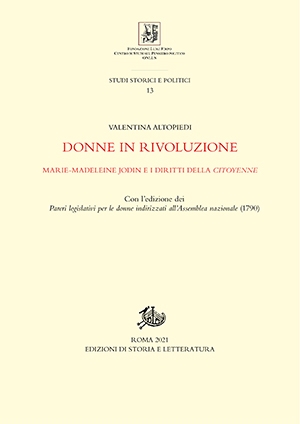
BOOK: Valentina ALTOPIEDI, Donne in rivoluzione. Marie-Madeleine Jodin e i diritti della citoyenne (Roma: Edizioni di Storia e Letteratura, 2022), ISBN: 978-8-8935-9628-2


ABOUT THE BOOK

Figlia di un collaboratore di Diderot, e corrispondente del filosofo, Marie-Madeleine Jodin propose all’Assemblea francese un nuovo piano di legislazione che restituisse alle donne i «diritti che ci assicurano la natura e il patto sociale», rivendicando l’onore e il diritto di concorrere alla prosperità pubblica e rompendo il silenzio a cui la politica sembrava aver condannato le donne: Pareri legislativi per le donne, a tutti gli effetti, può essere considerato il primo trattato femminista scritto da una donna nel periodo della Rivoluzione francese e dell’Illuminismo. Edito nel 1790, e qui in prima edizione annotata, l’opera è centrale per indagare l’elaborazione e la circolazione del linguaggio dei diritti nel XVIII secolo.


ABOUT THE AUTHOR 

Valentina Altopiedi, dopo un dottorato in Storia moderna alle Università di Torino e Paris 1, è attualmente cultrice della materia in Storia moderna presso il Dipartimento di Culture, Politiche e Società dell’Università degli Studi di Torino.


TABLE OF CONTENTS

Marie-Madeleine Jodin e i diritti della citoyenne;
1.Marie-Madeleine Jodin, una vita pubblica alla vigilia della Rivoluzione;
2.Pareri legislativi per le donne indirizzati all’Assemblea nazionale;
2.1. Fonti e riflessioni per una storia dei diritti della donna;
2.2. Quali diritti per le donne nella Rivoluzione francese?;
2.3. Un nuovo piano legislativo per riformare la società;
Pareri legislativi per le donne indirizzati all’Assemblea nazionale. Edizione con testo a fronte


More information can be found here.


25 February 2022

BOOK: Giorgio ZAMPARETTI (Ed.), Processo a Napoleone (Torino: Giappichelli Editore, 2022). ISBN: 9788892142299, pp. 128, € 14,00

(Source: Giappichelli)

ABOUT THE BOOK

A 200 anni dalla morte, Napoleone ancora affascina o respinge: riformatore illuminato e vettore in Europa degli ideali della Rivoluzione Francese, oppure guerrafondaio e depredatore di opere d’arte? Nel rispetto della presunzione di innocenza, in questo libro Napoleone è giudicato – tanto seriamente quanto per gioco – da una corte di autorevoli magistrati, appassionati di storia, pronunciatisi dopo avere ascoltato il serrato confronto tra chi lo incrimina e chi lo vuole assolto. Un processo iudendi causa che, muovendo dall’elemento del gioco, vuole far riflettere su una figura che nel bene e nel male ha segnato la nostra storia come europei. Al lettore scoprire l’«ardua sentenza» della corte togata, il verdetto di una giuria popolare e le chiose della dottrina. 

ABOUT THE EDITOR

Giorgio Maria Zamperetti è professore ordinario nel Dipartimento di Diritto, Economia e Culture (già Facolta' di Giurisprudenza) dell'Università degli Studi dell'Insubria, sede di Como (S.S.D. IUS/04).

TABLE OF CONTENTS

It's available here in PDF format.

17 May 2021

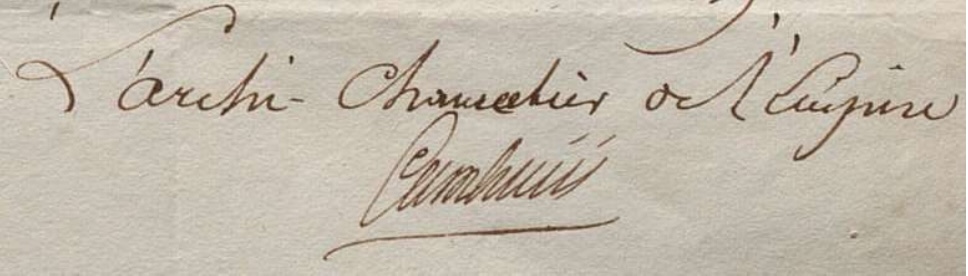
DIGITIZATION: Cambacérès papers acquired by local authorities in Montpellier (France)

 
(image: Cambacérès's signature; source: actualitté) 

First paragraph:

À Montpellier ce jour, ont été présentés les manuscrits des mémoires de Jean-Jacques-Régis de Cambacérès dans leurs versions successives. Cet ensemble remarquable, qui a été acquis au mois de novembre dernier par Montpellier Méditerranée Métropole pour la somme de 46.800 euros, viendra enrichir le fonds conservé à la médiathèque centrale Émile Zola concernant cet homme illustre, qui, avec sa famille, est étroitement lié à l’histoire de Montpellier.

The documents will be digitized and made accessible to all on the internet. 

Read more here.

23 September 2020

ADVANCE ARTICLE: Stephen W. SAWYER, "The Forgotten Democratic Tradition of Revolutionary France" (Modern Intellectual History)


(image source: Cambridge Core)

Abstract:

This article offers an interpretation of a key moment in the long history of democracy. Its hypothesis may be simply stated in the following terms: key political theorists and administrators in eighteenth- and early nineteenth-century France defined democracy as a means for solving public problems by the public itself. This conception of democracy focused on inventing effective practices of government, administrative intervention and regulatory police and differed fundamentally from our contemporary understandings that privilege the vote, popular sovereignty and parliamentary representation. Moreover, this conception of modern democracy overlapped and in some cases complemented, but—more importantly for this article—remained in significant ways distinct from, other early modern political traditions, in particular liberalism and classical republicanism. What follows therefore uncovers a largely forgotten, but widespread, conception of democracy in the crucial revolutionary age from the mid-eighteenth century to the mid-nineteenth by asking the question, was there a modern democratic tradition?

Read more on Cambridge CORE (DOI 10.1017/S1479244320000268).

16 May 2020

BOOK: Michel VERPEAUX & Pierre BODINEAU, Histoire constitutionnelle de la France (Paris: Presses Universitaires de France, 2020). ISBN: 9782715403208, pp. 128, € 9,00

Histoire constitutionnelle de la France
(Source: PUF)

ABOUT THE BOOK

Comparée aux États-Unis, la France semble bien versatile en matière constitutionnelle. Les historiens dénombrent ainsi près de quatorze constitutions depuis 1791 et chaque nouveau scrutin est l’occasion de débattre de l’opportunité d’une VIe République. Pour comprendre notre État de droit et analyser les règles qui régissent les rapports entre les gouvernés et le pouvoir, la dimension historique est essentielle. Car notre système constitutionnel est le résultat de ces évolutions, réactions, tâtonnements et réécritures. Depuis le régime parlementaire jusqu’au présidentialisme en passant par la cohabitation et par l’adoption du quinquennat, c’est toute l’histoire de la quête d’une démocratie mieux réglée qui nous est ici présentée.

ABOUT THE AUTHORS

Pierre Bodineau est professeur émérite de l’université de Bourgogne.
Michel Verpeaux est professeur émérite de l’université Paris I Panthéon-Sorbonne. Ils ont notamment enseigné à Sciences Po.

TABLE OF CONTENTS

Introduction
Chapitre premier – Les révolutions constitutionnelles (1789-1799)
I. La révolution juridique de l’été 1789
II. Le premier texte constitutionnel : la Constitution du 3 septembre 1791
III. L’opposition entre le gouvernement constitutionnel et le gouvernement révolutionnaire : la Convention (septembre 1792-août 1795)
IV. L’ordre républicain : la Constitution de l’an III et le Directoire (1795-1799)
Chapitre II – Le retour à l’ordre (1799-1815)
I. Le Consulat : le système de l’an VIII (1799-1804)
II. Le Premier Empire : une monarchie modernisée (1804-1815)
Chapitre III – L’émergence du régime parlementaire (1815-1870)
I. Le temps des chartes (1815-1848)
II. Les paradoxes de la Seconde République : vers une République sans républicains
III. Le retour au césarisme : le Second Empire (1852-1870)
Chapitre IV – La démocratie parlementaire : la IIIe et la IVe République (1870-1958)
I. L’installation difficile de la IIIe République
II. Le régime constitutionnel instauré par les lois constitutionnelles de 1875
III. Le régime parlementaire moniste et la pratique institutionnelle et politique de la IIIe République
IV. La IVe République ou l’échec du parlementarisme rationalisé
Conclusion
Bibliographie


More information here.

09 December 2019

OPEN ACCESS JOURNAL: H-France XI (2019), Issues 16-17: What the Revolution Means Today: Terror - The Revolution in World History

(image source: Wikimedia Commons)

Presentation by Jennifer Heuer (University of Massachusetts-Amherst):

I am delighted to introduce a series of exchanges around what the French Revolution means today. This series, spearheaded by Marisa Linton, commemorates the 230th anniversary of the Revolution, but also intends to inspire reflection on what the Revolution may continue to mean for us as scholars, teachers, and citizens.

The first, “Rethinking the French Revolutionary Terror,” edited by Marisa Linton, challenges some of our pervasive assumptions as scholars and teachers of the Revolution. Contributors to this strand question whether it is useful to talk about the Terror as a coherent and capitalized event, and consider what violence and trauma meant at other moments of the Revolution.
Volume 11, Issue 16“Rethinking the French Revolutionary Terror”Edited by Marisa Linton, Kingston University
“Introduction”
Marisa Linton
Kingston University
“Terror and the Revolutionary Tribunals”
Carla Hesse
University of California, Berkeley
“The Terror as a Difficult Past”
Ronen Steinberg
Michigan State University
In “The Revolution Abroad,” edited by Annie Jourdan, several scholars reflect on their own experiences researching and teaching the Revolution from outside France, including from the United States, Germany, the Netherlands, and Italy. They also consider how different national agendas and institutional contexts have shaped how—and how much—the French Revolution is regarded today.
Volume 11, Issue 17“The Revolution Abroad”Edited by Annie Jourdan, University of Amsterdam
“Introduction”
Annie Jourdan
University of Amsterdam
“The French Revolution: One American Historian’s View”
Rafe Blaufarb
Florida State University
“The French Revolution Abroad: Le cas italien”
Paolo Conte
Università della Basilicata
“The French Revolution Abroad: The Netherlands”
Matthijs Lok
University of Amsterdam
Upcoming issues:
“Revisiting French Revolutionary Culture,” edited by Sophie Matthiesson, turns our attention to material culture and consumptions. Contributors ask us to think not only about the importance of objects and archives, but also to reflect on how choices made by collectors and curators have influenced the s have influenced the basis of what we know about, and how we understand, the Revolution
A fourth strand, “Whose Rights? The French Revolution and the Present,” edited by Ian Coller, addresses what it means to engage with the history of the Revolution in our contemporary political and cultural world, from wrestling with questions of global history and activism in the classroom to the resonances of the MeToo movement and the rights of “living beings” writ large.
The last strand, “The French Revolution Beyond the Academy.” edited by Guillaume Mazeau, looks more closely at the continued powerful—if also sometimes problematic—presence of the Revolution in a myriad of contexts, from classroom games to political interventions to contemporary film.
We conclude with a videoed exchange between Lynn Hunt and Peter McPhee reflecting on the ideas and questions raised in these various strands
Overall, this series of salons was intended to include as diverse a range of voices as possible. We sought to bring together both relatively new scholars and well established people, Francophone and Anglophone scholars, and those from various parts of the world (including France, the United States, the UK, Australia, the Netherlands, Germany, and Italy.) There are many other people whose voices could –and should–have been part of this; we very much hope that this will spark continued conversations and exchanges!

12 November 2019

BOOK: René KOEKKOEK, The Citizenship Experiment. Contesting the Limits of Civic Equality and Participation in the Age of Revolutions [Studies in the History of Political Thought, 15; ed. Annelien DE DIJN] (Leiden/Boston: Martinus Nijhoff/Brill, 2019), ISBN 978-90-04-22570-1, X + 294 p. € 99

(image source: Brill)

Abstract:
The Citizenship Experiment explores the fate of citizenship ideals in the Age of Revolutions. While in the early 1790s citizenship ideals in the Atlantic world converged, the twin shocks of the Haitian Revolution and the French Revolutionary Terror led the American, French, and Dutch publics to abandon the notion of a shared, Atlantic, revolutionary vision of citizenship. Instead, they forged conceptions of citizenship that were limited to national contexts, restricted categories of voters, and ‘advanced’ stages of civilization. Weaving together the convergence and divergence of an Atlantic revolutionary discourse, debates on citizenship, and the intellectual repercussions of the Terror and the Haitian Revolution, Koekkoek offers a fresh perspective on the revolutionary 1790s as a turning point in the history of citizenship.
More information with Brill.

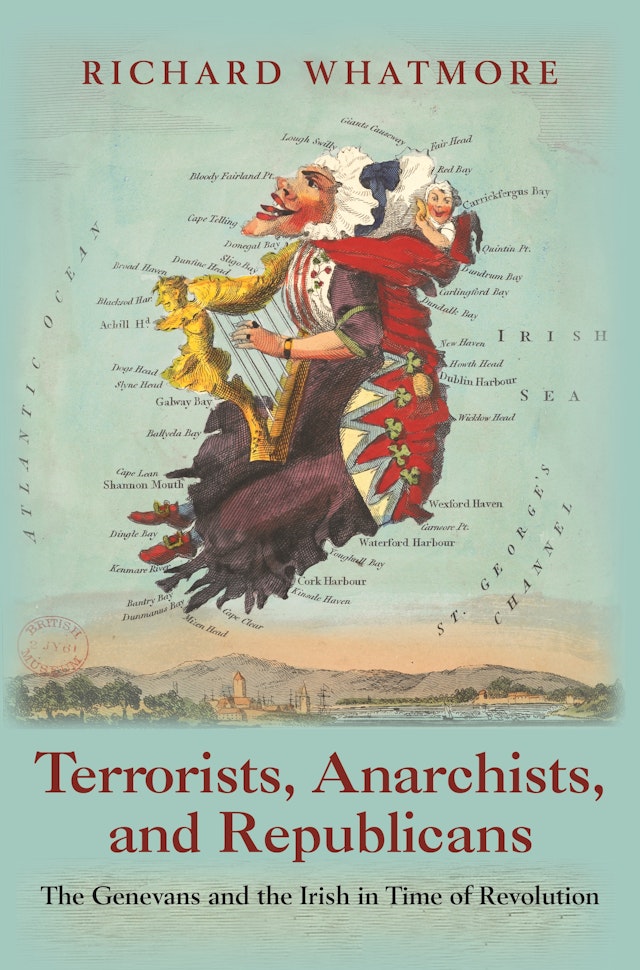
BOOK: RIchard WHATMORE, Terrorists, Anarchists, and Republicans: The Genevans and the Irish in Time of Revolution (Princeton: Princeton UP, 2019), 512 p. ISBN 9780691168777, 39,95 USD

(image source: Princeton UP)

Book abstract:
In 1798, members of the United Irishmen were massacred by the British amid the crumbling walls of a half-built town near Waterford in Ireland. Many of the Irish were republicans inspired by the French Revolution, and the site of their demise was known as Genevan Barracks. The Barracks were the remnants of an experimental community called New Geneva, a settlement of Calvinist republican rebels who fled the continent in 1782. The British believed that the rectitude and industriousness of these imported revolutionaries would have a positive effect on the Irish populace. The experiment was abandoned, however, after the Calvinists demanded greater independence and more state money for their project. Terrorists, Anarchists, and Republicans tells the story of a utopian city inspired by a spirit of liberty and republican values being turned into a place where republicans who had fought for liberty were extinguished by the might of empire. Richard Whatmore brings to life a violent age in which powerful states like Britain and France intervened in the affairs of smaller, weaker countries, justifying their actions on the grounds that they were stopping anarchists and terrorists from destroying society, religion and government. The Genevans and the Irish rebels, in turn, saw themselves as advocates of republican virtue, willing to sacrifice themselves for liberty, rights and the public good. Terrorists, Anarchists, and Republicans shows how the massacre at Genevan Barracks marked an end to the old Europe of diverse political forms, and the ascendancy of powerful states seeking empire and markets—in many respects the end of enlightenment itself.
On the author:
Richard Whatmore is professor of modern history and codirector of the Institute of Intellectual History at the University of St Andrews. He is the author of What Is Intellectual History?, Against War and Empire, and Republicanism and the French Revolution.
(source: Princeton UP)

26 April 2019

BOOK: Sébastien EVRARD, Chouans contre bleus (1793-1795) - La justice militaire sous la Révolution française (Paris: Librairie LGDJ, 2019). ISBN 978-2-84934-407-1, €31.00


(Source: LGDJ)

LGDJ has published a new book on the Armée des Côtes de Cherbourg (1793-1795) and military justice.

ABOUT THE BOOK

Parmi les différentes justices qui existaient sous la Révolution, la justice militaire est originale et bien mal connue, en raison de sa complexité et de l'accès peu aisé aux sources. C'est pourquoi elle conserve une bien mauvaise réputation chez ceux qui s'y sont intéressés.

Néanmoins, en étudiant l'Armée des Côtes de Cherbourg (1793-1795), alors en position depuis la Normandie jusqu'au Maine, les sources disponibles — inédites - permettent de se faire une idée bien précise de ce qu'elle fut, les infractions qu'elle a poursuivies (au premier chef desquelles on trouve la désertion, le vol...) et les sanctions qu'elle a rendues. Pas moins de 973 prévenus ont été inquiétés par la justice militaire et 391 d'entre eux ont été condamnés à des peines variées (mort, fers, détention, dégradation civique...).

Rendre la justice à l'encontre de soldats n'est pas une affaire facile : les difficultés rencontrées sont en effet immenses, depuis le choix des juges, leurs moyens d'action, les obstacles qu'ils peuvent rencontrer (lenteur, impunité, intervention des représentants du peuple...). Cependant, ces juges se sont efforcés de punir autant que possible les infractions et de réfréner les violences commises par des militaires : la République, en effet, ne pouvait accepter que ses enfants qui la servent en armes ne deviennent des « soudards ».

ABOUT THE AUTHOR

Sébastien Evrard est docteur en droit de l'Université Paris II (Panthéon-Assas), il enseigne le droit, l'histoire et l'économie à l'Université de Lorraine.

More information here