Search

Showing posts with label American Revolution. Show all posts

21 March 2024

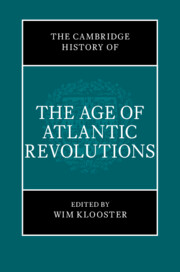
BOOK: Wim KLOOSTER (Ed.), The Cambridge History of the Age of Atlantic Revolutions (Cambridge: Cambridge University Press, 2023), 2400 p. 9781108567817, 3 vol. 320 GBP


(image source: CUP)

Abstract:

In three volumes, The Cambridge History of the Age of Atlantic Revolutions brings together experts on all corners of the Atlantic World who reveal the age in all its complexity. The Age of Atlantic Revolutions formed the transition from an era marked by monarchical rule, privileges, and colonialism to an age that stood out for republican rule, legal equality, and the sovereignty of American nations. The seventy-one chapters included reflect the latest trends and discussions on this transformative part of history, highlighting not only the causes, key events, and consequences of the revolutions, but stressing the political experimentation, contingency, and survival of colonial institutions. The volumes also examine the attempts of enslaved and indigenous people, and free people of color, to change their plight, offering a much-needed revision to R.R. Palmer's first synthesis of this era sixty years ago.

Table of contents:

Volume I. The Enlightenment and the British Colonies Volume II. France, Europe, and Haiti Volume III. The Iberian Empires. 

See here for the hardback and here for the digital version

23 June 2020

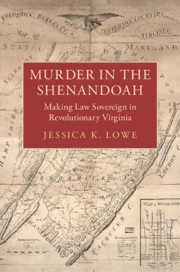
BOOK: Jessica K. LOVE, Murder in the Shenandoah. Making Law Sovereign in Revolutionary Virginia (Cambridge: University Press, 2019). ISBN: 9781108421782, pp. 222, £ 39.99

Murder in the Shenandoah
(Source: CUP)

ABOUT THE BOOK

On July 4, 1791, the fifteenth anniversary of American Independence, John Crane, a descendant of prominent Virginian families, killed his neighbor's harvest worker. Murder in the Shenandoah traces the story of this early murder case as it entangled powerful Virginians and addressed the question that everyone in the state was heatedly debating: what would it mean to have equality before the law - and a world where 'law is king'? By retelling the story of the case, called Commonwealth v. Crane, through the eyes of its witnesses, families, fighters, victims, judges, and juries, Jessica K. Lowe reveals how revolutionary debates about justice gripped the new nation, transforming ideas about law, punishment, and popular government.

ABOUT THE AUTHOR

Jessica K. Lowe teaches at the University of Virginia, School of Law.

TABLE OF CONTENTS

Introduction
1. The facts of the fight
2. The making of a republican judge
3. Examination: class, procedure, and local courts in Crane's Virginia
4. The Bloody Code and the logic of legal reform
5. Indictment: power shifts and power continuities in Virginia's courts
6. Crane's trial and its 'imperfect' verdict
7. 'That stigma on my character': judges, judicial review, and 'republican' interpretation of the laws
8. Murder or manslaughter? Crane's special verdict at the general court
9. Pardon request: mercy and Crane's 'lunatic fits'
Conclusion


More information is available with the publisher.


09 August 2019

BOOK: Carlton F.W. LARSON, The Trials of Allegiance: Treason, Juries, and the American Revolution (Oxford: Oxford University Press, 2019). ISBN 9780190932749, $34.95


(Source: OUP)

Oxford University Press is publishing a book on the law of treason during the American Revolution.

ABOUT THE BOOK

The Trials of Allegiance examines the law of treason during the American Revolution: a convulsive, violent civil war in which nearly everyone could be considered a traitor, either to Great Britain or to America.

Drawing from extensive archival research in Pennsylvania, one of the main centers of the revolution, Carlton Larson provides the most comprehensive analysis yet of the treason prosecutions brought by Americans against British adherents: through committees of safety, military tribunals, and ordinary criminal trials. Although popular rhetoric against traitors was pervasive in Pennsylvania, jurors consistently viewed treason defendants not as incorrigibly evil, but as fellow Americans who had made a political mistake. This book explains the repeated and violently controversial pattern of acquittals. Juries were carefully selected in ways that benefited the defendants, and jurors refused to accept the death penalty as an appropriate punishment for treason. The American Revolution, unlike many others, would not be enforced with the gallows.

More broadly, Larson explores how the Revolution's treason trials shaped American national identity and perceptions of national allegiance. He concludes with the adoption of the Treason Clause of the United States Constitution, which was immediately put to use in the early 1790s in response to the Whiskey Rebellion and Fries's Rebellion.

In taking a fresh look at these formative events, The Trials of Allegiance reframes how we think about treason in American history, up to and including the present.

ABOUT THE AUTHOR

Carlton F.W. Larson is Professor of Law at the University of California, Davis School of Law.

TABLE OF CONTENTS

Acknowledgments
Introduction

1. Treason in Colonial Pennsylvania
The Adoption of English Treason Law
Pennsylvania's Earliest Treason Cases
The Outbreak of War
The Disputes with Virginia and Connecticut

2. Resistance and Treason, 1765-1775
Justifying Resistance
A Jury of One's Peers
Identifying the Real Traitors

3. Treason Against America, 1775-1776
The War's First Treason Charges
The Second Round of Treason Charges
County Committees of Safety
Denunciation of Enemies
The British Legal Response to the Rebels
Independence

4. From Independence to Invasion, 1776-1778
The Pennsylvania Constitutional Convention and the Treason Ordinance
The Council of Safety and the County Committees
Enactment of a Treason Statute
The Case of James Molesworth and the Scope of Military Jurisdiction
The Test Act
Re-Opening the Courts
The Exiles to Virginia
The Fall of Philadelphia and Military Trials

5. The Winding Path to the Courthouse, 1778
Prosecutions in the County Courts
The Attainder Statute and Property Forfeitures
Chief Justice Thomas McKean and the Re-Opening of the Pennsylvania Supreme Court
The Special Commission for Bedford County
The Return to Philadelphia
Hiring Prosecutors and Court Employees
The Chester County Treason Trials

6. The Philadelphia Treason Trials, 1778-1779: Forming the Jury
The Grand Jurors
Trial Juror Selection: The Panel and Challenges
Trial Juror Demographics
Trial Juror Political Activity

7. The Philadelphia Treason Trials, 1778-1779: Trial and Deliberation
Defendant Demographics and Political Activity
Defense Counsel
Charges and Defenses
Trial Witnesses
Evidentiary Objections
Jury Deliberations
The Death Penalty

8. Resentment and Betrayal, 1779-1781
The Newspaper Debates over the Franks Trial
The Trial of Samuel Rowland Fisher
Fort Wilson
Modifications to Pennsylvania's Treason Law
The Battle Over Detentions
Misprision of Treason Cases before the Justices of the Pennsylvania Supreme Court
Benedict Arnold
The Aftermath: The Executions of David Dawson and Ralph Morden
The Berks County Tax Revolt
The Trials of Justin McCarty and Samuel Chapman

9. Peace, the Constitution, and Rebellion, 1781-1800
Treason Prosecutions after Yorktown
Treason Cases: Summary Data
The Escaping Prisoners Cases
The Returning Loyalists
The Continuing Threat of Internal Dismemberment
Treason and the United States Constitution
The Status of State Treason Law
The Whiskey Rebellion
Fries's Rebellion

Conclusion

Appendices
Notes
Index

More information here

09 October 2018

BOOK: Peter Charles HOFFER and Williamjames HOFFER, The Clamor of Lawyers: The American Revolution and Crisis in the Legal Profession (Ithaca: Cornell University Press, 2018). ISBN 9781501726071, $39.95


Cornell University Press is publishing a book on public pronouncements by British North American lawyers in the years preceding the American Revolution.

ABOUT THE BOOK

The Clamor of Lawyers explores a series of extended public pronouncements that British North American colonial lawyers crafted between 1761 and 1776. Most, though not all, were composed outside of the courtroom and detached from on-going litigation. While they have been studied as political theory, these writings and speeches are rarely viewed as the work of active lawyers, despite the fact that key protagonists in the story of American independence were members of the bar with extensive practices. The American Revolution was, in fact, a lawyers’ revolution.

Peter Charles Hoffer and Williamjames Hull Hoffer broaden our understanding of the role that lawyers played in framing and resolving the British imperial crisis. The revolutionary lawyers, including John Adams’s idol James Otis, Jr., Pennsylvania’s John Dickinson, and Virginians Thomas Jefferson and Patrick Henry, along with Adams and others, deployed the skills of their profession to further the public welfare in challenging times. They were the framers of the American Revolution and the governments that followed. Loyalist lawyers and lawyers for the crown also participated in this public discourse, but because they lost out in the end, their arguments are often slighted or ignored in popular accounts. This division within the colonial legal profession is central to understanding the American Republic that resulted from the Revolution.

ABOUT THE AUTHORS

Peter Charles Hoffer has taught early American history at Ohio State University, the University of Notre Dame, and Georgia, the latter since 1978. He is the author of John Quincy Adams and the Gag Rule, 1835–1850.

Williamjames Hull Hoffer was a Henry Rutgers scholar at Rutgers University in New Brunswick before he entered law school, receiving both his J.D. and Ph.D. He now teaches at Seton Hall University. He is co-author of The Federal Courts: An Essential History.

More information here

01 August 2018

BOOK: Sean WILENTZ, No Property in Man : Slavery and Antislavery at the Nation’s Founding (Cambridge: Harvard University Press, 2018). ISBN 9780674972223, €24.50


Harvard University Press will publish a book on the debate concerning slavery at the founding of the American Republic later this month. The book is available as from the 13th August.

ABOUT THE BOOK

A radical reconstruction of the founders’ debate over slavery and the Constitution, by the best-selling, award-winning author of The Rise of American Democracy.

Americans revere the Constitution even as they argue fiercely over its original toleration of slavery. Some historians have charged that slaveholders actually enshrined human bondage at the nation’s founding. The acclaimed political historian Sean Wilentz shares the dismay but sees the Constitution and slavery differently. Although the proslavery side won important concessions, he asserts, antislavery impulses also influenced the framers’ work. Far from covering up a crime against humanity, the Constitution restricted slavery’s legitimacy under the new national government. In time, that limitation would open the way for the creation of an antislavery politics that led to Southern secession, the Civil War, and Emancipation.

Wilentz’s controversial and timely reconsideration upends orthodox views of the Constitution. He describes the document as a tortured paradox that abided slavery without legitimizing it. This paradox lay behind the great political battles that fractured the nation over the next seventy years. As Southern Fire-eaters invented a proslavery version of the Constitution, antislavery advocates, including Abraham Lincoln and Frederick Douglass, proclaimed antislavery versions based on the framers’ refusal to validate what they called “property in man.”

No Property in Man invites fresh debate about the political and legal struggles over slavery that began during the Revolution and concluded with the Confederacy’s defeat. It drives straight to the heart of the most contentious and enduring issue in all of American history.

ABOUT THE AUTHOR

Sean Wilentz is George Henry Davis 1886 Professor of American History at Princeton University. He is the author of numerous books on American history and politics, including The Rise of American Democracy, which won the Bancroft Prize and was a finalist for the Pulitzer Prize, and The Politicians and the Egalitarians, chosen as Best History Book of the Year by Kirkus and the St. Louis Post-Dispatch. Wilentz’s writings on American music have earned him two Grammy nominations and two Deems-Taylor-ASCAP awards.

TABLE OF CONTENTS

Preface
A Note on Terminology
Introduction
1. Slavery, Property, and Emancipation in Revolutionary America
2. The Federal Convention and the Curse of Heaven
3. Slavery, Antislavery, and the Struggle for Ratification
4. To the Missouri Crisis
5. Antislavery, the Constitution, and the Coming of the Civil War
Epilogue
Notes
Index

More information here