Search

15 January 2024

REMINDER: Blog submissions (Word or RTF, no PDF)

We gently remind our readers that submissions for posts are more than welcome on esclhblog@gmail.com.

However, keep in mind the general instructions for the blog: we do not accept submissions in PDF. Please provide us with a Word- or RTF-document, with an image (free to use).

Our bloggers are volunteers, whose service to the ESCLH comes on top of their other academic commitments. 

VACANCY: Two fully-funded PhD-positions: Communicating the Law in Europe, 1500-1750 (St Andrews: University of St Andrews/ERC, DEADLINE 15 MARCH 2024)

(image source: Wikimedia Commons)


Two fully funded PhD studentships are available at the University of St Andrews to work as part of the ERC-selected/UKRI-funded project ‘Communicating the Law in Europe, 1500-1750’, under the supervision of the Principal Investigator, Dr Arthur der Weduwen. The project investigates how law was communicated in early modern Europe (c. 1500-1750), and what impact this had on European society.

The PhD studentships will begin in September 2024, will be based in the School of History at the University of St Andrews (with significant periods to be spent on research abroad), and will last for four years. 

These PhD studentships offer the successful applicants the exciting prospect of combining the pursuit of an independently researched thesis exploring a particular dimension of legal and political communication in early modern Europe with the opportunity to work collaboratively within a research team and to contribute to co-authored publications and the organisation of scholarly conferences.

The ‘Communicating the Law in Europe, 1500-1750’ project has been awarded a grant of €1.4 million by the European Research Council and is funded as part of the UKRI’s Frontier Research Guarantee scheme.  It will run for five years, from 1 January 2024 to 31 December 2028, and is led by the Principal Investigator, Dr Arthur der Weduwen.

The COMLAWEU project is the first to investigate comparatively how law was communicated to citizens and subjects by the authorities in early modern Europe (1500-1750). It pursues an original comparative study of the publication and circulation of municipal, regional and national law, encompassing oral communication, ceremonial proclamations and the employment of criers, as well as the affixing, distribution and sale of law texts, in manuscript and printed form.

Based on extensive archival research, this project will seek to establish for the first time to what extent the increasing body of law that was issued in early modern Europe was made publicly available, and in what forms.

The project seeks to add a new and much-needed perspective to the study of European politics in a critical era of state formation, framing the communication of law as an essential stabilising factor in an era of highly participatory but undemocratic politics.

This project will offer multiple comparative frameworks through which the communication of law will be studied, including Protestant and Catholic states, urban and rural areas, and empires, national kingdoms and city-states.

With the aid of such a comparative lens, it is an overarching aim of the project to analyse how the public dissemination of law shaped early modern civic society and influenced political participation and accountability.

The project team, led by the PI and comprising two postdoctoral research assistants and two PhD students, will work collaboratively, using a series of comparative case studies based on European regions to explore and reveal the complex ways in which European authorities communicated with their citizens and subjects.

Further details about this opportunity can be found on the School of History postgraduate funding page.

JOURNAL: LawArt. Rivista di Diritto, Arte, Storia IV (2023) [OPEN ACCESS]

(Image source: Giappichelli editore)


APERTURE/OVERTURES

PERCORSI/ITINERARIES: Entanglements nel diritto dell’arte: beni, patrimonio e circolazione / Entanglements in Art Law: Goods, Heritage, and Circulation 

DIALOGHI/COLLOQUIA

RIFRAZIONI. A PROPOSITO DI LAWART/REFRACTIONS. ABOUT LAWART

CROCEVIA/CROSSOVER


More information can be found here.

JOURNAL: Italian Review of Legal History (IX, 2023) [OPEN ACCESS]


(Image source: Riviste UNIMI)


TABLE OF CONTENTS


Presentazione de "Gli Statuti della Repubblica fiorentina del 1355 in volgare” – Biblioteca del Senato della Repubblica Giovanni Spadolini, Roma – Giornata di Studi De Statutis Society - 23 giugno 2023

More information can be find here.


12 January 2024

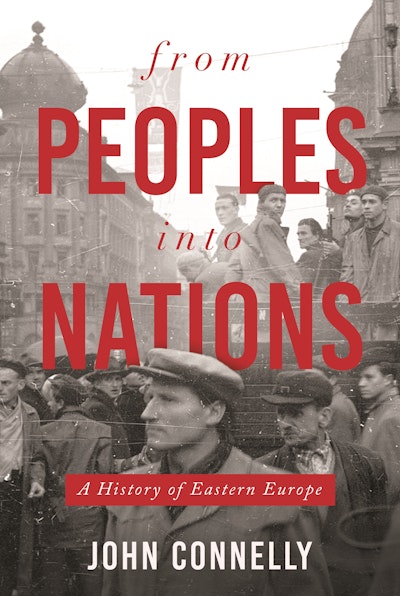
BOOK: John CONNELLY, From Peoples into Nations. A History of Eastern Europe (Princeton: Princeton University Press, 2020), 968 p., ISBN 9780691167121, 30 GBP


(image source: Princeton UP)

Abstract:

In the 1780s, the Habsburg monarch Joseph II decreed that henceforth German would be the language of his realm. His intention was to forge a unified state from his vast and disparate possessions, but his action had the opposite effect, catalyzing the emergence of competing nationalisms among his Hungarian, Czech, and other subjects, who feared that their languages and cultures would be lost. In this sweeping narrative history of Eastern Europe since the late eighteenth century, John Connelly connects the stories of the region’s diverse peoples, telling how, at a profound level, they have a shared understanding of the past. An ancient history of invasion and migration made the region into a cultural landscape of extraordinary variety, a patchwork in which Slovaks, Bosnians, and countless others live shoulder to shoulder and where calls for national autonomy often have had bloody effects among the interwoven ethnicities. Connelly traces the rise of nationalism in Polish, Austro-Hungarian, and Ottoman lands; the creation of new states after the First World War and their later absorption by the Nazi Reich and the Soviet Bloc; the reemergence of democracy and separatist movements after the collapse of communism; and the recent surge of populist politics throughout the region. Because of this common experience of upheaval, East Europeans are people with an acute feeling for the precariousness of history: they know that nations are not eternal, but come and go; sometimes they disappear. From Peoples into Nations tells their story.

On the author:

John Connelly is the Sidney Hellman Ehrman Professor of History and director of the Institute of Slavic, East European, and Eurasian Studies at the University of California, Berkeley. He is the author of Captive University: The Sovietization of East German, Czech, and Polish Higher Education and From Enemy to Brother: The Revolution in Catholic Teaching on the Jews. He lives in Kensington, California. 

 Read more here.


11 January 2024

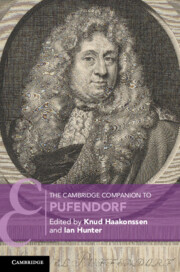
BOOK: Knud HAAKONSSEN & Ian HUNTER (eds.), The Cambridge Companion to Pufendorf [Cambridge Companions to Law] (Cambridge: Cambridge University Press, 2022), 350 p. ISBN 9781108460149, 29,99 GBP


(image source: CUP)

Abstract:

In the same intellectual league as Grotius, Hobbes and Locke, but today less well known, Samuel Pufendorf was an early modern master of political, juridical, historical and theological thought. Trained in an erudite humanism, he brought his copious command of ancient and modern literature to bear on precisely honed arguments designed to engage directly with contemporary political and religious problems. Through his fundamental reconstruction of the discipline of natural law, Pufendorf offered a new rationale for the sovereign territorial state, providing it with non-religious foundations in order to fit it for governance of multi-religious societies and to protect his own Protestant faith. He also drew on his humanist learning to write important political histories, a significant lay theology, and vivid polemics against his many opponents. This volume makes the full scope of his thought and writing accessible to English readers for the first time.

 Table of contents:

Preface
System of references and abbreviations
1. Introduction: life, work and historical context Ian Hunter
2. Politics and the constitution of the Empire Joachim Whaley
3. Pufendorf's composite method Michael Seidler
4. The metaphysics of moral entities
5. Human nature, the state of nature and natural law Ian Hunter
6. Pacts, language and property Pärtel Piirimäe
7. Family and marriage Simone Zurbuchen
8. Pacts, sovereignty and forms of government Ian Hunter and Knud Haakonssen
9. The civil order: law, punishment, and social value Knud Haakonssen
10. The law of nations Mads Langballe Jensen
11. Polemics and controversies: regarding the Eris Scandica Fiammetta Palladini
12. State, church, toleration, reconciliation Walter Sparn
13. Political histories Sebastian Olden-Jørgensen
14. Receptions, contestations and confusions Knud Haakonssen
Bibliography.

Read more here. 

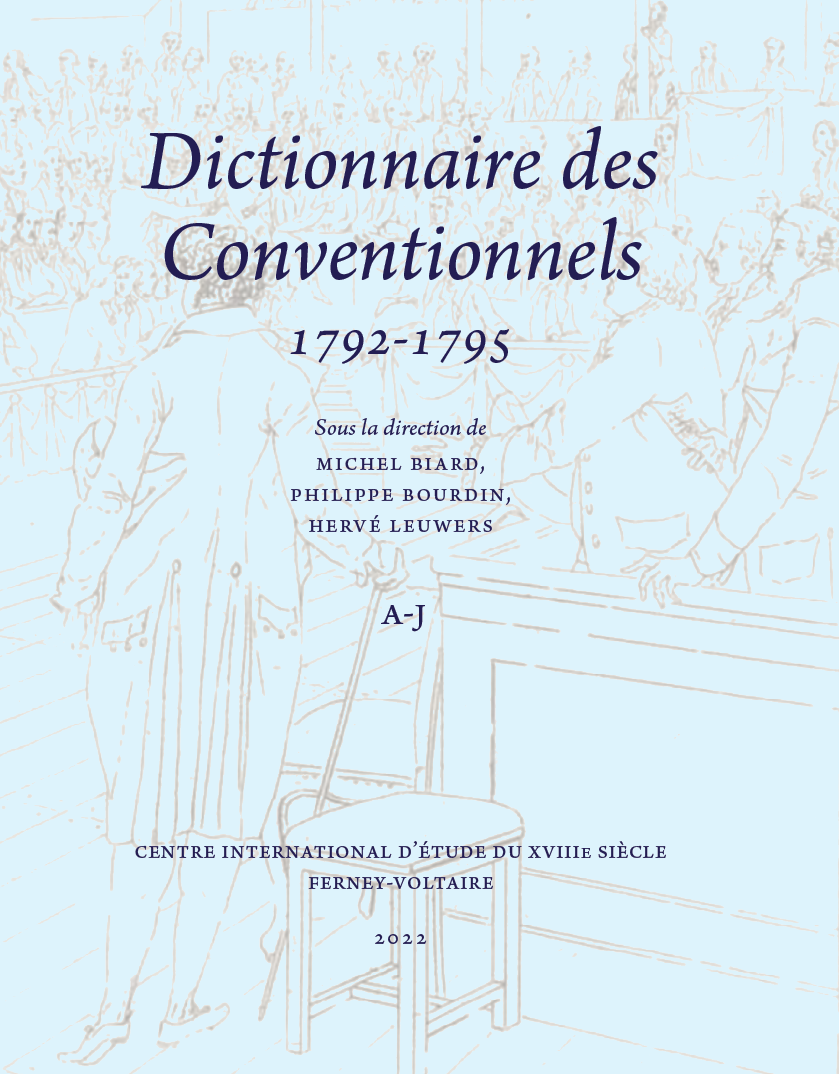
BOOK: Michel BIARD, Philippe BOURDIN & Hervé LEUWERS (dir.), Dictionnaire des Conventionnels 1792-1795 (Ferney-Voltaire: Centre international d'étude du XVIIIe siècle), XXXIV + 1310 p. ISBN 978-2-84559-153-0, 2022, €220


(image source: Etudes Robespierristes)

Abstract:
De l’entrée en république, le 21 septembre 1792, jusqu’à l’amnistie qui espérait une nouvelle fois clore la Révolution, le 4 brumaire an IV (26 octobre 1795), quelque neuf cents hommes ont siégé sur les bancs de la Convention nationale. Ensemble, non sans de profondes divisions, ils ont élaboré les bases d’une constitution démocratique mort-née (juin 1793), établi un «gouvernement révolutionnaire» destiné à «fonder» la république en période de guerre extérieure et intérieure (octobre 1793), puis inventé une république des «meilleurs», celle du Directoire, par la Constitution de l’an III (août 1795). Les hommes qui ont écrit l’histoire de ces trois années majeures demeuraient pour une partie d’entre eux méconnus. Depuis le Dictionnaire des Conventionnels de Kuscinski (1916), œuvre remarquable, mais inachevée et posthume, aucun travail d’ampleur n’avait permis d’examiner leurs parcours. Ces dernières années, les publications du Dictionnaire des Constituants (1991), puis du Dictionnaire des Législateurs (2007), sous la direction d’Edna Lemay, rendaient cette lacune plus visible encore. C’est pour la combler que ce Dictionnaire des Conventionnels, élaboré par une cinquantaine d’auteurs, a été conçu dans le cadre d’un projet financé par l’Agence nationale de la recherche; il retrace le parcours politique de ces fondateurs de la Première République, leurs missions dans les départements ou auprès des armées, leur travail dans les comités, leurs prises de position, leurs conflits et parfois leurs décès tragiques, en mettant les années 1792-1795 en perspective, par la présentation de leur cheminement, avant et après la Convention.
Table of contents:

Tome I

   Auteurs

   Principales abréviations

   Introduction

   Repères chronologiques

   Conventionnels Alard-Izoard

Tome II

   Principales abréviations

   Conventionnels Jac-Zangiacomi

   Cartes

– 1. Les départements à l’époque de la Convention (Michel Biard et François Delisle)

– 2. Nombre de représentants attribués aux départements (Michel Biard et François Delisle)

– 3. Nombre de représentants ayant siégé (Michel Biard et François Delisle)

– 4. Conventionnels présents aux appels nominaux du 20 septembre 1792 (Hervé Leuwers et François Delisle)

– 5. Conventionnels arrivés au 30 septembre 1792 (Hervé Leuwers et François Delisle)

– 6. Conventionnels arrivés au 31 octobre 1792 (Hervé Leuwers et François Delisle)

– 7. Adresses parisiennes des Conventionnels, carte 1 (Michel Biard et François Delisle)

– 8. Adresses parisiennes des Conventionnels, carte 2 (Michel Biard et François Delisle)

– 9. Nombre d’interventions par Conventionnel (Philippe Bourdin et François Delisle)

– 10. Conventionnels ayant déclaré leur fortune (Philippe Bourdin et François Delisle)

– 11. Nombre de missions par département (Michel Biard et François Delisle)

– 12. Représentants en mission aux armées (Michel Biard et François Delisle)

– 13. Les Conventionnels décédés de mort non naturelle (Michel Biard et François Delisle)

   Annexes

– 1. Les Conventionnels ayant siégé (Michel Biard)

– 2. Les présidents de la Convention nationale (Hervé Leuwers)

– 3. Les comités de la Convention nationale (Philippe Bourdin)

– 4. Girondins et Montagnards (Hervé Leuwers)

– 5. Les 426 représentants du peuple en mission (mars 1793-brumaire an IV) (Michel Biard)

– 6. Assemblées dans lesquelles ont siégé les Conventionnels (1789-1815) (Philippe Bourdin)

– 7. Âge des Conventionnels en 1793 (Philippe Bourdin)

– 8. Professions et fonctions des Conventionnels en 1789 et en 1800 (Philippe Bourdin)

– 9. Adresses parisiennes des Conventionnels (Michel Biard)

– 10. Les principaux orateurs (Philippe Bourdin)

– 11. Les 96 Conventionnels décédés de mort non naturelle (1793-1799) (Michel Biard)

– 12. Réintégrer au sein de la Convention les proscrits encore vivants (Michel Biard)

– 13. Le devenir des Conventionnels atteints par l’ordonnance du 24 juillet 1815 et la loi du 12 janvier 1816 (Hervé Leuwers)

– 14. Dates de décès des Conventionnels (Michel Biard)

Contributors:

Serge Aberdam, chercheur retraité au Département des sciences sociales de l’INRA Nathalie Alzas, docteure de l’université de Provence Gaid Andro, maîtresse de conférences à INSPE, université de Nantes Jean Bart, professeur émérite d’histoire du droit, université de Bourgogne Cyril Belmonte, docteur de l’université de Provence Mathias Berton, docteur de l’université Paris 1 Panthéon-Sorbonne Serge Bianchi, professeur émérite d’histoire moderne, université Rennes II Michel Biard, professeur d’histoire moderne, université de Rouen Normandie Bernard Bodinier, professeur honoraire d’histoire moderne, université de Rouen Justine Bodnar, master 2, université de Rouen Normandie Alexiane Boudaut, master 2, université de Rouen Normandie Philippe Bourdin, professeur d’histoire moderne, université Clermont-Auvergne, IUF Laurent Brassart, maître de conférences, université de Lille Patrice Bret, chercheur honoraire au Centre Alexandre Koyré, Paris Emilie Cadio, master 2, université Paris 1 Panthéon-Sorbonne Matthieu Carlot, professeur certifié Jean-Luc Chappey, professeur d’histoire des sciences, université Paris 1 Panthéon-Sorbonne Paul Chopelin, maître de conférences, université Jean Moulin Lyon 3 Guillaume Colot, docteur de l’université de Clermont-Ferrand Michel Combet, maître de conférences, université de Bordeaux Annie Crépin, maîtresse de conférences honoraire, université d’Artois Lorenzo Cuccoli, docteur des universités de Paris 1 et de Bologne Vincent Cuvilliers, docteur de l’université d’Artois Bernard Dailly, professeur certifié Hubert Delpont, docteur de l’université Bordeaux Montaigne Robert Demeude, docteur de l’université Paris 1 Panthéon-Sorbonne Jean-Étienne Dubois, docteur de l’université Clermont-Auvergne Anne-Marie Duport, docteure de l’université Paris 1 Panthéon-Sorbonne Annie Duprat, professeure honoraire d’histoire moderne, université de Cergy-Pontoise Pascal Dupuy, maître de conférences, université de Rouen Normandie Alain Duran, docteur de l’université Paris 1 Panthéon-Sorbonne Matthieu Fontaine, docteur de l’université d’Artois Bernard Gainot, maître de conférences honoraire HDR, université Paris 1 Panthéon-Sorbonne Daniel Galloyer, professeur agrégé Charlotte Goetz-Nothomb, chercheuse de l’équipe Pôlenordgroup, Bruxelles André Goudeau, docteur de l’université de Rouen René Grevet, professeur honoraire d’histoire moderne, université de Lille Samuel Guicheteau, formateur à l’INSPE, université de Nantes Jean-Pierre Harbulot, docteur de l’université de Lorraine Philippe Jarnoux, professeur d’histoire moderne, université de Bretagne occidentale, Brest Jean-Pierre Jessenne, professeur honoraire d’histoire moderne, université de Lille Anne Jollet, maîtresse de conférences, université de Poitiers Daniel Jouteux, président de la Société des Amis de la Révolution française – Club René Levasseur de la Sarthe Maxime Kaci, maître de conférences, université de Franche-Comté Isabelle Laboulais, professeure d’histoire moderne, université de Strasbourg Christine Lamarre, professeur honoraire d’histoire moderne, université de Bourgogne-Franche-Comté Christine Le Bozec, maîtresse de conférences honoraire, université de Rouen Normandie Jean-Baptiste Legoff, archiviste-paléographe, archives départementales d’Indre-et-Loire Éric Lem, ambassadeur Stefan Lemny, Bibliothèque nationale de France Hervé Leuwers, professeur d’histoire moderne, université de Lille Guillaume Lévêque, professeur agrégé Suzanne Levin, docteure de l’université Paris Nanterre Aurélien Lignereux, professeur d’histoire contemporaine, Sciences Po Grenoble – université Grenoble Alpes, IUF Nicolas Lumbroso, magistrat, doctorant à l’université de Lille Hugues Marquis, docteur en histoire, professeur agrégé à l’INSPE, université de Poitiers Jean-Claude Martin, attaché de conservation du patrimoine, Archives départementales de l’Orne Alain Massalsky, docteur de l’université Paris 1 Panthéon-Sorbonne Anne de Mathan, professeure d’histoire moderne, université de Caen Normandie Guillaume Mazeau, maître de conférences, université Paris 1 Panthéon-Sorbonne Raymonde Monnier, ingénieur de recherche honoraire au CNRS Philippe Moulis, docteur de l’université d’Artois Matthieu de Oliveira, maître de conférences, université de Lille Danièle Pingué, maîtresse de conférences honoraire, université de Franche-Comté Frédérique Pitou, professeure honoraire d’histoire moderne, université du Maine au Mans Anne Quennedey, docteure de l’université Paris-Sorbonne Anne Rolland-Boulestreau, professeure d’histoire moderne, université catholique de l’Ouest, Angers Jean-Paul Rothiot, maître de conférences honoraire, université de Nancy Catherine Schmidt, docteure de l’université Paris 1 Panthéon-Sorbonne Côme Simien, maître de conférences, université Paris 1 Panthéon-Sorbonne Cyril Triolaire, maître de conférences, université Clermont-Auvergne Bernard Vinot, docteur d’Etat de l’université Paris 1 Panthéon Sorbonne Dominique Waquet, chercheur associé, EHESS Emmanuel de Waresquiel, HDR, École pratique des hautes études

Read more here. 


10 January 2024

BOOK: Carolina ARMENTEROS & Andrea UNGARI (eds.), A Companion to Italian Constitutional History (1804-1938). The House of Savoy and the Making of the Nation-State [Brill's Companions to European History; 30] (Leiden/Boston: Brill, 2023), ISBN 978-90-04-53730-9


(image source: Brill)


Abstract:

This is the first account in English of the making of Italian nationhood from the perspective of constitutional history. It is also the first to consider the role that the House of Savoy played in this process. Bringing together influential experts in the field, the collection covers the evolution of the Italian constitution from Russian diplomacy’s little-known planning of the Risorgimento to the monarchy’s demise after its clashes with fascism. Combining systematic coverage with original research, the volume includes such varied themes as the king’s role in the Italian wars of independence, the Italian peninsula’s forgotten charters of 1848, and the story of the ephemeral building that housed the first Italian parliament. Contributors are: Carolina Armenteros, Andrea Ungari, Paolo Colombo, Frans Willem Lantink, Christian Satto, Giulio Stolfi, Valentina Villa, Tommaso Zerbi, and Romano Ferrari Zumbini.

Table of contents:

Notes on Contributors
List of Figures

Introduction
 Carolina Armenteros and Andrea Ungari
1 The Savoy Monarchy and the Parliamentary System: From the Kingdom of Sardinia to the Kingdom of Italy
 Andrea Ungari
2 “Changes Appropriate to the Times, and Circumstances”: The Crown and the Modernization of the State in the Kingdom of Sardinia (1814–53)
 Giulio Stolfi
3 The Pact and Its Overseer: Crown and Modern Constitutionalism in the Kingdom of Sardinia (1844–52)
 Romano Ferrari Zumbini
4 Constitutionalism or “Neoabsolutism”? Monarchies in Italy, 1848–1859/1866
 Frans Willem Lantink
5 The Making of Italy (through the Ephemeral): The First Italian Parliament between State-Building, “Risorgimental Neo-Medievalism,” and Glorification of the House of Savoy
 Tommaso Zerbi
6 More than Kings: The Role of the Italian Monarchs in the State-Building Process and Foreign Affairs
 Valentina Villa
7 The Role of the Crown in the Building of an Italian Identity (1878–1922)
 Paolo Colombo
8 1925: The Jubilee of King Victor Emmanuel III  Monarchy and Fascism in a Year of Transition and Afterward
 Christian Satto

Conclusions
 Francesco Bonini

Bibliography
Index

On the editors:

Carolina Armenteros, PhD. (2005), University of Cambridge, is Professor of Humanities and Social Sciences and Director of the Center for European Studies at the Pontificia Universidad Católica Madre y Maestra. Her extensive publications on political thought include her monograph The French Idea of History: Joseph de Maistre and his Heirs, 1794-1854 (Cornell, 2011). Andrea Ungari, Ph.D. (2002), is Professor of Contemporary History at the Università Guglielmo Marconi and Professor of the Theory and History of Political Parties and Political Movements at the Università Luiss Guido Carli. He has published more than a dozen books on Italian political and institutional history, including La guerra del Re. Monarchia, sistema politico e Forze armate nella Grande Guerra (Luini, 2018).

Read more here. 

09 January 2024

BOOK: Aniceto MASFERRER, C.H. VAN RHEE, Seán DONLAN & Cornelis HEESTERS (eds.), A Companion to Western Legal Traditions. From Antiquity to the Twentieth Century [Legal History Library, eds. C.H. VAN RHEE, Dirk HEIRBAUT & Matthew C. MIROW; 65] (Leiden/Boston: Martinus Nijhoff/Brill, 2023), ISBN 9789004687257, € 193,6


(image source: Brill)

Abstract:

This volume offers an extensive introduction to Western legal traditions from antiquity to the twentieth century. Drawing from a variety of scholarly writings, both in English and in translation, thirteen leading scholars present the current state of western legal history research and pave the way for new debates and future study. This is the ideal sourcebook for graduate students, as it enables them to approach the key questions of the field in an accessible way.

Contributors:

Aniceto Masferrer, C.H. (Remco) van Rhee, Seán P. Donlan, Stephan Dusil, Gerald Schwedler, Jean-Louis Halpérin, Jan Hallebeek, Agustín Parise, Heikki Pihlajamäki, Dirk Heirbaut, Bernd Kannowski, Adolfo Giuliani, Olivier Moréteau, and Jacques Vanderlinden.

 On the editors:

Aniceto Masferrer, Ph.D. (2000), is Professor of Legal History at the University of Valencia. He has published around 25 monographs and edited volumes in Spanish and English, including The Making of Dignity and Human Rights in the Western Tradition. A Retrospective Analysis (Springer, 2023). He is also the editor of GLOSSAE. European Journal of Legal History. C.H. (Remco) van Rhee, Ph.D. (1997), is Professor of European Legal History at Maastricht University. He has published widely on European legal history, the history of courts and adjudication, and modern civil procedure. He is an editor of Tijdschrift voor Rechtsgeschiedenis and contributed as chair of the working group on Obligations of the Judge and the Parties to the Model European Rules of Civil Procedure (UNIDROIT/European Law Institute, 2021). Seán P. Donlan, Ph.D. (2002), is Professor of Law at Thompson Rivers University. He has published on comparative legal history, comparative law, and Irish history. In addition to editing the journal Comparative Legal History, his edited publications include Comparative Law: Mixes, Movements, and Metaphors (Routledge, 2020) and Legal Traditions in Louisiana and the Floridas, 1763-1848 (The Law Book Exchange, 2019). Cornelis Heesters, MA, LLM, is an independent researcher, writer, editor, and translator living in Baltimore.

Read the book here: DOI  10.1163/9789004687257

08 January 2024

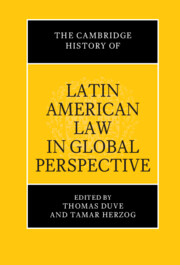
BOOK: Thomas DUVE & Tamar HERZOG (eds.), The Cambridge History of Latin American Law in Global Perspective (Cambridge: Cambridge University Press, 2024), ISBN 9781316518045 [OPEN ACCESS]


(image source: CUP)

Abstract:
Covering the precolonial period to the present, The Cambridge History of Latin American Law in Global Perspective provides a comprehensive overview of Latin American law, revealing the vast commonalities and differences within the continent as well as entanglements with countries around the world. Bringing together experts from across the Americas and Europe, this innovative treatment of Latin American law explains how law operated in different historical settings, introduces a wide variety of sources of legal knowledge, and focuses on law as a social practice. It sheds light on topics such as the history of indigenous peoples' laws, the significance of religion in law, Latin American independences, national constitutions and codifications, human rights, dictatorships, transitional justice and legal pluralism, and a broad panorama of key aspects of the history of statehood and law. This title is also available as Open Access on Cambridge Core.

On the editors:

Thomas Duve, Max Planck Institute for Legal History and Legal Theory, Frankfurt Thomas Duve is a director at the Max Planck Institute for Legal History and Legal Theory, and Professor of Comparative Legal History at Goethe University, Frankfurt. An expert in European and Latin American legal history, he specializes in the history of law and religion in a global perspective. Tamar Herzog, Harvard University, Massachusetts Tamar Herzog is the Monroe Gutman Professor of Latin American Affairs at Harvard University and an affiliated faculty member at the Harvard Law School. She is a legal historian of Spain, Portugal, and their overseas territories, having worked on colonial administration, penal justice, scribes, citizenship, land rights, and territorial conflicts. 

Table of contents:

Introduction Thomas Duve and Tamar Herzog
1. What is a legal history of Latin American law in a global perspective?
1.1 How was and is Latin American legal history written? Carlos Petit
1.2 What is a legal history and how does it relate to other histories? Tamar Herzog
1.3 How is law produced? Thomas Duve
1.4 What is global legal history and how can it be done? Mariana Dias Paes
2. How to approach indigenous law? Caroline Cunill
3. How to approach colonial law?
3.1 A civil law for a religious society Tamar Herzog
3.2 Religious normativity for colonial empires Thomas Duve
3.3 The domestic sphere Romina Zamora
4. Independence(s): what is a revolutionary law? Tamar Herzog
5. The coming of states? The nineteenth century
5.1 Constitutions José María Portillo
5.2 Codifications Agustín Parise
5.3 Contestations and exclusions Monica Dantas and Roberto Saba
6. The omnipresence of the state? The twentieth century
6.1 Towards the administrative state Eduardo Zimmermann
6.2 Dictatorships Cristiano Paixão
6.3 Transitional justice and human rights Ruti Teitel and Valeria Vegh Weis

7. Beyond the state – can state law survive in the twenty-first century? Daniel Bonilla Maldonado.

 Read more here. (this book is in open access)


BOOK: Burak KADERCAN, Shifting Grounds. The Social Origins of Territorial Conflict (Oxford: Oxford University Press, 2023), 320 p. ISBN 9780197686690, 54 GBP

(image source: OUP)

Abstract:
Territory has always played a key role in the origins, conduct, and consequences of armed conflict. For territories to exist in any meaningful sense, human groups need to think of them in the first place, and then act upon these thoughts: territory is what states and societies make of it. In Shifting Grounds, Burak Kadercan draws upon a wide variety of cases, ranging from the Thirty Years War to ISIS, to examine the relationship between "territorial ideas" and armed conflict. He argues that states and societies have adhered to different forms of territoriality across time and space, and territory, as well as territorial control, has meant different things in different time periods and regions. Building on this premise, Kadercan makes two claims. First, how state elites conceive territory within and beyond their domains affects their military objectives as well as methods and strategies for waging war. Second, adherence to different forms of territoriality leads to different modes and patterns of war, and wars themselves may affect how state elites and societies conceive territories. Kadercan then turns to the transformative roles that wars can play in shaping dominant territorial ideas and geopolitical assumptions and how the impact of such wars differs in Western and non-Western regions. Ranging broadly across different eras and world regions, Shifting Grounds sheds light on the shifting nature of the relationship between territorial ideas and armed conflict not only in the context of the distant the past, but also in present-day global politics.

Table of contents:

Chapter 1: Introduction: A Tale of Two Countries
Part One: Conceptual and Theoretical Framework
Chapter 2: Territory, War, and the "Territorial Trap"
Chapter 3: Territorial Orders and War
Part Two: How Territorial Ideas Affect Wars
Chapter 4: Rigid Borders, Spasmodic Wars: Mosaic and Monolithic Territorial Orders
Chapter 5: Fluid Frontiers and Forever War I: Amorphous Territorial Orders
Chapter 6: Fluid Frontiers and Forever War II: Virulent Territorial Orders
Part Three: How Wars Affect Territorial Ideas
Chapter 7: Systemic Wars and the Evolution of the Territorial Order(s)
Chapter 8: Conclusion: Territory and Territoriality in the Twenty-First Century
References

Index

Read more here. 


MEMBERSHIP: new bank account as of 1 JAN 2024


(image: David, Le serment des Horaces; source: Wikimedia Commons)

If you wish to become a member of the European Society for Comparative Legal History (ESCLH), please


1.       Email the Treasurer of the ESCLH, Dr. Judit Beke-Martos at treasureresclh@gmail.com with your name, your institutional affiliation, whether you are a PhD student, or not, and your current postal address. 

2.       Subsequently, please pay your annual membership fee (regular membership: 50 Euros per year, reduced membership fee for PhD students: 25 Euros per year) via bank transfer to the following account: 

Bank Account Holder: European Society for Comparative Legal History e.V. 
Bank: Deutsche Skatbank – VR-Bank Altenburger Land eG

IBAN: DE04 8306 5408 0005 3677 60

BIC: GENO DEF1 SLR

In the comment, please state your name and the year for which you are paying. 


SSRN PAPER: Samuel MOYN, "Animals and Slaves: A Legal Analogy between Domination and Reform" (forthcoming in Anne PETERS (ed.), Oxford Handbook of Global Animal Law (Oxford: OUP))


 (image source: Wikimedia Commons)

Abstract:

The analogy between animals and slaves is rooted deep in the Western tradition. This chapter argues that the parallel between animals and slaves has been static neither in its content nor its consequences to date. Originally it revolved around domesticated non-human agricultural labouring animals and their enslaved human counterparts. Over millennia, not only did it evolve away from the imaginative centrality of agriculture and therefore domesticated service (human or non-human). Its ethical and political implications underwent a grand reversal in modern times. A little more than two hundred years ago, the analogy began to allow for a common if dissident project of reducing physical cruelty, and eventually for an abolitionist politics that aimed for a more thoroughgoing emancipation from hierarchy.

Read the full paper on SSRN. 

22 December 2023

HOLIDAY: End-of-year break (23 DEC 2023-7 JAN 2024)

(image: Les Bouquinistes en Hiver, Eugène Galien-Laloue; source: Wikimedia Commons)

Dear reader, the ESCLH-blog goes into holiday mode from now. Enjoy the end of 2023, and expect us back in 2024 for a fresh start from 7 January on!

We published over 480 posts this year (ergo 1,3 per day, not counting the breaks), and attracted over 260 000 views. Since its creation back in 2010, the blog counts over 2,3 million views. We are happy that the efforts of our bloggers (Piotr, Arthur, Filip, Marco, Stefano, Priyasha, Kamilia) and former bloggers (Stefania, Gilles, Flavia and Annemieke) have made this kind of amplification possible. 

BOOK: Jean-Marie CAUCHIES & Jean-Marie YANTE (dir.), Ordonnances de Philippe le Bon pour le Comté de Namur 1421-1466 et le Duché de Luxembourg 1443-1464 [Recueil des Ordonnances des Pays-Bas; 1e série: 1381-1506] (Bruxelles: SPF Justice/CRALO-Société Archéologique de Namur, 2023), 208 p.


(image source: KCOWV-CRALO) 

Abstract:

Les ordonnances de Philippe le Bon pour le comté de Namur (1421-1466) et le duché de Luxembourg (1443-1464) viennent de rejoindre la deuxième section de la première série (1381-1506) du Recuel des Ordonnances des Pays-Bas. Les professeurs émérites Jean-Marie Cauchies (Université Saint-Louis Bruxelles, Université catholique de Louvain) et Jean-Marie Yante (Université catholique de Louvain), membres de la Commission Royale pour la Publication des Anciennes Lois et Ordonnances de Belgique, ont rédigé une introduction (pp. 5-24), et soigné l'édition scientifique et érudite de 42 et 23 actes namurois, ainsi que 38 actes luxembourgeois. Le volume est accompagné d'un index des noms propres (pp. 187-196) et d'un index des matières (pp. 197-199).

Cette publication a bénéficié du soutien de la Commission Royale pour la Publication des Anciennes Lois et Ordonnances de Belgique et de la Société archéologique de Namur, d'une subvention de la Fondation pour la protection du patrimoine culturel, historique et artisanal (Lausanne) et du Centre belge d'histoire rurale (Section de Louvain-la-Neuve).
Ordering:
Le volume peut être commandé auprès de la Bibliothèque du SPF Justice.

Source: KCOWV/CRALO blog. 

JOURNAL: Quaderni fiorentini per la storia del pensiero giuridico moderno, LII (2023) [OPEN ACCESS]

(Image source: Quaderni Fiorentini)


Quaderni fiorentini per la storia del pensiero giuridico moderno. Il diritto come forma dell’esperienza. Per Paolo Grossi


Modelli e dimensioni: storicità del diritto e dialogo con i giuristi. 

L’officina dello storico I. Ripensare il medioevo

L’officina dello storico I. Ripensare la modernità

L’officina dello storico II. La Codificazione e l’«assolutismo giuridico»

L’officina dello storico II. Un ‘secolo lungo’: il Novecento giuridico

La «pos-modernità». Costituzione e società

La «pos-modernità». Il problema della legalità

La «pos-modernità». Interpretatio e unità dell’ordine plurale

Letture

A proposito di…

Testimonianze

Ragguagli fiorentini

More information can be find here.