Search

Showing posts with label European Society for Comparative Legal History (ESCLH). Show all posts

03 June 2026

CALL FOR PAPERS AND POSTERS: 9th Biennial Conference of the European Society for Comparative Legal History: Transition and Transfers (Lund: Lund University, 21-23 JUN 2027) [DEADLINE 31 OCT 2026]


The organisers and the Executive Council of the European Society for Comparative Legal History are pleased to call for papers and posters for the upcoming European Society for Comparative Legal History 9th Biennial Conference to be held from 21 to 23 June 2027 at Lund University, Sweden.

The conference series started in Valencia (2010), followed by Amsterdam (2012), Macerata (2014), Gdansk (2016), Paris (2018), Lisbon (2022), Augsburg (2023), andSzeged (2025). The 2027 conference is hosted by the Olin Foundation for Legal History and supported by the Faculty of Law at Lund University.

The theme of the conference is ”Transitions and Transfers.” We are living in a time of unpredictability and changes, and this gives reason to pay attention to periods of transition in history. How and why did changes occur, who were the proponents and opponents? Changes in legal history have often had elements of transfer. Sometimes, legal needs have been met through drawing inspiration from other legal systems. On other occasions, legal rules have been imposed on other systems.

The papers, panels, and posters offered should deal with either transitions or transfers, or both. They should engage in dialogue with aspects of law across time and/or space that are of interest for comparative legal historians.

To offer a paper, please submit an abstract of up to 400 words. The abstract should include the title of your proposed paper and your personal data (full name, email address, work affiliation). Please also send a short CV (no more than 400 words). Anyone at any stage in their research career can offer a paper.

Abstracts will be assessed against: (1) the aim to have a diverse conference; (2) the novelty of the work; and (3) a professionally grounded proposal including a description ofthe methodology and most important sources, and a concise description of the expected research results.

It is also possible to submit a proposal for a complete panel. Panels normally consist of three papers. A panel proposal should – in addition to the abstracts and CVs of those who wish to present a paper in that panel – include an abstract for the entire panel, as well as a CV of the panel organizer.

Further, it is possible to submit a proposal for a poster. To offer a proposal for a poster, please submit an abstract of up to 400 words. The abstract should include the title of your project and your personal data (full name, email address, work affiliation). Please also send a short CV (no more than 400 words). 

Anyone at any stage in their research career can propose a poster. Accepted participants will be asked to submit to the organisers a PDF file in size A0 with the poster design, and the posters will be printed in Lund.

One author may only propose to give one paper or present one poster at the conference in order to allow as many people as possible to present their work.

All submissions – for papers, panels, and posters – should be in English and be sent to ESCLH2027@jur.lu.se, no later than 31 October 2026.

The list of accepted papers, panels, and posters will be announced by December 2026.

A conference website will be launched with further details of the conference in the autumn of 2026. The conference website will also contain information on the attendance fee for those not members of the ESCLH, and transport to and from Lund. The conference website will allow registration for the conference, starting early in 2027. Finally, the conference will be preceded by a PhD-workshop on 21 June 2027. Further information about the workshop will also be published in the autumn of 2026.

03 July 2025

CONFERENCE: 9th Biennial Conference of the European Society for Comparative Legal History in Lund, 21-23 JUN 2027


(image: Prof. Sunnqvist announcing the dates of the 2027 conference; source: BlueSky)

The 9th Biennial Conference of the ESCLH will take place in Lund (Sweden), as announced by Prof. Martin Sunnqvist. This event will be supported by the Olin Foundation and take place from 21 to 23 June 2027.

ELECTION: Agustín PARISE (Maastricht) elected as new President of the European Society for Comparative Legal History

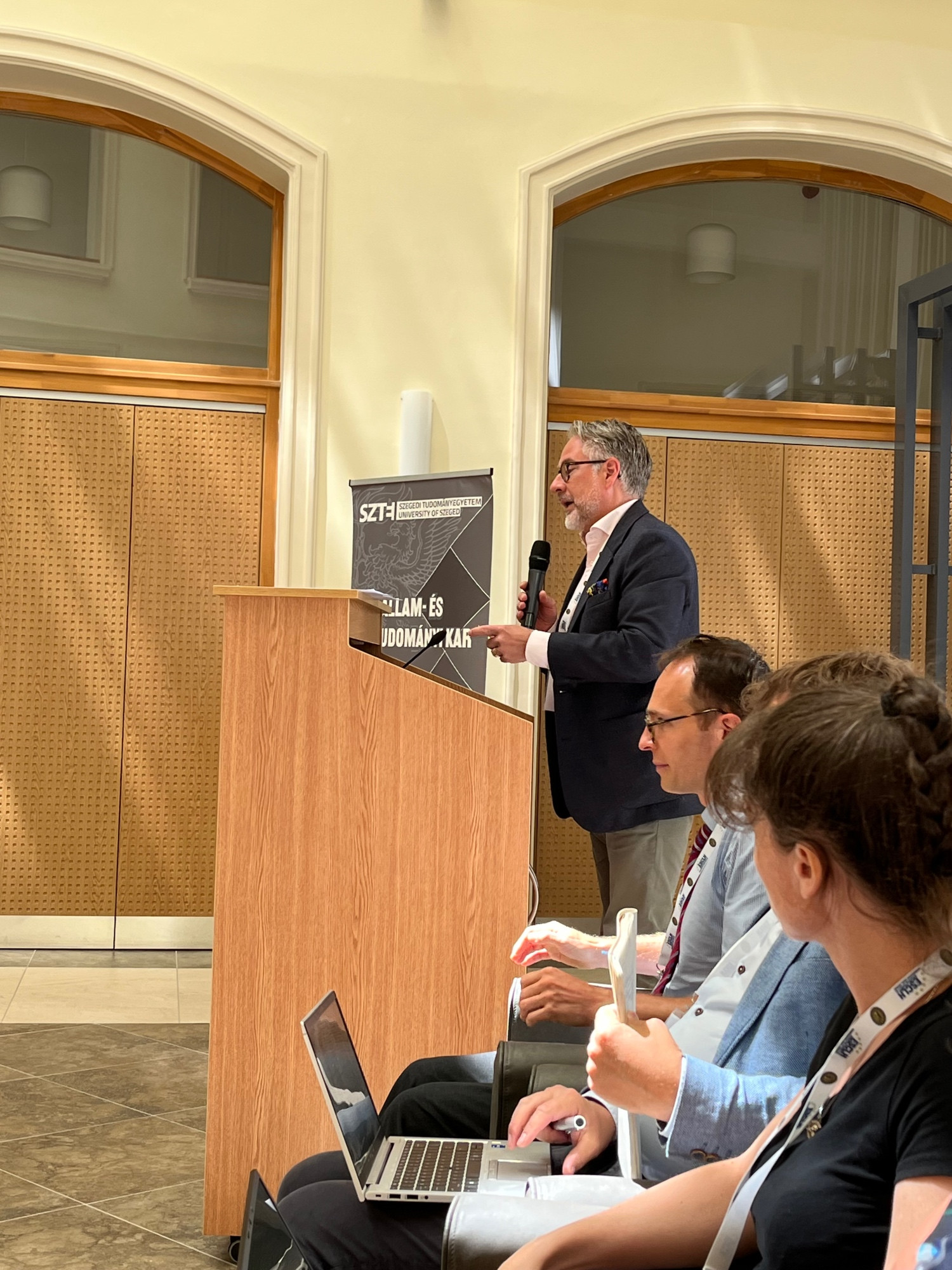
Agustín Parise (Maastricht) was elected as new President of the European Society for Comparative Legal History at the 8th Biennial Conference of the Society in Szeged.

He succeeds Matt Dyson (Oxford), who ran the society with a team of three vice-presidents, the secretary-general, the treasurer and the director of communications since the Paris conference in 2018. 

The society thanks its parting President for his outstanding performance.


08 January 2024

MEMBERSHIP: new bank account as of 1 JAN 2024


(image: David, Le serment des Horaces; source: Wikimedia Commons)

If you wish to become a member of the European Society for Comparative Legal History (ESCLH), please


1.       Email the Treasurer of the ESCLH, Dr. Judit Beke-Martos at treasureresclh@gmail.com with your name, your institutional affiliation, whether you are a PhD student, or not, and your current postal address. 

2.       Subsequently, please pay your annual membership fee (regular membership: 50 Euros per year, reduced membership fee for PhD students: 25 Euros per year) via bank transfer to the following account: 

Bank Account Holder: European Society for Comparative Legal History e.V. 
Bank: Deutsche Skatbank – VR-Bank Altenburger Land eG

IBAN: DE04 8306 5408 0005 3677 60

BIC: GENO DEF1 SLR

In the comment, please state your name and the year for which you are paying. 


31 October 2022

REMINDER CFP: The European Society for Comparative Legal History's Seventh Biennial Conference (Augsburg: University of Augsburg, 21 – 23 JUN 2023); DEADLINE 15 NOV 2022

(image source: Blogger)

The Organising Committee and the Executive Council of the European Society for Comparative Legal History are pleased to call for papers for the upcoming Society’s Seventh Biennial Conference to be held from 21 to 23 June 2023 at the University of Augsburg, Germany.

A conference in 2023 will be a change to our normal timing. We began in Valencia (2010), followed by Amsterdam (2012), Macerata (2014), Gdańsk (2016), Paris (2018), and most recently, after a delay caused by Covid, we enjoyed the event in Lisboa (2022). However, not only does that mean we did not have a conference for four years. Covid has also moved some other large international conferences now to even-numbered years. To avoid collision with these other conferences, the ESCHL conferences would after 2023 continue at two-year intervals moving them to uneven-numbered years. The offer from Augsburg was made some years ago, but kindly deferred and the Executive Council is delighted to be able to take it up now.

For the Augsburg event in 2023, there is no general conference theme. Rather, the organisers hope that the sessions will reflect – in terms of covered topics, time periods, and regions – the full breadth of international research in comparative legal history. The Organising Committee does so in the believe that the Society’s Biennial Conference should foremost be a platform for researchers to present their most recent research in comparative legal. Papers should address and explore doctrinal, theoretical, cultural, or methodological aspects of comparative legal history. Papers should also be comparative, covering at least two legal systems, as well as historical.

To offer a paper, please send an abstract of up to 400 words by 15 November 2022. Papers, and abstracts, should be in English. The abstract should give the title of your paper and your personal data (full name, email address, work affiliation). Please also send a short CV (no more than 4 pages). Everyone, at whatever stage in their research career can offer a paper. The application should be sent to: phillip.hellwege@jura.uni-augsburg.de. Abstracts will be assessed against: (1) the aim to have a diverse conference; (2) the novelty of the work; (3) the evidence of scholarly rigour and promise of a fully researched and referenced paper; (4) in order to allow as many people as possible to speak at the conference, a person may normally offer only one paper.

It is also possible to submit a proposal for a complete panel. Panels normally consist of three papers. A panel proposal should – in addition to the abstracts and CVs of those who wish to present a paper in that panel – include an abstract for the entire panel as well as a CV of the panel organizer.

Applicants will be informed by 15 December 2022 whether their paper has been accepted. The conference programme will be published on 31 December 2022 on the conference website:

https://www.uni-augsburg.de/de/fakultaet/jura/lehrende/hellwege/seventh_esclh_conference_2023/

(image: Augsburg, in Swabenland, aan de Leck, boven den Donau; behoorende onder het Duitsche rÿk; Amsterdam: Pieter Schenk, 1700; source: Europeana/Central Library of Florence)

The conference website will also contain information on the attendance fee for those who are not members of the ESCLH, on transport to and from Augsburg, on accommodation in Augsburg. Finally, the conference website will allow, starting 15 December 2022, registration for the conference.

Finally, the conference will be preceded by an additional PhD-workshop on 21 June 2023. Further information about the workshop will also be published on 15 December 2022.


13 October 2022

REMINDER ONLINE SEMINAR: Journal Comparative Legal History - Dialogues on Teaching Comparative Legal History - 19 October 2022: 17:00-18:00hs (CEST) [on Zoom]


Journal Comparative Legal History

Dialogues on Teaching Comparative Legal History

19 October 2022 – 17:00-18:00hs (CEST)


The journal Comparative Legal History is an official academic forum of the European Society for Comparative Legal History. It was first published in 2013 and aims to offer a space for the development of comparative legal history. Based in Europe, it welcomes contributions that explore law in different times and jurisdictions from across the globe. Submissions are currently welcome and are being assessed on a rolling basis.

The journal will host a one-hour public session to discuss the necessity and practicality of including comparative legal history in the law school curriculum. Editors (past and present) will present exploratory points and all attendees will be invited to join in a general discussion. Ought comparative legal history be routinely taught at schools of law? The presence of comparative legal history in the classroom may have an impact on the development of disciplinary autonomy and invite the revisiting of uncontested dogmas. It may further offer a forum for future generations to gain interest in the evolution of law across time and space. Does the teaching in this field have the potential to include new or otherwise marginalised perspectives? How would it fit within the framework of a demanding curriculum, often linked to regulatory requirements inherent to a profession? How would this teaching interplay with doctrinal studies? These and other questions will be explored during this public session.

The event is free and open to the public, and it will take place via Zoom.

Registration is required by sending an email to clhdialogues@gmail.com.

10 October 2022

LAST REMINDER: CALL FOR BLOGGERS: European Society for Comparative Legal History (DEADLINE 15 OCTOBER)


The blog of the European Society for Comparative Legal History (established in 2010) is a reference for all those seeking reliable information on publications, calls and vacancies in the broad interdisciplinary field of comparative legal history. Its readership spans the globe, with almost two million visits (approx. 14 000 per month). Lawyers, historians, sociologists and philosophers aim to understand the categories of legal thinking and practical manifestations of human behaviour across jurisdictions and traditions.

The blog is not an automated creation, but human-made. It thrives thanks to the efforts of volunteers who are ready to add content and correspond with submitting publishers or scholars. It is vital for our blog to remain up-to-date, and to reflect the real diversity within and outside of European academia. We aim to publish on a daily basis and maintain the uninterrupted stream of news. Therefore, the Society actively encourages young or established scholars to join the current team of bloggers.

Serving as a blogger contributes to your visibility in the world of legal history. It requires a limited amount of your time, and can also be intermittent. In any case, you will be part of a team.

Proposals can be sent (cover letter + cv) to esclhblog@gmail.com by 15 October. We will inform applicants of the outcome as soon as possible.

05 October 2022

REMINDER CFP: The European Society for Comparative Legal History's Seventh Biennial Conference (Augsburg: University of Augsburg, 21 – 23 JUN 2023); DEADLINE 15 NOV 2022

(image source: Blogger)

The Organising Committee and the Executive Council of the European Society for Comparative Legal History are pleased to call for papers for the upcoming Society’s Seventh Biennial Conference to be held from 21 to 23 June 2023 at the University of Augsburg, Germany.

A conference in 2023 will be a change to our normal timing. We began in Valencia (2010), followed by Amsterdam (2012), Macerata (2014), Gdańsk (2016), Paris (2018), and most recently, after a delay caused by Covid, we enjoyed the event in Lisboa (2022). However, not only does that mean we did not have a conference for four years. Covid has also moved some other large international conferences now to even-numbered years. To avoid collision with these other conferences, the ESCHL conferences would after 2023 continue at two-year intervals moving them to uneven-numbered years. The offer from Augsburg was made some years ago, but kindly deferred and the Executive Council is delighted to be able to take it up now.

For the Augsburg event in 2023, there is no general conference theme. Rather, the organisers hope that the sessions will reflect – in terms of covered topics, time periods, and regions – the full breadth of international research in comparative legal history. The Organising Committee does so in the believe that the Society’s Biennial Conference should foremost be a platform for researchers to present their most recent research in comparative legal. Papers should address and explore doctrinal, theoretical, cultural, or methodological aspects of comparative legal history. Papers should also be comparative, covering at least two legal systems, as well as historical.

To offer a paper, please send an abstract of up to 400 words by 15 November 2022. Papers, and abstracts, should be in English. The abstract should give the title of your paper and your personal data (full name, email address, work affiliation). Please also send a short CV (no more than 4 pages). Everyone, at whatever stage in their research career can offer a paper. The application should be sent to: phillip.hellwege@jura.uni-augsburg.de. Abstracts will be assessed against: (1) the aim to have a diverse conference; (2) the novelty of the work; (3) the evidence of scholarly rigour and promise of a fully researched and referenced paper; (4) in order to allow as many people as possible to speak at the conference, a person may normally offer only one paper.

It is also possible to submit a proposal for a complete panel. Panels normally consist of three papers. A panel proposal should – in addition to the abstracts and CVs of those who wish to present a paper in that panel – include an abstract for the entire panel as well as a CV of the panel organizer.

Applicants will be informed by 15 December 2022 whether their paper has been accepted. The conference programme will be published on 31 December 2022 on the conference website:

https://www.uni-augsburg.de/de/fakultaet/jura/lehrende/hellwege/seventh_esclh_conference_2023/

(image: Augsburg, in Swabenland, aan de Leck, boven den Donau; behoorende onder het Duitsche rÿk; Amsterdam: Pieter Schenk, 1700; source: Europeana/Central Library of Florence)

The conference website will also contain information on the attendance fee for those who are not members of the ESCLH, on transport to and from Augsburg, on accommodation in Augsburg. Finally, the conference website will allow, starting 15 December 2022, registration for the conference.

Finally, the conference will be preceded by an additional PhD-workshop on 21 June 2023. Further information about the workshop will also be published on 15 December 2022.

26 September 2022

REMINDER ONLINE SEMINAR: Journal Comparative Legal History - Dialogues on Teaching Comparative Legal History - 19 October 2022: 17:00-18:00hs (CEST) [on Zoom]


Journal Comparative Legal History

Dialogues on Teaching Comparative Legal History

19 October 2022 – 17:00-18:00hs (CEST)


The journal Comparative Legal History is an official academic forum of the European Society for Comparative Legal History. It was first published in 2013 and aims to offer a space for the development of comparative legal history. Based in Europe, it welcomes contributions that explore law in different times and jurisdictions from across the globe. Submissions are currently welcome and are being assessed on a rolling basis.

The journal will host a one-hour public session to discuss the necessity and practicality of including comparative legal history in the law school curriculum. Editors (past and present) will present exploratory points and all attendees will be invited to join in a general discussion. Ought comparative legal history be routinely taught at schools of law? The presence of comparative legal history in the classroom may have an impact on the development of disciplinary autonomy and invite the revisiting of uncontested dogmas. It may further offer a forum for future generations to gain interest in the evolution of law across time and space. Does the teaching in this field have the potential to include new or otherwise marginalised perspectives? How would it fit within the framework of a demanding curriculum, often linked to regulatory requirements inherent to a profession? How would this teaching interplay with doctrinal studies? These and other questions will be explored during this public session.

The event is free and open to the public, and it will take place via Zoom.

Registration is required by sending an email to clhdialogues@gmail.com.

09 September 2022

ONLINE SEMINAR: Journal Comparative Legal History - Dialogues on Teaching Comparative Legal History - 19 October 2022: 17:00-18:00hs (CEST) [on Zoom]


Journal Comparative Legal History

Dialogues on Teaching Comparative Legal History

19 October 2022 – 17:00-18:00hs (CEST)


The journal Comparative Legal History is an official academic forum of the European Society for Comparative Legal History. It was first published in 2013 and aims to offer a space for the development of comparative legal history. Based in Europe, it welcomes contributions that explore law in different times and jurisdictions from across the globe. Submissions are currently welcome and are being assessed on a rolling basis.

The journal will host a one-hour public session to discuss the necessity and practicality of including comparative legal history in the law school curriculum. Editors (past and present) will present exploratory points and all attendees will be invited to join in a general discussion. Ought comparative legal history be routinely taught at schools of law? The presence of comparative legal history in the classroom may have an impact on the development of disciplinary autonomy and invite the revisiting of uncontested dogmas. It may further offer a forum for future generations to gain interest in the evolution of law across time and space. Does the teaching in this field have the potential to include new or otherwise marginalised perspectives? How would it fit within the framework of a demanding curriculum, often linked to regulatory requirements inherent to a profession? How would this teaching interplay with doctrinal studies? These and other questions will be explored during this public session.

The event is free and open to the public, and it will take place via Zoom.

Registration is required by sending an email to clhdialogues@gmail.com.

25 May 2022

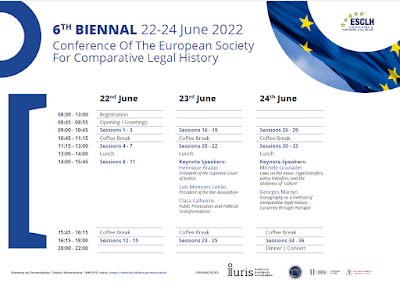
REMINDER CONFERENCE: 6TH BIENNAL Conference Of The European Society For Comparative Legal History - Lisbon, 22-24 June 2022


(Source: Iuris)

IURIS – Interdisciplinary Research Institute hosts the 6th Biennal Conference of the European Society for Comparative Legal History, running between the 22nd and 24th of June 2022, at the Faculty of Law of the University of Lisbon.

The conference, which will gather in Lisbon over a hundred researchers from around the world, will focus on legal professions and method, especially the methods of legal professionals across Europe and the world, picking up threads of thought from the earlier ESCLH conferences in Valencia (2010), Amsterdam (2012), Macerata (2014), Gdansk (2016), Paris (2018) to explore what roles Professions and Methods have played, and continue to play, within comparative legal history.

See the program and register here.

ESCLH members are exempt from paying the conference fee. The ESCLH annual fee is €50; please find more information here:

http://esclh.blogspot.com/p/donate-to.html

16 May 2022

CONFERENCE PROGRAM: 6TH BIENNAL Conference Of The European Society For Comparative Legal History - Lisbon, 22-24 June 2022


(Source: Iuris)

IURIS – Interdisciplinary Research Institute hosts the 6th Biennal Conference of the European Society for Comparative Legal History, running between the 22nd and 24th of June 2022, at the Faculty of Law of the University of Lisbon.

The conference, which will gather in Lisbon over a hundred researchers from around the world, will focus on legal professions and method, especially the methods of legal professionals across Europe and the world, picking up threads of thought from the earlier ESCLH conferences in Valencia (2010), Amsterdam (2012), Macerata (2014), Gdansk (2016), Paris (2018) to explore what roles Professions and Methods have played, and continue to play, within comparative legal history.

See the program and register here.

ESCLH members are exempt from paying the conference fee. The ESCLH annual fee is €50; please find more information here:

http://esclh.blogspot.com/p/donate-to.html

22 December 2021

JOURNAL: Comparative Legal History (new editorial team composition and international advisory board)

Comparative Legal History, the peer reviewed journal of our society, has reshuffled its editorial team and updated its international advisory board, following the call for copy editors and book reviews editors.

More information here.

26 November 2021

PRIZE: The Van Caenegem Prize 2022

 The European Society for Comparative Legal History (ESCLH) President and Executive Council are pleased to present the ESCLH Van Caenegem Prize competition. The prize will be awarded to a young legal historian deemed to have written the best article published in Comparative Legal History, the ESCLH journal, in 2020 and 2021 or on comparative legal history in another journal in the same two calendar years.


Art. 1: Name of the prize

The Van Caenegem prize is named in honour of Raoul Charles Van Caenegem, a pioneering author in the field of comparative legal history.

Art. 2: The best article in the field of comparative legal history

(1)           The Van Caenegem prize is awarded to the young legal historian(s) in the meaning of Art. 3 who wrote the best article in the field of comparative legal history.
(2)          Every article by a young legal historian published in the Society's journal (Comparative Legal History) in the two calendar years preceding the year in which the Society's Conference is held at which the prize is to be awarded will automatically be considered for the prize.
(3)           The Van Caenegem Prize Committee may consider articles in the field of comparative legal history which are published in the same years in other journals in the English language for the prize.
(4)           Authors and third parties may submit articles in the meaning of paragraph (3) to be considered for the prize. Submission should be made by 1 January of the year in which the Society’s Conference is held at which the prize is to be awarded. The submission must be made by email to the President of the ESCLH. The submission must include a pdf of the published article and a statement indicating that the author fulfils the requirements of Art. 3.

Art. 3: Young legal historian(s)

(1)   A legal historian is regarded to be a young legal historian in the meaning of these rules if he or she is in his or her early career. Accordingly, a legal historian is eligible for the prize if on 1 January of the year of the award ceremony he or she is still within eight years after completing his or her PhD; the Prize Committee can, in exceptional cases and on application, grant an extension of this period. Normally, a legal historian fulfilling the requirement of sentences 1 and 2 will not be eligible if he or she is already a full professor.
(2)   A legal historian who has previously received the prize is not eligible to receive the prize a
second time.
(3)   In case of co-authorship all co-authors must fulfil the requirements set out in Art. 3(1) and (2). Co-authors share the prize.

Art. 4: Van Caenegem Prize Committee

(1)           The Society awards the prize to the winner as determined by the Van Caenegem Prize Committee.
(2)           The Committee shall be appointed by the Society’s Executive Council in the year before the award ceremony. The Committee consists of a president and four further members:
(a)           At least two members (including the president of the committee) shall belong to the Society's Advisory Board.
(b)           Two members shall be chosen from the organisers of the Young Legal Historians Forum which took place within two years of the appointment of the Prize Committee. These two members should not currently be supervised for doctoral work by any other member of the committee. If the Young Legal Historians Forum did not have a conference in the two years period or if it ceases to exist or if for any other reason it is not possible to appoint two members from the organisers of the Young Legal Historians Forum, the Executive Council must chose two members who are themselves young legal historians within the meaning of
Art. 3(1).
(c)            The last member of the Committee shall be chosen from the international community of scholars in comparative legal history.
(d)           No member may be affiliated to the same institution as another member. No member’s institution may be in the same country as another member’s institution. 
(5)  The Society's president can, by appointment, fill a vacancy on the Prize Committee.
(6)  After reviewing the articles, a majority of votes determines the winner. The committee may decide that the prize is shared between two authors.
(7)  A member cannot vote if the vote concerns a relative within the fifth degree, a co-author of a publication or co-applicant of a project or the author is or has been an employee or grantholder at the same institution.

Art. 5: The award of the prize

The prize is awarded by the Society's president at the Society's Conference. The winner will be announced in the issue of the Comparative Legal History following the conference.

Art. 6: Prize money and certificate

The prize consists of a sum to be determined by the Executive Council and a certificate. The Prize Committee will write a one page report, detailing the academic qualities and importance of the article. The president and the further members of the Committee cannot communicate with those outside the Committee in any other way about their decision.

Art. 7: Dispute resolution


Any dispute in respect of a Van Caenegem Prize must be submitted to the president of the Society whose determination is final. 

Potential authors should consult the submission information on Comparative Legal History.

Past winners
2014 (Macerata Conference)

Bram Delbecke (KULeuven) for his article "The Political Offence and the Safeguarding of the Nation State: Constitutional Ideals, French Legal Standards and Belgian Legal Practice, 1830–70", Comparative Legal History I (2013), 45-74 (article link)

2016 (Gdańsk Conference)

Frederik Dhondt (VUB/UGent) for his article "‘Inter ruinas publicas scriptum’: Ernest Nys, a legal historian in defence of Belgian tax payers during the Great War", Comparative Legal History III (2015), 131-151 (article link)


2018 (Paris conference)

Shavana Musa (Manchester) for her article "Victims of maritime conflict, compensation claims and the role of the admiralty court in the early modern period", Comparative Legal History V (2017), 125-141 (article link)

2020 (Lisbon conference/postponed)

Nadeera Rupesinghe (Sri Lanka National Archives) for her article "Do you know the ninth commandment? Tensions of the oath in Dutch colonial Sri Lanka", Comparative Legal History VII (2019), 37-66 (article link)

15 December 2020

ANNOUNCEMENT: Journal Comparative Legal History – Submissions Welcome and New Issue

(image source: Taylor&Francis)

We received the following announcement about the journal Comparative Legal History.

Journal Comparative Legal History

Submissions Welcome and New Issue!

The journal Comparative Legal History is an official academic forum of the European Society for Comparative Legal History (ESCLH). It was first published in 2013 and aims to offer a space for the development of comparative legal history. Based in Europe, it welcomes contributions that explore law in different times and jurisdictions from across the globe.

Submissions are currently welcome and are being assessed on a rolling basis.

The journal welcomes contributions from the fields of law and history, and is likewise receptive of interdisciplinary legal studies with the comparative aspect at their core. Attention is also devoted to papers focusing on understudied jurisdictions and/or periods, as well as topics generally constricted to a specialist audience. Authors should feel free to approach the Articles Editor for initial inquiries on suitability.

The ESCLH is proud to announce that volume 8 issue 2 of Comparative Legal History has been released. The issue contains three articles, one review article, and two book reviews:

Articles

What is global legal history?

Thomas Duve

Legal history, as developed in nineteenth-century continental Europe, has a national tradition, but also a transnational past. During the last two decades, however, a new field of global legal history has emerged, not least as a response to Eurocentrism, methodological nationalism and the current reality of transnational and global law. In this article, I map some historiographic traditions of transnational legal history and the emerging field of global legal history, pointing out some important methodological problems and suggesting a knowledge-historical approach. It ends with a definition of global legal history as a critical history of the production of multinormative knowledge, understood as a process of distributed knowledge production through cultural translation, comprising theory and practice, drawing on a wide range of sources, on a transnational scale, with special attention for the dialectics of glocalisation.

Roman law in Ethiopia: traces of a seventeenth century transplant

Peter H Sand

This study tracks the ancient Ethiopian Fetḥa Nagaśt (‘Law of the Kings’) to its origins, which date back to compilations of Roman-Byzantine law from the fifth to the ninth centuries, first translated from Greek into Arabic by Coptic Christian jurists in Egypt in the twelfth and thirteenth centuries and into the classical Ethiopic language (Ge’ez) in the mid-seventeenth century. The transfer of this Eastern Roman torso of law to the radically different social environment of Ethiopia may be ranked as one of the earliest systemic ‘receptions’ in comparative legal history. While never attaining the dominant status of Roman law in medieval European practice, the survival and resilience of the Fetḥa Nagaśt in the subsequent evolution of the country’s legal and political system from the seventeenth century onwards has indeed been remarkable – including its ‘inspirational’ role acknowledged in twentieth-century modern codifications. What distinguishes Ethiopia from other ‘mixed legal systems’, though, is the absence of a ‘genetic’ relationship with any one foreign legal system.

States and non-state actors in hegemonic and counter-hegemonic narratives in international law: the Nigerian experience

Joycelin Chinwe Eze-Okubuiro

The historical background of Nigeria as a state and how state and non-state actors within its domain influence the nation’s domestic and international activities demonstrate the conflict and complexity between dominant ideologies and resistance between competing actors in Nigeria. Such struggles arose following the imposition of colonial rule and subsequent introduction of the English legal system, which unsettled existing indigenous systems that were hugely dependent on customary law. Although such platforms successfully served colonial interests, they were challenged by different resistance groups. Through historical narrative, this paper contributes to Global South scholarship in the hegemonic and counter-hegemonic discourse in international law, with Nigeria as a case study. The paper shows that in order to successfully address hegemonic tendencies, which flow from the international system and are sustained by the Nigerian state, the resistant role of non-state actors is imperative in the making of international law to accommodate the Nigerian experience.

Review Article

Seeking a disciplinary identity – the case of comparative legal history

A review of Comparative Legal History , edited by Olivier Moréteau, Aniceto Masferrer and Kjell A Modéer, Edward Elgar Publishing, 2019, 512 pp., £175,50 (hbk), ISBN 9781781955215

Jaakko Husa

Book Reviews

Law and identity in Israel: a century of debate

by Nir Kedar, Cambridge, Cambridge University Press, 2019, 236 pp., £85 (hbk), ISBN 9781108484350

Inbal Blau & Omer Aloni

Law and the Russian state: Russia’s legal evolution from Peter the Great to Vladimir Putin

by William E. Pomeranz, London and New York, Bloomsbury, 2018, x + 228 pp., £76,50 (hbk), ISBN 9781474224246

Heikki Pihlajamäki


The latest issue can also be found here

06 October 2020

JOURNAL: Comparative Legal History VIII (2020), no. 1

(Source: ESCLH)

Editorial

Heikki Pihlajamäki & Matthew Dyson, p. 1

Articles

Insuring vs. investing in litigation: a comparative legal history of litigation insurance and claim investment
Willem H. Van Boom, pp. 2-26

From Fukoku Kyohei to Fu-Guo-Qiang-Bing: a comparative analysis of Imperial China and Japan
David K.C. Huang & Nigel N.T. Li, pp. 27-51

Book Reviews

Ancient legal thought: equity, justice, and humaneness from Hammurabi and the Pharaohs to Justinian and the Talmud
by Larry May, Cambridge, Cambridge University Press, 2019, 750 pp., £110 (hbk), ISBN 978-1108484107
Anthony Smart, pp. 52-55

Reason and fairness. Constituting justice in Europe, from medieval canon law to ECHR
by Ulrike Müßig, Leiden and New York, Brill, 2019, 660 pp., 176€ (hbk), ISBN 978-9-004-39372-1
Annamaria Monti, pp. 55-57

Marktaustausch: Grundlegung einer juristisch-ökonomischen Theorie des Austauschverkehrs
by Johannes W. Flume, Tübingen, Mohr Siebeck, 2019, xxi + 304 pp., €84 (hbk), ISBN 978-3161568985
Janwillem Oosterhuis, pp. 57-63

War, law and humanity: the campaign to control warfare, 1853–1914
by James Crossland, London, Bloomsbury Academic, 2018, 256 pp., £31.30 (pbk), ISBN 978-1-350-04121-9
Thomas Kleinlein, pp. 63-66

Littératures populaires du droit. Le droit à la portée de tous
edited by Laetitia Guerlain and Nader Hakim, Issy-les-Moulineaux, LGDJ, 2019, 208 pp., 42 € (pbk), ISBN 978-2275057724
Filippo Rossi, pp. 66-70


More information with the publisher.

07 January 2019

CALL FOR PAPERS: ESCLH - Second Postgraduate Conference in Comparative Legal History, 27-29 June 2019 (DEADLINE: 15 January 2019)


We would like to remind interested scholars of the Second Postgraduate Conference in Comparative Legal History. The deadline for receipt of abstracts is 15 January 2019 : 

Second Postgraduate Conference in Comparative Legal History
27–29 June 2019, Augsburg University, Germany
Call for Papers
The European Society for Comparative Legal History (ESCLH) is pleased to announce its Second Postgraduate Conference. The ESCLH invites PhD-students (beyond their first year) and post-doctoral-researchers who work in the field of comparative legal history to participate in the conference. The conference will be held from 27 to 29 June 2019 at Augsburg University, Germany.
The ESCHL wants to overcome the narrow nationalism and geographical segregation of legal history in contemporary European scholarship and professional organisations. The society, thus, aims to promote comparative legal history, the explicit comparison of legal ideas and institutions in two or more legal traditions.
The Second Postgraduate Conference of the ESCLH will give advanced PhD-students and post-doctoral-researchers the opportunity to present their research in the field of comparative legal history to a panel of six leading experts. Furthermore, the conference will give all participants the opportunity to build academic networks. The experts on the panel cover a broad range of subjects: Ulrike Babusiaux (Zürich), Mia Korpiola (Turku), Annamaria Monti (Milano), Wim Decock (Leuven), Matthew Dyson (Oxford), and Aniceto Masferrer (Valencia).
The ESCLH invites advanced doctoral candidates and post-doctoral researchers to submit abstracts for presentation. The abstract should be of no more than 300 words and give the title of your research project, your field of research, and your personal data (full name, email address, affiliated university, CV) to:
phillip.hellwege@jura.uni-augsburg.de
The conference language is English and abstracts must be submitted in English. The closing date for receipt of abstracts is 15 January 2019. 12 applicants will be selected and invited to participate in the conference. Successful applicants will be informed by 15 February 2019.
Participants are expected to cover their own travel expenses. Accommodation and catering will be provided without charge.

30 October 2018

CALL FOR PAPERS: ESCLH - Second Postgraduate Conference in Comparative Legal History, 27-29 June 2019 (DEADLINE: 15 January 2019)


We are pleased to announce a Call for Papers for the 2nd ESCLH Postgraduate Conference: 

Second Postgraduate Conference in Comparative Legal History
27–29 June 2019, Augsburg University, Germany
Call for Papers
The European Society for Comparative Legal History (ESCLH) is pleased to announce its Second Postgraduate Conference. The ESCLH invites PhD-students (beyond their first year) and post-doctoral-researchers who work in the field of comparative legal history to participate in the conference. The conference will be held from 27 to 29 June 2019 at Augsburg University, Germany.
The ESCHL wants to overcome the narrow nationalism and geographical segregation of legal history in contemporary European scholarship and professional organisations. The society, thus, aims to promote comparative legal history, the explicit comparison of legal ideas and institutions in two or more legal traditions.
The Second Postgraduate Conference of the ESCLH will give advanced PhD-students and post-doctoral-researchers the opportunity to present their research in the field of comparative legal history to a panel of six leading experts. Furthermore, the conference will give all participants the opportunity to build academic networks. The experts on the panel cover a broad range of subjects: Ulrike Babusiaux (Zürich), Mia Korpiola (Turku), Annamaria Monti (Milano), Wim Decock (Leuven), Matthew Dyson (Oxford), and Aniceto Masferrer (Valencia).
The ESCLH invites advanced doctoral candidates and post-doctoral researchers to submit abstracts for presentation. The abstract should be of no more than 300 words and give the title of your research project, your field of research, and your personal data (full name, email address, affiliated university, CV) to:
phillip.hellwege@jura.uni-augsburg.de
The conference language is English and abstracts must be submitted in English. The closing date for receipt of abstracts is 15 January 2019. 12 applicants will be selected and invited to participate in the conference. Successful applicants will be informed by 15 February 2019.
Participants are expected to cover their own travel expenses. Accommodation and catering will be provided without charge.

06 July 2018

VACANCY: Copy-Editor for peer-reviewed journal Comparative Legal History (Routledge)


Comparative Legal History is a leading journal in its field and the official journal of the European Society of Comparative Legal History (ESCLH). The Journal is now looking for a copy editor. Together with the editor, articles editor, reviews editor, and the other copy editor, the new copy editor will be part of the Journal’s editorial team. The copy editor should be a legal historian and a member of the ESCLH. Native English proficiency and a doctoral degree are advantages, but not absolute requirements. Please send your application together with your CV to Prof. Heikki Pihlajamäki, the editor, by Aug. 1, 2018 at the latest (heikki.pihlajamaki@helsinki.fi). This is an exciting chance to take part in the making of a quality journal!

More information the journal with Routledge.

07 September 2017

ESCLH POSTGRADUATE CONFERENCE: Call for Papers, Augsburg University (22-24 Feb 2018); DEADLINE 31 OCT 2017

Postgraduate Conference in Comparative Legal History
22–24 February 2018, Augsburg University, Germany
Call for Papers
The European Society for Comparative Legal History (ESCLH) is pleased to announce its first Postgraduate Conference. The ESCLH invites PhD-students (beyond their first year) and post-doctoral-researchers who work in the field of comparative legal history to participate in the conference. The conference will be held from 22 to 24 February 2018 at Augsburg University, Germany.
The ESCLH wants to overcome the narrow nationalism and geographical segregation of legal history in contemporary European scholarship and professional organisations. The society, thus, aims to promote comparative legal history, the explicit comparison of legal ideas and institutions in two or more legal traditions.
The first Graduate Conference of the ESCLH will give advanced PhD-students and post-doctoral-researchers the opportunity to present their research in the field of comparative legal history to a panel of six leading experts. Furthermore, the conference will give all participants the opportunity to build academic networks. The experts on the panel cover a broad range of subjects: Ulrike Babusiaux (Zürich), Mia Korpiola (Turku), Wim Decock (Leuven), Jan Hallebeek (Amsterdam), Aniceto Masferrer (Valencia), Stephen Skinner (Exeter).
The ESCLH invites advanced doctoral candidates and post-doctoral researchers to submit abstracts for presentation. The abstract should be of no more than 300 words and give the title of your research project, your field of research, and your personal data (full name, email address, affiliated university, CV) to:

The conference language is English and abstracts must be submitted in English. The closing date for receipt of abstracts is 31 October 2017. 12 applicants will be selected and invited to participate in the conference. Successful applicants will be informed by 15 December 2017. Participants are expected to cover their own travel expenses. Accommodation and catering will be provided without charge.