Search

11 October 2022

CALL FOR PAPERS: Conference "A History of Constant Reform: Crime and Punishment in the Twentieth Century" - University of Fribourg, 8 - 9 June 2023 [DEADLINE 15 January 2023]


A History of Constant Reform: Crime and Punishment in the Twentieth Century

8 - 9 June 2023, Fribourg (Switzerland)

Deadline for applications: 15 January 2023


Although closely related, the histories of criminal justice and prisons are often studied apart. This workshop seeks to bring together historians and scholars from neighbouring disciplines working on various aspects of the history of crime, criminal justice, and incarceration in the twentieth century.

In the twentieth century, laws, legal institutions, and prison facilities seemed to be characterized by a constant process of reform. Though there were occasional accelerations and downturns, the reform movement never entirely stopped. Thus, the discourses and practices of criminality and of legal sanctions and their execution evolved substantially, while the individuals involved in the legal and penal systems – the accused, accusers, lawyers, judges, prison inmates, prison workers, and criminologists – became more diverse in terms of gender, social and geographic origin, professionalization, etc.

The goal of this workshop is to start a discussion of how reforms and changes in different steps of the criminal and penal system related to and influenced each other. Although closely related, the histories of criminal justice and prisons are often studied apart. This workshop seeks to bring together historians and scholars from neighbouring disciplines working on various aspects of the history of crime, criminal justice, and incarceration in the twentieth century, when phases of relative stability seemed to be followed by periods of rapid change. The 1970s in particular, though less well studied than previous periods of reform, seem to have been an especially intense time of debate about the criminal justice and prison systems.

We propose to follow four broad tracks to identify how different forces converged to generate moments of change in the twentieth century:

1. Visible Justice/Invisible Prisons?
In line with the dictum, “Ignorance of the law is no excuse,” making the legislative process public is one of the fundamental principles of democracy. Even before a law is adopted, every step in its creation must be publicly discussed, and after its adoption, it is supposed to be publicly available. The execution of penal sanctions on the other hand is almost entirely a black box. It takes place in areas separated from society and remains invisible to most people. In the twentieth century, making the living conditions in prisons known to the outside world was challenging, since the media paid little attention and few people cared about the inmate population, who were thought to deserve their fate. This situation was contested throughout the twentieth century by individuals and organizations both inside and outside prisons, but they were most successful in the 1970s, when anti-prison groups and other critics of the carceral system seemed to become more numerous.

What triggered the wider contestation? Were critics simply more efficient? Finding answers to such questions will lead us to examine the conditions that made the critique of the prison system possible. Prison living conditions are closely related to issues of funding. How did debates about the importance of self-financing of prisons change in the political sphere? Furthermore, has the tension between the public nature of legislative processes and the hidden nature of the penal system evolved over time? Did the democratization of politics that occurred during the twentieth century lead to a wider public involvement in the law-making process? How has this affected subordinate social groups? What were the relationships between the democratization of political life and the prison reform movement based on human rights principles?

2. Criminalization and Decriminalization
What was counted as criminal behaviour changed over the course of the twentieth century. Criminalization and decriminalization were complex processes that were related to changes in society, culture, politics, and the economy. The most famous example of criminalization of previously legal behaviour is the prohibition of alcohol consumption in the United States in the first half of the twentieth century; another is the criminalization and decriminalization of abortion. While changes in criminal laws were the most obvious expression of criminalization or decriminalization, there were also more subtle forms. For instance, increased reporting of sexual crimes in the early twentieth century led to increased visibility of behaviour that had previously gone mostly unreported. Intensified policing of public and private spaces could have a similar effect; the same is true for harsher or more lenient sentences by the courts. Moreover, the spread of new patterns of behaviour, such as ostentatious drug use by members of the counterculture, may have led to increased police activity and subsequent criminalization. In turn, the incarceration of drug addicts also posed significant problems for prisons.

What were the social, cultural, economic, and political driving forces and contexts of various forms of criminalization and decriminalization in the twentieth century? Which social groups were targeted, and which benefited? Which (political) activists lobbied for criminalization or decriminalization? And how did criminalization and decriminalization relate to historical shifts taking place in the second half of the twentieth century, such as the rise of the counterculture and the subsequent decline of middle-class mores, the increase of global migration, and the emergence of neoliberalism and right-wing populism?

3. Reform and Scientific Knowledge
Throughout the twentieth century, crime and criminal justice and punishment were subjects of scientific knowledge production. The late nineteenth and early twentieth centuries witnessed the rise of a well-documented naturalization and medicalization of crime and criminal justice. While sociological explanations on the social causes of crime had existed since at least the nineteenth century, medical experts began to individualize criminal behaviour by interpreting it as a sign of psychiatric illness or ‘abnormality.’ Especially in Nazi Germany, but also elsewhere, crime was racialized. Individuals who were racially classified as ‘Jews,’ ‘Gypsies,’ or ‘Slavs’ were seen as ‘naturally’ prone to criminal behaviour. Criminals – female criminals in particular– were seen as a threat to the fabric of society. In this regard, we would like to question the way women were viewed as a specific class of criminal subjects and how prisons were conceived differently for men and women over time. How was this differentiation challenged?

Starting in the 1960s, the medicalized, racist, and sexist view on crime and criminal justice came under scrutiny by proponents of the New Left. Related to this criticism, new sociological approaches started to gain influence, such as the labelling theory and the differential association theory, which focused on the interplay of crime, criminalization, and socialization in subcultures. Nevertheless, psychiatrists and their expertise still remain an important pillar in criminal procedures.

In the closing decades of the twentieth century, neoliberal theories of crime and punishment started to evolve. Following the rational choice theorem, neoliberals conceptualized criminals as rational and profit-seeking actors who freely and deliberately chose to commit crimes (as opposed to being forced by social circumstances or mental conditions) and were thus seen as fully responsible for their actions. What were the political implications of these and other developments in the knowledge production on crime, criminal justice, and punishment? How did scientific theories relate to and react to the rise of human rights and anti-racism? Did the role of psychiatrists, both as knowledge producers and as scientific experts in trials, evolve after the critique directed against them in the 1970s? How has knowledge production been influenced by the rise of neoliberalism and right-wing populism? We would also like to question the way psychiatry and psychiatric theories affected the carceral system. Did they trigger reforms of the prisons? Did they influence new conceptions of prison facilities?

4. Human Rights and Social Movement Advocacy as Driving Forces for Change?
The emergence of human rights in public discourse after the Second World War, promoted by the United Nations and the European Council, has been the driving force behind the push for minimum standards of respect for human rights in the management of prison facilities. However, historians have paid little attention to the impact of these standards on legal and prison reforms. How were these minimum standards, which entailed new obligations and a reduction of state autonomy, implemented in law and in prison facilities?

Supranational organizations were not the only ones calling for reform. In the wake of the 1968 movements, subordinate social groups demanded more attention and pushed for various forms of social discrimination such as racism and sexism in penal institutions to be addressed. In addition, legal reformers and scholars developed critiques of the law as an instrument used by the ruling classes to secure their domination. What effects did such critiques lead to in the penal system? What were the major improvements? How did social movements appeal to human rights in order to demand greater social rights? How did these movements influence the law and the execution of punishment? How did the social movement denounce injustice when it was part of the law? How were prisoners involved in the process of denunciation and reform? And finally, how do these developments relate to the increasing individualization of societies during the second half of the twentieth century?

Proposals of 300–500 words, accompanied by a short biographical note, should be sent by January 15, 2023 to the following addresses: maurice.cottier@unifr.ch and alix.heiniger@unifr.ch.

Decisions will be announced no later than February 1, 2023.

The conference will take place at the University of Fribourg, June 8 and 9 2023.

Organizers: Maurice Cottier and Alix Heiniger (Department of Contemporary History, University of Fribourg).

Kontakt

E-Mail: maurice.cottier@unifr.ch

Source: A History of Constant Reform: Crime and Punishment in the Twentieth Century. In: H-Soz-Kult, 05.10.2022, <www.hsozkult.de/event/id/event-130079>.

WORKSHOP: Verfassungs- und Verwaltungsgerichtshöfe und deren Bedeutung, Praxis im europäischen Vergleich - University of Vienna, 21/22 October 2022


Verfassungs- und Verwaltungsgerichtshöfe und deren Bedeutung, Praxis im europäischen Vergleich


Workshop über die historische Bedeutung und Verwendbarkeit der Rechtspraxis und ihrer Quellen bzw. über die Gerichtsbarkeit als historical agency mit Hinblick auf die heutigen rechtstheoretischen und rechtsdogmatischen Debatten

Veranstalter: Albert-Ludwigs-Universität Freiburg - Hans-Kelsen-Forschungsstelle / Universität Wien - Institut für Österreichische Geschichtsforschung

Veranstaltungsort: Universität Wien, Österreich

Datum: 21. - 22. Oktober 2022

Im Workshop wird die rechtstheoretische Frage nach dem Beziehungsgeflecht von Politik und Recht aus der historischen Perspektive – mit besonderem Fokus auf Oberstgerichte und Schiedsgerichte – diskutiert.

Dieser historische Fokus soll es uns ermöglichen, die Übersetzungsleistungen zwischen Politik und Recht, die Gestaltungsmöglichkeiten sowie Steuerungsfunktion von Recht und die Einflussmöglichkeiten von Politik auf Recht in konkreten-historischen Situationen und mit Bezug auf das institutionelle Setting der Gerichtsbarkeit aus der Perspektive der Rechtsgeschichte zu diskutieren, zugleich die diesbezüglichen, gegenwärtigen rechtstheoretischen und rechtsdogmatischen Debatten in einem größeren historischen Kontext auch geschichtswissenschaftlich neu zu lesen.

Wir fragen dabei nach der gesellschaftlichen Reaktion auf die Rechtspraxis bzw. nach der gerichtlichen Wahrnehmung gesellschaftlicher Konflikte in der Rechtsgeschichte.

- Wie bearbeitete, beantwortete die Rechtspraxis gesellschaftliche Erwartungen?
- Wie wurden und werden die sozialen Erwartungen internalisiert und gerichtlich verrechtlicht?
- Wie wurden und werden politische Themen dabei institutionalisiert und kanalisiert?
- Welche Konflikte lösten gewisse Gerichtsurteile aus?
- Wie produzierte die Rechtspraxis Rechtswissen, welches das heutige Rechtsdenken – in den unterschiedlichen Rechtstraditionen unterschiedlich formuliert und institutionalisiert – prägt?

Im ersten Panel wird nach den rechtstheoretischen und historischen Bedingungen gefragt, die den Oberstgerichten eine unterschiedlich gestaltete Rolle als politische Akteure zuweisen. Diese Frage nach der politischen Rolle vom Recht wird weitergeführt im Blick auf Schiedsgerichte, die auf internationaler Ebene wirtschaftliche und politische Ansprüche in eigenen Verfahren aushandeln und Lösungen entwickeln, die innerhalb der internationalen wie auch der nationalen Gemeinschaft Zustimmung oder Ablehnung findet.

Im dritten und vierten Panel verlagert sich die Diskussion auf einzelne Politikfelder.

Die Diskussion im Panel 3 bezieht sich auf die staatliche Verwaltung (besonders im post-habsburgischen Raum). Die Normgeltung ist besonders in Zeiten politischen und normativen Wandels von hoher Bedeutung. Bezüglich des (post-)habsburgischen Rechtsraumes lässt sich diesbezüglich erfragen: Wie gingen die Nachfolgestaaten mit dem normativen Erbe der Monarchie um? Wie positionieren sie sich zum weitergeltenden österreichischen und/oder ungarischen Recht?

Das letzte (vierte) Panel nutzt die beiden Politik- und Rechtsfelder von Staatsbürgerschaft und Ehe, die an der Schnittstelle von öffentlichem Recht und Privatrecht liegen, als Ausgangspunkt für die Analyse der Übersetzungsleistungen zwischen Politik und Recht in spezifischen politischen und gesellschaftlichen Situationen.

Programm

21. Oktober 2022 (Freitag)

09:00–12:00 Uhr Panel 1: Obergerichte als politische Akteure

Filippo Contarini (Luzern / Paris): Schweiz und ihre gegenwärtige Grundnorm

Péter Techet (Freiburg/Br.): Verfassungsgerichtsbarkeit in der Ersten Republik: Übersetzungsarbeit zwischen Recht und Politik

Kommentar: Lena Foljanty (Wien)

13:00–16:00 Uhr Panel 2: Schiedsgerichte / Privatisierung des Rechts / Tribunalisierung der Politik

Peter Collin (Frankfurt/M): Eine Justizkonstellation ganz eigener Art: Schiedsgerichte und Reichsversicherungsamt in der frühen deutschen Sozialrechtsprechung

Bruno de Lima (Frankfurt/M): Using Administrative Law and Civil Law to Fight Slavery: Luiz Gama's Freedom Claims before Brazilian Police Departments and Judicial Courts, 1860–1888

Kommentar: Miloš Vec (Wien)

16:30–19:30 Uhr Panel 3: Verwaltung – Recht – Politik im posthabsburgischen Rechtsraum

Peter Becker (Wien): Politische Transformationen in der Habsburgermonarchie

Gábor Egry (Budapest): Bruch der Staatlichkeit, Kontinuität des Rechts im post-habsburgischen Siebenbürgen

Jana Osterkamp (München): Rechtspluralismus und Justiz in der Transformationsphase der Tschechoslowakei

Kommentar: Claudia Kraft (Wien)

22. Oktober 2022 (Samstag)

09:00–12:00 Uhr Panel 4: Staatsbürgerrecht und Eherecht(spraxis) als politische Macht- und gesellschaftliche Konfliktfrage

Mark Cornwall (Southampton): Traitors in the Habsburg Rechtsstaat

Benno Gammerl (Florenz): Entscheidungen über Zugehörigkeit im British Empire und in der Habsburgermonarchie

Dominique Kirchner Reill (Miami): Hungarian Marriage Law in Italian Fiume and Its Practice

Kommentar: Franz Fillafer (Wien)

12:00–13:00 Uhr
Abschließender Kommentar zu den Ergebnissen: Thomas Olechowski (Wien)

Enddiskussion

Kontakt

E-Mail: peter.techet@jura.uni-freiburg.de


Quelle: Verfassungs- und Verwaltungsgerichtshöfe und deren Bedeutung, Praxis im europäischen Vergleich. In: H-Soz-Kult, 04.10.2022, <www.hsozkult.de/event/id/event-130082>.


10 October 2022

REMINDER: 3 PhD candidates in legal history (Tilburg Law School) (DEADLINE: 15 October 2022)


(Source: Career5)

Tilburg Law School currently has 3 vacancies for fully-funded PhD candidates in legal history for the CaPANES project on the historical use of sovereignty concepts in cities of commerce.

Department: Public Law & Governance 
Location: Tilburg  
Scientific area: Legal History 
Full time equivalent: 0.8-1.0 FTE (32-40 hours per week) 
Duration of employment contract: two years, with possible extension
Monthly full-time salary: €2,541 - €3,247 gross 
Closing date vacancy: October 15, 2022    


The department of Public Law and Governance (PLG) is looking for 3 PhD Candidates who will be working within the project ‘Causal Pattern Analysis of Economic Sovereignty’ (CaPANES), which is funded by the European Research Council (ERC, ERC Consolidator Grant 2021, nr 101044356). PLG is a large, diverse and interdisciplinary department, home to nearly 100 academic staff and a range of legal and social science disciplines. You will develop and grow in research, both individually and as part of a team of ambitious scholars.
  
Job Description 
As PhD Candidate in legal history, you will analyze the historical use of sovereignty concepts in cities of commerce. The CaPANES project hypothesizes that in the early modern period cities of commerce, even within states, had foreign relations of their own and made strategic use of legal terms that defined their economic sovereignty. The CaPANES project pursues legal-historical analysis of both the domestic context of cities of commerce and of their interactions with other cities and states. The CaPANES combines qualitative and quantitative methods (social network analysis, modelling), and aims to yield conclusions that are relevant also for discussions on present-day economic sovereignty. The PhD Candidates will analyze the law, institutions and correspondence of six cities of commerce (Florence, Toulouse, Rouen, Bruges, Southampton and Lübeck). The first PhD position is concerned with Bruges and Southampton (c. 1400-c. 1520), the second PhD position with Rouen and Lübeck (c. 1450-c. 1620) and the third one with Florence and Toulouse (c. 1400-c. 1550). 20% of the appointment may be dedicated to teaching and/or administration.


More info and full call here.

LAST REMINDER: CALL FOR BLOGGERS: European Society for Comparative Legal History (DEADLINE 15 OCTOBER)


The blog of the European Society for Comparative Legal History (established in 2010) is a reference for all those seeking reliable information on publications, calls and vacancies in the broad interdisciplinary field of comparative legal history. Its readership spans the globe, with almost two million visits (approx. 14 000 per month). Lawyers, historians, sociologists and philosophers aim to understand the categories of legal thinking and practical manifestations of human behaviour across jurisdictions and traditions.

The blog is not an automated creation, but human-made. It thrives thanks to the efforts of volunteers who are ready to add content and correspond with submitting publishers or scholars. It is vital for our blog to remain up-to-date, and to reflect the real diversity within and outside of European academia. We aim to publish on a daily basis and maintain the uninterrupted stream of news. Therefore, the Society actively encourages young or established scholars to join the current team of bloggers.

Serving as a blogger contributes to your visibility in the world of legal history. It requires a limited amount of your time, and can also be intermittent. In any case, you will be part of a team.

Proposals can be sent (cover letter + cv) to esclhblog@gmail.com by 15 October. We will inform applicants of the outcome as soon as possible.

REMINDER CFP, Workshop Series: New Directions in the Theory & History of International Law - Workshop II: "Beauty and Power: Aesthetics, History, & International Law" - Geneva, October 19-20, 2023 [deadline 25 November 2022]


The field of international legal history finds itself at a crossroads. After some decades, the tone of the literature on the “turn to history” has turned from celebration to self-critique. Indeed, the last couple of years has witnessed increased calls to pursue new directions in international legal history, departing from the “well-worn paths” initially explored. In this vein, some urge for a localized approach to the study of “legal politics,” while others push for a “history of international law in the vernacular,” a “grassroots analysis,” or a “radical historical critique.” In my own work, I have argued for a (new) materialist approach,  which resonates with other broader drives for the retrieval of Marxist perspectives in international legal history. Moreover, the “marked absences” of class, gender, and race from the traditional canon of the discipline seem like an increasingly inexcusable exclusion.  In sum, the stage is set for a profound reconsideration of the aims, methodologies, and archives of contemporary international legal history.

With this in mind, the interdisciplinary workshop series “New Directions in the Theory & History of International Law” aims to create a space where emerging and senior scholars of different traditions can meet and rethink on the past, present, and future of the theory and history of the discipline. For this purpose, the Geneva Graduate Institute will host a series of two-day academic workshops to promote productive conversations between different disciplinary sensibilities and perspectives along three core issues over the next three years.

These three cross-cutting themes are:

  • Political Economy, History, and International Law - held on June 2-3, 2022
    with Professor Susan Marks, London School of Economics

  • Beauty and Power: Aesthetics, History, and International Law - October 19-20, 2023
    with Professor Kate Miles, University of Cambridge

  • Space and Scale in International Legal History - Spring 2024 (tentative date TBD)
    with Professor Luis Eslava, University of Kent

Scholars who would like to present a paper at the second workshop on “Beauty and Power: Aesthetics, History, & International Law” are invited to submit a title and abstract (250─500 words) to daniel.quiroga@graduateinstitute.ch before November 25, 2022 (23:59 Geneva Time - CEST). A decision on acceptance of the abstract will be communicated by late October. We expect to host these workshops in person, but hybrid participation might be considered depending on the overall sanitary situation and the guidelines issued by the Geneva Graduate Institute. We are keen on exploring options for a collective publication effort after the workshop. As such, we encourage potential participants to bear this in mind as they prepare their abstracts.


All the relevant info here.

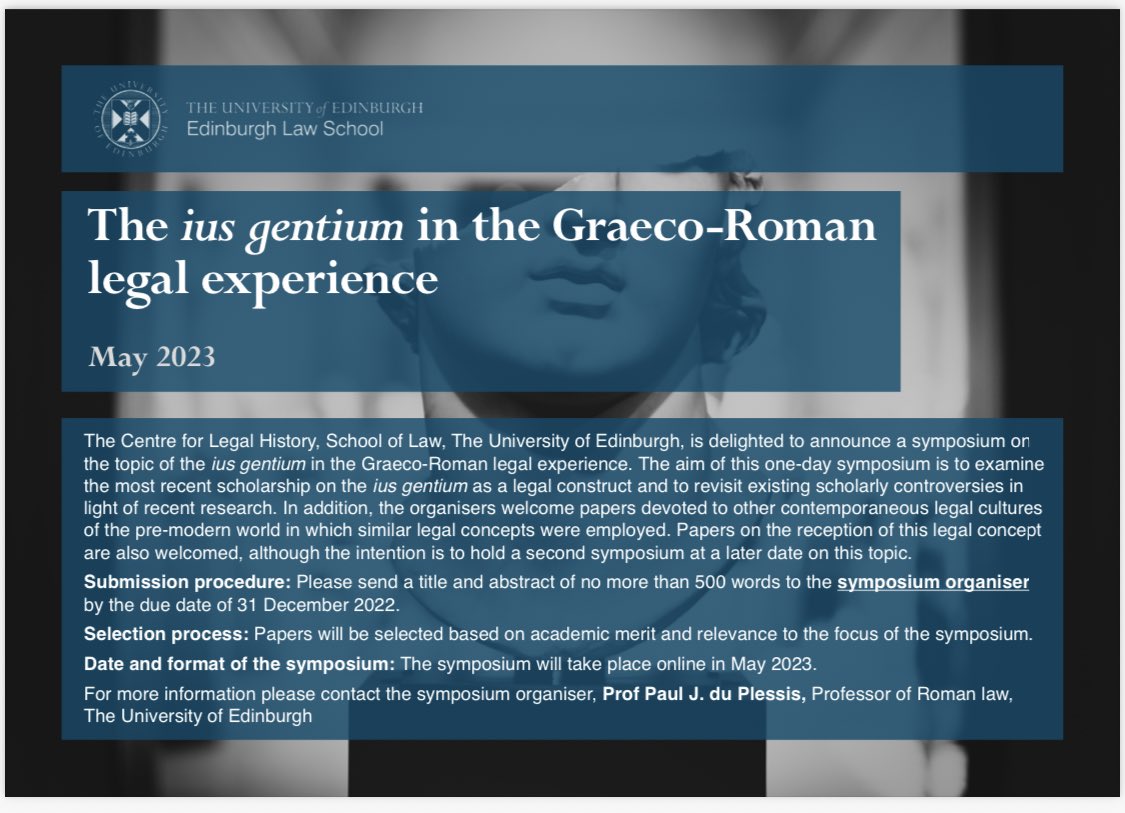
CALL FOR PAPERS: The Ius Gentium in the Graece-Roman Legal Experience (Edinburgh, May 2023) (DEADLINE: 31 December 2022)


(Source: Twitter)

We learned of a call for papers for a conference of the ius gentium in the Graece-Roman legal experience at Edinburgh next year. Here the call:

The Centre for Legal History, School of Law, The University of Edinburgh, is delighted to announce a symposium on the topic of the ius gentium in the Graeco-Roman legal experience. The aim of this one-day symposium is to examine the most recent scholarship on the ius gentium as a legal construct and to revisit existing scholarly controversies in light of recent research. In addition, the organisers welcome papers devoted to other legal cultures of the pre-modern world in which similar legal concepts were employed. Papers on the reception of this legal concept are also welcomed, although the intention is to hold a second symposium later this topic.

Submission procedure: Please send a title and abstract of no more than 500 words to the symposium organiser (Paul du Plessis)  by the due date of 31 December 2022.

Selection process: Papers will be selected based on academic merit and relevance to the focus of the symposium.

Date and format of the symposium: The symposium will take place online in May 2023.


07 October 2022

CALL FOR ABSTRACTS : The Forgotten Foundations of Feminist Legal Scholarship, Part 2: 1985-1995 (London/Zoom, 4 November 2022) (DEADLINE: 16 October 2022)


Via Criticallegalthinking, we learned of this call for paper proposals.

Contemporary feminist legal scholarship appears to have no history and almost no canonical texts. Unlike other fields in the humanities and social sciences, there has been an absence of interest in questions of feminist inheritance in law; a certain unwillingness to grapple with feminism’s intellectual and/or textual traditions. Individual studies, however radical or sophisticated in their orientation, appear to be situated in the ‘feminist present’ only, such that the past of legal feminism is void of any heritage worthy of being handed down. 

Yet despite this disregard or disavowal, contemporary feminist legal scholarship rests on the foundations of a corpus of post-war feminist texts. Those texts’ vital power shaped new, creative, and critical modes of thinking, new routes for understanding and reflection that challenged dominant thought inside and outside the academy. They animated multiple ways of revalorising lived experience and the subject’s embodied nature and in so doing raised radical questions about women’s social being. It is the forgetfulness of these earlier texts that these workshops wish to interrogate. The first workshop, held in Summer 2022, focused on feminist theoretical texts produced (mainly) in the years between 1970-1985. The second workshop, to be held in Autumn 2022, will focus on the body of new feminist, feminist legal, critical race feminist, postcolonial feminist and queer legal scholarship that emerged from the mid-1980s to early 1990s. 

In these two one-day workshops we wish to pose as a problem the present of feminist legal scholarship that has not only lost sight of most of these earlier texts, but has left this disconnection from its past to go entirely unnoticed. It is as if what credits feminist legal scholarship with contemporaneity is precisely the erasure of these earlier texts from its horizon. The questions to be addressed include: what is the position of these texts with regards to the present? How should we think of the feminist (legal) texts of the 1970s-90s today? How should we place our contemporary thought in relation to those texts?  How are we to receive these texts today? Why is it that feminist legal scholarship has developed no feminist canon or classical literature while continuing to reference/reverence the work of white male philosophers? In short, are we to reconnect and reconcile with the rich inheritance that feminist thought and practice of the ’70s, ’80s and ’90s has bequeathed us? Or should we continue to acknowledge as a sign of our contemporaneity the disjunction with our heritage? 

Call for Paper Proposals

Please send proposals of papers for the second workshop to Maria Drakopoulou (m.drakopoulou@kent.ac.uk) and/or Rosemary Hunter (r.c.hunter@kent.ac.uk). Proposals, including title and abstract of 150-300 words, should be submitted by 16 October 2022.

An indicative list of texts is attached although texts outside this list with justifications for inclusion are welcome.

Limited funding for travel costs may be available for research students and early career researchers. If you would need funding in order to attend, please let us know, with approximate cost, as soon as possible.

Workshop Organisers: Maria Drakopoulou and Rosemary Hunter.

Place: London in person + online for participants unable to travel

Date: 4 November 2022

LECTURE: Roman Law, from Totalitarianism to European Integration - University of Roma Tre - 13 ottobre 2022, 14:30 CET


06 October 2022

CALL FOR PAPERS : "Boire et Manger" [Journées internationales de la Société d'histoire du droit et des institutions des pays flamands, picards et wallons] (Lille: Université de Lille, 19-20 MAY 2023); DEADLINE 31 JAN 2023


(Source: Persée)

We learned of a call for papers for the next edition of the Journées d’Histoire du droit et des institutions des pays flamands, picards et wallons. Here the call :

Les Journées d’Histoire du droit et des institutions des pays flamands, picards et wallons se tiendront à Lille les 19 et 20 mai 2023 à Lille, à l’invitation de la section française de la société.  Le thème retenu cette année est « Boire et Manger ». 

« Boire et manger » constitue un enjeu permanent de la vie humaine. Se nourrir est en effet un besoin vital, biologique mais aussi une pratique sociale, culturelle, parfois même identitaire. Cette activité fait alors l’objet de normes sociales mais aussi juridiques : coutumes, règlements et lois. La nourriture donne aussi lieu à des contentieux tant sur le plan communautaire, local, étatique ou international.  Toutefois si sa réglementation peut apparaitre comme un invariant historique, elle prend des dimensions différentes selon les sociétés envisagées, tant dans le temps que dans l’espace.

Le colloque envisage alors  d’évoquer l’ensemble des dimensions juridiques et historiques du sujet : les propositions de communications pourront ainsi porter sur les approvisionnements, les règlements des métiers de bouche, le statut des nourrices, les règlements sanitaires et environnementaux, les taxes sur les denrées, les droits de passage, les empoisonnements, les vols d'aliments, le dernier repas des condamnés, les ordalies alimentaires, les interdits alimentaires, les rituels sacrés (jeûnes et sacrifices), les repas officiels, etc. 

Comme il est de coutume dans nos journées, il n’est pas fixé de limite temporelle, mais les communications s’intéresseront à l’Histoire de nos provinces.  Les propositions de communication devront être adressées à Tanguy Le Marc’hadour, président de la société, à l’adresse suivante, tanguy.lemarchadour@univ-artois.fr pour le 31 janvier 2023. Elles seront accompagnées d’une brève présentation du sujet envisagé. 

Les langues de travail recommandées sont le français, de préférence, mais aussi le néerlandais et l’anglais. Quelle que soit la langue utilisée, les communicants voudront bien faire un résumé ou une brève présentation sur Power point en anglais ou en français, si la communication se fait en anglais ou en néerlandais, et en anglais ou en néerlandais, si la communication est faite en français.

(Source : VUB Core)

JOB: Postdoctoral and Research Scholarships – Max Planck Institute for Legal History and Legal Theory (January-June 2023) (DEADLINE: 31 October 2022)


(Source: MPI Frankfurt)

The MPI in Frankfurt currently has a call for up to six scholarships for postdoctoral and senior researchers.

We award several Postdoctoral and Research Scholarships annually to enable outstanding researchers to spend time at the Max Planck Institute for Legal History and Legal Theory. Scholarship holders are expected to pursue their own research project, which should relate to the Institute’s current research agenda.

For the first half of the year 2023, the Department 
European and Comparative Legal History (Stefan Vogenauer) will award up to 6 scholarships for Postdoctoral and Senior Researchers proposing to work on one of the following topics:


Applications should include the following documents, written in English

  • Research proposal (up to 2500 words), including an explanation as to how the project relates to the Department’s main research activities
  • CV
  • List of publications
  • Names and contact details of two scholars who have agreed to provide references (upon request)
  • Scan of the completed and signed form ‘Additional Application Details’
  • Three relevant publications of the last five years (as PDFs)


Deadline: All applications must be submitted via the 
online application system by 31 October 2022. Decisions will be communicated before the end of the following month.

Scholarships run for either 3 or 6 months, starting at the beginning of January or April.
Scholars will receive a monthly stipend of either € 2,500 (postdoctoral researchers) or € 3,000 (senior researchers). Income from existing employment relationships or scholarships has to be set off against the amount awarded and will thus be taken into account when determining the exact amount of the stipend.

Contact
Anna Heym, International Office, 
io@lhlt.mpg.de


More info here

CONFERENCE : Standardisation and Localism in the Legal and Economic world of the Romans (Brussels/Ghent, 8-10 June 2023)


A conference organised under the umbrella of the international network ‘Structural Determinants of Economic Performance in the Roman World’ and the Committee for Legal History (KVAB)
by Emilia Mataix (Bilbao, Universidad del País Vasco UPV/EHU), Koenraad Verboven (Ghent University), Paul Erdkamp (Brussels, VUB)

Description

The adoption of standards in the Roman world is manifested in the production of objects, the use of measuring units, the construction of infrastructure, but also in symbolic representations of power by means of material culture, as well as in the use of standard contracts or reproducing legal formulaic writings. The effective use of these standards shows that individual beliefs, cultural norms, and formal institutions were aligned so as to reinforce trust among parties. Rome saw a proliferation of such abstract systems of trust, for example, by using standard weights and measures, which profoundly affected people’s lives from the most public settings to the most intimate.
However, one of the paradoxes of the Roman world is that, while standard objects or practices echoing Roman influences spread along different areas, the extension of these involved in many cases the further development or assimilation of foreign practices, objects or concepts, mixing cultural traditions or instead, reinforcing self-identity at a local level. One key example are the weights employed at different eastern Mediterranean ports, which translated Roman imperial units into local ones.
This international conference will be devoted to the study of the manifestations of standardisation and localisms in law and the economy of the Roman world, and consequently, their impact in diverse phenomena such as symbols, legal culture or commercial practices, but also in material culture, infrastructure and landscapes. The event also aims to recontextualize standards not only as echoes of Roman domination but as evidence of diverse socioeconomic practices and cross-cultural encounters, and how these are materially reflected echoing issues such as integration, assimilation, resilience, or a combination of imperial and provincial practices.

  • The conference focuses on six research questions:
    What is imperial and what local in the use of standards in different contexts? What does that imply about scale and integration in the Roman world?
  • How did people in the empire negotiate and integrate “Roman” standards in their society, economy, and culture? And vice versa?
  • What are the ethnic, cultural economic, legal or political reasons behind the attribution of specific names to phenomena or items linked with numeracy metrology or scale (e.g. pecunia from pecus, sheep)? Vice versa, what is the impact of a standard’s “identity” on how people perceive phenomena such as numeracy or scale?
  • How idiosyncratic or diverse could local adaptations of standards be in order to be understood by different economic agents?
  • How accurate were standards in the Roman world expected to be?
  • How did Roman standardised objects (e.g. amphorae or coins) or practices (e.g. legal procedures) and their particularities relate to their descriptions in textual sources?

The conference programme can be found here.

05 October 2022

BOOK REVIEW: Paul BRAND on Guido ROSSI (ed.), Authorities in Early Modern Law Courts (Forum Historiae Iuris, 9 JUN 2022) (OPEN ACCESS)


(images source: FHI)

First sentence:

This volume contains papers from a conference held at the Centre for Legal History in the School of Law in the University of Edinburgh in the summer of 2018. Guido Rossi, the main organiser hopes (as he suggests in his introduction) that these papers will help to suggest and chart a new direction for the legal history of Early Modern Europe and one which will use surviving evidence (both printed and manuscript) from the superior courts of different jurisdictions to demonstrate the role played by the various different kinds of legal authority (the medieval jus commune and its commentators, local customs and statutes and the prior judgments of those courts themselves) as legal foundation for their judgments and the ways in which the relative importance of each of these sources in each of these jurisdictions changed over time.

Read more here (DOI 10.26032/fhi-2022-007). 

REMINDER CFP: The European Society for Comparative Legal History's Seventh Biennial Conference (Augsburg: University of Augsburg, 21 – 23 JUN 2023); DEADLINE 15 NOV 2022

(image source: Blogger)

The Organising Committee and the Executive Council of the European Society for Comparative Legal History are pleased to call for papers for the upcoming Society’s Seventh Biennial Conference to be held from 21 to 23 June 2023 at the University of Augsburg, Germany.

A conference in 2023 will be a change to our normal timing. We began in Valencia (2010), followed by Amsterdam (2012), Macerata (2014), Gdańsk (2016), Paris (2018), and most recently, after a delay caused by Covid, we enjoyed the event in Lisboa (2022). However, not only does that mean we did not have a conference for four years. Covid has also moved some other large international conferences now to even-numbered years. To avoid collision with these other conferences, the ESCHL conferences would after 2023 continue at two-year intervals moving them to uneven-numbered years. The offer from Augsburg was made some years ago, but kindly deferred and the Executive Council is delighted to be able to take it up now.

For the Augsburg event in 2023, there is no general conference theme. Rather, the organisers hope that the sessions will reflect – in terms of covered topics, time periods, and regions – the full breadth of international research in comparative legal history. The Organising Committee does so in the believe that the Society’s Biennial Conference should foremost be a platform for researchers to present their most recent research in comparative legal. Papers should address and explore doctrinal, theoretical, cultural, or methodological aspects of comparative legal history. Papers should also be comparative, covering at least two legal systems, as well as historical.

To offer a paper, please send an abstract of up to 400 words by 15 November 2022. Papers, and abstracts, should be in English. The abstract should give the title of your paper and your personal data (full name, email address, work affiliation). Please also send a short CV (no more than 4 pages). Everyone, at whatever stage in their research career can offer a paper. The application should be sent to: phillip.hellwege@jura.uni-augsburg.de. Abstracts will be assessed against: (1) the aim to have a diverse conference; (2) the novelty of the work; (3) the evidence of scholarly rigour and promise of a fully researched and referenced paper; (4) in order to allow as many people as possible to speak at the conference, a person may normally offer only one paper.

It is also possible to submit a proposal for a complete panel. Panels normally consist of three papers. A panel proposal should – in addition to the abstracts and CVs of those who wish to present a paper in that panel – include an abstract for the entire panel as well as a CV of the panel organizer.

Applicants will be informed by 15 December 2022 whether their paper has been accepted. The conference programme will be published on 31 December 2022 on the conference website:

https://www.uni-augsburg.de/de/fakultaet/jura/lehrende/hellwege/seventh_esclh_conference_2023/

(image: Augsburg, in Swabenland, aan de Leck, boven den Donau; behoorende onder het Duitsche rÿk; Amsterdam: Pieter Schenk, 1700; source: Europeana/Central Library of Florence)

The conference website will also contain information on the attendance fee for those who are not members of the ESCLH, on transport to and from Augsburg, on accommodation in Augsburg. Finally, the conference website will allow, starting 15 December 2022, registration for the conference.

Finally, the conference will be preceded by an additional PhD-workshop on 21 June 2023. Further information about the workshop will also be published on 15 December 2022.

CALL FOR ABSTRACTS: Remapping Decisions: Splendid Encounters XI (Vienna, 27–28 April 2023) (DEADLINE: 15 October 2022)


(Source: RSA)

We learned of Call for Abstracts for a conference on diplomatic decision-making in the context of the multi-faceted political and cultural contacts between the Ottoman Empire and the rest of early modern Europe.

 The conference hosted by the Institute for Habsburg and Balkan Studies of the Austrian Academy of Sciences (IHB ÖAW) and the Institute for History of the Polish Academy of Sciences (IH PAN) seeks to examine the problem of diplomatic decision-making in the context of the multi-faceted political and cultural contacts between the Ottoman Empire and the rest of early modern Europe. Firstly, its main scope focuses on both power conflicts and conflict-management practice in Central Europe, Southeast Europe and the Mediterranean. In light of political actions, it shall also reflect the significance of cultural exchange in the directly affected regions, as well as the growing interest in the Ottoman Empire and the Near East in Europe. Secondly, in order to enrich this increasingly popular research field by new approaches, this event centers the procedure of decision-making which has been largely under-investigated in the field of European-Ottoman relations so far.

Splendid Encounters is a series of international and interdisciplinary conferences that aims to bring together scholars from different fields of study to consider diplomacy and diplomatic activities in the early modern period within the broadest possible framework. After nine successful meetings in, among others, Warsaw, Bath, Budapest, Prague, Toulouse, Florence and Lisbon we invite you to join us for another event, this time hosted by the Institute for Habsburg and Balkan Studies of the Austrian Academy of Sciences (IHB ÖAW) in Vienna.

View full CFP in a new window (PDF)

More info here

04 October 2022

CALL FOR APPLICATIONS: Max Weber Programme for Postdoctoral Studies (EUI) (DEADLINE: 18 October 2022)


(Source: EUI)

The EUI in Firenze currently has a call for postdoctoral fellows.

The deadline for applications is 18 October 2022 at 14:00 (Italian Time). Late applications for the ECO Department are accepted until all positions are filled. However, candidates in this field are likewise strongly advised to apply by the deadline.


The Max Weber Programme (MWP) at the European University Institute (EUI) is a unique postdoctoral programme in the historical and social sciences in Europe. It is open to applicants who are within 5 years from the completion of their PhD, from anywhere in the world, regardless of nationality. The Programme is highly selective, with an annual acceptance rate of <5% for a total of 55-60 Fellowships in the fields of political and social sciences, economics, law, and history. Preference is given to applicants who have only just completed their doctorate and have not had a postdoctoral fellowship before. Selected Fellows will benefit from the stimulating combination of a global programme located in the heart of Europe offering a broad menu of multidisciplinary and disciplinary activities.

The Programme awards 1 and 2 year long fellowships according to departments. In extraordinary cases only can a fellowship be extended to a third year.

The grant provided by the Fellowship is currently 2,070 EUR per month plus - when appropriate - a family allowance. Fellows in the Department of Economics and Political and Social Sciences who stay on for a second year will have the possibility of applying for a Part-time assistant professor contract (level ASSPR6/3) for 12 months involving some teaching duties and mentoring Ph.D. researchers: net remuneration would be approximately 850 EUR in addition to the monthly grant. The MWP operates a parental leave policy.

In addition to the scholarships funded by the Max Weber Programme itself, there are additional grants available that are funded by governments/foundations in Finland, Greece, Poland, Slovenia, Spain and Japan to which nationals of these countries (and in some cases residents in these countries) may also apply. Suitable applicants of any nationality may also apply for a second year at the Graduate Institute of International and Development Studies in Geneva (IHEID).

NB the availability of special grants varies from year to year – in some years more countries and agencies may offer grants and in others fewer. Up to date details can be found under the Information for Applicants tab. We automatically consider eligible applicants for these opportunities.

The Max Weber Fellows enjoy the superb research facilities of the European University Institute (including an outstanding library, a shared office space, and a personal research fund of 1000 EUR - 2000 EUR for second or third year Economics Fellows who are on the job market). The MWP is unique among postdoctoral programmes in helping Fellows to become full members of a global academic community.

Fellows are given training and support in all aspects of an academic career – from publishing and presenting, teaching, applying for research grants and jobs. A particular focus is placed on communicating effectively in English to different kinds of academic audiences.

Its placement record is second to none: most Max Weber Fellows secure an academic position in the finest institutions around the world upon completion of the Programme.

(Source: EUI)


NEWS: SIDHA 2023 and 2024

 We received the following news from the Société Internationale Fernand De Visscher pour l’Histoire des Droits de l’Antiquité (SIHDA).

The 76th session of the Société Internationale Fernand De Visscher pour l’Histoire des Droits de l’Antiquité (SIHDA) will be held at the University of Helsinki! The dates are August 22-26, 2023 and the venue will be the Faculty of Law in Helsinki.  

The theme of the conference is “Materiality and immateriality of ancient law." 

The call for papers will be published in late November. The organizing committee shall then also announce all practical details regarding the conference, travel and accomodation. To encourage early career researcher participation, there will be a heavily subsidized fees for students and young researchers.  

At the same session, the executive committee of the SIHDA granted the 77th session, to be held on September 23-28, 2024, to Osaka.

On behalf of the organizing committee, 

Kaius Tuori

03 October 2022

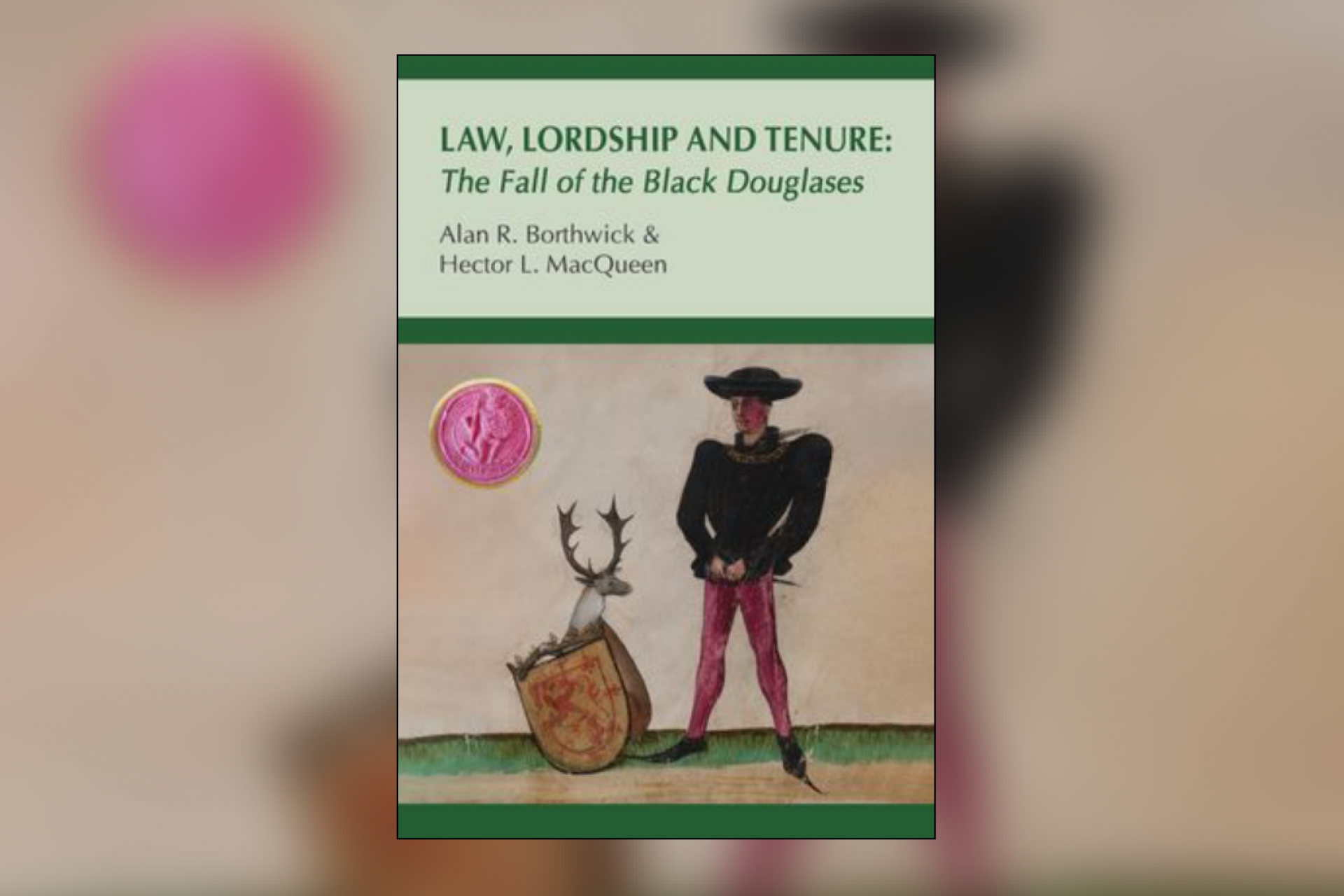
BOOK LAUNCH : Law, Lordship and Tenure: The Fall of the Black Douglases (Edinburgh/Zoom, 6 October 2022)


The Edinburgh Centre for Legal History is having an event to celebrate the publication of ‘Law, Lordship and Tenure: The Fall of the Black Douglases’.

About the book
This book is a new interpretation of the fall of later medieval Scotland’s greatest noble family, the Black Douglases, in 1455. The discussion reaches back in time to over a century before, as the family began its rise to the pinnacle of Scottish society. The killing of William eighth earl of Douglas by King James II in 1452 receives particular attention, as also the way in which he, his brother James (his successor as earl), and their predecessors exercised their power and authority as earls and lords, and it is suggested that their identifiable failings in this provide the key to understanding the catastrophe that befell the family in 1455. The principal analytical tool is the law relevant to these events and the specific meaning and significance of the documents (which is often a legal question) that evidence them. It is argued that this form of analysis is at least as relevant as any more political approach and that ‘legal consciousness’ was a vital feature of Scottish noble society.


About the authors
Alan Borthwick has been one of the archivist staff of the now National Records of Scotland for over 30 years, and in that time has worked in a variety of posts. He has been Head of the Private Records section since 2007. Alan was the lead curator for the NRS exhibition in 2005 at the Scottish Parliament when the Declaration of Arbroath was last publicly displayed. He was also lead curator for the two exhibitions of the "Wallace document" of 1300, at the Scottish Parliament (2012) and at Stirling Castle (2014). His PhD thesis, on the reign of King James II (1437-1460), was completed in 1989. He also contributed a number of articles to the Oxford Dictionary of National Biography (2004). Other contributions include "Montrose v Dundee and the Jurisdiction of Parliament and Council over Fee and Heritage in the Mid-Fifteenth Century", Parliamentary History xv (1) (1996) 33-53 and "An Addition to Scotia Pontifica", Innes Review xxxix (1) 61-64.

Hector MacQueen is Emeritus Professor of Private Law at the University of Edinburgh Law School, having previously been a member of staff from 1979 to 2021. He has worked on various aspects of Scottish legal history, especially in the medieval period, where his best-known work is Common Law and Feudal Society in Medieval Scotland (1993; reissued 2016). He also writes about 'legal nationalism' in Scotland and on the history of copyright. Hector is currently Vice-President of the Stair Society, having previously been its Literary Director 1999-2017. He is also a Fellow of the British Academy and of the Royal Society of Edinburgh, having been Vice-President (Humanities) of the latter 2008-2011. He is a Vice-President of the Scottish Text Society. He was awarded a CBE in the 2019 Birthday Honours list. Alan and Hector have previously co-authored a number of published articles, focussed mainly on mid-fifteenth century litigation.

Event Link

Register on Zoom

Source: University of Edinburgh


SEMINAR : Martineau on ‘Du droit de la guerre à la liberté contractuelle : l’évolution des justifications de l’esclavage africain au cours du XVIe siècle’ (Brussels, 5 October 2022)


(Source: CDI)

Professor Anne-Charlotte Martineau is presenting on ‘Du droit de la guerre à la liberté contractuelle : l’évolution des justifications de l’esclavage africain au cours du XVIe siècle’ at the Université Libre de Bruxelles this Wednesday.

Le Centre de Droit International a le plaisir de vous annoncer la reprise des Midis du Centre. Le premier Midi du Centre de cette nouvelle année académique se tiendra le mercredi 5 octobre 2022, à 12h15 et aura pour thème :  « Du droit de la guerre à la liberté contractuelle : l’évolution des justifications de l’esclavage africain au cours du XVIe siècle ». Il sera animé par Anne-Charlotte Martineau, chargée de recherche au CNRS, rattachée au Centre de théorie et analyse du droit dont elle est co-directrice.

Pour rappel, les Midis du Centre de Droit International se déroulent à la salle de réunion du Centre de Droit International (6, Av. Paul Héger, 1050 Bruxelles, Bâtiment H, 5ème étage, local H5.159). L’inscription est obligatoire via ce formulaire. 

Des sandwiches seront offerts aux participant·es sous réserve d’inscription avant 12h00 le jour ouvrable précédant l’événement. En cas d’inscription, nous vous remercions de venir effectivement à la séance ou, en cas d’empêchement impromptu, de nous prévenir aussitôt que possible. 

REMINDER: CALL FOR BLOGGERS: European Society for Comparative Legal History (DEADLINE 15 OCTOBER)


The blog of the European Society for Comparative Legal History (established in 2010) is a reference for all those seeking reliable information on publications, calls and vacancies in the broad interdisciplinary field of comparative legal history. Its readership spans the globe, with almost two million visits (approx. 14 000 per month). Lawyers, historians, sociologists and philosophers aim to understand the categories of legal thinking and practical manifestations of human behaviour across jurisdictions and traditions.

The blog is not an automated creation, but human-made. It thrives thanks to the efforts of volunteers who are ready to add content and correspond with submitting publishers or scholars. It is vital for our blog to remain up-to-date, and to reflect the real diversity within and outside of European academia. We aim to publish on a daily basis and maintain the uninterrupted stream of news. Therefore, the Society actively encourages young or established scholars to join the current team of bloggers.

Serving as a blogger contributes to your visibility in the world of legal history. It requires a limited amount of your time, and can also be intermittent. In any case, you will be part of a team.

Proposals can be sent (cover letter + cv) to esclhblog@gmail.com by 15 October. We will inform applicants of the outcome as soon as possible.

LECTURE SERIES: Société d'Histoire du Droit - Paris, 2022-2023


Les séances ont lieu à la Salle des Conseils de l’Université Panthéon-Assas, 12 place du Panthéon, 75005 Paris.

More information is available on the website of the Société d'Histoire du Droit, here.

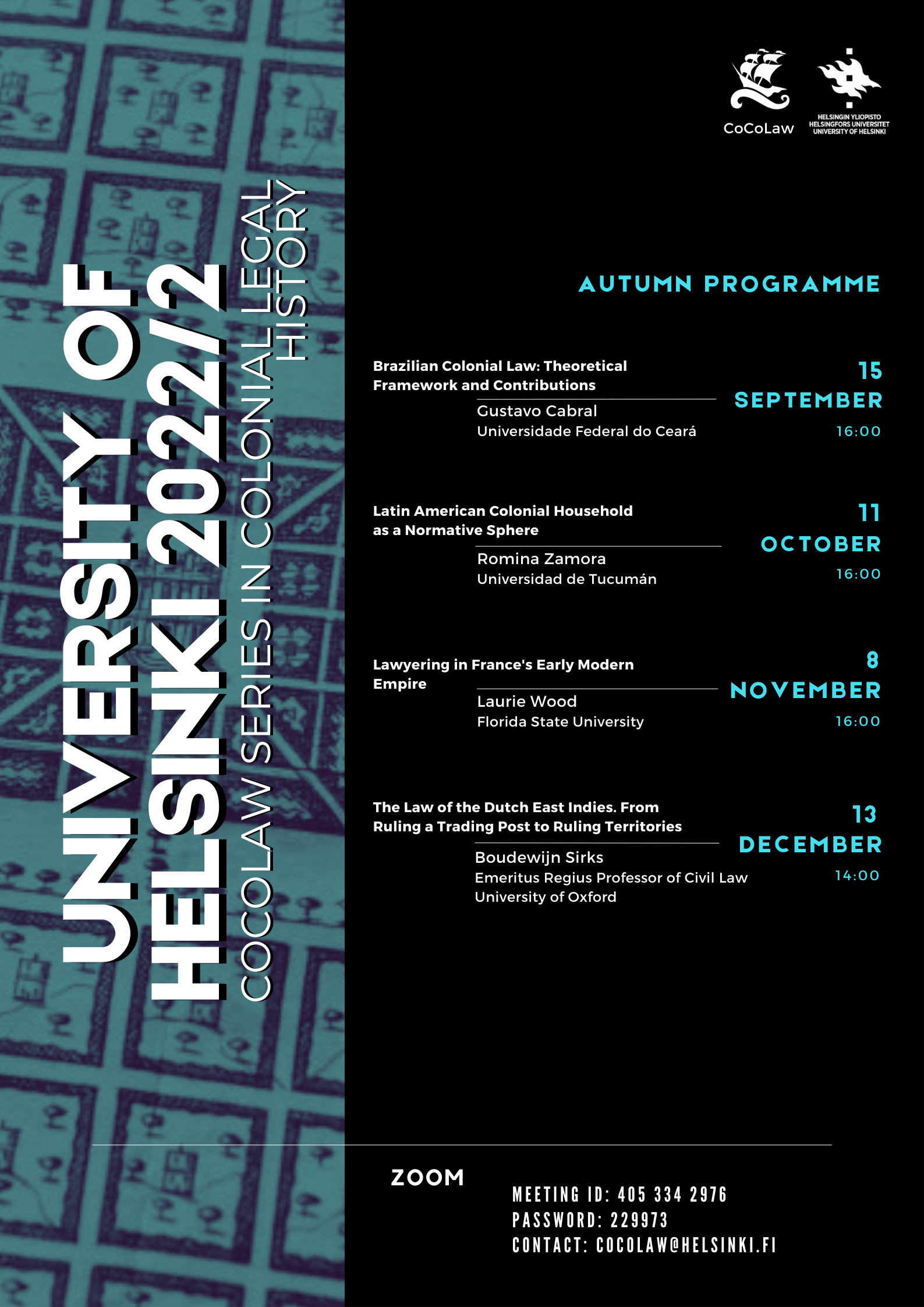
REMINDER LECTURE SERIES: CoCoLaw Series on Colonial Legal History 2022/2 - University of Helsinki (on Zoom)


We have been informed of the following lecture series:


Dear colleagues,

We are pleased to announce and invite you the Autumn Program for the CoCoLaw Series on Colonial Legal History 2022/2. There will be four lectures, one each month from September to December, to discuss the latest investigations about the law enacted on colonial spaces during the early modern period.

For this semester, we will have the following speakers:

15.09 – Brazilian Colonial Law: Theoretical Framework and Contributions - Gustavo Cabral, Universidade Federal do Ceará

11.10 – Latin American Colonial Household as a Normative Sphere - Romina Zamora, Universidad de Tucumán

8.11 – Lawyering in France’s Early Modern Empire - Laurie Wood, Florida State University

13.12 – The Law of the Dutch East Indies. From Ruling a Trading Post to Ruling Territories - Boudewijn Sirks, University of Oxford

All lectures will take place online via Zoom and everyone are welcome to join (Meeting ID 405 3342976, Password 229973).

Kind regards,


CoCoLaw Project - Comparing Early Modern Colonial Laws

University of Helsinki

CONFERENCE: Lo statuto come fonte di autonomia nella storia europea - Trento, 7 ottobre 2022