Search

Showing posts with label state formation. Show all posts

28 August 2026

CFP: Premodern State Formation: New Themes and Directions (Dresden: Dresden University of Technology, 20-21 MAY 2027) [DEADLINE 31 OCT 2026]

(Source: TU Dresden)


Organised by: Klaas Van Gelder (Brussels) & Hannes Ziegler (Dresden)

Practical:

Date: 20.-21.5.2027

Place: Dresden University of Technology

Abstract:

Late medieval and early modern societies are often considered to be relatively static: They were estate-based with limited demographic and economic expansion and relatively stable forms of rule, even though dynasties came and went, and multiple regions were part of different composite polities over the centuries. One of the most important challenges in explaining this period remains, however, that these were also, and at the same time, societies in transition. A highly promising model of not only describing but also explaining change with a view to these societies was and still remains the theory of state-building that seeks to explain the transition from medieval forms of statehood to the “modern” state. It

underlines the increasing involvement of the state in everyday matters, the growth of its bureaucratic apparatus, its territorial expansion, and its growing authority. Nevertheless, the causes, catalysts, chronology and consequences of these processes of state-building remain hotly debated until the present day. 

This conference seeks to resume a discussion on state-building that has been somewhat neglected in recent years. Nearly twenty years after the publication of the seminal 2009 volume on “Empowering Interactions” by Wim Blockmans, André Holenstein, and John Mathieu, a wide array of works on the various issues connected to state-building (i.e. taxation, litigation, fiscal-military expansion, etc.), has been published, but what is lacking is a forum to bring this research together and discuss the state of the art of the field in a more condensed manner. “Empowering Interactions” was, after all, the temporary endpoint of a long debate around the question whether state-building was best described as happening “from above” or “from below”. In the shadow of this larger debate, however, other topics have emerged and other problems are being discussed that only marginally touch on this debate. 

The role of gender (and more particularly: women) in processes of state-building is a case in point, but so is the question on how rural landscapes can be integrated in processes hitherto largely conceived by “centrist” perspectives dominated by courts, capitals and cities. Cases such as these are not adequately addressed in what is currently often considered to be the state of the field, and there are likely still more. Furthermore, new and promising analytical concepts have been developed that urged historians to pay greater attention to specific aspects of the aforementioned processes, such as ‘accountability’ and ‘popular control’.

This conference aims to take stock of the current state of the research connected to, resulting from and inspired by the Empowering Interactions approach. It is an open invitation to researchers working in the field of late-medieval and/or early modern state-building to showcase their research and explore the conceptual and methodological lacunae in current research. What is – above and beyond the “Empowering Interactions” – the state of the field? What are the most pressing blank spaces? What are the most promising new avenues of research? Topics of interest include (but are not limited to):

- Litigation
- Rural communities
- Petitions
- Representative institutions
- Dynasties
- Women
- Public administrations
- Cities and towns
- Republicanism
- Media and print

We are currently looking for papers (ca. 25min) addressing one or more of the above aspects. If you are interested in participating, please send an abstract by 31 October 2026 of no more than 500 words and a short CV (1-2 pages) to klaas.van.gelder@vub.be and hannes.ziegler@tu-dresden.de. The organizers are hoping to reimburse participants for travel and accommodation costs.

More information here.

06 July 2026

CALL FOR ABSTRACTS: Imperial Legal Spaces and Transitions: Law, Statehood and Administration in Ukraine between Empire, War and State Formation (~1900-1922) (Regensburg: University of Regensburg/Institute for East European Law, 18-19 MAR 2027); DEADLINE 31 JUL 2026


https://www.ostrecht.de/wp-content/uploads/2022/05/ior-LOGO-Standard-2048x1017-1-1920x953.png

Application Deadline: 31 July 2026
Location: University of Regensburg / Institute for East European Law, Germany

Description:

The early 20th century marked a period of profound political, social and legal upheaval for the region
that is now Ukraine. Within a few decades, the region witnessed the collapse of empires, the First World
War, successive occupations and military administrations, competing attempts to establish states, and
the transition to Soviet structures of governance. These developments were accompanied not only by
political and social transformations, but also by a fundamental reorganisation of legal institutions, norms and practices.
While the political history and history of violence of this transitional period have already been researched to some extent, there is still a lack of legal and administrative historical analysis that focuses not only on breaches of the law or the breakdown of legal systems, but also on how the law and institutions function in transitional situations.
The conference therefore focuses on the question: How do legal spaces function when political orders
collapse but institutions (must) continue to operate?
The conference aims to examine the region of present-day Ukraine between approximately 1900 and
1922 as an imperial, or, respectively, post-imperial legal space in which different normative orders, ad-
ministrative traditions and institutional practices did not disappear abruptly, but continued to operate,
overlap, adapt or hybridise.
The conference does not view law merely as a codified norm, but, above all, as a social practice, an
instrument of power and legitimacy, and a resource for stabilising everyday life and administration.

Potential Topics Include:

• Legal transfer and legal pluralism between Habsburg Galicia and the territories oft he Russian
Empire
• Military law and extraordinary justice in the First World War
• Competing legal systems in the years 1917–1921
• Administrative and judicial practice in local borderland spaces
 

The conference adopts a practice- and actor-oriented approach that views law not merely as a normative
system, but as a framework for action. Particular attention is paid to institutional continuities, informal
practices and the role of local decision-makers. At the same time, the conference adopts a transnational
and comparative perspective. The region of present-day Ukraine is not considered in isolation but within its interconnections with Central European, Russian, and later Soviet legal systems. This approach allows for the analysis of regional and local transitions not merely as national anomalies but as part of broader European transformation processes.
The conference seeks to foster an international exchange of perspectives on the region’s history. We
therefore warmly encourage not only scholars from Ukraine but also scholars from other countries, in-
cluding Germany, Poland, Hungary, Romania, Slovakia, and the Czech Republic, to participate.
We welcome contributions from legal history, history, political science, and related disciplines. Applica-
tions from researchers at all career stages are strongly encouraged.

The conference languages are Ukrainian, German and English.

An application for external funding is currently being prepared. Subject to approval, travel and accom-
modation costs may be covered.

As an outcome of the conference, an edited volume with an internationally renowned publisher is
planned. In addition, selected contributions will be published in an open working paper series.

Application Guidelines:

To participate in the conference, please submit the following application documents by July 31, 2026:

1. Detailed academic CV
2. Topic proposal for the presentation and short abstract (max. 2,000 characters including spaces)
3. List of publications, highlighting the five most relevant to the conference

Please send your application (as a single PDF file) and any inquiries to:
office@ostrecht.de

The results of the selection process will be announced by early September 2026.

We look forward to receiving your submissions and to welcoming you in Regensburg in March
2027!

Find more here. 

12 June 2026

BOOK: Thomas DUVE & Tamar HERZOG (eds.), Historia del Derecho de América Latina en Perspectiva Global [Historia del Derecho en América Latina, 1ª Edición] (México: Tirant lo Blanch, 2026), 680 p., ISBN 9788410959361

(image source: Tirant)

Abstract:

Este libro es el resultado de un esfuerzo colectivo de investigadores de América Latina, Europa y los Estados Unidos que se propusieron escribir una historia del Derecho centrada en las experiencias compartidas de las sociedades latinoamericanas a lo largo de un extenso período histórico, iniciado antes de la invasión europea del continente y que se prolonga hasta nuestros días. Su propósito era construir un relato capaz de identificar tendencias comunes, dar cuenta de las profundas transformaciones ocurridas a lo largo de este recorrido e integrar dichos procesos en una perspectiva más amplia. Esta historia «pan-latinoamericana», abordada desde una perspectiva global, muestra cómo América Latina se enfrentó a desafíos similares a los de otras regiones del mundo y cómo los debates surgidos en la región estuvieron con frecuencia vinculados a discusiones que tenían lugar en otros contextos. Los actores latinoamericanos contribuyeron activamente a estas discusiones y de ellas recibieron influencias, inspiración y nuevos marcos de reflexión.

Desde el punto de vista metodológico, los autores privilegian las preguntas sobre las respuestas, los procesos sobre los resultados y los contextos sobre las meras descripciones de soluciones jurídicas. La obra explora dónde, cómo y por qué se materializa el Derecho, quiénes son sus protagonistas y cuáles son los principales escenarios en los que actúa. Asimismo, pone de relieve los múltiples niveles en que opera el fenómeno jurídico y su profunda interrelación con los procesos sociales, políticos, culturales y económicos.

On the author:

Thomas Duve es director del Instituto Max Planck de Historia y Teoría del Derecho, y catedrático en la Facultad de Derecho de la Universidad Goethe de Fráncfort. Es especialista en historia del derecho y sus relaciones con la religión en los imperios ibérico.

Tamar Herzog ocupa la cátedra Monroe Gutman en la Universidad de Harvard. Su principal área de interés es la historia jurídica y social de la península ibérica y sus territorios de ultramar.

Table of contents:

Introducción       
Thomas Duve
Tamar Herzog
1. ¿En qué consiste la Historia del Derecho de América Latina en perspectiva global?
1.1. ¿Cómo se escribió y se escribe la Historia del Derecho de América Latina?        
Carlos Petit
1.2 ¿Qué es la Historia del Derecho y cómo se relaciona con otras Historias?       
Tamar Herzog
1.3. ¿Cómo se produce el Derecho?        
Thomas Duve
1.4. ¿Qué es la Historia del Derecho global y cómo puede llevarse a cabo?        
Mariana Dias Paes
2. ¿Cómo aproximarse al Derecho indígena?
2. ¿Cómo aproximarse al Derecho indígena?        
Caroline Cunill
3. ¿Cómo abordar el Derecho colonial?
3.1. Un Derecho civil para una sociedad religiosa        
Tamar Herzog
3.2. Normatividad religiosa para imperios coloniales        
Thomas Duve
3.3. La esfera doméstica        
Romina Zamora
4. Independencia(s): ¿Qué es un Derecho revolucionario?
4. Independencia(s): ¿Qué es un Derecho revolucionario?        
Tamar Herzog
5. ¿El advenimiento de los Estados? El siglo XIX
5.1. Constituciones        
José María Portillo
5.2. Codificaciones        
Agustín Parise
5.3. Contestaciones y exclusiones        
Monica Dantas
Roberto Saba
6. ¿La omnipresencia del Estado? El siglo XX
6.1. Hacia el Estado Administrativo        
Eduardo Zimmermann
6.2. Dictaduras       
Cristiano Paixão
6.3. Justicia transicional y derechos humanos        
Ruti Teitel
Valeria Vegh Weis
7. Más allá del Estado: ¿Puede sobrevivir el Derecho estatal en el siglo XXI?
7. Más allá del Estado: ¿Puede sobrevivir el Derecho estatal en el siglo XXI?        
Daniel Bonilla Maldonado

Find more on: Tirant. 

20 September 2024

BOOK: Charles Edward SMITH, Colonial Massachusetts Laws and Liberties and the English Commonwealth State Formation, the Rule of Law, and the People’s Welfare (Leiden: Brill, 2024). ISBN: 978-90-04-70633-0, € 172.78

(Source: Brill)

ABOUT THE BOOK

On July 4, 1653, the Nominate or Barebones Parliament convened with a minority of committed radicals (Levellers and religious extremists) and a conservative majority of Cromwell’s allies. During acrimonious debates on law reform, the radicals demanded a condensed law book similar to the one adopted in Colonial Massachusetts.
These mostly overlooked events reveal a radical wing of Puritanism determined to found a self-governing state, fully cognizant of the real possibility that England would interdict such attempts by force of arms. This work investigates the motives for such a hazardous undertaking, and the possible influences these events had on the colony’s posterity.

ABOUT THE AUTHOR

Charles Edward Smith, Ph.D. (1998), University of Chicago, has recently retired from the US Dept. of Defense, where he served as the Director of Legislative Operations in the Office of the Assistant Secretary for Legislative Affairs.

TABLE OF CONTENTS

Preface

Abbreviations

Introduction

Part 1
The English Commonwealth and the Protestant Reformation
1 Massachusetts Capital Laws of 1642
2 Education and Radical Religiosity

Part 2
Creating a Legal Authority in the “New World”
3 No Taxation without Representation
4 The Negative Voice
5 The Standing Council

Part 3
Publishing Massachusetts Laws and Liberties
6 The Body of Liberties of 1641
7 Divine Magistracy vs. a Rule of Law
8 The Laws and Liberties of 1648

Part 4
Transatlantic Legal Reform and Popular Sovereignty
9 Penal Laws, Debt, and Early Modern Markets
10 Ship Money, Rex v. Hampden, and Matters of State
11 Popular Sovereignty: Salus Populi Suprema Lex

Part 5
Imperial Ambitions
12 An Arbitrary, Absolute, and Unlimited Power
13 Sovereignty of the Law

Conclusion

Works Cited

Index


More information with the publisher.


21 August 2023

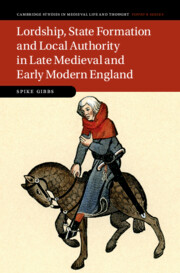
BOOK: Spike Gibbs, Lordship, State Formation and Local Authority in Late Medieval and Early Modern England (Cambridge: Cambridge University Press, 2023). ISBN: 9781009311830


ABOUT THE BOOK

Providing a new narrative of how local authority and social structures adapted in response to the decline of lordship and the process of state formation, Spike Gibbs uses manorial officeholding – where officials were chosen from among tenants to help run the lord's manorial estate – as a prism through which to examine political and social change in the late medieval and early modern English village. Drawing on micro-studies of previously untapped archival records, the book spans the medieval/early modern divide to examine changes between 1300 and 1650. In doing so, Gibbs demonstrates the vitality of manorial structures across the medieval and early modern era, the active and willing participation of tenants in these frameworks, and the way this created inequalities within communities


ABOUT THE AUTHOR

Spike Gibbs is Junior Professor for the Economic History of the Middle Ages at the University of Mannheim. His writing on manorial officials, felony forfeiture and managing stray animals has been published in journals such as the Journal of British Studies and the English Historical Review. This is his first book.


TABLE OF CONTENTS

Introduction

1. The changing role of manorial officers and manor courts

2. Manorial officeholding and selection processes: participation or restriction?

3. Manorial officeholding and unfreedom

4. Manorial officeholding and village governance: misconduct and landscape control

5. State formation I: the parish

6. State formation II: vills, quarter sessions and constables

Conclusion

Appendix 1: Categorising presentments

Appendix 2: Identifying individuals

Appendix 3: Population estimates.


More information can be found here.

05 July 2022

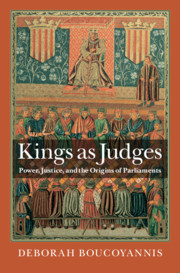
BOOK: Deborah BOUCOYANNIS, Kings as Judges: Power, Justice, and the Origins of Parliaments (Cambridge: Cambridge University Press, 2021). ISBN 9781107162792, £ 29.99


(Source: CUP)

Cambridge University Press has recently published  Kings as Judges: Power, Justice, and the Origins of Parliaments

ABOUT THE BOOK

How did representative institutions become the central organs of governance in Western Europe? What enabled this distinctive form of political organization and collective action that has proved so durable and influential? The answer has typically been sought either in the realm of ideas, in the Western tradition of individual rights, or in material change, especially the complex interaction of war, taxes, and economic growth. Common to these strands is the belief that representation resulted from weak ruling powers needing to concede rights to powerful social groups. Boucoyannis argues instead that representative institutions were a product of state strength, specifically the capacity to deliver justice across social groups. Enduring and inclusive representative parliaments formed when rulers could exercise power over the most powerful actors in the land and compel them to serve and, especially, to tax them. The language of rights deemed distinctive to the West emerged in response to more effectively imposed collective obligations, especially on those with most power.

ABOUT THE AUTHOR

Deborah Boucoyannis, George Washington University, Washington DC

Deborah Boucoyannis teaches Comparative Politics at George Washington University. This book is based on a dissertation that received the American Political Science Association's Ernst Haas Best Dissertation Award in European Politics and the Seymour Martin Lipset Best Dissertation Award from the Society for Comparative Research. She has published in Perspectives on Politics, Politics and Society, and other journals.

TABLE OF CONTENTS

Preface and acknowledgments
Part I. The origins of Representative Institutions: Power, Land, and Courts:
1. Introduction
2. A theory of institutional emergence: regularity, functional fusion, and the origins of parliament
3. Explaining institutional layering and functional fusion: the role of power
Part II. Origins of Representative Rractice: Power, Obligation, and Taxation:
4. Taxation and representative practice: bargaining vs compellence
5. Variations in representative practice: 'absolutist' France and Castile
6. No taxation of elites, no representative institutions
Part III. Trade, Towns, and the Political Economy of Representation:
7. Courts, institutions, and cities: Low Countries and Italy
8. Courts, institutions, and territory: Catalonia
9. The endogeneity of trade: the English wool trade and the Castilian mesta
Part IV. Land, Conditionality, and Property Rights:
10. Power, land, and second-best constitutionalism: Central and Northern Europe
11. Conditional land law, property rights, and 'Sultanism': premodern English and Ottoman land regimes
12. Land, tenure, and assemblies: Russia in the sixteenth and seventeenth centuries
Part V. Why Representation in the West: Petitions, Collective Responsibility, and Supra-Local Organization:
13. Petitions, collective responsibility, and representative practice: England, Russia, and the Ottoman Empire
Conclusion
Bibliography
Index.


More info here

14 April 2022

CONFERENCE: "Avant l’État. Droit international et pluralisme politico-juridique en Europe, XIIe -XVIIe siècle" - 18-19 May 2022, Lille & Kortrijk


(Source: KU Leuven)

Alors que l’État national souverain a longtemps été considéré comme l’acteur exclusif des relations internationales, ce projet a l’ambition de nouer un dialogue entre historiens et historiens du droit pour s’interroger sur le droit international conçu comme le cadre multi-normatif qui régit les relations entre une grande variété d’acteurs. Cette notion nous paraît mieux s’adapter aux traits spécifiques de la constellation politique médiévale et pré-moderne, qui était caractérisée par l’entrelacement de différentes juridictions, fondées sur des liens de dépendance personnelle et sur des relations de sujétion territoriale, par la coexistence d’une pluralité de centres de pouvoir au statut variable et par la répartition de l’autorité politique à différents niveaux. Les thèmes abordés dans les deux rencontres (la première à Rome le 20 septembre 2021 et la deuxième à Lille et Courtrai les 18-19 mai 2022) incluent la guerre, les représailles, la diplomatie, les relations féodales, le droit de la mer, le commerce ou encore les relations avec les juifs et les « infidèles », notre ambition générale étant de faire porter la réflexion sur trois questions transversales : celle des acteurs du droit international ; celle des sources du droit international, qui ne constituait pas à l’époque prémoderne une branche autonome de la science juridique ; celle enfin de la gestion des conflits, en particulier à travers la négociation, la médiation et l’arbitrage.


Duration of each presentation: 20 minutes

The programme is available here.

Those who wish to follow the event remotely are invited to write to dante.fedele@univ-lille.fr
Illustration: Paul Klee, “Polyphon gefasstes Weiss”, 1930


03 March 2022

BOOK: Gianluca RUSSO. Governare castigando: le origine dello stato territoriale fiorentino nelle trasformazioni del penale (1378-1478). (Minalo: Giuffrè, 2021). ISBN 9788828838722. € 42


(Source: https://shop.giuffre.it/024215159-governare-castigando-le-origini-dello-stato-territoriale-fiorentino-nelle-trasformazioni-del-penale-1378-1478-.html)

PARTE PRIMA LA COSTRUZIONE DEL DOMINIO SOTTO IL REGIME ALBIZZESCO(1378-1434) 
CAPITOLO PRIMO L’ORDINE PUBBLICO COME TUTELA DELL’ORDINE POLITICO. L’EMERGENZA REPRESSIVA
CAPITOLO SECONDO PROFILI EGEMONICI DEL PENALE NEGLI STATUTI FIORENTINI DEL PRIMO QUATTROCENTO
CAPITOLO TERZO IL CONTROLLO DEL CORPO SOCIALE. L’OFFENSIVA MORALIZZATRICE
CAPITOLO QUARTO STRATEGIE PENALI A « CONSERVATIONE E AUGUMENTO » DEL DOMINIO TERRITORIALE

PARTE SECONDA IL CONSOLIDAMENTO DEL DOMINIO SOTTO IL REGIME MEDICEO(1434-1478) 
CAPITOLO QUINTO GLI OTTO. DA CACCIATORI DI RIBELLI A GIUDICI CRIMINALI
CAPITOLO SESTO « IURIS ORDINE NON SERVATO ». OLTRE GLI STATUTI
CAPITOLO SETTIMO ESERCITARE RIGORE E CLEMENZA. LA VICENDA DI VOLTERRA RIBELLE
CAPITOLO OTTAVO « IL CASO DE’ PAZZI ». LO SPETTRO DEL CRIMEN MAIESTATIS
CONCLUSIONE QUATTROCENTO FIORENTINO E STATO MODERNO. SUL CRINALE TRA REPUBBLICA E PRINCIPATO

More information: https://shop.giuffre.it/024215159-governare-castigando-le-origini-dello-stato-territoriale-fiorentino-nelle-trasformazioni-del-penale-1378-1478-.html  

13 January 2020

JOB: Vacancy for a fulltime historian, project LORDSHIP - Lordship and State Formation in the County of Flanders, 15th - 18th Century (Ghent University/Belgian State Archives, DEADLINE 5 FEB 2020)


(source: Rijksarchief)

The Belgian State Archives recruit a fulltime historian for the BRAIN-be 2.0-project LORD (Lordship and State Formation in the County of Flanders, 15th - 18th C.), under the direction of professors Frederik Buylaert and Thijs Lambrecht (UGent, Department of History).

The application should be drafted in Dutch.

Link to the full vacancy here.