Search

Showing posts with label jurisprudence. Show all posts

03 June 2026

CALL FOR APPLICATIONS: “Great Little Ideas” – Corpus Christi Graduate Legal Research Course (Oxford: Corpus Christi College, September 2026)

(image source: Corpus Christi College)

Applications are now open for the Great Little Ideas: Corpus Christi Graduate Legal Research Course, which will take place at Corpus Christi College, Oxford, from 1 to 27 September 2026.


The research-led course is designed for graduate law students working on a PhD or equivalent legal research project and aims to support participants in developing a “Great Little Idea” — whether a chapter of a thesis, a broader doctoral theme, or another focused legal research question worth pursuing.


The course is a non-degree academic opportunity resulting in a certificate of completion and seeks to foster independent legal research through seminars, discussion, and engagement with Oxford’s intellectual environment.


Participants will benefit from:

  • seminars on research methods and the craft of legal scholarship delivered by College Law Fellows;

  • extensive access to Oxford library resources;

  • access to Corpus Christi College facilities; and

  • opportunities to engage with the broader academic atmosphere of Oxford.

The course further aims to strengthen participants’ abilities in:

  • analysing and refining abstract legal questions;
  • constructing and critically assessing complex arguments;
  • advancing significant research and writing projects; and
  • developing academic communication and presentation skills.

The participation fee is £375, while accommodation at a College property is available separately for £50.25 per night (inclusive of VAT).


Applications are open to graduate research students working on a PhD or equivalent legal topic. The organisers particularly encourage applications from candidates from underrepresented or disadvantaged backgrounds.


Applicants should submit:

  • a short CV (maximum 4 pages), and
  • a statement of up to 500 words describing their “Great Little Idea” and explaining why the Oxford course would be an appropriate setting for its development.

The deadline for applications is Monday, 8 June 2026. Applications and informal inquiries should be directed to Professor Matt Dyson (matthew.dyson@law.ox.ac.uk).


More information is available via the official announcement by Corpus Christi College, Oxford.

07 October 2024

BOOK: Luka BURAZIN, Kenneth Einar HIMMA & Giorgio PINO (eds.), Jurisprudence in the Mirror. The Common Law Meets the Civil Law World (Oxford: OUP, 2024), 544 p. ISBN 9780192868688, 110 GBP


(image source: OUP)

Abstract:
There is something quite puzzling about the global conversation on jurisprudence. On the one hand, jurisprudence is supposed to deal with abstract questions concerning the nature, structure, and distinctive features of the law. These questions are not tightly associated with, or dependent on, the particular legal practices in one jurisdiction or another. But, on the other hand, it seems that jurisprudents are tacitly affected by their background institutional context: there is an evident divide between theorizing about the law in the civil law world and in the common law world. Jurisprudence in the Mirror: The Common Law World Meets the Civil Law World systematically presents the major achievements of contemporary civil law jurisprudence to the common law world and bridges the gap in analytic jurisprudence as it is currently practiced in the two traditions. The volume seeks to bring different voices to the table and overcome the cultural and linguistic divides that have created barriers in philosophical exchanges. The book's structure is dialogical: it includes twelve essays written by prominent and influential jurisprudents from the civil law world, each followed by a response by a jurisprudent from the common law world. This approach highlights what the two worlds share, where they part ways, and why. The varied contributions reveal how their respective legal traditions shape fundamental legal concepts and jurisprudential debates and will be invaluable to readers from both the civil and common law worlds.

On the authors:

Luka Burazin, Full Professor, University of Zagreb, Kenneth Einar Himma, Continuing Guest Professor, University of Zagreb, and Giorgio Pino, Full Professor of Philosophy of Law, Roma Tre University Luka Burazin is a full professor in legal theory at the University of Zagreb. In 2022 he was elected president of the Croatian section of IVR. He has published papers in journals Rechtstheorie, ARSP, Diritto e questioni pubbliche, Ratio Juris, Jurisprudence, Doxa, and in books by OUP, Edward Elgar and Springer. He co-edited books Law and State (Peter Lang 2015), Law as an Artifact (OUP 2018) and The Artifactual Nature of Law (Edward Elgar 2022). He is a co-editor of journal Revus. He has translated several legal theory books and a number of legal theory papers into Croatian. Kenneth Einar Himma is a continuing guest professor at the Faculty of Law at the University of Zagreb. He has published extensively in the areas of philosophy of law, philosophy of information and information ethics, philosophy of religion, and applied ethics. He is the author of Morality and the Nature of Law (OUP 2019) and Coercion and the Nature of Law (OUP 2020). He has published well over 100 essays and book reviews in these various areas and is on the editorial boards of Legal Theory, Law and Philosophy, Ratio Juris, Revus, and other journals in the area. Giorgio Pino is Full Professor of Philosophy of Law at Roma Tre University. He is a member of the Executive Committee of the IVR. He has published 9 books (in Italian, four of which have been translated in Spanish), and several scholarly articles in various international journals such as Law and Philosophy, Ratio Juris, Doxa, Analisi e Diritto, Ragion Pratica, Diritto & Questioni Pubbliche. He has held visiting positions at, among others, the EUI, Paris 1-Sorbonne, and Columbia University.

More information here. 


12 August 2024

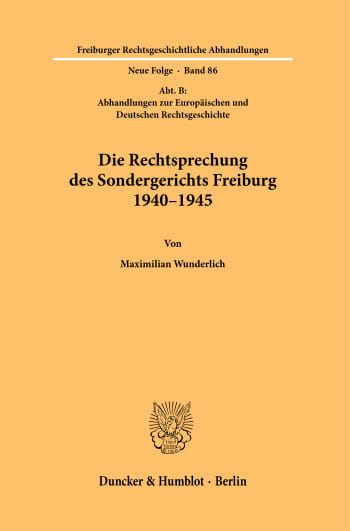
BOOK: Maximilian WUNDERLICH, Die Rechtsprechung des Sondergerichts Freiburg 1940 - 1945 [Freiburger Rechtsgeschichtliche Abhandlungen. Neue Folge; vol. 86] (Berlin: Duncker & Humblot, 2024), 445 p., ISBN 978-3-428-19170-3

 Cover: Die Rechtsprechung des Sondergerichts Freiburg 1940–1945

ABOUT THE BOOK:

Die Arbeit widmet sich in juristischer, historischer sowie statistischer Herangehensweise der Frage, was vor dem Sondergericht Freiburg als nationalsozialistischem Strafgericht geschah. Sie wertet dafür die Rechtsprechung des Freiburger Sondergerichts erstmals unter Analyse sämtlicher noch erhaltener Urteile des Gerichts sowie weiterer Justizakten aus den Beständen des Landesarchivs Baden-Württemberg und des Bundesarchivs systematisch nach den Rechtsgrundlagen des NS-Kriegsstrafrechts und im Vergleich zu anderen Sondergerichten aus. Diese Archivstudie ermöglichte darüber hinaus eine Begutachtung der Biographien der Freiburger Sonderrichter, die die Verstrickung der südbadischen Justiz in den Nationalsozialismus offenlegt, sowie eine soziographische Studie über die vom Sondergericht Freiburg verurteilten Personen. Resümierend stellt der Autor fest, dass die Rechtsprechung des Sondergerichts Freiburg ein justizförmig getarntes Werkzeug nationalsozialistischer Politik war.

Read more here.

05 October 2023

CFP: WG Hart Workshop 2024, 'Historicising Jurisprudence: Person, Community, Form' - Institute for Advanced Legal Studies, London - 26-27 June 2024 [DEADLINE 4 December 2023]

(Source: IALS)

WG Hart Workshop 2024

Historicising Jurisprudence: Person, Community, Form 

Institute for Advanced Legal Studies, London, 26-27 June 2024


We invite abstracts (of 300-500 words) for the 2024 Hart Conference on Historicising Jurisprudence: Person, Community, Form. Abstracts should be emailed to m.delmar@qmul.ac.uk by Monday 4 December 2023. Further details on the theme are included below. Please note that bursaries are available for PhD and Early Career Scholars as well as scholars from the Global South. There will also be a prize for the best paper from a PhD / Early Career Scholar.

Academic Directors.  Maksymilian Del Mar (Queen Mary University of London); and Michael Lobban (All Souls College, Oxford)

Conference Keynotes.  Professor David Armitage, Harvard University; Professor Paul Halliday, University of Virginia; Professor Lorna Hutson, University of Oxford; Professor Lena Salaymeh, Ecole pratique des hautes etudes, Paris, and University of Oxford    

PhD and Early Career Paper Prize.  A prize will be offered to the best paper submitted by a PhD or Early Career Scholar. To be eligible for the prize, please first submit your abstract in the usual way. When you submit the abstract, please indicate clearly that you are a PhD or Early Career Scholar (within 5 years of your PhD). Once your abstract has been accepted, a further date will be set for the submission of a paper (approx. 6,000-8,000 words, all inclusive). Please note that the requirement to submit a written draft of the paper is only a requirement for those entering the prize (not for presenting at the conference). The prize will be judged by the Academic Directors.

Travel and Accommodation Bursaries.  A limited number of bursaries, contributing to travel and accommodation costs for the conference, is available for two categories of scholars: 1) those who are PhD students and Early Career Scholars (within 5 years of their PhD); and 2) those who live and work in the Global South. To be eligible for these, please indicate clearly you are applying for a bursary when you submit your abstract, and please confirm (e.g., by a statement on letterhead from your Head of School) that you either do not have access to other sources of funding or any funding you have is likely to be insufficient.

General Summary of the Theme.  Jurisprudence, or the philosophy of law, often appears as an abstract and impersonal domain of intellectual practice, and one divorced from the politics and culture of its time. Jurisprudential questions are often treated as timeless, with each jurisprudential text approached as articulating its own autonomous vision of a universal theory of law. The substance of jurisprudential ideas is also typically seen to be independent of the means via which these ideas are expressed, and thus separate from the history of aesthetics and the humanities, including literature and the arts. While recognizing the universal and impersonal aspirations of jurisprudence, this conference seeks to explore its historicization in particular times and places. The conference thus invites participants to take an alternative view of jurisprudence: as a human, all too human, practice, which is deeply personal while also being deeply social, and one that is shot through with historically-situated politics and culture. By digging deeply into its situated ethics, politics, and aesthetics, this conference will explore different ways of historicising jurisprudence. The conference will foreground and pursue the following kinds of questions:

  • How is the production of jurisprudential thought related to the personal, felt, experience of individuals who produce it, as well as to the role those individuals play in the power struggles of their time and place?
  • In what ways is jurisprudential thought a communal enterprise, and thus the result of many hands working together in irreducibly social contexts?
  • What are the forms and genres of jurisprudence, and how are those forms and genres related to the very substance of jurisprudential views?


A detailed CFP is available here: https://ials.sas.ac.uk/news/wg-hart-workshop-2024-announced-historicising-jurisprudence-person-community-form

02 April 2021

JOB OPENING: Assistant Professor in Jurisprudence - Tilburg University | Tilburg Law School, apply for this position before April 26, 2021.


Tilburg University | Tilburg Law School is looking for a: ASSISTANT PROFESSOR IN JURISPRUDENCE - Requisition ID 17301 


Tilburg Law School is looking for an Assistant Professor in Jurisprudence

Department: Public Law & Governance (PLG)

Location: Tilburg

Scientific discipline: jurisprudence 

Full time equivalent: 1.0 fte 

Duration of employment agreement: 5 years 

Monthly full time salary:  €3,746 - €5,127 gross 

This is a job opportunity for an Assistant Professor in Jurisprudence, in the department of Public Law and Governance (PLG). PLG is a large, diverse and interdisciplinary department, home to nearly 100 academic staff and a range of legal and social science disciplines. You will develop and grow in teaching as well as research, both individually and as part of a team of ambitious scholars.

Job description

As assistant professor, you develop and teach courses in the Dutch Law bachelor (Dutch, courses Inleiding tot de Rechtswetenschap and Rechtswetenschap) and in the Liberal Arts bachelor (English, courses Fundamentals of Public Law and Law and Society). You will supervise master theses. You also participate in research carried out by the team of the legal philosophy, jurisprudence and legal history scholars, part of the Department of Public Law and Governance. In the course of your appointment, you will develop a research profile, in line with the Signature Plan of Global Law and Governance. The research conducted within Tilburg Law School is aimed at both scientific and societal relevance. It is organized into several cross-departmental research programs, including Global Law and Governance, New Modes of Lawmaking and Governance in a Multilayered Order, Law and Security, and Law and Technology. Key research themes of jurisprudence include democratic governance and the rule of law. Your teaching and research is managed according to PLG’s Work Allocation Model (WAM), where the general ratio for full-time academic staff is 60% Teaching and Service and 40% Research. 

Job requirements 

Tilburg University believes that academic excellence is achieved through the combination of outstanding research and education, in which social impact is made by sharing knowledge. In doing so, we recognize that excellence is not only achieved through individual performance, but mostly through team effort in which each team member acts as a leader connecting people. 

You have a PhD in Law. Should you not yet have your PhD, you must defend successfully your PhD before the requested start date. You have a profile that combines public law with meta-juridical research (legal theory, legal philosophy, sociology of law or legal history). Your growth potential in the field of research is evident from peer reviewed international publications.You are willing to apply for external research funding. You have scientific integrity and will contribute to an open and diversified culture of excellence. You have demonstrable teaching experience and good didactic skills. In addition, you are a collaborator with good communication skills. You are fluent in English and in Dutch. You are expected to have a Basic Teaching Qualification (in Dutch: BKO), or are prepared to acquire this within the first year of your appointment. You are committed to be an active member of our team and the department and to integrate in the environment provided by the department and the school.

Employment conditions

Tilburg University offers excellent terms of employment. We believe flexibility, development, and good employee benefits are very important. We make clear agreements on career paths and offer all kinds of facilities and schemes to maintain an optimum balance between work and private life. Tilburg University fosters diversity and inclusion; that is why we pursue an active policy for inclusive teams where diverse talents can flourish.

The starting gross salary varies between €3,746 - €5,127 per month (full time) based on scale 11 of the Collective Labor Agreement Dutch Universities. Tilburg University actively promotes equal and transparent salary between men and women by strictly applying predetermined parameters based on the candidate’s experience. Employees recruited from abroad may be eligible for the 30% tax facility- this means that 30% of your salary will be paid as a tax-free reimbursement.

Tilburg University offers you an employment agreement for a period of (in principle) 5 years. 

You are entitled to a holiday allowance amounting to 8% and a year-end bonus of 8.3% of your gross yearly income. If you work 40 hours per week, you receive 41 days of paid recreational leave per year. Please visit Working at Tilburg University for more information on our employment conditions. 

Information and application

More information on the vacated position can be obtained from dr. Dave De ruysscher at d.deruysscher@tilburguniversity.edu

Please apply for this position online before April 26, 2021. Address your cover letter to to the Dean of Tilburg Law School, Prof. dr. Geert Vervaeke, and add a resume, your publication list and your best publication (paper), recent teaching evaluations, your research proposal and a minimum of two references, (including name, telephone number and email address). We only approach referees for those candidates placed on the short-list.

Selection interviews will take place in the period from May 10, 2021 until May 28, 2021 with the possibility of a second interview round in the week of May 31, 2021 until June 4, 2021. 

The selection committee consists of:

Prof. dr. Mijke Houwerzijl, Chair of the Appointment and Promotions Committee (APC) 

Prof. dr. Eleni Kosta, Member of the APC

Ms. dr. Floor Fleurke, Member of the APC 

Prof. dr. Joseph Mc Cahery, Member of the APC

Prof. dr. Nikolas M. Rajkovic, PLG Head of Department 

Hans Alewijnse, Secretary of the APC 

 Minimum 4 of the 6 mentioned members above will be present during the interviews. Ideally, the preferred candidate will start no later than August 16, 2021.

Organization

Under the motto of ‘Understanding society’, Tilburg University’s more than 1,500 employees develop knowledge, transfer it to others, and bring people from various disciplines and organizations together. In this way, we want to contribute to solving complex social issues. Our focus areas are economics, business and entrepreneurship, social and behavioral sciences, law and public administration, the humanities and digital sciences, and theology. Tilburg University is internationally known for its high standards in education and scientific research, as well as its good support facilities. The Tilburg University campus offers both quietness and connectivity as it is located in a wooded park, ten minutes away from the city center, main highways, and railways. A mid-sized city of 200,000 inhabitants in the South of the Netherlands, and in proximity to cities like Amsterdam, Brussels, Paris, and London, Tilburg is situated at the very heart of Western Europe.

Tilburg Law School offers highly ranked national and international education and research in law and public administration. Currently, more than 4,000 students are enrolled at Tilburg Law School. Students in Tilburg can choose from five Bachelor's programs, one of which is taught in English (Bachelor Global Law) and ten Master's programs, eight of which are taught in English. The international orientation of Tilburg Law School is reflected in these Bachelor's and Master's programs. The research conducted within Tilburg Law School is aimed at social relevance and provides students with the tools and skills to study and deal with current issues at an academic level. The research within Tilburg Law School is organized into five cross-departmental research programs: 1) Global Law and Governance; 2) New Modes of Lawmaking and Governance in a Multilayered Order; 3) Law and Security; 4) Sustainable Business Law and Taxation; and 5) Law and Technology. 

The Department of Public Law & Governance is a unique collaboration of researchers in the fields of: International Law, European law, Constitutional Law, Administrative Law, Environmental Law, Public Administration, Legal Philosophy, Political Science, Legal History and Jurisprudence. Collaboration within the department is very much inspired by joint research interests.

Recruitment code

Tilburg University applies the recruitment code of the Dutch Association for Personnel Management & Organization Development (NVP).


 More information available here.