Search

Showing posts with label Law and philosophy. Show all posts

14 June 2024

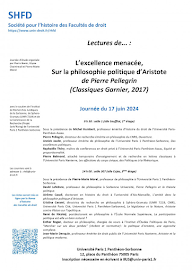
CONFERENCE: Lectures de... n° 17 : L'excellence menacée, Sur la philosophie politique d'Aristote, de Pierre Pellegrin (Garnier, 2017) (Paris: Université Paris 1 Panthéon-Sorbonne, 17 JUN 2024)


(Source: UnivdroitUnivdroit)


Programme


9 h 30 : salle 1 (aile Soufflot, 1er étage)

Sous la présidence de Michel Humbert, professeur émérite d'histoire du droit de l'Université Paris-Panthéon-Assas.

Pierre Pellegrin, directeur de recherche émérite en philosophie du CNRS, Ouverture.

Annick Jaulin, professeur émérite de philosophie de l'Université Paris 1 Panthéon-Sorbonne, Des excellences politiques.

Raphaëlle Théry, maître de conférences en droit privé à l'Université Paris-Panthéon-Assas, Equité et proportionnalité.

Pierre Balmond, attaché temporaire d'enseignement et de recherche en lettres classiques à l'Université Paris Nanterre, Les affections du corps civique, des Politiques à la Rhétorique.


14 h 00 : salle 307 (aile Cujas, 3ème étage)

Sous la présidence de Pierre-Marie Morel, professeur de philosophie à l'Université Paris 1 Panthéon-Sorbonne.

David Lefebvre, professeur de philosophie à Sorbonne Université, Pierre Pellegrin et la théorie politique.

Jérôme Casali, doctorant en histoire du droit à l'université d'Aix-Marseille, L'amitié dans la philosophie politique d'Aristote.

Cristina Cerami, directrice de recherche en philosophie à Sphère-Gramata (UMR 7219, CNRS, Université Paris Cité, Université Paris 1 Panthéon-Sorbonne), Le législateur et la Nature, Aristote contre Platon sur l'apolitique.

René de Nicolaÿ, postdoctorant en philosophie à l'Ecole Normale Supérieure, La participation politique est-elle un bien naturel ?

Esther Rogan, docteur en philosophie, chargée de cours à l'Institut d'Etudes Politiques de Paris, “Marcher sur ses deux jambes” (réaliste et normative) : la politique d'Aristote, une approche complexe.

Jean-Marie Denquin, professeur émérite de droit public de l'Université Paris Nanterre, Aristote et la politique moderne.


Inscription nécessaire en écrivant à IRJS@univ-paris1.fr.

Comme théoricien de la politique, Aristote fournit aux législateurs les moyens de penser la réalité des cités pour leur permettre d'instaurer des régimes droits, notamment une méthode fine pour penser la diversité des formes constitutionnelles et une théorie des changements et révolutions dans les cités.

Journée d'étude organisée par Pierre Bonin, Ulysse Chaintreuil et Pierre-Marie Morel.


Université Paris 1 Panthéon-Sorbonne

12 place du Panthéon

75005 Paris

18 December 2023

BOOK: Soulef AYAD-BERGOUNIOUX, Gouverner sans contraindre. Une histoire structurale des régimes de domination (Paris: L'Harmattan, 2023), 220 p. ISBN 9782336423920, € 24

(image source: leslivresdephilosophie)

Abstract:
Comment conduire les gouvernés à obéir à un État, né de mouvements révolutionnaires inconstitutionnels, fondé sur les principes d’égalité des droits et de souveraineté populaire ? Comment se fait-il qu’au sein d’une démocratie qui suppose, a minima, la participation des citoyens à la décision politique, les agents sociaux se soumettent quasi-naturellement à des lois qui sont le fait de bienheureux qui dominent en vertu de la confiance librement aliénée que leur accordent les dominés ? C’est parce que depuis plus de deux siècles, l’obéissance de la majorité à la minorité gouvernante ne résulte nullement d’une contrainte manifeste, mais d’une docilité, d’une morale intériorisée, qu’elle ne cesse pas d’étonner. Se libérer de cette illusion ne va pas sans une critique historique du mode de domination symbolique issu de la Révolution française.

 Read more here.


22 November 2023

BOOK: Dario MANTOVANI (dir.), L'équité hors du droit (Paris: Collège de France, 2023), 248 p. ISBN 978-2722606326, € 28


(image source: livres de philosophie)


Abstract:
Comment définir l'équité ? Comment l'appliquer en période de pandémie, lorsque l'on façonne une politique climatique ou que l'on s'interroge sur le plurilinguisme ? Sans cesse évoquée mais toujours équivoque, depuis des siècles, l'équité suscite à la fois la question de sa définition et de sa mise en pratique. En partant des sens antiques de l'équité, cet ouvrage a pour vocation d'étudier la diffraction de cette notion originellement juridique, rhétorique et éthique dans d'autres disciplines à l'époque contemporaine. Il propose donc une comparaison de son acception dans l'Antiquité avec l'usage qu'en font les sciences actuelles, sous le prisme d'un regard et d'une pensée modernes. Ainsi, dans une perspective diachronique, le droit antique, la rhétorique, les sciences religieuses, l'histoire et l'archéologie rencontrent-ils la philosophie contemporaine, l'économie, l'éthique, ou encore le droit de l'environnement, la sociologie, la linguistique et le droit comparé.


Table of contents:

Sommaire

Dario Mantovani – Introduction. De l’aequitas à l’équité

Première partie. Généalogies : l’équité en Grèce et à Rome

Philippe Hoffmann – L’épieikeia aristotélicienne et la littérature grecque ancienne

John Scheid – L’aequitas est-elle une déesse ? Le culte d’Aequitas

Charles Guérin – L’aequitas dans la rhétorique cicéronienne : émergence, stabilisation et expansion d’une catégorie argumentative

Deuxième partie. Diffractions modernes

Claudine Tiercelin – L’équité : que peut donc bien avoir à en dire le philosophe ?

Bruno Karsenti – L’équité, œuvre de justice : aux sources de la politique de la sociologie

Innovation et inégalités – Philippe Aghion

Jean-François Delfraissy et Pierre-Henri Duée – L’équité à l’épreuve de la Covid-19

Troisième partie. L’équité hors et dans le droit

Jean-Luc Egger – L’équité linguistique

Laurent Fonbaustier – Équité intergénérationnelle et environnement

Jean-Louis Halpérin – L’équité à l’épreuve du comparatisme

Alain Supiot – L’équité hors du droit : remarques marginales

(source: Collège de France


05 October 2023

CFP: WG Hart Workshop 2024, 'Historicising Jurisprudence: Person, Community, Form' - Institute for Advanced Legal Studies, London - 26-27 June 2024 [DEADLINE 4 December 2023]

(Source: IALS)

WG Hart Workshop 2024

Historicising Jurisprudence: Person, Community, Form 

Institute for Advanced Legal Studies, London, 26-27 June 2024


We invite abstracts (of 300-500 words) for the 2024 Hart Conference on Historicising Jurisprudence: Person, Community, Form. Abstracts should be emailed to m.delmar@qmul.ac.uk by Monday 4 December 2023. Further details on the theme are included below. Please note that bursaries are available for PhD and Early Career Scholars as well as scholars from the Global South. There will also be a prize for the best paper from a PhD / Early Career Scholar.

Academic Directors.  Maksymilian Del Mar (Queen Mary University of London); and Michael Lobban (All Souls College, Oxford)

Conference Keynotes.  Professor David Armitage, Harvard University; Professor Paul Halliday, University of Virginia; Professor Lorna Hutson, University of Oxford; Professor Lena Salaymeh, Ecole pratique des hautes etudes, Paris, and University of Oxford    

PhD and Early Career Paper Prize.  A prize will be offered to the best paper submitted by a PhD or Early Career Scholar. To be eligible for the prize, please first submit your abstract in the usual way. When you submit the abstract, please indicate clearly that you are a PhD or Early Career Scholar (within 5 years of your PhD). Once your abstract has been accepted, a further date will be set for the submission of a paper (approx. 6,000-8,000 words, all inclusive). Please note that the requirement to submit a written draft of the paper is only a requirement for those entering the prize (not for presenting at the conference). The prize will be judged by the Academic Directors.

Travel and Accommodation Bursaries.  A limited number of bursaries, contributing to travel and accommodation costs for the conference, is available for two categories of scholars: 1) those who are PhD students and Early Career Scholars (within 5 years of their PhD); and 2) those who live and work in the Global South. To be eligible for these, please indicate clearly you are applying for a bursary when you submit your abstract, and please confirm (e.g., by a statement on letterhead from your Head of School) that you either do not have access to other sources of funding or any funding you have is likely to be insufficient.

General Summary of the Theme.  Jurisprudence, or the philosophy of law, often appears as an abstract and impersonal domain of intellectual practice, and one divorced from the politics and culture of its time. Jurisprudential questions are often treated as timeless, with each jurisprudential text approached as articulating its own autonomous vision of a universal theory of law. The substance of jurisprudential ideas is also typically seen to be independent of the means via which these ideas are expressed, and thus separate from the history of aesthetics and the humanities, including literature and the arts. While recognizing the universal and impersonal aspirations of jurisprudence, this conference seeks to explore its historicization in particular times and places. The conference thus invites participants to take an alternative view of jurisprudence: as a human, all too human, practice, which is deeply personal while also being deeply social, and one that is shot through with historically-situated politics and culture. By digging deeply into its situated ethics, politics, and aesthetics, this conference will explore different ways of historicising jurisprudence. The conference will foreground and pursue the following kinds of questions:

  • How is the production of jurisprudential thought related to the personal, felt, experience of individuals who produce it, as well as to the role those individuals play in the power struggles of their time and place?
  • In what ways is jurisprudential thought a communal enterprise, and thus the result of many hands working together in irreducibly social contexts?
  • What are the forms and genres of jurisprudence, and how are those forms and genres related to the very substance of jurisprudential views?


A detailed CFP is available here: https://ials.sas.ac.uk/news/wg-hart-workshop-2024-announced-historicising-jurisprudence-person-community-form

06 September 2021

BOOK: Jens MEIENHENRICH & Martin LOUGHLIN (eds.), The Cambridge Companion to the Rule of Law (Cambridge: CUP, 2021), ISBN 9781108600569


(image source: CUP)

Book abstract:

The Cambridge Companion to the Rule of Law introduces students, scholars, and practitioners to the theory and history of the rule of law, one of the most frequently invoked-and least understood-ideas of legal and political thought and policy practice. It offers a comprehensive re-assessment by leading scholars of one of the world's most cherished traditions. This high-profile collection provides the first global and interdisciplinary account of the histories, moralities, pathologies and trajectories of the rule of law. Unique in conception, and critical in its approach, it evaluates, breaks down, and subverts conventional wisdom about the rule of law for the twenty-first century.

On the editors:

 Jens Meierhenrich, London School of Economics Jens Meierhenrich is Associate Professor of International Relations at the London School of Economics and Political Science and previously taught at Harvard University. His books include The Legacies of Law (2008), The Remnants of the Rechtsstaat (2018), The Violence of Law (2021), and, as co-editor, The Oxford Handbook of Carl Schmitt, 2016). Martin Loughlin, London School of Economics Martin Loughlin is Professor of Public Law at the London School of Economics and Political Science and previously taught at the University of Glasgow and at the University of Manchester. His books include Sword and Scales (2000), The Idea of Public Law (2003), Foundations of Public Law (2010), and, as co-editor, The Paradox of Constitutionalism (2007).

Table of contents:

Part I. Introduction: Thinking About the Rule of Law Jens Meierhenrich and Martin Loughlin
Part II. Histories:
1. Classical Athens' radical democratic 'rule of law' Adriaan Lanni
2. Rechtsstaat versus the rule of law Jens Meierhenrich
3. État de droit: the gallicization of the rechtsstaat Luc Heuschling
4. Islamic conceptions of the rule of law Lawrence Rosen
5. Empires and the rule of law Lauren Benton and Lisa Ford
Part III. Moralities:
6. The rule of law as an essentially contested concept Jeremy Waldron
7. The rule of law in Montesquieu Sharon R. Krause
8. The spirit of legality: A. V. Dicey and the rule of law Mark D. Walters
9. Michael Oakeshott's republican theory of the rule of law Martin Loughlin
10. The morality of the rule of law: Lon Fuller Kristen Rundle
11. E. P. Thompson and the rule of law: qualifying the 'unqualified good' Douglas Hay
12. Functions of the rule of law Brian Z. Tamanaha
13. Modeling the rule of law Barry R. Weingast, Gillian K. Hadfield and Jens Meierhenrich
Part IV. Pathologies:
14. Thomas Hobbes and the rule-by-law tradition David Dyzenhaus
15. Conservative critiques of the rule of law Peter C. Caldwell
16. Judith Shklar's critique of legalism Seyla Benhabib and Paul Linden-Retek
17. The Frankfurt school and the rule of law William E. Scheuerman
18. Critical legal studies and the rule of law Mark Tushnet
19. Feminist critiques of the rule of law Vanessa E. Munro
20. Critical race theory and the rule of law Khiara M. Bridges
Part V. Trajectories:
21. Economic development and the rule of law Shane Chalmers and Sundhya Pahuja
22. Democracy and the rule of law Martin Krygier
23. Constitutionalism and the rule of law Roberto Gargarella
24. Punishment in the rule of law Lindsay Farmer
25. Populism and the rule of law Nicola Lacey
26. An 'international rule-of-law movement'? Stephen Humphreys
27. Measuring the rule of law Tom Ginsburg and Mila Versteeg
28. Post-conflict rule of law Jane E. Stromseth
29. A global rule of law Anne Orford
Part VI. Conclusion:

30. What the rule of law is… and is not Jens Meierhenrich.

 (source: CUP)


29 June 2021

BOOK : Elodie DJORDJEVIC (dir), Isabelle AUBERT (dir), Gilles MARMASSE (dir), La pensée et les normes, (Editions de la Sorbonne, 2021), ISBN : 979-1-0351-0638-6, pp. 362, 24€


A propos de l'ouvrage : 


Résumé de l'éditeur : L'ouvrage La pensée et les normes rend hommage à l'œuvre de Jean-François Kervégan, professeur de philosophie à l’Université Paris 1 Panthéon-Sorbonne. Philosophe des normativités, Jean-François Kervégan investit les champs de la philosophie allemande et de la philosophie pratique. En histoire de la philosophie allemande, on lui doit une actualisation de la pensée de Hegel, des études sur Kant, Marx, Jürgen Habermas et Axel Honneth. En philosophie pratique, outre des ouvrages consacrés à C. Schmitt, ses travaux s’intéressent notamment aux droits subjectifs, à l’institutionnalisme et à la nature des normes juridiques.

La pensée et les normes discute les pistes de réflexion engagées par Jean-François Kervégan. En écho à ses travaux, les contributions du présent volume examinent les rapports entre les normes et la raison, à partir de l’histoire de la philosophie ou au prisme d’approches plus contemporaines mêlant philosophie, sciences sociales et droit.


Les contributeurs sont : Franck FISCHBACH, Geminello PRETEROSSI, Robert B. PIPPIN, Emmanuel PICAVET, Emmanuel RENAULT, Catherine COLLIOT-THELENE, Olivier BEAUD, Denis BARANGER, Mathieu CARPENTIER, Pierre-Yves QUIVIGER, Norbert WASZEK, Bruno HAAS, Myriam BIENENSTOCK, Olivier TINLAND, Marcos NOBRE, Jean-François KERVEGAN.


A propos des directeurs de l'ouvrage :  


Elodie DJORDJEVIC est maître de conférences à l’université Paris II Panthéon-Assas et Directrice adjointe de Droit & Philosophie. Son sujet de thèse était : "Rationalité et normativité. Hegel et la question du jugement politique."


Isabelle AUBERT est maître de conférences en philosophie (spécialité philosophie du droit) à l'​Université Paris 1-Panthéon Sorbonne. Son sujet de thèse était : " Sujet et intersubjectivité chez Jürgen Habermas"


Gilles MARMASSE  est professeur de philosophie à l’université de Poitiers.  Son sujet de thèse était : "De la nature à l'esprit. Corps animal et corps humain chez Hegel"


Sommaire : 


Isabelle AUBERT, Élodie DJORDJEVIC, Gilles MARMASSE : Avant-Propos


PREMIÈRE PARTIE. KANT, HEGEL ET LA NORMATIVITÉ

Franck FISCHBACH : Qu'est-ce que la vie éthique ? Un essai d’analyse

Élodie DJORDJEVIC : Action et causalité. Remarques sur la conception hégélienne de l’imputation


Gilles MARMASSE : Le débat sur la morale kantienne dans Grâce et dignité de Schiller


Geminello PRETEROSSIEntre Hegel et Schmitt


Robert B. PIPPINLes consolations de l’absolu ? À propos de L’effectif et le rationnel. Hegel et l’esprit objectif de J.-F. Kervégan


DEUXIÈME PARTIE. PENSER LES NORMES AUJOURD’HUI

Emmanuel PICAVETLes normes, les institutions et l’effectivité paradoxale des principes rationnels


Isabelle AUBERT : La réalité morale est-elle construite ?


Emmanuel RENAULTCritique sociale et connaissance


Catherine COLLIOT-THELENE : Le contractualisme contemporain : quelles parties, à quel contrat ?


TROISIÈME PARTIE. LE TRAVAIL DES JURISTES

Olivier BEAUD : Max Weber, les droits subjectifs et l’État. Quand un sociologue prend au sérieux le langage des juristes


Denis BARANGER : L’évanescence de la norme. Essai sur l’instabilité ontologique du phénomène normatif


Mathieu CARPENTIER : Un slogan pour une étiquette ? Sur la séparation du droit et de la morale


Pierre-Yves QUIVIGER : Une théorie institutionnelle du sujet de droit


QUATRIÈME PARTIE. HÉRITAGES HÉGÉLIENS

Norbert WASZEK : De l’Encyclopédie de Hegel à la création par les hégéliens de nouvelles disciplines scientifiques


Bruno HAAS : Hegel théoricien du musée


Myriam BIENENSTOCK  : L’« esprit absolu » hégélien entre les XIXe et XXIe siècles


Olivier TINLAND  : Nietzsche, Hegel et les contradictions de « l’âme allemande »


Marcos NOBRE : La Phénoménologie de l’esprit en tant que modèle philosophique


CINQUIÈME PARTIE. RETOUR SUR UN PARCOURS


Jean-François KERVEGAN  : Normativité, juridicité, rationalité : un bilan