Search

Showing posts with label medieval history. Show all posts

07 July 2026

BOOKS: Violet SOEN, Wouter DRUWÉ, Wim FRANCOIS & Ralph DECONINCK (eds.), Innovationes Lovanienses: Arts, Law and Theology at the University of Louvain (1425–1797) and Students, Scholars and Their Books at the University of Louvain (1425–1797) [Lectio, ed. Pieter D'HOINE/Studium Lovaniense, ed. Violet SOEN] (Turnhout: Brepols, 2026) [OPEN ACCESS]


(image source: Brepols)

Two open access volumes on the University of Leuven/Louvain in the late Middle Ages and Early Modern Age have been published recently.

Innovationes Lovanienses: Arts, Law and Theology at the University of Louvain (1425–1797) (eds. Violet Soen, Wouter Druwé, Wim François & Ralph Deconinck)
DOI 10.1484/M.LECTIO-EB.5.145524
Abstract:

Throughout the first centuries of its existence, the University of Louvain functioned as a crossroads for the transmission of texts, ideas, and even images from Antiquity, across the Middle Ages, and through the Renaissance. From its foundational bulls between 1425 and 1432, the university was established as a prototypical studium generale, drawing inspiration from earlier institutions in Paris and Cologne and adopting elements from contemporary universities like Rostock and Geneva. Situated at the heart of Europe, the University of Louvain quickly became a pivotal center for the reception and dissemination of both ancient and contemporary knowledge across the continent, and later, the Habsburg Empire. This volume examines how teachers and students examined old and innovative ideas across various constituent bodies of the university, including the Faculty of Arts or the College of the Three Tongues, or neighboring institutions, like the Jesuit College. Contributions span the Faculties of Law, adopting insights on the newly promulgated Tridentine decrees or novel moral economies, to the Faculty of Theology, a hotbed of the controversies surrounding grace, free will, and salvation in post-Tridentine Catholicism. Of the many scholars that were active in Louvain, special attention is devoted to the philologist Petrus Nannius, the theologians Michael Baius and Jacobus Janssonius, the lawyers Petrus Peckius and Johannes Wamesius, and the Jesuits Robertus Bellarminus and Leonardus Lessius, along with the lectures they gave at the Louvain house of their Order.

Chapters

  • Innovationes Lovanienses. What Is New about the ‘Old’ University of Louvain (1425–1797)? (Violet Soen)
  • The Old and the New. Scholastic Elements in the Works of Petrus Nannius (1496–1557), Professor of the Collegium Trilingue in the First Half of the Sixteenth Century (Aline Smeesters)
  • Diagrammatic Innovations in Louvain Logic Notebooks (Seventeenth-Eighteenth Centuries) (Lorenz Demey)
  • The Role of Legal Practice in Louvain’s Legal Education (c. 1550–1650) (Wouter Druwé)
  • What Makes a Legal Commentary? . Louvain Professors on Liber Extra and Liber Sextus (Sixteenth-Eighteenth Centuries) (Piotr Alexandrowicz)
  • Teaching Canon Law after Trent. Mapping Juridical Sources in the Lectures of Petrus Peckius (1529–1589) (Ana Luiza Ferreira Gomes Silva)
  • When the Sun Stopped Setting. Louvain Lawyers & Theologians on Issues of Monopolies and Competition (1500–1670) (Wout Vandermeulen)
  • Knowledge of Nature and Scripture at the Threshold of Modernity. Michael Baius’s (1513–1589) Louvain Lecture on Romans 1 (Jarrik Van Der Biest)
  • The Internal Act of Faith in the Commentaries on the Summa theologiae. Produced in Sixteenth- and Seventeenth-century Louvain (with a Comparison with Previous Iberian Commentators) (Lidia Lanza)
  • The Jesuit College and Knowledge Transmission: Robert Bellarmine’s Lectiones Louanienses (1570–1576) and the Spanish Scholastic Legal-Economic Thought (Shiri Roelofs)
  • Ex nudo Dei beneplacito. On Concord and Discord between Luis de Molina’s Concordia (1588) and Leonardus Lessius’s De gratia efficaci (1610) (C.J. (Niels) De Bruijn)
  • Vision, Love, and Joy. The Louvain Jesuit Leonard Lessius (1554–1623) on Beatitude (Patrícia Calvário)

Students, Scholars and Their Books at the University of Louvain (1425–1797) (eds. Violet Soen, Wouter Druwé, Wim François & Ralph Deconinck)
DOI 10.1484/M.LECTIO-EB.5.145522
Abstract:

Integrating prosopographical, cartographical, and book-historical data, this collective volume on the first University of Louvain (1425–1797) contributes to ongoing interdisciplinary inquiries into the intellectual productions of students, scholars, and printers in the Early Modern era. The ten contributions examine the state of the art at the University of Louvain, whose output was supported by the vibrant printing presses of the Low Countries and the continual mobility of its scholars across continental Europe. The essays first unravel the transregional circuits of Louvain’s students, scholars, and printers, built upon their geographical mobility throughout Europe. The second part explores how early modern students at Louvain created their study materials by compiling lecture notes, rearranging the contents, and binding them into codices, often adorned with drawings or printed engravings – a practice that remained prevalent until the eighteenth century. Further contributions trace the introduction of the handpress to the city of Louvain, which, beginning in 1473, brought new opportunities for producing textbooks for broader markets, as typography and physical features transformed handbook production. Louvain’s publication network was especially dense in the sixteenth century, and publication rates remained high through the eighteenth century. This volume offers new insights into the hybrid world of oral teaching, handwritten note-taking, and printed textbook production by students, scholars, and printers at one of Europe’s intellectual crossroads.

Chapters

  • From Magister Dixit to STUDIUM.AI. New Perspectives on Students, Scholars and Their Books at the University of Louvain (1425–1797) (Violet Soen)
  • Louvain Scholars on the Move. Networks and Mobility Patterns at the Early University of Louvain. An Analysis of Academic Mobility (1425–1797) (David de la Croix & Maria Vitale)
  • From Transregional Recruitment to Self-reproduction. Building a Teaching Staff at the University of Louvain in Its First Two Decades (1425–1443) (Christiaan Engberts)
  • Who’s Who in STUDIUM.AI. New Linked Data about Students, Scholars and Printers at the Early Modern University of Louvain (1425–1797) (Violet Soen Yann Ryan)
  • The Louvain Lecture Halls during Theological Controversy. The Benedictine Student Stephanus Puelincx and His Notes on the Lectures of Jacobus Janssonius (c. 1607) (Linde Van den Eede)
  • In the University Classroom. Seventeenth-century Notebooks of Arts Students at the Universities of Louvain and Leiden (1651–1700) (An Smets)
  • Drawing Practices as Learning and Recreational Processes in Louvain Student Notebooks (Seventeenth–Eighteenth Centuries) (Gwendoline de Mûelenaere)
  • Honesti et probi adolescentes. Pardon Letters and Student Violence at the Early Modern University of Louvain (Sixteenth–Seventeenth Centuries) (Gert Gielis, Luke Giraudet & Quintin Verreycken)
  • The Importance of Typography in Knowledge Transfer. The Materiality of Louvain Printed Philosophy Textbooks (1474–1562) (Dieter Cammaerts)
  • Shedding (More) Light on Sixteenth-century Mapping Practices. Pieter Pourbus’s Application of Gemma Frisius’s Triangulation Methods (Jan Trachet & Hendrik Hameeuw)
  • Integrating Library and Prosopographical Data in the Early Modern Publication Network of the University of Louvain (1501–1797) (Rossana Scebba & Margherita Fantoli)
Both books can be read in open access with Brepols


26 March 2026

BOOK: Lars REGULA & Jörg ULBERT (eds.), Consular Jurisdiction. On the History of the Judicial Functions of Consulates (12th–20th Century) [Legal History Library, eds. Dirk HEIRBAUT, Matthew C. MIROW, Michelle McKINLEY & C.H VAN REE, 83; Studies in the History of International Law, ed. Randall LESAFFER, 30] (Leiden/Boston: Martinus Nijhoff/Brill, 2026), ISBN 978-90-04-75519-2

(image source: Brill)

Abstract:
For today’s practitioners, the history of the judicial functions of consulates is far more colourful and obscure than modern consular law might suggest. Take, for instance, Consul Annibale de Rossetti in Egypt, who had to arbitrate a lawsuit between two German merchants and was completely overwhelmed. De Rossetti neither knew German nor was he familiar with the law he was expected to apply. Modern consuls often react with disbelief at the fact that their predecessors acted not only as judges, but also as regulatory authorities and bailiffs. This volume brings together contributions on the history of the legal roles and functions of consulates, spanning from America to China and from their origins in the Middle Ages to the modern consulate.

Résumé:

L’histoire des fonctions judiciaires des consulats est bien plus riche et obscure pour les praticiens d’aujourd’hui que ne le laisse penser le droit consulaire moderne. Par exemple, lorsque le consul Annibale de Rossetti, en Égypte, dut trancher un litige entre deux commerçants allemands, il fut dépassé par la situation. De Rossetti ne connaissait ni l’allemand, ni le droit qu’il était censé appliquer. Les consuls modernes réagissent souvent avec incrédulité en apprenant que leurs prédécesseurs exerçaient à la fois les fonctions de juges, d’autorités réglementaires et d’huissiers de justice. De volume réunit des contributions portant sur l’histoire des rôles et fonctions juridiques des consulats, de l’Amérique à la Chine, depuis leurs origins au Moyen Âge jusqu’au consulat moderne. 

Contributors:

Marcella Aglietti, Eleonora Angella, Arnaud Bartolomei, Thibault Bechini, Giorgio Ennas, Ana Belem Fernández Castro, Juliette Françoise, Laura Galoppini, Sacha Gauthier Olssy, Thomas Gidney, Berna Kamay-Ulusay, Jessica Marglin, Cédric Quertier, Lars Regula, Victor Simon, Jörg Ulbert, and Dominique Valérian.

On the editors:

Lars Regula, University of Hamburg, is a Ph.D. student at the Chair for Legal History. His research deals with German consular jurisdiction in the Ottoman Empire. Jörg Ulbert, Ph.D. (2001), Université de Bretagne-Sud, is maître de conférences at the same university. He has published monographs and many articles on diplomatic and consular history, including Consul et services consulaires au XIXe siècle (2010) with Lukian Prijac. 

Read more here: DOI: 10.1163/9789004755192.

14 January 2026

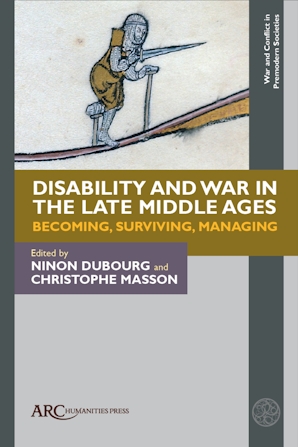
BOOK: Ninon DUBOURG & Christophe MASSON, Disability and War in the Late Middle Ages. Becoming, Surviving, Managing [War and Conflict in Premodern Societies] (York: ARC Humanities Press, 2025), 256 p. ISBN 9781802701647


(image source: ARC Humanities Press)

Abstract:
Issues relating to disability and war remain largely overlooked by military and disability historians. This exclusion is all the more striking since there was hardly a more likely place for receiving permanent injury than a battle, and we can barely imagine a worse place for disabled people than a battlefield. This volume aims to shed new light on a topic pertaining to multiple fields of research: social history, technical medical history, disability history, military history, and the Genesis of the Modern State. This book gathers specialists of premodern history to bring together new research from a variety of disciplines—history, archaeology, literature, and modern medicine—and working with diverse sources, such as account books, biographies, poems, romance texts, Icelandic sagas, petitions and pardon letters, post-battle records, prostheses, skeletons and funerary treatments, chronicles, and theoretical treatises.

Table of contents:

List of Illustrations

Preface

Introduction. "Disability and War: Becoming, Surviving, Managing" by Ninon Dubourg and Christophe Masson

Chapter 1. "The Recidivists: Healed Cranial Trauma from Conflicts in the Late Medieval Period" by Christopher J. Knüsel

Chapter 2. "Disability and Trauma in Battle in the Medieval Icelandic Sagas" by Yoav Tirosh

Chapter 3. "Hungry for Love: Disabling the Knightly Body and Mind through Starvation in Sir Thomas Malory’s Le Morte Darthur" by Kristina Hildebrand

Chapter 4. "A Vulnerable Military Masculinity: Soldiers and Disability in Late Medieval Pardon Letters (France, England, and the Low Countries)" by Quentin Verreycken

Chapter 5. "Traumatic Repercussions: Warfare and Disability in the French Countryside" by Aleksandra Pfau

Chapter 6. "Investigating the Lifecycle of the Medieval English Soldier: Disability, Mental Trauma, and Medicine in Connection with War in Late Medieval English Records" by Wendy J. Turner

Chapter 7. “'What pain I suffered at that time, anyone can well imagine...': Experiences of War, Injury, and Pain in Fifteenth- and Sixteenth-Century Germany and Switzerland" by Bianca Frohne

Chapter 8. "Mechanism/Organism: The Premodern Iron Hand as Conceptual Interface" by John Gagné

Chapter 9. "After Combat: War Wounds, Soldiers’ Benefits, and Dynastic Policies in the Burgundian–Habsburg Armies (1363–1506)" by Michael Depreter

Select Bibliography

Index

On the editors:

Ninon Dubourg is an Alexander von Humboldt Fellow based at the University of Cologne. She studies physical and mental disability, as well as old age, among lay and clerical individuals in late medieval Europe. Christophe Masson is a Permanent Researcher for the Fund for Scientific Research (FNRS) in Belgium. His work addresses the social, cultural, institutional, and technical dimensions of late medieval warfare. 

Read more here.

26 September 2025

BOOK: Albert RIGAUDIÈRE, Identité, tradition, innovation dans les villes du Massif Central (XIIIe-XVe siècle) [Bibliothèque d'histoire médiévale, eds. Elisabeth CROUZET-PAVAN & Bruno DUMÉZIL, 41] (Paris: Classiques Garnier, 2025), 1083 p. ISBN 9782406179054, € 68


(image source: Classiques Garnier)

Abstract:

Circonscrit aux villes d’Auvergne et à leurs voisines, cet ouvrage démontre qu’en dépit d’un héritage conservateur et de pratiques institutionnelles figées, les trois derniers siècles du Moyen Âge apportent de profondes mutations, tout autant dans le domaine du politique que de la finance.

Read more here:  DOI 10.48611/isbn.978-2-406-17907-8

(source: HiD)

22 April 2024

BOOK: Wolfram BRANDES, Helmut REIMITZ, Jack TANNOUS (eds.), Legal Pluralism and Social Change in Late Antiquity and the Middle Ages. A Conference in Honor of John Haldon (Frankfurt am Main: Klostermann, 2024). ISBN: 9783465045502


ABOUT THE BOOK

In seinem gesamten wissenschaftlichen Leben wirkte Professor John Haldon als intellektuelles Bindeglied zwischen verschiedenen akademischen Kulturen, Methoden und Disziplinen. Der profunde Kenner der byzantinischen Gesellschaft verbindet in seinem Werk die akribische Untersuchung von Texten und materiellen Zeugnissen mit einem ganzheitlichen Verständnis der Sozialgeschichte. Haldons Ideen haben maßgeblich dazu beigetragen, die Byzantinistik für neue methodologische Perspektiven zu öffnen und breitere Horizonte für den Vergleich mit anderen politischen Systemen und Strukturen in der europäischen sowie der islamischen Welt von der Spätantike bis zur frühen Neuzeit zu erschließen. Ausgehend von einer Konferenz, die das Center for Collaborative History an der Princeton University 2018 anlässlich seines 70. Geburtstags veranstaltete, zieht dieses Buch – es ist mehr als nur eine Festschrift – eine Bilanz von Haldons Impulsen. Dabei liegt der Fokus auf der Geschichte des Rechts und der Rechtskultur in der Transformation der römischen Welt.


More information can be found here.

15 March 2024

BOOK: Isabella LAZZARINI, L'Italie des États territoriaux. XIIIe-XVe siècle (trad. Michèle GRÉVIN) [EHESS-Translations] (Paris: Editions de l'EHESS, 2024), ISBN 978-2-7132-3375-3, € 25


(image source: EHESS)

Abstract:
Vingt ans après sa publication, voici la traduction d’un classique résultant de plusieurs décennies de recherches, L’Italia degli Stati territoriali. Secoli XIII-XV. Isabella Lazzarini livre dans ce texte l’essence des débats qui ont agité l’historiographie italienne sur l’évolution de l’Europe politique et la naissance de l’État moderne. De plus, elle y propose une grammaire du fonctionnement politique des sociétés italiennes de la fin du Moyen Âge et de la Renaissance. Cet ouvrage éclaire d’un jour nouveau le sujet complexe des « deux Italies ». À partir d’un vaste panorama historiographique, l’autrice y retrace le parcours qui mène des régimes politiques que tout oppose, tels que les communes, les royaumes ou les seigneuries, à la création d’États indépendants mais interconnectés. Réfutant la partition entre Italie du Nord, foyer de toutes les modernités (urbanisation, développement économique, etc.), et Italie du Sud, enlisée dans un supposé archaïsme (économique, social, politique, etc.), elle analyse le développement simultané de ces entités et la naissance d’un langage commun au sein du jeu global italien. Ce réseau de pouvoirs en équilibre instable, véritable laboratoire politique à l’échelle européenne dont il s’agit ici de faire la généalogie, dessine la voie italienne vers l’État moderne, barrée à la fin du XVe siècle par l’essor des royaumes de France et d’Espagne.

Read more here


07 December 2022

BOOK: Joshua C. TATE, Power and Justice in Medieval England: The Law of Patronage and the Royal Courts (New Haven, CT: Yale University Press, 2022), 272 pp., ISBN 9780300163834, $55


(image source: Yale University Press)

Book description: 

Appointing a parson to the local church following a vacancy—an “advowson”—was one of the most important rights in medieval England. The king, the monasteries, and local landowners all wanted to control advowsons because they meant political, social, and economic influence. The question of law turned on who had the superior legal claim to the vacancy—which was a type of property—at the time the position needed to be filled.

In tracing how these conflicts were resolved, Joshua C. Tate takes a sharply different view from that of historians who focus only on questions of land ownership, and he shows that the English needed new legal contours to address the questions of ownership and possession that arose from these disputes. Tate argues that the innovations made necessary by advowson law helped give birth to modern common law and common law courts.

About the author: 

Joshua C. Tate is a professor of law at the SMU Dedman School of Law. He is an academic fellow of the American College of Trust and Estate Counsel and serves the Selden Society as a member of the council and as the honorary treasurer for the United States.

More information can be found here

24 March 2022

BOOK: Francesco BOZZI, Le spire della vipera. Le aderenze viscontee fra Tre e Quattrocento (Milano, Franco Angeli, 2021), ISBN: 978-8835-1-3503-6

(Image source: Wikipedia


ABOUT THE BOOK

Nella seconda metà del Trecento fecero la loro comparsa, in maniera più o meno diffusa in larga parte della penisola, i trattati di aderenza. Legami elastici e flessibili, le adherentie coordinavano fra di loro due poteri asimmetrici, solitamente una "potenza grossa" (come Milano, Venezia, Firenze, e così via) e realtà minori, come signorie o comunità. Le adherentie avevano, di per sé, schiette connotazioni militari: per mezzo di esse il principalis riceveva sostegno militare e logistico, mentre l'adherens otteneva protezione e differenti forme di legittimazione. Nota ma non ancora indagata a fondo, l'aderenza è un osservatorio privilegiato per esaminare le pratiche politiche bassomedievali in tutta la loro complessità.

I Visconti, come e più di altre potenze, fra Tre e Quattrocento fecero costante ricorso a tale forma pattizia per gestire tanto i processi di costruzione statale che li videro impegnati, quanto le relazioni interstatali (pacifiche o conflittuali che fossero) con le altre potenze della penisola. Lo studio sull'aderenza nella sua "forma viscontea" permette così, da una parte, di apprezzare le caratteristiche e le peculiarità impresse al legame dai signori (e poi dai duchi) di Milano, mentre dall'altra consente di analizzare, sotto nuovi punti di vista, temi ampi e nodali come quelli inerenti ai processi di costruzione statale, alla nascita e allo sviluppo delle relazioni interstatali, allo scoppio dei conflitti, ai processi di pace, e molto altro ancora. Tematiche che, ancora oggi, continuano a dimostrare tutta la loro rilevanza.


ABOUT THE AUTHOR

Francesco Bozzi è professore a contratto presso l'Università degli Studi di Milano. Si occupa di temi inerenti alla storia politica e istituzionale bassomedievale, in particolare in merito agli spazi lombardi.


TABLE OF CONTENTS

  • Premessa
  • I primi sviluppi dell'aderenza viscontea (L'elenco del 1351; La pace di Sarzana del 1353; Per riassumere: all'inizio del legame)
  • Le aderenze in una signoria bicefala (Bernabò Visconti e i suoi aderenti; Le aderenze subalpine di Galeazzo II Visconti; Elenchi e aderenti a confronto; Per riassumere: due strumenti per due signori)
  • L'aderenza tra signoria e ducato (Di padre in figlio; Tra continui conflitti: gli sviluppi dell'aderenza (1385-1395); Le aderenze del primo duca; Per riassumere: un legame per fare la guerra, un legame per fare lo stato)
  • L'aderenza tra crisi e ricostruzione (Legami lacerati; La rinascita di un potere centrale; Per riassumere: come sopravvivere a una crisi)
  • L'aderenza nell'età di Filippo Maria Visconti (Il ritorno del duca; Scenari frammentati: l'aderenza viscontea in Piemonte; La vipera, il giglio e il leone; Un idealtipo dell'aderenza viscontea; Il crepuscolo dell'aderenza viscontea; Per riassumere: l'aderenza nel lungo ducato di Filippo Maria)
  • Epilogo
  • Appendice

More information can be found here.

01 February 2022

NEWS: Decease of two eminent French early modern historians


(image source: Fnac)

Two eminent French early modern historians (whose works are relevant for legal history) have died.

Arlette Jouanna, author of important books on the French monarchy (cf. Le Pouvoir absolu, above) and the Wars of Religion (Le devoir de révolte):

Comme vous le savez, elle était spécialiste de la noblesse et de la société aux XVIe et XVIIe siècles. Sa thèse d’Etat sur « l’idée de race » au XVIe siècle avait fait date et elle avait forgé le concept de « devoir de révolte » pour caractériser les engagements aristocratiques pendant les guerres de Religion. Plus récemment, elle avait publié une magnifique biographie de Montaigne.

Maurice Gresset:

Maurice Gresset nous a quittés le 22 janvier 2022, à l’âge de 93 ans. Il était professeur émérite d’histoire moderne de l’Université de Franche-Comté et membre de nombreuses associations. Il avait consacré sa thèse au “monde judiciaire à Besançon, de la conquête par Louis XIV à la Révolution française” (Paris, CTHS, 1980). Il avait notamment publié Une famille nombreuse au XVIIIe siècle. Le livre de raison d’Antoine-Alexandre Barbier, notaire et vigneron bisontin 1762-1776 (Toulouse, Privat, 1981) et L’introduction de la vénalité des offices en Franche-Comté, 1692-1704 (Paris,1989). Il a également contribué à ce que la Citadelle de Besançon conçue par Vauban soit classée au patrimoine de l’Unesco.

Earlier last week, the renowned specialist of medieval military history Philippe Contamine equally passed away. See obituary in yesterday's Le Monde.

(source: AHMUF

30 November 2021

CALL FOR APPLICATIONS: Turin Humanities Programme - 2nd Call for Applications, 2021 - 2022-2024 Research Cycle: “Political Thought and the Body: Europe and East Asia, ca. 1100-1650” (deadline 15 February 2022)

(Source: Fondazione 1563)

TURIN HUMANITIES PROGRAMME

 2nd CALL FOR APPLICATIONS - 2021 

2022-2024 RESEARCH CYCLE 

“Political Thought and the Body: Europe and East Asia, ca. 1100-1650” 


INTRODUCTION 

Fondazione 1563 per l’Arte e la Cultura della Compagnia di San Paolo (hereinafter “Fondazione 1563”) has since 2013 supported research and advanced training in the field of the humanities. In a wider effort to pursue this goal, in 2020 Fondazione 1563 has launched the Turin Humanities Programme, a research initiative that allows junior scholars to work on interrelated research projects under the guidance of especially appointed Senior Fellows. THP aims at promoting two-year research projects about relevant global history topics. Under THP in 2020 Fondazione 1563 launched a first call for application for research on the Enlightenment legacy: the rights of man in a global perspective. 

SUBJECT OF THE CALL 

Fondazione 1563 is now pleased to launch the second call for applications to award up to 4 two-year fellowships for advanced studies on Political Thought and the Body: Europe and East Asia, ca. 1100-1650. 

The Director of Studies for this programme (2022-2024) will be Serena Ferente, Professor of Medieval History at the University of Amsterdam. For information and questions please email: info@fondazione1563.it

Applicants are invited to submit research projects of a maximum of 3000 words, plus bibliography. Projects are expected to engage with one or more aspects of the general research framework Political Thought and the Body: Europe and East Asia, ca. 1100-1650. Proposals are expected to focus on the symbolic use of the body in political discourse through the analysis of texts, objects and images produced in the Euro-Mediterranean and/or East Asian world during the period between ca. 1100 and ca. 1650. Proposals should also contain an illustration of the different project phases, the relevant sources and methodologies and the expected outcomes, which will be considered an integral part of the project itself. Details of the research framework can be found here. 

In addition to the research proposal, applicants must submit their Curriculum vitae et studiorum and: - an article-length piece of writing, published or unpublished, which demonstrates innovative thinking (written in English, French, German, Italian, or Spanish) and - the contact information of two scholars familiar with the applicant’s work and willing to act as their referees (one of whom can be their PhD supervisor); only the referees of shortlisted candidates will be contacted by the Fondazione 1563. Successful candidates will carry out their individual research projects under the supervision of the Director of Studies. They will also collaborate to the organization of activities such as seminars, conferences, exhibitions and summer schools, during which they will be invited to share their research projects with a wider community of academics as well as students and the general public. 

ELIGIBLE APPLICATIONS 

The call is open to applicants holding a doctorate in History or in any discipline in the Humanities. Applicants who will be awarded their doctoral title before 31 July 2022 are also eligible to apply. Applicants should normally be within 7 years of the award of their Ph.D. They must be fluent in English, both spoken and written. English will be the working language of THP. There are no nationality requirements. Fondazione 1563 encourages applications from scholars of all backgrounds. We welcome diversity and are committed to creating an inclusive work environment. 

FELLOWSHIP GRANTS 

Each of the 4 Fellowships consists of an overall grant of € 50.000 (before taxes) to be paid according to the terms and conditions available here. The grant will last two years, starting on September 1, 2022 until August 31, 2024. These grants may not be held in conjunction with any other award. Fellows will be requested to reside in Turin for the duration of the fellowship and Fondazione 1563 will provide accommodation according to the terms and conditions available here. If the fellow is awarded any other grant during the THP fellowship, Fondazione 1563 reserves the right to withdraw and cancel the remaining part of the grant to be disbursed. For any further information on the grants please refer to the THP Terms and Conditions of Grant, that can be found here. 

HOW TO SUBMIT A PROPOSAL 

Applications must be submitted online by filling out the form available on the website of Fondazione 1563 at www.fondazione1563.it/application-form-thp-2021/ under THP/Call for applications/THP-2021. Applications submitted by other means will not be considered. For the application instructions please visit the following page. 

Applications must be submitted by February 15, 2022 (11.00 PM CET).

EVALUATION CRITERIA 

The Scientific Committee of the THP and the Director of Studies of the second research cycle of the THP will evaluate eligible applications according to the applicant’s qualifications and the quality and feasibility of the research project proposed. The committee will make its decisions on the basis of a comprehensive evaluation of the dossiers. The research proposals will be evaluated based on the following criteria (in no particular order): 1) coherence with the call and the research framework; 2) originality, quality, and scientific relevance of the research proposal; 3) clarity of the research questions, methods, and expected outcomes; 4) contribution to the geographical and chronological remit of the project; 5) appropriate planning in terms of research and implementation. Applicants shortlisted after the first selection will be contacted by email in order to arrange online interviews that will focus on the research proposal and the applicant’s curriculum. The interviews will be held in English and will take place remotely in early March 2022. Once the interview has been scheduled, it will not be possible to reschedule it. Candidates who do not attend the interview will be deemed to have withdrawn. 

HOW THE FELLOWSHIPS ARE AWARDED 

The fellowships will be awarded by the Scientific Committee of the THP, by the Director of Studies of the second research cycle and with the approval of the Board of Directors of Fondazione 1563. Successful applicants will be notified in writing via email and will be required to fill out and return the fellowship acceptance form, accepting the terms contained therein, within 7 working days from the notification. Candidates who do not return this form will be deemed to have withdrawn.


More information is available here.

24 November 2020

BOOK: Samuel HAYAT, Corinne PENEAU & Yves SINTOMER (Eds.), La représentation avant le gouvernement représentatif (Rennes: Presses Universitaries de Rennes, 2020). ISBN: 978-2-7535-7972-9, pp. 372, € 30,00


ABOUT THE BOOK

Ce livre souligne le rôle joué par la représentation symbolique dans les pratiques politiques et il éclaire, à partir d’une large palette d’exemples, les pratiques parlementaires médiévales et modernes. Il étudie les différentes manières de représenter le peuple par des procédures inscrites dans la loi ou, au contraire, apparues lors de périodes de révoltes. Ces contributions d’historiens et de politistes spécialistes de la représentation politique au sein d’espaces variés (France, Aragon, Saint-Empire, Suède, péninsule italienne, Chine, etc.) aux époques médiévale et moderne invitent à mieux évaluer, par contraste, la signification de la démocratie représentative contemporaine.

ABOUT THE EDITORS

Samuel Hayat est chargé de recherche CNRS au Centre d’études et de recherches administratives, politiques et sociales (CERAPS). Au croisement de l’histoire des idées, de la sociologie historique et de la théorie politique, il travaille sur la représentation politique et sur les révolutions et les mouvements ouvriers du XIXe siècle.

Corinne Péneau est maître de conférences en histoire médiévale à l’université de Paris-Est Créteil et membre du Centre de recherche en histoire européenne comparée (CRHEC). Ses travaux portent sur la Suède médiévale, l’élection des rois et la question de la représentation au Moyen Âge.

Yves Sintomer est professeur de science politique à l’université Paris 8 – Saint-Denis, membre du Centre de recherches sociologiques et politiques de Paris (CRESPPA) et Associate Member au Nuffield College (Oxford). Il travaille actuellement à une théorie de la représentation politique et de la démocratie dans une perspective globale et non occidentalo-centrée.

The table of contents can be downloaded in PDF version here.

27 April 2020

JOURNAL: Tempo. V. 25, nº 1. Open Access.

Tempo - Home Page

The journal Tempo, from the Fluminense Federal University (Niterói, Brazil) has published its firts 2020 issue. Along with some general articles of legal historical interest, its dossier "Conflict Regulation on the Middle Ages" also aims to build bridges with legal scholarship.

Articles

Construyendo sentidos, reforzando estereotipos: representaciones gráfico-narrativas de crímenes sexuales en las revistas Ercilla y Vea. Chile, 1940-1963 | Leon, Marco Antonio

Dossier "Conflict regulation on the middle ages"

Between powers: jurisdictions and conflict regulations in Middle Age: 5th to 15th centuries |Fernandes, Fabiano; Boy, Renato Viana

Value and economic calculation in the Early Middle Ages | Silva, Marcelo Cândido da

Land ownership in Anglo-Saxon Northumbria: jurisdiction, conflict and convergence (8 th century) |Silva, Renato Rodrigues da

King Henry Plantagenet in the midst of his barons: public and territorial consultation at great assemblies in England (1155-1188) | Cerda, José Manuel

To inquire in the name of Afonso II: The king’s jurisdiction at the service of the Christian aristocracy (Portugal, 13th century) | Coelho, Maria Filomena

Portuguese medieval queens’ jurisdictions: an analysis of queenship | Coser, Miriam

More information:http://www.scielo.br/scielo.php?script=sci_issuetoc&pid=1413-770420200001&lng=en&nrm=iso

08 July 2019

CALL FOR PAPERS: Papers on Irish medieval history – International Medieval Congress (6-9 July 2020, Leeds) (DEADLINE: 31 August 2019)

(Source: IMC 2020)

We learned of a Call for Papers for the Leeds International Medieval Congress (full CfP here), and also specifically for those working on Irish medieval history. Here the call from the colleagues at Trinity College Dublin:

Every other year a large cohort of Trinity College Dublin medievalists go to Leeds. It is that time again, but this time, we want to include everyone. If you research any aspect of medieval Ireland or the Irish Sea Region, if you are based in Ireland (UCD, QUB, Galway, etc.), if you study intercultural, interregnal, interregional, international, or comparative aspects, if you like beer, or even if you don’t like beer, you should submit a paper to one of our sessions!

The IMC’s theme for next year is ‘Borders’. This can include:

● Borders between medieval polities (e.g. Eóganacht and Dál Cais, Dubh Linn and Uí
Chennselaig, or the Countship of Ulster and Tír Chonaill)
● Borders between cultures (e.g. Differences between food culture of the Cineál Conaill
and Dál Riada)
● Temporal borders (e.g. ‘late antique’ versus ‘early medieval’, or ‘late medieval’ versus
early modern’)
● Liminal people crossing anyone of the previous types of borders
● Borders between medieval societies and modern conceptions of them (e.g. ‘was the
Rí Temrach really the ‘high-king of Ireland’?’)
● Comparisons between regions (e.g. tenth-century Tuadmuman with tenth-century
Italy)
● Borders created by studying medieval Continental history in Ireland, or by studying
medieval ‘Ireland’ on the Continent
● A great discovery that you made that has nothing to do with ‘borders’
● A funny pun relating to your research that you just thought of


Please send an abstract of no more than 150 words (50 is also fine) to Stephen Hewer
hewers@tcd.ie by 31 August 2019. It is customary for the title and topic of your paper to
change before July 2020, so don’t worry too much about that.

For more info on the conference as a whole, please see the IMC 2020 website

15 February 2019

CALL FOR PAPERS: Assistance, protection and social control in the States of Savoie and neighbouring states (Nice: Faculté de droit et de science politique, 28-29 NOV 2019); DEADLINE 1 MAY 2019

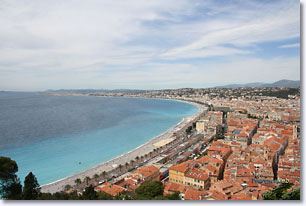
(image source: provenceweb)


Summary:
L’étude des sources juridiques et judiciaires a toujours été essentielle pour l’histoire sociale ; celle qui a pris forme durant les années 60 du XXe siècle n’aurait pu exister sans elles. Pour autant, cette histoire sociale a débuté par une « histoire par le haut » : les études consacrées aux sources juridiques ont commencé par aborder le droit tel qu’il était produit par les institutions publiques et les acteurs juridictionnels. Mais cela a également permis d’inaugurer une nouvelle approche de la source juridique de la part de l’histoire sociale : non seulement ces sources peuvent être utilisées pour éclairer des éléments oubliés d'histoire sociale, mais leur approche, dans une perspective sociologique ou anthropologique, peut améliorer notre compréhension des constructions normatives et des pratiques judiciaires. Nice- Faculté de droit et science politique, 28-29 Novembre 2019
Arguments:
Ainsi, une lecture du droit tel qu’il est appliqué aux individus et tel qu’ils le ressentent offre d’importantes opportunités : elle peut d’abord fournir un complément à ce que peuvent apporter d’autres sources historiques, mais nous éclairer également sur le contexte sociopolitique et les éléments d’expérience sociale qui produisent des sources juridiques dans toute leur diversité. Ce colloque a ainsi pour objectif d’explorer la manière dont des sources juridiques peuvent être utilisées dans une perspective analytique d’histoire sociale. La thématique choisie concerne le domaine dans lequel le droit est le plus proche de besoins des individus : celui de l’assistance, de la protection et du contrôle social. Cette problématique centrale de l’histoire sociale n’a jamais été abordée dans les États de Savoie : l’historiographie de l’assistance, de la protection et du contrôle social y est quasiment inexistante, en tous cas envisagée à partir de sources juridiques et judiciaires. Or, l’assistance, la protection et le contrôle social sont des enjeux humains, sociétaux, politiques, économiques, juridiques voire juridictionnels de premier ordre et posent, dans une perspective d’histoire sociale, de multiples questions : Celle d’abord des personnes assistées, en situation de faiblesse de précarité, ou de vulnérabilité et de leurs besoins : les pauvres (mendiants, vagabonds, familles pauvres, familles nombreuses), les malades ou victimes d’accidents (contaminés contagieux, victimes d’épidémies, déments, infirmes, victimes de guerre, blessés), les vieillards, les femmes (veuves, filles-mères, prostituées), les enfants (enfants abandonnés, orphelins), les étrangers (migrants, réfugiés, déplacés, voyageurs, pèlerins), les prisonniers, chômeurs, naufragés… Cette même diversité se retrouve lorsqu’on s’intéresse aux dispositifs d’assistance, qu’il s’agisse des moyens (aumônes, assurances privées, assurances sociales, mutuelles) ou des structures (hôpitaux, hospices, asiles, lazarets, sanatoria, ateliers de charité, xenodochia). On la retrouve aussi lorsqu’on pense aux acteurs de l’assistance et de la protection, qu’il s’agisse d’acteurs privés (corporations, confréries de pénitents, associations de dévotion, entreprises, philanthropes, sociétés de secours mutuels, loges maçonniques) ou bien d’acteurs institutionnels (États, Communes, Départements, Provinces, Églises, congrégations religieuses, armée, monts de piété, caisses de crédit municipal). La cadre chronologique est volontairement large, puisqu’il couvre la période du Moyen Âge, de l’Âge baroque, des Temps modernes et de l’histoire contemporaine. Le Cadre géographique est celui des Anciens États de Savoie (dans leur acception la plus large) et des États limitrophes à titre de comparaison et afin de mettre en lumière la circulation des modèles et des pratiques. Les langues du colloque étant l’italien, le français et l’anglais, la communication faite dans une langue fera l’objet d’un résumé d’une page dans au moins une des deux autres langues, et sera distribué au moment du colloque. Les communications seront limitées à 20 minutes.
 Practicalities:
Les propositions de communication devront parvenir à l’adresse suivante :marc.ortolani@univ-cotedazur.frEn mentionnant :
  • les coordonnées de l’auteur (adresse mail, téléphone)
  • le titre (même provisoire) de la communication
  • un bref résumé (10 lignes maximum)
  • une présentation de l’auteur (10 lignes maximum)
Délai de réponse à l’appel à communication : au plus tard le 1er mai 2019
Scientific committee:
  • Michael Breen (Reed College)
  • Marco Carassi (Archivio di Stato, Turin)
  • Françoise Briegel (University of Geneva)
  • Thomas Kuehn (Clemson University)
  • Marc Ortolani (Université Côte d’Azur)
  • Daniel Smail (Harvard University)
  • Angelo Torre (University of Eastern Piedmont)
  • Gian  Savino Pen Vidari (Université de Turin)
  • Matt Vester (West Viginia University)
  • Olivier Vernier (Université Côte d’Azur)

(source: calenda)

14 February 2019

PODCAST: Medieval History for Fun and Profit by Dr. Alice Rio and Dr. Alice Taylor


King’s College Dr. Alice Rio and Dr. Taylor have recently made a podcast called “Medieval History for Fun and Profit”. Episode 13 deals with justice in the Middle Ages.

How fair was what passed for a criminal justice system?” How could the concern for justice be so universal, yet exclude so many people? Were lords less likely to be convicted than poor people? (And what about pigs or butterflies?) Listen and find out.

The full podcast can be found here

12 December 2015

BOOK: "La loi de la chair. Le droit au corps du conjoint dans l'œuvre des canonistes (XIIe-XVe siècle)" by Marta Madero (Paris, 2015)


Marta Madero, La loi de la chair Le droit au corps du conjoint dans l'œuvre des canonistes (XIIe-XVe siècle)

all information here

Presentation

En montrant que le droit au corps de l'autre est aussi, à partir du XIIe siècle, au coeur de l’institution du mariage, Marta Madero éclaire d’une manière nouvelle une histoire – celle des relations charnelles et des liens matrimoniaux – qui a fait pourtant l’objet de nombreux travaux ces dernières décennies. Elle a découvert en effet que les canonistes du XIIe au XVe siècle construisent un régime juridique des rapports de chair avec les règles que le droit romain appliquait aux rapports de possession et de propriété des hommes sur les choses et même à la subordination des choses entre elles. L’objet du consentement est bien, dès le XIIe siècle – on a eu tendance à l’oublier –, le droit au corps du conjoint. Mais est-ce que ce droit s’exerce sur une chose qui serait le corps, ou sur une partie du corps ? Ou bien s’agit-il d’une servitude réelle que ce corps porte comme l’on dit qu’un champ est grevé d’une servitude de passage attachée aux champs voisins ? Quels sont les actes qui font naître ou cesser ce droit au corps du conjoint ? Peut-il renaître, et comment ? Invoquer le droit au corps de l’autre, c’est aussi, on le comprend alors, une autre façon de purifier les liens de la chair comme les alchimistes éliminent les scories de la matière. Et l’œuvre au noir des canonistes et des juges ouvre ainsi le vaste espace d’une casuistique dont l’étude nous prépare à mieux comprendre sans doute les méthodes et l’historicité du droit contemporain, mais aussi peut-être la préhistoire de nos sexualités.

Table of contents

11 December 2015

BOOK: "I paesaggi dell’Italia medievale" by Riccardo Rao (Rome, 2015)


Riccardo Rao, I paesaggi dell'Italia medievale, Carocci, Roma 2015

all information here

Presentation

Castelli e chiese, città e villaggi, boschi e campi, foreste dei re e beni comuni: il filo rosso che consente di orientarsi nei mille volti del Medioevo è costituito dalla capacità dell’uomo di popolare lo spazio e di costruire paesaggi pensati su misura per le collettività, rurali e cittadine, che abitano nei territori locali. I molteplici paesaggi dell’Italia medievale – nei differenti contesti regionali, dal Nord al Sud della Penisola – sono oggetto di una continua trasformazione. Dalla caduta dell’Impero romano d’Occidente, quando l’eredità di Roma e dell’Antichità risulta ancora ben visibile, passando per l’età dei comuni urbani, che modellano non solo la città, ma anche le campagne, imprimendovi l’immagine del governo collettivo, fino agli ultimi complessi secoli del Medioevo, segnati dal calo demografico dovuto alla peste nera (1348), in cui si affermano nuove gerarchie insediative e nuove colture: lungo un percorso millenario di cambiamento si disegna un volto inedito per le città e le campagne della Penisola. Nei paesaggi che il Medioevo consegna ai secoli successivi già si possono leggere molti degli elementi che ancora oggi caratterizzano il mondo in cui viviamo.

Table of contents here

20 October 2015

BOOK: Peter ARNADE & Walter PREVENIER, Honor, Vengeance and Social Trouble. Pardon Letters in the Burgundian Low Countries (Ithaca: Cornell UP), 2015, 256 p. ISBN 9780801453465, 26,95 USD


(image source: Cornell UP)

Prof. em. dr. Walter Prevenier (Ghent, Medieval History) and  Prof. dr. Peter Arnade (Univ. of Hawai at Mānoa) published a joint work on pardon letters in the Burgundian Netherlands.

Summary:
Among the more intriguing documentary sources from late medieval Europe are pardon letters—petitions sent by those condemned for serious crimes to monarchs and princes in France and the Low Countries in the hopes of receiving a full pardon. The fifteenth-century Burgundian Low Countries and duchy of Burgundy produced a large cache of these petitions, from both major cities (Bruges, Ghent, Antwerp, and Dijon) and rural communities. In Honor, Vengeance, and Social Trouble, Peter Arnade and Walter Prevenier present the first study in English of these letters to explore and interrogate the boundaries between these sources’ internal, discursive properties and the social world beyond the written text.
Honor, Vengeance, and Social Trouble takes the reader out onto the streets and into the taverns, homes, and workplaces of the Burgundian territories, charting the most pressing social concerns of the day: everything from family disputes and vendettas to marital infidelity and property conflicts—and, more generally, the problems of public violence, abduction and rape, and the role of honor and revenge in adjudicating disputes. Arnade and Prevenier examine why the right to pardon was often enacted by the Burgundian dukes and how it came to compete with more traditional legal means of resolving disputes. In addition, they consider the pardon letter as a historical source, highlighting the limitations and pitfalls of relying on documents that are, by their very nature, narratives shaped by the petitioner to seek a favored outcome. The book also includes a detailed case study of a female actress turned prostitute.
An example of microhistory at its best, Honor, Vengeance, and Social Trouble will challenge scholars while being accessible to students in courses on medieval and early modern Europe or on historiography.
Table of contents:
Introduction. The Forgiving Prince: Pardons and Their Origins
1. Social Discord: Disputes, Vendettas, and Political Clients
2. Violence, Honor, and Sexuality
3. Marital Conflict
4. Actress, Wife, or Lover? Maria van der Hoeven Accused and Defended
Conclusion. People and Their Stories
Bibliographical Note
Index
 Reviews:
"Honor, Vengeance, and Social Trouble will be of interest to both historians and a broader reading public intrigued by its often dramatic themes. Peter Arnade and Walter Prevenier present a valuable and compelling view of the social world of a vital and often under-illuminated part of late medieval Europe. This book clearly models the effective use of complex and often-compromised sources in reconstructing the social worlds of ordinary people, and for that reason it will be a useful supplement in both undergraduate and graduate teaching."—Wayne te Brake, Purchase College, State University of New York, author ofShaping History: Ordinary People in European Politics, 1500–1700

"In this fascinating study of pardon letters, juridical records at the interstices of legal custom, literary construct, and social action, Peter Arnade and Walter Prevenier offer expert guidance as we ponder the questions they raise about sex and gender, family and personal honor, social networking and individual resistance. Even more important, they open up a rich world of human crime and passion ignored by most traditional sources."—Walter Simons, Dartmouth College, author of Cities of Ladies: Beguine Communities in the Medieval Low Countries, 1200–1565

More information on the publisher's website.