The subject of this article is the Commercial Law for Bosnia and Herzegovina from 1883. This law represented a legal transplant of German commercial law. At the time of its adoption in 1883, the Commercial Law did not represent a mirror of society. However, archival sources point to the fact that the government did not actually aim to impose a law that reflected the socio-economic conditions or business and commercial practices in Bosnia and Herzegovina. The imposition of this legal transplant was aimed at unifying commercial law in a unified customs territory. A contextual analysis, based on archival sources, economic policies and economic history, confirmed that the government was interested in imposing precisely this kind of legal solution (legal transplant) to achieve specific legal, social and economic effects and transform the existing socio-legal and economic system of Bosnia and Herzegovina.
Search
22 May 2026
CLH ARTICLE: Mehmed BECIC, The Commercial Law for Bosnia and Herzegovina from 1883: A legal transplant debate perspective (Comparative Legal History, XIII (2025), nr. 2 (December), pp. 222-251)
17 July 2024
BOOK: Elena MACCIONI, I tribunali mercantili nei comuni italiani. Giustizia, politica, economia (secoli XII-XV) (Roma: Viella, 2024). ISBN: 9791254695593
ABOUT THE BOOK
Fra XII e XIII secolo nelle città dell’Italia centro-settentrionale (e non solo) iniziarono a sorgere universitates mercantili dalla natura sfuggente. Assunsero la forma del tribunale, della corporazione, dell’ufficio comunale; ed ebbero in molti casi un ruolo cruciale nelle vicende politiche urbane ed extraurbane.
Attraverso un prolifico ricorso alla comparazione, questo saggio ne rintraccia le tipologie, le modalità di azione, il ruolo politico, diplomatico, giudiziario e amministrativo; e restituisce un’immagine estremamente complessa delle dinamiche di potere, in corrispondenza sia dell’emergere del comune podestarile e popolare che dei domini personali.
Il risultato va al cuore pulsante stesso della vita associata tardomedievale, nutrito dal dialogo continuo fra le ragioni della giustizia, della politica e dell’economia.
ABOUT THE AUTHOR
Elena Maccioni è assegnista di ricerca presso l’Università di Cagliari. Si occupa di storia economica, giuridica e politica della Corona d’Aragona e delle città italiane, con un particolare riguardo per Genova. Fra le sue pubblicazioni si segnala Il Consolato del mare di Barcellona: tribunale e corporazione di mercanti (1394-1462), Viella-IRCVUM, 2019.
TABLE OF CONTENTS
Introduzione
1. Davanti al mare
- Genova e Venezia: giustificare una scelta geografica
- Genova: il contesto politico, istituzionale ed economico
- Venezia: il contesto politico, istituzionale ed economico
- Genova: la normativa
- Genova: la giustizia mercantile
- Venezia: struttura istituzionale, normativa e giustizia mercantile
- Venezia: le rappresaglie
- Conclusioni
2. Le mercanzie in Pianura padana
- Introduzione
- Piacenza
- Cremona
- Verona
- Pavia
- Milano
- Conclusioni
3. Il Centro Italia
- Introduzione
- Siena
- Pisa
- Firenze
- Conclusioni e confronti
Conclusioni
More information can be found here.
20 December 2019
BOOK: Stefania GIALDRONI et al., eds., Migrating Words, Migrating Merchants, Migrating Law (Leiden - New York: Brill, 2019). ISBN 978-90-04-41664-2, €116.00
Contributors are Cornelia Aust, Guido Cifoletti, Mark R. Cohen, Albrecht Cordes, Maria Fusaro, Stefania Gialdroni, Mark Häberlein, Uwe Israel, Bart Lambert, David von Mayenburg, Hanna Sonkajärvi, and Catherine Squires.
Albrecht Cordes is Professor of Medieval and Early Modern Legal History and Civil Law at the Goethe University Frankfurt/Main. His research is especially focused on the history of commercial law, Hanseatic legal history and the history of conflict resolution.
Serge Dauchy is Research Director at the CNRS (Lille-France) and Professor of Legal History at the University Saint-Louis of Brussels. His main research topics are the history of civil procedure, comparative history of central courts and the history of Québec.
Dave De ruysscher, Ph.D. (2009), is Associate Professor at Tilburg University and at Vrije Universiteit Brussels. As a legal historian and lawyer, he specialized in the history of commercial and private law of the early modern period and the nineteenth century.
Heikki Pihlajamäki is Professor of Comparative Legal History at the University of Helsinki. He has published extensively on the legal history of Scandinavia, Europe and America, including Conquest and the Law in Swedish Livonia (ca. 1630-1710): A Case of Legal Pluralism in Early Modern Europe (Brill, 2017).
Notes on Contributors
Introduction
Albrecht Cordes and Stefania Gialdroni
1 Migrating Words and Migrating Custom among the Geniza Merchants: Maimonides on Commercial Agency Law
Mark R. Cohen
2 Propter ConversationemDiversarum Gentium: Migrating Words and Merchants in Medieval Pisa
Stefania Gialdroni
3 ʻMigrating Seamen, Migrating Laws’? An Historiographical Genealogy of Seamen’s Employment and States’ Jurisdiction in the Early Modern Mediterranean
Maria Fusaro
4 Lingua Franca and Migrations
Guido Cifoletti
5 Brokers as German-Italian Cultural Mediators in Renaissance Venice
Uwe Israel
6 German-East Slavic (Language) Contacts in Legal Texts of the Thirteenth-Fifteenth Centuries
Catherine Squires
7 The Language of the Law: The Lübeck Law Codes (ca. 1224–1642)
Albrecht Cordes
8 A Legal World Market? The Exchange of Commercial Law in Fifteenth-Century Bruges
Bart Lambert
9 Wörter für Wucher: Ius commune and the 16th Century Debate on the Legitimacy of South German Trading Houses
David von Mayenburg
10 Transfer of Credit, Mercantile Mobility, and Language among Jewish Merchants in Seventeenth and Eighteenth Century Central and East Central Europe
Cornelia Aust
11 Coming to Terms with the Atlantic World: German Merchants, Language, and English Legal Culture in the Early Modern Period
Mark Häberlein
12 Laws – Customs – Conventions: French Merchants and French Legal Doctrines in the Brazilian Law Courts in the Second Half of the Nineteenth Century
Hanna Sonkajärvi
Index
23 March 2018
ANNOUNCEMENT: PHEDRA - Pour une Histoire Européenne du DRoit des Affaires
17 October 2017
Eric SCHNAKENBOURG (ed.), Neutres et neutralité dans l'espace atlantique durant le long XVIIIe siècle (1700-1820)/Neutrals and Neutrality in the Atlantic World during the Long Eighteenth Century (1700-1820). Une approche totale/A Global Approach (Bécherel: les Perséides, 2015), 491 p. ISBN 9782371250147
L’étude de la neutralité révèle les tensions entre les logiques de guerre et les logiques négociantes qui manifestent, autant l’une que l’autre, l’intensité des relations au sein du monde atlantique. C’est pourquoi la neutralité doit être étudiée comme une réalité transversale inscrite dans un espace marqué par la fluidité des circulations. Elle impose de dépasser les cadres nationaux pour promouvoir une approche ouverte des interconnections afin d’envisager à nouveaux frais les questions relatives à la neutralité et au rôle des neutres au cours du long XVIIIe siècle. Cette approche, qui participe du décloisonnement spatial et thématique de l’histoire atlantique, permet d’embrasser dans une même perspective aussi bien « les » Amériques, septentrionale, intertropicale et méridionale, que l’Europe. La neutralité atlantique est une arène au sein de laquelle se nouent des relations entre Européens, entre Américains, et entre Européens et Américains. Elle peut être envisagée comme une entrée dans la réflexion sur la formation d’un espace euroaméricain économique,juridique et diplomatique.
Introduction :More information here (publisher's website).
Neutralité atlantique et atlantique de la neutralité
Atlantic neutrality and the neutrality of the Atlantic
Partie 1 : Les circulations et réseaux du commerce neutre / circulation and networks of neutral commerce
Ana Crespo Solana, Madrid, Cooperation or Neutrality? How the war affects business strategies: The case of Cadiz (1700-1740)
Holger Weiss, Turku, Trade and neutrality during times of war: An analysis of the Danish-European and Danish-African relationships on the Gold Coast during the second half of the eighteenth century
Eric Schnakenbourg, Nantes, Substitution aux échanges des temps de paix ou modalité de l’interlope ? Le commerce neutre et les colonies françaises des Antilles pendant la guerre de Sept Ans
Boris Deschanel, Paris I Panthéon-Sorbonne, Les neutres dans les stratégies négociantes : l’exemple des sociétés Chauvet à Marseille (1785-1802)
Silvia Marzagalli, Nice, La navigation américaine pendant les French Wars (1793-1815) : une simple reconfiguration des circuits commerciaux par neutres interposés ?
Partie 2 : Les acteurs de la neutralité atlantique / The actors of Atlantic neutrality
Barry Stiefel, Charleston, Jews as Neutral Middlemen in the Long XVIIIth century Atlantic World
Manuel Covo, Warwick, Droit de la neutralité, pratiques de mobilité marchande et catégorisation politique à l’ère des révolutions : entre Antilles et États-Unis (années 1790)
Dominique Goncalvès, Toulouse, Le commerce de Cuba avec les neutres à travers les Actes de sessions du Consulat royal, 1797-1807.
Clément Thibaud, Nantes, América libre : les Neutres et la naissance du premier républicanisme hispano-américain (1793-1820)
Partie 3 : Les poles du commerce neutre / the centers of neutral commerce
Victor Enthoven, Amsterdam, ‘‘The unlimited cupidity of the Dutch merchants’’: St. Eustatius and Anglo-Dutch controversy over neutral rights, 1680-1780
François Antoine, Bruxelles, La guerre d’Indépendance américaine et la tentative de relance du commerce international des Pays-Bas méridionaux
Miguel Dantas da Cruz, Lisbonne, The Lisbon international trade and the ambiguities of the Portuguese Neutrality (1795-1807)
Ale Pålsson, Stockholm, Common Ground: Swedish neutrality and transit trade in S:t Barthélemy 1800-1820
Partie 4 : La neutralité dans les rivalités entre états / Neutrality in the interstate rivalry
François Ternat, Rouen, La neutralisation de la frontière. Un essai de solution diplomatique en Amérique du Nord à la veille de la guerre de Sept Ans
Marc Belissa, Paris Ouest Nanterre La Défense, Faire la guerre pour avoir le droit d’être neutre ? Les enjeux politiques de la neutralité américaine (1776-1812)
Nicolas Terrien, Nantes, Les neutres, la course maritime et l’effondrement de l’empire atlantique de la monarchie espagnole (1810-1824)
CONCLUSION French
CONCLUSION English
16 September 2016
WORKSHOP: "Migrating Words, Migrating Merchants: Migrating Law" (Frankfurt, September 19-21 2016)
WHEN September 19-21 2016
WHERE Frankfurt
all information here
The Fondaco dei Tedeschi in the commercial center of Venice, by the eastern foot of the Rialto Bridge, represents the scope of this workshop – in all three regards suggested in the title.
23 July 2016
NOTICE: "Prizes in memory of Tullio Ascarelli and Domenico Maffei" (February 28, 2019)
WHAT Prizes in memory of Tullio Ascarelli and Domenico Maffei, one in Legal History and one in Commercial Law
WHEN deadline February 28 , 2019
WHERE Italy
for any information: premioascarelli@gmail.com
19 October 2015
BOOK: "La vie financière dans le monde romain: les métiers de manieurs d’argent (IVe siècle av. J.-C.–IIIe siècle ap. J.-C.)" , Jean Andreau (Efr, Rome, 2015)
Jean Andreau, La vie financière dans le monde romain: les métiers de manieurs d’argent (IVe siècle av. J.-C.–IIIe siècle ap. J.-C.)
- Jean Andreau est directeur d'études émérite de l'École des Hautes Études en Sciences Sociales (EHESS). Historien de l'économie du monde ancien, il est l'auteur notamment de La banque et les affaires dans le monde romain, Paris, Le Seuil, 2001, et de L'économie du monde romain, Paris, Ellipses, 2010.
08 September 2015
BOOK: Luisa BRUNORI, Societas quid sit. La société commerciale dans l'élaboration de la Seconde Scolastique [Collection des Presses de l’Université de Sceaux] Paris, Mare & Martin , 2015, 248 p., ISBN: 9-782849-341797, € 30
Nomôdos signals the following work at the crossroads of legal history and theology:
La pratique marchande du XVIème siècle, en pleine transformation à la suite des grandes découvertes, devance la doctrine et sollicite avec force l'élaboration de couvertures juridiques nouvelles adaptées à un commerce devenu transatlantique.Table of contents:
Dans ce contexte économique, un particulier ne peut assumer seul les dépenses et le risque liés aux traversées transocéaniennes. Ainsi une grande nouveauté émerge : ces expéditions aux coûts exorbitants et aux risques très élevés imposent aux sociétés commerciales de recourir à des personnes contribuant par un seul apport en liquidités, sans participation aux traversées, et attendant d'en tirer un gain en retour. Il s'agit des associés capitalistes.Dès lors, les problèmes juridiques se compliquent : le contrat de société est-il un prêt usuraire déguisé ? Apporter uniquement du capital dans une société et en percevoir des bénéfices revient-il à accorder un prêt onéreux et donc usuraire ? Et par conséquent : quelle est la nature de ce capital social, distinct des apports d'opéra et industria ? Comment classer une société commerciale dans laquelle certains associés n'apportent que de l'argent pour en tirer une rémunération, et qui devient, par là même, une société "de capitaux" plutôt que "de personnes" ?Les auteurs de la Secode Scolastiques s'interrogent sur ces problématiques. Ces docteurs sont contraints de remettre en cause les piliers de l'économie et du droit médiévaux. Ils reconsidèrent la conception de la valeur de l'argent et repensent ainso tout le sytème du droit des contrats, c'est-à-dire du droit des échanges entre les particuliers. Et le contrat de société, âme du droit des affaires, était le plus problématique de toutes les formes contractuelles.
Introduction, p. 19
Partie I. L’autonomie du contrat de société commerciale : le dépassement des limites de la société de personnes
Chapitre 1. Une nécessaire mise en contexte de la société commerciale, p. 37
Section 1. Le contexte culturel et l’angle d’observation : théologie et économie vers un droit averti des sociétés, p. 37
Section 2. « Économie oblige ». Les nouveaux défis du droit des affaires, p. 58
Chapitre 2. Personnes et capitaux dans les nouvelles sociétés commerciales entre le XVe et le XVIIesiècle, p. 75
Section 1. Identifications, définitions, distinctions, p. 75
Section 2. Autonomie et filiation par rapport à la société de personnes, p. 98
Partie II. Le capital dans la société commerciale : titre légitime de profit
Chapitre 1. Les terrains de tensions entre personnes et capitaux, p. 143
Section 1. L’assise de la société commerciale, p. 143
Section 2. Les différents types de société, p. 163
Chapitre 2. La rémunération du capital : usure ou titre légitime de profit pour le socius stans ?, p. 177
Section 1. Patrimoine de la société et patrimoine des associés : autonomie et superposition, p. 177
Section 2. La participation capitaliste au contrat de société commerciale comme titre légitime de profit, p. 213
Conclusion, p. 229Bibliographie, p. 233
More information at the publisher's website.
24 July 2015
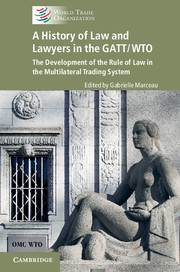
BOOK: Gabrielle MARCEAU (ed.), A History of Law and Lawyers in the GATT/WTO. The Development of the Rule of Law in the Multilateral Trading System. Cambridge: CUP, May 2015. 648 p. ISBN 9781107085237. £ 95
Gabrielle Marceau (WTO Secretariat, Geneva) published a collective work at Cambridge University Press on A History of Law and Lawyers in the GATT/WTO. The Development of the Rule of Law in the Multilateral Trading System
Abstract:
How did a treaty that emerged in the aftermath of the Second World War, and barely survived its early years, evolve into one of the most influential organisations in international law? This unique book brings together original contributions from an unprecedented number of eminent current and former GATT and WTO staff members, including many current and former Appellate Body members, to trace the history of law and lawyers in the GATT/WTO and explore how the nature of legal work has evolved over the institution's sixty-year history. In doing so, it paints a fascinating portrait of the development of the rule of law in the multilateral trading system, and allows some of the most important personalities in GATT and WTO history to share their stories and reflect on the WTO's remarkable journey from a 'provisionally applied treaty' to an international organisation defined by its commitment to the rule of law.
=> Provides a new perspective on the role of law and lawyers in the GATT/WTO Secretariats which highlights the multiple roles of lawyers and non-lawyers in enhancing the rule of law in the multilateral trading system
=> Offers an historical and analytical description of the evolution of the rule of law in the GATT/WTO systems and the various and sometimes contradictory ways in which commitment to the rule of law has manifested itself in the multilateral trading system
=> Contributions from a wide range of current and former GATT and WTO staff, as well as members of the Appellate Body, provide unprecedented insights into the legal work in the multilateral trading system, as experienced by a wide range of persons
Table of contents:
1. Introduction and overview
2. Moving towards an international rule of law? The role of the GATT and the WTO in its development
Part I. The Role of Law and Lawyers in the GATT System:
1948–92: Infancy: Reflections on the Origins of Legalization in the GATT:3. We were young together: at the GATT, 1956–58
4. Law and lawyers in the multilateral trading system: back to the future
5. Towards a GATT legal office
6. A short history of the rules division
Childhood: the Tokyo Round and the establishment and work of the first legal office:
7. Remembrance of things past: my time at the GATT
8. The first years of the GATT legal service
9. Early dispute settlement in the GATT
10. GATT dispute settlement practices: setting the stage for reform
11. The role of law in international trade relations and the establishment of the Legal Affairs Division of the GATT
12. From the GATT to the WTO: a personal journey
13. The establishment of a GATT Office of Legal Affairs and the limits of 'public reason' in the GATT/WTO dispute settlement system
14. Evolving dispute settlement practice with respect to anti-dumping in the late 1980s and early 1990s
Part II. Legal Work After the Entry into Force of the WTO:
1993–95: Adolescence: Transition from the GATT to the WTO:15. The Legal Affairs Division and law in the Uruguay Round and the GATT
16. Taking care of business: the Legal Affairs Division from the GATT to the WTO
17. From the GATT to the WTO: the expanding duties of the Legal Affairs Division in non-panel matters
18. The WTO Dispute Settlement Body: procedural aspects of its operation
Young adult: the WTO as a formal international organisation:
19. Making law in 'new' WTO subject areas: competition policy and government procurement
20. The meat in the sandwich
21. From theory to practice: drafting and applying the Dispute Settlement Understanding (DSU)
22. WTO panel composition: searching far and wide for administrators of world trade justice
23. Legal counsel to the administration: a legal adviser who should not look like one
24. Outside looking in, after many years on the inside looking out
Part III. The Changing Legal Character of the Multilateral Trading System:
1996 to Today: Adulthood: The Quasi-Judicialization of the Panel Process by the Rules and Legal Affairs Divisions:25. The first years of WTO dispute settlement: dealing with controversy and building confidence
26. From Seattle to Doha: from the surreal to the unreal. A personal account
27. Extending the scope and strengthening the legitimacy of WTO dispute settlement and some personal recollections Bruce Wilson
28. Working in WTO dispute settlement: pride without prejudice
29. The meaning of everything: the origin and evolution of the GATT and the WTO analytical index
30. When science meets law: the rule of law in the development of the panel's expert consultation process
Gaining maturity: the appellate body and the impact of the appellate review on the development of international trade law:
31. The founding of the appellate body
32. The authority of an institution: the appellate body under review
33. Launching the appellate body
34. Revisiting the appellate body: the first six years
35. Not in clinical isolation
36. The appellate body in its formative years: a personal perspective
37. Reflections on the functioning of the appellate body
38. A country boy goes to Geneva
39. Contribution of the WTO appellate body to treaty interpretation
Part IV. Looking Ahead: New Challenges and Opportunities:40. Advising the Director-General: brevity is the soul of wit, even for a lawyer
41. The Legal Affairs Division at thirty and beyond
42. Will the increased workload of WTO panels and the appellate body change how WTO disputes are adjudicated?
43. Concluding remarks.
23 July 2015
CONFERENCE: Legal History at the 14th Quadrennial Conference for Eighteenth Century Studies (Rotterdam, 27-31 July 2015)
The 14th edition of the bilingual quadrennial International Conference for Eighteenth Century Studies (ISECS) will take place at the Erasmus University Rotterdam (Netherlands). This interdisciplinary mass gathering unites historians, linguists, philosophers, musicologists, art historians and lawyers from across the globe.
The organisers distributed an 80 page-program and the abstracts of all papers listed per day. The following panels, keynotes and round tables are of potential interest to legal historians (in view of the sheer size of the event, it is almost impossible to be exhaustive):
Monday 27 July
S013(11:00 -12:30, Room: T3-10: Mandeville Building)
The Bubbles of 1720: New Economic and Cultural Perspectives
Organizer / Chair:
Catherine Labio
Condorelli, Stefano: The 1720 Financial Bubble: A European Perspective
Yamamoto, Koji: Homo Bulla: Young Students' Responses to the Bubble in 1721
Labio, Catherine: The Sounds of the Mississippi Bubble
S009(11:00 -12:30, Room: M3-03: Aberdeen: Van Der Goot Building)
Markets and Military Monarchies’: Enlightened Reflections On the Threat of Despotism, Pufendorf to Mandeville
Organizer / Chair: Robert von Friedeburg
Klerk, Marianne: Reconstructing Rule of Law and Reason of State in the Age of Louis XIV
Von Friedeburg, Robert: The Transformation of Reflections on Tyranny into those on ‘Despotism’ under the Threat of Military Monarchy
S030(14:00 -15:30, Room: T3-35: Mandeville Building)
Opening Markets: Swedish Consuls in Southern Europe, C. 1700-1800
Organizer / Chair: Silvia Marzagalli
Östlund, Joachim: The Swedish Trade Route to the Mediterranean: Consuls, Trade Security and the Development of Reciprocal Ransoming Agreement during the Eighteenth Century
Fryksén, Gustaf: Swedish Trade and Intelligence in the Mediterranean: Consular Incentives towards Commercial Expansion 1723-1763
Beaurepaire, Pierre-Yves and Marzagalli, Silvia: ‘Pour l'Avantage et l'Accroissement du Commerce Suédois’. Consul Fölsch and Swedish Trade Growth (1780-1805)
Müller, Leos: Swedish Consular Service andShipping under the Neutral Flag in the Mediterranean, 1770-1800/p>
Tuesday 28 July
S046(09:00 -10:30, Room: M3-04: Auckland: Van Der Goot Building)
Droit et Diplomatie au XVIIIe Siècle
Organisateur/Président: Frederik Dhondt, Eric Schnakenbourg
Dhondt, Frederik: "Le congrès de Soissons (1728-1729) et le droit des gens"
Lloret , Sylvain: "Du langage commun au dialogue de sourds : la protection juridique des marchands français en Espagne au XVIIIe siècle"
Schnakenbourg, Eric: "À la recherche d’une légitimité juridique : Le droit maritime et relations internationales au XVIIIe siècle"
Simon, Victor: "Origine et évolution de la protection diplomatique française dans les échelles du Levant et de Barbarie
S054(I)(09:00 -10:30,Room: T3-35: Mandeville Building)
Le Marché Panckoucke (1782-1832) Ou l’Ouverture de la Connaissance (I)
Organisatrice/Président: Martine Groult, Rolando Minuti
Leoni, Marina: La Méthodique de Quatremère de Quincy. L'Architecture entre beaux-arts et savoirs scientifiques
Delia, Luigi: Lumières sur le jusnaturalisme. Remarques sur la réception encyclopédique du droit naturel
Doig, Ann Kathleen Hardesty: Ebauche d'une étude transversale : le Dictionnaire "Physique" de l'Encyclopédie méthodique
Groult, Martine: Ordre encyclopédique et ordre méthodique
S053(09:00 -10:30, Room: T3-17: Mandeville Building)
Migrant Merchant Cultures and the Transition to Modernity: Financial and Memorial Practices of Trade Communities From the 18th to the Early 19Th Century
Organizer / Chair: Maria A. Stassinopoulou
Ressel,Magnus: Charitable Foundations Of Lutheran Merchants In 18th Century Venice
Ransmayr, Anna: “Speculation And Usury”: Financial Crisis And Profiteering
Saracino, Stefano / Soursos, Nathalie: Private Vs. Public Crises And The Foundations And Endowments Of The Greek-Orthodox In Vienna (18th/19th Century)
Mantouvalos, Ikaros: The Social Reproduction Of The Family Capital And The Redefinition Of The Family Memory: Greek Testators In Pest And Their Endowment Strategies (18th Century -Early 19th Century)
S061(11:00-12:30, Room: M3-04: Auckland: Van Der Goot Building)
Rousseau
Organizer /Chair:Annelien de Dijn
de Dijn, Annelien: Rousseau and Republicanism
Verhoeven, Willem: Reason or Sense? Rousseau’s Moral Epistemology and Conception of Natural Law
Vargas, Thiago: “No one touches his neighbor's garden”: Rousseau's economic lessons in Émile.
S074(14:00 -15:30, Room: M3-04: Auckland: Van Der Goot Building)
Montesquieu: de L'Esprit et des Lois
Organisateur/Président:Catherine Volpilhac-Auger, Lorenzo Bianchi, Rolando Minuti
Myrtille Méricam-Bourdet -« Je disais... » dans mes Pensées : théorie et pratique de l’esprit
Joshua Bandoch, Montesquieu, Esprit, and the Politics of Place
Stéphane Pujol - De l'esprit faux et des mauvais esprits. Quand Voltaire réécrit les Lettres persanes
Vernazza, Diego: L’esprit général, l’objet d’une nation, et le problème de l’idéal
S080(14:00 -15:30, Room: T3-16: Mandeville Building)
The Indies Companies in The Age of Revolution
Organizer / Chair:Malick W. Ghachem
Leos Müller Fatah - Black, Karwan: The dismantling of the chartered companies in the Dutch Atlantic
Stern, Philip: A Plassey Revolution?: Rewriting the English East India Company in the Late Eighteenth Century
Ghachem, Malick: The Revolt against the French Indies Company
Van Rossum, Matthias: A troublesome Company: The VOC and revolts, circa 1740-1800
Wednesday 29 July
KN308 (09:00 –10:30, Room: M1-12: Oxford: Van Der Goot Building)
Keynote 4: Who was the Enlightenment? Social Networks and Digital Humanities
Keynote Speaker: Dan Edelstein
Chair: Keith Bake
RT302 (11:00 -12:30, Room: M3-15 Forum: Van Der Goot Building)
Round table 3 – The Politics of Enlightenment
Organizer / Chair: Matthijs Lok
Israel, Jonathan
McMahon, Darrin
Clark, Jonathan
de Dijn, Annelien
S114 (11:00 -12:30, Room: M3-03: Aberdeen: Van Der Goot Building)
Panel Commerce
Organizer / Chair:Inger Leemans
Rubinstein, Elena: Lord Bolingbroke about British economy after Glorious Revolution in his last work "Some Reflections on the Present State of Nation"
Valmori, Niccolò: The rise of a New World: American securities market and European investors at the end of the eighteenth century.
Zabel, Christine: Tomorrow is Today’s Uncertainty: Speculating in Early Modern Europe
Cruz, Miguel: Making the Empire defendable: international commercial networks and the 18th century Portuguese Atlantic World
S111(I)(14:00 -15:30,Room: T3-16: Mandeville Building)
Economic Knowledge in Encyclopedic Compilations of the 18th Century -Structures and Translations/ Le Savoir Économique Dans Les Compilations Encyclopédiques Du XvIIIe Siècle -Structures Et Traductions (I)*Panel of the Deutsche Gesellschaft für die Erforschung des Achtzehnten Jahrhunderts
Organizer / Chair:Hanco Jürgens, Hans-Jürgen Lüsebrink
Lüsebrink, Hans-Jürgen: Le Dictionnaire Universel de Commerce (1723) de Savary Des Bruslons comme modèle d'une encyclopédie économique au Siècle des Lumières -structure, transformations, transferts
Jürgens, Hanco: Translations and circulations of economic knowledge of India in European encyclopedias
Baggerman, Arianne: Blussé's Complete Description of Trades and Occupations
S111(II)(16:00 -17:30,Room: T3-16: Mandeville Building)
Economic Knowledge in Encyclopedic Compilations of the 18th Century -Structures and Translations/ Le Savoir Économique Dans Les Compilations Encyclopédiques Du XvIIIe Siècle-Structures Et Traductions (II)*Panel of the Deutsche Gesellschaft für die Erforschung des Achtzehnten Jahrhunderts
Organizer / Chair:Hanco Jürgens, Hans-Jürgen Lüsebrink
Donato, Clorinda: "Promoting Commerce, Trade and the Maritime Prowess of the Venetian Republic in the Encyclopédie méthodique de Padoue (1784-1817)
Greilich, Suzanne: Savoir économique et l'Espagne des Lumières
D'Aprile, Iwan-Michelangelo: Transfer of Economic Knowledge in German Encyclopediae: From Krünitz to Brockhaus
Thursday 30 July
KN309 (09:00 –10:30, Room: M1-12: Oxford: Van Der Goot Building)
Keynote 5: Eloges de l'injustice. De Diderot à Sade
Keynote Speaker: Céline Spector
Chair: Hans-Jürgen Lüsebrink
Friday 31 July
S197(I)(09:00 -10:30, Room: M3-05: Praag: Van Der Goot Building)
Le Moment Beccaria (1765-1810). Les Origines intellectuelles du Droit Pénal Moderne (I)
Organisateur/Président:Philippe Audegean
Rao, Annamari: Humanité et utilité : le débat sur Beccaria dans les milieux intellectuels napolitains
Berti, Francesco: Tommaso Natale et la critique de la philosophie démocratique de Beccaria
Ippolito, Dario: Beccaria VS Montesquieu : le problème pénal dans la réflexion de Dalmazzo Francesco Vasco
Monti, Annamaria: La question del’arbitraire judiciaire entre 1764 et 1810 : un débat européen
S196(II)(11:00 -12:30,Room: M3-04: Auckland: Van Der Goot Building)
Liberty in Commercial Society: Conceptions of Liberty in the Age of the Enlightenment (II)
Organizer / Chair:Eleni Leontsini
Esser dos Reis, Helena: Embuscades de la liberté: difficultés à la protection des droits de l'homme.
Ueno, Hiroki: Domesticating Global Economy: Montesquieu, Adam Smith, and the Invention of National Economy.
Leontsini, Eleni: Adam Ferguson’s Republican Conception of Liberty
S196(III)(14:00 -15:30,Room: M3-04: Auckland: Van Der Goot Building)
Liberty in Commercial Society: Conceptions of Liberty in the Age of the Enlightenment (III)
Organizer / Chair:Eleni Leontsini
Balazs, Peter: Deux conceptions rivales de la liberté dans la Hongrie du XVIIIe siecle
Konstantakopoulos, Stavros: Benjamin Constant and the Limitations of the Liberty of the Moderns
S197(II)(11:00 -12:30, Room: M3-05: Praag: Van Der Goot Building)
Le Moment Beccaria (1765-1810). Les Origines intellectuelles du Droit Pénal Moderne (II)
Organisateur/Président:Luigi Delia
de Champs, Emmanuelle: Une culture démocratique de la décision juridique? Juges et jurés chez Beccaria, Condorcet et Bentham
Ferrand, Jérôme: Beccaria, «père» du droit pénal moderne ou «dernier des mohicans» matérialistes?
Rother, Wolfgang: Johann Christian Gottlieb Schaumann et les débuts de la psychologie criminelle
Béal, Christophe: Beccaria, Bentham, Hart et la philosophie pénale
S221(14:00 -15:30,Room: M2-10: Rochester: Van Der Goot Building)
Enemies of Exclusion: Opposition to Closed Markets in Overseas Trade
Organizer / Chair: Joris van den Tol
Hoonhout, Bram: Free trade at the fringes of empire? Cross-imperial trade and the expansion of the Dutch West-Indian colonies of Essequibo and Demerara, 1750-1800
Heijmans, Elisabeth: Hand in hand with the state:Regional merchant communities and centralized French empire building
Odegard, Erik: The Dutch East India Company and the opening of the Malabar Military Labor market, 1760-1795
Brinkman, Anna: British Prize Law and the Loss of Spanish Neutrality, 1756-1763
15 May 2015
PODCAST: Giacomo Todeschini on Economics and Trade in Medieval Canon Law and Theology (France Culture, 24 April 2015)
La Fabrique de l'Histoire received Prof. Giacomo Todeschini (Trieste) to discuss his work on "Richesse franciscaine : de la pauvreté volontaire à la société de marché" (Lagrasse: Éditions Verdier, 2008, 281 p., ISBN 9782864325499; translation from Italian). A rich interview on property and possession, usury, credit, creditworthiness and reputation, or the erroneously "primitivist" nature of economic concepts in 13th century theology.
Full podcast available here.
06 May 2015
CALL FOR ABSTRACTS: World Congress of Roman and Comparative Law, "Contracts, Goods and Trade Market" (Valparaiso, 23-24 Jul 2015); DEADLINE 15 JUN 2015
We were informed of the call for abstracts for the upcoming "World Congress of Roman and Comparative Law" in Valparaiso (Chile).
Each participant will have 20 minutes to give his communication. All proposals should relate to the main subject of the congress: “Contracts,goods and trade market”. Presentations can be given in Spanish, English, French, Italian, German or Portuguese.
The following publication of the works presented to the Congress will be subject to a blind refereeing process and to the editorial norms of the Revista de Estudios Histórico-Jurídicos (www.derecho.ucv.cl). The deadline to send the full text of the communications that wish to be included in the publication will be notified in due time
Proposals are expected by 15 June 2015.
More information on the conference website.
17 April 2015
JOURNAL: Merchant Morality in the 18th Century Mediterranean (Rives 2014, nr. 49)
The journal Rives méditerranéennes published a theme issue on "merchant morality in the 18th Century Mediterranean".
Summary:
Par l’existence d’une densité et d’une variété institutionnelles et par la prégnance du commerce sur l’économie, l’espace méditerranéen du long XVIIIe siècle peut être perçu comme un laboratoire pertinent pour travailler la thématique des moralités marchandes. Ce numéro se penche sur la question au croisement de quatre niveaux d’analyse : les trajectoires et les caractéristiques personnelles des négociants, avec leurs stratégies d’autoreprésentations ; les encastrements politiques, culturels et sociaux qui façonnent les groupes marchands (l’État, la paroisse, la « nation », la ville, la religion…) ; les institutions productrices de normes et de comportements normés (l’État, mais aussi les tribunaux de commerce, les assemblées de marchands…) ; et les pratiques qui mettent les éthiques, les lois et les discours à l’épreuve du terrain.
Table of contents (source: revues.org)
-
Christopher Denis-Delacour et Biagio SalveminiIntroduction. Moralités marchandes du XVIIIe siècle [Accès restreint]Débats savants et pratiques normatives
- Francisco Zamora Rodríguez« Les François lui ont l’obligation d’avoir favorisé leur commerce pendant la guerre » [Résumé | Accès restreint]Représentation consulaire, fraude et contrebande commerciale
- Andrea AddobbatiLe banquier juif du Roi Soleil [Résumé | Accès restreint]Notes de recherche sur l’anecdote entre le XVIIe et le XVIIIe siècle
- Sébastien LupoEnjeux éthiques et correspondances négociantes dans l’espace méditerranéen au XVIIIe siècle [Résumé | Accès restreint]
- Daniele AndreozziRespectabilité et confiance au travers de la norme et de la fraude [Résumé | Accès restreint]Le cas de Trieste au XVIIIe siècle
- Annastella CarrinoHonneur marchand et espaces urbains [Résumé | Accès restreint]Le cas Straforello et Peragallo à Marseille à la fin du XVIIIe siècle
- Mathieu GrenetMoralités marchandes et charité communautaire [Résumé | Accès restreint]le cas des Grecs de Venise, XVIe-début XIXe siècle
- Julien Puget
- Alessandro Tuccillo
15 April 2015
CONFERENCE: Capital, Investment and Innovation in the Roman World (Free University of Brussels (VUB), 28-30 May 2015)
The Research Network "Structural Determinants of Economic Performance in the Roman World" (Ghent/Leuven/VUB, funded by the Research Foundation Flanders (FWO)) organises a conference in Brussels (VUB) on 28-30 May 2015 around the theme "Capital, Investment and Innovation in the Roman World".
Presentation:
Capital may be defined to comprise all man-made resources available for production. These include (1) financial capital : all monetary wealth in whatever form (stocks of currency, bullion, transferable credit bonds, etc.) available to buy whatever is needed or used to realize production: supplies, tools, equipment, labor, licenses, information, etc.; as well as (2) real (or physical) capital: all material resources such as tools, workshops and factories, warehouses, etc. needed or used to realize production. Both forms of capital may be privately or publicly owned. In a wider sense the concept 'human capital' denotes the embodied stock of human competencies, intellectual and other, that allow a person to perform the tasks necessary to create 'labor'. In order to retain a clear focus for the project and monograph, however, we will limit ourselves for this project to these 'classical' definitions of capital. The concept 'social capital', while valuable in itself, would take us too far from what we consider the core issues of our project. We explicitly focus, furthermore, on investments and innovations, i.e. on the quantitative and qualitative changes that stocks of financial, real and human capital underwent in the Roman world. The objective is to produce a coherent and innovative study of capital, investment and innovation in the Roman world.Programme:
Capital and credit are important elements in the furthering or holding back of economic growth. The allocation of capital, labor and natural resources through market and non-market channels determines economic performance.
Hence, fundamental issues in understanding the functioning of the economy of the Roman world include: who had access to capital, to what extent, and in what form, and how they dealt with it. Various segments of society controlled capital to different extents and used it for diverse purposes.
Did the social and political elites of the Roman world treat the wealth they controlled fundamentally differently from the magnates of the capitalistic era, or do the different forms and instruments of the Roman business world no more than cloak an essentially identical mentality? To what extent did other segments of society have access to capital, and how did capital circulate through society?
Asking these questions implies that we should not limit our study to the formal instruments of banking and business, but also take into account the wider institutional framework, both the formal rules and the social networks and informal arrangements that eased or hampered the dissemination of capital. Recent approaches within NIE (North, Wallis & Weingast, Violence and Social Orders, 2009) urge us to look at political and social conditions that constrained the pre-modern economy. According to a pessimistic view, the predatory and exploitative inclinations of the state and of the politically leading rentier class, who extracted the surpluses produced by the peasantry and an underprivileged workforce, hampered the accumulation and productive investment of capital. In other views, it was not the shortage of capital, but the poor allocation of capital that restrained economic performance. The question, however, is whether this is a valid assessment of the situation in the Roman Empire.
Some questions that we will discuss are:
•Did the political and social elites perceive money as an economic asset?
•What part of their property and income consisted of disposable money? How easily and/or readily were assets such as land, buildings, workshops, or slaves transferred into financial capital through factor and commodity markets?
•To what extent did the political and social elites dominate ownership of capital goods (land, natural resources, raw materials, production facilities, tools)?
•What is the role of the state (on imperial and local levels) in the accumulation of capital? What was the property rights regime of publicly owned goods ? What is the role of war in the dissemination and destruction of (fixed) capital?
•What was the role of religious institutions, such as temples, in the creation of capital and in making it available? Were there subject to the same property rights regime as private persons?
•How well did the credit market function? What does the level of interest tell us about the value of capital? Which requirements and whose needs determined the development of formal and informal instruments of the credit market?
•What was the role of private voluntary collectives, such as collegia, in the creation of capital and in making it available ? Were there subject to the same property rights regime as private persons ?
•To what extent was credit necessary for production ? What form did this credit take ? To what extent was consumption credit provided for by commercially oriented financial institutions or entrepreneurs - i.e. by enterprises whose financial assets constituted working capital rather than reserves for future consumption ?
•How and by whom were capital goods besides land and natural resources (tools, machines, production facilities, work animals) produced and allocated?
Equally important is the question to which purposes capital was used: what scope for investment did the agricultural and non-agricultural sectors offer, and to what extent was capital invested in means of production that boosted productivity rather than in status-enhancing assets such as urban palaces, benefactions, and expensive cooks? While investments potentially created growth, market oriented capital investment is as much a response to an expanding market as it is an incentive for economic growth in itself. The increasing urbanization and market integration of the Roman world made productive capital investment an increasingly attractive option, as it widened the market and increased the stability of demand. At the same time, to what extent did landowners and businessmen actually respond to these changing conditions of the market? And how did their response to population decline and the shrinking of the urban markets aggravate the economic decline that seems to occur in many parts of the Roman world after the second century AD? The examples of capital investment in agriculture, transportation, and industry in our archaeological and written sources are undeniable, but what limits were there to the investment of capital in the economy ?
One form of investment that deserves particular interest and which operated at all levels of society is that in knowledge and expertise. As with other forms of investment, a costly and time-consuming effort in gaining specialized know-how and expertise was economically only viable in conditions of sufficient - and sufficiently stable - demand. The ways in which knowledge and expertise were disseminated in pre-modern societies has been used as a marker of the economic development of such societies. In concrete terms, how did servile and freeborn workers and artisans acquire the knowledge they needed? To what extent did this stimulate or constrain economic development? In which ways was professional education embedded in the social and domestic context of business, agriculture, and industry? How is education of labor related to the control of capital and other means of production? Who had what interest in the acquisition and dissemination of expertise and know-how among the free and servile population.
Some questions that we will discuss are:
•What forms of investment in agriculture and other sectors of the economy are visible in the archaeological and written sources?
•What conditions stimulated or constrained investments in the various economic sectors? To what extent did imperial and local taxation stimulate and restrain capital investment? To what extent did investment opportunities stimulate the development of financial institutions?
•What is the relation between capital investment and productivity? Is capital investment related to economies of scale?
•To what extent did investments in agriculture lead to an increase in available animal energy and higher labor productivity? To what extent did a fall in demand cause a reversal of this development?
•How was knowledge and expertise acquired and disseminated in various sectors? What is the relationship between the acquisition of specialized knowledge and capital investment in equipment and infrastructure?
As with investment, incentives to modernize methods of production in agriculture or other economic sectors can be seen as stemming from the rise in urban markets and the increase of rural industries as much as causing economic growth in the first place. In many societies, capital investment went hand in hand with innovation. The investment in expertise and know-how does not only concern the dissemination of existing knowledge, but also provides the starting point for the creation of new technologies and methods. Innovation in the Graeco-Roman world not only consisted of the introduction of new cash and fodder crops and new agricultural techniques, but also of the introduction of new forms of equipment and technologies, and of the application of existing methods on a vastly larger scale. A fundamental question concerns the goals of innovation, i.e. whether innovation was intended to overcome the constraints of production (as in irrigation in agriculture or the application of new technologies in industry), to introduce new sources of energy, or to reduce the input of labor. Available energy was a constraining factor in pre-industrial economies, which makes energy-enhancing innovations of vital importance for economic growth. Of equal importance for the allocation of production factors, however, is the extent to which such sources of energy could be concentrated or transported (such as coal was from the 18th century onwards).
Some questions that we will discuss are:
•What forms of innovation occurred in agriculture, transportation, and industry, and what caused these innovations? To what extent did the costs involved and the risks inherent in novelty cause an aversion to innovation?
•What is the relation between innovation and technological change? To what extent do we see investment in larger installations?
•To what extent is the model of the 'low equilibrium trap', which is seen as limiting the need or drive for innovation, a valid model for the Roman world?
•Which goals determined these innovations? What is the relation between the nature of the workforce and the production process?
•In what ways is investment and innovation related to the increase in the availability of new sources of energy?
Koen Verboven & Paul Erdkamp, IntroductionAbstracts can be found on the conference website.
Part 1. Capital
•K. Gunnar Persson, Capital, labour, and income estimates in the Roman world
•Wim Broekaert / Arjan Zuiderhoek, Capital goods in the Roman economy
•Norman Underwood, Laboring for God: The Clergy and Human Capital in the Later Roman Empire
•Leonardo Gregoratti, Temples and traders in Palmyra
•Koen Verboven, Credit institutions and financial capital in the Roman world
•Marguerite Ronin, Cooperative investment in rural communities of the Roman Empire
Part. 2. Investment
•Christiano Viglietti, Pecunia adpensa. Capital, investment, and innovation in an uncoined-money economy: Rome c. 700-350 BCE
•Jean Andreau, Capital and investment in the Campanian tablets
•Sitta Von Reden, Credit and Investment in Roman Egypt
•G. Minaud, Chiffre d'affaires, bénéfice et capitalisation
•Mick Stringer, Impensae, operae and pastio uillatica. New venture investments in the Roman agricultural treatises.
•Annalisa Marzano, A story of land and water: Capital and Investment in large-scale fishing and fish-salting operations
•Tim Clerbaut, The Roman villae: new beacons of capital production, capital management and Romanization in the Roman North
Part. 3. Innovation
•Paul Erdkamp, Malthusian constraints on the Roman economy. A critique of the ‘low equilibrium trap’
•Helmuth Schneider, Technical innovations in the Roman world
•Robin Veal, Forest resources and technical innovation in the Roman economy
•Andrew Wilson, Concluding remarks
13 March 2015
WORKSHOP: Elements of proof and commercial litigations in the Mediterranean (XV - XIX century) (ERC Program Mediterranean Reconfigurations), Paris I, 16-18 June 2015; DEADLINE 29 MARCH 2015
HSozKult reports the following event on early modern and modern transnational commercial law - DEADLINE 29 MARCH 2015:
What can the evidentiary artifacts that are deployed to resolve commercial litigations tell us about the legal configuration of the Mediterranean between the fifteenth and nineteenth centuries?
Since 2012, the ERC-funded Mediterranean Reconfigurations research program (ConfigMed) has been studying commercial disputes, legal pluralism, and intercultural trade in the Mediterranean, at the crossroads of different traditions, legal regimes and referents. In this context, our method helps to address conflicts involving economic actors from Europe to the Ottoman Empire and North Africa, as well as to focus on the encounters, compromises and possible exchanges of these geographical entities.
Systems of legal proof belonging to the prominent legal structures from ancient times to the modern era have been subject of several investigations and a wide range of publications between the late 1950s and early 1960’s, when the collapsing colonial empires discovered - or rediscovered - the foundations of indigenous legal theories, known to play a critical role in their independence.
This workshop aims to continue this work and these reflections with a particular emphasis on the production and circulation of the elements of legal proof in the Mediterranean. Based on the examination of written certificates and declarations, we propose to examine their effect on both the commercial world and legal systems that are often seen as closed within itself.
One of the primary axes of this workshop will be the analysis of the procedures of dispute resolution through the production and circulation of certificates and written testimonies. The origins, formal diversity, materiality and logic of these artifacts should be able to provide food for thought on the nature and resolution of disputes, as well as the practical functions of institutions, such as consulates and commercial courts.
Particular attention will be paid to cases involving agents of different backgrounds (i.e. disputes with the infidels, and those conflicts between local people and foreigners or traveling people); effort will be made to understand the terms and limitations of access to justice for the different actors (for example, did Muslims submit an appeal to the European courts?), as well as the logics and practices of intermediation that were made possible by the presentation of the evidentiary elements.
Our thinking is based on findings from recent research, such as those devoted to the procedures of "summary justice", available to foreigners and merchants in Europe, or, in the land of Islam to the Siyasah doctrine and the practices of justice administered by the ruler instead of the qadis or the uses by foreigners of the Ottoman Imperial Council (Divan) in case of commercial conflicts. The workshop aims to explore such legal procedures by peering into the archives, as well as by tracing the circulation of written documents. Our interest, therefore, will not be invested in the legal and philosophical systems of any single "civilization" or "cultural area", but rather in the socio-cultural relations between them prompted by commercial litigations, as well as issues raised by the coexistence or interpenetration of different evidentiary logics.
As such, this workshop aims to overcome the vision of a Mediterranean reduced to the strict opposition between an Islamic legal system of evidence - oral and highly structured by the formalist constraints of the so called divine law - and a radically different Western evidentiary system oriented towards a Weberian Rationalisierung, marked by the triumph of the written and notarization of the modern law.
This will necessarily involve careful consideration of the circulation and use of evidence, for the reconstitution of the chain of correspondences between litigants, intermediaries and user or producer institutions of evidentiary elements. This should produce material to discuss the relevance of the boundaries usually drawn between worlds that seem to be permeable, such as those opposing the oral and the written, the private and the public. For example, the Ottoman judicial practice had established processes of validation and certification of private acts with values similar to the certificates produced by the public authority of the Latin notary.
Moreover, we will need to go beyond an analysis of evidence reducing them to their mere functions and original purpose - to convey the truth about the facts – in order to fully interpret them as tools of thought. The formal aspect of the evidence, the logic of their composition and communication, the rhetoric used in their language(s) and any external sign of validity may be used in order to evaluate, in a new light, the texture of legal cultures of different eras, territories and differentiated social groups. By considering these evidentiary pieces as instruments, the workshop will address the role of evidence in the analysis of communication processes and interpret it as a privileged scenario of legal and cultural creativity in a trans-Mediterranean space formed by different resolutions of commercial litigations.
Thus, the contributions addressing the following issues are particularly welcome:
- At what point in the legal procedure did the presentation and the examination of evidence occur, and on what criteria were they evaluated? What were the effects of this presentation on the outcome of the case?
- Are the evidences used in commercial disputes specific to the world of Mediterranean trade, or do they come from other legal systems and/or Mediterranean and extra-Mediterranean cultural worlds? Is it possible to link the resolution of commercial disputes in terms of other problems, such as solicitations for return of goods taken by corsairs?
- Do the materiality, nature and functions of these instruments relate to particular spaces, institutions or types of procedures?
- Beyond the usual formal classifications, what distinctions can be made between different written pieces attached to trials? Is there a type of documentation specific to the Mediterranean legal system that is mobilized more than others in order to win the case in a trade dispute?
- What is the role of private deeds in the resolution of these disputes? Under what legal, political or religious conditions, and in what particular contexts are they of greatest importance for the actors?
- Does the study of legal procedures from the point of view of the evidentiary elements confirm the hypothesis that the commercial courts would have had a more flexible approach than other courts vis-à-vis the written evidence?
- In case of confrontation between several regimes of legal evidence, how would the regulatory institution decide on the value of the pieces presented? Did mixed regimes exist that relied, perennially or ad hoc, on the articulation of different forms of evidence, or even on their hybridization?
- What was the process of validating the evidence? And what can this process tell us about the function of institutions, the effects of procedures and the legal culture of the actors?
- Finally, what were the main institutions issuing certificates and documents of proof of all kinds? Do particular schemas appear in the uses of these institutions by social actors? And what were the communication logics provided by the legal procedures? Were they defined by the circulation of the written pieces?
Contact: Prof. dr. W. Kaiser (Paris I): wolfgang.kaiser@univ-paris1.fr.
11 February 2015
WORKSHOP: The Making of Commercial Law; Small, Medium-Sized and Large Companies in Law and Economic Practice (Brussels, 21-22 May 2015)
The Free University of Brussels (VUB), Research Group CORE (Contextual Research in Law) organizes a two-day workshop in the project "The Making of Commercial Law" (Helsinki/VUB/Frankfurt/Lille-II).
Abstract:
Programme:
The goal of this workshop is to bring together scholars who have worked on the interactions between law and economic practice, and to address topics concerning the history of business ventures, from the Middle Ages until c. 1900. The papers of participants assess differences with regard to the size of partnerships and companies. Over the past years, limited and general partnerships have received ample attention from economic and legal historians. Organizational laws containing structural models for small enterprises (e.g. the French sprl and German GmbH) have been held up to the light. Doctrine and case law concerning partnerships have been analyzed. It seems that in both legal and economic practice, and for all periods mentioned, smaller companies mattered more than has previously been thought, and even in periods in which corporations existed. In view of this, many ideas about companies and firms – large and small – can be reconsidered. Topics that will be discussed during the workshop are, among others, legal personhood, limited liability, corporate finance, and corporate governance.
The workshop is the second in a series on the history of commercial law, organized during the 2014-2017 period in Helsinki, Brussels and Frankfurt. The conferences will be organized in the framework of the project “The making of commercial law: common practices and national legal rules from the early modern period to the modern period".
Organizational committee:
Thursday 21 May 2015
9h coffee
9h30-10h50 first session
- Ulla Kypta (University of Basel), Associates or Agents? Trading Enterprises in Northern and Southern Germany in the Late Middle Ages
- Bart Lambert (Durham University) Making Size Matter Less: Italian Merchant Guilds as Tools for Capital Redistribution in Late Medieval Bruges
10h50-11h05 coffee
11h05-12h35 second session
- Anja Amend-Traut (Würzburg Universität), Structure of Early Enterprises – from Commenda-like Arrangements to Chartered Joint-Stock Companies (Early Modern Period)
- Luisa Brunori (Université Paris Sud 11 – Université Lille 2), The Secunda Scholastica and the Commercial Company: Persons and Capital in the 16th and 17th Centuries
12h35-14h lunch
14h-15h20 third session
- Bram Vanhofstraeten (Maastricht University), Small-scale and Medium-sized Industrial Enterprises in Seventeenth-Century Liège
- Julie Hardwick (University of Texas), 'She Failed to Make a Book': Account Books, Small Enterprises and Emerging Practices of Record Keeping in Early Modern Lyon
15h20-15h35 break
15h35-17h fourth session
- Stefania Gialdroni (Roma Trè, Arcadia University), Incorporation and Limited Liability in the English EIC: an Uneasy Relationship
- Jelten Baguet (Vrije Universiteit Brussels), Corporate Governance in a Small-Scale Pre-Modern Maritime Enterprise: The Case of the Ostend Company (1722-1731)
Friday 22 May 2015
9h coffee
9h30-10h50 fifth session
- Carlos Petit (Universidad de Huelva), From Commercial Guild to Commercial Law. Spanish Company Regulations, 1737-1848.
- Annamaria Monti (Bocconi University), Italian Late 19th-Century Companies: Size and Corporate Governance
10h50-11h05 coffee
11h05-12h25 sixth session
- Ron Harris (Tel Aviv University), Private companies in 19th century England
- Dag Michalsen (Oslo University), The Development of Norwegian Company Law 1875-1910
12h30-14h lunch
14h-15h20 seventh session
- Joeri Vananroye (KU Leuven), Partnerships in 19th-20th c. French and Belgian Doctrine
- Dave De ruysscher (Vrije Universiteit Brussels), Small Companies, Contractual Leeway and Third-Party Protection (Belgium, c. 1830-c. 1850)
15h20-15h45 break
15h45-17h10 eighth session
- Edouard Richard (Université de Rennes), The Banque d’Union générale: Legal Aspects of its Shut-Down (1878-1885).
- Matthijs de Jongh (Court of Appeal, Amsterdam), Fuzzy Borders: Dutch Partnership and Company law in the Second Half of the 18th Century.
Practical information:Dave De ruysscher (Vrije Universiteit Brussels-Research Foundation Flanders (FWO)), Heikki Pihlajamäki (University of Helsinki), Albrecht Cordes (Goethe-Universität Frankfurt), Serge Dauchy (Université Lille 2)
SQUARE Brussels Meeting Centre (www.square-brussels.com/, Glass Entrance, rue Mont des Arts, B-1000 Brussels), BrusselsSource: Nomôdos.
Entrance is free, but registration is required. The final date is 15 April 2015. Please send an email to dderuyss@vub.ac.be. Papers will be sent to participants.