Search

Showing posts with label Workshop. Show all posts

30 April 2026

SEMINAR: Disabilities and Women in Ancient Rome: Legal, social and cultural perspectives (Helsinki: University of Helsinki, 4 MAY 2026) [HYBRID]


(image source: UH)

Disabilities and Women in Ancient Rome: Legal, social and cultural perspectives 
 University of Helsinki

Workshop: In-person&Online

In person participation: University of Helsinki, Main Building (Unioninkatu 34), Room U3039 (3rd floor)

Registration through this form

Remote participation: via Zoom (https://helsinki.zoom.us/j/69089076203)

 Monday, 4 May 2026, from 10:00 to 17:30 EEST


Program:

10:0011:15 keynote: Prof. Christian Laes: Women and disabilities in Antiquity: between presentism and daily life 

11:3013:00 session 1: Disabled Women in the Roman Narratives 

Sofia Vierula: The case of Harpaste: Lived experience of disability in Seneca’s letter to Lucilius 

Mathilde Chartrand: The Daily Life of a Furiosa: On the Gendered Consequences of Mental Illness

Fran Geldard: Enslavement and Disability in Eusebian Martyr Narrative

[Lunch] 

14:0015:30 session 2: Women, Disability and Roman Law

Arnaud Paturet: Some Reflections on the Status of Deaf People by Roman Jurists 

Kaius Tuori: Infirmity and monstrosity: on the legal construction of female disability in law

Jana Mauri Marlborough: Against All Odds: The Legal Position of Wet Nurses in Roman Law

[Coffee]

16:0017:30 session 3: Intersections of Gender and Disability in Late Antiquity 

Gaetana Balestra: Muta puella fuit: The Mute Woman between tutela mulierum and Justinian's Legislation.

Elena Pezzato Heck: Mental Illness as Grounds for Repudiation in Late Antiquity and the Justinian Era

Arttu Alaranta: Vulnerable Life-Cycle Moments and Disabilities in Women’s Asceticism during Late Antiquity 

More information is available on UH website. 


06 January 2026

CALL FOR PAPERS: Workshop "To Write the Earth: Law, the Global, and Planetary World-Making" (Florence: EUI, 26-27 JUN 2026); DEADLINE 15 JAN 2026


Workshop—Call for Contributions   

To Write the Earth: Law, the Global, and Planetary World-Making 

Organising committee: Nikolas M. Rajkovic (Tilburg), Arnulf Becker Lorca (EUI), Tim Lindgren (EUI), Kalypso Nicolaïdis (EUI), Francisco-José Quintana (Edinburgh) & Sofia Ranchordas (Tilburg/LUISS) 


Cartography literally means “to write the earth.” If maps write rather than mirror the world, they function as world-making texts that narrate space, distribute authority, and normalize particular orders under the guise of spatial precision. Modern international law is deeply shaped by this cartographic inheritance: sovereignty, territory, and jurisdiction rest on a vision of the earth as a continuous surface partitioned into polygonal units under human control. That this image appears natural is itself a political achievement. It is a way of writing the world that has come to stand in for the planet itself. 

Yet this anthropocentric world-writing is neither exclusive nor inevitable. Many other modes of composing the earth exist and have persisted across time: indigenous cosmologies, ecological and multispecies ontologies, oceanic and atmospheric imaginaries, logistical and digital infrastructures, climate and earth-system models. These do not merely represent different geographies; they articulate distinct assumptions about agency, relation, obligation, and the grounds of authority. The challenge is not simply to add the non-human or other-thanhuman to existing legal frameworks, but to recognize that the very scale and composition of the world shift when humans are no longer presumed to be its sole authors and agents. 

As climatic destabilization intensifies, the language of the “planetary” has emerged as a conceptual alternative to the “global”, which had itself emerged as an alternative to the “international”. Yet these semantic shifts remains superficial if they do not grapple with the deeper conceptual question: How is the earth written, by whom, and to what ends? And how is it written through law? What, precisely, distinguishes the planetary, the global, and the international—and how might these distinctions matter for legal thought and practice? What does it mean to think of the planetary as something other than the global enlarged? How does “planetary law” depart or intersect with other naming projects such as “global law” and “transnational law”? And what forms of law and authority become possible when the earth is understood as a site of multiple and contested writings? Attending to these shifting modes of earth-writing also requires attention to legal and other expert crafts. Planetary and global projects are made and remade through the expert practices of drafting, interpreting, standard-setting, contracting, modelling, litigating, and enforcing. Asking how the earth is written therefore also means asking who writes these norms, in which institutional sites, with what materials and procedures, and how they travel, sediment, or are resisted. 

This workshop invites participants to examine how diverse practices of earth-writing— cartographic, legal, literary, scientific, ecological, and infrastructural—stabilize or unsettle the relationship between law, the global, and the planetary. The workshop is substantively and methodologically interdisciplinary: no single field possesses the conceptual resources required to rethink world-making at planetary scale. It brings together scholars in law, international relations, geography, anthropology, history, political theory, STS, and critical environmental studies to collaborate experimentally. 

Suggested and Interacting Themes (To explore possible themes of coherence) 

1.  World-Making and International Law’s Anthropocentric Inheritance How international law historically linked its ordering project to human-centered concepts (sovereignty, peoplehood, jurisdiction). What happens when ecological and more-than-human processes are no longer background conditions but legal participants? 

2.  Colonial and Imperial Earth-Writings How imperial mapping, surveying, and classificatory practices produced the “global” as a legible whole. What forms of erasure, enclosure, and extraction are reproduced in contemporary legal frameworks? 

3.  Writing Planetary Codes  How existing legal doctrine is being, and can be, rewritten for planetary purposes. Has work on global and planetary legal thinking paid sufficient attention to doctrine and professional legal work? Can close attention to legal craft and doctrinal imagination open spaces within international, global, and transnational legal thought to reshape legal frameworks towards fairer environmental futures? What would such changes look like, down to the level of doctrinal detail? 

4.  Approaches Beyond the Human: Rights of Nature, Post-Human Legalities, and Planetary Scholarship How emerging thought experiments and legal interventions (rights of rivers, ecological personhood, relational ontologies, multispecies jurisprudence) reconfigure who or what can bear authority. 

5.  Imagining Planetary Legal Orders What conceptual tools, narrative forms, and representational practices might enable legal thought to respond to planetary transformations without reproducing global cartographic logics. How might plural earth-writings co-exist without collapsing into universalism? And what would such orders look like in legal detail? 

6.  The Persistence of the Social What risks being obscured by the rise of the language of the planetary. How might projects of planetary law governance remain accountable to questions of redistribution, labour, care, and welfare, historically understood as core responsibilities of the (sovereign) state?  

Workshop Format 

This workshop is structured as a collaborative research laboratory rather than a venue for presenting finished papers. Participants will circulate short working papers or conceptual position pieces (2,000–4,000 words) in advance. Sessions will proceed through shared reading, roundtable discussion, and collective conceptual exploration. Our aim is to develop new analytic vocabularies, methodological approaches, and research directions that render planetary world-making newly thinkable. The workshop will culminate in the co-development of an edited scholarly volume, To Write the Earth, extending the inquiry initiated in the workshop. 

Call for Contributions 

Interested scholars are invited to submit an abstract of 250–500 words outlining their proposed contribution. Please include your name, institutional affiliation, and a brief biographical note (2–3 sentences). We strongly encourage PhD researchers and postdocs to apply as well as more senior colleagues. There is a limited budget for the workshop, and those submitting abstracts should be prepared to finance their own travel and accommodation.   

Submit abstracts by 15 January 2026 to: n.m.rajkovic@tilburguniversity.edu  In the subject title: “To write the Earth, Abstract submitted by [Your Name]” 

Due to limited human resources, only acceptances and invitations will be communicated by 3 February 2026.  

22 April 2025

CALL FOR PAPERS: The Mixed Courts of Egypt, 1876-1949: between imperial internationalism and shared legal knowledge (Frankfurt: MPILHLT, 23-24 FEB 2026) [DEADLINE 1 JUL 2025]

(image source: MPILHLT)


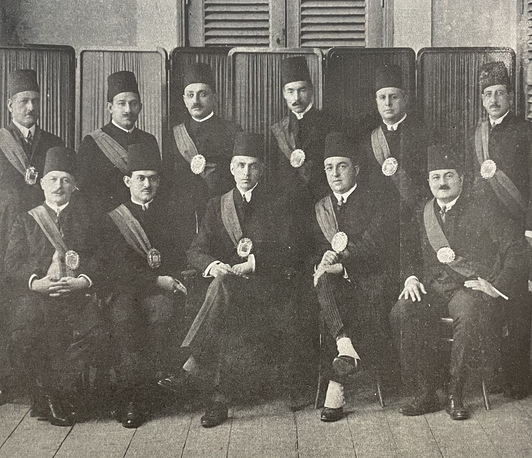
How did the Mixed Courts of Egypt impact legal knowledge and societies on both sides of the Mediterranean? 150 years after these once highly influential institutions heard their first cases, the Max Planck Institute for Legal History and Legal Theory will dedicate a workshop to this question.
The event will take place in Frankfurt am Main on 23-24 February 2026. It is organized by Dr. Michel Erpelding, head of the newly constituted Max Planck research group ‘The hidden heritage of the European Union: the legacy of the law of the League of Nations’, and Mrs Aya Bejermi, whose work as a researcher within that group focusses on mixed courts established in semi-colonial contexts.

Topics of interest
The organizers have issued a call for papers (available in three languages) inviting submissions on topics such as the normative production and environment of the Mixed Courts, their relation to the political context during the time of their operation, and the sociology of actors involved with them.
The call welcomes papers based on archival sources and/or on doctrinal writings and the case law of Mixed Courts.

Submission details
Abstracts of no more than 500 words, written in English, French or Arabic and including the author’s name, e-mail address and a short curriculum vitae, should be submitted to erpelding@lhlt.mpg.de by 1st July 2025. Successful applicants will be notified via e-mail by 1st September 2025 and are expected to produce a summary draft paper by 31st January 2026.
The event will be held in person with no conference fee. Financial support for travel and accommodation is available. For more information, please contact Dr. Michel Erpelding.

04 December 2024

CALL FOR PAPERS: W G Hart Workshop 2025: Regulating the Global Movement of Care (London: Institute for Advanced Legal Studies, 11-12 JUN 2025); DEADLINE 6 JAN 2025

Call for Papers


W G Hart Workshop 2025


Regulating the Global Movement of Care


Institute for Advanced Legal Studies, London

11-12 June 2025


We invite abstracts (of 250-300 words) for the 2025 W G Hart Workshop focusing on the role of law in regulating the global movement of care. Given the historical and contemporary significance of the issue of the movement of carers, we welcome abstracts that explore the legal regulation of care (including comparative and international aspects) through the lens of a variety of disciplines: law, history, anthropology, politics, sociology, criminology, and creative arts.


The Workshop is organised around four themes – precarity, advocacy, protection, and kinship networks (see below) – reflecting the varied facets through which law’s role in regulating the movement of care can be examined. Care is broadly defined and includes healthcare, social care, domestic care, as well as unpaid care. Legal requirements often create precarity by imposing stringent professional regulatory standards on migrant care workers or permitting the claw back of visa fees. Law may also be a tool in the hands of carers and individuals and organisations who support them to battle against exploitation. Legal regulation may, in some instance, offer protection to migrant care workers. Law, in particular immigration requirements, can also define relationships between migrant carers and their broader kinship networks both in their host countries and in the countries that they come from.


Abstracts should be emailed to adrienne.yong@city.ac.uk and p.saksena@leeds.ac.uk by 5pm on Monday, 6 January 2025. Please also include a brief biography of the speaker in the submission. Further details on the workshop themes are included below.


Academic Directors:


Dr Adrienne Yong (City St George’s, University of London)

Dr Priyasha Saksena (University of Leeds)

Dr Amanda Spalding (University of Leeds)

Dr Amrita Limbu (University of Leeds)

Professor Marie-Andrée Jacob (University of Leeds)


Keynotes:


Professor Eram Alam (Harvard University)

Professor Majella Kilkey (University of Sheffield)


Plenaries:


A lived experiences panel featuring care workers and supporting organisations and individuals

A creative arts panel featuring Dr Ella Parry-Davies (King’s College London) and collaborators in research on performance as method with migrant domestic workers


Travel and Accommodation Bursaries:


The W G Hart Workshop supports and encourages the participation of ECRs (within 5 years of PhD) and PhD students. If you require support for travel and accommodation to attend the workshop, please provide an indication of this when you submit your abstract with confirmation (e.g., by a statement on letterhead from your Head of School) that you either do not have access to other sources of funding or any funding you have is likely to be insufficient.


Workshop Themes:


Theme 1: Precarity

Precarity is present throughout many aspects of the global movement of carers. Institutionally, migration itself is a process filled with uncertainty – migrants, employers, and lawyers have all reflected on the various uncertainties of applying to migrate or sponsor migration. For individuals, the very nature and structure of this form of migration – which generally operates through sponsorship arrangements where their residence is tied to their employer – leaves them very vulnerable to precarious working conditions. This insecurity may be created or exacerbated by both legal and illegal practices such as “debt bondage”, repayment fees or misleading promises. Beyond the working and living conditions, care professionals (including healthcare professionals) are regularly confronted with the precarity of their professional identity. Moreover, the very use of migration to plug gaps in local care work shortages creates a different kind of precarity – the uncertainty of the system in the long run: whether it is a sustainable approach, whether the immigration policies will remain in the long-run, and especially what recruitment means for care work performed in sending countries. All the above issues may also intersect with various other characteristics such as race, class, and gender to further entrench insecurity and create new forms of it. Under this theme, we seek to examine the various forms of precarity created or exacerbated by the global movement of care to identify areas for improvement or regulation as well as to better understand the lived experience of those who participate in this system.


Theme 2: Advocacy

The global movement of care has become a field stimulating relationships between the state, various charities, and other bodies at the local, national, and international level. Networks of stakeholders organise themselves around the goals of resolving the crisis of care and workforce shortages via the NHS, associated charities, and private agencies. The World Health Organisation calls upon states to follow its code of practice on ethical international recruitment to avoid depleting sending countries of their healthcare workforce, and recommends the examination of fairness, efficiency, and transparency of governance safeguards, including those related to the oversight of the management of health and social care workforce. Despite this flurry of organisational activities and ample media attention, the experiences of carers themselves and those advocate on their behalf remain too often ignored. Under the theme of advocacy, we pay attention to various ways with which social movements, activism and lobbying are central to the ecology of global movement of carers. From the #lifttheban campaign to give people seeking asylum the right to work, to journalists documenting modern slavery within international recruitment, to professional associations supporting healthcare professionals from specific community or country of origin to court litigation, and to more localised informal mechanisms, we wish to examine the various forms and normative directions “advocacy” can take in this field.


Theme 3: Protection

Legal protection underlies the regulation of the movement of carers globally through international and domestic law and policies. There are various intersecting legal provisions that apply to a carer moving across borders, including external migration policies and domestic immigration laws, as well as the protection that these carers are offered before, during and after their moves in their new host territories. The perception of migrants and their journeys across borders have become so polarised that policies attributed to curbing protections are now frequently employed by politicians to gain political favour. This can arguably undermine any real urgent protection that migrants might find themselves in need of. As a large proportion of moving migrant carers in the health and social care sectors often do so with the intention of filling a need in the host territory’s economy, these sectors come under increasing scrutiny in terms of regulation. However, as regulation does not always translate to protection, under this theme, we seek to examine the regimes of protection that are available to migrant carers moving across borders, legal or otherwise, to critically assess the level, extent, and effectiveness of any protection offered, and to evaluate any differentiation that may arise within the legal framework itself. It is importantly not limited simply to legal frameworks of protection, as there is also an understanding that underlying cultural and societal factors also impact on the extent of protection offered and received by carers.


Theme 4: Kinship Networks

In the global movement of care, immigration regimes have primarily focused on the flow of “labour”, largely overlooking the significance of familial considerations. Despite repeated policy adjustments aimed at addressing the shortage of care with foreign workers, care and wellbeing of migrants or their families – whether back home or accompanied – has seldom received attention of policymakers. In fact, family migration, often the privilege of migrants to the West, is now garnering attention from policymakers as a privilege requiring reconsideration or reduction. Raising the minimum income requirements for bringing dependants or imposing restrictions on bringing dependants are commonly adopted measures by migration regimes to control and manage migration. Under this theme, we pay attention to various issues and aspects of family and kinship within the global movement of carers, exploring the implications of regulation on migrants and their families.


More information here.


08 November 2024

WORKSHOP: Online Workshop on Environment, Law, and History convened by Susian BARTIE & David SCHORR (Zoom, 15 NOV 2024)

(image source: Wikimedia Commons)
 

While environmental history and legal history are well-developed fields with dedicated forums for discussion new scholarship, those of us interested in the intersection of these two fields have to date had a harder time meeting up with scholars with similar interests. After successful sessions at last year's conference of the European Society for Environmental History and this past summer's meeting of the World Congress of Environmental History, we will finally be kicking off an ongoing online workshop, in which we will discuss pre-circulated drafts with the authors from around the world. We plan to meet on Zoom a few times a year, for about an hour each time.


Our first workshop session will take place 15 November 2024 at 8 am GMT. We will discuss with David Wilson of the Department of Humanities at the University of Strathclyde his paper, "Towards an Optimum Yield: Science, Technology, and Fisheries Development in Lake Malawi, 1930-1964". The following session, in January 2025, will feature Rebecca McLennan of the UC Berkeley History Department. 


To receive a copy of David's paper and a Zoom link, or to ask to be put on the list for messages about future workshop sessions, please email one of us. 


Best wishes,


Susan Bartie (susan.bartie[at]anu.edu.au)

David Schorr (dschorr[at]tauex.tau.ac.il)


22 January 2024

WORKSHOP: La codification européenne du droit des affaires. Perspectives historiques et contemporaines (Lille: Université de Lille, 5 FEB 2024)


(click on image to enlarge)


Lundi 5 février, 14h

Faculté des Sciences juridiques, politiques et sociales

1 place Déliot, Lille


Victor Simon, professeur à l’Université de Lille

Ouverture de la journée l’étude


Nicolas Cornu-Thénard, professeur à l’Université Paris Panthéon-Assas &

Nicolas Laurent-Bonne, Professeur à l’Université Paris-Est Créteil

Présentation de la revue Tribonien


Pauline Pailler, professeur à l’Université Paris Cité

Les conflits de qualification en droit européen des affaires


Alexis Mages, professeur à l’Université de Bourgogne

Retour sur le(s) discours de la méthode… Idéalisme (F. Cosentini) Vs réalisme (R. Demogue)


Cristina Ciancio, professeur associé à l’Università degli studi del Sannio

La codification commerciale dans le Royaume d'Italie : entre modèles européens et solutions originales


Frank Schäfer, professeur à l’Albert-Ludwigs-Universität

Uniform Code Instead of Divided Codes: Lessons for the Relationship of the Law of Obligations and Commercial Law


Anna Klimaszewska, professeur assistant à l’Uniwersytet Gdanski et professeur invité à l’Universitetet i Oslo

Que peuvent apprendre les créateurs du Projet de Code européen des affaires de plus de 200 ans d'adoption de lois commerciales en Pologne ?


More information: see poster.

17 January 2024

WORKSHOP: Egodocuments in Legal History: Individual Experiences and Memories as Sources of Legal Cultural Change (Turku: Turku Faculty of Law, 8 FEB 2024)

(image source: Wikimedia Commons)

The appreciation of different types of autobiographical writing as historical sources has grown considerably in the last decades. Diaries, travel journals, memoirs and autobiographies describe their authors’ affairs, impressions and emotions. Such egodocuments also include confessions, family genealogies and personal letters.


Some researchers have discovered the possibilities of egodocuments for legal historical research as sources when studying e.g. legal work, law studies, litigation and legal culture more generally. Yet, they are still much underused.

This workshop aims at exploring a variety of early modern and modern egodocuments and demonstrating their potential for legal history research. Despite the fact that egodocuments have rarely been written for legal purposes, they can be used to answer both more traditional and novel research questions in legal history.

We will discuss the uses of such sources in legal history research through examples from various types of egodocuments. During this workshop, we will investigate the range of research topics, questions and methodological issues relating to their use and how they enrich our knowledge of the legal cultures of the past.

Preliminary Program:

10.30 Welcome and some practicalities (Mia Korpiola, Turku)
10.45 The Possibilities of Egodocuments for Legal History Research (Mia Korpiola)
11.15 Discussion
11.30 Lunch
12.30 Case Study 1: Egodocuments and Early Modern Law Studies (Marianne Vasara-Aaltonen, Helsinki)
Discussion
13.10 Case Study 2: Using Egodocuments for Uncovering Nineteenth-Century Legal Work (Elsa Hietala, Turku/Sarka - The Finnish Museum of Agriculture
Discussion
13.50 Coffee
14.10 Case Study 3: Discovering the Lives of the First Swedish Female Lawyers through Egodocuments (Elsa Trolle Önnerfors, Lund)
Discussion
14.50 Introduction to workshop (Mia Korpiola)
15.00 Working in groups
15.30 Presentation of group work
16.00 Final discussion

Venue: Cal2109, Calonia, Caloniankuja 3, University of Turku
For more information, please contact prof. Mia Korpiola, mia.korpiola[at]utu.fi . Registration takes place via the following link: https://konsta.utu.fi/Default.aspx?tabid=88&tap=17539 (incl. dietary requests, allergies).

20 April 2023

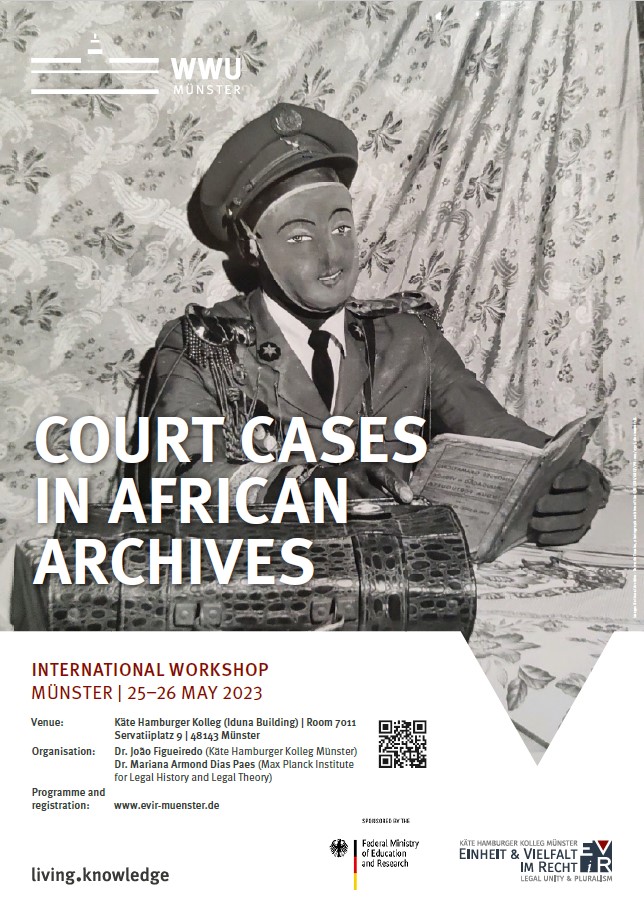
WORKSHOP: Court Cases in African Archives (Münster: Käte Hamburger Kolleg, 25-26 MAY 2023)


(image source: WMU Münster)

Concept:

Africa is usually absent from Global Legal History debates. Working on local archives, with locally produced sources such as court cases, can be a method to overcome this blind spot. Court cases are very privileged historical sources since they show the actual engagement of the local population in disputing the concrete meanings of legal norms and legal categories. They also allow us to understand better the interaction of different normative systems that shaped law and the resolution of conflicts in colonial societies. Court cases abound in Lusophone Africa archives. However, despite the richness of their collections, the documents are often unorganized and unidentified, making it very difficult for the academic community to use them. This workshop addresses the methodological challenges and historiographical opportunities of working with processes held in African archives.

Program:

Thursday, 25 May 2023

14.00 | Welcome and Introduction

14.30 | Section 1

Mariana Armond Dias Paes (Frankfurt am Main) | Court Cases and Legal Pluralism in Portuguese Colonial Africa

Luíz Cabral de Oliveira (Lisbon) | Law in Books vs Law in Action: Félix Correia de Araújo, a Remarkable Angolan Judge in the Late 18th Century

16.00 | Coffee break

16.30 | Section 2

João Figueiredo (Münster) | The Records of “Trials of Gentilic Cases” in the National Archive of Angola (AHA)

Cristina Nogueira da Silva (Lisbon) | Colonial Justice in Mozambique (1915-1954): Preserving and Changing Indigenous Customary Law

18.30 | Dinner


Friday, 26 May 2023

10.30 | Keynote

Benedetta Rossi (London) | Rethinking the Abolition of Slavery in Africa’s Legal History

12.00 | Lunch in the Kolleg

13.00 | Section 3

Esteban Salas (London) | Freedom and Portuguese Legal Anxieties in Benguela at the Turn of the Nineteenth Century

Matheus Pereira (Lisbon) | Legal Processes of Assimilation from below: African Experiences in Mozambique during Portuguese Colonial Exploitation (c. 1900-1960)

14.40 | Coffee break

15.00 | Section 4

Fernanda Thomaz (Juiz de Fora, Brazil) | Power, Discourse and Matrimonial Conflicts in the Production of Court Cases in Northern Mozambique (1930-1950)

Sophie Kotanyi (Berlin) | Contemporary Audio-Visual Archive of Palaver and Treating a Case of Involuntary Kindoki ‘Witchcraft’ by Neutralizing it

16.30 | Final Remarks

17.00 | Farewell and Outlook


More information here.

11 October 2022

WORKSHOP: Verfassungs- und Verwaltungsgerichtshöfe und deren Bedeutung, Praxis im europäischen Vergleich - University of Vienna, 21/22 October 2022


Verfassungs- und Verwaltungsgerichtshöfe und deren Bedeutung, Praxis im europäischen Vergleich


Workshop über die historische Bedeutung und Verwendbarkeit der Rechtspraxis und ihrer Quellen bzw. über die Gerichtsbarkeit als historical agency mit Hinblick auf die heutigen rechtstheoretischen und rechtsdogmatischen Debatten

Veranstalter: Albert-Ludwigs-Universität Freiburg - Hans-Kelsen-Forschungsstelle / Universität Wien - Institut für Österreichische Geschichtsforschung

Veranstaltungsort: Universität Wien, Österreich

Datum: 21. - 22. Oktober 2022

Im Workshop wird die rechtstheoretische Frage nach dem Beziehungsgeflecht von Politik und Recht aus der historischen Perspektive – mit besonderem Fokus auf Oberstgerichte und Schiedsgerichte – diskutiert.

Dieser historische Fokus soll es uns ermöglichen, die Übersetzungsleistungen zwischen Politik und Recht, die Gestaltungsmöglichkeiten sowie Steuerungsfunktion von Recht und die Einflussmöglichkeiten von Politik auf Recht in konkreten-historischen Situationen und mit Bezug auf das institutionelle Setting der Gerichtsbarkeit aus der Perspektive der Rechtsgeschichte zu diskutieren, zugleich die diesbezüglichen, gegenwärtigen rechtstheoretischen und rechtsdogmatischen Debatten in einem größeren historischen Kontext auch geschichtswissenschaftlich neu zu lesen.

Wir fragen dabei nach der gesellschaftlichen Reaktion auf die Rechtspraxis bzw. nach der gerichtlichen Wahrnehmung gesellschaftlicher Konflikte in der Rechtsgeschichte.

- Wie bearbeitete, beantwortete die Rechtspraxis gesellschaftliche Erwartungen?
- Wie wurden und werden die sozialen Erwartungen internalisiert und gerichtlich verrechtlicht?
- Wie wurden und werden politische Themen dabei institutionalisiert und kanalisiert?
- Welche Konflikte lösten gewisse Gerichtsurteile aus?
- Wie produzierte die Rechtspraxis Rechtswissen, welches das heutige Rechtsdenken – in den unterschiedlichen Rechtstraditionen unterschiedlich formuliert und institutionalisiert – prägt?

Im ersten Panel wird nach den rechtstheoretischen und historischen Bedingungen gefragt, die den Oberstgerichten eine unterschiedlich gestaltete Rolle als politische Akteure zuweisen. Diese Frage nach der politischen Rolle vom Recht wird weitergeführt im Blick auf Schiedsgerichte, die auf internationaler Ebene wirtschaftliche und politische Ansprüche in eigenen Verfahren aushandeln und Lösungen entwickeln, die innerhalb der internationalen wie auch der nationalen Gemeinschaft Zustimmung oder Ablehnung findet.

Im dritten und vierten Panel verlagert sich die Diskussion auf einzelne Politikfelder.

Die Diskussion im Panel 3 bezieht sich auf die staatliche Verwaltung (besonders im post-habsburgischen Raum). Die Normgeltung ist besonders in Zeiten politischen und normativen Wandels von hoher Bedeutung. Bezüglich des (post-)habsburgischen Rechtsraumes lässt sich diesbezüglich erfragen: Wie gingen die Nachfolgestaaten mit dem normativen Erbe der Monarchie um? Wie positionieren sie sich zum weitergeltenden österreichischen und/oder ungarischen Recht?

Das letzte (vierte) Panel nutzt die beiden Politik- und Rechtsfelder von Staatsbürgerschaft und Ehe, die an der Schnittstelle von öffentlichem Recht und Privatrecht liegen, als Ausgangspunkt für die Analyse der Übersetzungsleistungen zwischen Politik und Recht in spezifischen politischen und gesellschaftlichen Situationen.

Programm

21. Oktober 2022 (Freitag)

09:00–12:00 Uhr Panel 1: Obergerichte als politische Akteure

Filippo Contarini (Luzern / Paris): Schweiz und ihre gegenwärtige Grundnorm

Péter Techet (Freiburg/Br.): Verfassungsgerichtsbarkeit in der Ersten Republik: Übersetzungsarbeit zwischen Recht und Politik

Kommentar: Lena Foljanty (Wien)

13:00–16:00 Uhr Panel 2: Schiedsgerichte / Privatisierung des Rechts / Tribunalisierung der Politik

Peter Collin (Frankfurt/M): Eine Justizkonstellation ganz eigener Art: Schiedsgerichte und Reichsversicherungsamt in der frühen deutschen Sozialrechtsprechung

Bruno de Lima (Frankfurt/M): Using Administrative Law and Civil Law to Fight Slavery: Luiz Gama's Freedom Claims before Brazilian Police Departments and Judicial Courts, 1860–1888

Kommentar: Miloš Vec (Wien)

16:30–19:30 Uhr Panel 3: Verwaltung – Recht – Politik im posthabsburgischen Rechtsraum

Peter Becker (Wien): Politische Transformationen in der Habsburgermonarchie

Gábor Egry (Budapest): Bruch der Staatlichkeit, Kontinuität des Rechts im post-habsburgischen Siebenbürgen

Jana Osterkamp (München): Rechtspluralismus und Justiz in der Transformationsphase der Tschechoslowakei

Kommentar: Claudia Kraft (Wien)

22. Oktober 2022 (Samstag)

09:00–12:00 Uhr Panel 4: Staatsbürgerrecht und Eherecht(spraxis) als politische Macht- und gesellschaftliche Konfliktfrage

Mark Cornwall (Southampton): Traitors in the Habsburg Rechtsstaat

Benno Gammerl (Florenz): Entscheidungen über Zugehörigkeit im British Empire und in der Habsburgermonarchie

Dominique Kirchner Reill (Miami): Hungarian Marriage Law in Italian Fiume and Its Practice

Kommentar: Franz Fillafer (Wien)

12:00–13:00 Uhr
Abschließender Kommentar zu den Ergebnissen: Thomas Olechowski (Wien)

Enddiskussion

Kontakt

E-Mail: peter.techet@jura.uni-freiburg.de


Quelle: Verfassungs- und Verwaltungsgerichtshöfe und deren Bedeutung, Praxis im europäischen Vergleich. In: H-Soz-Kult, 04.10.2022, <www.hsozkult.de/event/id/event-130082>.


07 October 2022

CALL FOR ABSTRACTS : The Forgotten Foundations of Feminist Legal Scholarship, Part 2: 1985-1995 (London/Zoom, 4 November 2022) (DEADLINE: 16 October 2022)


Via Criticallegalthinking, we learned of this call for paper proposals.

Contemporary feminist legal scholarship appears to have no history and almost no canonical texts. Unlike other fields in the humanities and social sciences, there has been an absence of interest in questions of feminist inheritance in law; a certain unwillingness to grapple with feminism’s intellectual and/or textual traditions. Individual studies, however radical or sophisticated in their orientation, appear to be situated in the ‘feminist present’ only, such that the past of legal feminism is void of any heritage worthy of being handed down. 

Yet despite this disregard or disavowal, contemporary feminist legal scholarship rests on the foundations of a corpus of post-war feminist texts. Those texts’ vital power shaped new, creative, and critical modes of thinking, new routes for understanding and reflection that challenged dominant thought inside and outside the academy. They animated multiple ways of revalorising lived experience and the subject’s embodied nature and in so doing raised radical questions about women’s social being. It is the forgetfulness of these earlier texts that these workshops wish to interrogate. The first workshop, held in Summer 2022, focused on feminist theoretical texts produced (mainly) in the years between 1970-1985. The second workshop, to be held in Autumn 2022, will focus on the body of new feminist, feminist legal, critical race feminist, postcolonial feminist and queer legal scholarship that emerged from the mid-1980s to early 1990s. 

In these two one-day workshops we wish to pose as a problem the present of feminist legal scholarship that has not only lost sight of most of these earlier texts, but has left this disconnection from its past to go entirely unnoticed. It is as if what credits feminist legal scholarship with contemporaneity is precisely the erasure of these earlier texts from its horizon. The questions to be addressed include: what is the position of these texts with regards to the present? How should we think of the feminist (legal) texts of the 1970s-90s today? How should we place our contemporary thought in relation to those texts?  How are we to receive these texts today? Why is it that feminist legal scholarship has developed no feminist canon or classical literature while continuing to reference/reverence the work of white male philosophers? In short, are we to reconnect and reconcile with the rich inheritance that feminist thought and practice of the ’70s, ’80s and ’90s has bequeathed us? Or should we continue to acknowledge as a sign of our contemporaneity the disjunction with our heritage? 

Call for Paper Proposals

Please send proposals of papers for the second workshop to Maria Drakopoulou (m.drakopoulou@kent.ac.uk) and/or Rosemary Hunter (r.c.hunter@kent.ac.uk). Proposals, including title and abstract of 150-300 words, should be submitted by 16 October 2022.

An indicative list of texts is attached although texts outside this list with justifications for inclusion are welcome.

Limited funding for travel costs may be available for research students and early career researchers. If you would need funding in order to attend, please let us know, with approximate cost, as soon as possible.

Workshop Organisers: Maria Drakopoulou and Rosemary Hunter.

Place: London in person + online for participants unable to travel

Date: 4 November 2022

08 December 2021

WORKSHOP: “Regulae iuris and maxims of law in the legal historical perspective” (Online, 21-22 January 2022)


We learned of a workshop on regulae iuris organised at Ghent University (Zoom).

Workshop

Preliminary Programme

21 January 2022 (Friday), 13:00 – 18:00 CET

Organizer:           Dr. Ilya A. Kotlyar

Event Host:         Pr. Dirk Heirbaut

13:00-15:30, First Session

1.       Dr. Ilya A. Kotlyar, “Medieval dialectical method digitizable? Introduction of a research project”

2.       Pr. Gero R. Dolezalek, “Early glossators eagerly searched for “regulae””

3.       David De Concilio, “From loci to regulae. The development of brocards and the Western European legal tradition (c.1160-c.1215)”

4.       Pr. Emanuele Conte, (Coniectio or coniunctio: a philological aspect of the Digest's definition of Regula)

5.       Pr. Paul J. Du Plessis, “A structural investigation of D.50.17 (De diversis regulis iuris antiqui)”.

15:30-16:00, Break

16:00-18:00, Second Session

6.       Pr. David Deroussin, "On the use and usefulness of the regulae iuris in a codified system (France). The example of Dupin âiné".

7.       Pr. Harry Dondorp, “Duorum in solidum dominium esse non posse”

8.       Dr. Emmanuel G.D. van Dongen, “Quod quis ex sua culpa damnum sentit, damnum sentire non videtur”

9.       Pr. James Gordley, “Regulae Iuris and Legal Maxims: Whence and Whither?”

Event Venue:     Zoom (link to be announced)


Persons interested in participating can reach out to Ilya.Kotlyar@ugent.be 

30 September 2020

CALL FOR PAPERS: SLS/BIICL Workshop “Celebrating the Historical Turn: International Law in Global Histories” (25 November 2020, ONLINE) (DEADLINE: Monday 12 October 2020)


(Source: BIICL)

The 29th Society of Legal Scholars (SLS) and British Institute of International and Comparative Law (BIICL) Workshop on Theory and International Law has as its subject “Celebrating the Historical Turn: International Law in Global Histories”. Here the re-opened call for papers:

Over the last two decades, both the role of international law in global history and the history of the discipline of international law itself have increasingly come under scrutiny from critical and often interdisciplinary perspectives that challenge what Slotte and Halme-Tuomisaari call the ‘textbook narrative’, a reading of history as having an ‘internal coherence, logical continuity and seeming comprehensiveness’ (Slotte and Halme-Tuomisaari, 2016). Rather, international law scholars have turned to explore the ‘dark sides’, the ‘hidden histories’ and the counter-narratives to the dominant assumptions about international law’s past as a field and within global history. This ‘historical turn’, or return to history, by international lawyers mirrors a similar phenomenon in other academic disciplines and has brought to the fore the role of international law in instrumentalizing and reproducing the political and economic projects of powerful hegemons and other actors through the twentieth (and earlier) centuries. Studies have explored international law’s role in the history of empire, colonialism, peacemaking, the development of international human rights law and international criminal law, and so on. Others have developed intellectual histories of prominent figures, periods or movements within the discipline. These works often deploy diverse methodologies, including those that aim to de-centre conventional or epochal narratives, for instance by deploying post-colonial or Marxist perspectives. This ‘historical turn’ has also included the increasing use of archival material either to examine the internal perspectives of particular protagonists or to create innovative historical methodologies. As Orford has argued, it marks a ‘turn to history as method, rather than a turn to history in terms of engaging with the past rather than the present’ (Orford, 2017). In celebrating and engaging with this ‘historical turn’, the 29th Society of Legal Scholars (SLS) and British Institute of International and Comparative Law (BIICL) Workshop on Theory and International Law will take place (online) on Wednesday 25th November. The Workshop aims to investigate histories within and of international law, including, but not limited to: the role of international legal argument, norms, or its protagonists in shaping historical events; intellectual histories of disciplinary figures or movements; the role of international legal theory and methodology in historical perspective; the deployment of archival and other empirical methods to shed light on critical moments or challenges in international legal history. In light of the revised timing and format for the event we are re-opening the call for papers. As before, we invite paper proposals which aim to engage with questions on the role of international law in global history from various disciplinary and inter-disciplinary perspectives. In addition to those grounded in legal and historical research, papers that draw insights from other scholarly disciplines, including but not limited to climate science, geography, philosophy, politics or economics are particularly welcome. We particularly welcome papers which employ innovative methods and/or are self-reflexive about methodology. We are pleased to announce that a keynote address will be given by Professor Aoife O’Donoghue (Durham).


Application Process Submission of abstracts is open to academics, including graduate students, and to legal practitioners. Please submit an abstract in Word or PDF of no more than one page to Dr Aisling O’Sullivan (A.O-Sullivan@sussex.ac.uk) and Dr Richard Collins (r.collins@ucd.ie). The following information should also be provided with each abstract: • The author’s name and affiliation • The author’s CV, including a list of relevant publications • The author’s contact details, including email address

The deadline for submission of abstracts is Monday 12th October 2020. Applicants will be informed by Friday 16th October 2020.


All info can be found here