Search

Showing posts with label Ancient law. Show all posts

30 April 2026

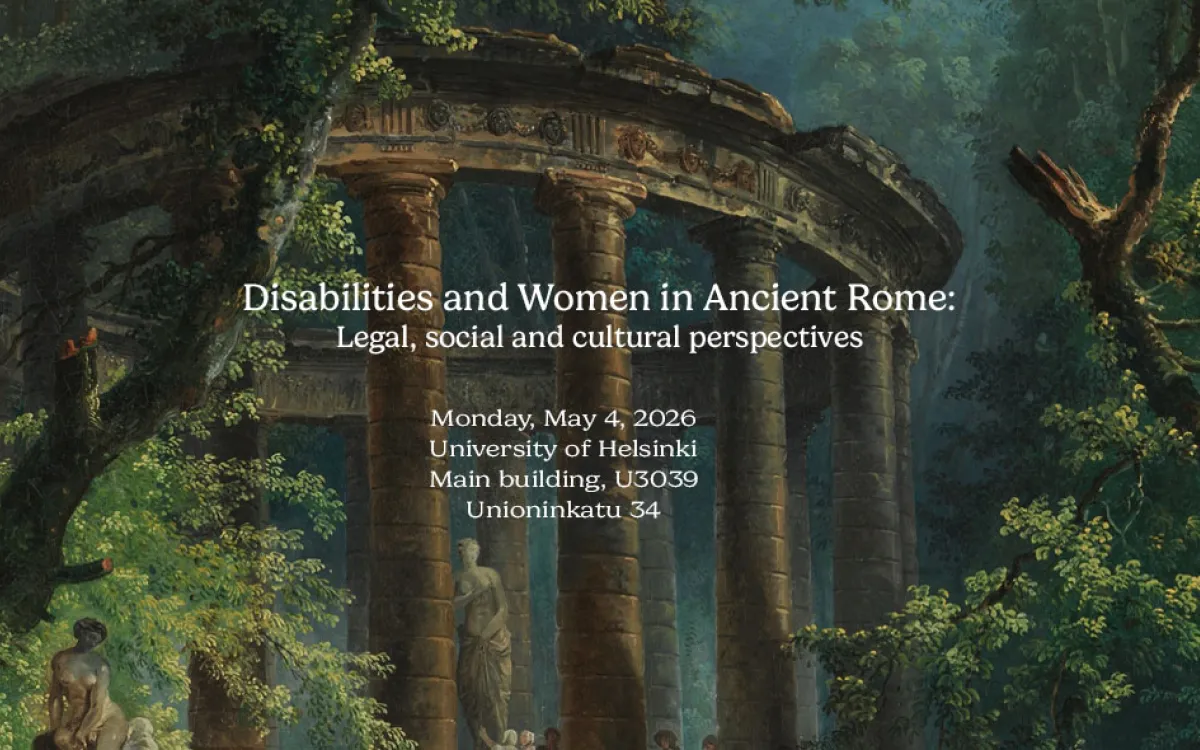
SEMINAR: Disabilities and Women in Ancient Rome: Legal, social and cultural perspectives (Helsinki: University of Helsinki, 4 MAY 2026) [HYBRID]


(image source: UH)

Disabilities and Women in Ancient Rome: Legal, social and cultural perspectives 
 University of Helsinki

Workshop: In-person&Online

In person participation: University of Helsinki, Main Building (Unioninkatu 34), Room U3039 (3rd floor)

Registration through this form

Remote participation: via Zoom (https://helsinki.zoom.us/j/69089076203)

 Monday, 4 May 2026, from 10:00 to 17:30 EEST


Program:

10:0011:15 keynote: Prof. Christian Laes: Women and disabilities in Antiquity: between presentism and daily life 

11:3013:00 session 1: Disabled Women in the Roman Narratives 

Sofia Vierula: The case of Harpaste: Lived experience of disability in Seneca’s letter to Lucilius 

Mathilde Chartrand: The Daily Life of a Furiosa: On the Gendered Consequences of Mental Illness

Fran Geldard: Enslavement and Disability in Eusebian Martyr Narrative

[Lunch] 

14:0015:30 session 2: Women, Disability and Roman Law

Arnaud Paturet: Some Reflections on the Status of Deaf People by Roman Jurists 

Kaius Tuori: Infirmity and monstrosity: on the legal construction of female disability in law

Jana Mauri Marlborough: Against All Odds: The Legal Position of Wet Nurses in Roman Law

[Coffee]

16:0017:30 session 3: Intersections of Gender and Disability in Late Antiquity 

Gaetana Balestra: Muta puella fuit: The Mute Woman between tutela mulierum and Justinian's Legislation.

Elena Pezzato Heck: Mental Illness as Grounds for Repudiation in Late Antiquity and the Justinian Era

Arttu Alaranta: Vulnerable Life-Cycle Moments and Disabilities in Women’s Asceticism during Late Antiquity 

More information is available on UH website. 


13 March 2026

BOOK REVIEW: Clifford ANDO on The Cambridge Comparative History of Ancient Law, edited by Caroline Humfress, David Ibbetson, Patrick Olive (Comparative Legal History, XIII (2025), nr. 2 (December), pp. 315-317)

(Image source: Taylor&Francis)


The Cambridge Comparative History of Ancient Law is a wonderful book. Its very great strengths derive from its unusual history of composition, and the book is at its best when, in one way or another, writers actualize the volume's aspirations most sharply. It is never less than exciting and informative, and the patient collaboration among experts in different fields to which it testifies should be a model for future projects of this kind.

The Comparative History aspires to place ʻNear Eastern, Hellenistic, Greek, Egyptian, Roman, Chinese and Indian source material in conversation with each other’ (xi). To achieve this, the editors assembled teams in ‘roughly’ five working groups: Near Eastern (including Egypt, sometimes, which was also Greek, sometimes, and Roman, sometimes); Greek (including Hellenistic, sort of); Roman; ʻspecialists in ancient “Chinese” material’; and ʻspecialists in ancient “Indian” sources’ (xii). The categories are not tidy. In practice, the Ancient Near East is sometimes represented by Babylonian material and sometimes by Old Testament Hebrew sources. Rabbinic law is treated nearly exclusively in Chapter 6, ʻLaw and Religion’, which seems not only a kind of caricature but also a neglect of recent efforts to describe the Rabbinic project as that of articulating a ʻcivil law’ for the Jews.


To read the full review, please click here. Online access is free for members of the European Society for Comparative Legal History. For further information about the volume on our blog, please visit here

DOI: 10.1080/2049677X.2025.2580106

14 June 2024

BOOK: Caroline HUMFRESS, David IBBETSON & Patrick OLIVELLE (eds.), The Cambridge Comparative History of Ancient Law (Cambridge: Cambridge University Press, 2024), ISBN 9781009452243, € 175,06


(image source: CUPCUP)

Abstract:

The Cambridge Comparative History of Ancient Law is the first of its kind in the field of comparative ancient legal history. Written collaboratively by a dedicated team of international experts, each chapter offers a new framing and understanding of key legal concepts, practices and historical contexts across five major legal traditions of the ancient world. Stretching chronologically across more than three and a half millennia, from the earliest, very fragmentary, proto-cuneiform tablets (3200–3000 BCE) to the Tang Code of 652 CE, the volume challenges earlier comparative histories of ancient law / societies, at the same time as opening up new areas for future scholarship across a wealth of surviving ancient Near Eastern, Indian, Chinese, Greek and Roman primary source evidence. Topics covered include 'law as text', legal science, inter-polity relations, law and the state, law and religion, legal procedure, personal status and the family, crime, property and contract.

On the editors:

CAROLINE HUMFRESS is Professor of History and Co-Director of the Institute of Legal and Constitutional Research at the University of St Andrews, and an L. Bates Lea Global Professor of Law at the University of Michigan Law School. She is a Philip Leverhulme Prize winner and recipient of Il Premio della Corte Costituzionale della Reppublica Italiana (awarded by the Gérard Boulvert Society for the Study of European Civilization). She has published widely on ancient and early medieval law, rhetoric and forensic practice, and their intersections with modern scholarship; DAVID IBBETSON is Regius Professor Emeritus of Civil Law at the University of Cambridge and an Honorary Fellow of Clare Hall, where he was President from 2013 to 2020. He has published widely on the ways in which Roman law influenced (and continues to influence) English law, as well as the way in which Roman law related to other early legal systems; PATRICK OLIVELLE has been Chair of both the Department of Religious Studies at Indiana University, Bloomington, and of the Department of Asian Studies at the University of Texas. He has edited and translated seven early treatises on Indian law, including the Laws of Manu and the legal treatise of Yājñāvalkya. As the author of over thirty books, his works have won awards from the Association for Asian Studies and the American Academy of Religion.

Table of contents:

1. Orientation David Ibbetson
2. Law as text Michael Gagarin, Ernest Caldwell, David Ibbetson, Timothy Lubin, Geoffrey MacCormack, Joseph Manning and Martha T. Roth
3. Legal science Dario Mantovani, Ernest Caldwell, Sophie Demare-Lafont, Caroline Humfress, David Ibbetson, Geoffrey MacCormack, Patrick Olivelle, Robin Osborne, William Tooman, and Bruce Wells
4. War, peace and interstate relations Katelijn Vandorpe, Sophie Démare-Lafont, Geoffrey MacCormack, Mark McClish, Patrick Olivelle and Nicolas Wiater
5. Law and the state Mark McClish, Ari Bryen, Sophie Demare-Lafont, Geoffrey MacCormack and Robin Osborne
6. Law and religion Bruce Wells, Noah Bickart, Donald Davis, Edward Harris, Caroline Humfress, Geoffrey MacCormack, Robin Osborne and Katelijn Vandorpe
7. Legal procedure Patrick Olivelle, Michael Gagarin, Caroline Humfress, Geoffrey MacCormack, Joseph Manning and Bruce Wells
8. Status and family Timothy Lubin, Ari Bryen, Sophie Démare-Lafont, Michael Gagarin, Caroline Humfress, Geoffrey MacCormack and Joseph Manning
9. Crime, redress, and social control Ari Z. Bryen, Timothy Lubin, Geoffrey MacCormack and Robin Osborne
10. Property Joseph G. Manning, Edward Harris, David Ibbetson, Timothy Lubin and Geoffrey MacCormack
11. Commerce and contracts David Ibbetson, Ernest Caldwell, Edward Harris, Geoffrey MacCormack, Joe Manning and Patrick Olivelle
12. Conclusion Caroline Humfress.

Read more here (DOI 10.1017/9781009452243).

16 December 2022

CALL FOR PAPERS: Société Internationale Fernand De Visscher pour l’Histoire des Droits de l’Antiquité, 22 and 23 July 2023

(Source: https://univ-droit.fr/societe-savante/10662-societe-internationale-fernand-de-visscher-pour-l-histoire-des-droits-de-l-antiquite)


Chers collègues et amis,

La 76e session de la Société Internationale Fernand De Visscher pour l’Histoire des Droits de l’Antiquité se déroulera à l’Université d’Helsinki, du 22 au 26 août 2023, sur le thème :

Matérialité et immatérialité dans les droits de l’antiquité 

J'ai ajouté à cette lettre un appel à contributions séparé en cinq langues. Le site web de la conférence, sur lequel toutes les informations seront mises à jour, est déjà disponible à l'dresse https://www.helsinki.fi/en/conferences/sihda-2023. La date limite de réception des propositions est le 3 mars 2023. J'ai également ajouté quelques informations pratiques

à cette lettre.

Des informations sur les événements sociaux et les excursions, ainsi que sur les voyages et les hôtels, seront incluses dans la deuxième lettre circulaire envoyée en février 2023.

Nous nous réjouissons de vous rencontrer à Helsinki!

Cordialement,

Kaius Tuori

l’Université d’Helsinki

kaius.tuori@helsinki.fi


1st Circular letter

Dear colleagues and friends,

The 76th session of the Société internationale Fernand De Visscher pour l’Histoire des Droits de l’Antiquité shall take place at the University of Helsinki on August 22-26, 2023 with the theme:

Materiality and immateriality of ancient law

I have added to this letter a separate call for papers in five languages. The conference website, where all information will be updated, may already be found at

https://www.helsinki.fi/en/conferences/sihda-2023 The deadline for proposals is March 3, 2023. I have also added some practical information to this letter.


Information on the social events and excursions, as well as travel and hotels, will be included in the second circular letter sent in February 2023.

We are looking forward to meeting you in Helsinki!

Sincerely yours,

Kaius Tuori

University of Helsinki

kaius.tuori@helsinki.fi


Practical information

Deadline for proposals is March 3, 2023.

The conference website may be found at https://www.helsinki.fi/en/conferences/sihda-2023

The submission of proposals should be done through our electronic submission system: https://elomake.helsinki.fi/lomakkeet/121213/lomake.html

The languages of the conference are French, English, German, Italian, Latin, and Spanish.

The registration fee will range from 75 euros for doctoral students to 350 euros for last-minute registrations with all dinners and excursions.

The location of the conference is Porthania, the Faculty of Law of the University of Helsinki, Yliopistonkatu 4.

The information about the social program, excursions and hotel reservations, as well as travel suggestions, will be announced in the second circular letter, in February 2023.

The weather in August is usually mild and not too hot.

Will there be a sauna? Yes, there will be opportunities.


Appel à contributions pour la 76ème session internationale de la SIHDA : Matérialité et immatérialité dans les droits de l’antiquité

SIHDA Helsinki 2023, 22-26.8.2023

https://www.helsinki.fi/en/conferences/sihda-2023

email: sihda2023@helsinki.fi

L’étude des droits de l’antiquité se distingue de presque tous les autres domaines du droit dans la mesure où les sources y afférentes se répartissent nettement entre celles qui sont strictement matérielles, locales et casuistiques, par opposition à celles transmises presque exclusivement par une tradition textuelle, et qui se sont répandues au-delà des frontières nationales au fil du temps jusqu’à atteindre une portée presque universelle. Par exemple, le droit romain est connu à travers des sources documentaires provenant de chaque recoin de l’Empire, à partir d’inscriptions et de manuscrits, de tablettes de cire et de papyrus, qui révèlent le droit de la vie quotidienne et la manière dont le droit était utilisé dans la résolution des conflits. Par ailleurs, la compilation par Justinien et autres manuscrits ont permis au droit romain d’exercer une forte influence dans les cultures juridiques ultérieures, s’étendant bien au-delà des frontières de l’Empire romain, dans des lieux comme le Japon ou le continent américain.

L’objectif de cette session est d’explorer les implications de cette dichotomie. C’est pourquoi nous sollicitons des communications qui exposent comment les fouilles archéologiques et l’étude méticuleuse des sources anciennes ont transformé notre idée du droit de l’antiquité, apportant avec elles des idées telles que la diversité ou le pluralisme juridique, mais également des enquêtes sur la manière dont l’acte même de réception et son impact sur les cultures juridiques modernes a subtilement influencé notre compréhension, en particulier, du droit romain antique.

Les mots-clés sont matérialité et immatérialité, la juxtaposition d’un objet matériel comme une inscription et les notions immatérielles du droit et de la jurisprudence.

Dans le cadre du thème de la conférence, nous sommes particulièrement intéressés par des communications qui abordent :

- le rapport entre tradition documentaire et tradition manuscrite sur les droits de l’antiquité, par exemple des analyses juridiques autour du pluralisme juridique sur les disjonctions et les contradictions entre les deux types de sources;

- de nouvelles découvertes, par ex. les sources épigraphiques ou papyrologiques et leur signification; - le rôle des sources matérielles non littéraires dans la compréhension de la tradition juridique de l’antiquité; - l’application des thèmes de la matérialité juridique dans les droits de l’antiquité;

- l’impact de l’écriture et du matériel d’écriture dans le droit et la pratique juridique;

- l’environnement matériel du droit, comme les espaces de création et de pratique du droit, l’archéologie juridique et la symbolique juridique;

- les manières dont la matérialité était conceptualisée dans le droit antique, le droit des choses, la substantialité et la notion de materia;

- réception de la tradition manuscrite du droit antique et la projection d’idées modernes dans les textes de l’Antiquité.


Comme il est d’usage, ces exemples ne sont en aucun cas restrictifs et nous acceptons des propositions sur un large éventail de sujets, pour autant qu’ils aient un lien avec les droits de l’antiquité. Nous attendons des propositions pour des panels thématiques et des communications individuelles. Comme lors des réunions précédentes, un panel de base comportera trois communications de 20 minutes ainsi qu’un débat postérieur, mais nous acceptons également des panels animés par un ou plusieurs responsables. Nous recherchons aussi des propositions thématiques qui transcendent les limites géographiques ou chronologiques. Nous souhaitons également mettre en place quelques nouveaux types de panels ou formes de présentation structurée d’une durée de 90 minutes. Ils incluent le format de table-ronde (1-2 président(s), 3-4 présentateurs avec des présentations de 10 minutes) mettant l’accent sur la discussion, des propositions de panel d’auteurs-lecteurs sur des livres récents importants (1-2 président(s), 3-4 commentateurs) ainsi que des ateliers de compétences/pédagogie (président, 3-4 animateurs) qui se consacrent à l’étude et/ou l’enseignement des droits de l’Antiquité.


Call for papers: Materiality and immateriality of ancient law

SIHDA Helsinki 2023, 22-26.8.2023

https://www.helsinki.fi/en/conferences/sihda-2023

email: sihda2023@helsinki.fi

The study of ancient law is distinguished from nearly all other fields of law in that its sources are divided sharply between sources that are intensely material, local and casuistic as opposed to sources that are transmitted almost exclusively through a textual tradition and which have spread over national boundaries and over time to have an almost global reach. For example, Roman law is known through documentary sources from all around the ancient world, from inscriptions and manuscripts, wax tablets and papyri, telling of the law of everyday life and how law was used in conflict resolution. On the other hand, the Justinianic compilation and other manuscripts have enabled Roman law to have an immense influence in later legal cultures, spreading far beyond the borders of the Roman Empire, to places like Japan or America.

The aim of this conference is to explore the implications of this dichotomy. We invite papers that study how archeological excavations and the meticulous study of ancient sources have transformed our conception of ancient law, bringing with it ideas such as diversity or legal pluralism, but equally investigations on how the very act of reception and impact on modern legal cultures has subtly influenced our understanding of ancient law. The key words are materiality and immateriality, the juxtaposition of a material object such as an inscription and the immaterial ideas of law and jurisprudence. 

Within the theme of the conference, we are especially interested in papers that engage:

- the relationship between documentary and manuscript tradition on ancient law, for instance legal pluralistic analyses on disjunctions and contradictions between the two

- new discoveries in e.g. the epigraphic or papyrological sources and their significance - the role of material, non-literary sources in understanding the ancient legal tradition

- the application of themes of legal materiality in ancient law

- the impact of writing and writing materials in law and legal practice

- the material surroundings of law, such as spaces of creating and practicing law, legal archaeology and legal symbolism

- the ways how materiality was conceptualized in ancient law, the law of things, substantiality and the notion of materia

- reception of the manuscript tradition of ancient law and projections of modern ideas into the ancient materials

As is traditional, these examples are not in any way restrictive and we welcome proposals from a broad range of topics. As always, we welcome proposals that represent the entirety of the ancient world, from ancient Mesopotamia to Late Antiquity. We invite proposals for complete panels and individual papers. As before, a basic panel consists of three papers of 20 minutes and discussion (with a total of 90 minutes), but we also welcome panels with a dedicated commentator or commentators. We encourage thematic proposals that transcend geographic or chronological boundaries.

We are also introducing a few new types of panels or forms of structured presentation for a 90-minute slot. They include the roundtable format (1-2 chairs, 3-4 presenters with 10- minute presentations) with emphasis on discussion, author-meets-readers panel proposals on important recent books (1-2 chairs, 3-4 commentators) as well as skills/pedagogical workshop (chair, 3-4 presenters) that engage in the study and/or teaching of ancient law.


Richiesta di contributi: Materialità ed immaterialità dei diritti dell’Antichità

SIHDA Helsinki 2023, 22-26.8.2023

https://www.helsinki.fi/en/conferences/sihda-2023

email: sihda2023@helsinki.fi

Lo studio dei diritti dell’Antichità si distingue da quello di quasi tutti gli altri campi del sapere giuridico per il fatto che le fonti di tali diritti si dividono in modo netto tra fonti a forte caratterizzazione materiale, locale e casuistica, in opposizione ad altre tràdite quasi esclusivamente attraverso una tradizione manoscritta, la cui diffusione è stata in grado di oltrepassare i confini nazionali e del tempo, sino a raggiungere una portata pressoché globale. Per esempio, il Diritto romano è conosciuto attraverso fonti documentarie provenienti da tutto il mondo antico, che spaziano dalle iscrizioni ai manoscritti, alle tavolette cerate e ai papiri, e sono in grado di raccontare il diritto applicato nella vita di tutti i giorni e di come le regole venissero utilizzate nella risoluzione dei conflitti. D’altro canto, la compilazione giustinianea e altre opere di tradizione manoscritta hanno permesso al Diritto romano di esercitare un’influenza enorme sulle esperienze e le culture giuridiche delle epoche successive, la quale è andata espandendosi ben oltre i confini dell’antico Impero Romano, sino a raggiungere luoghi come il Giappone o l’America.

L’obiettivo di questa conferenza consiste nell’esplorare le implicazioni che la suddetta dicotomia tra le differenti tipologie di fonti comporta. Gli organizzatori invitano, pertanto, coloro che intendano partecipare a presentare ricerche volte ad indagare tanto il modo in cui gli scavi archeologici e lo studio meticoloso delle fonti antiche abbiano contribuito a trasformare le nostre idee sul diritto antico, facendo emergere concezioni quali quelle di diversità e pluralismo giuridico, quanto ed egualmente indagini sul modo in cui la concreta attività di recezione delle fonti e l’impatto da essa avuto sulle culture giuridiche moderne abbia sottilmente influenzato il nostro stesso modo di concepire i diritti antichi.

Le parole chiave sono materialità ed immaterialità, come esse possono essere apprezzate, ad esempio, attraverso la giustapposizione di un oggetto materiale, quale può essere un’iscrizione, e i concetti immateriali di diritto e giurisprudenza.

Nell’ambito del tema generale della conferenza, gli organizzatori sono particolarmente interessati a quelle relazioni che intendano affrontare uno dei seguenti argomenti:

- il rapporto tra tradizione delle fonti documentarie e tradizione manoscritta in relazione ai diritti dell’Antichità, visto ad esempio attraverso analisi in tema di pluralismo giuridico in grado di investigare incongruenze e contraddizioni tra le due tipologie di fonti menzionate

- la scoperta di nuove fonti, ad esempio epigrafiche o papirologiche, ed il loro significato

- il ruolo delle fonti materiali e non letterarie nella comprensione della tradizione giuridica dell’Antichità

- l’impiego di temi concernenti la materialità giuridica nel diritto antico

- l’impatto della scrittura e la rilevanza dei supporti materiali per la scrittura nel diritto e nella pratica legale

- i luoghi materiali del diritto, come, ad esempio, gli spazi dove creare ed esercitare il diritto, l’archeologia giuridica ed il simbolismo giuridico

- i modi in cui la materialità venne concettualizzata nell’Antichità, i diritti reali, la sostanzialità fisica e la nozione di materia

- la recezione della tradizione manoscritta dei diritti antichi e le retroproiezioni di idee e concetti moderni sulle fonti e i materiali del passato

Come da tradizione, gli esempi di tematiche che potranno essere discusse sopra elencati non sono esaustivi, e verranno accolte proposte di relazioni riguardanti il più ampio spettro possibile di argomenti. Come sempre, infatti, gli organizzatori saranno lieti di ricevere proposte per interventi in grado di rappresentare il mondo antico nella sua complessità ed interezza, dalla realtà dell’antica Mesopotamia e sino alla tarda Antichità. Gli organizzatori invitano i potenziali partecipanti a presentare proposte tanto per più interventi strutturati tenuti da un gruppo di relatori, quanto per relazioni singole ed individuali. Seguendo una regola consolidata, nel caso di più interventi strutturati tenuti da un gruppo di relatori su di un dato tema (basic panel) sono previste tre relazioni di 20 minuti ciascuna alle quali poi fa seguito la discussione (per una durata, nel complesso, di 90 minuti), ma gli organizzatori incoraggiano anche serie di interventi tenute da un gruppo di relatori che prevedano poi un confronto con uno o più commentatori appositamente scelti e nominati. Gli organizzatori, altresì, incoraggiano proposte tematiche in grado di trascendere i confini geografici e temporali.

Si è infine deciso di introdurre alcune nuove tipologie di presentazioni di gruppo o comunque strutturare della durata di 90 minuti. Esse includono il formato della tavola rotonda (con 1 o 2 presidenze e 3 o 4 relatori, i quali potranno tenere un intervento di 10 minuti ciascuno), durante la quale dovrà essere dato risalto al momento della discussione, proposte di incontri autori-lettori dedicate a libri di particolare importanza e di recente pubblicazione (1 o 2 presidenze e 3 o 4 commentatori), nonché, da ultimo, seminari di tipo didattico/pedagogico concentrati sulle competenze per lo studio e/o l’insegnamento dei diritti dell’Antichità.


Aufruf für Beiträge: Materialität und Immaterialität des antiken Rechts

SIHDA Helsinki 2023, 22-26.8.2023

https://www.helsinki.fi/en/conferences/sihda-2023

email: sihda2023@helsinki.fi

Die Erforschung des antiken Rechtes unterscheidet sich von fast allen anderen Rechtsgebieten dadurch, dass seine Quellen deutlich in materielle, lokale und kasuistische Quellen unterteilt sind, im Gegensatz zu Quellen, die fast ausschließlich durch eine Texttradition überliefert sind und sich über nationale Grenzen hinweg und im Laufe der Zeit zu einer fast globalen Reichweite verbreitet haben. Das römische Recht beispielsweise ist durch dokumentarische Quellen aus der ganzen antiken Welt bekannt, durch Inschriften und Manuskripte, Wachstafeln und Papyri, die vom Recht des täglichen Lebens und der Anwendung des Rechts bei der Konfliktlösung erzählen. Andererseits haben die justinianische Sammlung und andere Handschriften dem römischen Recht einen immensen Einfluss auf spätere Rechtskulturen verschafft, der weit über die Grenzen des Römischen Reiches hinausging, etwa nach Japan oder Amerika.

Ziel dieser Konferenz ist es, die Auswirkungen dieser Dichotomie zu untersuchen. Wir freuen uns über Beiträge, die untersuchen, wie archäologische Ausgrabungen und das akribische Studium antiker Quellen unsere Vorstellung vom antiken Recht verändert haben, indem sie Ideen wie Diversität oder Rechtspluralismus mit sich brachten, aber auch Untersuchungen darüber, wie der Akt der Rezeption und der Einfluss auf moderne Rechtskulturen unserVerständnis des antiken Rechts subtil beeinflusst hat.

Die Schlüsselwörter sind Materialität und Immaterialität, die Gegenüberstellung eines materiellen Gegenstands wie einer Inschrift und der immateriellen Ideen von Recht und Rechtsprechung.

Im Rahmen der Thematik der Konferenz sind wir besonders an Beiträgen interessiert, die sich mit folgenden Themen beschäftigen:

- das Verhältnis von urkundlicher und handschriftlicher Überlieferung des antiken Recht, z.B. rechtspluralistische Analysen zu Disjunktionen und Widersprüchen zwischen diesen Überlieferungsformen

- neue Entdeckungen z.B. in den epigraphischen oder papyrologischen Quellen und deren Bedeutung 

- die Rolle der materiellen, nicht-literarischen Quellen für das Verständnis der antiken Rechtstradition

- die Anwendung von Themen der juristischen Materialität im antiken Recht

- der Einfluss von Schrift und Schriftgut im Recht und in der Rechtspraxis

- das materielle Umfeld des Rechts, wie z. B. Räume der Rechtsschöpfung und -ausübung, Rechtsarchäologie und Rechtssymbolik

- die Art und Weise, wie Materialität im antiken Recht konzeptualisiert wurde, das Recht der Dinge, Substantialität und der Begriff der materia

- die Rezeption der handschriftlichen Überlieferung des antiken Rechts und die Projektion 11 moderner Vorstellungen in die antiken Materialien.

Wie üblich sind diese Beispiele in keiner Weise einschränkend, und wir begrüßen Vorschläge aus einem breiten Themenspektrum. Wie immer begrüßen wir Vorschläge, die die gesamte antike Welt abdecken, vom alten Mesopotamien bis zur Spätantike. Wir laden zu Vorschlägen für komplette Panels und Einzelbeiträge ein. Wie bisher besteht ein normales Panel aus drei 20-minütigen Vorträgen und einer Diskussion (mit einer Gesamtdauer von 90 Minuten), aber wir begrüßen auch Panels mit einem oder mehreren engagierten Kommentator*innen. Wir ermutigen zu thematischen Vorschlägen, die über geografische oder zeitliche Grenzen hinausgehen.

Wir führen zudem einige neuartige, neunzigminütige Panels oder strukturierte Präsentationen ein. Dazu gehören das Roundtable-Format (1-2 Vorsitzende, 3-4 Referenten mit 10-minütigen Präsentationen), das den Schwerpunkt auf die Diskussion legt, Autor- trifft-Leser-Panelvorschläge zu bedeutenden neueren Büchern (1-2 Vorsitzende, 3-4 Kommentatoren) sowie Kompetenz-/Pädagogik-Workshops (Vorsitzender, 3-4 Referenten), die sich mit dem Studium und/oder der Lehre des antiken Rechts befassen.


Candidatura abierta para la presentación de contribuciones: Materialidad e inmaterialidad del derecho antiguo

SIHDA Helsinki 2023, 22-26.8.2023

https://www.helsinki.fi/en/conferences/sihda-2023

email: sihda2023@helsinki.fi

El estudio del derecho antiguo se distingue de casi todos los demás campos del derecho en que sus fuentes se dividen claramente entre intensamente materiales, locales y casuísticas frente a aquellas que se transmiten casi exclusivamente a través de una tradición textual, y se han extendido más allá de los límites del territorio nacional y a través del tiempo, hasta lograr un alcance casi global. Por ejemplo, el derecho romano es conocido a través de fuentes documentales de todo el mundo antiguo, desde inscripciones y manuscritos, tablillas de cera y papiros, que hablan del derecho de la vida cotidiana y de cómo se usaba la  ley en la resolución de conflictos. Por otro lado, la compilación de Justiniano y otros manuscritos han permitido que el derecho romano tenga una inmensa influencia en las culturas legales posteriores, extendiéndose mucho más allá de las fronteras del Imperio Romano, a lugares como Japón o América.

El objetivo de esta conferencia es explorar las implicaciones de esta dicotomía. La invitación se extiende a trabajos que estudien cómo las excavaciones arqueológicas y el estudio meticuloso de fuentes antiguas han transformado nuestra idea de derecho antiguo, trayendo consigo ideas como diversidad o pluralismo jurídico, pero igualmente, investigaciones acerca de cómo el propio acto de recepción e impacto en las culturas jurídicas modernas ha influido sutilmente en nuestra comprensión del derecho romano antiguo.

Las palabras clave son materialidad e inmaterialidad, en cuanto a la yuxtaposición de un objeto material como una inscripción y las ideas inmateriales del derecho y la jurisprudencia.

Dentro del tema de la conferencia, estamos especialmente interesados en trabajos que incluyan o se centren en:

- la relación entre la tradición documental y manuscrita en el derecho antiguo, por ejemplo, análisis centrados en la óptica del pluralismo jurídico sobre disyunciones y contradicciones entre ambos tipos de fuentes.

- nuevos descubrimientos, p.ej. fuentes epigráficas o papirológicas y su significado

- el papel de las fuentes materiales no literarias en la comprensión de la antigua tradición jurídica

- la aplicación de temas relacionados con la materialidad que afecta el derecho antiguo

- el impacto de la escritura y los materiales de escritura en el derecho y la práctica jurídica

- el entorno material del derecho, como los espacios de creación y práctica del derecho, la arqueología y los símbolos legales

- las formas en que la materialidad fue conceptualizada en el derecho antiguo, la ley de las cosas, la sustancialidad y la noción de materia 

- recepción de la tradición manuscrita de la ley antigua y proyecciones de ideas modernas en los materiales antiguos

Como es tradicional, estos ejemplos no son de ninguna manera restrictivos y damos la bienvenida a propuestas de una amplia gama de temas. Invitamos propuestas para paneles completos y trabajos individuales. Como antes, un panel básico consiste en tres ponencias de 20 minutos y discusión, pero también aceptamos paneles con un comentarista o comentaristas dedicados. Animamos especialmente la presentación de propuestas temáticas que trasciendan fronteras geográficas o cronológicas.

Con ocasión del evento, estamos introduciendo algunos nuevos tipos de paneles o formas de presentaciones estructuradas en espacios de 90 minutos. Incluyen el formato de mesa redonda (1-2 presidentes, 3-4 presentadores con presentaciones de 10 minutos) con énfasis en la discusión, propuestas de paneles de autor y lectores sobre libros recientes importantes (1-2 presidentes, 3-4 comentaristas) así como como taller de técnicas/pedagógico (presidente, 3-4 presentadores) que se dedican al estudio y/o enseñanza del derecho antiguo.

04 June 2020

BOOK: Marianne ELSTER, Die Gesetze der späten tömischen Republik von den Gracchen bis Sulla (133 - 80 v.Chr.) (Göttingen: Vandenhoeck & Ruprecht, 2020). ISBN 978-3-946317-62-3, EUR 70.00


Vandenhoeck & Ruprecht Verlage has published a new collection (including commentary) of laws of the late Roman republican period (133-80 BC).

ABOUT THE BOOK 

Dieser Band bietet erstmals einen umfassenden Überblick über die Gesetzgebung in der späten römischen Republik (133 - 80 v.Chr.). War die Gesetzgebung zuvor noch auf Einzelfälle ausgerichtet, spielte sie zunehmend eine Rolle in innenpolitischen Auseinandersetzungen. Volkstribune wie Tiberius und Gaius Gracchus sahen in ihr ein Mittel, ihre politischen Ziele zu verfolgen. Daher legten sie der Volksversammlung nicht nur einzelne, sondern immer mehrere Gesetze zur Abstimmung vor. Themen wie Acker-, Getreide- und Bürgerrechtsgesetze bestimmten diese Gesetzessammlungen.
Zu jedem Gesetz werden die lateinischen und griechischen Texte zitiert und übersetzt. Ein wissenschaftlicher Kommentar sowie einschlägige Literaturangaben erleichtern zusätzlich den Zugang zu den einzelnen Gesetzen. Ein wertvolles Arbeitsinstrument für alle, die sich mit der römischen Republik, ihrem Recht und ihrer politischen Kultur befassen.

ABOUT THE AUTHOR

Dr. Marianne Elster ist Althistorikerin und lebt in Uelzen.

More info here

28 November 2018

BOOK: Thanos ZARTALOUDIS, The Birth of Nomos (Edinburgh: Edinburgh University Press, 2018). ISBN 9781474442008, $150.00


(Source: OUP)

Edinburgh University Press is publishing a book on the concept of law in ancient Greek philosophy.

ABOUT THE BOOK

Delves into the history of the ancient Greek word nomos (and related words) to reveal the interdisciplinary depth of this term beyond its later meaning of 'law' or 'law-making'

This is a highly original, interdisciplinary study of the archaic Greek word nomos and its family of words. Thanos Zartaloudis draws out the richness of this fundamental term by exploring its many uses over the centuries.

The Birth of Nomos includes extracts from a wide range of ancient sources, in both the original and English translation, including material from legal history, philosophy, philology, linguistics, ancient history, poetry, archaeology, ancient musicology and anthropology. Through a thorough analysis of these extracts, we gain a new understanding of nomos and its foundational place in the Western legal tradition.

ABOUT THE AUTHOR

Thanos Zartaloudis is a Reader in Legal Theory and History at Kent Law School, University of Kent, Kent Law School and Lecturer in History and Theory Studies at the Architectural Association School of Architecture in London.

TABLE OF CONTENTS

List of Abbreviations

Preface: Anthroponomikos

Part I: Homeric Nomos
1. The Nomos of Feasts and 'Sacrifices'
2. Nomos Moiregenes
3. The Nomos of the Land
4. Pastoral Nomos
5. Nemesis

Part II: Post-Homeric Nomos
6. The Nomos of the Post-Homeric Poets
7. The Nomos of Heraclitus
8. Nomos Basileus
9. The Nomos of the Tragedians
10. Nomos Mousikos

Bibliography

More information here

02 October 2018

BOOK: Konstantinos A. KAPPARIS, Athenian Law and Society. (London: Routledge, 2018). ISBN 9781472449184, £125.00


(Source: Routledge)

Later this month, Routledge is publishing a book on Athenian law and society.

ABOUT THE BOOK

Athenian Law and Society focuses upon the intersection of law and society in classical Athens, in relation to topics like politics, class, ability, masculinity, femininity, gender studies, economics, citizenship, slavery, crime, and violence. The book explores the circumstances and broader context which led to the establishment of the laws of Athens, and how these laws influenced the lives and action of Athenian citizens, by examining a wide range of sources from classical and late antique history and literature. Kapparis also explores later literature on Athenian law from the Renaissance up to the 20th and 21st centuries, examining the long-lasting impact of the world’s first democracy.

ABOUT THE AUTHOR

Konstantinos A. Kapparis is UF Research Foundation Professor and Director of the Center for Greek Studies at the University of Florida, USA. He studied with D.M. MacDowell at the University of Glasgow. His research interests include the Attic Orators, Athenian Law, Greek and Roman Medical Authors, Women’s History and Gender Studies, and the Social History of the Graeco-Roman World. He has published a commentary on Apollodoros Against Neaira (and also an expanded Modern Greek commentary of the same speech), a monograph on Abortion in the Ancient World, a large volume on Prostitution in the Ancient Greek World, a co-authored volume entitled Legal Speeches of Democratic Athens, and he has co-edited a collection of the articles of D.M. MacDowell. He has also published a number of articles on topics such as prostitution, citizenship and immigration, gender studies, history of medicine and science, and textual criticism.

TABLE OF CONTENTS

Foreword
Abbreviations
Introduction
The development of Athenian law
Sources of Athenian law
Scholarship on Athenian law and society
Chapter 1. The administration of justice in the Polis
1.1 Sources
1.2 The division of powers in the Athenian Democracy
1.3 The question on the rule of law in the Athenian Democracy
1.4 Accountability of officials and individuals before the law
1.5 Protections of core human rights in Athenian Law
1.6 Open Government in the Athenian Democracy
1.7 Dispute resolution: processes and types of lawsuits
1.8 Blocking an improperly introduced lawsuit
1.9 The "amateurism" of Athenian Law?
1.10 Rules of Evidence and the Rule of Law
1.11 Executive officers of the Athenian State
Chapter 2. Citizens, Metics and Slaves in Athenian Law
2.1. Sources
2.2. Citizenship in the Greek Polis
2.3. Introduction into the Citizen Body
2.4. The rights, privileges and duties of Athenian citizen men
2.5. Metics
2.6. Slaves
2.7. Legal procedures for status disputes
Chapter 3. The Athenian oikos
3.1. Sources
3.2. The oikos and the polis
3.3. The oikos and its members
Chapter 4. The formation and purpose of marriage: wives and concubines
4.1. Sources
4.2. The ever-shifting definition of marriage
4.3. Lawful marriage: types and purpose
4.4. Alternative unions and concubines
4.5. Conclusions
Chapter 5. The continuation of the oikos: inheritance and succession
5.1. Sources
5.2. Succession by natural legitimate sons
5.3. Legitimate daughters and dowry
5.4. Epikleros
5.5. Illegitimate children
5.6. Wills and succession by adopted children
Chapter 6. The oikos in peril: Divorce, adultery, prostitution
6.1. Sources
6.2. Divorce
6.3. Adultery
6.4. Prostitution
Chapter 7. Criminal Justice: Violence and Property Crimes
7.1 Sources
7.2. Assault and slander: violence in Athenian Law and life
7.3. Hybris
7.4. Non-violent conflict resolution: arbitration
7.5. Sexual violence
7.6. Property crimes and disputes
Chapter 8. Religion, the state and the law
8.1. Sources
8.2. The intersection of religion and the law
8.3. State Religion, festivals and the law
8.4. Prosecutions on religious grounds
8.5. Homicide
Chapter 9. The safety net: Protecting those in need
9.1. Sources
9.2. Protecting legal minors and the elderly from abuse
9.3. Providing for Disabled Citizens
9.4. Caring for the elderly
9.5. Income support for the poor and the needy
9.6. The Athenian healthcare system: Medical care and the law
9.7. Conclusions
Epilogue: Athenian law as the voice of the Democracy
Bibliography
Index

More information here

28 June 2018

BOOK: Alex IMRIE, The Antonine Constitution : An Edict for the Caracallan Empire [Impact of Empire] (Leiden/New York: Brill, 2018). ISBN 978-90-04-36822-4, €94.00

(Source: Brill)

Brill has just published a book on the Constitutio Antoniniana.

ABOUT THE BOOK

In The Antonine Constitution, Alex Imrie approaches the famous edict of AD 212 from numerous angles, offering an assessment of its rationale that is rooted in the dynamic period of the early third century. Controversial since its discovery, it is depicted here as a keystone in Caracalla’s attempt to revolutionise the public image of the Severan dynasty after murdering his brother.

There is an inherent paradox between the apparently progressive nature of the edict, and the volatile emperor responsible for it. The enigma is only heightened by a dearth of ancient evidence relating to the legislation. By combining literary and material evidence with the surviving papyrological record, Alex Imrie shows that Caracalla’s rationale is best understood in an embedded context.

ABOUT THE AUTHOR

Alex Imrie, Ph.D. (2015), is a Tutor in Classics at the University of Edinburgh. He divides his time between teaching and outreach activities across Scotland. He has published articles on Caracalla and the Severan period. This is his first monograph.

TABLE OF CONTENTS

Preface
List of Abbreviations
List of Figures, Table and Illustration

Introduction
 The Antonine Constitution in Scholarship
 An Edict for the Caracallan Empire

Contexts
 The Historical Context: 193–212
 The Antonine Constitution in Ancient Literature
 The Role of the Jurists
 The Antonine Constitution and the Giessen Papyrus

The Fiscal Rationale
 Early Imperial Economic Activity
 Decline and Crisis in the High Empire
 The Severan Recovery
 The Economy under Caracalla
 The Economic Function of the Antonine Constitution
 The Vicesima Hereditatum
 The Purpose of Caracallan Fiscal Innovation

The Military Rationale
 Obstacles to Legionary Recruitment
 The Severan Reforms
 The Military Application of the Antonine Constitution

Alexander Imitatio
 Alexandrian Influences in the Antonine Constitution
 Alexander Iconography in the Caracallan Empire
 The Political Significance of Alexander Iconography

Securing the Caracallan Empire
 The Drive for Aequitas
 Re-writing the Severan Past
 A Religious Offering
 The Indulgentissimus Princeps
 A Social Contract

Epilogue

Appendix
 Text, Translation and Commentary of the Giessen Papyrus
Bibliography
Index 

More information with the publisher


08 March 2016

SUMMER SCHOOL: Laws in Antiquity: Law and Legal Systems from Mesopotamia, Egypt, Rome and Byzantium (Amsterdam, 16-30 Jul 2016)


(image source: VU Amsterdam)

Prof. dr. J. Hallebeek (VU Amsterdam) announced the organisation of a summer course aiming at Advanced students of either History or Law; no previous knowledge of the other discipline is required on the subject Laws in Antiquity: Law and Legal Systems from Mesopotamia, Egypt, Rome and Byzantium. The course consists of 46 contact hours (3 ECTS) and comes with a fee of € 1 000.

Course content;
The laws and legal systems governing our lives today have deep historical roots. As early as the third millennium BC, people in Mesopotamia were compiling laws and employing various legal mechanisms. Surviving legal manuals and other sources tell us how the ancient Egyptians regulated sales, loans, donations, marriage and divorce, inheritances and leases. And it was in Roman times that the foundations were laid for the so-called civilian tradition, which still reverberates in the private law of continental Europe, South America and parts of the Far East (Japan, China).
On this course, leading experts on ancient law guide you through the theoretical and historical aspects of these systems and their unique characteristics, focusing on such themes as contracts, delict, property and family law. We begin with general presentations of the different systems, their features and context, before moving on to the study and analysis of exemplary texts (in English translation) in a workshop setting. By the end of the course you will have gained a sense of legal life across several ancient civilizations: the Mesopotamian, Hittite, Egyptian, Roman and Byzantine.
Excursions:
A visit to the Van der Meer-Collection of cuneiform tablets and ancient Near Eastern artefacts at VU University Library and a combined visit to Valkhof Museum (Roman heritage) in Nijmegen and the Roman temples at Elst. (excursion destinations may be subject to change). 
Learning objectives:
  • You will develop a basic sense of the cultural and historical roots of present-day legal reality in Europe and other parts of the world.
  • You will be familiar with the main features of several different legal systems in the ancient world and their cultural background.
  • You will be familiar with cross-cultural research.
  • You will understand the basics of interdisciplinary methodology and thought, in this case combining history and law.
  • You will be familiar with the notion of history, its importance and its relevance to our lives in the present.
Reading material:
Ancient Near Eastern Law Greengus, Samuel (1995), “Legal and Social Institutions of Ancient Mesopotamia”. In: Sasson, Jack M. (ed.), Civilizations of the Ancient Near East (vol. 1), pp. 469-484. New York: Scribner.
Lafont, Sophie (1994), “Ancient Near Eastern Laws: Continuity and Pluralism”. In Levinson, Bernard M. (ed.), Theory and Method in Biblical and Cuneiform Law: Revision, Interpretation and Development, pp. 91-118. Sheffield: Sheffield Academic Press.
Roth, Martha T. (1997), “Introduction”. In: Roth, Martha T. (ed.), Law Collections from Mesopotamia and Asia Minor (second edition), Writings from the Ancient World 6, pp. 1-10. Atlanta: Scholars Press.
Westbrook, Raymond (2003), “Introduction: The Character of Ancient Near Eastern Law”. In: Westbrook, Raymond (ed.), A History of Ancient Near Eastern Law, Handbuch der Orientalistik 72, pp. 1-90. Leiden: Brill.
Ancient Egyptian Law Selected chapters in: Westbrook, Raymond (ed.) (2003), A History of Ancient Near Eastern Law. Leiden: Brill.
In Vol. I:
Jasnow, Richard , “Old Kingdom and First Intermediate Period”, pp. 93 et seq. (optional);
Jasnow, Richard , “Middle Kingdom and Second Intermediate Period”, pp. 255 et seq. (optional);
Jasnow, Richard , “New Kingdom”, pp. 289 et seq. (mandatory).
In Vol. II:
Jasnow, Richard, “Third Intermediate Period”, pp. 777 et seq. (mandatory);
Manning, Joseph Gilbert, “Demotic Law”, pp. 819 et seq. (mandatory).
Materials on Roman and Byzantine law to be announced at a later date. 
 Apply here.
 Course flyer available here.

29 March 2015

BOOK: " “The Best in the West”: Educator, Jurist, Arbitrator: Liber Amicorum in Honour of Professor William Butler" ed. Erpyleva N. Iu., Gashi-Butler M.E. (2014)

The Best in the West”: Educator, Jurist, Arbitrator: Liber Amicorum in Honour of Professor William Butler

Natalia Iu ErpylevaMaryannn Gashi-ButlerWildy, Simmonds & Hill, Publishers, 2014

All information here

Concepts of Justness in Aristotle and Cicero are analysed. Both follow formal approach to Justness, proper to legal science. Looking for model of moral perfection and dignity Cicero appeals to the findings of Quintus Mucius Scaevola (II-I BC), founder of European legal science, who revealed the nature of just in proper application of formal equality (bonum et aequum). For Roman lawyers just person was a person that was following a model of a 'vir bonus' (good man). Abstract qualities of a good man were products of law and at the same time elemenst of legal system. The very conformity to the principles of law makes a participant of legal interaction 'good man'. Abstract notion of 'aequity' (justness) was seen as a source of law. In Byzantine times 'aequity' became a quality of the Emperor, while the just nature of law was substituted by 'justness' of the ruler. Some scholars connect the abstraction of 'aequity' with this new approach and deem Roman law texts corrupted in later times. However, the authenticity of the traditional texts can be proved.

26 October 2014

ARTICLE: "Roman Business Associations", by Andreas M. Fleckner


Roman Business Associations, by Andreas M. Fleckner,  Max Planck Institute for Comparative and International Private Law,  forthcoming in Roman Law and Economics, ed. Giuseppe Dari-Mattiacci.

Download the article here
Abstract

Roman businessmen could choose between three legal forms for joint business ventures: the societas, the societas publicanorum, and the peculium of a commonly held slave. None of these forms led to larger firms with publicly traded shares. The high level of instability is one of the key explanations: it was difficult under Roman law to commit capital in the long term and finance capital-intensive enterprises. Thesocietas was inevitably liquidated following numerous dissolution events. Members could withdraw their money at any time; their private creditors were not barred from seizing common assets. The peculium was even more unstable: in addition to the dissolution events of the societas, the joint venture came to an end and all peculiumitems reverted back to the masters if the commonly held slave died. The societas publicanorum developed into a more stable institution over time. During the same period, however, its business almost disappeared. Why did Roman law fail to provide organizational forms that allowed businessmen to form large associations and commit capital in the long term? A closer analysis of Roman society suggests that reservations in the social and political setting rather than economic factors or oddities of Roman legal doctrine caused business associations to remain small and unstable. This is an important lesson from history, both for the theory of the firm and for the role that law plays in it.