Search

Showing posts with label Ancient Greece. Show all posts

13 July 2026

BOOK: Jesse JAMES, Laws of All the Greeks. International Law as Social Reality in Ancient Greece [The History and Theory of International Law, eds. Nehal BHUTA, Francesca IURLARO, Anthony PAGDEN & Benjamin STRAUMANN] (Oxford: OUP, 2026), 456 p. ISBN 9780197838525, 130 GBP


(image source: OUP)

Abstract:

The ancient Greek world was permeated with international law, the binding rules of behavior that Greeks across the Mediterranean followed and enforced for centuries. But why was international law effective in this world? Laws of All the Greeks offers an original answer rooted in contemporary social theory, presenting a definitive account of ancient Greek international law while delving into the social and psychological foundations that made it potent and durable. Challenging recent claims that international law did not exist in the Greek world, Laws of All the Greeks makes a robust case not only for its existence, but for the importance of taking ancient Greek international law as an historical subject in the first place. It provides an updated history of select elements of that law, including the right to private self-help; judicial treaties known as symbola; and piracy. Combining the findings of recent scholarship on Greek history, identity, and social networks, novel readings of documentary and literary sources, and the lessons of sociology and psychology, Jesse James demonstrates how the webs of identity binding the Greek world together affected both the rules of international law and their effectiveness at guiding legal and economic behavior. This study thus complicates and enriches prevailing approaches that emphasize formal institutions, structural features, or economic rationalism, offering instead a model for applying legal sociology to the historical study of international law.

Table of contents:

Part I. Background and Framework
1:Introducing Greek International Law
2:The Reality of Greek International Law
3:Psychology, States, and International Legal Socialization
4:International Identity and Socialization in Ancient Greece
Part II. Syla and Symbola: International Law and Commerce
5:Syla: Approaching Legal Self-Help in the Greek World
6:Syla as Self-Help in Greek International Law
7:Symbola: Social Origins of a Legal Institution
8:Symbola from the Athenian Empire to the Hegemony of Rome
Postscript
Part III. Expanding the View
9:Piracy
10:Oaths
11:The Thessalian Koinon as an International Legal Structure

12:Conclusion

On the author:

Jesse James is a historian, lawyer, and Classicist. He earned his J.D. at the University of California, Berkeley School of Law and practiced law for several years in Manhattan, litigating disputes at state, federal, and international levels. He then earned his Ph.D. in Classics at Columbia University. He has held fellowships at Harvard Law School, the American School for Classical Studies at Athens, the Columbia Institute for Ideas and Imagination in Paris, and the Kommission für Alte Geschichte in Munich.

Read more here.


24 November 2021

BOOK: Luciano CANFORA, Tucidide e il colpo di stato (Bologna: Il Mulino, 2021). ISBN: 978-88-15-29252-0, pp. 320


(Source: Il Mulino)

ABOUT THE BOOK

«E nessuno degli altri cittadini per paura faceva più opposizioni, vedendo che i partecipanti alla congiura erano tanti; ma se anche qualcuno si opponeva, subito moriva in un modo inopportuno, e non si indagava sui colpevoli né si punivano i sospetti, ma il popolo se ne stava tranquillo ed era così atterrito che chi non subiva alcuna violenza già riteneva di fare un guadagno, anche se era costretto al silenzio».
Accade di rado che uno storico si trovi immerso nel cuore di una rivoluzione e ne esca vivo. È quanto capitò a Tucidide, nell'anno 411 a.C. Mentre era impegnato nella scrittura, in tempo reale, della interminabile guerra che condusse al tracollo l'impero ateniese, lo storico si trovò coinvolto nel fuoco della effimera e sanguinosa rivoluzione oligarchico‐radicale che mirava a stroncare lo strapotere popolare e a chiudere il conflitto abbracciando il nemico, assunto come modello e come alleato. Nel bel mezzo della crisi, Tucidide poté dar vita a questo caso unico della storiografia antica, e non solo: la rivoluzione raccontata dall'interno e dall'osservatorio privilegiato delle più riservate posizioni di comando. I misteri e i retroscena di quella vicenda sono qui disvelati nelle pagine di Luciano Canfora.


 ABOUT THE AUTHOR

Luciano Canfora nato a Bari (1924), è ordinario di Filologia greca e latina presso l’Università di Bari. Laureatosi in Storia romana, ha svolto il perfezionamento in Filologia classica alla Scuola Normale di Pisa. Assistente di Storia Antica, poi di Letteratura Greca, ha insegnato anche Papirologia, Letteratura latina, Storia greca e romana. Fa parte del Comitato scientifico della “Society of Classical Tradition” di Boston e della Fondazione Istituto Gramsci di Roma. Dirige la rivista «Quaderni di Storia» e la collana di testi “La città antica”. Fa parte del comitato direttivo di «Historia y critica» (Santiago, Spagna), «Journal of Classical Tradition» (Boston), «Limes (Roma)». Ha studiato problemi di storia antica, letteratura greca e romana, storia della tradizione, storia degli studi classici, politica e cultura del XX secolo. Molti dei suoi libri sono stati tradotti in USA, Francia, Inghilterra, Germania, Grecia, Olanda, Brasile, Spagna, Repubblica Ceca.


TABLE OF CONTENTS

Un doveroso chiarimento
I. Gli aspetti materiali
II. Antifonte e il suo doppio
III. Tucidide di fronte al colpo di Stato
IV. Sul pensiero politico di Tucidide
V. L’ambigua critica oligarchica della «democrazia realizzata» ateniese: un caso di «sovversivismo delle classi dirigenti»
VI. Un’impresa «grande»: abbattere la democrazia
VII. Una cronaca in presa diretta
VIII. Il paradosso di Frinico: Tucidide tra Samo e Taso
IX. Il punto di osservazione di Tucidide
X. Chi uccise Frinico?
XI. Cronaca dall’interno della sala del Consiglio: lo scontro finale
XII. È incauto screditare il racconto tucidideo
XIII. Restaurazione e resa dei conti giudiziaria
XIV. La condanna di Antifonte
XV. Lo storico nella rivoluzione
Appendici
Tucidide, La guerra del Peloponneso (VIII, 45-98)
Abbreviazioni
Indice dei nomi e dei personaggi


More information with the publisher.

29 June 2020

BOOK: Lorenzo GAGLIARDI & Laura PEPE (Eds.), Dike. Essays on Greek Law in Honor of Alberto Maffi (Milano: Giuffrè Francis Lefebvre, 2019). ISBN: 9788828803034, pp. XX-396, € 40,00

Dike


ABOUT THE BOOK

The essays collected in this volume are meant to honor of Alberto Maffi, two years after his retirement. They are all on Greek law, the subject to which professor Maffi has devoted most of his life and scholarship. The papers, whose authors are among the most eminent scholars from all over the world, deal with the main topic of ancient Greek law (private law, criminal law, constitutional law), and range from archaic and hellenistic Greece to Egypt in Roman times. The title of this Festschrift, Dike, celebrates the first international review in Greek and Hellenistic law that Alberto Maffi established, together with Eva Cantarella, twenty years ago.

ABOUT THE EDITORS

Lorenzo Gagliardi is associate professor at the Department of Private Law and Legal History, Università degli Studi di Milano.
Laura Pepe is research fellow at the Department of Private Law and Legal History, Università degli Studi di Milano.


More information available with the publisher.

11 March 2020

BOOK: Michael GAGARIN, Democratic Law in Classical Athens (Austin: University of Texas Press, 2020). ISBN 978-1-4773-2037-2, $45.00


University of Texas Press has published a new book on law in classical Athens.

ABOUT THE BOOK

The democratic legal system created by the Athenians was completely controlled by ordinary citizens, with no judges, lawyers, or jurists involved. It placed great importance on the litigants’ rhetorical performances. Did this make it nothing more than a rhetorical contest judged by largely uneducated citizens that had nothing to do with law, a criticism that some, including Plato, have made?

Michael Gagarin argues to the contrary, contending that the Athenians both controlled litigants’ performances and incorporated many other unusual features into their legal system, including rules for interrogating slaves and swearing an oath. The Athenians, Gagarin shows, adhered to the law as they understood it, which was a set of principles more flexible than our current understanding allows. The Athenians also insisted that their legal system serve the ends of justice and benefit the city and its people. In this way, the law ultimately satisfied most Athenians and probably produced just results as often as modern legal systems do. Comprehensive and wide-ranging, Democratic Law in Classical Athens offers a new perspective for viewing a legal system that was democratic in a way only the Athenians could achieve.

ABOUT THE AUTHOR

Michael Gagarin is the James R. Dougherty, Jr. Centennial Professor of Classics Emeritus at the University of Texas at Austin. His books include, most recently, The Laws of Ancient Crete, c. 650–400 BCE (with Paula Perlman).

TABLE OF CONTENTS

Preface
Introduction
Chapter 1. Democracy
Chapter 2. Performance
Chapter 3. Negotiation
Chapter 4. Rhetoric
Chapter 5. Rules and Relevance
Chapter 6. Justice
Chapter 7. Public Interest
Chapter 8. The Rule of Law
Conclusion
Bibliography
Index Locorum
General Index

More info here

30 August 2019

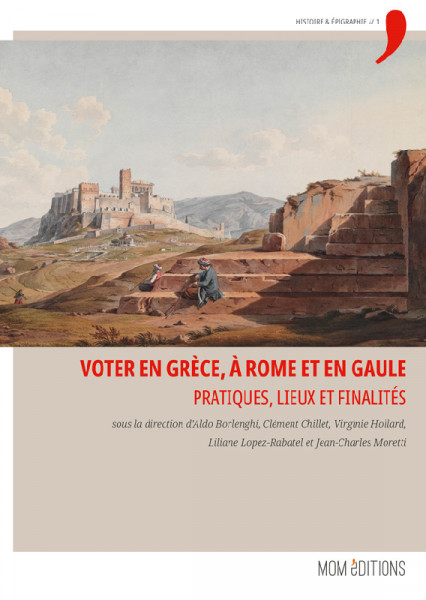
BOOK: Aldo BORLENGHI et al., eds., Voter en Grèce, à Rome et en Gaule : Pratiques, lieux et finalités (Lyon: MOM Editions, 2019). ISBN 978-2-3566-8062-4, €50,00


MOM Editions has published an edited collection on voting and voting systems in Ancient Greece, Rome and Gaul.

ABOUT THE BOOK

Dans ses aspects aussi bien théoriques que matériels, le système du vote dans les mondes grec et romain a depuis longtemps été exploré au sein d'études plus générales sur les institutions ou les différents types de régimes politiques. Il n'a cependant jamais fait l'objet de publications réunissant à la fois les témoignages textuels et les résultats des fouilles archéologiques, dans l'optique d’une compréhension globale de cette pratique.

De ce constat est né le projet d’une synthèse portant sur les modalités, les lieux et les finalités du vote en Grèce, à Rome et en Gaule, dans une perspective comparatiste. Menée dans le cadre d’un programme de recherche interdisciplinaire soutenu par l’université Lumière Lyon 2 et la Maison de l’Orient et de la Méditerranée, cette recherche a suscité, selon les régions et les périodes concernées, des questionnements spécifiques mais elle a aussi fait émerger des points de convergence.
La collaboration de chercheurs issus de plusieurs disciplines – l’histoire, la philologie et l’archéologie – a permis de cerner la pratique du vote à travers ses implications politiques, ses modalités procédurales et la place qui lui a été réservée dans l’espace civique par les différentes sociétés antiques qui l’ont mise en œuvre.

Le présent ouvrage, qui présente une synthèse sur chacune des aires géographiques étudiées et rassemble vingt et une contributions issues de séminaires ou de journées d’études qui se sont tenus à Lyon, à la Maison de l’Orient et de la Méditerranée, de la fin de l’année 2012 au printemps 2014, propose une approche inédite de l’acte de vote dans l’Antiquité.

TABLE OF CONTENTS

Préface
Première partie – Le monde grec
Liliane Lopez-Rabatel
Introduction
Liliane Lopez-Rabatel
Le vote dans le monde grec, procédures et équipement
Marcel Piérart
Ni anarchie ni despotisme. Les élections du Conseil dans la cité des Lois
Christine Mauduit
Le suffrage d'Athéna : réflexions sur le vote dans la tragédie grecque
Enzo Lippolis
Riunioni, operazioni di voto e agoni nell'agorà di Atene
Jean-Charles Moretti
La Pnyx, lieu de vote
Deuxième partie – Le monde romain
Clément Chillet, Virginie Hollard
Introduction
• Les procédures
Dominique Hiébel
Les élections romaines, emblèmes de la souveraineté populaire ou artifices politiques de l'oligarchie ?
Xavier Dupuis
Les curies électorales dans les cités provinciales, une évolution du modèle romain ?
Frédéric Hurlet
Le tirage au sort dans les cités de l’Occident romain
Michel Tarpin
La paperasse avant le papier : enregistrement, déclarations, identité, contrôles à Rome
• Les lieux
Yann Bertelet
Templa de majesté et conception du vote à Rome
Michel Humm
Les espaces comitiaux à Rome pendant la période républicaine
Clément Chillet
Le comitium comme lieu de vote à Rome : une relecture
Aldo Borlenghi
Les installations de vote dans les villes d’Italie : état de la question sur les assemblées électorales dans l’aire du forum
• Les finalités
Gilles van Heems
Le suffrage archaïque : vote et assentiment populaire en Étrurie et à Rome à l’époque des rois et des tyrans
Virginie Hollard
Étude sur la nominatio dans les élections des magistrats de Rome. Éléments apportés à l’histoire d’une étape technique du vote romain et de son évolution entre la République et le régime impérial
Théo Brignoli
La plèbe et le peuple, modalités de l’expression d’organes essentiels de la cité
Troisième partie – Le monde gaulois
Aldo Borlenghi
Introduction
Emilie Mitsakis
Les procédures électorales en Gaule d’après les sources littéraires
Franck Perrin
À la recherche d’un corps civique en Gaule préromaine
Catherine Gaeng, Patrice Méniel, Jeannot Metzler
L’espace public de l’oppidum de Titelberg (L)
Romain Guichon
Des jetons de vote gaulois ? Le petit mobilier circulaire en contexte politico-religieux
Matthieu Poux
Voter dans les sanctuaires en Gaule romaine : espaces architecturaux, indices matériels et cadre institutionnel
Postface
Yves Sintomer
Voter dans l’Antiquit : un regard depuis le XXIe siècle

More info here

12 June 2019

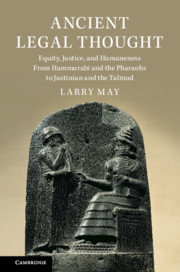
BOOK: Larry MAY, Ancient Legal Thought : Equality, Justice, and Humaneness from Hammurabi and the Pharaohs to Justinian and the Talmud (Cambridge: Cambridge University Press, 2019). ISBN 9781108484107, £110.00


(Source: CUP)

Cambridge University Press has published a new book on legality and the role of law in ancient societies.

ABOUT THE BOOK

This is a study of what constituted legality and the role of law in ancient societies. Investigating and comparing legal codes and legal thinking of the ancient societies of Mesopotamia, Egypt, Greece, India, the Roman Republic, the Roman Empire and of the ancient Rabbis, this volume examines how people used law to create stable societies. Starting with Hammurabi's Code, this volume also analyzes the law of the pharaohs and the codes of the ancient rabbis and of the Roman Emperor Justinian. Focusing on the key concepts of justice equity and humaneness, the status of women and slaves, and the idea of criminality and of war and peace; no other book attempts to examine such diverse legal systems and legal thinking from the ancient world.

ABOUT THE AUTHOR

Larry MayVanderbilt University, Tennessee

Larry May is Professor of Philosophy and Law, Emeritus at Vanderbilt University, Tennessee. He has published thirty-seven books, including Limiting Leviathan: Hobbes on Law and International Affairs (2013), Proportionality in International Law, with Michael Newton, (2014), Contingent Pacifism (Cambridge, 2015), Necessity in International Law, with Jens Ohlin (2016), International Criminal Tribunals, with Shannon Fyfe (Cambridge, 2017), and is editor of The Cambridge Handbook of the Just War (Cambridge, 2017). His books have won awards in law, philosophy, and political science and he has advised the US State Department, the CIA, the NIH, and the International Committee of the Red Cross.

TABLE OF CONTENTS

Part I. Mesopotamia and Egypt: Section 1. Ancient Procedural Law:
1. Ancient legal reasoning
2. Judging, trials, and assemblies
3. Oaths, ordeals, and truth
Section 2. Freedom, Equality, and Legal Status:
4. Debt forgiveness and equity
5. Freedom and slavery
6. Class, legal status, and equality
7. Women's separate sphere
Section 3. Crime and Punishment:
8. Complicity and conspiracy
9. Crime and Lex Talionis
10. Capital punishment
Section 4. International Justice:
11. Ancient treaties and trust
12. Aggressive war and necessity
Part II. Greece and China: Section 5. Law, Justice and Equity:
13. Custom and law in Ancient Greece and China
14. Justice and equity
15. Trial, juries, and democratic assemblies
Section 6. Legal Status:
16. Citizens and aliens
17. Women
18. Slavery and democracy
Section 7. Responsibility and Punishment:
19. Causation and responsibility
20. Homicide and pollution
21. Justification, excuse, and mitigation
22. Hubris and impiety
Section 8. War and Amnesty:
23. Amnesty, sanctuary, and exile
24. Justified war and the law of nations
Part III. India and the Roman Republic: Section 9. Law, Justice and Equity:
25. Law and its sources in Ancient Roman and Indian law
26. Legal procedures and trials
27. Equity and justice
Section 10. Legal Status and Social Class:
28. Legal status of women
29. Social class and slavery
Section 11. Responsibility and Punishment:
30. Political and moral crimes
31. Punishment, cruelty, and humaneness
32. Crimes concerning legal and political abuse
Section 12. War and Treaties:
33. Treaties, hostages, and keeping faith
34. The rules of war and the law of peoples
Part IV. Rabbinic Law and the Roman Empire: Section 13. Justice, Equity, and Conflict of Laws:
35. Law, morality, and religion
36. Dual legal regimes
37. The law and ancient legal scholars
Section 14. Differential Status:
38. Women in Jewish and Roman thought
39. Slaves in Jewish and Roman legal thought
Section 15. Responsibility:
40. Intention and causation in criminal law
41. Injury and murder
42. Public punishment, penal prisons, and police
Section 16. Universal Law at the End of Ancient Times:
43. Universal law and human rights
44. The origins of the just war doctrine
45. Final thoughts on equity, justice, and humaneness.

More information here

24 April 2019

CONFERENCE: Citizenship in Classical Antiquity: Current Perspectives and Challenges (London, 1-3 July 2019)


(Source: UCL)

UCL (in cooperation with the Jagiellonian University) is organizing an international congress on citizenship in classical antiquity.

International conference

The Department of Greek and Latin, University College London, in co-operation with the Department of Classical Philology, Jagiellonian University in Kraków.

1-3 July 2019

University College London
What did citizenship mean in the ancient world, why was it important, and why should it matter to us today? Citizenship has been defined as 'both a set of practices cultural, symbolic and economic) and a bundle of rights and duties (civil, political and social) that define an individual's membership in a polity' (Isin & Wood 1999, Citizenship & Identity), and has existed in various forms since antiquity, holding complex resonances up to the present day. Depending on the socio-political context, a person's citizenship may be a matter of territorial belonging or blood descent; it may offer privileged or exclusive access to resources or participation in communal decision-making; it may provide a sense of group belonging that can be productive and rewarding, but such identification may also be open to discursive redefinitions and manipulation, primarily in public political debate. Citizenship may be connected to certain civic values, though how these are realised in practice may not always be simple. There are those for whom a society's emphasis on citizenship may cause serious problems, such as stateless persons and migrants.

The immediacy of issues surrounding the concept and practice of citizenship in the modern world calls for a re-investigation of the notion in its ancient contexts. Topics of discussions include but are not limited to:

- similarities and differences across Greek, Roman, Near-Eastern, or broader Mediterranean ideas of citizenship;
- insiders' and outsiders' perspectives in considering what citizenship entails (emic vs etic);
- the semantics and varying definitions of 'citizen' and 'citizenship';
- the self-presentation of citizens as a privileged social group;
- citizenship, social change, and social conflict;
- citizenship and the control of resources;
- interactions between citizenship and other (group) identities;
- creating and exploiting citizen identities in discourse;
- the importance and limits of legal definitions;
- civic training and education;
- political participation and majoritarianism;
- the topicality or inapplicability of classical paradigms.

This three-day conference is intended to promote discussion among scholars across different disciplines working on the theme of citizenship in classical antiquity in any capacity. It will include keynote lectures by Prof. Clifford Ando (Chicago), Prof. John Davies FBA, FSA (Liverpool), Prof. Engin Isin (QMUL), Dr Catherine Neveu (CNRS-EHESS), and Prof. Josiah Ober (Stanford), and will also include a public discussion event on the evening of Tuesday 2nd July.

We expect to be able to offer bursaries to assist graduate students in attending the conference.

For any enquires related to the Conference, please email: Jakub Filonik(jakub.filonik@uj.edu.pl) or Christine Plastow (christine.plastow@open.ac.uk)

The full program, as well as more information, can be found here

28 November 2018

BOOK: Thanos ZARTALOUDIS, The Birth of Nomos (Edinburgh: Edinburgh University Press, 2018). ISBN 9781474442008, $150.00


(Source: OUP)

Edinburgh University Press is publishing a book on the concept of law in ancient Greek philosophy.

ABOUT THE BOOK

Delves into the history of the ancient Greek word nomos (and related words) to reveal the interdisciplinary depth of this term beyond its later meaning of 'law' or 'law-making'

This is a highly original, interdisciplinary study of the archaic Greek word nomos and its family of words. Thanos Zartaloudis draws out the richness of this fundamental term by exploring its many uses over the centuries.

The Birth of Nomos includes extracts from a wide range of ancient sources, in both the original and English translation, including material from legal history, philosophy, philology, linguistics, ancient history, poetry, archaeology, ancient musicology and anthropology. Through a thorough analysis of these extracts, we gain a new understanding of nomos and its foundational place in the Western legal tradition.

ABOUT THE AUTHOR

Thanos Zartaloudis is a Reader in Legal Theory and History at Kent Law School, University of Kent, Kent Law School and Lecturer in History and Theory Studies at the Architectural Association School of Architecture in London.

TABLE OF CONTENTS

List of Abbreviations

Preface: Anthroponomikos

Part I: Homeric Nomos
1. The Nomos of Feasts and 'Sacrifices'
2. Nomos Moiregenes
3. The Nomos of the Land
4. Pastoral Nomos
5. Nemesis

Part II: Post-Homeric Nomos
6. The Nomos of the Post-Homeric Poets
7. The Nomos of Heraclitus
8. Nomos Basileus
9. The Nomos of the Tragedians
10. Nomos Mousikos

Bibliography

More information here

02 October 2018

BOOK: Konstantinos A. KAPPARIS, Athenian Law and Society. (London: Routledge, 2018). ISBN 9781472449184, £125.00


(Source: Routledge)

Later this month, Routledge is publishing a book on Athenian law and society.

ABOUT THE BOOK

Athenian Law and Society focuses upon the intersection of law and society in classical Athens, in relation to topics like politics, class, ability, masculinity, femininity, gender studies, economics, citizenship, slavery, crime, and violence. The book explores the circumstances and broader context which led to the establishment of the laws of Athens, and how these laws influenced the lives and action of Athenian citizens, by examining a wide range of sources from classical and late antique history and literature. Kapparis also explores later literature on Athenian law from the Renaissance up to the 20th and 21st centuries, examining the long-lasting impact of the world’s first democracy.

ABOUT THE AUTHOR

Konstantinos A. Kapparis is UF Research Foundation Professor and Director of the Center for Greek Studies at the University of Florida, USA. He studied with D.M. MacDowell at the University of Glasgow. His research interests include the Attic Orators, Athenian Law, Greek and Roman Medical Authors, Women’s History and Gender Studies, and the Social History of the Graeco-Roman World. He has published a commentary on Apollodoros Against Neaira (and also an expanded Modern Greek commentary of the same speech), a monograph on Abortion in the Ancient World, a large volume on Prostitution in the Ancient Greek World, a co-authored volume entitled Legal Speeches of Democratic Athens, and he has co-edited a collection of the articles of D.M. MacDowell. He has also published a number of articles on topics such as prostitution, citizenship and immigration, gender studies, history of medicine and science, and textual criticism.

TABLE OF CONTENTS

Foreword
Abbreviations
Introduction
The development of Athenian law
Sources of Athenian law
Scholarship on Athenian law and society
Chapter 1. The administration of justice in the Polis
1.1 Sources
1.2 The division of powers in the Athenian Democracy
1.3 The question on the rule of law in the Athenian Democracy
1.4 Accountability of officials and individuals before the law
1.5 Protections of core human rights in Athenian Law
1.6 Open Government in the Athenian Democracy
1.7 Dispute resolution: processes and types of lawsuits
1.8 Blocking an improperly introduced lawsuit
1.9 The "amateurism" of Athenian Law?
1.10 Rules of Evidence and the Rule of Law
1.11 Executive officers of the Athenian State
Chapter 2. Citizens, Metics and Slaves in Athenian Law
2.1. Sources
2.2. Citizenship in the Greek Polis
2.3. Introduction into the Citizen Body
2.4. The rights, privileges and duties of Athenian citizen men
2.5. Metics
2.6. Slaves
2.7. Legal procedures for status disputes
Chapter 3. The Athenian oikos
3.1. Sources
3.2. The oikos and the polis
3.3. The oikos and its members
Chapter 4. The formation and purpose of marriage: wives and concubines
4.1. Sources
4.2. The ever-shifting definition of marriage
4.3. Lawful marriage: types and purpose
4.4. Alternative unions and concubines
4.5. Conclusions
Chapter 5. The continuation of the oikos: inheritance and succession
5.1. Sources
5.2. Succession by natural legitimate sons
5.3. Legitimate daughters and dowry
5.4. Epikleros
5.5. Illegitimate children
5.6. Wills and succession by adopted children
Chapter 6. The oikos in peril: Divorce, adultery, prostitution
6.1. Sources
6.2. Divorce
6.3. Adultery
6.4. Prostitution
Chapter 7. Criminal Justice: Violence and Property Crimes
7.1 Sources
7.2. Assault and slander: violence in Athenian Law and life
7.3. Hybris
7.4. Non-violent conflict resolution: arbitration
7.5. Sexual violence
7.6. Property crimes and disputes
Chapter 8. Religion, the state and the law
8.1. Sources
8.2. The intersection of religion and the law
8.3. State Religion, festivals and the law
8.4. Prosecutions on religious grounds
8.5. Homicide
Chapter 9. The safety net: Protecting those in need
9.1. Sources
9.2. Protecting legal minors and the elderly from abuse
9.3. Providing for Disabled Citizens
9.4. Caring for the elderly
9.5. Income support for the poor and the needy
9.6. The Athenian healthcare system: Medical care and the law
9.7. Conclusions
Epilogue: Athenian law as the voice of the Democracy
Bibliography
Index

More information here

09 March 2018

BOOK: Emiliano Jerónimo BUIS, Taming Ares: Interstate Law, and Humanitarian Discourse in Classical Greece [Legal History Library/Studies in the History of International Law, vol. 26/10; ed. Randall LESAFFER] (Leiden/Boston: Martinus Nijhoff/Brill, 2018), ISBN 978-90-04-36382-3, € 125

(image source: Brill)

Book abstract:
In Taming Ares Emiliano J. Buis examines the sources of classical Greece to challenge both the state-centeredness of mainstream international legal history and the omnipresence of war and excessive violence in ancient times. Making ample use of epigraphic as well as literary, rhetorical, and historiographical sources, the book offers the first widespread account of the narrative foundations of the (il)legality of warfare in the classical Hellenic world. In a clear yet sophisticated manner, Buis convincingly proves that the traditionally neglected study of the performance of ancient Greek poleis can contribute to a better historical understanding of those principles of international law underlying the practices and applicable rules on the use of force and the conduct of hostilities.
On the author:
Emiliano Jerónimo Buis, PhD in Classics and Postdoctoral Degree in Law (Universidad de Buenos Aires) is Professor of International Law and Ancient Greek at that university and at UNICEN, as well as researcher at the CONICET in Argentina. He has widely published on the theory and history of international law, ancient Greek literature (especially drama) and Athenian law.
Table of contents:
Foreword   Randall Lesaffer Preliminary Considerations Acknowledgments List of Figures and Maps Introduction  1  Between Ares and Athena  2  In-between Custom and Convenience: Analyzing the Restrictive Discourse of War  3  Towards International Law in the Ancient World: Practices and Contexts  4  Inhumane Acts, Human Words: Analyzing the Restrictive Discourse of War

Part 1: The Concepts

Normativity, Hegemony, and Democratic Performance: The Case of Classical Athens  1  International Normativity, Subordination, and Political Imposition in the Ancient World  2  Justice, Law, Laws and Decrees: The Issue of Terminology  3  Nomothesia: The Act of Legislating  4  Dramatic Competitions and Athenian Festivals  5 Justice as Spectacle in Athens: Judicial praxis  6  The Assembly, the Theater, and the Courts: Performative Activities of Democracy   Summation: Democracy as Performative Ritual 2 Greek poleis and Their International Subjectivity  1  Towards an Archaeology of the Subject: Did Legal Entities Have a Legal Personality in the Greek World?  2  The Role of the polis in the Signing of Treaties during the Peloponnesian War   Summation: International Subjectivity in Ruins

Part 2: The Rules

Ius ad bellum and Its Limits on Inter-polis Law  1  The Rhetoric of the Use of Armed Force in the Greek World  2  The Vocabulary of the Grounds: The Spoken and the Unspoken in Thucydides  3  Considerations on Guilt, Responsibility, Motivation and Encouraging: Helen’s Case  4  Exoneration from the Attack: The Adversary’s Responsibility  5  A ‘Legal’ Rhetoric of Self-Defense?   Summation: Restraining the Use of Armed Force 4 Ius in bello and Its Limits in Inter-polis Law  1  Greek Warfare between Military Necessity and Limitation  2  The Legal Matrix: The Foundations of “Common,” “Universal,” Inter-polis, and Intra-Hellenic Law  3  Geneva in Greece: The nomos of the Greeks with Respect to the Protection of Victims and Practices in Wartime: Humanitarian Limits?  4  The Hague in Greece: The nomos of the Greeks with Respect to the Restriction of Means and Methods of Warfare: Humanitarian Limits?  5 Responding to Atrocity: Prosecution of War Crimes?   Summation: Towards a Framework of Restraint Conclusions: About Apples, Branches, and Humanitarian Strategies Appendix A: Chart of Treaties Signed by Greek poleis during the Peloponnesian War (431–404) Appendix B: Digital Images of Treaties and Decrees Bibliography  1 Ancient Sources (Critical Apparatus of Greek Texts, Translations and Comments)  2 Critical Bibliography  3  Instrumenta studiorum Index

More information with Brill.

10 May 2015

BOOK: "La Démocratie contre les experts. Les esclaves publics en Grèce ancienne" by Paulin Ismard (Paris, March 2015)


La Démocratie contre les experts. Les esclaves publics en Grèce ancienne, by Paulin Ismard


Paris, Le Seuil (L'Univers historique),  mars 2015, 288 p., 20€
all information here

Supposons un instant que le dirigeant de la Banque de France, le directeur de la police et celui des Archives nationales soient des esclaves, propriétés à titre collectif du peuple français. Imaginons, en somme, une République dans laquelle certains des plus grands serviteurs de l’État seraient des esclaves.

Ils étaient archivistes, policiers ou vérificateurs de la monnaie: tous esclaves, quoique jouissant d’une condition privilégiée, ils furent les premiers fonctionnaires des cités grecques. En confiant à des esclaves de telles fonctions, qui requéraient une expertise dont les citoyens étaient bien souvent dénués, il s’agissait pour la cité de placer hors du champ politique un certain nombre de savoirs spécialisés, dont la maîtrise ne devait légitimer la détention d’aucun pouvoir. Surtout, la démocratie directe, telle que la concevaient les Grecs, impliquait que l’ensemble des prérogatives politiques soit entre les mains des citoyens. Le recours aux esclaves assurait ainsi que nul appareil administratif ne pouvait faire obstacle à la volonté du peuple. En rendant invisibles ceux qui avaient la charge de son administration, la cité conjurait l’apparition d’un État qui puisse se constituer en instance autonome et, le cas échéant, se retourner contre elle.

Que la démocratie se soit construite en son origine contre la figure de l’expert gouvernant, mais aussi selon une conception de l’État qui nous est radicalement étrangère, voilà qui devrait nous intriguer.

Author
Paulin Ismard est maître de conférences en histoire grecque à l’université Paris 1 Panthéon-Sorbonne. Il a récemment publiéL’Événement Socrate (Flammarion, 2013, prix du livre d’histoire du Sénat 2014)