This collection of essays, as Luisa Brunori’s introduction explains, explores the legal landscape of merchant institutions from the medieval to the modern periods. The book, which is the third component of the PHEDRA project (‘Pour une Histoire Européenne du DRoit des Affaires’), originates from a colloquium held in Lille (France) in November 2021. A central thesis of the project is that commercial law is inherently supra-national and supra-legal. Commercial law, the volume argues, cannot be understood through analysing national systems alone, nor by merely comparing those systems. Instead, one must look to transnational merchant networks, such as Hanses, nations, trading posts, and factors, to study how business norms influenced and were influenced by formal commercial law.
Search
Showing posts with label Commercial Legal History. Show all posts
06 February 2026
BOOK REVIEW: Emily KADENS on La dynamique juridique des réseaux marchands: Hanses, nations, agences, filiales et comptoirs, edited by Luisa Brunori (Comparative Legal History, XIII (2025), nr. 2 (December), pp. 318-323)
(Image source: Taylor&Francis)
To read the full review, please click here. Online access is free for members of the European Society for Comparative Legal History. For further information about the volume on our blog, please visit here
DOI: 10.1080/2049677X.2025.2580114
13 July 2023
CFP: Workshop 'Sovereignty and Commercial Cities (c. 1400 - c. 1650)' - Tilburg University, 14-15 December 2023 [DEADLINE 1 OCTOBER 2023]
On the 14th and 15th of December a two day workshop will be held at Tilburg University in order to bring together scholars working on urban history, legal history and economic history of the later medieval and early modern period.
The focus of this workshop is the sovereignty of cities of trade. If interested, please send in an abstract of 500 words to d.deruysscher@Tilburguniversity.edu before 1 October 2023.
30 November 2021
BOOK: Dave DE RUYSSCHER, Albrecht CORDES, Serge DAUCHY, Stefania GIALDRONI & Heikki PIHLAJAMÄKI (eds.), Commerce, Citizenship, and Identity in Legal History [Legal History Library, 54, eds. C.H. VAN RHEE, Dirk HEIRBAUT & Mathew C. MIROW] (Leiden/Boston: Martinus Nijhoff/Brill, 2021), 232 p. ISBN 978-90-04-47285-3, € 106
(image source: Brill)
Book abstract:
Legal historians have analysed the characteristics of merchant guilds and nationes (i.e., associations of foreign merchants), as well as the political clout of merchants, including foreign ones. However, how the legal status of citizens related to the merchant class and how its contents were influenced by trade remains largely unclear. Did governments have a policy of citizenship that was tailored to commercial interests? Were foreign merchants belonging to a separate legal category of resident? If so, what defined this category? To what extent could different types of legal status and membership of communities or guilds overlap? And how did all this affect merchants’ identities, their self-images of belonging? This collection of essays provides anwers to these questions.
Table of contents:
Introduction
1 The Bannum in Italian Bankruptcy Law (Fourteenth-Fifteenth Centuries)
Marta Lupi
2 “Without regard to foreignness” The Reciprocal Equal Treatment of Foreign Creditors in the Early Modern German Territories
Remko Mooi
3 Modifying Procedural Practices, Shaping Economic Identities The Middle Class and Negotiated Debt Adjustment in Commercial Courts in Belgium (1883–1914)
Pieter De Reu
4 Citizenship in Early Modern Amsterdam An Artisanal Identity?
Marco In ‘t Veld and Maurits den Hollander
5 The Pareres of the Governors of the Frankfurt Exchange Legal Opinions of Frankfurt Merchants in the Eighteenth Century
Sonja Breustedt
6 Identity, Conflict and Commercial Law Legal Strategies of Castilian Merchants in the Low Countries (Fifteenth–Sixteenth Centuries)
Gijs Dreijer
7 The Learning Market in Early Modern Antwerp (Seventeenth–Eighteenth Centuries) Circulation of Knowledge within the Context of Private Partnership Contracts
Patrick Naaktgeboren
8 Family, Religion, and Business Cooperation Jewish Private Partnerships in Eighteenth-Century Amsterdam
Manon Moerman
9 “Tolerate their religion, but not their usury” Conrad Summenhart on Tolerating Jewish Bankers in an Era of Mass Expulsions
Joost Possemiers
On the editors:
Dave De ruysscher is Associate Professor at the Department of Public Law and Governance at Tilburg Law School, Tilburg University, The Netherlands, and Associate Professor at the Department of Interdisciplinary Studies of Law at the Faculty of Law and Criminology, Vrije Universiteit Brussel, Belgium. Albrecht Cordes is Professor of Medieval and Early Modern Legal History and Civil Law at the Goethe University Frankfurt/Main. His research is especially focused on the history of commercial law, Hanseatic legal history and the history of conflict resolution. Serge Dauchy is Senior Research director at the CNRS and director of the Centre d'Histoire Judiciaire of Lille University, France. He is also Professor at the Faculty of Law of the Université Saint-Louis of Brussels, Belgium. His main research topics are the history of civil procedure, comparative history of central courts and the history of Québec. Stefania Gialdroni is Assistant Professor at the Department of Law at Roma Tre University, Italy. She will soon move to the Department of Private Law and Critical Legal Studies at the University of Padua (Italy), where she has been promoted to the position of full professor. Heikki Pihlajamäki is Professor of Comparative Legal History at the University of Helsinki, Finland, and Academy Professor at the Academy of Finland. He has published extensively on the legal history of Scandinavia, Europe and America, including Conquest and the Law in Swedish Livonia (ca. 1630-1710): A Case of Legal Pluralism in Early Modern Europe (Brill, 2017).
(source: Brill)
04 March 2021
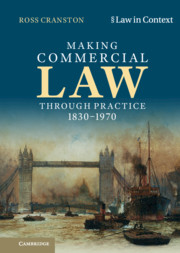
BOOK: Ross CRANSTON, Making Commercial Law through Practice 1830–1970 - Law as Backcloth (Cambridge: Cambridge University Press, 2021). ISBN 9781107198890, 85.00 GBP
(Source: CUP)
CUP is publishing a new book on the
modern history of commercial law in Britain.
ABOUT THE BOOK
Making Commercial Law Through
Practice 1830–1970 adds a new dimension to the history of Britain's commerce,
trade manufacturing and financial services, by showing how they have operated
in law over the last one hundred and forty years. In the main law and lawyers
were not the driving force; regulation was largely absent; and judges tended to
accommodate commercial needs, so that market actors were able to shape the law
through their practices. Using legal and historical scholarship, the author
draws on archival sources previously unexploited for the study of commercial
practice and the law's role in it. This book will stimulate parallel research
in other subject areas of law. Modern commercial lawyers will learn a great
deal about the current law from the story of its evolution, and economic and
business historians will see how the world of commerce and trade operated in a
legal context.
ABOUT THE AUTHOR
Ross Cranston, London
School of Economics and Political Science
Ross Cranston is a Professor of Law at the London School of Economics and
Political Science. He was previously a High Court Judge for England and Wales
2007–2017, and was Solicitor General for England and Wales 1998–2001.
TABLE OF CONTENTS
1. Commercial and Legal Context
2. The Commodity Markets of
London and Liverpool
3. Agents, 'Agents' and Agency
4. Sale, Hire and the
Distribution of Manufactured Goods
5. International Commodity Sales
6. Bank Finance for Trade and
Industry.
More info here
09 February 2021
BOOK: Victor SIMON, Les échelles du Levant et de barbarie - Droit du commerce international entre la France et l'Empire ottoman, XVIe-XVIIIe siècle [Bibliothèque d'histoire du droit et droit romain; 38] (Paris: LGDJ, 2021), 380 p. ISBN 978-2-275-08394-0, €57
(image source: Furet)
Book abstract:
Au coeur des grandes recompositions géopolitiques de la première moitié du XVIe siècle, François Ier tisse d'étroites relations avec l'Empire ottoman de Soliman. Cette "alliance impie" avec le grand seigneur se prolonge par l'octroi d'importants privilèges commerciaux, désignés sous le terme de capitulations, au profit des sujets du roi de France. En se fondant sur ces textes, des négociants provençaux développent alors des réseaux commerciaux complexes en Méditerranée orientale et en Afrique du Nord. Ceux-ci établissent en effet des maisons de commerce dans les principales cités ottomanes qu'ils qualifient d'échelles du Levant et de Barbarie, comme autant de têtes de pont du négoce européen. A partir du ministère de Colbert, ce lucratif commerce international est peu à peu envisagé comme un facteur stratégique, permettant de soutenir la puissance de l'Etat. La monarchie s'insinue dès lors toujours plus loin dans la direction des affaires, en orientant l'activité des marchands au moyen d'une réglementation de plus en plus rigide qui entrave les initiatives individuelles. En réaction, les négociants impliqués dans le commerce méditerranéen formulent des thèses libérales très critiques vis-à-vis de la politique royale. A la confluence du droit international public, de la législation royale et des usages commerciaux, l'histoire juridique des échelles du Levant et de Barbarie est, dès lors, traversée d'insolubles tensions entre milieux d'affaires et grands administrateurs du royaume. Prix Araxie Torossian de l'Académie des sciences morales et politiques Prix André Isoré de la Chancellerie des universités de Paris Prix de l'Association des historiens des facultés de droit Prix de thèse de l'Université Paris II Panthéon-Assas.
On the author:
Victor Simon est professeur à l'Université de Lille.
12 June 2020
BOOK: Luisa BRUNORI, Serge DAUCHY, Olivier DESCAMPS & Xavier PREVOST (dir)., Le droit face à l'économie sans travail. Tome II: l'approche internationale [Histoire du Droit; 7] (Paris: Classiques Garnier, SEPT 2020), 329 p. ISBN 978-2-406-09729-7
(image source: Classiques Garnier)
Book abstract:
Ten years after the beginning of the subprime crisis, the situation in the early years of the third millennium requires a broad look at the dynamics of the jobless economy, understood as the set of financial operations that do not directly compensate human labor or the exchange of goods.
Papers by Luisa Brunori, Serge Dauchy, Olivier Descamps, Xavier Prévost, David Kusman, David Carvajal de la Vega, Claudio Marsilio, Roman Zaoral, David Gilles, Anja Amend-Traut, Jean Hilaire, Erik Aerts, Carlos Petit, Guido Rossi, Oscar Cruz Barney, Dave De ruysscher and Alain Wijffels.
Read more: DOI 10.15122/isbn.978-2-406-09729-7. The book is currently available as e-book, and will appear in print in September.
(source: Classiques Garnier)
21 October 2019
WORKSHOP: "Identity, Citizenship and Commerce" (Brussels: VUB, 7-8 NOV 2019)
Conference abstract:
This workshop delves into the theme of identity and citizenship with regard to trade. Legal historians have to date not paid much interest to how commerce had an impact on citizenship and identity. It remains unclear how the rich sets of rules that in the later Middle Ages, the Early Modern period and the nineteenth century were crafted to define citizenship, and political constellations as well, were affected by developments of commerce. Questions that will be answered are the following: Did governments have an immigration policy that was tailored to commercial interests? Did this translate into a broad legal support for residents, not being citizens? How were the interests of visitors valued as compared to those of citizens? Were merchants belonging to a separate legal category? If so, what defined this category? Was there a difference in legal effects of contracts involving citizens or foreigners? To what extent did different types of legal identity (merchant, citizen, member of nationes mercatorum) overlap or come into conflict? Was there an influence from “capitalist” virtues on the legal notions of citizen and resident?Programme:
7 November 2019, U-Residence, Pleinlaan 2, B-1050 Brussels, Zwarte ZaalPractical information:
14h-14h20 D. De ruysscher (Vrije Universiteit Brussels, Tilburg University), Introduction
14h20-14h50 A. Cordes (Goethe-Universität Frankfurt), Traces of Identity in Medieval Maritime Law
14h50-15h20 C.M. In’t Veld (Vrije Universiteit Brussel) and M. den Hollander (Tilburg University) Citizenship in Early Modern Amsterdam: An Artisanal Identity?
15h20-15h45 coffee break
15h45-16h30 R. Mooi (Tilburg University) Foreign Creditors in the Early Modern German Territories: Towards a Reciprocal Equal Treatment
16h30-17h15 P. De Reu (Vrije Universiteit Brussel) Modifying Procedural Practices, Shaping Economic Identities. An Inquiry into Middling Groups in Financial Distress and Negotiated Debt Adjustment in Commercial Courts in Belgium 1883-1914
19h informal dinner
8 November 2019, room D2.18, Building D, Pleinlaan 2, B-1050 Brussels
9h coffee
9h30-10h15 G. Martyn (Ghent University), The Portuguese Nations in Bruges and Antwerp
10h15-11h G. Dreijer (University of Exeter, Vrije Universiteit Brussel), Legal Strategies, Citizenship and the Development of Commercial Law: the Presence of Spanish Merchants in the Low Countries (15th-16th Centuries)
11h coffee break
11h15-12h J. Possemiers (KU Leuven) Conrad Summenhart’s Writings against Tolerance for ‘Jewish Usurers’ and their Context
12h-12h45 P. Naaktgeboren (Maastricht University), Private Partnerships and Partners’ Entrepreneurial Identity in Early Modern Antwerp
12h45 lunch break
14h15-15h M. Lupi (Tilburg University), The Ban as Deprivation of Citizenship Within Bankruptcy Law of Medieval Florence
15h-15h45 M. Moerman (Maastricht University) Jewish Commercial Associations in the Early Modern Period: The Case of Sephardic Business Partnerships in Amsterdam (17th and 18th centuries)
15h45-16h30 S.Plasschaert (Vrije Universiteit Brussels), Unions and Networks in the 19th-Century Antwerp Marine Insurance Industry
16h30-17h book discussion
19h formal dinner
Register with Dave De ruysscher.
(source: VUB-CORE)
Labels:
Commercial Legal History,
Identity,
Workshop
29 May 2019
BOOK: Johannes W. FLUME, Marktaustausch Grundlegung einer juristisch-ökonomischen Theorie des Austauschverkehrs (Tübingen: Mohr Siebeck, 2019). ISBN 978-3-16-156898-5, €84.00
(Source: Mohr Siebeck)
Mohr Siebeck has published a new book on the
legal foundation of markets and contracts.
ABOUT THE BOOK
Johannes W. Flume analyses the legal foundation
of markets and contracts. He formulates a theory of market exchange, which
shows that markets are legal products and that all exchange contracts in a
market economy are derivatives because they derive their value from underlying
market prices.
Johannes W. Flume zeigt, wie in den vergangenen vierhundert Jahren an den
Börsen aus den archetypischen Formen der Austauschverträge – Tausch und Kauf –
Futures-Märkte entstanden sind. Dabei arbeitet er heraus, dass der allgemeine
Austauschmarkt der Kaufverträge und die Futures-Märkte ein gemeinsames
privatrechtliches Fundament haben. Der monetäre Wert von Verträgen, das
Pekuniarinteresse, wird in diesen Märkten jeweils durch das Verhältnis zwischen
Kaufpreis und Marktpreis errechnet. Beim Kaufvertrag wird so der Schadensersatz
statt der Leistung ermittelt, während an den Börsen das Pekuniarinteresse in
automatisierten Rechenvorgängen festgestellt wird. Der Autor formuliert hierauf
aufbauend eine Theorie des Marktaustauschs: Märkte sind Rechtsprodukte und sämtliche
Austauschverträge sind in einer Marktwirtschaft Derivate, denn sie leiten ihren
Wert vom Basiswert der Marktpreise ab.
ABOUT THE AUTHOR
Johannes W. Flume Geboren 1979; Studium der
Rechtswissenschaften an den Universitäten Regensburg, Köln und Bonn; 2008
Promotion; Rechtsreferendar im OLG-Bezirk Köln; 2011 Max Planck Scholar und
Visiting Fellow am Wolfson College, Cambridge; 2012–18 Wissenschaftlicher
Mitarbeiter an der Universität Tübingen; 2018 Habilitation (Universität Köln);
seit 2018 Gastprofessor an der Freien Universität Berlin.
More info here
23 April 2019
CONFERENCE: Pour une histoire européenne du droit des affaires : comparaisons méthodologiques et bilans historiographiques (Paris: IHD, 21 JUN 2019)
(image source: PHAEDRA Project)
Summary:
La journée a pour objet de s’interroger sur les manières dont sont menées les recherches en histoire du droit des affaires à travers l’Europe, afin de lancer le programme PHEDRA sur des bases historiographiques et méthodologiques solides.Programme:
Sous la présidence de Jean Hilaire – Université Paris Panthéon-Assas
9.30h. «Propos introductifs», Olivier Descamps – Université Paris Panthéon-Assas
10.00h. « L’Italie », Ferdinando Mazzarella – Università di Palermo
discutant Victor Simon – Université de Reims Champagne-Ardennes
10h45. « L’Espagne », Margarita Serna Vallejo – Universidad de Cantabria
discutant Florent Garnier – Université de Toulouse 1 Capitole
11.30 « Le Benelux », Alain Wijffels – Cnrs/Université de Lille
discutant Alexis Mages – Université de Bourgogne
12h15-13h45. Déjeuner
13h45. « Le Royaume-Uni », Guido Rossi – University of Edimburgh
discutant Olivier Serra – Université de Rennes 1
14h30. « L’Allemagne », Mathias Schmoeckel – Universität Bonn
discutant Nicolas Laurent-Bonne – Université Clermont-Auvergne
15h15. «La France», Carine Jallamion – Université de Montpellier
Discutant: David Deroussin – Université de Lyon III Jean Moulin
16h. « Propos conclusifs »
Luisa Brunori – Cnrs/Université de Lille et Xavier Prévost – Université de Bordeaux
(more information on the PHAEDRA website)
Labels:
Commercial Legal History,
Conference,
trade
05 April 2019
BOOK: Guillaume CALAFAT, Une mer jalousée. Contribution à l'histoire de la souveraineté (Méditerranée, XVIIe siècle) [L'univers historique] (Paris: Seuil, 2019), 456 p. ISBN 9782021379365, € 25
(image source: Seuil)
Book abstract:
Comment disait-on le droit sur les mers à l’époque moderne ? Par quels dispositifs les pouvoirs politiques dotés d’une façade maritime tentaient-ils de faire respecter un pouvoir de « juridiction », entendu comme un « droit de dire le droit », sur un espace liquide particulier ? Ces questions sur la liberté, la communauté et l’empire des mers ont donné lieu à une grande controverse juridique livrée à l’échelle du globe. Une mer jalousée propose d’en faire l’histoire à partir de l’observatoire méditerranéen. De la mer Adriatique aux mers du Levant, du golfe du Lion aux littoraux nord-africains, l’enquête décline à différentes échelles, depuis les bureaux des juristes jusqu’aux ponts des navires, un large éventail de conceptions concurrentes des limites maritimes et des eaux « territoriales ». Ce faisant, l’ouvrage revient, au carrefour de l’histoire, du droit et de la philosophie, sur des notions juridiques cardinales de la pensée politique moderne, telles que la « propriété », l’« occupation », la « possession » et la « souveraineté ». Guillaume Calafat les inscrit dans une généalogie de longue durée embrassant l’histoire antique et médiévale, les textes du droit romain et leurs commentaires médiévaux, les lois byzantines comme la normativité musulmane. Une mer jalousée s’appuie ainsi sur une centaine de textes imprimés à propos de la domination des mers, en les croisant avec des libelles manuscrits, des atlas, des cartes, des traités, des gravures, afin de brosser le portrait d’une mer au statut disputé et incertain.On the author:
Guillaume Calafat est maître de conférences à l’Université Paris 1 Panthéon-Sorbonne (Institut d’histoire moderne et contemporaine). Ses recherches portent sur la Méditerranée de l’époque moderne, et notamment sur les échanges marchands et maritimes entre Europe occidentale et monde ottoman.(source: Seuil)
Labels:
Book,
Commercial Legal History,
Comparative legal history,
Early modern legal history,
history of international law
21 January 2019
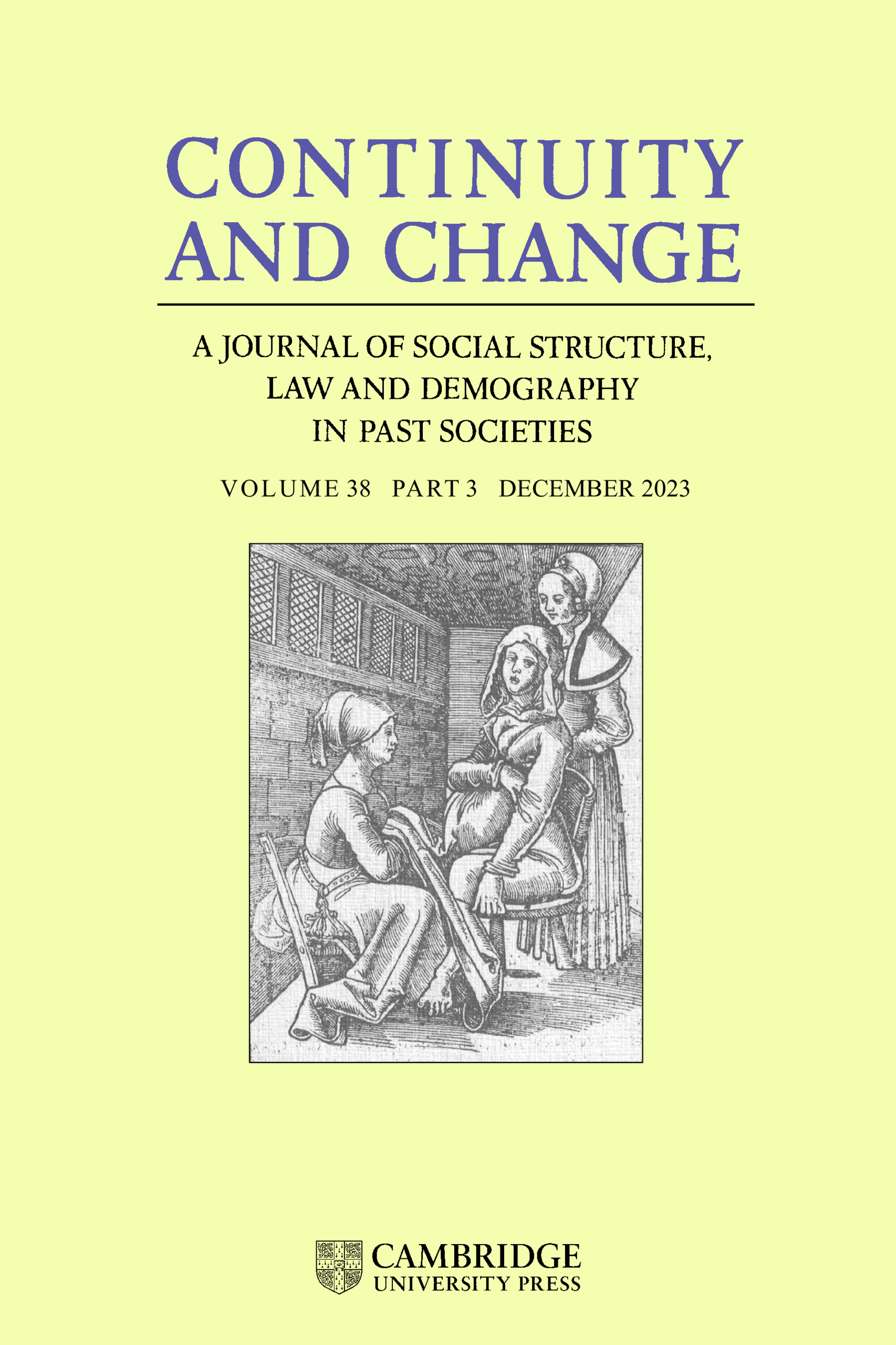
JOURNAL: Thematic Issue "Merchants and commercial conflicts in European History" (Continuity and Change, A Journal of Social Structure, Law and Demography in Past Societies XXXIII (2018), No. 3)
(image source: Cambridge Core)
Alain Wijffels, Introduction: Commercial quarrels--and how (not) to handle them
Abstract:
The settlement of structural commercial conflicts of interest cannot be exclusively subsumed under the heading of dispute resolution. Even when a particular conflict opposing specific individuals or groups of interests could be settled, the broader underlying conflicts of interest would subsist and re-emerge. Both commercial and institutional or political actors would therefore rely on various techniques of conflict management, a process imposing restraint on the opposing parties while allowing sufficient leeway for business to be continued. Both conflict resolution and conflict management were devices of public and corporate governance, and therefore, following the late medieval tradition, instruments more or less based on established patterns of legal or quasi-legal models legitimised by accepted or conventional parameters of ‘justice’Flávio Miranda, Conflict Management in western Europe: the case of the Portuguese merchants in England, Flanders and Normandy, 1250-1500
Abstract:
Recent historiography argues that the legal autonomy of municipal governments created the necessary conditions for successful commercial transactions and economic growth in certain parts of Europe in the later Middle Ages, and that these features attracted foreign merchants. This article uses empirical data from England, Flanders and Normandy to test the following questions: were there significant differences in rules, laws and institutions between one place and another in late medieval western Europe? Were the Portuguese merchants drawn to markets that hypothetically had more effective institutions? The findings demonstrate that legal institutions and conflict management were very similar across western Europe, and that there is no evidence that the Portuguese opted for trading in a certain market because of its effective institutions. Moreover, the article claims that the merchants seemed to prioritise protection and privilege while trading abroad, and it highlights the role of commercial diplomacy in conflict management.Thomas K. Heebøll-Holm, Law, order and plunder at sea: a comparison of England and France in the fourteenth century
Abstract:
This article addresses the management of maritime plunder and conflict in the waters of England and France in the fourteenth century. It argues that during this century a fundamental change occurred. Around 1300, maritime conflict was handled by recourse to the strictly civil law merchant and law maritime, or by Marcher law. However by the 1350s and 1360s the kings of England and France, moved by contemporary political events and theories of sovereignty at sea, created courts of Admiralty that challenged the previous systems’ jurisdiction. These initiatives eventually paved the way for the criminalisation of private maritime conflict.Justyna Wubs-Mrozewicz, The late medieval and early modern Hanse as an institution of conflict management
Abstract:
Ever since research on the Hanse began in the nineteenth century, there have been repeated efforts to redefine the boundaries and the core of the phenomenon. Views of the Hanse have evolved, and it has been seen by turns as a profoundly German league of towns, and as a network or organisation of towns and traders that was present in commercial centres and harbours from Novgorod to Portugal, and from Norway to Italy. In more general discussions on the institutional development of commerce in Europe, many of them influenced by the New Institutional Economics, the Hanse has even appeared as a mega-guild. The revival of the field of institutional economics and the history of commerce in pre-modern Europe has recently spawned a reappraisal of Hanseatic sources. The present article contributes to this debate by arguing that from the perspective of conflict management, the late medieval and early modern Hanse was an institution. There were several institutional mechanisms, such as a strong preference for mediation and arbitration in conflicts between individuals, as well as a mediation strategy for internal conflicts between towns. All of these mechanisms combined in a multifaceted institution of conflict management, which represented the added value of Hanse membership for traders, and for their towns.Andrea Caracausi, A reassessment of the role of guild courts in disputes over apprenticeship contracts: a case study from early modern Italy
Abstract:
This article analyses the mechanisms of conflict resolution in apprenticeship contracts using a large database of disputes from early modern Italy. It finds that the guild court under investigation (the Padua Woollen Guild court) did not enforce training contracts, but rather sought to improve on incomplete contracts by adding clauses, thereby helping individuals renegotiate and redefine the contractual arrangements into which they had decided to enter. However, power relations within the court operated largely in favour of employers, both merchants and master craftsmen. The article concludes that alternative contract enforcement systems, such as municipal or state courts, were probably better suited than corporative systems for resolving disputes surrounding apprenticeship.Read more on Cambrige Core.
(source: Legal History Blog)
01 November 2018
WORKSHOP: Transferring and Translating Concepts in Law and History (Brussels: VUB, 14 DEC 2018)
(image source: KUL)
Transferring and Translating Concepts in
Law and History
2nd
Workshop of Average - Transaction Costs and Risk
Management during the First Globalization (Sixteenth-Eighteenth Centuries)
14th December 2018, Black Room, U-residence
Generaal Jacqueslaan 271, 1050 Brussels
9.00-9.30
Maria Fusaro (Exeter-AveTransRisk) & Dave De ruysscher (VUB-Tilburg-
AveTransRisk) Introduction
9.30-10.30
Nick Foster (SOAS) The Modern Financial Shari’a: A Possible Comparator in the
Study
of the Law of General Average
10.30-11.00
COFFEE
11.30-12.30
Albrecht Cordes (Frankfurt), The Language of the
Law: The Lübeck Law Codes (ca.
1224
- 1642)
12.30-13.30
Ana Maria Rivera Medina (UNED- AveTransRisk), The construction of the concept of
maritime risk from the ius proprium to a maritime law
in the Iberian world (13th–16th C.)
13.30-14.30
LUNCH
14.30-15.30
Dave De ruysscher (VUB-Tilburg- AveTransRisk), Legal
rules in the merchants'
words:
maritime law in merchant manuals (16th c.)
15.30-16.30
Heikki Pihlajamäki (Helsinki) Philipp
Crusius and the German Translation of the
Medieval
Swedish Town and Land Laws (1648)
16.30-17.00 COFFEE
17.00-18.00 Nandini Chatterjee (Exeter) Persian
documents in English courts: some reflections
on
legal translation
18.00-19.00 Giacomo
Todeschini (Trieste), Contractual consensus, mutual agreement and
duress:
theological and socioeconomic implications at the origin of the
European
dynamics of contracts (14th-16th C.)
19.00-19.30 General Discussion
18 October 2018
BOOK: Arnaud BARTOLOMEI et al. (eds.), De l’utilité commerciale des consuls. l’institution consulaire et les marchands dans le monde méditerranéen (xviie-xxe siècle) (Rome: Publications de l’École française de Rome, 2017). ISBN 9782728312603
(Source: École française de Rome)
Publications de
l’École française de Rome published a new book on consuls in the Mediterranean
world between the 17th-20th century.
ABOUT THE BOOK
Les vingt-huit études rassemblées ici s’intéressent aux multiples rôles
joués par les consuls et l’institution consulaire auprès des marchands actifs
dans l’espace méditerranéen du XVIIe au XXe siècle.
Ce livre offre tout d’abord une présentation et une analyse des fonds et des
sources disponibles pour mener à bien cette enquête historique, depuis les
abondantes correspondances jusqu’aux manuels consulaires. Il met également à
l’épreuve des pratiques et des usages les prérogatives juridictionnelles des
consuls concernant le règlement des contentieux marchands et la certification
des transactions et des contrats dans l’Empire ottoman comme en Europe
occidentale. L’ouvrage propose ensuite d’observer la variété des contextes
d’exercice des consuls et les stratégies commerciales différenciées de leurs
autorités de tutelle, de la République de Gênes à la Suède, en passant par le
Royaume-Uni, les États-Unis d’Amérique, la République des Sept-Îles ou le
Royaume de France. Plusieurs études soulignent enfin les marges de manœuvre
politiques, diplomatiques et économiques de consuls qui évoluent dans des
relations de pouvoir et des réseaux d’affaires aux contours mouvants. En posant
de la sorte la question de l'utilité commerciale des consuls, ces différents
chapitres invitent à jeter un regard nouveau sur l’histoire de la fonction
consulaire et sur les mécanismes de régulation politiques et institutionnels du
commerce international aux époques moderne et contemporaine.
Cet ouvrage a été publié avec le concours du GIS Histoire et Science de la
Mer.
ABOUT THE EDITORS
Arnaud
Bartolomei (ed.)
Agrégé d’histoire et ancien membre de la Casa de Velázquez, Arnaud
Bartolomei est actuellement maître de
conférences en histoire moderne et contemporaine à l’Université Côté d’Azur et
membre du Centre de la Méditerranée Moderne et Contemporaine. Ses recherches
portent sur les pratiques et les institutions du commerce à distance dans les
espaces européens, atlantiques et méditerranéens au XVIIIe et au XIXe siècle.
Guillaume Calafat (ed.)
Guillaume Calafatest maître de conférences à l’Université Paris 1 Panthéon-Sorbonne
(Institut d’Histoire Moderne et Contemporaine). Ancien élève de l’École Normale
Supérieure, agrégé d’histoire, ancien membre de l’École Française de Rome, ses
recherches portent sur les échanges marchands et maritimes et leurs régulations
dans la Méditerranée de l’époque
moderne.
Mathieu Grenet (ed.)
Docteur en histoire de l’Institut Universitaire Européen de Florence,
Mathieu Grenet est maître de conférences en histoire moderne à l’INU
Champollion d’Albi, chercheur au sein de l’UMR 5136 FRAMESPA et membre du
projet ERC « Mediterranean reconfigurations ». Il s’intéresse en particulier
aux mobilités internationales, aux contacts interculturels et aux constructions
identitaires à l’époque moderne.
Jörg Ulbert
(ed.)
Jörg Ulbert est maître de conférences en allemand à l’Université de
Bretagne Sud. Ses recherches portent sur l’histoire des services consulaires
français aux XVIIe et XVIIIe siècles ainsi que sur les rapports
franco-allemands à l’époque moderne.
TABLE OF CONTENTS
Arnaud Bartolomei
Introduction
Chapitre 1 – Les sources de l'enquête
Jörg Ulbert
Les sources de l’enquête. Introduction
Anne Mézin
Les archives des consulats français à l’étranger conservées aux Archives
nationales
Patrick Boulanger
Au service du royaume en Méditerranée… Les correspondances des consuls de
France des XVIIe et XVIIIe siècles dans les archives de la CCI Marseille
Provence
Jérôme Cras and Bérangère Fourquaux
Les fonds conservés au Centre des Archives diplomatiques de Nantes (CADN)
Pascal Even
Les archives consulaires à l’administration centrale du ministère des
Affaires étrangères et du Développement international
Arnaud Bartolomei and Vivien Faraut
L’exploitation de la correspondance consulaire. Apports et enjeux d’un
traitement quantitatif des données
Pierre-Yves Beaurepaire and Silvia Marzagalli
Exploiter et éditer une correspondance consulaire. Premier retour
d’expérience à partir du cas Fölsch
Viorel Panaite
Les consuls de France dans le Levant au cours de l’ambassade de François
Savary de Brèves à Constantinople (1593-1605) à partir d’une source ottomane
conservée à la Bibliothèque nationale de France
Jörg Ulbert
Les manuels consulaires français d’avant 1914 comme sources des études
consulaires
Chapitre 2 – Les juridictions du consul : une institution au service des
marchands et du commerce ?
Guillaume Calafat
Les juridictions du consul : une institution au service des marchands et du
commerce ? Introduction
Guillaume Calafat
La juridiction des consuls français en Méditerranée : litiges marchands,
arbitrages et circulations des procès (Livourne et Tunis au XVIIe siècle)
Arnaud Bartolomei and Anne Brogini
De la réglementation aux pratiques marchandes : l’enregistrement des actes
dans les chancelleries consulaires françaises (XVIIe-XIXe siècles)
Julien Sempéré
Un consulat sans chancellerie : le cas du consulat français de Barcelone
(1679-1716)
Salvatore Bottari
Consoli inglesi nella Sicilia del Settecento : funzioni istituzionali e
attività informali
Mehdi Jerad
Enjeux marchands et intérêts de pouvoir autour de la juridiction
contentieuse des consuls de France à Tunis (1827-1836)
Chapitre 3 – L’institution consulaire en Méditerranée, des stratégies
commerciales différenciées
Mathieu Grenet
L’institution consulaire en Méditerranée, des stratégies commerciales
différenciées. Introduction
Matteo Barbano
A lucrative, dangerous business : le consulat anglais à Alger, Tunis et
Tripoli dans la deuxième moitié du XVIIe siècle
Danilo Pedemonte
Surveiller et réunir. Consuls génois et consuls anglais en Méditerranée au
XVIIIe siècle : deux modèles en regard
Gustaf Fryksén
Les réseaux de la diplomatie et du commerce : George Logie, consul de Suède
et intermédiaire marchand en Afrique du Nord, v. 1726-1763
Silvia Marzagalli
Le réseau consulaire des États-Unis en Méditerranée, 1790-1815 : logiques
étatiques, logiques marchandes ?
Gerassimos Pagratis
Le funzioni mercantili dei consoli della Repubblica Settinsulare, 1800-1807
Chapitre 4 – L’institution consulaire française à Cadix et en Espagne au
XVIIIe siècle. Un « modèle » ?
Arnaud Bartolomei
L’institution consulaire française à Cadix et en Espagne au XVIIIe siècle.
Un « modèle » ? Introduction
Anne Mézin
La défense des intérêts des négociants français de Cadix dans la première
moitié du XVIIIe siècle d’après la correspondance ministérielle
Olivier Le Gouic
Le consulat de France à Cadix face aux réformes carolines (1765-1788)
Sylvain Lloret
Informer et protéger : l’agent général de la Marine et du Commerce de
France à Madrid et les marchands français de Cadix (1748-1784)
Chapitre 5 – Entre l’État, les intérêts marchands et l’intérêt personnel,
l’agency des consuls
Arnaud Bartolomei
Entre l’État, les intérêts marchands et l’intérêt personnel, l’agency des
consuls. Introduction
Marco Schnyder
Une nation sans consul. La défense des intérêts marchands suisses à Lyon
aux XVIIe et XVIIIe siècles
Thierry Allain
Relations de pouvoirs et enjeux marchands autour du réseau consulaire
néerlandais en Méditerranée (XVIIe-XVIIIe siècles)
Marcella Aglietti
Politica, affari e guerra. I consoli dell’arciduca Carlo d’Asburgo a
Livorno durante la guerra di successione spagnola
Annastella
Carrino
Un console
napoletano nel Mediterraneo borbonico : Francisco Hombrados (1755-1765)
Mathieu Grenet
Pétitions marchandes autour de la fonction consulaire : la diaspora grecque
et la naissance de la diplomatie néohellénique
Fabrice Jesné
Consuls et affairistes : une relecture de la « pénétration pacifique »
italienne dans les Balkans à la veille de la Grande Guerre
Mathieu Jestin
Le musée commercial impossible : un projet emblématique de l’action
consulaire française à Salonique au tournant des XIXe et XXe siècles
Bibliographie
10 October 2018
CALL FOR PAPERS: A Global History of Free Ports. Capitalism, Commerce and Geopolitics (Venice/Helsinki, APR/JUN 2019) (DEADLINE 31 OCT 2018)
(image source: University of Helsinki)
The history of free ports research network is organising a number of conferences in the next years, in order to work towards a standard publication and interactive research platform for the history of free ports from the 16th to the early 20th century. Please check our website (www.helsinki.fi/a-global-history-of-free-ports) for an impression.
The first two meeting will take place in Venice (April 2019) and in Helsinki (June 2019).
For the call for papers of both the Venice and Helsinki meetings, see:
We are looking for case studies that engage with the transformations of the various functions of free ports over time and the spread of free ports from Italy and the Mediterranean to the Atlantic, Asia and the global level. The research may open up to the wider international development of trade and its institutions by taking a perspective that can be long-term, comparative or comprehensive (involving a combination of intellectual, policy, and economic angles). Papers may also address cultural, religious, diplomatic and network perspectives.
Texts that are presented at conferences may be published as a ‘dossier’/ special issue in the Intellectual History Archive open access working paper series of the Helsinki Centre for Intellectual History. A selection of revised papers will be included in a book publication.
Abstracts (of ca. 500 words) and titles may be sent by email tokoen.stapelbroek@helsinki.fi and ctazzara@scrippscollege.edu by 31 October 2018. Invited speakers are subsequently requested to provide short papers (ca. 5,000 words) that will be pre-circulated among participants. For further information, see the ‘Call(s) for papers’. For those who do not possess their own research budgets or travel funds, we can try to contribute towards your travel and accommodation costs.
(source: ESILHIL Blog)
13 June 2018
WORKSHOP: Argent et marchandises en voyage XIVe-XIXe siècle (Lille: Université Lille II/CHJ, 22 JUN 2018)
(image source: Lille II/CHJ)
The Centre d'Histoire Judiciare (Université Lille-II) organises a workshop on the theme "Argent et marchandises en voyage, XIVe-XIXe siècle".
Papers:
- Les banques publiques dans la péninsule Ibérique et en Roussillon (XIVe-XVIe siècle) : des tentatives de mainmise sur la circulation des capitaux (Jean Charriaud, Paris II)
- En barils plutôt que par lettre obligatoire. La circulation des capitaux anglais dans les Pays-Bas durant la campagne diplomatique et militaire d’Edouard Ier Plantagenêt contre Philippe Le Bel (1294-1298) (David Kusman, ULB)
- La responsabilité du transporteur (XVe -XIXe siècle) (Anne Daillant, Paris Saclay)
- La garantie sous écriture privée dans le grand commerce de la première Époque moderne : la rhétorique épistolaire face à une crise de confiance (Ilario Mosca, EPHE)
- Spanish silver with en English accent. The Indian bullion and the Genoese brokers’ intermediation (1630-1670) (Claudio Marsilio, Lisboa)
- L’organisation du trafic vers les Petites Antilles françaises dans la première moitié du XVIIe siècle. Aspects financiers et logistiques (Eric Roulet, Université du Littoral Côté d'Opale)
- Les lettres de voiture dans l’ancien droit français (XVIIe-XVIIIe siècle) (Céline Drand, Strasbourg)
- Sécuriser le voyage des marchandises sans assurances. Litiges et régulation des transports continentaux à l’époque moderne (Lyon, XVIIe -XVIIIe (Benoît Saint-Cast, Lyon-2)
- La commission de transport : aux origines d’une qualification incertaine (Victor Simon, Reims)
- The grains of Odessa. Reality and trade in the Ottoman Levant during modern era (Chiara Baldestein, Roma III)
- Le voyage retour de l’argent : la notion de rechange chez les juristes de la seconde modernité (Victor Le Breton-Blond, Bordeaux)
The full programme can be downloaded here.
(source: Lille II/CHJ)
Labels:
Commercial Legal History,
Early modern legal history,
late medieval/early modern history,
Workshop
10 May 2018
BOOK REVIEW: Carsten GROTH: Hanse und Recht. Eine Forschungsgeschichte (Vierteljahrschrift für Sozial- und Wirtschaftsgeschichte, 2016)
(image source: Duncker & Humblot)
Ulrich Andermann reviews Carsten Groth (Hrsg.), Hanse und Recht. Eine Forschungsgeschichte [Freiburger Rechtsgeschichtliche Abhandlungen] (Berlin: Duncker & Humblot) for the Vierteljahrschrift für Sozial- und Wirtschaftsgeschichte.
Fulltext here.
24 February 2018
CALL FOR PAPERS: Commercial Law in South--Eastern Europe: Legislation and Jurisdiction from Tanzimat Times until the Eve of the Great War (Regensburg: Uni Regensburg, Fall 2019); DEADLINE 1 MAY 2018
(image source: Germany Travel)
Conference abstract:
Im 19. Jahrhundert sah sich das Osmanische Reich zu umfassenden Reformen gezwungen. Diese betrafen neben Verfassung und Verwaltung insbesondere auch Zivilrecht und Rechtspflege. Man orientierte sich stark an Frankreich und setzte unter anderem 1850 den Code de Commerce in Geltung, ohne daß die bisher geltenden Regelungen vollständig außer Kraft getreten wären. Im Aufeinandertreffen von überkommenem osmanischem Recht, Gerichtssystem und Gerichtspersonal einerseits und hochmodernem französischem Recht andererseits hat sich ein eigenständiger Rechtskulturraum in Südosteuropa entwickelt.
Im Zuge des Zerfalls des Osmanischen Reiches erfolgte eine Neuordnung Südosteuropas: Mit Rumänien (1878), Serbien (1878), Montenegro (1878), Bulgarien (1908) und Albanien (1913) entstanden eigenständige Staaten; Bosnien-Herzegowina wurde 1878 unter österreichische Verwaltung gestellt und 1908 annektiert. Die spätosmanische südosteuropäische Rechtskultur bildete das Fundament der Rechtskultur dieser Staaten, das reformierte französisch-osmanisch Recht wurde Bestandteil der einzelstaatlichen Rechtsordnungen. Gleichzeitig wirkten aber auch Einflüsse des deutsch-österreichisch-ungarischen Rechts (Allgemeines Deutsches Handelsgesetzbuch von 1861) in diesen Rechtskulturraum hinein, teilweise direkt, teilweise über den vom deutschen Recht beeinflußten italienischen Codice di Commercio von 1882.
Am Beispiel des Commercial Law soll der südosteuropäische Rechtskulturraum exploriert werden. Dabei sollen über eine bloße Dokumentation der rechtshistorischen Ereignisse hinaus zum einen Fragen der Rechtsrezeption bzw. des Rechtstransfers eine wichtige Rolle spielen, zum anderen Fragen der Rechts- und Gerichtspluralität. Insbesondere im Falle Bosnien-Herzegowinas dürfte es auch auf kolonialpolitische Fragestellungen ankommen. Hierfür bedarf es zunächst der Beantwortung ganz grundlegender Fragen für die einzelnen Territorien/Staaten, bevor eine Auswertung einschlägiger Gerichtsakten erfolgen kann.
- Wie haben sich während des Berichtszeitraums, im Spiegel der jeweiligen verfassungs-rechtlichen Wandlungen, die Rechtsordnung des jeweiligen Territoriums/Staates insgesamt und der Normbestand des Handels- und Gesellschaftsrechts insbesondere entwickelt? Wann und unter welchen Umständen erfolgte die Rezeption bzw. der Transfer welcher fremden Normen des Handels- und Gesellschaftsrecht in die jeweilige Rechtsordnung? Entstand hierdurch ein homogenes Rechtssystem oder ein Rechtspluralismus und in welchem Verhältnis zueinander standen gegebenenfalls die unterschiedlichen Normenkörper?
- Welche Behörden oder Gerichte waren für die Anwendung der Normen zuständig? Welche Behördenhierarchien oder Instanzenzüge bestanden? Ist ein Nebeneinander mehrerer konkurrierender Institutionen anzutreffen und auf welche Weise wurde die Konkurrenz aufgelöst? Wie wurde das jeweilige Personal rekrutiert, wie war es ausgebildet, welchen Regeln unterlag es, wie wurde es besoldet? Welche Regelungen zur Unabhängigkeit der Rechtsprechung bestehen? Auf Grundlage welcher Normen und mit welchem Inhalt waren der Ablauf der Verfahren und der Vollstreckung von Entscheidungen geregelt? Wer vertrat die Parteien gegebenenfalls vor Gericht, ist ein professioneller Anwaltsstand entstanden?
- Einzelfallebene: Was ergibt eine quantitative Analyse im Hinblick auf die Anzahl der durchgeführten Verfahren, persönliche Merkmale der Streitparteien, Verfahrensgegenstände, ordentliche und außerordentliche Rechtsmittel, freiwillige Erfüllung oder Notwendigkeit der Vollstreckung von Entscheidungen, gütliche Einigungen? Was ergibt eine qualitative Analyse der Einzelfallakten im Hinblick auf den Stil der Entscheidungen und auf die Anwendung des geltenden/konkurrierenden Rechts? Bestehen Diskrepanzen zwischen geschriebenem und angewendetem Recht, was ist die Rolle des Gewohnheitsrechts oder der Tradition? Wie haben Parteien und Gericht argumentiert, auf welche Autoritäten berufen sie sich, wen oder was zitieren sie? Wie ist das Verfahren abgelaufen? Gibt es Hinweise auf sachfremde Einflüsse wie Bestechung oder Patronage? Wie ist gegebenenfalls die Zwangsvollstreckung abgelaufen, wie effektiv wurden also die Entscheidungen durchgesetzt?
Practical:
Wir erbitten Ihre Vorschläge (max. 500 Wörter plus kurzer Lebenslauf) bis 1. Mai 2018 an martin.loehnig@ur.de. Wir informieren Sie bis 1. Juni 2018 über das Ergebnis der Begutachtung.
Im Herbst 2019 wird an der Universität Regensburg eine Tagung stattfinden, auf der die ausgearbeiteten Papers präsentiert und diskutiert werden können. Die Kosten Ihrer Anreise und Ihres Aufenthalts in Regensburg erstatten wir Ihnen gerne.
Die überarbeiteten Fassungen der Tagungsbeiträge werden - gerne auch in ausführlicherer Version - in Form eines Tagungsbandes, der bei einem angesehenen Fachverlag erscheinen soll, publiziert.
Für weitere Informationen wenden Sie sich bitte an martin.loehnig@ur.de.
Labels:
Call for papers,
Commercial Legal History
Subscribe to:
Posts (Atom)