


The ESCLH aims to promote comparative legal history and seeks affiliation with individuals and organisations with complementary aims.

Book abstract:
Mit dem „Anschluss“ im März 1938 bildete die österreichische Polizei einen wesentlichen Bestandteil des nationalsozialistischen Terrorregimes. Die Publikation bietet einen umfassenden Einblick in Bedeutung, Funktion und Entwicklungsgeschichte dieser Exekutive der Gewalt. Ausgehend von der weitgehend reibungslosen Eingliederung der Exekutive in den NS-Repressionsapparat widmen sich 32 nationale und internationale Expert*innen der Geschichte der österreichischen Polizei im Nationalsozialismus – von der Umwandlung der Sicherheitsstrukturen nach dem „Anschluss“ 1938 bis hin zur Organisation des Terrorregimes in der Heimat und den eroberten Gebieten. Die Polizei war maßgeblich in Kriegsverbrechen und den Holocaust involviert. Beispiele von Widerstand innerhalb der Polizei verweisen zugleich auf die Frage nach individuellen Handlungsoptionen. Im Fokus stehen zudem die gerichtliche Ahndung von NS-Verbrechen und Entnazifizierungsmaßnahmen der Nachkriegszeit. Durch die Öffnung der Polizei-Archive gelingt erstmals ein umfassender Einblick in die Arbeitsweise der Exekutive der Gewalt.
Finde more here.
Call:
What can legal history tell us about legal change in the immediate future? History does not repeat itself, but might enlighten us about the future and the possible choices that can be made. For instance the introduction of printed law will not have the same consequences as the introduction og digital law, but can still be used to detect what possible questions that might arise from a change in the technology used to communicate law. Legal history might have such an enlightening function both when society and politics change, causing law also to change, and when law is politically changed to make society change. Bringing in this element of legal futurology does not change the character of legal history as an empirically based science, mainly focused on investigating and interpretating texts of the past. However, it adds a dimension to legal history of empirically founded efforts to venture into the unknown.
The editors welcome contributions from all relevant fields of science with a maximum length of 200 000 characters. Contributions should be submitted by using rechtskultur@ur.de within 30. April 2025. All contributions will be peer reviewed, and admittance for publications rests on the merits of the contribution alone.
Consult the journal's archive in open access here.
Abstract:
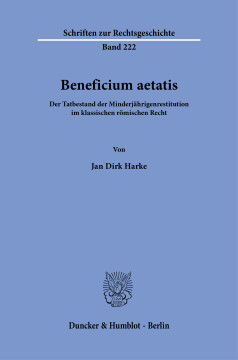
»Beneficium Aetatis. The Requirements for the Restitution of Minors in Roman Law«: The restitution of a person under the age of 25 was a central element of the protection of minors in Roman law. Although it is not easy to determine the conditions for this legal remedy due to the laconicism of the sources, they do allow one conclusion to be drawn: in order to obtain restitution, the minor did not have to demonstrate a concrete mental weakness. Rather, his restitution depended on the abstract criterion of whether or not the disadvantage suffered by him would also have affected a prudent adult.
Table of contents:
| Inhaltsverzeichnis | 5 |
|---|---|
| Einleitung | 7 |
| Erstes Kapitel: Ein subjektiver Tatbestand der restitutio? | 10 |
| I. Circumventio und facilitas | 10 |
| II. Ulpians Kommentierung des Restitutionsedikts | 15 |
| 1. Die Ediktslaudationen | 15 |
| 2. Der zur Wiedereinsetzung zugelassene Personenkreis | 17 |
| 3. Cum minore gestum | 27 |
| 4. Causae cognitio und Zuständigkeit | 34 |
| 5. Zwischenergebnis | 42 |
| III. Andere Werke | 43 |
| 1. Ulpian | 43 |
| 2. Paulus | 49 |
| 3. Weitere Juristen | 55 |
| IV. Die Konstitutionen | 61 |
| V. Ergebnis | 64 |
| Zweites Kapitel: Alter als Restitutionsgrund | 66 |
| I. Der entscheidende Maßstab | 66 |
| II. Ein beneficium aetatis | 70 |
| III. Irrelevanz der Betreuerbeteiligung | 81 |
| IV. Eine Ausnahme | 88 |
| V. Ergebnis | 93 |
| Drittes Kapitel: Der Schaden und sein Nachweis | 95 |
| I. Grande damnum und circumscriptio manifesta | 95 |
| II. Schadensträchtige und neutrale Vorgänge | 106 |
| III. Beweisführung und causae cognitio | 117 |
| IV. Ergebnis | 123 |
| Ertrag | 125 |
| Literaturverzeichnis | 127 |
| Quellenverzeichnis | 129 |
Read the book here: DOI 10.3790/978-3-428-59167-1.
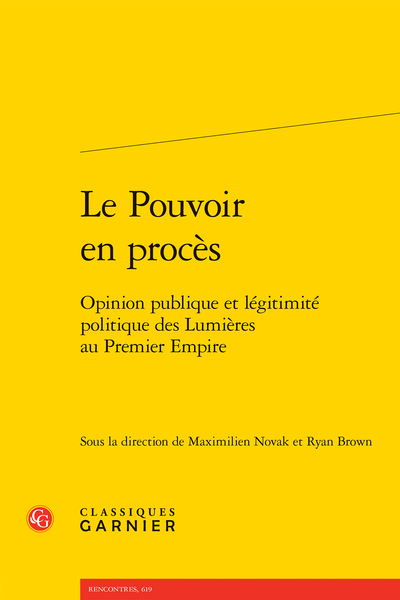
Ces actes proposent d’examiner le rôle de l’opinion publique comme une force politique légitime, allant de l’Ancien Régime au Premier Empire. Ils permettent de jeter un regard nouveau sur un grand débat historiographique centré sur la formation et l’influence de l’opinion publique.
Table of contents:
Avant-propos L’opinion publique, juge et témoin Brown (Ryan), Novak (Maximilien)
Préface Qui dit opinion publique dit Habermas Jones (Colin)
PREMIÈRE PARTIE L’OPINION PUBLIQUE AU PRISME DES INTERPRÉTATIONS LITTÉRAIRES ET THÉÂTRALES
The Autobiographer as Jurist Rousseau’s Confessions, the Practice of Judicial Proof, and the Court of Public Opinion Brown (Ryan)
Lumières et Discours victimaire Penser le pire Morrissey (Robert)
Transformations of the Social Bond on the Revolutionary Stage Maslan (Susan)
DEUXIÈME PARTIE OPINION PUBLIQUE ET ADMINISTRATION IMPÉRIALE PERSPECTIVES EUROPÉENNES ET COLONIALES
Les juristes internationalistes, les affaires étrangères et l’opinion publique (1789-1830) Cahen (Raphaël)
Wrongful Praising Flattery and strategies of survival in Napoleonic Italy Harsanyi (Doina Pasca)
Public Opinion and Empire A Black Epistemological Approach Pichichero (Christy)
TROISIÈME PARTIE LES DIFFÉRENTS CORPS DE L’OPINION MESURE, REPRÉSENTATION, INSTRUMENTALISATION
Thermomètre et variation de l’opinion publique Généalogie d’une métaphore politique Novak (Maximilien)
The King's Two Heads and the Body of Public Opinion Pop (Andrei)
Prendre les vétérans pour témoins L’opinion publique et les vétérans de la guerre d’Espagne Ramonda (Thomas)
Postface La Terreur, scène du commun Baecque (Antoine de)

ABOUT THE BOOK
The ‘humble petition’ was ubiquitous in early modern society and featured prominently in crucial moments such as the outbreak of the civil wars and in everyday local negotiations about taxation, welfare and litigation. People at all levels of society – from noblemen to paupers – used petitions to make their voices heard and these are valuable sources for mapping the structures of authority and agency that framed early modern society.
The Power of Petitioning in Early Modern Britain offers a holistic study of this crucial topic in early modern British history. The contributors survey a vast range of sources, showing the myriad ways people petitioned the authorities from the sixteenth to the eighteenth centuries. They cross the jurisdictional, sub-disciplinary and chronological boundaries that have otherwise constrained the current scholarly literature on petitioning and popular political engagement. Teasing out broad conclusions from innumerable smaller interventions in public life, they not only address the aims, attitudes and strategies of those involved, but also assesses the significance of the processes they used. This volume makes it possible to rethink the power of petitioning and to re-evaluate broad trends regarding political culture, institutional change and state formation.
ABOUT THE EDITORS
Brodie Waddell is Senior Lecturer in Early Modern History at Birkbeck, University of London.
Jason Peacey is Professor of Early Modern British History at University College London.
TABLE OF CONTENTS
List of figures and tables
List of contributors
1 Introduction: power, processes and patterns in early modern petitioning
Brodie Waddell and Jason Peacey
2 Genre, authorship and authenticity in the petitions of Civil War veterans and widows from north Wales and the Marches
Lloyd Bowen
3 The process and practice of petitioning in early modern England
Hannah Worthen
4 ‘The universal cry of the kingdom’: petitions, privileges and the place of Parliament in early modern England
Jason Peacey
5 Gathering hands: political petitioning and participative subscription in post-Reformation Scotland
Karin Bowie
6 ‘For the dead Fathers sake’? Orphans, petitions and the British Civil Wars, 1647-1679
Imogen Peck
7 The edges of governance: contesting practices and principles of justice in seventeenth-century fen petitions
Elly Robson
8 Shaping the state from below: the rise of local petitioning in early modern England
Brodie Waddell
9 The local power of petitioning: petitions to Cheshire quarter sessions in context, c.1570-1800
Sharon Howard
10 Afterword
Ann Hughes
Index
More info with the publisherpublisher.

ABOUT THE BOOK
Following recent historiographical appeals on the need to study knowledge exchanges between European maritime rivals and their impact on overseas expansionist processes, this book makes this study for the Portuguese overseas empire between the fifteenth and seventeenth centuries. As the first European maritime power to systematically launch long-distance voyages, Portugal became a model worth emulation when Spain, France, England and the Dutch Republic started their own overseas enterprises. In different chapters that each adopt a case study relation (Portugal-Spain, Portugal-England, Portugal-France and Portugal-Dutch Republic), this book documents how Portuguese maritime knowledge was outsourced by its maritime rivals. The impact that Portuguese nautical knowledge had is evaluated, resorting particularly to a wide range of diplomatic and espionage documents. Finally, the book discusses the alleged Iberian secrecy policies regarding maritime knowledge, explaining why there is no serious reason to consider their success.
ABOUT THE AUTHOR
Nuno Vila-Santa is a post-doctoral fellow from the RUTTER project founded by the European Research Council. His main works deal with the history of the Portuguese overseas empire in Asia and with Portuguese connections to Europe in the 16th century
TABLE OF CONTENTS
Acknowledgments
Introduction: Maritime History and History of Knowledge for the 16th Century European History
1. The First Global Exchange and Dispute Over the Globe: The Portuguese–Spanish Nautical Interchange (1415–1580)
2. Unexpected or Predictable Espionage and Diplomacy? Portuguese Nautical Knowledge and the English Voyages to West Africa (1551–59)
3. Spying Ambassadors for a French Overseas Empire? Michel de Seure and Jean Nicot’s Maritime and Cosmographical Espionage in Portugal (1557–61)
4. Mare Clausum and Secret Science: João Pereira Dantas and the Portuguese Strategies to Control French and English Overseas Plans (1557–68)
5. A Spy or a Go–Between? Jan Huygen van Linschoten, the Itinerario, and the Rise of Dutch Overseas Expansion (1583–1611)
Conclusion: Five Connected Histories of Knowledge? Portugal, Spain, France, England, the Dutch Republic, and the Attempted Secrecy Policies
Illustrations
Quoted Bibliography and Sources
Index
More information with the publisher.

Abstract:
This article revisits the genesis of the Law of Suspects of 17 September 1793, locating it in the longer durée of community and police surveillance, and the semantic field of ‘suspicion’ from the early eighteenth century to April 1793. It argues that the hermeneutics of suspicion, deployed by both citizens and the police as a means to ensure public safety, was a practice of keeping a watch out for suspicious social types (vagabonds, demobilized soldiers, foreigners, religious minorities etc.): people out of place or without occupation. With the Revolution of 1789, the social valences of suspicion underwent a carnivalesque inversion: the idle were now aristocrats rather than the poor; the drifter was now an émigré rather than a vagabond, immigrant, or solider; the religious outsider was now the recusant priest. But as the crisis of 1793–94 deepened, fear corroded all efforts to classify the social world. The Law of Suspects was an effort to rein in popular violence by offering a new way of reading social life through speech, comportment and behaviours rather than fixed categories of identity. ‘The suspect’—an identity defined only by transgression—incarnated the evil-doppelgänger of ‘the citizen’, whose legal parameters were yet to be defined.
Read the full article here (DOI 10.1093/fh/crad066).

ABOUT THE BOOK
The Maritime Silk Road foregrounds the numerous networks that have been woven across oceanic geographies, tying world regions together often far more extensively than land-based routes. On the strength of the new data which has emerged in the last two decades in the form of archaeological findings, as well as new techniques such as GIS modelling, the authors collectively demonstrate the existence of a very early global maritime trade. From architecture to cuisine, and language to clothing, evidence points to early connections both within Asia and between Asia and other continents—well before European explorations of the Global South. The human stories presented here offer insights into both the extent and limits of this global exchange, showing how goods and people travelled vast distances, how they were embedded in regional networks, and how local cultures were shaped as a result.
ABOUT THE EDITORS
Franck Billé is a cultural anthropologist based at the University of California, Berkeley, where he is program director for the Tang Center for Silk Road Studies. He is the author of Sinophobia (Hawaii, 2015), coauthor of On the Edge (Harvard, 2021), editor of Voluminous States (Duke, 2020), and coeditor of Yellow Perils (Hawaii, 2019) and Frontier Encounters (Open Book, 2012). He is currently finalizing his latest book, Somatic States: On Cartography, Geobodies, Bodily Integrity (Duke University Press). More information about his current research is available on his website: www.franckbille.com.
Sanjyot Mehendale is Chair of the P.Y. and Kinmay W. Tang Center for Silk Road Studies and Vice Chair of the Center for Buddhist Studies at UC Berkeley. Her main research concerns is a focus on the Kushan period, in particular on trade and cultural exchange and the relationship between Kushan kingship and Buddhist institutions. A recipient of a National Endowment for the Humanities Fellowship, she has developed, in collaboration with the Electronic Cultural Atlas Initiative, a digital archive of the Begram ivory and bone carvings, which were once housed in the National Museum in Kabul, Afghanistan (www.ecai.org/begramweb=). The author of several articles on Silk Roads art and archaeology, she is the co-editor of Central Asia and the Caucasus: Transnationalism and Diaspora (Routledge, 2005).
James W. Lankton is currently a Senior Research Associate at UCL Institute of Archaeology in London and has been a Visiting Scholar at the Tang Center for Silk Road Studies, UC Berkeley. For the past twenty years James has focused on the interpretation of chemical analyses of early glass found both East and West, with recent projects on glass from South and Southeast Asia and Korea in the late 1st c. BCE to the 6th c. CE, and Egypt and the Mediterranean basin from the Late Bronze Age.
TABLE OF CONTENTS
Illustrations
Acknowledgments
(Franck Billé, Sanjyot Mehendale, and James W. Lankton) Introduction
Globalities
1. (Eivind Heldaas Seland) Spaces, Places and Things: The Spatial Dimension of Early Indian Ocean Exchange
2. (Hyunhee Park) Open Space and Flexible Borders: Theorizing Maritime Space through Premodern Sino-Islamic Connections
3. (James W. Lankton) From Regional to Global: Early Glass and the Development of the Maritime Silk Road
Regional Nodes
4. (Jun Kimura) Archaeological evidence of shipping and shipbuilding along the Maritime Silk Road
5. (Ariane De Saxcé) Networks and cultural mapping of South Asian maritime trade
6. (Shadreck Chirikure) Southern Africa and the Indian Ocean World: Relocating Agency From “Center” to “Periphery,” From the Maritime Silk Road to the Maritime Ivory Route
Localities
7. (John N. Miksic) Chinese Ceramics on the Maritime Silk Road The Importance of Context
8. (Derek Heng) Urban Demographics along the Maritime Asian Silk Road: Archaeological Small Finds and Settlement Patterns at Pre-Modern Port-Settlements of the Malay Region
9. (Osmund Bopearachchi) Indian Ocean Trade through Buddhist Iconographies
Contributors
Index
More information with the publisher.

Abstract:
Hagiography comprises idealised biographical histories of religious, political, cultural, and academic figures. While often centring on character, they also record academic accomplishments that evidence a person's worth as an exemplar. Critically, academic hagiographies are central to canon creation. This article investigates if hagiographical tendencies within international legal history authenticates the modern depiction of the international lawyer akin to the form of the nineteenth century white male intellectual. The article asks whether there is a role for (anti)hagiography to establish sites of personal identification. Within international law, the historical turn studies both the role of international law in global histories and the discipline, but the turn can be explained as a form of canon creation, within which hagiography plays a role, and within that, processes of aphasia, intentional forgetting, and international legal silences. This article reflects on hagiography as an unacknowledged international legal historiographic methodology and sets out a nine-part method for establishing an (anti)hagiographic approach to personal identification with the canon.
Read the full article here: DOI 10.1080/20414005.2024.2337558.

(Source: wikimedia)
The oldest Polish journal of legal history, Czasopismo Prawno-Historyczne (CPH; Legal History Journal), published by the Faculty of Law and Administration at AMU since 1948, is organizing a series of online lectures. The editor-in-chief of CPH, Dr. Hab. Maksymilian Stanulewicz, a professor at AMU, warmly invites all interested scholars and students to participate in our online lectures and to submit papers to CPH. The series is organized by the Editorial Secretary of CPH, Dr. Piotr Alexandrowicz (piotr.alexandrowicz@amu.edu.pl). For more information on the series, please visit the website.
SECOND LECTURE
Title: The partitions of Poland in the light of the 18th century concepts of international law
Speaker: Prof. Michael G. Müller
Date: May 21 st , 4:00 pm CEST
Link to the online meeting: https://bit.ly/legalhistory2
Abstract: Recent research has delivered substantially new insight into the diplomatic history of the partitions of Poland in the 18th Century. We are now able to thoroughly reconstruct the strategies by which the partitioning powers tried to justify their action, and to follow Western responses to that. The lecture will examine the respective diplomatic and public discourse in the light of contemporary concepts of international law.
CV: Born 1950. M. A. in History and Slavonic Languages at the University of Frankfurt/Main 1974, PhD in East European History 1977. Worked as researcher in East European History at the universities of Frankfurt/Main and Giessen as well as at the Berlin Historical Commission (Historische Kommission zu Berlin). Between 1990 and 1992 research grants awarded by the German Research Foundation (Deutsche Forschungsgemeinschaft) and the “Immanuel Kant”-programme. Habilitation in Modern and East European History at the Freie Universität Berlin 1993. From 1992 to 1996 professor for East Central European History at the European University Institute in Florence (Italy). 1996-2019 chair for East European History in Halle. Co-editor of Kwartalnik Historyczny; 2003-2014 German chairman of the Joint Polish-German Commission for the Revision of School Textbooks; 2012 Doctor honoris causa, University of Warsaw.
Website: https://www.geschichte.uni-halle.de/mitarbeiter/mueller/


