Search

Showing posts with label china. Show all posts

29 May 2026

BOOK: Luigi NUZZO, Simulacri di sovranità. Una storia del diritto internazionale a Tianjin [Per la storia del pensiero giuridico moderno, ed. Giovanni CAZZETTA; vol. 147] (Milano: Lefebvre Giuffrè, 2026). ISBN: 978828884312, pp. 394, € 57,00


ABOUT THE BOOK

Collana: Per la storia pensiero giuridico moderno.

Attraverso l'analisi delle costruzioni giuridiche, delle strategie diplomatiche e delle pratiche di governo mediante le quali, tra Otto e Novecento, Gran Bretagna, Francia, Stati Uniti, Germania e Italia ottennero e amministrarono le rispettive concessioni nei pressi della città di Tianjin, il volume ricostruisce una delle possibili storie del diritto internazionale. È una storia 'fangosa', come i territori occupati dalle potenze occidentali. Una storia che prende forma nella trama dei rapporti tra consolati, legazioni e ministeri, nelle negoziazioni con il governo e i funzionari cinesi, negli atti di espropriazione, nelle speculazioni degli imprenditori commerciali, nei progetti militari di governance internazionale e nei tentativi di riforma del sistema giurisdizionale. Oggetto di una molteplicità di discorsi giuridici e di pratiche sociali, le concessioni di Tianjin costituirono un vero e proprio laboratorio per sperimentazione di nuove forme giuridiche. Esse spinsero i giuristi a interrogarsi sui limiti del diritto internazionale e a immaginare nuove categorie interpretative per comprendere spazialità inedite, non riconducibili alle forme tradizionali di Stato, nazione o città. Lo studio dei lease agreements che ne costituirono il fondamento consente, pertanto, di cogliere come pratiche di governo e ardite costruzioni giuridiche abbiano spezzato il nesso tra potere governamentale, territorio e sudditi, modificando profondamente il concetto di sovranità e dando origine a nuovi spazi sociali. Al tempo stesso, gli atti appropriativi all'origine di quegli accordi consentono di guardare in modo più consapevole alla storia del diritto internazionale e al rapporto tra diritto e violenza, e permettono, ancora una volta, di identificare nell'occupazione l'atto fondativo di un nuovo ordine giuridico.


ABOUT THE AUTHOR 

Luigi Nuzzo è professore ordinario di Storia del diritto medievale e moderno e Storia del diritto internazionale presso l'Università del Salento.


More information with the publisher.

29 February 2024

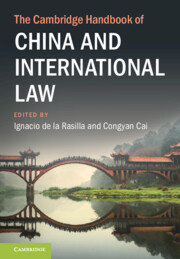
BOOK: Ignacio DE LA RASILLA & Congyan CAI (eds.), The Cambridge Handbook of China and International Law (Cambridge: Cambridge University Press, 2024), ISBN 9781316517406, 150 GBP


(image source: CUP)

Abstract:

This handbook provides a comprehensive road map to China's engagement with international law and an upgraded bridge between Chinese and Western approaches in times of turmoil. Written by a leading group of Chinese and Western specialists, it examines how China is assimilating into, and putting its stamp on, the global legal order. It offers updated analyses of China's relationship with international institutions, human rights law, international trade law, the law of the sea, the laws of peace and war, international criminal law, global health law, international investment law, international environmental law, climate change, international terrorism law, outer-space law, intellectual property law, cyber-space warfare, international financial law, international dispute settlement, territorial disputes, the Belt and Road Initiative, the Community of Shared Future for Mankind, China's constitutional law, the judicial application of international law, state immunity, the international rule of law, China's treaty practices and the extraterritorial application of Chinese laws.

On the editors:

Ignacio de la Rasilla holds the Han Depei Chair and is a One Thousand Talents Plan Professor at the Wuhan University Institute of International Law and Wuhan Academy of International Law and Global Governance in China. He is the author or editor of six books including International Law and History, Modern Interfaces (Cambridge University Press, 2021). Congyan Cai is a professor of international law in the School of Law and an adjunct professor at School of International Relations and Public Affairs at Fudan University. He is the author of The Rise of China and International Law, Taking Chinese Exceptionalism Seriously (Oxford University Press, 2019).

Table of contents:

Introduction: China and international law – not a map but perhaps a compass Ignacio de la Rasilla and Congyan Cai
Part I. Taking Centre Stage In Global Governance and the International Legal Order:
1.China's reform and opening-up and its move to international institutions Yun Zhao
2. The belt and road initiative and the international legal order: why it happened, what it does and how, and what it brings about Congyan Cai
3. The Community of shared future for mankind and international law Ignacio de la Rasilla and Yayezi Hao
Part II. Interfaces between National and International Law:
4. The constitution of China and international law: from selective adaptation to normative consensus Chao Wang and Xin Xiang
5. Chinese and Western perspectives on the rule of law and its international implications Karen J. Alter and Ji Li
6. International law in Chinese courts Björn Ahl
Part III. Selected areas of Chinese state practice:
7. China's treaty practices: politicization of law or legalization of politics? Carrie Shang Shu and Wei Shen
8. The solid state of state immunity in the People's Republic of China Timothy Webster
9. The 'effect doctrine' and the extraterritorial application of Chinese national laws: it's easier said than done Yongping Xiao and Lei Zhu
Part IV. International Peace and Security:
10. The Chinese approach to the jus ad bellum in International law and cyber-warfare Zhixiong Huang and Yaohui Ying
11. China and international terrorism law Congyan Cai and Yifei Wang
12. China and international criminal law: a dual-identity dilemma Dan Zhu
Part V. Human-Centred International Law:
13. China and international human rights law Ruijun Dai
14. China and global health law in the face of COVID-19 Qingjiang Kong and Shuai Guo
15. China and international humanitarian law Binxin Zhang
Part VI. The Habitat And The Global Commons:
16. China and international environmental law: sageliness within and kingliness without? Nengye Liu
17. China and global climate change law governance: a unison of top-down governance and multi-stakeholder engagement approach Tianbao Qin and Bingyu Liu
18. China and the law of the sea Haiwen Zhang
19. China and the non-weaponization of outer space: towards a relational normativity Matthias Vanhullebusch
Part VII. International Economic Law:
20. China and International trade law: rising from within the system or always an outlier? Jiangyu Wang
21. China: an emerging rule-maker in international investment law? Freya Baetens and Sheng Zhang
22. China and international intellectual property law: striving to become a respected player Jianqiang Nie
23. Chinese Multilateralism in international financial law Bin Gu
Part VIII. International Dispute Settlement:
24. China and international dispute settlement by adjudicative and other means Ignacio de la Rasilla and Yayezi Hao

25. China and the settlement of territorial disputes Xinjun Zhang and Xidi Chen.

Read more here

19 December 2022

BOOK: Ryan Martinez MITCHELL, Recentering the World: China and the Transformation of International Law (Cambridge: Cambridge University Press, 2022), 250pp, ISBN 9781108498968, £95


(image credit: Cambridge University Press)

Book description:
Recentering the World recovers a richly contextual, detailed history of Western-imposed legal structures in China, as well as engagements with international law by Chinese officials, jurists, and citizens. Beginning in the Late Qing era, it shows how international law functioned as a channel for power relations, techniques of economic domination, as well as novel forms of resistance. The book also radically diversifies traditionally Eurocentric accounts of modern international law's origins, demonstrating how, by the mid-twentieth century, Chinese jurists had made major contributions to international organizations and the UN system, the international judiciary, the laws of armed conflict, and more. Drawing on extensive archival research, this book is a valuable guide to China's often conflicted role in international law, its reception and contention of concepts of sovereignty, property, obligation, and autonomy, and its gradual move from the 'periphery' to a shared spot at the 'center' of global legal order.
Table of contents: 
Introduction: 'In the Nineteenth Century, There was No International Law'
Part I. Preserving Stateliness, 1850–1894:
1. Universal Prosperity
2. Synarchy
3. Vast Imperium
Part II. Asserting Sovereignty, 1895–1921:
4. The Public Law of Planet Earth
5. The Problem of Equality
6. Reconstituted Hierarchies
Part III. Internationalisms, 1922–2001:
7. Changing Circumstances
8. New Orders
9. Perpetual Peace
Conclusion: From Object to Subject? – China in a World of Institutions
Glossary of Chinese and Japanese Names
Bibliography
Index
About the author: 
Ryan Martínez Mitchell is an associate professor at the Faculty of Law of the Chinese University of Hong Kong. He holds a J.D. from Harvard Law School and a Ph.D. in Law from Yale University. His scholarship on China and international law has appeared in a number of leading scholarly journals.
More information can be found here.  

17 May 2021

PODCAST: Une "conversation mondiale" exceptionnelle sur les origines de la laïcité entre Carlo Ginzburg et Sanjay Subrahmanyam (France Culture, 14 MAY 2021)

(cartoon on the imminent rupture of the link between Church and State during the French Third Republic; source: France Culture)

 Abstract:

A l’ordre du jour ce soir : le "Temps du débat" poursuit la conversation entamée il y a longtemps déjà entre deux grands historiens et intellectuels, Carlo Ginzburg, professeur d’histoire moderne à l’Ecole Normale supérieure de Pise et à l’université de Californie à Los Angeles et Sanjay Subrahmanyam, professeur également à UCLA et au Collège de France. L’un et l’autre s’intéressent ces temps-ci à ce qu’on appelle habituellement la religion mais aussi au sécularisme. Après une année où la France fut secouée encore par les débats liés à la laïcité, nous avons plaisir à élargir dans le temps et l’espace ces questions profondément renouvelées par la recherche et la confrontation mondiale des idées.

(source: France Culture)

22 March 2019

BOOK: Julia LOVELL, Maoism. A Global History (London: Penguin, 2019), 624 p., ISBN 9781847922496, 30 GBP

(image source: Penguin)

Book abstract:
For decades, the West has dismissed Maoism as an outdated historical and political phenomenon. Since the 1980s, China seems to have abandoned the utopian turmoil of Mao’s revolution in favour of authoritarian capitalism. But Mao and his ideas remain central to the People’s Republic and the legitimacy of its Communist government. With disagreements and conflicts between China and the West on the rise, the need to understand the political legacy of Mao is urgent and growing. The power and appeal of Maoism have extended far beyond China. Maoism was a crucial motor of the Cold War: it shaped the course of the Vietnam War (and the international youth rebellions that conflict triggered) and brought to power the murderous Khmer Rouge in Cambodia; it aided, and sometimes handed victory to, anti-colonial resistance movements in Africa; it inspired terrorism in Germany and Italy, and wars and insurgencies in Peru, India and Nepal, some of which are still with us today – more than forty years after the death of Mao. In this new history, Julia Lovell re-evaluates Maoism as both a Chinese and an international force, linking its evolution in China with its global legacy. It is a story that takes us from the tea plantations of north India to the sierras of the Andes, from Paris’s fifth arrondissement to the fields of Tanzania, from the rice paddies of Cambodia to the terraces of Brixton. Starting with the birth of Mao’s revolution in northwest China in the 1930s and concluding with its violent afterlives in South Asia and resurgence in the People’s Republic today, this is a landmark history of global Maoism.
Discover more with the publisher.