Search

Showing posts with label capitalism. Show all posts

07 January 2026

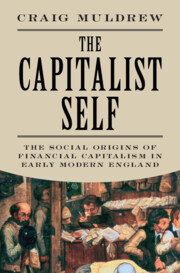
BOOK: Craig MULDREW, The Capitalist Self. The Social Origins of Financial Capitalism in Early Modern England (Cambridge: Cambridge University Press, 2025), ISBN 9781009644488, €40,85


(image source: CUP)

Abstract:

In this radical reinterpretation of the Financial Revolution, Craig Muldrew redefines our understanding of capitalism as a socially constructed set of institutions and beliefs. Financial institutions, including the Bank of England and the stock market, were just one piece of the puzzle. Alongside institutional developments, changes in local credit networks involving better accounting, paper notes and increased mortgaging were even more important. Muldrew argues that, before a society can become capitalist, most of its members have to have some engagement with 'capital' as a thing – a form of stored intangible financial value. He shows how previous oral interpersonal credit was transformed into capital through the use of accounting and circulating paper currency, socially supported by changing ideas about the self which stressed individual savings and responsibility. It was only through changes throughout society that the framework for a concept like capitalism could exist and make sense.

Read more here: DOI  10.1017/9781009644488.

14 July 2022

BOOK: Emmanuelle TOURME JOUANNET, Le droit international le capitalisme et la terre. Histoire des accaparements de terres d'hier à aujourd'hui [Collection de droit international] (Bruxelles: Bruylant, 2021), ISBN 9782802769996, 412 p.

(image source: Larcier)


Abstract:

Le présent ouvrage étudie les liens historiques qui se sont noués entre le droit international et le capitalisme à travers le statut conféré à la terre. Il s’agit en fait de prolonger sous un angle nouveau notre réflexion sur les finalités du droit international et les critères empiriques de la justice sociale au plan international.

L’objet de ce livre est bien d’écrire une histoire portant sur le triptyque constitué par le droit international, le capitalisme et la terre, cette dernière servant à la fois de moteur originaire et de révélateur a posteriori des liens intrinsèques qui se sont noués à travers le temps et l’espace entre les deux premiers. En témoigne le phénomène contemporain de l’accaparement des terres. Depuis au moins deux décennies il se produit une véritable « ruée mondiale vers les terres » de la part de certains États et surtout des grands acteurs économiques privés pratiquant l’agro-business et l’agro-carburant.

Or l’ensemble des règles du droit international économique et du droit transnational des investissements a contribué à l’augmentation continue de ces accaparements et au fait que la terre fasse aujourd’hui l’objet d’une financiarisation à outrance qui va jusqu’à la dématérialiser. La terre devient un asset, une valeur refuge en bourse pour les investisseurs/accapareurs. De milieu tangible le plus concret, le plus immuable et matériel qui soit, la terre est passée à l’état d’un produit financier qui est par principe volatile, immatériel et impalpable. Ce faisant elle fait l’objet d’une exploitation intensive poussée à son extrême afin d’obtenir le plus de rendements possibles et donc de bénéfices.

Qu’est-ce que donc alors que la terre selon le droit international ? Est-ce un milieu, un espace ou un bien détenu en pleine propriété par l’être humain ? Est-ce le substrat de l’identité des êtres humains ou est-ce une marchandise ? D’où vient le besoin incessant de nouvelles terres qui a jalonné toute l’histoire humaine et que le droit international a licité tout au long des siècles ? Pourquoi tant de guerres et de contentieux pour des territoires ou la délimitation de frontières ? Pourquoi tant d’accaparements et de dépossessions de terres ou vivaient et où vivent encore des peuples autochtones ou des populations rurales démunies? Mais aussi quel est le rapport des questions liées à la terre avec la Nature et avec la Terre considérées comme un tout ?

Ce livre est une invitation à réfléchir à ces questions en cheminant à travers le temps.

Summary:

Introduction

Chapitre 1 – Origines conceptuelles du discours juridique européen sur l’appropriation et l’exploitation de la terre – Le droit des gens moderne

Chapitre 2 – Moment colonial de l’accaparement des terres − Le droit international des nations civilisées

Chapitre 3 – Marché mondial des terres − Droit international de la société globale

Conclusion

More details on the publisher's website.

(source: ESIL IGHIL Blog)

03 May 2022

LECTURE: Renaissance Florence and the Origins of Capitalism: A Business History Perspective (Law and History Workshop, 10 May 2022, Stanford-ONLINE)


We learned that the last seminar of the Law and History Workshop organized by the Stanford Center for Law and History will be held on Tuesday, May 10, from 12:45-2:00PM (Pacific) in Room 320D, Stanford Law School, and via Zoom. 

Francesca Trivellato, Institute for Advanced Study, School of Historical Studies will present, “Renaissance Florence and the Origins of Capitalism: A Business History Perspective.” Professor Trivellato will present in-person but participants will be able to attend either in-person or online. 

Please RSVP by Monday, May 2. To RSVP, click here. Those who confirm their attendance will receive a separate email containing the paper and link to the event after the RSVP deadline.

For those who attend in-person, however, lunch will be provided at 12:25PM, 20 minutes before the workshop at Room 320D. We also ask all those who attend in-person to comply with current Stanford event guidelines which can be found here.


ABSTRACT

From the 1940s to the 1970s, the commercial revolution of the Middle Ages was a historiographical concept with considerable traction. This article revisits the literature that brought about and engaged with that concept, with specific reference to Florence. In so doing, it draws attention to the place once held by business history in the study of Europe’s takeoff. It also discusses the preliminary results of an ongoing project on limited partnerships in early modern Tuscany, which reaffirms the relevance of business history for understanding preindustrial economies but steers away from a teleological search for the origins of modern capitalism.


More information can be found here.


24 November 2020

SEMINAR: GiD Lab “Capitalism in Motion” (Youtube)


Please find here a summary of the event “Capitalism in Motion”, an online discussion on the development of capitalism to which several legal historians also contributed.

The GiD Lab online panel discussion “Capitalism in Motion. Imagining, Transforming, and Inventing Economic Forms over Time” demonstrated how the views of historians and scholars might contribute to the discussion on the development of capitalism over several centuries and into the modern era. Topics of discussion addressed in particular were the rise of business corporations in the medieval Mediterranean world and beyond, the invention and replication of economic tools – such as money, contracts and joint stock companies – and how the transformation and migration of key components of capitalism occurred across geographies, between cultures and over time. The event took place on 5 November 2020 at the Berlin Science Week and was organized by the German Historical Institute in Rome (GHI Rome) and the Central Office of the Max Weber Foundation in Bonn (MWS). In case you missed it, you can find a short event report by Madeleine Winkler and the recording here.

The video of the event, as well as the full review, can be found here


29 January 2020

BOOK : R. SZRAMKIEWICZ and O. DESCAMPS, Histoire du droit des affaires (Paris, L.G.D.J), 39 EUR. ISBN : 978-2-275-04507-8

(Source : LGDJ) 


 ABOUT THE AUTHORS :

Pr. Romuald SZRAMKIEWICZ (†) was a leading Professor of legal history in different French universities.

Pr. Olivier DESCAMPS is Professor at the University Paris II Panthéon-Assas, and Director of the Institut d'Histoire du Droit (CNRS-UMR 7184), Paris. 

BOOK ABSTRACT :

This is a new edition of the famous publication of Pr. Romuald SZRAMKIEWICZ (†). This book provides a historical perspective on trade law and institutions (from the earliest Antiquity to Contemporary times), at the time of globalisation. 

This publication is especially dedicated to students, academics, and those who want to understand current issues by learning the discipline's past.  

MORE INFORMATION (IN FRENCH) :

https://www.lgdj.fr/histoire-du-droit-des-affaires-9782275045078.html


03 October 2017

CALL FOR PAPERS: Young Scholars Conference: 'Historical Capitalism and International Law' (Paris, Sciences Po Law School, 18-19 Jan 2018); DEADLINE 15 OCT 2017

(image source: Sciences Po)

« HISTORICAL CAPITALISM AND INTERNATIONAL LAW »
CALL FOR CONTRIBUTIONS TO YOUNG SCHOLARS’ CONFERENCE
Sciences Po Law School, Paris, 18 and 19 January 2018

From the refugee crisis to climate change, from international terrorism to the ascent of extreme right governments, from increasing inequalities to new identity-based conflicts: the promises of liberal economic globalisation seem to be under attack all over. As a result, reflections on the relations between economy and society are increasingly present in the public debate, notably from the perspective of a more radical critique of the very basis of the capitalist system. This renewed interest is echoed for example in (yet another) return to Karl Marx’s writings, particularly in the German, French and Anglo-American press, in response to the now famous critiques of economic inequalities in liberal-democratic and market-driven societies, such as those raised by Thomas Piketty.
In the academic debate, although an increasing number of international lawyers have recently made historical interventions in their discipline in search of new possible futures, from a legal perspective in-depth analyses of the origins and functioning of the capitalist system remain limited. On the contrary, many historians have been focusing on the subject of capitalism and have developed analytical tools to critically analyse it, without however giving full importance to the constitutive role of law in the functioning of the capitalist system. 
The young scholars’ conference which will take place on 18 and 19 of January 2018 at Sciences Po Law School, Paris, as part of CIERA’s programme colloques juniors will explore the topic “Historical Capitalism and International Law” and try to fill some of these gaps. We borrow the notion of historical capitalism from Immanuel Wallerstein (Le Capitalisme historique, La Découverte, 2011) who points towards an analysis of the capitalist system as a specific historical process based on the principle of the continuous accumulation of capital. Originally historical, this definition underlines the particularities of capitalism as a social construction embedding several economic, social, political and cultural dimensions, all of which can be further articulated through analysing the legal dimension. Hence, this kind of analysis allows the elaboration of interdisciplinary perspectives, which depart from the material reality of capitalism to analyse its origins, functioning, current challenges and the prospect of its potential future developments. This conference will focus on the nature and evolution of economic and social institutions, their role in the exchanges and movement of peoples, ideas and commodities, as well as the way through which encounters, confrontations and interactions have shaped them in turn.

An interest in this particular dialogue lies principally in the perception of law as a social product which enjoys a relative autonomy in relation to other economic, social and cultural disciplines. Since law itself produces its own concrete realities and at the same time is an instrument around which various social actors struggle, it should not be analysed in complete isolation from other social processes. The interplay of voices coming from different disciplines is therefore central to grasping the specificity of law in the production of historical capitalism; particularly if one wants to avoid falling into analytical traps, such as the tendency to reduce law to a superstructure or on the other hand the reduction of histories and analysis of law to elements separated from the functioning of society. The conference will hence gather lawyers and historians, as well as social science scholars, appealing to the diverse and complementary approaches of each discipline in order to understand the forms of organisation which capitalism has taken in different times, in different places and at different scales. Each session will involve discussions between lawyers and historians working on related topics.
Contributions to the conference should explore one of the three following subject areas: 1) international law and the histories of capitalist expansion; 2) the history of international law and political conflicts in capitalism; 3) histories of international law and narratives of capitalist modernity. The publication of a special issue of the Journal of History of International Law is also being considered and would incorporate certain contributions from the conference.

Abstracts from 300 to 500 words shall be submitted indicating the subject area of the proposed contribution, along with a CV by 15 October 2017 to capitalismehistorique.di@gmail.com. Successful applicants will be notified by 5 November 2017 at the latest. English will be the main working language during the conference.
We encourage applications from the members of the HeiParisMax network, of the Collège doctoral franco-allemand en droit public comparé européen and of scholars affiliated to history centres connected to CIERA. There will be an equal number of contributions from both men and women, participants from French and German institutions, and those proposing historical or legal approaches. Applications from other areas of the world are also accepted and encouraged. A portion of the travel and accommodation expenses of selected participants will be covered by the conference.

Scientific Committee:
Lisa Herzog (Institut für Sozialforschung der Johann Wolfgang Goethe-Universitat)
Claire Lemercier (Centre de Sociologie des Organisations de Sciences Po)
Anne Peters (Max-Planck-Institut für ausländisches öffentliches Recht und Völkerrecht)
Emmanuelle Tourme-Jouannet (Ecole de droit de Sciences Po)

Organisational Committee:
Filipe Antunes Madeira da Silva (Ecole de droit de Sciences Po)
Robin Caballero (Humboldt Universität zu Berlin/ Université Paris 1 Panthéon-Sorbonne)
Alberto Rinaldi (Ecole de droit de Sciences Po)
Milan Tahraoui (Université Paris 1 Panthéon-Sorbonne/ Max Planck Institut für ausländisches Recht und Völkerrecht)
Leonie Johanna Vierck (Max-Planck-Institut für ausländisches öffentliches Recht und Völkerrecht)


With the Support of:
Centre interdisciplinaire d’études et de recherches sur l’Allemagne (CIERA)
Collège doctoral franco-allemand en droit public comparé européen
Ecole doctorale de Sciences Po
Ecole de droit de Sciences Po
Max-Planck-Institut für ausländisches öffentliches Recht und Völkerrecht
HeiParisMax – Partenariat académique franco-allemand