Search

Showing posts with label business history. Show all posts

03 May 2022

LECTURE: Renaissance Florence and the Origins of Capitalism: A Business History Perspective (Law and History Workshop, 10 May 2022, Stanford-ONLINE)


We learned that the last seminar of the Law and History Workshop organized by the Stanford Center for Law and History will be held on Tuesday, May 10, from 12:45-2:00PM (Pacific) in Room 320D, Stanford Law School, and via Zoom. 

Francesca Trivellato, Institute for Advanced Study, School of Historical Studies will present, “Renaissance Florence and the Origins of Capitalism: A Business History Perspective.” Professor Trivellato will present in-person but participants will be able to attend either in-person or online. 

Please RSVP by Monday, May 2. To RSVP, click here. Those who confirm their attendance will receive a separate email containing the paper and link to the event after the RSVP deadline.

For those who attend in-person, however, lunch will be provided at 12:25PM, 20 minutes before the workshop at Room 320D. We also ask all those who attend in-person to comply with current Stanford event guidelines which can be found here.


ABSTRACT

From the 1940s to the 1970s, the commercial revolution of the Middle Ages was a historiographical concept with considerable traction. This article revisits the literature that brought about and engaged with that concept, with specific reference to Florence. In so doing, it draws attention to the place once held by business history in the study of Europe’s takeoff. It also discusses the preliminary results of an ongoing project on limited partnerships in early modern Tuscany, which reaffirms the relevance of business history for understanding preindustrial economies but steers away from a teleological search for the origins of modern capitalism.


More information can be found here.


04 June 2020

JOURNAL: Diplomatica (Vol. II, Issue 1)


(Source: Brill)

Diplomatica has published the first issue for its 2020 volume, with a focus on the history of business diplomacy. The table of contents here:
  
Multinational Corporations as Diplomatic Actors: an Exploration of the Concept of Business Diplomacy
By: Huub Ruël
Pages: 1–12
  
Business Diplomacy from an IR Perspective
By: Niels van Willigen
Pages: 13–19
  
Early Modern Business Diplomacy: an Appraisal
By: Cátia Antunes
Pages: 20–27
  
  
The Dutch East India Company and Business Diplomacy
By: Adam Clulow and Tristan Mostert
Pages: 28–38
  
  
Trading Companies and Business Diplomacy in the Early Modern World
By: David Veevers and William A. Pettigrew
Pages: 39–47
  
  
Business and Diplomacy in the Twentieth Century: a Corporatist View
By: Thomas David and Pierre Eichenberger
Pages: 48–56
  
  
Merely “Ad hoc” Diplomacy? A Global Historical Comparison of Early Modern Japanese–Spanish and Qing-Russian Foreign Relations
By: Birgit Tremml-Werner and Lisa Hellman
Pages: 57–78
  
  
Private Diplomacy and Dutch Foreign Relations: the Rijkens Group and the West New Guinea Dispute 1949–62
By: David Verster
Pages: 79–99
  
  
“India Looks at the World”: Nehru, the Indian Foreign Service & World Diplomacy
By: Swapna Kona Nayudu
Pages: 100–117
  
  
Russian Science Diplomacy
By: Olga Krasnyak
Pages: 118–134
  
  
“A Number One Diplomatist”: Josephine McNeill, Ireland’s Minister to the Netherlands, 1950–55
By: Michael Kennedy
Pages: 135–144
  
  
The Slow Ascent of Women in Dutch Diplomacy: the Case of Maria Witteveen
By: Marc Dierikx
Pages: 145–153
  
  
Women in Diplomacy: the Equality Agenda
By: Anne Barrington
Pages: 154–162
  
  
Informal Alliance: The Bilderberg Group and Transatlantic Relations During the Cold War, 1952–1968, written by Thomas W. Gijswijt, 2019
By: Dino Knudsen
Pages: 163–166
  
  
La missione di Decio Francesco Vitelli nella storia della nunziatura di Venezia: Dai primi incarichi alla guerra di Castro (1485–1643), written by Marco Albertoni, 2017
By: John Condren
Pages: 167–168
  
  
Preventing Palestine. A Political History from Camp David to Oslo, written by Seth Anziska, 2018
By: Lorena De Vita
Pages: 169–171
  
  
Diplomacy in the 21st Century: A Brief Introduction, written by Paul Sharp, 2019
By: Alison Ruth Holmes
Pages: 172–173
  
  
The Institution of International Order: From the League of Nations to the United Nations, edited by Simon Jackson and Alanna O’Malley, 2018
By: Quincy Cloet
Pages: 174–176
  
  
Enemy Number One: The United States of America in Soviet Ideology and Propaganda, 1945–1959, written by Rósa Magnúsdóttir, 2018
By: Marsha Siefert
Pages: 177–179
  
  
International Development: A Postwar History, written by Corinna R. Unger, 2018
By: David Webster
Pages: 180–182
  
  
Announcement: The Mattingly Prize
Pages: 183

More info here

11 February 2020

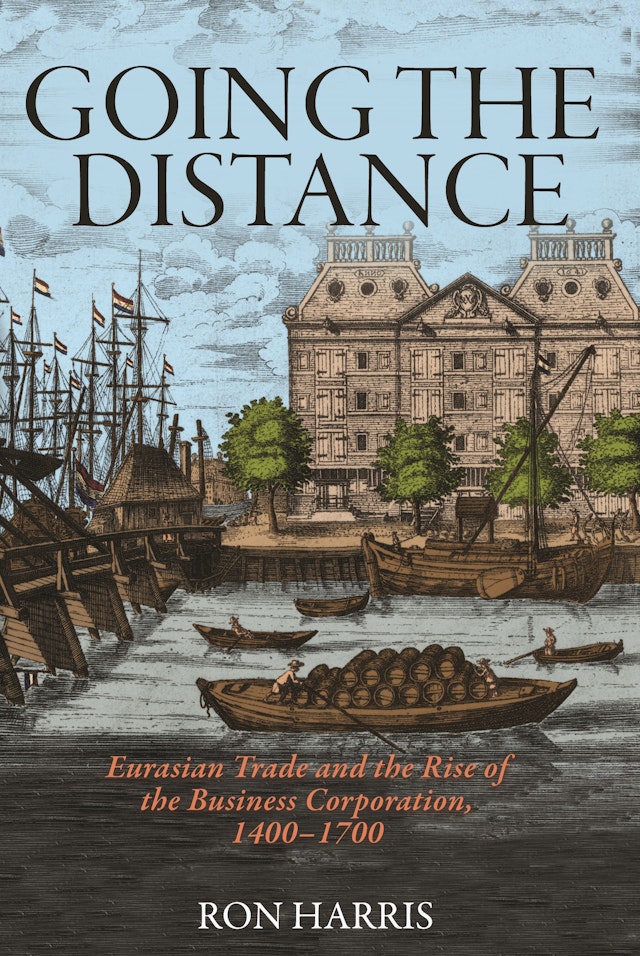
BOOK: Ron HARRIS, Going the Distance: Eurasian Trade and the Rise of the Business Corporation, 1400-1700 (Princeton: Princeton University Press, 2020). ISBN 9780691150772, £34.00


Princeton University Press is publishing a new book on Eurasian trade and the rise of the business corporation (1400-1700).

ABOUT THE BOOK

Before the seventeenth century, trade across Eurasia was mostly conducted in short segments along the Silk Route and Indian Ocean. Business was organized in family firms, merchant networks, and state-owned enterprises, and dominated by Chinese, Indian, and Arabic traders. However, around 1600 the first two joint-stock corporations, the English and Dutch East India Companies, were established. Going the Distance tells the story of overland and maritime trade without Europeans, of European Cape Route trade without corporations, and of how new, large-scale, and impersonal organizations arose in Europe to control long-distance trade for more than three centuries.

Ron Harris shows that by 1700, the scene and methods for global trade had dramatically changed: Dutch and English merchants shepherded goods directly from China and India to northwestern Europe. To understand this transformation, Harris compares the organizational forms used in four major regions: China, India, the Middle East, and Western Europe. The English and Dutch were the last to leap into Eurasian trade, and they innovated in order to compete. They raised capital from passive investors through impersonal stock markets and their joint-stock corporations deployed more capital, ships, and agents to deliver goods from their origins to consumers.

Going the Distance explores the history behind a cornerstone of the modern economy, and how this organizational revolution contributed to the formation of global trade and the creation of the business corporation as a key factor in Europe’s economic rise.

ABOUT THE AUTHOR

Ron Harris is professor of legal history and former dean of law at Tel Aviv University. He is the author of Industrializing English Law.

More info here


20 December 2019

CALL FOR PAPERS: Kinship and Business. Law, Gender and Generational Perspectives (16th-20th centuries) (Bolzano, 17-19 September 2020) (DEADLINE: 28 February 2020)


(Source: UniVie)

The University of Vienna has a CFP for a conference on “Kinship and Business. Law, Gender and Generational Perspectives (16th–20th Centuries)” (conference languages: German, English, Italian). Here the call:

Organisationsteam:
Margareth Lanzinger (Institut für Wirtschafts- und Sozialgeschichte, Universität Wien)
Siglinde Clementi (Kompetenzzentrum für Regionalgeschichte, Freie Universität Bozen)
Andrea Bonoldi (Dipartimento di Economia e Management, Università di Trento)

Keynote: Martha Howell (Columbia University)

Wirtschaften gestaltet sich in und über soziale Beziehungen. In der wirtschafts- und sozialhistorischen Forschung stehen dabei je nach Perspektive ganz unterschiedliche Formen und Qualitäten sozialer Beziehungen im Fokus. Unternehmen als Form sozialer Organisation des Wirtschaftens gehören zu den etablierten Themenfeldern. In den letzten Jahrzehnten hat sich die historische Verwandtschaftsforschung konstituiert, die sich sowohl den kulturell und rechtlich geprägten Konzepten von Verwandtschaft widmet als auch spezifischen Beziehungsnetzen und Organisationsformen und damit verbundenen Praktiken des Wirtschaftens.

Ziel der Tagung ist es, Unternehmen im weitesten Sinn und Verwandtschaft – in Verbindung mit Recht, Geschlecht und Generation – in Beziehung zueinander zu setzen.

Tagungssprachen sind Deutsch, Englisch und Italienisch mit Simultanübersetzung ins Englische.
Bitte senden Sie einen Themenvorschlag (1 Seite/300 Wörter) und einen KurzCV in der gewählten Tagungssprache bis 28. Februar 2020 an:

Siglinde Clementi (Freie Universität Bozen), siglinde.clementi@unibz.it

Weiterführende Informationen in deutscher Sprache finden Sie hier.
Weiterführende Informationen in englischer Sprache finden Sie hier.

More info with the Universität Wien

14 June 2018

WORKSHOP: Business and the Law. Historical Perspectives on Legal Change (21-23 June 2018, Universität Bayreuth)


(Source: H/Soz/Kult)

Please find below information regarding the workshop “Business and the Law. Historical Perspectives on Legal Change”, which includes several panels with legal historical contributions.

About

Firms act in tightly regulated legal environments. Yet as new products, production processes, and economic practices emerged that environment has been constantly questioned, undermined, and rebuilt. At the same time, legal changes challenged established economic practices like the ban on child labor or new cartel laws. Our workshop, generously funded by the DFG, will address the relation of businesses and the law from a broad and subtle perspective. The aim of the workshop is to understand legal change as a change in routines that affected the ways in which businesses and courts interpreted the "rules of the game". Such a change could manifest itself in written law or lead to a fundamentally different way of interpreting it. In both cases the focus needs to be on economic and legal practices, i.e. on the question what the law meant in its historical context and how it actually affected economic actions.

The workshop focuses on theoretical work as well as empirical case studies that help to shed light on the historical transformations of legal institutions at the intersection of businesses and the law. Papers will address one of the following research questions with a focus on developments since the 19th century.

1. The Relation of Firm Behavior and the Law: Conceptual Clarifications and Historical Perspectives
What do we mean when we talk about "the law" and its effects on business practices? What is "legal change" and what are the possible channels through which such change can take place? To what extent did the meaning of the law change itself over time? The first section of the workshop is intended to discuss some of the underlying concepts and theories important for understanding the problem of the relationship of business behavior and the law. Such a clarification includes discussing the law as a restraining and enabling institution as well as the question of relevant actors. We assume that economists, historians, and legal scholars may have different views on what they perceive as "the law" or "legal institutions".

2. Lobbying, Legal Entrepreneurs and Legal Change
In which ways have firms tried to manipulate legislative and judicial power to change the legal framework? What do we know about the decision making processes inside the firms or by individual businessmen to act as "political entrepreneurs"? Is it possible to make statements about the effects of such interventions? Papers will focus on historical case studies from different time periods that shed some light on these questions.

3. Business Practices and Regulation / Business Law and Its Effects
What effects had legal change, whether a new law or the removal of an old one, on firm behavior? Did firms comply with the new legal rules or did they try to undermine it, sticking to the routines they had been used to? What were the long term effects of such firm reactions on legal practice and written law? Historical case studies seem to suggest that negotiations could be very complicated with different degrees of success. Although the intentions of lawmakers could be realized to some extent, as in the case of cartel law after the Second World War, firm reactions played an important part regarding how new laws were implemented in practice. A number of different historical papers will address these issues.

4. Rule-Breaking and Business Scandals
What happened to the legal environment when firms and entrepreneurs simply failed to play by the rules? History is full of such cases, including scandalous fraud schemes as well as cases in which legal rule breaking was perceived as legitimate and a result of outdated legal regulations. Yet what distinguished the criminal behavior of Bernard Madoff from the copy right infringements of Pirate Bay or Google Books if it could not have been rule-breaking per se? Why did some cases of legal rule-breaking lead to a tightening of the rules while others led to their re-interpretation or elimination? In this section case studies will discuss and explain the effects of business crime – understood broadly and independent of whether perceived as legitimate or illegitimate - on legal institutions.

Programm

June 21
Welcome and Introduction (Louis Pahlow and Sebastian Teupe)
Panel 1: Conceptual Clarifications (Chair: Louis Pahlow)
Martha Prevezer (Queen Mary University of London): "Relationship between Firm Behaviour and the Law. Conceptual Clarifications and Historical Perspectives".
Sebastian Teupe (University of Bayreuth): "Business History and the Law".
Panel 2: Lobbying, Legal Entrepreneurs and Legal Change. Pt. 1. (Chair: Kim Priemel)
Samuel Klebaner (University of Bordeaux): "Managing Technical Changes from the Scales of Legal Regulation. German Clean Cars against the European Pollutant Emissions Regulations in the 1980s".
Harald Espeli (BI Norwegian Business School, Oslo): "Business Influence on the Late Enactment of Limited Liability Companies in Norway. The Role of Shipping Interests (1880-1916)".
Brian Cheffins (University of Cambridge): "Law and the Divorcing of Ownership and Control in Corporate America".

June 22
Panel 3: Lobbying, Legal Entrepreneurs and Legal Change. Pt. 2. (Chair: Sebastian Teupe)
Franz Hederer (University of Frankfurt): "Lobbyists as Lawmakers? The Economic Council in Weimar Germany as an actor in economic policy".
Peter Labuza (USC School of Cinematic Arts, Los Angeles): "United Arithmetic. Legal Contracts and the Financialization of Corporate Governance and Executive Labor in the Motion Picture Industry".
Panel 4: Business Practices and Regulation (Chair: Robert Bernsee)
Michael Buchner (Universität des Saarlandes, Saarbrücken): "Legal Change and Business Practices: The Role of Commercial Usages. Some Examples from Securities Trading in 19th Century Germany".
Thomas Storrs (University of North Carolina at Greensboro): "This Will Drive Them Wild…Wild. Comptroller James Saxon’s Transformation of American Banking, 1961-1966".
Panel 5: Rule-Breaking and Business Scandals (Chair: Jan-Otmar Hesse)
Eva Schäffler (Institut für Zeitgeschichte, Berlin): "What Is Not Prohibited Is Allowed. Legal Loopholes in the Czech Privatization Process".
Sverre Flaatten (The Norwegian Police University College): "Decriminalizing Creative Destruction in Norway. Business Scandals and the Securities Laws of the Late 19th Century".

June 23
Panel 6: Business Law and Its Effects: Patents and International Law (Chair: Thomas Welskopp)
Alexander Donges (University of Mannheim): "The Consequences of a Radical Patent Regime Change. A Natural Experiment".
Michael Schneider (Heinrich-Heine-University Duesseldorf): "The German Chemical Industry in Transnational Perspective. Innovations and Global Patent Protection during the Early 20th Century".
Nikitas E. Hatzimihail (University of Cyprus): "Companies as Border-Crossing Legal Entities".
Miriam Frey (University of Bayreuth): "Which Countries Mutually Recognize Commercial Court Decisions?".

Kontakt
Sebastian Teupe
Juniorprofessur für Wirtschaftsgeschichte, Kulturwissenschaftliche Fakultät
Universität Bayreuth, Universitätsstraße 30, 95447 Bayreuth


More information to be found on the website of H/Soz/Kult

23 March 2018

ANNOUNCEMENT: PHEDRA - Pour une Histoire Européenne du DRoit des Affaires


PHEDRA
Pour une Histoire Européenne du DRoit des Affaires 

Sano di Pietro, La Madonna raccomanda Siena a Papa Callisto III, détail, 1456, Siena, Pinacoteca Nazionale

Droit particulier, mais droit universel, tel semble être le paradoxe apparent du droit des affaires. Ius proprium, il l’est évidemment : c’est le droit propre aux affaires. Pourtant, sa propension à l’universalité a clairement été mise en évidence : la dimension transfrontalière du droit des affaires se révèle précocement, conduisant à lui conférer une homogénéité et une porosité internationale qui n’ont pas d’égaux. Cela est particulièrement vrai pour ce qui concerne l’Europe. Des dynamiques de longue durée dans l'évolution du droit des affaires – tant dans ses aspects normatifs que discursifs – ont investi l'ensemble du continent, laissant des sillons homogènes qui ont considérablement influencé le développement des cultures juridiques contemporaines, lesquels méritent, à nos yeux, une confrontation approfondie et étendue, qui ne doit pas pour autant nier les ruptures historiques et les diversités géographiques. 
Cette dimension transfrontalière du ius mercatorum, lequel porte dans son nom même les caractères du particularisme juridique, a conduit certains juristes contemporains à parler de la lex mercatoria comme d'un ordre juridique « anational »[1]. Cette qualification par la négative a, selon nous, le défaut de faire abstraction du substrat culturel propre à l’espace européen – au-delà de ses seuls aspects juridiques – dans lequel le droit des affaires s'est façonné. 
En effet, si ce droit profondément proprium a tendu vers l’uniformité à l'échelle européenne2, les raisons de ce phénomène ne peuvent pas, sans doute, être trouvées uniquement dans la force irréfrénable du marché. La seule analyse économique du droit des affaires ne saurait suffire à en comprendre les dynamiques.
Au-delà des raisons de praticité, il semble donc indispensable de s’interroger sur les ressorts historiques, culturels voire anthropologiques, qui pourraient permettre de dégager des caractères européens de l'évolution du droit des affaires. Il s’agit là d’un débat passionnant qui, loin d’être clos – malgré d’importantes contributions –, a récemment été rouvert de manière magistrale, dans une perspective d’ensemble, laquelle se demandait si le droit européen a une histoire[2].
Partant de ces constats et de ces questionnements, nous souhaitons lancer une réflexion d’ampleur sur l’histoire du droit des affaires à l'échelle européenne. L’idée-force consiste à travailler sur la longue durée (du Moyen Âge au XXIe siècle) et au niveau européen (Europe continentale et insulaire) de façon structurée, sur les trajectoires du développement du droit des affaires. Pour ce faire la constitution d'un groupe de travail stable et ramifié, permettant le développement dans le temps d'une réflexion approfondie et d’envergure, semble être l’instrument à la fois le plus efficace et le plus prometteur.

(davantage d'informations ici)


[1] Filali OSMAN, Les principes généraux de la lex mercatoria : contribution à l'étude d'un ordre juridique anational, Paris, 1992. 2 Albrecht CORDES, « The search for a medieval Lex mercatoria », in Vito Piergiovanni (ed.), From Lex Mercatoria to Commercial Law, Berlin, 2005, p. 53-68.
[2] Alain WIJFFELS, Le droit européen a-t-il une histoire ? En a-t-il besoin ?, Paris, Fayard [Leçons inaugurales au Collège de France], 2017.

07 February 2014

CFP: "The organization of business in Early Modern Europe", (Utrecht, 21 – 23 August 2014)


What: The organization of business in Early Modern Europe, Session Proposal for the 18th Annual Congress of the European Business History Association, Call for papers
Where: Universiteit Utrecht, Domplein, 3512, Utrecht
When: 21-23 August 2014

Deadline: 15 February 2014
All information here

Aim of the Session

Large-scale enterprises such as the English or Dutch East India Companies loom large over the business history of early modern Europe because they pioneered the legal form of the modern corporation. In reality, the majority of private business enterprises, whether in the commercial or manufacturing sectors, maintained a family basis. They were normally organized as sole proprietorships or general partnerships, that is, private enterprises in which owners and managers had the same decision-making power and shared equally all profits and losses. During the late Middle Ages, however, merchants across the Mediterranean developed contractual forms that allowed them to raise funds from outside investors, who were not involved in managing the business and who remained liable only for their portion of the investment.

Since Max Weber, limited liability partnerships have been credited with a crucial role in the growth of impersonal markets because they allowed merchants to expand the range of investors beyond their families. We do not know, however, what led to the adoption of this new form or how widely it spread in Europe. This session will lay the ground for a more ambitious research aiming to map the relative importance of different kinds of private business organizations in Europe from 1500 to 1800 and to develop a comparative methodology to explain geographical and chronological variations. With the session in Utrecht, we want to take the first step in establishing a network of specialists on different countries to stimulate empirical research an theoretical reflection on the organization of business in early modern Europe.

21 January 2014

ARTICLE: Herbert J. Hovenkamp on "Interest Groups in the Teaching of Legal History"

Herbert J. Hovenkamp's  "Interest Groups in the Teaching of Legal History", in Philosophy of Law e-Journal, vol.7, n. 7


 Abstract

One reason legal history is more interesting than it was several decades ago is the increased role of interest groups in our accounts of legal change. Diverse movements including law and society, critical legal theory, comparative law, and public choice theory have promoted this development, even among writers who are not predominantly historians. Nonetheless, in my own survey course in American legal history I often push back. Taken too far, interest group theorizing becomes an easy shortcut for assessing legal movements and developments without fully understanding the ideas behind them.
Intellectual history in the United States went into decline because its practitioners often wrote as if the history of ideas drove everything else, either disregarding or minimizing the role of interest groups. In the process it became viewed as inherently conservative because its source materials came almost exclusively from elite white males. On the other side, social and economic history have been driven by impulses originating from both the left and the right that sees policy as little more than the outcome of conflict among interest groups. Further, these preference are generally "naked" in the sense that they reveal little more than the desires of each individual for wealth, stability, social status, or other recognition. Articulated ideas are little more than rationalizations, and the public processes that make legal rules are largely a zero sum game. 
I try to instill in my students the idea that legal history is a much more complex process in which ideas and preferences interact. In differing areas and at different times one may dominate over the other, but almost never permanently. Further, ideas lead to preferences just as much as the other way around.
Teaching legal history in this fashion is more challenging to both the instructor and the students because it requires that ideas be taken more seriously. One cannot simply pass a hand over an entire area such as business policy and proclaim it to be the result of Social Darwinism, populism, labor and the surge in immigration, or some other interest group movement. I certainly do not expect my students to become experts in Calvinism, the social contract, classical political economy, genetic determinism, Freud, or the many other areas that wander into and out of my legal history course. But I do expect them to learn enough to take them seriously, and to understand that these intellectual ideas were as powerful to those who encountered them as the ideas that we hold today. 

Article available for free download here