Search

Showing posts with label legal scholarship. Show all posts

18 May 2021

ADVANCE ARTICLE: Lorren Eldridge, "Gone and forgotten: Vinogradoff's historical jurisprudence" (Legal Studies)

(image source: CUP)

 Abstract:

Sir Paul Vinogradoff was once well known for his historically contextualised approach to legal theory which held that legal ideas were the contingent products of social factors. Law was necessarily engaged with other subjects, and ‘historical jurisprudence’ could produce real insight into the nature of law – in part by placing theories such as analytical jurisprudence in context, evaluating and modifying theoretical models by reference to the contingent social facts of an era. This was part of the nineteenth-century turn to ‘science’ in history and a focus on methodology. Sir Henry Maine argued that legal history proved the insufficiency of analytic theories, but his method met with many criticisms, some of which Vinogradoff sought to address. However, Vinogradoff's insights have rarely been pursued or developed, with legal history favouring Maitland's more doctrinal approach, and legal theory rejecting historical jurisprudence – at least explicitly. Despite its imperfections, historical jurisprudence offers a rich and valuable way to understand law, including to evaluate analytical models such of those of HLA Hart, and as a methodology for dialogue between comparative and historical legal scholarship. It has, in fact, continued to do so without explicit recognition in the 100 years since Vinogradoff's death.

Read more here: DOI 10.1017/lst.2020.41.

16 October 2019

VIDEO: Eminent Scholars. Audio and Video Archives of Eminent Legal Scholars (Melbourne: Institute for International Law and the Humanities)

(image source: Wikimedia Commons)

The Eminent Scholars-audio and video archive (Prof. Sundhaya Pahuja & Adil Hasan Khan, Institute for International Law and the Humanities, Melbourne Law School) has uploaded material on the following scholars:
- Ratna Kapur
- Muthucumaraswamy Sornarajah
- Mohammed Bedjaoui
- Peter Fitzpatrick
- Upendra Baxi

Read, watch and listen here.

(source: ESILHIL Blog)

21 February 2019

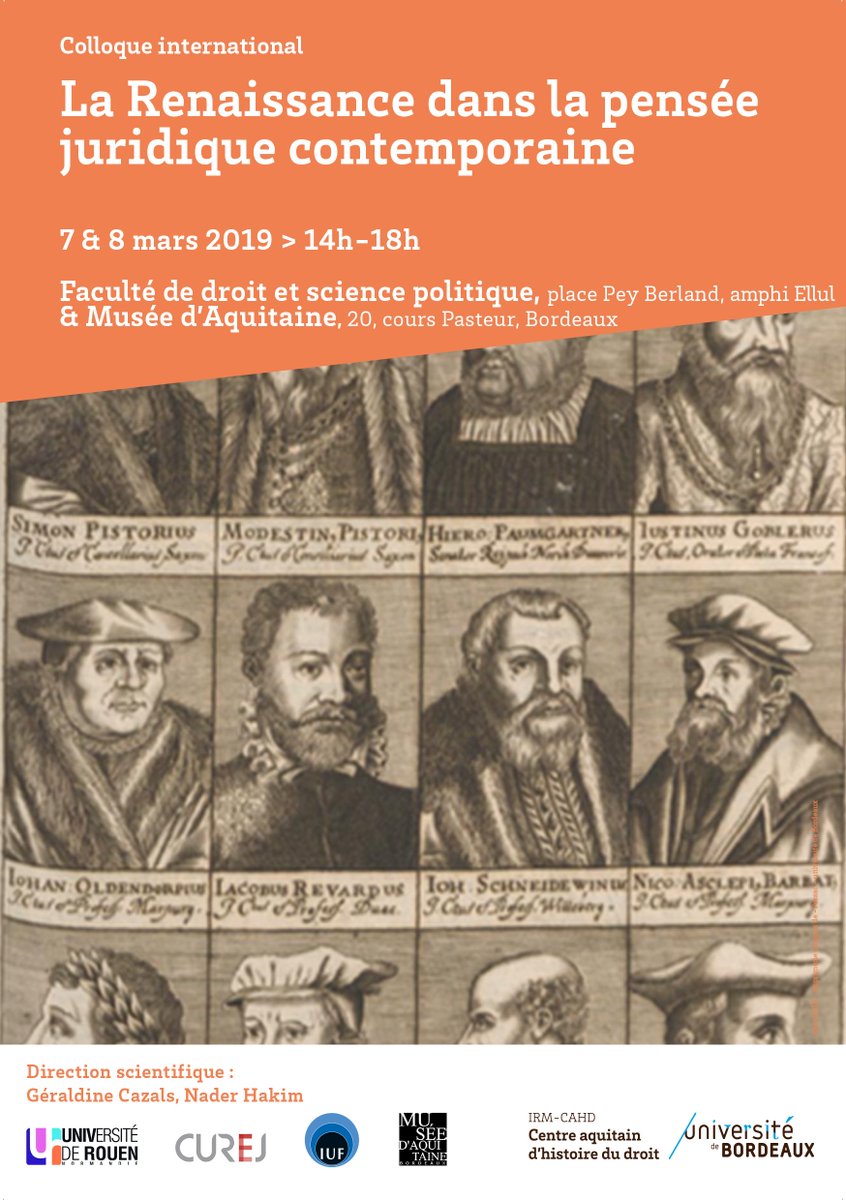
CONFERENCE: La renaissance dans la pensée juridique contemporaine (Bordeaux, 7-8 MAR 2019)

(image source: CHJ/Lille)

Overview of the papers presented below.

Thursday 7 March:

Introduction. Continuités et discontinuités de la pensée juridique (Géraldine Cazals, Institut universitaire de France/Université de Rouen Normandie et Nader Hakim, université de Bordeaux)

L’humanisme juridique : pour une gouvernance alternative (Alain Wijffels, Centre national de la recherche scientifique, Centre d’histoire judiciaire/Université de Louvain, Lille)

The place of legal humanism in shaping the 19th century idea of law. The case of Bartoliens and Cujaciens in Jacques Berriat-SaintPrix, Histoire du droit romain, suivie de l’histoire de Cujas (1821) (Adolfo Giuliani, Université d’Helsinki)

Le concept d’équité au XIXe siècle et celui des juristes français de la Renaissance (Lorenzo Maniscalco, Université de Cambridge)

Portalis et les auteurs du XVIe siècle (Raphaël Cahen, chercheur postdoctoral, Vrije Universiteit Bruxelles)

Friday 8 March:

Le droit et l’Église chez Pietro Tamburini. L’influence française (Grazia Grasso, Institut international de Lancy, Genève)

La place des auteurs de la Renaissance dans les recueils d’arrêts du XIXe siècle (Pierre-Nicolas Barenot,Université de Saint-Étienne)

L’édition des œuvres des jurisconsultes humanistes français au XIXe siècle (Xavier Prévost, université de Bordeaux)

L’historiographie contemporaine face au droit privé de la Seconde Scolastique : discontinuités et débats (Luisa Brunori)

L’œuvre de Guillaume Budé et son historiographie aux XIXe et XXe siècles (Luigi-Alberto Sanchi, Centre national de la recherche scientifique, Institut d’histoire du droit, Paris)

The full brochure can be downloaded here.

27 July 2018

ADVICE FOR YOUNG SCHOLARS: Should I do an edited collection ? (Legal History Blog, 23 JUL 2018)

(image source: blogger)

The Legal History Blog published the results of a survey conducted among scholars concerning the practice of partcipating in edited collections.

First paragraph:
Group publications can be challenging in many ways. We asked legal historians for their advice on doing edited volumes or special issues (h/t: LSA Law and History CRN). Our questions:
  • What works and what doesn’t?
  • What did you learn the hard way or wish you had known from the start?
  • Was it worth it in the end?
  • Were there any unexpected benefits?
We received a ton of responses. In the first post of this series, we share advice on contributing a chapter as an author. The second post will be about putting together such collections as an editor of the volume or special issue. The third will cover advice from scholars who have been editors of journals that produce special issues.
Read more here.