Search

Showing posts with label legal literacy. Show all posts

22 April 2024

SEMINAR: When Law Leaves the Lawbooks: Legal Diffusion and Normative Instability in Medieval Europe (Frankfurt am Main: Max Plank Institute, 23 APR 2024, h. 18:00 CET) [ONLINE]


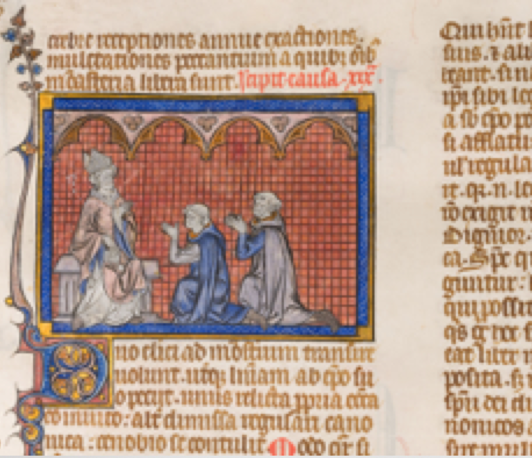
Like medieval jurists, modern scholars frequently rely on the authoritative, codified versions of legal norms when considering the relationship between legal developments and social change in the European Middle Ages. Too rarely have medievalists followed the lead of early modernists in emphasizing the multi-sited production and translation of legal knowledge. Yet just as in the early modern era, medieval law did not circulate only in its codified forms; knowledge of its language and provisions could also be transmitted and transformed through other written genres, to say nothing of oral renderings and visual representations. Using a thirteenth-century conciliar decree as a starting point (and building on a newly available online database of medieval ecclesiastical legislation), this talk will accordingly explore the paths by which legal innovations moved from medieval council chambers and university classrooms into local contexts, undergoing significant textual and interpretative transformations along the way.


Rowan Dorin (AB & PhD Harvard; MPhil Cambridge) is Associate Professor of History at Stanford University. In addition to his recent book, No Return: Jews, Christian Usurers, and the Spread of Mass Expulsion in Medieval Europe (Princeton UP, 2023), he has published articles on medieval canon law, Jewish-Christian relations, digital humanities, and the circulation of people, goods, and manuscripts in the premodern world.


Those interested in participating in person or online should register here.

More information can be found here. 


12 February 2019

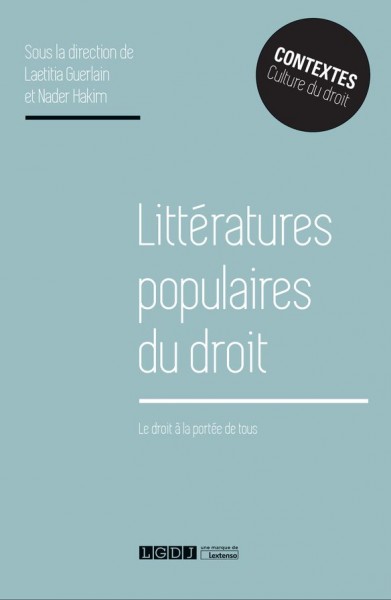
BOOK: Nader HAKIM & Laetitia GUERLAIN (dir.), Littératures populaires du droit. Le droit à la portée de tous [Contextes, Culture du droit, eds. Anne-Sophie CHAMBOST] (Paris: LGDJ, 2019), 216 p., €42. 978-2-2750-5722-4

(image source: LGDJ)

Book abstract:
La littérature populaire du droit existe-t-elle ? La question peut paraître incongrue alors que le droit est un savoir spécialisé et un privilège de la communauté des juristes. Le juriste n’est-il pas celui ou celle qui maîtrise tous les textes du droit ? C’est toutefois oublier que dans les caves et greniers ou dans les bibliothèques traînent une foule de livres qui ne sont ni scientifiques, ni réservés aux juristes. C’est également faire fi d’une question essentielle qui n’est autre que le droit intéresse tout un chacun et que « nul n’est censé ignorer la loi ». De cette ambivalence relative à l’arme du droit naît un genre littéraire : les textes publiés à destination des profanes, cette littérature « populaire » en ce qu’elle n’est ni réservée aux juristes, ni forcément écrite par des juristes de profession. Il y a ainsi une littérature grise qui ne retient guère l’attention et qui pourtant véhicule ce qu’est le droit pour toute une population de professionnels divers et variés, de curieux et d’utilisateurs allant de l’artisan ou de l’architecte jusqu’à « l’homme de la rue » et qui n’ont jamais mis les pieds dans une faculté de droit, un cabinet d’avocat ou même dans un tribunal. Ni inventaire ni quête du droit dans la littérature, les études d’histoire du droit réunies dans ce volume, majoritairement issues d’un colloque organisé à la Maison française d’Oxford, se proposent ainsi d’explorer tout un continent inconnu en tentant de le cartographier, de le sonder et d’interroger son ancienneté et sa variété dans plusieurs pays européens.
On the editors:
 Laetitia Guerlain et Nader Hakim sont historiens du droit à l’Université de Bordeaux et se consacrent à l’histoire contemporaine de la pensée juridique et à l’inscription du droit dans les sciences sociales.
Table of contents:
Laetitia Guerlain et Nader Hakim (Université de Bordeaux), Prolégomènes. La littérature populaire du droit existe-t-elle ? Sous le sacré… le profane, p. 3 Oliviero Diliberto (Università di Roma “Sapienza”, Zhongnan University of Economics and Law, Wuhan, Chine), Un’edizione popolare e divulgativa della Legge delle XII Tavole, p. 41 Annamaria Monti (Università Bocconi), Aperçus des littératures populaires du droit en Italie au XIXe siècle, p. 49 Hiram Kümper (Université de Mannheim), Implementing Juridical Reform : Popular Jurisprudence in Late Medieval and Early Modern Germany, p. 67 Prune Decoux (Université de Bordeaux), Codes, codification et presse américaine : une rencontre en demi-teintes, p. 79 Pierre-Nicolas Barénot (Université de Saint-Étienne), L’ABC du droit : la lexicographie juridique et le profane, p. 101 Cyrille Dounot (Université d’Auvergne), Littératures populaires et droit canonique au XIXe siècle, l’impossible mariage, p. 115 Kevin Brémond (Université de Bordeaux), Le Droit Populaire : une tentative de journal juridique populaire à l’aube de la Troisième République, p. 131 Guillaume Richard (Université Paris Descartes), Les « guides du sinistré » (1915-années 1920) : le sinistré, entre sujet de l’administration et stratège, p. 149 Mathieu Touzeil-Divina (Université Toulouse 1 Capitole), Le premier et le second Journal du Droit administratif (JDA) : littératures populaires du droit public ?, p. 179 
More information on the volume here.

08 October 2015

CALL FOR PAPERS: Learning Law by Doing: Exploring Legal Literacy in Premodern Societies (Turku, 14-15 January 2016); DEADLINE 23 NOVEMBER 2015

(image source: University of Turku)


We received the following call for papers from Prof. M. Korpiola (Turku/Finland), member of the Society's Board:

Learning Law by Doing: Exploring Legal Literacy in Premodern Societies

In many European regions, there was a gap between learned law and the largely illiterate laity. Especially where the legal language was another than the vernacular, such as Latin or Law French, this effectively helped to monopolize law and legal knowledge to learned lawyers. Yet, in the shades of what are generally called legal professionals, there were many other people who had some legal literacy, i.e., knowledge of the law and legal skills. Indeed, one may regard legal know-how as a sliding scale between what could be called true professionalism and complete ignorance. While trained legal professionals have been much researched, the legal knowledge and skills of laymen have largely been unexplored in legal history.

In this largely unresearched grey area, one finds people who had pursued some law studies, but never taken a degree or finished the required curriculum. There were also people doing some legal work or part-time advocacy such as scribes, scriveners, clerks, bailiffs and officials. Jury-members, lay magistrates and priests were legal literates in their communities and could also act as legal intermediaries between the people and the authorities. In eighteenth-century Japan even inn-keepers started to offer legal services to the people.

Legal literates had often acquired some knowledge of the contents of the law or legal skills by doing law-related work or being exposed to the practice of law in their lives. This way more marginal groups such as peasants, women and children could acquire a modicum of legal literacy. However, little research has been done on legal literacy in the premodern world, partly because of a scarcity of sources and the marginality of many common people.

This conference explores many facets of legal literacy in the pre-modern world: Europe and European colonies, but also other non-European legal cultures. Believing that cross-fertilization of different academic disciplines (law, social history, literacy studies etc.) will help research the elusive phenomenon, we invite papers on various aspects of the phenomenon, e.g.:
•    groups or individuals who had acquired some legal literacy
•    what legal skills and knowledge were acquired and how this was manifested
•    mechanisms of acquiring legal literacy
•    the uses of legal literacy
•    what legal literacy signified for individuals personally and as members of their community
•    conflicts and/or cooperation between self-made legal literates and members of the legal profession
•    sources for exploring legal literacy

PROPOSAL SUBMISSIONS AND FURTHER INFORMATION:
For more information about the conference or to submit a proposal (about 200 words), please contact Professor Mia Korpiola (mia.korpiola[at]utu.fi, Faculty of Law, University of Turku). The deadline for submitting paper proposals is 23 November 2015.