Search

Showing posts with label Mongol legal history. Show all posts

05 July 2023

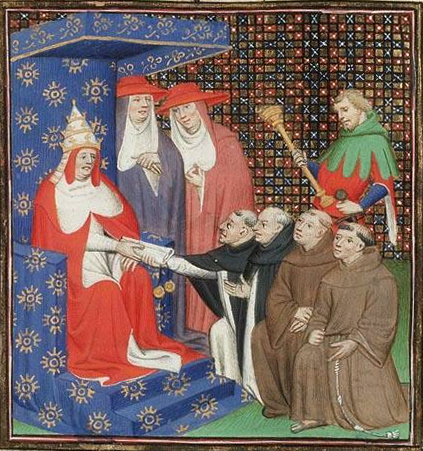
CONFERENCE: The Papacy and the Mongolian reigns in the 13th and 14th Centuries (18, 19, 20 July 2023, Wuppertal-Beijing-ONLINE)


The international conference "The Papacy and the Mongolian Reigns in the 13th and 14th Centuries" intends to investigate the phase of relations between Rome and the Far East which is to be places in the first half of the 14th century, a phase that went beyond the first evangelization of the Mongols and times at the institutionalisation of these relations.

The international conference will take place simultaneously in Wuppertal for the European participants and in Beijing for the participants from China, connected via zoom and will be held, due to time difference, on the mornings of 18, 19 and 20 July 2023.

Information and zoom access: cappuccio@uni-wuppertal.de.


***

PROGRAMME


18.07.2023 - Sources

09.00 Johrendt Jochen / Li Wendan: Introduction

09.15 Johrendt Jochen (Bergische Universität Wuppertal): Letters concerning the Mongols in the papal registers

10.15 Alberzoni Maria Pia (Università Cattolica del Sacro Cuore, Milano): The travelogues of the Franciscans in the East

10.45 Andreose Alvise (Università di Udine): Odoric of Pordenone, the Franciscan order and the Papacy

11.45 Li Wendan (Peking University): Historical commentaries on the papal letters concerning the Mongols in the 14th century

12.15 Hautala Roman (Oulu University): Catholic missionary work in the Golden Horde: Factors that contributed to its development

12.45 Discussion


19.07.2023 - Themes and actors of the interaction

09.00 Cappuccio Caterina / Massetti Francesco (Bergische Universität Wuppertal): The Papacy and the Church of Zaytun. Formation and institutionalisation of a Latin diocese in Yuan China

09.45 Concina Chiara Maria (Università di Verona): "aperiatur via... apta nunciis sepe mittendis". The corrispondence between the pope Benedict XII and the Alans in the context of the East-West relations

11.00 Bueno Irene (Università di Bologna): “De societate Christianorum ac Tatarum”: Armenian and Mongols in the diplomatic schemes of the Avignon popes.

11.30 Chen Chunxiao (Chinese Academy of Social Sciences): Byzantine wives of the Mongol Khans

12.00 Musarra Antonio (Sapienza, Università di Roma): Genöse and Venetian merchants in the Far East

12.30 Discussion


20.07.2023 - Perception in the Far East

09.00 Dang Bahoai (Peking University): Two problems related with China mission of Pope Clement V

09.30 Ma Xiaolin (Nankai University): Chinese sources concerning the letters of Toghon Temür and the Alans to Pope Benedict XII

11.00 Qiu Zhirong (Renmin University of China): Some Mongolian terms in Odorico da Pordenone's Relations

11.30 Qiu Yihao (Fudan University): An unknown papal mission in 1312?

12.00 Fujisaki Mamoru (University of Tokyo): Explaining the Christian faith in the papal letters to the Mongols

12.30 Discussion and concluding remarks


More information can be found here.

05 June 2020

BOOK: Paolo SARTORI and Ulfat ABDURASULOV, Seeking Justice at the Court of the Khans of Khiva (Leiden-New York: Brill, 2020). ISBN 978-90-04-41939-1, USD 179.00


(Source: Brill)

Brill is publishing a new book on the legal history of the Khanate of Khiva.

ABOUT THE BOOK

This book aims to shed light on the juridical field of the Khanate of Khiva at the end of the 19th and the beginning of the 20th century. The 'Khanate of Khiva' is the term employed in Western historiography to denote the political formation that was put in place by the Qonghrats. The latter was a dynasty of Uzbek origin that ruled roughly between the last quarter of the 18th century and 1920. It ruled over the region known as Khorezm (Ar. Khwarazm), one of the biggest oases of Central Asia, traversed by the Amu Darya and nestled within the territory of what is today Uzbekistan, Kazakhstan, and Turkmenistan.

The main objective of this work is to show that prior to Sovietization the dispensation of justice in Khorezm depended mostly on a group of officials who represented the dynasty in power, but who lacked any specialised legal training.

It is important to reflect on this particular aspect of the legal system developed by the Muslim principality that we refer to as 'the Khanate of Khiva,' for conventional wisdom says that the practice of law in pre-modern Muslim societies was usually the business of the 'ulama', i.e., the scholars of Islam.

ABOUT THE AUTHORS

Paolo Sartori, Ph.D. (2006), University of Rome ‘la Sapienza’ is Senior Fellow at the Austrian Academy of Sciences. He is the author of Visions of Justice: Sharīʿa and Cultural Change in Russian Central Asia (Brill, 2016) and is the Editor-in-Chief of the Journal of the Economic and Social History of the Orient

Ulfat Abdurasulov, Ph.D. (2009), History Institute, Tashkent, is Senior Fellow at the Austrian Academy of Sciences. A recipient of many grants, he published in many scientific journals such as Iranian StudiesAb Imperio,Eurasian StudiesIslamic Law and Society, and Der Islam.

More info here

11 October 2019

BOOK: Jean-Pierre DIENY, Le Droit Mongol dans l’État Sino-Mandchou (1644-1911) (Paris: Editions de Boccard, 2019). ISBN 978-2-85757-079-0, 35,00 €


Editions De Boccard has published a new book on Chinese Ming dynasty laws in the Mongol sphere.

ABOUT THE BOOK

Partant d’une description complète de la législation impériale promulguée par le gouvernement des Qing pour la Mongolie, l’auteur examine dans ce livre les problèmes nés de l’introduction de cette législation aux Mongols et de l’application de celle-ci. L’étude d’un large éventail de documents juridiques — incluant les codes mongols antérieurs aux Qing, la législation impériale, les règlements administratifs et les jugements rendus à la fois aux niveaux local et central — lui permet d’analyser les interactions entre le droit et diverses questions relatives à l’autonomie locale, au pluralisme juridique, à l’assimilation politique et aux relations entre le centre et la périphérie. L’auteur défend l’idée que les Qing tendirent à mettre en valeur l’approche et les principes du droit chinois lors de l’élaboration de la législation propre aux Mongols. Ils transférèrent progressivement une grande partie de concepts étrangers à la tradition juridique mongole, sinon leur totalité. Malgré les efforts importants mis en œuvre pour contrôler et normaliser l’administration des régions périphé-riques jusqu’à en faire une extension de la Chine intérieure plutôt qu’un protectorat gouverné par l’aristocratie locale, et malgré les effets de l’immigration Han en Mongolie, les principes du droit mongol ne disparurent cependant pas complètement, ainsi qu’en témoignent les jugements rendus par les juges des niveaux inférieurs de l’administration Qing en Mongolie.

More info here

24 January 2019

BOOK: Natalia KROLIKOWSKA-JEDLINSKA, Law and Division of Power in the Crimean Khanate (1532-1774) (Leiden-New York: Brill, 2019). ISBN 978-90-04-38432-3, €102.00


(Source: Brill)

Brill has published a book on law in the Crimean Khanate.

ABOUT THE BOOK

The Crimean Khanate was often treated as a semi-nomadic, watered-down version of the Golden Horde, or yet another vassal state of the Ottoman Empire. This book revises these views by exploring the Khanate’s political and legal systems, which combined well organized and well developed institutions, which were rooted in different traditions (Golden Horde, Islamic and Ottoman). Drawing on a wide range of sources, including the Crimean court registers from the reign of Murad Giray (1678-1683), the book examines the role of the khan, members of his council and other officials in the Crimean political and judicial systems as well as the practice of the Crimean sharia court during the reign of Murad Giray.

ABOUT THE AUTHOR

Natalia Królikowska-Jedlińska, Ph.D. (2010), University of Warsaw, is Assistant Professor at that university. She has published articles on the Crimean Khanate and the Northern Caucasus in the Early Modern Period.

TABLE OF CONTENTS

Preface
 The Chronological Scope of the Research
 Outline of the Book
Acknowledgments
List of Illustrations
List of Abbreviations
Note on Place Names, Proper Names, and Transliteration
Concordance of Frequently Mentioned Place Names
Glossary
Introduction
 Historiography of the Crimean Khanate
 Sources
1 Murad Giray and His Times
 1 The Context of the Crimean Khanate Ruled by Murad Giray
 2 Murad Giray as Viewed by Crimean Chroniclers
2 The Household, Deputies, and the Council of the Khan
 1 The Khan’s Household
 2 The Kalga
 3 The Nuraddin and His Officials
 4 The Khan’s Council
3 The Khan and the Nobles
 1 The Crimean Nobles to 1532
 2 The Crimean Nobles in the Years from 1532 to 1774
4 Provincial Kadıs and Their Courts
 1 The Kadı and Court Personnel
 2 The Limitations of the Judicial Power of the Kadı and His Subordinates
5 Law and Its Practice in the Khanate’s Sharia Courts
 1 The Law Applied in the Crimean Courts
 2 Litigants of the Sharia Courts: A Basic Statistical Analysis
Conclusion: A Fragile Balance
Appendices
Appendix I: Transliteration, Translation, and Facsimile of the Order Issued by Khan Canibeg Giray
Appendix II: Transliteration, Translation, and Facsimile of a Case Brought to the Council of Murad Giray
Appendix III: Summaries of the Cases Judged at the Khan’s Council (1678–82)
Appendix IV: List of the Officials Recorded in the Crimean Sicils during the Reign of Murad Giray
Selected Bibliography
Index

More information here

13 August 2018

BOOK: Bettine BIRGE, Marriage and the Law in the Age of Khubilai Khan - Cases from the Yuan Dianzhang (Cambridge: Harvard University Press, 2017). ISBN 9780674975514, €49.50

(Source: HUP)

Harvard University Press recently published a book on marriage law during the reign of Khubilai Khan.

ABOUT THE BOOK

The Mongol conquest of China in the thirteenth century and Khubilai Khan’s founding of the Yuan dynasty brought together under one government people of different languages, religions, and social customs. Chinese law evolved rapidly to accommodate these changes, as reflected in the great compendium Yuan dianzhang (Statutes and Precedents of the Yuan Dynasty). The records of legal cases contained in this seminal text, Bettine Birge shows, paint a portrait of medieval Chinese family life—and the conflicts that arose from it—that is unmatched by any other historical source.

Marriage and the Law in the Age of Khubilai Khan reveals the complex, sometimes contradictory inner workings of the Mongol-Yuan legal system, seen through the prism of marriage disputes in chapter eighteen of the Yuan dianzhang, which has never before been translated into another language. Birge’s meticulously annotated translation clarifies the meaning of terms and passages, some in a hybrid Sino-Mongolian language, for specialists and general readers alike. The text includes court testimony—recorded in the vivid vernacular of people from all social classes—in lawsuits over adultery, divorce, rape, wife-selling, marriages of runaway slaves, and other conflicts. It brings us closer than any other source to the actual Mongolian speech of Khubilai and the great khans who succeeded him as they struggled to reconcile very different Mongol, Muslim, and Chinese legal traditions and confront the challenges of ruling a diverse polyethnic empire.

ABOUT THE AUTHOR

Bettine Birge is Associate Professor in the Department of East Asian Languages and Cultures, with a joint appointment in the Department of History, at the University of Southern California.

TABLE OF CONTENTS

Maps, Figures, and Charts*
Abbreviations
Introduction
I. The Age of Khubilai Khan and the Yuan dianzhang
1. The Historical and Social Context of the Yuan dianzhang
2. Yuan Administration and the Legal System
3. Origins, Contents, and Transmission of the Yuan dianzhang
4. Notes on the Translation
II. Chapter 18, “Marriage,” from the Yuan dianzhang: An Annotated Translation
5. Sections 1–2: Marriage Rites and Exchanges; Getting Married
6. Sections 3–5: Marriage between Officials and Commoners; Marriages of Military Personnel; Divorce
7. Sections 6–8: When the Husband Dies; Levirate Marriage Approved; Levirate Marriage Rejected
8. Sections 9–12: Secondary Wives; Marriage between Slaves and Commoners; Marriage of Entertainers; Marriage during the Mourning Period
Appendix A: Translation of Title Page of the Yuan dianzhang
Appendix B: Marriage Cases from Chapter 18 of the Yuan dianzhang in Chronological Order
Appendix C: Marriage Cases from Chapter 18 of the Yuan dianzhang with Dates
Bibliography
Acknowledgments
Index


More information here