Search

Showing posts with label Law and Politics. Show all posts

31 January 2022

ONLINE WEBINAR: Lauterpacht Centre for International Law, Friday Lecture: 'International Law and the Politics of History' - Prof. Anne Orford, Melbourne Law School - Friday, 4 February 2022 - 1.00pm

(Source: LCIL)

LECTURE SUMMARY

As the future of international law has become a growing site of struggle within and between powerful states, debates over the history of international law have become increasingly heated. In this lecture discussing her new book 'International Law and the Politics of History', Anne Orford explores the ideological, political, and material stakes of apparently technical disputes over how the legal past should be studied and understood. Drawing on a deep knowledge of the history, theory, and practice of international law, she argues that there can be no impartial accounts of international law's past and its relation to empire and capitalism. Rather than looking to history in a doomed attempt to find a new ground for formalist interpretations of what past legal texts really mean or what international regimes are really for, she urges lawyers and historians to embrace the creative role they play in making rather than finding the meaning of international law.

Friday, 4 February 2022 - 1.00pm. You can register here.

ABOUT THE SPEAKER

Anne Orford is Melbourne Laureate Professor and Michael D Kirby Chair of International Law at Melbourne Law School, and Visiting Professor of Law and John Harvey Gregory Lecturer in World Organizations at Harvard Law School. She researches and teaches in the areas of international law, history and theory of international law, international dispute settlement, international economic law, and climate change. She is a Fellow of the Academy of the Social Sciences in Australia and a past President of the Australian and New Zealand Society of International Law. Her publications include International Law and the Politics of History (Cambridge University Press, 2021), Pensée Critique et Pratique du Droit International (Pedone, 2020), International Authority and the Responsibility to Protect (Cambridge University Press, 2011), and Reading Humanitarian Intervention (Cambridge University Press, 2003), and the edited collections Revolutions in International Law: The Legacies of 1917 (Cambridge University Press, 2021) (co-editor), The Oxford Handbook of the Theory of International Law (Oxford University Press, 2016) (co-editor), and International Law and its Others (Cambridge University Press, 2006). She presented a special course on Civil War and the Transformation of International Law at the Hague Academy of International Law in 2021. She has been awarded honorary doctorates in law by Lund University, the University of Gothenburg, and the University of Helsinki, and the Woodward Medal for Excellence in Humanities and Social Sciences by the University of Melbourne.

24 November 2021

BOOK: Luciano CANFORA, Tucidide e il colpo di stato (Bologna: Il Mulino, 2021). ISBN: 978-88-15-29252-0, pp. 320


(Source: Il Mulino)

ABOUT THE BOOK

«E nessuno degli altri cittadini per paura faceva più opposizioni, vedendo che i partecipanti alla congiura erano tanti; ma se anche qualcuno si opponeva, subito moriva in un modo inopportuno, e non si indagava sui colpevoli né si punivano i sospetti, ma il popolo se ne stava tranquillo ed era così atterrito che chi non subiva alcuna violenza già riteneva di fare un guadagno, anche se era costretto al silenzio».
Accade di rado che uno storico si trovi immerso nel cuore di una rivoluzione e ne esca vivo. È quanto capitò a Tucidide, nell'anno 411 a.C. Mentre era impegnato nella scrittura, in tempo reale, della interminabile guerra che condusse al tracollo l'impero ateniese, lo storico si trovò coinvolto nel fuoco della effimera e sanguinosa rivoluzione oligarchico‐radicale che mirava a stroncare lo strapotere popolare e a chiudere il conflitto abbracciando il nemico, assunto come modello e come alleato. Nel bel mezzo della crisi, Tucidide poté dar vita a questo caso unico della storiografia antica, e non solo: la rivoluzione raccontata dall'interno e dall'osservatorio privilegiato delle più riservate posizioni di comando. I misteri e i retroscena di quella vicenda sono qui disvelati nelle pagine di Luciano Canfora.


 ABOUT THE AUTHOR

Luciano Canfora nato a Bari (1924), è ordinario di Filologia greca e latina presso l’Università di Bari. Laureatosi in Storia romana, ha svolto il perfezionamento in Filologia classica alla Scuola Normale di Pisa. Assistente di Storia Antica, poi di Letteratura Greca, ha insegnato anche Papirologia, Letteratura latina, Storia greca e romana. Fa parte del Comitato scientifico della “Society of Classical Tradition” di Boston e della Fondazione Istituto Gramsci di Roma. Dirige la rivista «Quaderni di Storia» e la collana di testi “La città antica”. Fa parte del comitato direttivo di «Historia y critica» (Santiago, Spagna), «Journal of Classical Tradition» (Boston), «Limes (Roma)». Ha studiato problemi di storia antica, letteratura greca e romana, storia della tradizione, storia degli studi classici, politica e cultura del XX secolo. Molti dei suoi libri sono stati tradotti in USA, Francia, Inghilterra, Germania, Grecia, Olanda, Brasile, Spagna, Repubblica Ceca.


TABLE OF CONTENTS

Un doveroso chiarimento
I. Gli aspetti materiali
II. Antifonte e il suo doppio
III. Tucidide di fronte al colpo di Stato
IV. Sul pensiero politico di Tucidide
V. L’ambigua critica oligarchica della «democrazia realizzata» ateniese: un caso di «sovversivismo delle classi dirigenti»
VI. Un’impresa «grande»: abbattere la democrazia
VII. Una cronaca in presa diretta
VIII. Il paradosso di Frinico: Tucidide tra Samo e Taso
IX. Il punto di osservazione di Tucidide
X. Chi uccise Frinico?
XI. Cronaca dall’interno della sala del Consiglio: lo scontro finale
XII. È incauto screditare il racconto tucidideo
XIII. Restaurazione e resa dei conti giudiziaria
XIV. La condanna di Antifonte
XV. Lo storico nella rivoluzione
Appendici
Tucidide, La guerra del Peloponneso (VIII, 45-98)
Abbreviazioni
Indice dei nomi e dei personaggi


More information with the publisher.

23 April 2021

BOOK: Marcus PAYK and Kim C. PRIEMEL, Crafting the International Order - Practitioners and Practices of International Law since c.1800 (Oxford: OUP, 2021). ISBN 9780198863830, 99.00 USD


(Source: OUP)

OUP is publishing a new edited collection on how lawyers have shaped international politics over the last 300 years.

ABOUT THE BOOK

This volume sheds light on how lawyers have made sense of, engaged in, and shaped international politics over the past three hundred years. Chapters show how politicians and administrators, diplomats and military men, have considered their tasks in legal terms, and how the field of international relations has been filled with the distinctly legal vocabulary of laws, regulations, treaties, agreements, and conventions.

Leading experts in the field provide insights into what it means when concrete decisions are taken, negotiations led, or controversies articulated and resolved by legal professionals. They also inquire into how the often-criticised gaps between juristic standards and everyday realities can be explained by looking at the very medium of law. Rather than sorting people and problems into binary categories such as 'law' and 'politics' or 'theory' and 'practice', the case studies in this volume reflect on these dichotomies and dissolve them into the messy realities of conflicts and interactions which take place in historically contingent situations, and in which international lawyers assume varying personas.

ABOUT THE EDITORS

Marcus M. Payk is professor of modern history at Helmut Schmidt University in Hamburg, Germany. He has a special interest in international history, legal history, German and European history, and has published widely in these fields. His research has been supported by various grants and scholarships both in Europe and the United States.


Kim Christian Priemel is professor of contemporary European history at the University of Oslo. He specializes in legal history, social and economic history, and media history. He has authored and edited several books and has published in the Journal of Modern History, the Journal of Contemporary History, and Central European History.

TABLE OF CONTENTS

1. Introduction: Thinking Law, Talking Law, Doing Law: How Lawyers Craft(ed) the International Order, Marcus M. Payk and Kim Christian Priemel

2. Shaping a New Profession: Japanese Encounters with International Law, c. 1600-1900, Andrew Cobbing

3. Legal Practitioners: Nineteenth Century International Jurisdiction and the Ambiguous Role of the Members of the Mixed Commissions, Fabian Klose

4. Legal Advice, the Foreign Office, and Britain's Neutrality Policy, 1870-1914, Gabriela A. Frei

5. The First R2P: US Legal Advisers and the Right to Protect Citizens in the Early Twentieth Century Americas, Benjamin A. Coates

6. Hammarskjöld at The Hague: Sweden and the Peace Conference of 1907, Michael Jonas

7. The Draughtsmen: International Lawyers and the Crafting of the Paris Peace Treaties, 1919-20, Marcus M. Payk

8. Legal Legwork: How Exiled Jurists Negotiated Recognition and Legitimacy in Wartime London 1939-45, Julia Eichenberg

9. Changing Hats. Nuremberg's Visible College and the Politics of Internationalism, 1941-49, Kim Christian Priemel

10. Fluid Boundaries in the Divisible College: The International Law Association and the Indus Waters Dispute in the 1950s, Katharina Rietzler

11. Agents of Constitutionalism: The Quest for a Constitutional Breakthrough in European Law, 1945-1964, Morten Rasmussen


More info here

17 December 2020

BOOK: Isabella CONSOLATI, Dominare tempi inquieti. Storia costituzionale, politica e tradizione europea in Otto Brunner (Bologna: Il Mulino, 2020). ISBN: 978-88-15-29069-4, pp. 216, € 21,00


(Source: Il Mulino)

ABOUT THE BOOK

L’autrice ricostruisce il pensiero politico di Otto Brunner (1898-1982) così come emerge dalla sua produzione storiografica. Criticando l’indebita proiezione di concetti politici moderni sul passato medievale, Brunner ha ridefinito la comprensione stessa della politica moderna. Il confronto con Carl Schmitt, Max Weber, Karl Marx e con la sociologia del suo tempo induce lo storico austriaco a precisare il criterio del ‘politico’ all’interno della società industriale contemporanea e dell’ideologia che la sostiene. L’analisi delle strutture secolari – dei concetti fondamentali e delle costituzioni materiali – che secondo lui hanno dato forma alla storia sociale europea è volta ad affermare l’esistenza di una tradizione politica tipicamente europea, nobiliare e cristiana, che fa da contrappeso all’intima instabilità della modernità.

ABOUT THE AUTHOR

Isabella Consolati è assegnista di ricerca in Storia delle Dottrine Politiche presso il Dipartimento di Storia, Culture e Civiltà dell'Università di Bologna. Titolo della ricerca: Semantica del concetto di mercato.

TABLE OF CONTENTS

Introduzione. Il dominio come storia

I. Sulla storia del ‘politico’

1. Storia e politica

2. La realtà del dominio

3. La costituzione oltre lo Stato

4. Consociazione e signoria

II. Storia e struttura della razionalità europea

1. Dall’Impero all’Europa

2. Per una nuova storia sociale

3. Capitalismo e società industriale

4. Città, borghesia e Stato moderno

5. Il mimetismo del dominio

III. Ethos, ideologia, tradizione

1. Alla ricerca della tradizione europea

2. Declino dell’individualità aristocratica

3. La transizione ideologica

4. Tradizione e rivoluzione

Indice dei nomi


More information with the publisher.

27 October 2020

BOOK: Christian LAURANSON-ROSAZ & Philippe DELAIGUE (Eds.), Mémoires des origines et stratégies de légitimation du pouvoir (Paris: Mare & Martin, 2020). ISBN : 978-2-84934-489-7, pp. 400, € 39


(Source: Mare & Martin)

ABOUT THE BOOK

Collection Histoire du droit et des institutions.

L’imaginaire du pouvoir, sa représentation ou sa mise en scène, pour ne pas dire sa «théâtralisation», constitue un thème d’études et de recherches majeur qui rejoint la grande question de l’identitaire. Cet imaginaire a des initiateurs, dont l’identification varie selon les temps et les lieux – l’élite, les clercs, maîtres de la culture et du sacré – et des vecteurs : le droit et les traditions, la littérature officielle ou populaire, la mémoire. Cette publication met en lumière la mise en scène des stratégies de légitimation du pouvoir, initiées par les acteurs eux-mêmes ou par ceux qui, de l’extérieur, se donnent pour mission de justifier leur action. La thématique est donc très actuelle. La qualité des auteurs, ainsi que la part très importante consacrée aux expériences étrangères, donnent à cet ouvrage un caractère exceptionnel dans une thématique riche et jusqu’à aujourd’hui encore peu fouillée. La démarche comparative, ainsi que le champ chronologique très étendu des contributions, lui confèrent une place à part dans le champ de la recherche en Histoire du droit.

ABOUT THE EDITORS

Philippe Delaigue est Maître de conférences HDR d'histoire du droit à l'université Jean Moulin-Lyon 3 et membre du CLHDPP.

Christian Lauranson-Rosaz (1952-2016) était Professeur d'histoire du droit à l'université Jean Moulin-Lyon 3, membre du Centre lyonnais d'histoire du droit et de la pensée politique.


More information with the publisher.

14 May 2020

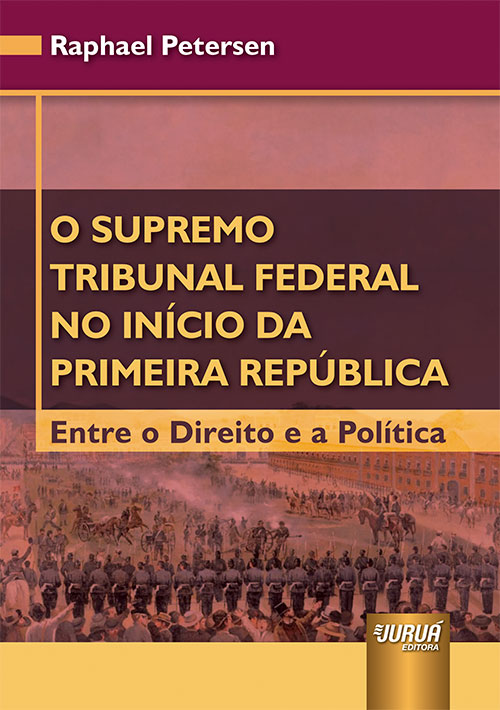
BOOK: Raphael PETERSEN, O Supremo Tribunal Federal no Início da Primeira República: Entre o Direito e a Política (Juruá: Curitiba, 2020). 213 p. R$ 62


Abstract:
Esta obra aborda a atuação do Supremo Tribunal Federal na primeira década republicana, entre os anos de 1889 e 1898. Escrito a partir da consulta a debates parlamen­tares, autores da época e a integra de mais de duzentos julgamentos, busca compreender o papel do Tribunal no contexto político e jurídico da Primeira República. Chamado a se manifestar em face dos mais importantes eventos políticos, como a Revolta da Armada, a Revolução Federalista e o atentado ao presidente Prudente de Moraes, o STF, nessa difícil conjuntura, passou a tra­balhar institutos jurídicos como o controle de constitu­cionalidade e o controle dos atos administrativos, e a julgar habeas corpus, ações penais originárias e ações anulatórias. Além do papel político-institucional, a obra permite que se conheça a tradição constitucional bra­sileira em julgamentos como o caso do Navio Jupiter, primeiro caso de grande repercussão em que houve o exercício do controle de constitucionalidade das nor­mas, e o caso da Anistia de 1895, em que se impugnava a imposição de condições aos anistiados políticos da Revolução Federalista.

Author:
Juiz Federal Substituto da 4ª Região desde 2013, estan­do atualmente lotado em Novo Hamburgo/RS. Possui Mestrado em Direito pela Universidade Federal do Rio Grande do Sul/UFRGS, com ênfase em História do Direi­to. Foi Assessor no Superior Tribunal de Justiça, entre os anos de 2010 e 2013. 

More information: https://www.jurua.com.br/shop_item.asp?id=28455

19 April 2019

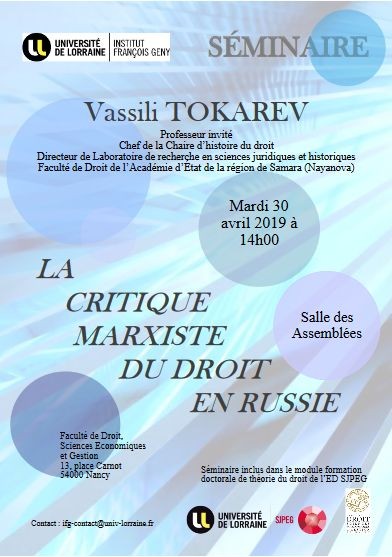
SEMINAR: Vasili TOKAREV (Samara), La critique marxiste du droit en Russie (Nancy: Université de Lorraine, 30 APR 2019)

(image source: Nomôdos)

Abstract:
Notre objectif est d’analyser les racines historiques et les caractéristiques de la critique marxiste du droit en Russie, compte tenu des contextes politiques et historiques spécifiques. De façon générale, il s’agit de mettre en lumière la naissance et l’évolution de la pensée juridique marxiste et le rôle des responsables de l’application du droit qui utilisaient le « sens de la justice révolutionnaire » comme source juridique formelle dans la consolidation de la « démocratie populaire » et dans la construction d’un État de type socialiste qui se distingue par son originalité qualitative. Il faut comprendre pourquoi le marxisme qui est une orientation fort critique de la pensée politique, s’est facilement enraciné dans une Russie. Pour ce faire, nous analysons les conceptions du droit de Plekhanov, de Lénine, de Boukharine, de Pasukanis, etc. et son influence sur le droit public et le droit privé russe (1917-1991).
Programme:
 14h00 : Intervention de Vassili Tokarev, Professeur invité, Chef de la chaire d'histoire du droit, Directeur de laboratoire de recherche en sciences juridiques et historiques de la Faculté de Droit de l'Académie d'Etat de la région de Samara (Nayanova - Russie)
More information on Nomôdos.

23 July 2016

BOOK: "Anonymous Speech. Literature, Law and Politics" by Eric Barendt (July 2016)


Anonymous Speech. Literature, Law and Politics, by Eric Barendt
all information here

Anonymous Speech: Literature, Law and Politics discusses the different contexts in which people write anonymously or with the use of a pseudonym: novels and literary reviews, newspapers and political periodicals, graffiti, and now on the Internet. The book criticises the arguments made for a strong constitutional right to anonymous speech, though it agrees that there is a good case for anonymity in some circumstances, notably for whistle-blowing. One chapter examines the general treatment of anonymous speech and writing in English law, while another is devoted to the protection of journalists’ sources, where the law upholds a freedom to communicate anonymously through the media. A separate chapter looks at anonymous Internet communication, particularly on social media, and analyses the difficulties faced by the victims of threats and defamatory allegations on the Net when the speaker has used a pseudonym. In its final chapter the book compares the universally accepted argument for the secret ballot with the more controversial case for anonymous speech.
This is the first comprehensive study of anonymous speech to examine critically the arguments for and against anonymity. These arguments were vigorously canvassed in the nineteenth century – largely in the context of literary reviewing – and are now of enormous importance for communication on the Internet.

About the Author

Eric Barendt is Emeritus Professor of Media Law at University College London.