Search

Showing posts with label English law. Show all posts

27 October 2025

BOOK: Geoffrey SAMUEL, Principia Iuris. A Historical and Comparative Introduction to the English Common Law (Cheltenham: E. Elgar, 2025), 284 p. ISBN 9781035350568, 90 GBP


(image source: Elgar)

Abstract:

This book provides a strong introduction to the principal domains of legal knowledge by examining a structured list of legal maxims, many originating in medieval Roman and canon law. Oriented by historical and methodological approaches, it explores legal thought and reasoning through a comparative lens. Geoffrey Samuel explains the differences between common law and civil continental traditions, outlining preceding works on regulae iuris across the centuries. With an emphasis on English law, the book analyses basic principles and addresses the law of obligations, the law of actions and the law of property and public law. Delving into fundamental legal remedies, substantive law and legal institutions, Samuel questions whether some maxims are more memorable or indisposable than others and shows the impact they have had on legal theory. Exploring historical developments, the book also maps the original sources of key theories, utilising a civil law taxonomical plan to classify them. Principia Iuris is an invaluable resource for students and academics in law, legal theory and legal history. Its unique insights into common law mentalities will also greatly benefit legal educators and practising lawyers.

 Contents:

Contents
Preface
Introductory remarks
1 Law as a discipline
2 Historical considerations and the development of English law
and its institutions
3 Procedure and appeals
4 Legal taxonomy and legal theory
5 Public law
6 Law of persons
7 Law of things
8 Law of obligations (1)
9 Law of obligations (2)
10 Law of actions
11 Legal method and reasoning
Final thoughts
Bibliography

Read more here. 

27 May 2025

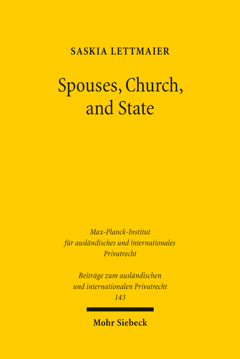
BOOK: Saskia LETTMAIER, Spouses, Church, and State. Marriage Law in England and Protestant Germany from the Reformation until the Close of the Nineteenth Century [Beiträge zum ausländischen und internationalen Privatrecht; 143] (Tübingen: Mohr Siebeck, 2025), 415 p., ISBN 978-3-16-162493-3

Cover von 'undefined'

ABOUT THE BOOK:
 
Saskia Lettmaier widmet sich der vielleicht bedeutendsten Transformation, die das Ehe(band)recht in den letzten 500 Jahren erfahren hat: Seiner Umgestaltung von einer einheitlichen, in der Hand der Universalkirche liegenden und von theologischen Denkmustern geprägten Ordnung hin zu einer Vielzahl von disparaten staatlichen Einzelordnungen, die von säkularen Leitvorstellungen geprägt sind. Am Beispiel von England und Preußen analysiert sie, wie und warum es zu diesem Wandel kam und warum die Veränderungen von Territorium zu Territorium unterschiedlich ausfielen.
 
Find more here.


01 December 2023

BOOK: Lorren ELDRIDGE, Law and the Medieval Village Community. Reinvigorating Historical Jurisprudence [Transforming Legal Histories] (London: Routledge, 2023), 254 p. ISBN 9781032375557, 97,5 GBP


(image source: Routledge)

Abstract:
This book expands on established doctrine in legal history and sets out a challenge for legal philosophers. The English medieval village community offers a historical and philosophical lens on the concept of custom which challenges accepted notions of what law is. The book traces the study of the medieval village community from early historical works in the nineteenth century through to current research. It demonstrates that some law-making can and has been ‘bottom-up’ in English law, with community-led decisionmaking having a particularly important role in the early common law. The detailed consideration of law in the English village community reveals alternative ways of making and conceiving of law which are not dependent on state authority, particularly in relation to customary and communal property rights. Acknowledging this poses challenges for legal theory: the legal positivism that dominates Western legal philosophy tends to reject custom as a source of law. However, this book argues that medieval customary law ought to be considered ‘law’ if we are ever going to fully understand law – both then and now. The book will be a valuable resource for researchers and academics working in the areas of Legal History, Legal Theory, and Jurisprudence.

On the author:

Lorren Eldridge is an Early Career Fellow in Legal History at the University of Edinburgh. She is a lawyer and legal historian whose research considers the relationship between legal history and legal theory, especially the legal philosophical approach and method known as historical jurisprudence.

Read more on the publisher's website. 

20 September 2019

BLOG: Prof. John HUDSON (St Andrews) on "The historical differences between Scottish and English Law, and what it means for Brexit" (BBC History Extra)

(image source: BBC History Extra)

Presentation:
This week has seen challenges to the prorogation of UK parliament in both Scottish and English courts. Ahead of an appeal in the Supreme Court of the United Kingdom, Professor John Hudson of the University of St Andrews explains why elements of Scots and English law remain distinct to this day…
Read more with History Extra.

29 April 2019

BOOK: Alexander ORAKHELASHVILI, Domesticating Kelsen: Towards the Pure Theory of English Law [Elgar Studies in Legal Theory] (Cheltenham: Edward Elgar Publishing, 2019). ISBN 9781788111416, £67.50


Edward Elgar is publishing a new book on Hals Kelsen’s theories and English law.

ABOUT THE BOOK

There exists a genuine degree of scepticism as to whether Hans Kelsen’s pure theory of law can rationalise the intricacies of the English legal system. This groundbreaking book examines pertinent aspects of English law relating to constitutional patterns of law-making, the relationship between law and policy, and the ultimate efficacy of the legal order, through the pure theory’s prism.

This insightful book demonstrates that Kelsen’s theory is highly suitable to examine some of these issues, and in some aspects of English law it actually possesses the analytical cutting edge. Beginning with an overview of the outlook and methodology of the pure theory of law and placing it within the broader focus of positive scholarship, Orakhelashvili moves on to offer a description of the relationship between methods of the legal theory and the workings of a legal system, along with assessments of the relationship between law and policy in legal theory and in judicial practice, and of criticisms of the pure theory.

Thoughtful and perceptive, this book will be valuable reading for legal scholars, social scientists, judges, practicing lawyers, legal historians, political scientists, and law students.


TABLE OF CONTENTS

Contents: 1. The Essence and Basic Methods of the Pure Theory 2. The State and the Law 3. Law and its “Others”: Natural Law, Morality and Social Policy 4. Constitution and Normative Hierarchy 5. The Basic Norm and Efficacy of the Legal System 6. The Rule of Law Conclusion Index
More information here

07 March 2019

JOURNAL: The Journal of Legal History XL (2019), Issue 1

(image source: University of Glasgow)

The Emergence and Development of Statutory Process for the Compulsory Purchase of Land for Transport Infrastructure in England and Wales, c.1530–1800 (Stephen Gadd)
Abstract:
Before 1539, highway improvement in England and Wales (other than the clearance of illegal obstructions) was achieved only by crown licence following a satisfactory inquisition ad quod damnum. Magna Carta chapter 39 recorded that ‘that no free man is to be … disseised … except by … the law of the land’, but in the wake of other wide-ranging reforms in the 1530s, amid a growing sense of the common weal and desire for ‘improvement’, parliament overcame this obstacle to economic infrastructural development by adjustment of ‘the law of the land’, assuming prerogative power and delegating by statute the authority for the compulsory purchase of land. In this case it was for river navigation at Exeter, and not until 1662 was the power extended to roads. Compensation was always to be paid, but legislation rarely stipulated the explicit outright purchase of freehold. Parliament was willing to grant these powers to trustees or other public bodies, or indeed to private individuals, but only if it was considered that doing so served the public interest.
Rebutting the Presumption: Rethinking the Common Law Principle of Marital Coercion in Eighteenth- and Nineteenth-Century England (Emily Ireland)
Abstract:
While many historians refer to the legal presumption of marital coercion when discussing patterns of lenient judicial treatment of women in eighteenth-and nineteenth-century English criminal trials, few have analyzed the presumption in enough detail to ascertain the impact it genuinely had. This article undertakes close legal analysis of marital coercion. It argues that the presumption was not frequently referred to in nineteenth-century Old Bailey criminal trials for receiving stolen goods because of increasing judicial strictness as to the application of the presumption. A defendant had to prove her marriage, her husband’s presence at the crime scene, and, by the nineteenth century, evidence of her husband’s actual control. The presumption may have shifted from an irrebuttable presumption to one rebuttable upon proof that any of these requirements were absent. Therefore, women’s lenient court treatment during the modern period cannot be straightforwardly attributed to frequent successful recourse to marital coercion.
‘It is necessary that the issue be heard to cry or squall within the four [walls]’: Qualifying for Tenancy by the Curtesy of England in the Reign of Edward I (Gwen Seaborne)
Abstract:
This article considers the test used to determine the presence or absence of life in newborn babies, in relation to a widower’s entitlement to remain in land brought to the marriage by his wife, as tenant by the curtesy of England. To qualify for curtesy, a widower needed to have produced a live and legitimate child, but, since even a short period of life was sufficient, there might be disputes as to whether a child which was now dead had ever been alive. The common law therefore had to develop a way of settling this difficult matter of confirming or denying the presence of life. Several thirteenth-century sources show an emphasis on a sound as an indicator of life. This article considers the use of a sound criterion in this area, arguing that thinking and practice surrounding the appropriate test were more complex, less settled, and more interesting than has been represented in somewhat perfunctory accounts in the work of later lawyers and legal historians. This is significant for the understanding of this area of medieval law, but also has broader implications within legal history and historiography, and for scholars from other fields such as medieval social and medical history.
Scottish Legal History Group Report 2018
Migrations of Manuscripts 2018 (sir John Baker)

Book Reviews:
Commentaries on the Laws of England (Ian Williams)
A History of Tort Law: 1900-1950 (Mark Wilde)
Ecclesiastical Law, Clergy and Laity: A History of Legal Discipline and the Anglican Church (Charlotte Smith)
Read all papers on Taylor&Francis online.

08 November 2018

BOOK: Matt DYSON & Benjamin VOGEL, The Limits of Criminal Law. Anglo-German Concepts and Principles (Cambridge/Antwerp: Intersentia, 2018), XXXII + 598 p. ISBN 9781780686615, € 99

(image source: Intersentia)

Book abstract:
The Limits of Criminal Law shines light from the outer edges of the criminal law in to better understand its core. From a framework of core principles, different borders are explored to test out where criminal law’s normative or performative limits are, in particular, the borders of crime with tort, non-criminal enforcement, medical law, business regulation, administrative sanctions, counter-terrorism and intelligence law. The volume carefully juxtaposes and compares English and German law on each of these borders, drawing out underlying concepts and key comparative lessons. Each country offers insights beyond their own laws. This double perspective sharpens readers’ critical understanding of the criminal law, and at the same time produces insights that go beyond the perspective of one legal tradition. The book does not promote a single normative view of the limits of criminal law, but builds a detailed picture of the limits that exist now and why they exist now. This evidence-led approach is particularly important in an ever more interconnected world in which different perceptions of criminal law can lead to profound misunderstandings between countries. The Limits of Criminal Law builds picture of what shapes the criminal law, where those limits come from, and what might motivate legal systems to strain, ignore or strengthen those limits. Some of the most interesting insights come out of the comparison between German systematic approach and doctrinal limits with English law’s focus on process and judgment on individual questions.
On the authors:
Matthew Dyson is an Associate Professor in the Faculty of Law, University of Oxford. He is an associate member of 6KBW College Hill Chambers, a Research Fellow of the Utrecht Centre for Accountability and Liability Law and Vice President of the European Society for Comparative Legal History. Benjamin Vogel is Senior Research Fellow at the Max Planck Institute for Foreign and International Criminal Law in Freiburg, Germany. He is Assistant Editor of the Foreign Review of the Zeitschrift für die gesamte Straf-rechtswissenschaft. 
A free preview of the table of contents and preliminary pages is accessible here.

More information with the publisher.

10 October 2018

BOOK: Ian WARD, Writing the Victorian Constitution [Palgrave Modern Legal History] (London: Palgrave, 2018). ISBN 978-3-319-96675-5, 63,59 €

(Source: Palgrave)

Palgrave is publishing a book on four key texts of English constitutional law (Edmund Burke’s Reflections on the Revolution in France, Lord Macaulay’s History of England, Walter Bagehot’s The English Constitution and Albert Venn Dicey’s Introduction to the Study of the Law of the Constitution)

ABOUT THE BOOK

 This book charts the writing of the English constitution through the work of four of the most influential jurists in the history of English constitutional thought—Edmund Burke, Thomas Babington Macaulay, Walter Bagehot and Albert Venn Dicey. Stretching from the French Revolution to the death of Queen Victoria, their writing is both representative of and formative to the Victorian constitution. Ian Ward traces how constitutional writing changed over the course of the long nineteenth century, from the poetics of Burke and the romance of Macaulay, to the pragmatism of Bagehot and the jurisprudence of Dicey. A century on, our perception of the English constitution is still shaped by this contested history.

ABOUT THE AUTHOR

Ian Ward is Professor of Law at Newcastle University, UK. He has written a number of books on related areas of English legal and constitutional history, including most recently Sex, Crime and Literature in Victorian England (Hart, 2014) and Law and Brontës (Palgrave, 2012).

More information here

23 July 2018

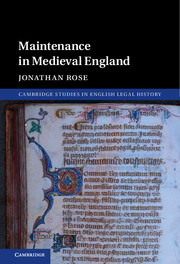
BOOK: Jonathan ROSE, Maintenance in Medieval England (Cambridge: Cambridge University Press, 2017), xviii + 410 p. ISBN 9781107358324, 85 GBP

(image source: Cambridge)

Book abstract:
This is the first book covering those who abused and misused the legal system in medieval England and the initial attempts of the Anglo-American legal system to deal with these forms of legal corruption. Maintenance, in the sense of intermeddling in another person's litigation, was a source of repeated complaint in medieval England. This book reveals for the first time what actually transpired in the resultant litigation. Extensive study of the primary sources shows that the statutes prohibiting maintenance did not achieve their objectives because legal proceedings were rarely brought against those targeted by the statutes: the great and the powerful. Illegal maintenance was less extensive than frequently asserted because medieval judges recognized a number of valid justifications for intermeddling in litigation. Further, the book casts doubt on the effectiveness of the statutory regulation of livery. This is a treasure trove for legal historians, literature scholars, lawyers, and academic libraries.
Table of contents:
1. Introduction
2. Social norms relating to the assistance of others
3. Legal responses to the corruption of justice
4. The early litigation 1272–1327
5. Efforts to deal with corruption of justice in the reign of Edward III
6. Criminal and civil litigation during the reign of Edward III
7. Maintenance and medieval literature
8. Changes in the late medieval period
9. The development of the law of maintenance: permissible justifications for meddling
10. The development of the law of maintenance: illegal maintenance
11. Livery
12. Achieving the legislative objectives of the maintenance statutes
13. Conclusion.
On the author:
Jonathan Rose is Professor of Law and Willard H. Pedrick Distinguished Research Scholar Emeritus, Sandra Day O'Connor College of Law, Arizona State University; Faculty Affiliate, Arizona Center for Medieval and Renaissance Studies, Arizona State University; and Affiliated Faculty Member, Department of History, Arizona State University. He has taught legal history, contracts, professional responsibility, and antitrust. He has also received several awards for outstanding teaching. Professor Rose is the author of numerous articles and other works on legal history, antitrust, economic regulation, and legal ethics.

More information with the publisher.

29 May 2018

BOOK: Lorna HUTSON (ed.), The Oxford Handbook of English Law and Literature, 1500-1700 [Oxford Handbooks] (Oxford: OUP, 2017), 832 p. ISBN 9780199660889, GBP 95

(image source: OUP)

Book abstract: 
This Handbook triangulates the disciplines of history, legal history, and literature to produce a new, interdisciplinary framework for the study of early modern England. For historians of early modern England, turning to legal archives and learning more about legal procedure has seemed increasingly relevant to the project of understanding familial and social relations as well as political institutions, state formation, and economic change. Literary scholars and intellectual historians have also shown how classical forensic rhetoric formed the basis both of the humanist teaching of literary composition (poetry and drama) and of new legal epistemologies of fact-finding and evidence evaluation. In addition, the post-Reformation jurisdictional dominance of the common law produced new ways of drawing the boundaries between private conscience and public accountability. This Handbook brings historians, literary scholars, and legal historians together to build on and challenge these and similar lines of inquiry. Chapters in the Handbook consider the following topics in a variety of combinations: forensic rhetoric, poetics and evidence; humanist and legal learning; political and professional identities at the Inns of Court; poetry, drama, and visual culture; local governance and legal reform; equity, conscience, and religious law; legal transformations of social and affective relations (property, marriage, witchcraft, contract, corporate personhood); authorial liability (libel, censorship, press regulation); rhetorics of liberty, slavery, torture, and due process; nation, sovereignty, and international law (the British archipelago, colonialism, empire).
 Table of contents:
Introduction: Law, Literature and History, Lorna Hutson Part I. Textual and Interpretative Culture
1: Forensic Rhetoric and Humanist Education, Kathy Eden
2: Idiosyncratic Books and Common Learning: Readings on Statutes at the Inns of Court', Margaret McGlynn
3: Common Law Scholarship and the Written Word, Ian Williams
4: 'Attentive Mindes and Serious Wits': Legal Training and Early Drama, James McBain
5: Why Shylocke Loses his Case: Judicial Rhetoric in The Merchant of Venice, Quentin Skinner
Part II. Literature and the Legal Profession, 1500-1700
6: Legal Satire and the Legal Profession in the 1590s: John Davies' Epigrammes and Professional Decorum, Jessica Winston
7: The Emblem Book and Common Law, Peter Goodrich
8: The Monarchical Republic: Constitutionality and the Legal Profession, Paul Raffield
9: The Legal Masque: Humanity and Liberty at the Inns of Court, Martin Butler
10: Paradise Lost? Law, Literature, and History in Restoration England, Christopher Brooks
Part III. Administering the Law
11: Law Enforcement and the Local Community, James Sharpe
12: The Changing Persona of the Justices and their Quarter Sessions, Norma Landau
13: Law and the Evidentiary Environment, Barbara Shapiro
14: Legal Reform and 2 Henry IV, Virginia Strain
Part IV. Temporal and Spiritual, Law and Conscience 15: Immunities and Monasticism: Bale to Shakespeare, Joshua P. Phillips
16: Epieikeia and Conscience, Alan Cromartie
17: The Ecclesiastical Polity, Ethan Shagan
18: Making Law and Recording It: John Selden on Excommunication, Jason Rosenblatt
19: Seldenism, Elliott Visconsi
Part V. Legal and Literary Imagining
20: Contract, Luke Wilson
21: Contract and Conjugality in Early Modern England, Tim Stretton
22: The Literary Thing: The Imaginary Holding of Isabella Whitney's 'Wyll' to London, 1573, Carolyn Sale
23: Witch Wives, Frances Dolan 24: Corporate Persons, Between Law and Literature, Henry Turner
Part VI. Libel, Publication, and the Press
25: Edward Coke, Roman Law, and the Law of Libel, David Ibbetson
26: Censorship in Law and Practice in Seventeenth Century England: Milton's Aeropagitica, Joad Raymond
27: Managing the Later Stuart Press, 1662-1696, Martin Dzelzainis
28: The Torture of John Felton, 1628, Alastair Bellany Part VII. Liberties, Slaveries, and English Law 29: From Sovereignty to the State: The Tragicomic Clemency of Massinger's The Bondman, Bernadette Meyler
30: Birthrights and the Due Course of Law, Paul Halliday
31: Legal Agency as Literature in the English Revolution: The Case of the Levellers, Nigel Smith
32: Base Slavery and the Roman Yoke, Mary Nyquist
Part VIII. The Extra-English Legal World: Between Colony, Nation, and Empire
33: Spenser, Plowden, and the Hypallactic Instrument, Andrew Zurcher
34: Law and Literature in Scotland, c.1450-1707, Rab Houston
35: Forensic History: Henry V and Scotland, Lorna Hutson
36: Henry V, Anachronism, and the History of International Law, Christopher Warren
37: Empire and Natural Law in Dryden's Heroic Drama, Edward Holberton
38: English Liberties Outside England: Floors, Doors, Windows, and Ceilings in the Legal Architecture of Empire, Dan Hulsebosch
On the editor:
 Edited by Lorna Hutson, Merton Professor of English Literature, University of Oxford Lorna Hutson is Merton Professor of English Literature at the University of Oxford. Educated in San Francisco, Edinburgh, and Oxford, she has taught at the Universities of St Andrews, UC Berkeley, Hull, and Queen Mary, London. She has served as Head of English at St Andrews (2008-11) and has held fellowships from the Folger, the Huntingdon, the Guggenheim, and the Leverhulme Trust. Her books include Thomas Nashe in Context (1989), The Usurer's Daughter (1994), and The Invention of Suspicion (2007). Circumstantial Shakespeare (2015) was based on the Oxford Wells Shakespeare Lectures in 2012. She has also edited Ben Jonson's Discoveries (1641) for the Cambridge Complete Works of Ben Jonson (2012) and written numerous articles on Renaissance topics.
More information with OUP.

19 November 2014

ARTICLE: "The Rhetoric and Reality of English Law in Colonial Maryland, Part 1 - 1632-1689", by Jeffrey K. Sawyer

Jeffrey K. Sawyer, University of Baltimore - School of Law, The Rhetoric and Reality of English Law in Colonial Maryland, Part 1 - 1632-1689, Maryland Historical Magazine, Vol. 108, No. 4, Winter 2013, pp. 392-409

All information here

Abstract
The rule of English law in the English-speaking colonial world is at once obvious and puzzling. Along with language, the law anchored the Englishness of life in colonial America, At the same time, warring states and rival investors used law and diplomacy as weapons in their arsenals of global competition, and so the law of nations provided an unstable and frequently contested framework for exploration and settlement. The governance of struggling Atlantic settlements (especially before 1660) rose, fell, and was reconstructed with the various fortunes of each. In these early settlements there was much law-making, but law was perhaps negotiated as often as it was applied; local officials frequently adjusted English rules to local circumstances. The more historians investigate this world, the harder it is to be sure, exactly, how colonial law worked.

This article examines why a perennial contest over the precise authority of English law was so central to the rule of law in early Maryland. Two new perspectives will help further this inquiry, which has long interested colonial historians generally and historians of Maryland in particular. The first is a heightened appreciation of the fact that early American legal history unfolded in distinct phases. The second is a recognition that the contest over English law in the colonies developed along different but overlapping dimensions, a political or rhetorical dimension and an operational dimension. This latter world of law was the reality of lawsuits, debt collection, inheritance, criminal prosecutions, judgments, and so on.