Search

19 October 2011

Call for Papers: XVIIIth Annual Forum of Young Legal Historians (30 May-2 June 2012)

The XVIIIth Annual Forum of Young Legal Historians of the Association of Young Legal Historians (AYLH) will be held in Vienna from 30 May-2 June 2012. The theme is “Making things legal”: Law-making and procedural reality in the European legal traditions:


The secular tradition of modern European jurisprudence agrees on the basic assumption that law is actually ‘made’ in one way or another. The conditions and procedures of law-making are subject to constant change and, accordingly, the creation of legal norms is one of the major areas of research for legal historians. The questions they ask relate to the legitimacy of normative acts, their economic, political and social impetus or even the media of their representation. Scholars direct their attention at all stages of the legislative process, i.e. from the very first considerations to the publication of a legal act.

14 October 2011

NOTICE: Brown and Donlan on The Laws and Other Legalities of Ireland, 1689–1850

Michael Brown (Aberdeen) and Seán Patrick Donlan (Limerick) have published, with Ashgate, The Laws and Other Legalities of Ireland, 1689–1850:

The Laws and Other Legalities of Ireland, 1689-1850This collection is the first to concentrate attention on the actual relationship that existed between the Irish population and the state under which they lived from the War of the Two Kings (1689–1691) and the Great Famine (1845–1849). Particular attention is paid to an understanding of the legal character of the state and the reach of the rule of law, addressing such themes as how law was made and put into effect; how ordinary people experienced the law and social regulations; and how Catholics related to the legal institutions of the Protestant confessional state. These themes will help to situate the study of Irish society into the mainstream of English and European social history.

The contents include:
  • The laws in Ireland, 1689–1850: a brief introduction, Michael Brown and Seán Patrick Donlan

07 October 2011

NOTICE: Rockwell on Spanish and Mexican Law (Lawbook Exchange)

As part of its extraordinary and ongoing mission to republish valuable legal texts of the past, the Lawbook Exchange has announced the publication of

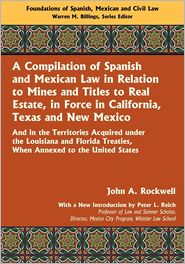
John A Rockwell, A Compilation of Spanish and Mexican Law in Relation to Mines and Titles to Real Estate, in Force in California, Texas and New Mexico; and in the Territories Acquired Under the Louisiana and Florida Treaties When Annexed to the United States (1851), with a new introduction by Peter L Reich

This is the latest text from the Foundations of Spanish, Mexican and Civil Law series (Warren M Billings, series editor). Other titles in the series include:
  • Laws and Decrees of the State of Coahuila and Texas in Spanish and English (1839), JP Kimball, trs., with a new introduction by Joseph W McKnight.
  • Joseph M White, A New Collection of Laws, Charters and Local Ordinances of the Governments of Great Britain, France and Spain: Relating to the Concessions of Land in their Respective Colonies, Together with the Laws of Mexico and Texas on the Same Subject, to Which is Prefixed Judge Johnson's Translation of Azo and Manuel's Institutes of the Civil Law of Spain (1839), with a new introduction by Agustin Parise.

06 October 2011

NOTICE: Morigiwa, Stolleis, and Halperin on the Interpretation of Law in the Age of Enlightenment

I’ve just become aware of the release (by Springer) of a very interesting text by Yasutomo Morigiwa, Michael Stolleis, and Jean-Louis Halperin (eds), Interpretation of Law in the Age of Enlightenment: From the Rule of the King to the Rule of Law (2011):

This book examines the actual practice of the interpretation of law in the Age of Enlightenment versus the ideology of the Age and explains the reason for and difference between the two. The ideology of the Age of Enlightenment was that law, i.e., the will of the sovereign, can be explicitly and appropriately stated, thus making interpretation redundant. However, the reality was that in the 18th century, there was no one leading source of national law that would be the object of interpretation. Instead, there was a plurality of sources of law: the Roman Law, local customary law, and the royal ordinance. Yet, in deciding a case in a court of law, the law must speak with one voice, making interpretation to unify the norms inevitable. This book discusses the process involved and the role played by justification in terms of reason - the hallmark of Enlightenment.

The table of contents includes:

Editors’ Preface; Morigiwa Yasutomo, Michael Stolleis, Jean-Louis Halpérin.- Foreword from the Herstec Project; Sato Shoichi.- About the Contributors.- I. Introduction.- Judicial Interpretation in Transition from the Ancien Régime to Constitutionalism; Michael Stolleis.- II. The case of France.- Legal Interpretation in France under the Reign of Louis XVI through the Gazette des Tribunaux; Jean-Louis Halpérin.- Legal Interpretation through the Case Law Book of the Parlement de Flandre; Serge Dauchy.- II. The case of Germany.- The Object of Interpretation: Legislation and Competing Normative Sources of Law in Europe during the 16th to 18th Centuries; Heinz Mohnhaupt.- The Concept and Means of Legal Interpretation in the 18th Century; Jan Schröder.- Necessity: Pandectists between Norm and Reality (1780-1870); Hans-Peter Haferkamp.- IV. The Nature of Legal Interpretation.- Interpretation by Another Name; Morigiwa Yasutomo.- What is Interpretation of the Law for the French Judge? Michel Troper.- The Craft of Interpretation ; Bradley Wendel.- Concluding Remarks.- Legal Interpretation in 18th Century Europe: Doctrinal Debates versus Political Change ; Jean-Louis Halpérin.- Index.

30 September 2011

NOTICE: SOLON's Law, Crime and History

SOLON's (2011) 1 Law, Crime & History e-journal is now available.


Contributions include the following articles:
  • David Cox, ‘The Wolves let loose at Wolverhampton’: A study of the South Staffordshire Election ‘Riots’, May 1835' 1-31
  • Iain Channing, 'Freedom of Expression from the ‘Age of Extremes’ to the ‘Age of Terror’: Reflections on Public Order Law and the Legal Responses to Political and Religious Extremism in 1930s Britain and the Post 9/11 32-57
  • Chris Monaghan, In Defence of Intrinsic Human Rights: Edmund Burke’s Controversial Prosecution of Warren Hastings, Governor-General of Bengal 58-107
  • Lisa Denmark, Worshipping Bacchus: Prohibition in Savannah, 1899-1922 109-140
  • James Windle, Ominous Parallels and Optimistic Differences: Opium in China and Afghanistan 141-164
  • Haia Shpayer-Makov, Revisiting the Detective Figure in Late Victorian and Edwardian Fiction: A View from the Perspective of Police History 165-193
There are also conference reports from SOLON's 2nd International War Crimes Conference (3-5 March 2011):

26 September 2011

CALL FOR PAPERS: Second EUROPEAN SOCIETY FOR COMPARATIVE LEGAL HISTORY Conference (Amsterdam 9-10 July 2012

The Second ESCLH Conference will be held in Amsterdam from 9-10 July 2012. The theme is:

COMPARATIVE LEGAL HISTORY
Definitions and Challenges


Comparative Legal History is a relatively young discipline. It focuses explicitly on the comparison of legal ideas and legal institutions in divergent legal traditions. The European Society for Comparative Legal History (ESCLH) was founded in 2009 in order to promote such comparison. Its Inaugural Conference (Valencia, 5-6 July 2010) showed that it is not always easy to find material which is suitable for serious comparison and to establish the criteria which have to be met in order to come to grips with this material.

The Second ESCLH Conference, which will take place on 9-10 July 2012 at Amsterdam and will be hosted by the VU University, aims at addressing this fundamental problem. Under the heading “Definitions and Challenges” it will try to delineate the landmarks which fruitful legal historical comparison requires and to trace the specific problems that a comparative-historical approach of the various branches of law may encounter. The keynote address will be delivered by David Ibbetson, Regius Professor of Civil Law at the University of Cambridge.

As regards the papers for the parallel sessions, the Conference first of all hopes to provide a venue for legal historians and comparatists to present their investigations in order to discuss their work, exchange ideas and broaden their views. For this reason you are invited to propose papers on any subject within the field of comparative legal history.

However, following the methodological problems dealt with under the heading “Definitions and Challenges”, this Conference also aims at presenting investigations into specific areas of law, where legal historical comparison has proven to be fruitful. These investigations have in common that they do not depart from normative legal concepts (which sometimes only seemingly appear to be comparable) but from functional problems of a more factual, meta-juridical nature.

The first is ‘Fascist Criminal Law’ (co-ordinator: Stephen Skinner, University of Exeter). This theme is important in both historical and contemporary terms. A recurrent theme in recent and ongoing work on law and democracy in Europe has been the challenge of dealing with ‘darker’ aspects of law’s ideological, substantive and methodological roots in anti-democratic legal orders. In terms of legal history, grappling with the meanings of ‘fascism’ and the ideological, rhetorical and substantive dimensions of criminal law under fascist regimes requires a comparative approach in order to identify the distinguishing characteristics of such regimes. Arguably, the area of criminal law brings into sharp relief the power-relationship between State and citizen, and as such, it is a key area of law to be studied in order to understand the nature of fascist systems.

The second area, ‘Corporate law’ (co-ordinator: Tammo Wallinga, University of Antwerp), is a field of law which can be analyzed from various legal perspectives, without focussing on the comparison of a specific dogmatic concept. Just as the theme ‘Fascist Criminal law’ touches upon fundamental issues, such as the relationship between State and citizen, corporate law has its own characteristic issues: various types of enterprise – market-related or not – establishment and organization of a company, the relationship with consumers, civil authorities, debtors and creditors, workers’ rights, etc. Here, comparison aims at understanding the changing nature of corporate law within a changing economic context, from medieval society, through the ages of early capitalism and industrialisation to present day issues.

Factual information:
- Those interested in presenting a paper at the ESCLH Conference 2012 are requested to submit the title of their paper and a short abstract (approximately 250 words) before January 1st to the organizing committee c/o Jan Hallebeek, VU University Amsterdam (j.hallebeek@vu.nl).
- Papers should deal with a topic within the field of comparative legal history. Presentations should not exceed 15 minutes and should be in English.
- Please indicate whether your paper is related to the general theme (Comparative Legal History, Definitions and Challenges), one of the specific fields of law (Fascist Criminal Law, Corporate Law) or another subject.
- In January 2012 it will be announced which papers are accepted. The abstracts of these papers will shortly thereafter be made available on the Conference-website.

Additional information, including advice on accommodation and directions, is available on the Conference-website.

09 September 2011

NOTICE: Law and Governance in pre-Modern Britain (14-15 October - London, Ontario, Canada)

The Department of History at the University of Western Ontario will host a conference on “Law and Governance in pre-Modern Britain”, on 14-15 October 2011.

Speakers include Paul Brand (All Souls College, Oxford), C.W. Brooks (University of Durham), Sara Butler (Loyola University, New Orleans), Charles Donahue (Harvard University), R.H. Helmholz (University of Chicago), Richard Kaeuper (University of Rochester), James Masschaele (Rutgers University), Shannon McSheffrey (Concordia University), Cynthia Neville (Dalhousie University), Bruce O’Brien (University of Mary Washington), Lisi Oliver (Louisiana State University), Robert Palmer (University of Houston), Robin Chapman Stacey (University of Washington) and Tim Stretton (St. Mary’s University).

26 August 2011

NOTICE: New ESCLH Advisory Board

The European Society for Comparative Legal History (ESCLH) is delighted to announce the members of the ESCLH Advisory Board:


Thomas Duve (Max Planck)
Richard Helmholz (Chicago)
David Ibbetson (Cambridge)
Antonio Pérez Martín (Murcia)
Kjell Modéer (Lund)


22 August 2011

NOTICE: Scottish Legal History Group Conference

The Thirty-First Annual Conference of the Scottish Legal History Group will be held on 1 October 2011

The thirty-first Annual Conference and AGM of the Scottish Legal History Group will be held in the Reading Room of the Advocates’ Library, Parliament House, Edinburgh, on Saturday 1st October 2011. All welcome upon payment of the conference fee of £10 to the Secretary, Dr Mark Godfrey, School of Law, University of Glasgow, Glasgow G12 8QQ.

Programme

10.30am Coffee
11.00 First Session
  • Bess Rhodes (University of St Andrews), 'Property, Piety and Power: Land Tenure in the Burgh of St Andrews, c.1500-1580'
  • Dr Anna Groundwater (University of Edinburgh), '"We bund and oblissis us never more to querrell": Bonding and the Application of the Law in the Reign of James VI'
12.30 Pre-lunch drinks. Break for Lunch.
2.15 Second Session

01 August 2011

Vattel's International Law from a XXIst Century Perspective - Le Droit International de Vattel vu du XXIe Siècle (V. Chetail and P. Haggemnacher, eds.)


To celebrate the author's Le droit des gens ou principes de la loi naturelle appliqués à la conduite et aux affaires des nations et des souverains (1758), Martinus Nijhoff published a collective work on Swiss diplomat and legal scholar Emer de Vattel (1714-1767), edited by Vincent Chetail and Peter Haggenmacher (Graduate Institute, Geneva) assembling contributions from authorities in both positive public international law and legal history.

Contents:

Research Handbook on the Theory and History of International Law (A. Orakhelashvili, ed.)


Edward Elgar recently published a Research Handbook on the Theory and History of International Law (560 p.), edited by Alexander Orakhelashvili (University of Birmingham).

Contents:

ForewordPhilip Allott

PART I: THE ESSENCE AND DEVELOPMENT OF INTERNATIONAL LEGAL THEORY
1. The Relevance of Theory and History: The Essence and Origins of International LawAlexander Orakhelashvili

2. Early-Modern Scholarship on International Law
Alain Wijffels

31 July 2011

6 Jahrbuch Junge Rechtsgeschichte - Yearbook of Young Legal History 2010


Inszenierung des Rechts - Law on Stage [6 Jahrbuch Junge Rechtsgeschichte - Yearbook of Young Legal History 2010] is now available through Martin Meidenbauer Verlag or http://www.amazon.de/Die-Inszenierung-Rechts-Law-Stage/dp/3899752422/ref=sr_1_6?ie=UTF8&qid=1311695066&sr=8-6. The book (344 pages) contains a selection of papers presented at the 16th European Forum of Young Legal Historians organized at the Johann-Wolfgang-Goethe-Universität in Frankfurt in March 2010.

Table of contents:

Vorwort (Viktoria Draganova, Stefan Kroll, Helmut Landerer and Ulrike Meyer)

Kapitel I, "Inszenierung des Rechts"
  • Law on Love’s Stage:  Étienne Forcadel’s (1519-1578) Cupido Jurisperitus (Wim Decock), 17-37
  • Der scheiternde Dritte: Inszenierungstechniken der Vermittlung in derliterarischen Streitkultur  (Johanna Bergann) 37-47
  • Die „improvisierte“ Komödie als forensische Taktik in Ciceros Caeliana  (Tamás Nótári), 49-69
  • Show Trials of the Red Revolution – Political Trials and Public Opinion  during the Finnish Revolution of 1918 (Jukka Siro) 71-81
  • Recasting the Role of Slaves in the Roman Economic Theatre (Egbert Koops) 83-99
Kapitel II, "Symbole im Recht"
  • Die Historizität der Autorität oder: Des Verfassungsrichters neue Robe (Sebastian Felz) 101-117
  • The Oath as Evidence in Old-Polish Land Law Litigation in Early- Modern Period (Adam Muniuszko) 119-133)
  • To Have and to Hold – Driving Licences as Important Legal Documents  for the Normal Course of Life (Helmut Landerer) 135-153
Kapitel III, "Medien des Rechts"
  • Mirror of Changing Law: The Journal des Tribunaux in the fin de siècle (Bart Coppein) 155-175
  • Frieden durch Sicherheit: Notarielle Urkunden als Konstrukt zur  Beweissicherung  (Sarah Bachmann) 177-195
  • Rechtsformen in der Ingelheimer Rechtslandschaft (Alexander Krey - Regina Schäfer) 197-211
  • Roman Boundary Stones in Croatia: Legal Content and its Forms in Acts  of Dispute Resolution  (Ivan Milotić) 213-227
Kapitel IV, "Legitimation und Verfahren"
  • Kurbayerische Visitationen im 17. und 18. Jahrhundert:  Zur Inszenierung von Herrschaftsrechten zwischen Aktendeckeln (Birgit Näther) 229-241
  • Law, Finances and Politics: The Significance of Economic Contexts for  the Formation of Norms  (Lea Heimbeck) 243-259
  • The Case of Patricide in the Century of the Codes (Ninfa Contigiani) 261-277
  • Zigeunerrecht und Zigeunergericht: Zur Fortwirkung überlieferter  archaischer Konfliktbewältigungsformen in der Gegenwart am Beispiel  des Romani Kris (Dóra Frey) 279-299
Kapitel V, "Recht und Macht"

Law on the Diplomatic Stage: the 1725 Ripperda Treaty (Frederik Dhondt) 303-323

28 July 2011

NOTICE: The “Political Arithmetick” of Empires in the Early Modern Atlantic World, 1500–1807

I received word last night about a conference on 'The “Political Arithmetick” of Empires in the Early Modern Atlantic World, 1500–1807'. It's Sponsored by the Department of History, University of Maryland, College Park, and the Omohundro Institute of Early American History and Culture. It'll take place from March 17–18, 2012 at the University of Maryland, College Park:

This conference takes its title from the celebrated pamphlet of Sir William Petty published in 1690. The organizers are particularly eager to receive submissions from scholars working on subjects that Petty and his contemporaries believed formed the basis of the new concept of “political economy,” especially as these related to the Americas from the sixteenth century through the eighteenth.

Petty’s pamphlet was largely devoted to the question of how best to construct an English empire within which trade, people, and nation would flourish. His calculations involved not only economic factors but also issues of authority, hierarchy, and justice. The purpose of this conference is to examine the many components, economic as well as cultural, that cohered and/or fractured empires in the early modern Atlantic world between 1500 and 1807.

The organizers encourage papers that examine the religious, cultural, or economic components that shaped the formation of imperial structures in the early modern era. Topics such as religious conformity or the lack thereof, paper money, credit, agriculture, manufacturing, trade, piracy, and monopoly as they related to the creation and expansion of empires are appropriate. So, too, are demography, slavery, the Native American presence, and the migration of labor, whether free or indentured. Finally, the organizers welcome proposals on the ideological character of domestic and international law and the role of ideas in determining the configuration of early modern empires. These subjects may be addressed by focusing exclusively on a single empire or within a comparative context.

Proposals consisting of a maximum of 300 words must be received electronically no later than July 31, 2011. Please include a two-page c.v. that contains your current mailing and e-mail addresses and your telephone number. Materials may be submitted online at the conference Web site, http://oieahc.wm.edu/conferences/political/cfp.cfm. All submissions will be acknowledged by e-mail. If you do not receive an acknowledgement, please resubmit or contact Kim Foley (kawahl@wm.edu).

26 July 2011

CALL FOR PAPERS: Law as Culture: Legal Development and Social Change Panel (47th International Congress on Medieval Studies)

I just received the following message--very much in the spirit of some of our members--about the 47th International Congress on Medieval Studies:

I'm running a panel on legal history at the 47th International Congress on Medieval Studies, May 10-13, 2012, in Kalamazoo, Michigan. The title of the panel is Law as Culture: Legal Development and Social Change. The general call for papers is here( http://www.wmich.edu/medieval/Assets/pdf/congress/CallForPapers2012.pdf).

The Law as Culture series has been going on at Kalamazoo most years since 1994, sponsored much of the time (including this time) by the Selden Society; for the last couple of years, I've been co-organizing these panels with medieval historian Paul Hyams of Cornell. Here are a few paragraphs I wrote about it; the last paragraph has been recycled from earlier CFPs:

Law was an important part of medieval culture, just as in modern culture.

High and low people alike regularly attended some court or other - serfs attended their lord's court while barons attended the royal court - and rates of litigation (for instance in medieval England) were surprisingly high (by modern standards). Feudalism, an important medieval institution, was largely (though not exclusively) a set of legal rules, and disputes over the overlapping jurisdictions of secular and ecclesiastical courts played a large role in the evolution of church-state relations. The legal system shaped medieval society just as it was shaped by it. The historian of medieval law must study social, economic, and cultural history, but the historian of medieval society, economy, and culture must also study the law.

This panel, therefore, will explore the intersection among law, economics, and culture in the context of the evolution of medieval European law.

This session is part of a series of panels under the general title of "Law as Culture in the Middle Ages" that ran first from 1994 to 2003, and was revived in 2010. The Anglo-American Selden Society has stood sponsor for much of this time. The series has succeeded in bringing together literary scholars, lawyers and historians in the special atmosphere of Kalamazoo and to their mutual benefit, to consider the contributions, good and bad, which Law made to the culture of the Middle Ages. Papers have been presented by scholars of the two learned laws (canon and Roman), of secular laws (especially the Anglo-American Common Law), and of vernacular literatures (especially Old French, Old and Middle English). They have drawn enthusiastic audiences that have filled and on occasion overflowed from the rooms allotted them. We have been able to offer a hearing to young scholars alongside some very well known ones.

For this panel, I welcome any papers on medieval legal history.

English legal history is welcome; so is Continental legal history, canon law, or any other tradition practiced in the medieval West, e.g. Jewish or Islamic law.

The concept of "medieval" at Kalamazoo tends to be fairly broad, so you often find papers dealing with late Antiquity on one end, and the Renaissance on the other.

Especially, as the title "Law as Culture" hints, papers are encouraged that draw connections between law and other fields, especially in the humanities or economics (though doctrinal legal papers are also fine).

Those who are interested should send me an abstract at volokh at post dot harvard dot edu by September 15, 2011.

- Sasha Volokh, Emory Law School

20 July 2011

NOTICE: 47th International Congress on Medieval Studies (10-13 May 2012)

I just learned of the 47th International Congress on Medieval Studies. The conference:
 
marks the 50th anniversary of Western Michigan University's first Conference on Medieval Studies that grew into the International Congress on Medieval Studies, takes place May 10-13, 2012. The deadline for session proposals was June 1, 2011. The Call for Papers is now available. Printed copies of the Call for Papers are mailed in July.

The Congress is an annual gathering of over 3,000 scholars interested in Medieval Studies. It features over 550 sessions of papers, panel discussions, roundtables, workshops, and performances. There are also some 90 business meetings and receptions sponsored by learned societies, associations, and institutions. The exhibits hall boasts nearly 70 exhibitors, including publishers, used book dealers, and purveyors of medieval sundries. The Congress lasts three and a half days, extending from Thursday morning until Sunday at noon.

06 July 2011

NOTICE: Jansen on The Making of Legal Authority

I just noticed that Nils Jansen's The Making of Legal Authority: Non-legislative Codifications in Historical and Comparative Perspective (2010) was not noted here last year. It seemed relevant enough to the ESCLH to do so now.

Description
 
Accounts of the nature of legal authority typically focus on the authority of officially sanctioned rules issued by legally recognised bodies - legislatures, courts and regulators - that fit comfortably within traditional state-centred concepts of law. Such accounts neglect the more complex processes involved in acquiring legal authority.

Throughout the history of modern legal systems texts have come to acquire authority for legal officials without being issued by a legislature or a court. From Justinian's Institutes and Blackstone's Commentaries to modern examples such as the American Law Institute's Restatements and the UNIDROIT Principles of International Commercial Contracts academic codifications have come to be seen as legally authoritative, and their norms applied as such in courts and other contexts.

How have such texts acquired legal authority? Does their authority undermine the orthodox accounts of the nature of legal systems? Drawing on examples from Roman law to the present day, this book offers the first comparative analysis of non-legislative codifications. It offers a provocative contribution to the debates surrounding the harmonisation of European private law, and the growth of international law.

Features

-Offers the first extended study of the process by which non-legislative codifications are recognized as binding by legal authorities
-Uses the methodology of comparative law and legal history
-Draws on historical and modern examples of non-legislative codifications, including Justinian's Institutes, Blackstone's Commentaries, the Draft Common Frame of Reference and the American Law Institute's Restatements
-Reproductions of the primary texts allows for comparison of the visual aspects of legal texts

About the Author(s)


Professor Dr Nils Jansen currently serves of the Law Faculty at the University of Munster, Germany. He holds the Chair for Roman Law, Legal History, German and European Private Law, and is a Principal Investigator in the Cluster of Excellence Religion and Politics in the Cultures of Pre-Modernity and Modernity. He is the author of several books in German, and co-edited Beyond the State. Rethinking Private Law with Ralf Michaels.

16 June 2011

CALL FOR PAPERS: Justice in Ottoman Society - Institutions, Actors and Practices

A workshop on Justice in Ottoman Society: Institutions, Actors and Practices is being held from 7-8 January 2012 at the Institut Français d’études Anatoliennes - Istanbul:

Justice in Ottoman society was made through a complex configuration, sustained by ​​ the interaction of different sources of legal references (Sharia, Kanun and custom) as well as different institutions or actors, giving rise to a multiplicity of different practices. If the plurality of legal references in the operative field of justice (i.e. in the Ottoman qadi courts) has long occupied the attention of researchers, the study of the multiplicity of actors and institutions operating in the field of justice has remained rather on the margins of the interest of legal historians.

Yet, in Ottoman society, people who were involved in a legal conflict had several alternative ways to resolve their dispute. Throughout the Empire there were of course qadi courts that would redress injustices and would also serve the individuals in conflict resolution. However, the qadi courts were not the only institution imposing fees or other penalties against wrongdoers. There was also the imperial assembly (divan), authorities from within the different religious communities or other experts that subjects could consult in case of conflict. Moreover, the military authorities such as governors and their assemblies (eyalet divanı) could also act in the sphere of justice as arbitrators or executive powers. What is more, the judicial or executive power of one (such as qadis) could be corrected, supplemented or balanced by the others (such as the office of vali, şeyhülislam, the Grand Vizier and muftis).

This workshop has been organized as a part of an ongoing seminar on the plurality of legal institutions and procedures in the Ottoman Society that has been held under the direction of Işık Tamdoğan at the Institut Français d’Etudes Anatoliennes in Istanbul since October 2011, under the title “La justice dans la société ottomane : institutions, acteurs et pratiques”.

For more information, visit: http://www.ifea-istanbul.net/website_2/index.php?option=com_content&view=category&layout=blog&id=81).

The aim of the workshop is to contribute to a better understanding of the interaction of these various institutions and actors in the process of conflict resolution between individuals or in the larger context of making justice in general, as well as during/in the punishment process. It should also be underlined that in Ottoman society disputes and conflicts among individuals or groups could be resolved without resorting to any of the abovementioned institutions. This is particularly apparent on occasions when the society seeks to make justice of its own. Such judicial practices as amicable settlements or even direct revenge that were taking place outside of these legal institutions will be given a considerable place in our discussion in this workshop. Whether punitive or reconciliatory (as is the case in sulh) it is again the interaction between these different spheres of justice, (“informal” or more “official”) that will constitute the heart of our discussion.

These institutions and practices, which interacted in a complex and subtle manner are far from being uniform in space and time, throughout the Empire. It is for this reason that in this workshop we aim to approach their respective developments as well as their transformations over time (15th-19th centuries) and space (from Balkans to Arab provinces).

In order to approach this complex field of Ottoman justice, we propose to work around certain issues:

1. The strategies of individuals:
- Did individuals have any leeway in choosing the institution by which they could settle their disputes?
- According to which criteria (personal status or the nature of the conflict) people selected these institutions (Qadi court or the imperial divan)?

2. The interaction of different institutions:
- When a legal process was under way, how did these different institutions could intervene and take a role in this process?
- What kind of a division of labor took place between the various bodies and institutions - such as the qadi and the provincial governor?
- The interaction between the legal courts and governors’ divan or Imperial divan will be of particular interest for our workshop but also a particular attention will be paid to the legal opinions (fatwas) of the provincial muftis during the juridical debates.
- Is it possible to argue that there existed a clearly defined hierarchy between these different institutions or were they operating in their own ways depending on the nature of the conflict in question, the status of the individuals in conflict or random choice of the plaintiffs?

3. Legal practices outside the institutions:
-How were the conflicts resolved outside of these institutions?
- What kind of legitimacy had these “practices” vis-à-vis the legal and executive institutions (such as the qadi and governors)?

While we have funds in place to pay the costs of some participants, these are limited and priority will be given to those who cannot find funding elsewhere. Participants are strongly advised to seek funding from their own universities or research bodies. Working languages of the workshop will be French, Turkish and English. Potential participants are invited to send their proposals by July 30th 2011, to isik@netcourrier.com. Individual paper submissions should include the full details of the presenter and an abstract of 200 words (for a thirty-minute presentation).

REGISTRATION: Bloody Days - Massacres in Comparative Perspective

The University of Pennsylvania Law School, the McNeil Center for Early American Studies, and the Georgetown Institute for Global History are jointly sponsoring a conference, "Bloody Days: Massacres in Comparative Perspective," to be held at the McNeil Center in Philadelphia on 23-24 June 2011:

Ab Initio: Law in Early America

Psychologists and sociologists have studied and theorized massacres, but there is no comparable body of work by historians. "Bloody Days" hopes to give some coherence and depth to the historical study of such outbreaks of violence by bringing together scholars and scholarship in a conference dedicated to presentation of work on massacres across time and space. Scholars who work on all periods and all parts of the world are urged to apply. The conference will feature a keynote address by Karl Jacoby of Brown University.

Registration is now open.

02 June 2011

NOTICE: New Issue of Law and History

The latest issue of Law & History Review has been published. It includes sections on both 'Racial Discrimination and the Law in Comparative Perspective' and 'Reflections on Further Research in Comparative Legal History'.

I strongly recommend Philip Girard and Jim Phillips' 'Rethinking ‘the Nation’ in National Legal History: A Canadian Perspective':

Articles

Craig Bryan Yirush - Claiming the New World: Empire, Law, and Indigenous Rights in the Mohegan Case, 1704–1743

Sachin S. Pandya - The First Liability Insurance Cartel in America, 1896–1906

Kif Augustine-Adams - Marriage and Mestizaje, Chinese and Mexican: Constitutional Interpretation and Resistance in Sonora, 1921–1935

Forum: Racial Determination and the Law in Comparative Perspective

John W. Wertheimer - Introduction

John W. Wertheimer, Jessica Bradshaw, Allyson Cobb, Harper Addison, E. Dudley Colhoun, Samuel Diamant, Andrew Gilbert, Jeffrey Higgs and Nicholas Skipper - “The law recognizes racial instinct”: Tucker v. Blease and the Black–White Paradigm in the Jim Crow South

Christopher J. Lee - Jus Soli and Jus Sanguinis in the Colonies: The Interwar Politics of Race, Culture, and Multiracial Legal Status in British Africa

Thomas Pegelow Kaplan - “In the Interest of the Volk…”: Nazi-German Paternity Suits and Racial Recategorization in the Munich Superior Courts, 1938–1945

Forum: Essay

Ariela J. Gross - Race, Law, and Comparative History

Forum: Comment

Peter C. Caldwell - When the Complexity of Lived Experience Finds Itself Before a Court of Law

Reflections on Further Research in Comparative Legal History

Theresa Alfaro-Velcamp and Robert H. Mclaughlin - Immigration and Techniques of Governance in Mexico and the United States: Recalibrating National Narratives through Comparative Immigration Histories

Philip Girard and Jim Phillips - Rethinking ‘the Nation’ in National Legal History: A Canadian Perspective

NOTICE: International School of Ius Commune (Erice, Sicily: 6-12 October 2011)

The Ettore Majorana Foundation and Centre for Scientific Culture presents the 31st International School of Ius Commune in Erice (Sicily, Italy) from 6-12 October 2011. The Directors of the School are Manlio Bellomo (Catania), Kenneth Pennington (Catholic University of America), and Orazio Condorelli (Catania). The Director of this course is Andrea Romano (Messina). The theme is 'The Formation and Crisis of the Great Systems of Law: The Legacy of the Romano-Canonical Ius commune':


The objective of this course will be to explore the foundations and then the crisis of the European systems of law in the age of the Ius commune (canon, Roman, and feudal law). A further objective will be to measure the rich inheritance that contemporary legal systems have received from these legal systems, even if, in some cases, profoundly changed.

The present legal realty puts the entire concept of “great juridical systems” in crisis. This means that it is necessary to understand the inheritance of the past that had created and elaborated the Ius commune. This world had inumerable conflicting local norms established by the iura propria that had to be balanced and measured against the Ius commune. It is necessary, then, to explore and clarify how present day European and other legal systems evolved from this heady stew.

An elementary aspect of this development was the transformation that took place in the twelfth century. From the sixth to the eleventh centuries, European law can be characterized as an age of Sapientia iuris that was transformed in the twelfth century into an age of Scientia iuris. The twelfth century was an age in which not only law but theology, philosophy, and medicine emerged as independent and autonomous academic fields of knowledge.

From this historical perspective it is useful to consider the potential of the Ius commune to be a unifying instrument that regulated the plethora of distinct institutions (empire, kingdoms, city states, republics, Roman law, canon law, germanic and feudal law, iura propria, custom) into a system of jurisprudence that had one language, common norms, a methodology, a political structure, and a system of values. It was a jurisprudence that strove to render to every person his rights (ius suum cuique tribuere).

The course proposes, furthermore, to expand the horizons of these questions to include legal systems outside continental Europe. A key issue is the difference between systems of “codified law” and systems of “common law”.Both, however, had their roots in the Ius commune.

The great American jurist and historian John Henry Wigmore created a paradigm in 1928 that identified 16 legal systems. Other scholars have found only three. If one includes historical legal systems the number would be much larger. They all, however, have their place in the history of law. And they all must be taken into account to understand the evolution of legal institutions.

The lecturers and topics include:

• Andrea Romano (Università di Messina, I): “Ius Commune”, “Common Law”, “Civil Law”: origini, nessi e crisi dei grandi sistemi giuridici europei. Un’introduzione.
• Manlio Bellomo (Università di Catania, I): Avventure delle categorie giuridiche nelle società dell’Europa continentale.
• Italo Birocchi (Università di Roma “La Sapienza”, I): Il diritto comune fra storia e teoria.
• Giovanni Chiodi (Università di Milano “Bicocca”, I): Diritto Comune e Common Law.
• Orazio Condorelli (Università di Catania, I): Consuetudini delle città di Sicilia e restituzione dei “male ablata”: tra “ius proprium” e “utrumque ius”.
• José Manuel De Bernardo Ares (Universidad de Córdoba, E): El derecho comun y el derecho positivo en la formacion del Estado Moderno (siglos XVI-XVIII) (I, II).
• Gigliola Di Renzo Villata (Università di Milano Statale, I): Il diritto comune e la formazione del diritto penale “maturo” (secc. XIV-XVI) (I); Il “favor defensionis” nei “Tractatus varii” di Egidio Bossi ovvero l’eredità del passato e una prospettiva per il futuro (II).
• Antonello Miranda (Università di Palermo, I): Diritto Romano Comune e Common Law: una discussa influenza.
• Emma Montanos Ferrín (Universidad de La Coruña, E): ¿Crisis del sistema del derecho común en la literatura jurídica gallega del siglo XIII? Juan Francisco de Castro y sus “Discursos criticos”.
• Daniela Novarese (Università di Messina, I): Fra sistema di diritto comune e sistema di civil law: alle origini della codificazione del diritto in Europa.
• Andrea Padovani (Università di Bologna, I): La repressione dell’eresia in Italia settentrionale (sec. XIII. Tra “ius proprium” e “ius commune”.
• Kenneth Pennington (Catholic University of America, Washington D.C., USA): The Norms of the Ius commune in Conflict with the Power of the Early Modern State.
• Hans Schlosser (Universität Augsburg, D): Ius commune e apoteosi positivistica della legge - sec. XIX.
• Manuel Torres Aguilar (Universidad de Córdoba, E): Paz y conflictos en el Mediterraneo: derecho, politica y cultura.
• José Luis Villacanas (Universidad Complutense, Madrid, E): Alfonso X y su vinculation con el ius commune (I); Carlos V y el derecho romano-imperial (II).

The School is sponsored by: The Italian Ministry of Education, University and Research – Sicilian Regional Government – Catholic University of America, Washington D.C. – University of Catania – University of Messina – Universidad de Córdoba (Spain), UNESCO Chair in Conflict Resolution – Fondazione Cassa di Risparmio di Imola

For information and applications please write to:

Prof. Orazio Condorelli
Università di Catania
Facoltà di Giurisprudenza
via Gallo 24
I-95124 Catania
tel. 0039-095-230417
ocondorelli@lex.unict.it