Search

24 October 2025

PRIZE LECTURE: Sarton Medal for Legal History 2025 to Prof. em. dr. Lucien BÉLY (Sorbonne-Université/Institut de France-Académie des sciences morales et politiques), "Les femmes dans la diplomatie aux temps modernes" (Ghent: UGent, 13 NOV 2025)


Sarton Medal 2025 – Sartonmedaille 2025

on Thursday, November 13th at 4 pm


in Auditorium Leon De Meyer of the University Forum

Sint-Pietersnieuwstraat 33, 9000 GENT


The Ghent University Sarton Committee,

Prof. Dr. Michel Tison, Dean of the Faculty of Law and Criminology


have the honour to invite you to the Sarton Lecture,

the laudatio and the handing over of the Sarton Medal to


Prof. Dr. Lucien Bély

(Institut de France – Sorbonne Université)


Programme


- Welcome by dean Michel Tison.


- Laudatio of Prof. Dr. Lucien Bély by Prof. Dr. Rik Opsommer.


- Sarton lecture, in French, by Prof. Dr. Lucien Bély on


Les femmes dans la diplomatie aux temps modernes

to be published in Sartoniana as:

Women in diplomacy in the Early Modern Era


- Handing over of the Sarton Medal by Prof. Dr. Maarten Van Dyck, Academic Secretary of the Sarton Committee


- Drink offered by the Faculty of Law and Criminology.


George Sarton (1884-1956), one of the founding fathers of the history of science as an academic discipline, was an alumnus of Ghent University. In 1912, one year after his graduation in physics and mathematics, he wrote to a friend: “J'ai décidé de vouer ma vie à l'étude désintéressée de l'histoire des sciences”. He established two leading journals in the field (Isis in 1912 and Osiris in 1934) and the History of Science Society. In 1984, at the centenary of Sarton's birthday, Ghent University decided to establish a Sarton Chair of History of Science. Each year the Sarton committee, consisting of representatives of the faculties of Ghent University, selects the Sarton chair holder and the Sarton medallists. The Sarton chair holder and the medallists are invited to lecture on the history of science in the faculties of the university.. The lectures are published in the annual journal Sartoniana. (www.sartonchair.ugent.be).

ARTICLE: Arno DAL RI Jr., "The Circulation of Italian Legal Models of International Law in Brazil between the Empire and the “Estado Novo” (1822-1945)" (La Comunità Internazionale LXXX (2025), nr. 3)

(image source: comunitainternazionale)
 

Abstract:

The legal models developed within Italian international law doctrines began arriving in Brazil in the 19th century, taking on different forms depending on their context and the authors who used them. This article aims to analyze the circulation of these legal models between 1822 and 1946, that is, from the year of independence of this great Latin American country until the promulgation of its fifth constitution. These periods saw Italian doctrinal heritage compete with French and German ones in its dialogue with Brazilian realities. Furthermore, it aims to highlight how the theoretical models proposed by the protagonists of Italian international law were received and interpreted by their Brazilian counterparts. This research draws on the writings of Pierre Bourdieu on the international circulation of ideas.

Read more here. 

CONFERENCE: Constituer les archives audiovisuelles de la justice (1985-2025): itinéraire de la loi du 11 juillet 1985 (Toulouse: CTHDIP, 31 OCT 2025)


(image source: CTHDIP)

Abstract:

Ce colloque organisé par le Centre Toulousain d’Histoire du Droit et des Idées Politiques, en partenariat avec les Archives départementales de la Haute-Garonne, la Cour d’appel de Toulouse, les Archives nationales et l’Association française pour l’histoire de la justice s’intéresse à la genèse, à la rédaction et à la pratique de cette loi depuis 40 ans. Originellement portée par Robert Badinter, alors ministre de la Justice, elle autorise exceptionnellement un retour des caméras dans le prétoire. Elle s’inscrit dans un héritage tout en portant une dimension inédite : la création d’archives audiovisuelles de la justice en France. De 1985 à 2025, une trentaine de procès ont ainsi été filmés depuis l’inaugural procès de Klaus Barbie à Lyon. L’exemple des procès filmés de la catastrophe AZF en est une illustration locale de son application. Cette journée d’étude questionnera la relation entre les professionnels du droit et la captation audiovisuelle au regard des fins historiques ou scientifiques prévues en 1985 et plus récemment avec la loi du 22 décembre 2021 pour un motif d’intérêt public d’ordre pédagogique, informatif, culturel ou scientifique. Enfin, ces nouvelles archives entre passé, présent et avenir envisageront les enjeux d’archivage et de conservation spécifiques prévus.


More information here.

BOOK: Wiebe HOMMES, The Convention and the Kingdom. How the Netherlands Received the European Convention on Human Rights [Law in Context] (Cambridge: Cambridge University Press, 2025), ISBN 9781009676816


(image source: Cambridge)

Abstract:
How and why did the European Convention turn from a neglected legal tool into one of the most important human rights documents in legal practice? This book argues this remarkable development wasn't merely the result of a top-down movement initiated by the European Court, but of a far more dynamic process in which the national and European spheres engaged in constant co-creation. Focusing on the Netherlands and uncovering little known archival sources, it lays bare how the Convention was received over time throughout the entire Kingdom. In doing so, it incorporates insight into how European human rights were perceived in Europe and beyond. A much more varied story comes to light in which contingency and interaction take centre stage, and which uncovers the choices that continue to shape the character of the Convention as we know it today.

Table of contents:

  • Introduction
  • 1. 1945–1954 Constructing the moral basis for European integration
  • 2. 1954–1962 The open beginning of the Convention
  • 3. 1962–1968 From European rights to human rights
  • 4:
  • 1968–1979 European human rights in the age of activism
  • 5. 1979–1989 The defining decade: How the Convention became 'mainstream'
  • 6. 1989–2022 From permissive consensus to persistent critique
  • On the author:

    Wiebe Hommes , Universiteit van Amsterdam 

     Read more here: DOI 10.1017/9781009676809.


BOOK REVIEW: Joanna N. ERDMAN on Roe: the history of a national obsession by Mary Ziegler (Comparative Legal History, XIII (2025), nr. 1 (June), pp. 173-179)

(Image source: Taylor&Francis)


Mary Ziegler wrote Roe: The History of a National Obsession at the start of 2022. By the year’s end, the US Supreme Court overturned Roe v Wade.

Yet for Ziegler, Roe was not – and has never been – simply a judicial decision that could be overturned. Roe ‘is a symbol of everything that divides us’ (xii). The us are activists, lawyers, lobbyists, politicians, judges and ordinary Americans who, for the last half-century, have used Roe as a symbol to express and to hold cultural differences and political disagreements, ambiguities, and even contradictions, over basic national values (xi). There is no overturning Roe because Roe has been turning and turning in a national obsession over the United States of America itself.

The chapters name these national values: democracy, liberty, and equality, with liberties of choice and religion, and equalities of gender, class and race, as questions of law, science, and justice. The chapters are written chronologically, punctuated by US Supreme Court judgments, when decade by decade, ideas about Roe were tested and challenged, accepted, dismissed, or simply never acknowledged. Yet again Ziegler does not let the court write this history. Narrative, not authority, structures the book. Roe is carried through time as a symbol of choice and coercion, judicial activism and restraint, scientific truth and perversion, social justice and neglect, religious liberty and strife. ‘When we talk about Roe, we contradict ourselves and one another’ (158). These contradictions only show the complexity of ideas about abortion, ideas which sometimes switched sides in political debates, debates that rarely reduced to two sides. Ziegler captures this ‘robust popular constitutional practice’ (158) in Roe as a cultural object of obsessive attachment and struggle, promise and provocation. Of course, as Roe travelled through time, Roe also travelled around the world and carried the contradictions of its meaning into comparative constitutional abortion law and politics, making this national history recognisable and relatable transnationally.


To read the full review, please click here. Online access is free for members of the European Society for Comparative Legal History. For further information about the volume on our blog, please visit here

DOI: 10.1080/2049677X.2025.2500221


23 October 2025

JOURNAL: LUMI. Rivista di Studii Nantu à l'Età di i Lumi à di e Rivoluzioni VI (2025): Le "Droit au bonheur", une idée toujours neuve ? [OPEN ACCESS]


(image source: Lumi/Università di Corsica)

Conférence inaugurale (Antonio Trampus)

À propos de la felicità pubblica des révolutionnaires corses du XVIIIe siècle (Erick Miceli)
Abstract:

This paper arises from the interaction between a methodological approach rooted in the history of ideas (through the study of fragments of libraries owned by Corsican revolutionaries and unpublished texts) and a political history based on archival sources. What was the reality of political ideas on the ground? Our aim is to reflect on one of the key terms of the constitution of 16–18 November 1755: felicità. But what does this felicità, elevated alongside libertà as one of the main aims of the new national government, actually represent? Often associated with the term pubblica, the felicità of the Paolists is not individual (as it might have been for the ancient Romans), but collective. The Felicità pubblica is above all a concept or project mobilized by a few in the name of others; it reflects a society that is unmistakably vertical in structure. Although the idea of a nation’s right to happiness is formally proclaimed in a series of little-known printed texts from 1767, the transfer of the idea of collective happiness to the individual level does not unfold in the same way as it did in Anglo-Saxon liberal societies, particularly during the American Revolution, which enshrined the individual pursuit of happiness as a constitutional value. Nevertheless, the Corsican revolutionaries were not unaware of the Enlightenment-era debates on Happiness, one of the central themes of the eighteenth century. While the insurgent islanders’ understanding of this concept remained within the orbit of the Italian Enlightenment—where the notion of happiness was often translated into a Catholic idiom—the Corsicans took a different path, entrusting the collective with the management of Happiness. This approach is a shared feature of Italian republicanisms, which grant felicità a central value. Felicità pubblica is one of the common stakes of the res publica. Where the Paolists introduce a substantial innovation, however, is in the conjunction of felicità with another term: tranquillità. Public happiness can only emerge in a territory where—thanks to the State—populations live in a state of tranquillità! In this aspect of the Paolist conceptual corpus, the island’s republican experiment reuses and reshapes preexisting intellectual material, reformulating it in the process. Ideas are not fixed but alive. The study of the importance of felicità helps us better understand the place of the Corsican Republic in the long continuum of Mediterranean and global republican histories.

Le droit au bonheur comme fondement des droits sociaux (Jean-Guy Talamoni)
Abstract:

The right to happiness, an idea that originated in Corsica in the 18th century, has had a considerable following, from the United States to Bhutan, via many countries including France. This right has generated an interesting body of case law, particularly in the United States, and many researchers have examined the subject. However, a number of questions remain unanswered: its actual nature – is the happiness in question private or public? – the question of its legal scope – how justiciable is it ? Among the avenues that are attracting the most attention, we will focus here on a hypothesis that is attractive in many respects : could the right to happiness be the foundation of all social rights ?

Le droit au bonheur chez les princes des Lumières : une approche comparative (XVIIIème-XIXème siècles) (Thibaut Dauphin)
Abstract:

This article examines the intellectual and political genealogy of the right to happiness, a modern construct closely tied to Enlightenment thought. Through a comparative lens, it analyses how various “princes of the Enlightenment” – monarchs or republican leaders – invoked the notion of happiness in political discourse and constitutional texts, from Sweden to Corsica, from the United States to Latin America, and from Canada to Japan. The study contrasts collective (public felicity) and individual (right to pursue happiness) conceptions, emphasising the rhetorical malleability of happiness, often used as a tool for political legitimation. It reveals the transatlantic circulation of the idea and its adaptation across regimes, revolutionary moments, and political cultures.

Au risque de l’oxymore ? Napoléon Bonaparte et le droit au bonheur (Pierre-Antoine Tomasi)
Abstract:

Examiner l’existence d’un « droit au bonheur » à l’aune de l’action de Napoléon Bonaparte peut apparaître comme une gageure tant, accusé d’avoir été la cause des malheurs de l’Europe, l’héritage de l’Empereur reste controversé. Le « droit au bonheur » s’affirme pourtant comme un élément structurant du constitutionnalisme napoléonien. En effet, pour Napoléon, le but premier d’une Constitution consiste à assurer le bonheur des peuples. L’idée est énoncée avec constance, de ses écrits de jeunesse jusqu’aux Constitutions de l’Empire et de ses Etats satellites. Cet article se propose aussi bien d’interroger la genèse des idées de Bonaparte sur ce point, en insistant sur la part trop méconnue des textes révolutionnaires corses du XVIIIe siècle, ainsi que d’en mesurer les implications concrètes sur le plan du droit constitutionnel. Sur ce dernier aspect, l’élément le plus instructif de l’expérience napoléonienne réside certainement dans le fait que « le droit au bonheur », gravée dans le serment de la Constitution de l’an XII, servit de norme de référence à une sanction juridique, et non des moindres, à savoir le décret de déchéance de l’Empereur adopté par le Sénat en avril 1814.

La recherche du bonheur, de la Constitution de Paoli à la Déclaration d’indépendance des États-Unis (Wanda Mastor)
Abstract:

This article examines the pursuit of happiness as crystallized in two major texts, one of which is much better known than the other, even though it is more recent. The Constitution of Independent Corsica of 1755 on the one hand, and the United States Declaration of Independence of 1776 on the other. While the Corsican and American revolutionaries shared a common passion for freedom and the pursuit of happiness rather than the proclamation of its right, the contours of happiness were significantly different. The American conception of happiness, inspired by liberal individualism, contrasts with the happiness of the Corsican Nation.

Penser la République comme écrin du bonheur et de la liberté : l’Idéologie de Destutt de Tracy et Cabanis (Laura André Lombard)
Abstract:

The Ideologues, whose core members were Destutt de Tracy and Cabanis, intended to found the republic on a sensualist theory of knowledge fuelled by the physiological studies of Cabanis. The purpose of the science of man that they developed was to gain a better understanding of man so as to be able to teach him the means to achieve happiness and freedom, two terms which, for Destutt de Tracy, were synonymous. This access to freedom involves directing desires towards happiness and presupposes that everyone acquires the ability to judge. This programme can only be achieved if it is supported by the State, in particular through education.

L’ île-utopie comme « lieu de bonheur » dans la pensée d’Étienne Cabet (Deborah Paci)
Abstract:

The small size of the island makes it a laboratory for social experimentation. The geographical characteristics of the island space, namely its separation from other lands, contribute to the preservation of a specificity that lends itself to political uses. This article examines the island utopia as a “place of happiness”, focusing in particular on the work of the utopian socialist Étienne Cabet, author of Voyage en Icarie (1840).

Le bonheur, une ambition déçue du constitutionnalisme révolutionnaire (Ludovic de Thy)
Abstract:

The main part of the actors of the French revolutionary constitutionalism believed that they could bring general and permanent happiness to French society, simply by adopting a constitution. However, when we look at the content of the latter, neither the general principles nor the more specific mechanisms that are presented as leading to happiness are a consensus.

Le revenu universel, préalable nécessaire au droit au bonheur ? (Martine Long)
Abstract:

Although universal income is now widely regarded as a “left-wing idea”, historically it has been defended by very diverse currents of thought ranging from ultra-liberals to orthodox communists. Despite different names and assumptions, three elements characterize this notion: the individual character, the universal character and finally the unconditionality. Beyond controversies, at a time when the main inequality is that of wealth, universal income would be a means to rebuild society, to fight against the categorization of devices and individuals and to restore some equity.

Entre bonheur privé et bonheur commun : l’inévidence constitutive de l’intérêt général à la française. (Lino Castex) 
Abstract:

To hold together the force of interest and the force of generality—this is the particularly ambivalent engine of the French doctrine of the general interest. Understanding the meaning of the “happiness of all,” as inscribed in the preamble of the 1789 Declaration, requires a historical recontextualization of this conception of the general. Situated between two theoretical specters—on the one hand, a utilitarianism in the service of “the greatest happiness for the greatest number,” and on the other, a Rousseauist vision of education toward “public happiness”—the French path to the general rests on a constitutive ambiguity that relinquishes neither the value of the individual nor the objective of transcending particular wills. We propose to reconstruct the theoretical crucible of the French conception of the general, in order to better grasp the delicate balance in the political pursuit of happiness, between the right to well-being and the quest for a shared felicity. In doing so, we highlight the persistence of this modern ambivalence within our own political vocabulary.

Le droit au bonheur, une idée émergente en droit comparé (Carine David)
Abstract:

The right to happiness occupies a unique place among fundamental rights and freedoms, as a fundamental right. As the foundation of state organization, yet it is rarely included in constitutions. However, the right to happiness is experiencing significant growth within the framework of the happiness world movement, political decision-makers and civil society, returning to the foundations of social organization, promote the happiness of the greatest number.

La poursuite du droit au bonheur en Chine, au Japon, et dans les deux Corées : Reflets d’une pluralité de modèles de société (Alicia Vanderpotte)
Abstract:

The expression and understanding of emotional experience are neither universal nor unambiguous. Emotional experience arises from the complex interaction of cultural, sociological, economic, historical and legal determinants. The conceptualization of happiness thus differs considerably between China, North Korea, South Korea and Japan, revealing a plurality of distinct social models. In China, although an individualistic conception of happiness is emerging among the population, the Constitution reflects a syncretism between the Confucian ideal of social harmony and Marxistcommunist ideology, articulated through the notion of common prosperity and well-being. This framework structures political discourse and long-term development plans, prioritizing collective happiness. In North Korea, while the founding texts of the regime initially drew upon a Marxist conception of happiness, this later evolved into the Juche doctrine, adopting a nationalist vision of the nation’s prosperity, though reality starkly contrasts with its constitutional claims. Unlike China and North Korea, which rejected the Western individualistic notion of happiness, South Korea and Japan embraced it by incorporating the “right to the pursuit of happiness” into their constitutions. However, they preserved the Confucian cultural dimension through the inclusion of the common good. This right has been effectively implemented through Japan’s decentralized constitutional system and South Korea’s centralized system, with the latter yielding more significant results.

Bonheur individuel et bonheur collectif, à propos des deux faces de la conception juridique du bonheur (Félicien Lemaire)
Abstract:

The legal perception of happiness, inherited from American and French revolutionary declarations, encourages us to consider individual happiness and collective happiness in solidarity, juxtaposing the two approaches. In States that refer to the notions of happiness and well-being in their constitutions, as well as in international texts, the pursuit of collective happiness is, however, more commonly sought by introducing a hierarchy between the two conceptions. Contemporary individualism, concretely displayed in Western societies, disrupts this hierarchy, with the observation of a rise in individual rights. But legal analysis in this area is not limited to the ebb and flow of individualism. The enabling standards contained in constitutions and international law weigh on States. They require them to develop public policies facilitating the pursuit of happiness and well-being, not only on the individual level but also in the collective dimension of rights.

De la chance au choix : La transformation du bonheur sous le prisme de la distance (Mohamed Outahar)
Abstract:

This article offers a critical reinterpretation of the notion of happiness through the lens of an original theoretical framework: The Distance Theory. In contrast to the contemporary conception of happiness rooted in the injunction to constant satisfaction, emotional performance, and self-control, I argue that true happiness lies neither in immediacy nor in achievement, but in the quality of distance between the self and its desires. Here, distance is not understood as absence or rupture, but as a relational, ontological, and reflective space; one that enables awareness, transformation, and the emergence of meaning. From this perspective, happiness is neither a fleeting emotion nor a final state to be reached; it becomes a rhythm of existence, an inner posture grounded in the right positioning between attachment and withdrawal. To rethink happiness in the light of distance is to restore its freedom, the freedom to arise within openness and the in-between. This framework thus invites us to conceive of happiness not as a right to be claimed, but as a quality of being to be cultivated.

L’urbanisme du futur pour accéder au bonheur ? Les leçons à tirer des utopies urbaines depuis le XVe siècle (Emmanuelle Bornet)
Abstract:

Urban utopias are « cities born from a human ideal of thinkers or designers ». They have been developing in literature since the 15th century, and all emphasize the same condition for access to a happy life : the presence of nature in living spaces. The general reflection carried out in this contribution will be essentially anchored in the history of ideas and the philosophy of urban planning. We will study quotes from the main utopian works written since the 15th century and their concrete experiments undertaken during the four industrial revolutions (coal, oil, green energy and the internet). This will allow us to recontextualize historically, sociologically and politically the place of nature in living spaces. We will then perceive its historical importance in access to a happy (urban) life. Finally, we will see that in the 21st century, utopian urban construction is giving rise to new debates : the place of natural heritage and sustainable development in societies and the relevance of generic cities generating standardized happiness for their inhabitants.

L’épanouissement humain dans la forme de vie démocratique (Gaël Berthier)
Abstract:

This article examines the nature of democratic happiness and its moral and political conditions. It argues that one of the promises of democracy is to enable each individual to emancipate themselves and to lead a dignified life, grounded in individual autonomy. This autonomy implies the ability to choose one’s values and to construct a reflective relationship to oneself and to others. This framework allows us to conceive of a form of deep happiness, distinct from immediate satisfactions and connected to virtuous activity. It thus leads to a just way of inhabiting the world. Such happiness presupposes integrity—that is, fidelity to what truly matters to oneself—even in the face of value conflicts linked to our vulnerability, and it requires a form of practical wisdom to guide one’s choices. Democratic flourishing also requires a society that protects individuals from domination, understood as arbitrary interference, and that cultivates non-domination as a moral disposition enriching interpersonal relations. This involves attention to others and their claims, to justice, and to nature. Democratic happiness thus appears as a shared task, engaging both individuals and institutions, and oriented by justice, autonomy, and non-domination.

“Les jours heureux”. Normes et droits universalistes du bonheur, de la Résistance à la Vème République. (Remy Badouî)
Abstract:

Happiness has been a legitimate aspiration of politicians and governments since modern times. In the face of the disasters and misfortunes of war, it represents an issue of collective cohesion and good government.  In contrast to the Vichy regime, which set the conditions for the country’s rebirth in the misfortune of the Defeat, from 1942 onwards the internal and external Resistance set out the challenges of the French rebirth of a nation freed from the German yoke under the concept of happiness. The de Gaulle and Pompidou years were devoted to this construction.

Potentialités inexplorées. Pour une reconceptualisation normative des catégories actuelles du travail à la lumière du droit au bonheur (Alessio Belli)
Abstract:

This article begins by examining the normative foundations of the right to happiness, attributing to it the status of a constitutional interest: a systematic and teleological reading of constitutional rights and freedoms implies the establishment of the conditions necessary for individuals to determine and pursue autonomously the ends by which they intend to seek happiness and give meaning to their lives. Based on the recognition of the current centrality of work as a crucial area of personal fulfilment, the article then analyses the link between work and the constitutional interest in happiness, drawing on the Aristotelian concept ofeudaimonia – happiness through the exercise of one’s abilities and the cultivation of one’s virtues – and highlighting the emancipatory scope inscribed in this sense in the development of labour law. At the same time, the economic-competitive reorganisation of work and labour law on the basis of categories such as “flexibility”, “employability”, “activation”, etc., is gradually weakening the emancipatory normativity mentioned above, producing widespread forms of commodification. And yet these categories offer potential for individual self-determination that is little or never exploited, and which could foster the free construction of capabilities and the individual pursuit of happiness at work. Thus, in the final sections, the article proposes an update of the emancipatory normativity of labour law through a reconceptualisation of work on Hegelian and Honnethian foundations that could widen the margins of freedom in and of work and construct a legal concept of professionality that can be interpreted as the subject’s self-constitution and self-appropriation, and as a transition towards a right to work that is propitious to the pursuit of personal happiness.

Cultiver le bonheur dans l’éducation : perspectives interdisciplinaires et orientations futures (MIhaela Vancea)
Abstract:

 In today’s increasingly complex and fast-paced world, marked by challenges such as climate change, wars, global poverty and rising inequalities, the pursuit of happiness and well-being has become a fundamental goal of education. This paper aims to explore the concept of  happiness within the educational context, drawing on insights from various disciplines to highlight its multidimensional nature. Happiness is more than a fleeting emotion; it is a fundamental human aspiration that has been studied across various fields for centuries. From ancient philosophers to modern scientists, understanding what constitutes a ‘good life’ has been central to the study of happiness. In recent decades, interest in well-being has grown, recognising happiness as a fundamental human right with profound implications for policy, society, and individual lives. Within the educational sphere, happiness influences students’ academic performance, social and emotional development, and overall life satisfaction. This paper adopts an interdisciplinary approach, integrating insights from philosophy, psychology, sociology, and education to develop a holistic understanding of happiness in education. It argues that fostering happiness through interdisciplinary thinking is essential for promoting well-being and cultivating flourishing individuals.

Changer le cours de la justice ? Une famille de la petite notabilité urbaine face à l’institution judiciaire (Laetizia Castellani)

Read all articles for free here.


CALL FOR EDITOR: Journal Comparative Legal History [DEADLINE 31 OCT 2025]


 Journal Comparative Legal History

Call for Editor

Deadline: 31 October 2025


The European Society for Comparative Legal History (ESCLH) is seeking applications for the position of Editor of its flagship journal, Comparative Legal History. The journal is an official academic forum of the ESCLH. It was first published in 2013 and aims to offer a space for the development of comparative legal history. Based in Europe, it welcomes contributions that explore law in different times and jurisdictions from across the globe.

Evidence of scholarly ability, experience in editing, and membership (or a commitment to become a member if appointed) of the ESCLH are requirements. Full training in the journal’s processes will be provided as needed.

You would become part of a tradition of scholars and contribute to the advancement of comparative legal history as part of a warm, supportive, and dedicated team. The ESCLH particularly welcomes applications from people with backgrounds which are underrepresented in academia generally, and in the ESCLH and the journal particularly.

This position is not paid.

Applications, with a brief cover letter and short CV (no more than 6 pages) should be sent to Matthew Dyson, matthew.dyson@law.ox.ac.uk (President of the ESCLH) by 31 October 2025.

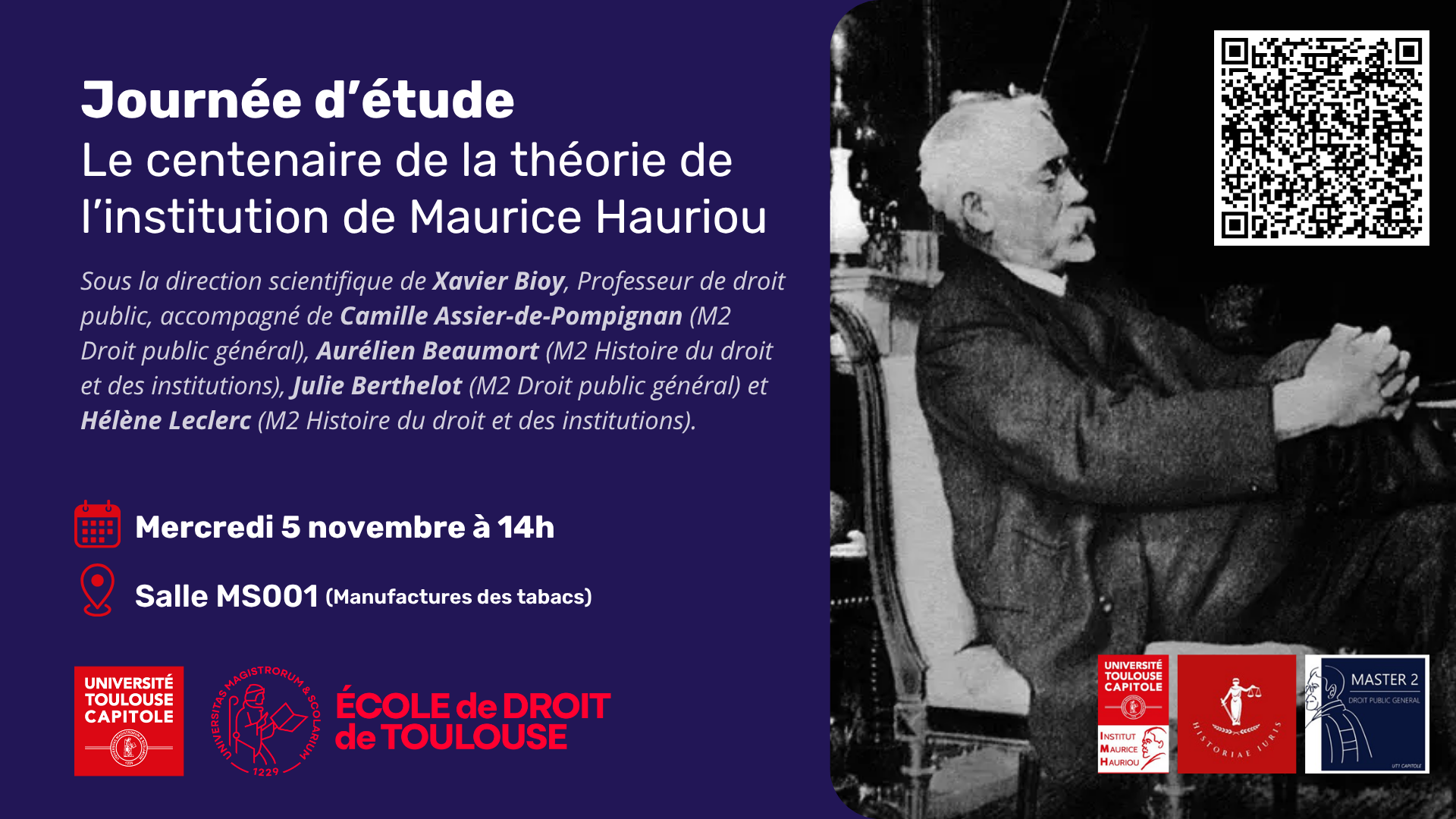
CONFERENCE: Le centenaire de la théorie de l'institution de Maurice Hauriou (Toulouse: Manufacture des Tabacs, 5 NOV 2025)


(image source: Université Toulouse Capitole)


Abstract:

Le Master Droit public Général et le master Histoire du droit et des institutions de l'École de Droit de Toulouse, organisent une journée d’étude consacrée au centenaire de la théorie de l'institution de Maurice Hauriou, sous la direction scientifique de Xavier Bioy, Professeur de droit public à l’Université Toulouse Capitole et membre de l’EDT-R (IMH), accompagné de Camille Assier-de-Pompignan (M2 Droit public général), Aurélien Beaumort (M2 Histoire du droit et des institutions), Julie Berthelot (M2 Droit public général) et Hélène Leclerc (M2 Histoire du droit et des institutions). Découvrez le programme !

Program:

13h30 : Accueil du public

14h00 : Ouverture de la Journée d’étude
Matthieu Poumarède, Doyen de l’École de Droit de Toulouse, Professeur de droit privé

14h20 : Propos introductifs
Hélène Leclerc, étudiante en M2 Histoire du droit et des institutions à l’UTC

14h30 : Théologie et évolutionnisme à l’origine de la théorie de l’institution
Tristan Pouthier, Professeur de droit public à l’Université Paris-Cergy

14h50 : Le rejet de la sociologie Durkheimienne au fondement de la théorie de l’institution
Léo Ravaux, qualifié maître de conférences en histoire du droit et en droit public à l’Università di Corsica Pasquale Paoli

15h10 : Débat

15h30 : Pause

15h50 : Filiations académiques de la théorie de l’institution : une école de Toulouse ?
Aurélien Beaumort, étudiant en M2 Histoire du droit et des institutions à l’UTC
Julie Berthelot, étudiante en M2 Droit public général à l’UTC

16h10 : L’influence du Doyen Hauriou dans le droit public italien, l’œuvre de Costantino Mortati
Cesare Pinelli, Professeur de droit public à l’Université Rome I - La Sapienza

16h30 : Hauriou et le droit privé : les fondements du régime d’état
Xavier Bioy, Professeur de droit public à l’UTC et vice- doyen
Julia Schmitz, Maitre de conférences de droit public à l’UTC

16h50 : Débat

17h10 : Conclusion

Camille Assier-de-Pompignan, étudiante en M2 Droit public général à l’UTC

 Read more here.

BOOK: Fernando CASTRILLO DÁVILA, Entre justicia, poder y política. La Suprema Corte en el régimen liberal mexicano, 1853-1882 (México: Tirant lo Blanch / Barra Mexicana de Abogados, 2025) pp. 384, ISBN: 9788410952102, $ 489.00 MXN


(Source: Tirant lo Blanch)

ABOUT THE BOOK 


La Constitución de 1857 establecía que, en ausencia del presidente de la república, el presidente de la Suprema Corte de Justicia debía asumir interinamente su cargo. Aunque esta disposición surgió como una fórmula excepcional para asegurar la continuidad del gobierno y prevenir disputas por el poder, desde 1858 hasta 1877, todos los presidentes del máximo tribunal, sin excepción, reclamaron en algún momento la titularidad del Ejecutivo. Con frecuencia, estas pretensiones políticas desataron conflictos que profundizaron la crisis que ya vivía el Estado a consecuencia de la imposición modernizadora de la Reforma liberal. El presente trabajo estudia estos conflictos por la presidencia a la luz de otro precepto fundamental en el arreglo de la judicatura federal, a saber, la elección popular de los magistrados, novedad democrática de la Constitución liberal. De esta manera, la obra explora las consecuencias que tuvo la convergencia de ambas disposiciones constitucionales, la alternativa que permitió corregir el problema en la década de 1880 y el difícil ejercicio de las atribuciones políticas de la Corte durante las décadas de consolidación del Estado liberal.


Series: Historia del Derecho en América Latina.


ABOUT THE AUTHOR 

Fernando Castrillo Dávila es doctor en Historia por el Colegio de México. Se ha dedicado al estudio del constitucionalismo y de las instituciones políticas mexicanas de la segunda mitad del siglo XIX y de principios del XX. Entre sus publicaciones recientes destaca su libro 'La guerra que nos hizo nación. La arqueología del nacionalismo liberal en México y Puebla, 1855-1872', publicado por la Secretaría de Cultura de Puebla en 2022. Ha sido docente en la Universidad Iberoamericana-Puebla y actualmente es investigador posdoctoral en el Instituto de Ciencias Sociales y Humanidades de la Benemérita Universidad Autónoma de Puebla.

More information with the publisher.

22 October 2025

ADVANCE ARTICLES: Grotiana

(image source: Brill)

The Carnegie Translation of Grotius: Influencing Public Opinion (William E. Butler)
DOI 10.1163/18760759-46010001
Abstract:

There have been several English translations of the Grotius classic On the Law of War and Peace (1625) inspired either by the intellectual impact of his ideas and/or by the perceived relevance of this work to crises in international relations at particular moments in human experience. Of the half dozen or so English versions of this work, none was more targeted to the public at large than the 1925 (1928) translation commissioned, financed, and produced by the Carnegie Foundation in New York and Washington D. C. under the direction of James Brown Scott, who retained Professor Francis Kelsey and his team for this undertaking. Based on archival research at Georgetown University, Columbia University, Cambridge University, Oxford University, and the University of Michigan with particular reference to the surviving records of George Finch (Secretary of the American Society of International Law and to James Brown Scott), of the Carnegie Foundation (on deposit at Columbia University), of Francis Kelsey (University of Michigan), of William Whewell (Trinity College, Cambridge University); and of John Morrice (The Bodleian Library, Oxford University), this article traces the origins of the Carnegie Grotius translation, the initial problems encountered in securing a translator, the principles of translation, the printing history (with particular attention to achieving the goal of mass distribution of the volumes), and the subsequent steps undertaken to ensure that the Grotius translation reached maximum readership. Although the Grotius translation was part of a series, exceptional measures were explored to ensure that this text – the ‘jewel’ of the series – received maximum attention. The principles of translation are addressed in the context of the virtues and disadvantages of literary as opposed to literal translation and the extent to which distortions may arise in an effort to adapt Grotius to the modern world, to make Grotius read as though he had composed his work in English rather than Latin. The printing history of the Carnegie translation includes not merely its initial appearance, but several reprintings undertaken by various publishers in the second half of the twentieth century.

Adventures in Governance: Grotius Societies and the International Order (Mark Somos & Matthew Cleary)
DOI 10.1163/18760759-46010004
Abstract:

This article reviews the twentieth-century history of four Grotius societies and places them in the joint contexts of legal studies on “governance”, whereby international law is shaped through soft power generated by substate or parastatal actors, and historical studies on “internationalism”, which trace the building blocks of the current international order back to popular grass-root movements and to elites’ intellectual opportunism. Based on archival work, the article shows that the British, Dutch, German, and Indian-Australian Grotius societies fit well into these joint contexts, and underline the entrepreneurial instrumentalisation of Grotius as a figure head for pacifists, lawyers, and prominent political and religious figures alike.

Ius Naturale, War as Punishment, and Grotius’s Justification of Dutch Colonial Imperialism (Jiangmei Liu)
DOI 10.1163/18760759-46010006
Abstract:

The resurgence of interest in war as punishment calls for a critical reexamination of Hugo Grotius’s theory of punitive war. Bridging intellectual history and colonial studies, this article engages two key debates: the philosophical foundations of Grotius’s conception of punishment as one just cause for war, and its entanglement with Dutch colonial violence. On the philosophical side, although existing scholarship has identified Grotius’s innovation in conceptualizing punishment as a subjective right within a secular natural law framework, important conceptual ambiguities persist. This article addresses three foundational questions: first, how Grotius’s distinctive conception of human nature as self-preservation and sociability enables a novel reconceptualization of punishment as a subjective right, given the growing doubts about its subjectivity; second, whether and to what extent this theory can be considered secular, given its undeniable theological roots; and third, how the shift from divine to human enforcement of natural law—through the right to punish—reshapes its status as universally obligatory law within a genealogical trajectory. On the historical-political side, through close textual and contextual analysis of De iure praedae commentarius and De iure belli ac pacis, the article further demonstrates how Grotius’s evolving account of punitive war may be closely linked to the justification of Dutch colonial expansion. It concludes by reflecting on Grotius’s complex legacy and the dangers posed by contemporary efforts in reviving the idea of war as punishment.

The Contested Claims of Convention Refugees: Grotius to the Rescue (Andreas Follesdal)
DOI 10.1163/18760759-46010008
Abstract:

The 1951 UN Refugee Convention protects a very small set of individuals, namely those who are persecuted by state authorities due to their race, religion or membership of a particular social group. Critics charge that this definition is unduly narrow. Arguments inspired by Grotius on the one hand help explain the special claims of such Convention refugees, and hence fill a gap in recent “state system legitimacy” defenses of the Refugee Convention. The Convention compensates for a normative “construction flaw” of the system of sovereign nation states. Other inhabitants of the Earth and their governments contribute to injury to Convention refugees by leaving them no state free place to go. States’ immunity also allows them to perpetrate such particularly wicked ab-uses of state power, in violation of the rule of law. On the other hand, Grotius’s arguments also help us justify a broader interpretation of which “particular social groups” to include among the Convention refugees, beyond those whose international human rights are violated.

Latius Patere Caritatis Quam Iuris Regulas (ibp iii.13.4.1) Is De Iure Belli ac Pacis a Law Book? (Alain Wijffels)
DOI 10.1163/18760759-46010010
Abstract:

De iure belli ac pacis pursued and renovated at the same time the medieval tradition of jurisprudence as a science of the art of good governance, specifically in the field of international governance. Grotius used the potential and devices of neo-classical studies in order to strengthen the jurist’s expertise in various forms of non-legal normativity, and to channel these into his own jurisprudential discourse. Virtues considered as duties were integrated in that discourse, but at different levels of Grotius’s multi-layered concept of law. Charity could thus be envisaged as a natural norm, both pre-Christian and universal, but also, according to enhanced standards, as a law of the Gospel, and hence as specifically Christian divine law.

Per gravissimas procellas in hanc felicitatem temporum: Livian and Tacitean Style Changes in Grotius’s De antiquitate reipublicae Batavicae (Seppe De Craemere)
DOI 10.1163/18760759-46010007
Abstract:

In ‘De antiquitate reipublicae Batavicae’ Hugo Grotius writes a history of the constitution of the province of Holland. He claims that it has always been an aristocratic republic, like it is in his own time. In this article, I argue that Grotius writes in a style reminiscent of Livy in the first chapters on the early history, then changes to a style more like that of Tacitus in the chapters on the Burgundian and Habsburg rulers, and back to a Livian style in the last chapter. The key to the meaning of these style changes is given in the first sentence of the book, a quotation from Tacitus’s Annals. This motto not only refers to the discussion in Tacitus on the difference between writing history in a republic and in a monarchy, it also alludes to Machiavelli’s ‘The Prince’. In this way, Grotius stresses the need to limit the power of a ruler.

Christianity, Natural Law, and Magistracy: De Iure Belli and the Sermon on the Mount (Sarah Mortimer) [OPEN ACCESS]
DOI 10.1163/18760759-4601001
Abstract:

One of the central themes of De iure belli ac pacis (ibp) is the relationship between natural law and the law of Christ. Grotius’s position here was shaped in important ways by his project of Biblical annotation, especially his work on Matthew 5 (the Sermon on the Mount) where Jesus discusses punishment and resistance. Though published only in 1641, Grotius’s annotations circulated in the early 1620s as part of a wider debate on the legitimacy of magistracy, and – as Grotius was aware – they were used to defend very different positions. This article indicates the wider contours of that debate among the exiled Remonstrant community and argues that we should see ibp as, at least in part, a contribution to it. The legacy of that debate would shape later writing and the article ends with a ‘post-Grotian’ Remonstrant account of the relationship between natural law and Christianity.

Grotius on Natural Slavery (Gustaad van Nifterik) [OPEN ACCESS]
DOI 10.1163/18760759-46010015
Abstract:

Grotius’s references to the Aristotelian idea of natural slavery seem incompatible with the idea that is at the heart of his legal argument about slavery, the idea that slavery is contra naturam. This article attempts to connect these seemingly incompatible ideas and examine them in relation to the three types of slavery that appear in Grotius’s work: voluntary slavery, penal slavery, and war slavery. It turns out that the two ideas do not really support each other on a theoretical level. In practice, however, this may well be the case.

The Coastal Seas in International Law: Contextualising Grotius’s De Iure Belli ac Pacis (Stefano Cattelan & Louis Sicking)
DOI 10.1163/18760759-46010013
Abstract:

This article reconsiders Hugo Grotius’ contribution to the law of the sea by shifting the focus from Mare liberum (1609) to the more nuanced arguments of De iure belli ac pacis (1625). While often portrayed as the chief advocate of the freedom of the seas, his later work reveals a more complex position: without abandoning the principle of free navigation on the high seas, he acknowledged that coastal states might, under specific conditions, assert exclusive rights over adjacent waters. Situating Grotius within a longue durée framework, the article traces the evolution of coastal jurisdiction from medieval practices in the Low Countries and beyond, through early modern diplomatic disputes over fishing rights and neutral waters. In particular, Grotius outlined the distinction between maritime dominium and imperium, hinting at the fact that exclusive rights at sea derived from either physical proximity to the coast or effective control. The discussion then extends to Cornelius van Bynkershoek’s De dominio maris dissertatio (1702), which developed the so-called cannon-shot rule as pragmatic compromise between maritime sovereignty and the freedom of the seas. By contextualising Grotius’ contribution, the article underscores the negotiated and dynamic character of the law of the sea. It also shows how historical debates on coastal jurisdiction continue to resonate today.

Book reviews

  • The Cambridge History of International Law, Volume 1, edited by Randall Lesaffer and Anne Peters (David Kennedy) 
  • The Working Papers of Hugo Grotius. Transmission, Dispersal, and Loss, 1604–1864, written by Martine Julia van Ittersum (Marco Barducci)
  • The Cambridge Companion to Pufendorf, edited by Knud Haakonssen and Ian Hunter (Heikki Haara)
Read more here.

CONFERENCE REPORT: 3rd Central and Eastern European Legal History Conference (Cracow: Jagiellonian University, 8-10 OCT 2025)


(image source: Krakow.wiki)

We received the following message from  Paulina Kamińska:

On 8–10 October 2025, the Faculty of Law and Administration of the Jagiellonian University in Krakow hosted the 3rd Central and Eastern European Legal History Conference. The conference was held in a stationary format at Collegium Novum and Larisch Palace at 12 Bracka Street in Krakow.
This was the third conference in this series, with previous ones held at the University of Vienna (2019) and Pázmány Péter Catholic University in Budapest (2023). This year's edition has been prepared by the Legal and Historical Departments of the Faculty of Law and Administration of the Jagiellonian University (Scientific Committee: prof. dr hab. Dorota Malec, dr hab. Zdzisław Zarzycki, prof. dr hab. Andrzej Dziadzio, ks. prof. dr hab. Franciszek Longchamps de Bérier, dr hab. Iwona Barwicka-Tylek, dr hab. Izabela Lewandowska-Malec, prof. UJ, prof. dr hab. Krystyna Chojnicka; members of the Organizing Committee: Dr hab. Maciej Mikuła, prof. UJ, Dr Anna Ceglarska, Dr Paulina Kamińska, Dr Mateusz Mataniak, Mgr Wiktor Dziemski, Mgr Izabela Wasik, Mgr Paweł Kaźmierski), in cooperation with the Critical Heritage Studies Hub Flagship Project and the editorial team of the journal ‘Cracow Studies of Constitutional and Legal History’. The event was held under the patronage of the Rector of the Jagiellonian University, the Mayor of Krakow and the Polish Society for the History of Law. TVP3 Krakow provided media patronage. The conference was attended by over 100 researchers from European countries: Austria, Belgium, Croatia, the Czech Republic, Germany, Poland, Romania, Serbia, Slovakia and Hungary. The conference languages were English and German.
During the conference, participants presented papers related to the history of law in Central and Eastern Europe. They shared the results of their research and enriched the discussion. The program included 21 different panels, which can be viewed here: https://ceelhc.confer.uj.edu.pl/programme
The book of abstracts has been prepared (available here: https://ceelhc.confer.uj.edu.pl/book-of-abstracts).
It is worth mentioning that on the last day of the conference, after the thematic sections had ended, a 3MT (Three Minutes Thesis) competition was held. Moreover, the attraction was a tour of Collegium Maius, the oldest university building.


BOOK: Martin LÖHNIG, Northern Italy as a contact zone between Austro-Hungarian and Italian law (Torino: Giappichelli, 2025), 288 p. ISBN 9791221113396, € 40


(image source: Giappichelli)

Abstract:
Northern Italy as a Contact Zone between Austrian-Hungarian and Italian Law" documents the results of an international research project that comprehensively examines for the first time the development of civil law in the territories acquired by Italy after the Third Italian War of Independence and after the First World War. In these territories, the previously applicable Austrian-Hungarian law simply continued to apply. After a few years, the applicable Italian law replaced it, but some special features are still valid today. Other regulations inspired the pending all-Italian law reforms. Beyond wars and disputes over self-determination and the protection of minorities, Northern Italy therefore appears to be a zone in which Austrian and Italian law have entered into a particularly close relationship with each other. A book not only for legal historians, but for all lawyers who wish to explore this important chapter in European legal history.

Read more here. 

CONFERENCE: L'ordre public [Société d'histoire du droit et des institutions des pays bourguignons, comtois et romands] (Dijon: MSH, 3-4 NOV 2025)

(image: "Le Grand Duc d'Occident", Philip the Good, after Rogier van der Weyden, ca 1455; Wikimedia Commons)
 

The Society for Institutional and Legal History of Burgundy, Franche Comté and Romandy organises its annual conference at the Maison des Sciences de l'Homme in Dijon, the Duchy's capital.

Program here.

(source: Hi-D)

21 October 2025

JOURNAL: Journal of the History of International Law/Revue d'histoire du droit international XXVII (2025), nr. 3 (Oct)


(image source: Brill)

'The Right of Existence of Peoples as Independent Nations’ Raphael Lemkin, the Tokyo Tribunal, and Aggression (Julia Klaus)
DOI 10.1163/15718050-bja10133
Abstract:

The article uncovers a significant historical connection between Raphael Lemkin, known for his work on genocide, and the International Military Tribunal for the Far East in 1947. Archival discoveries reveal Lemkin’s involvement in discussions on defining the legal concept of aggressive war, aiming to influence the proceedings of the Tokyo Tribunal. A transcript of a US War Department conference shows how Lemkin’s legal philosophy, balancing natural law and practical pragmatism, guided his views on aggression. His preference for a common law approach to formulating legal norms also became evident. Linking the 1947 conference report to an earlier publication by Lemkin sheds light on his role in imagining a practicable legal concept of aggression during the pre- and post-World War II era. This historical connection and a survey of the epistemic communities around Lemkin foster a deeper understanding of his multifaceted contributions to international law and the prevention of mass atrocities.

Kashmir’s Erasure from International Law David Lilienthal and the Forgotten Pre-History of the Indus Waters Treaty (1948–1951) (Rishabh Bajoria) [OPEN ACCESS]
DOI 10.1163/15718050-bja10134
Abstract:

From East Timor to Palestine, political erasures flowing from the legal concepts of self-determination and permanent (state) sovereignty over natural resources remain enduring sites of struggle. This article traces how international law produced such an erasure in Kashmir through a pre-history of the 1960 Indus Waters Treaty. David Lilienthal, famous as the architect of the Tennessee Valley Authority, argued that harnessing the Indus waters for India and Pakistan’s postcolonial development required setting aside Kashmiri demands for self-determination. International law had to transform the waters into common property owned by India and Pakistan and protect their economic value from popular politics. Adjudication of the water dispute was dismissed because a public legal argumentative battle would inflame controversy. Instead, disputes needed to be solved by international law. This pre-history of the Treaty cuts against celebratory narratives of the water-sharing arrangement by showing what lies beneath the surface of a seemingly successful treaty regime.

China Unbounded Extraterritoriality, Nationality, and the Late Qing’s Engagement with International Law (Maria Adele Carrai)
DOI 10.1163/15718050-bja10129
Abstract:

Extraterritoriality in China has traditionally been viewed through the lens of the unequal treaties, often symbolizing China’s subjugation to foreign powers. This article repositions the narrative by highlighting the Qing government’s active adaptation of modern international law and its implementation of extraterritoriality to protect its nationals abroad. By the late 19th century, the Qing began to reimagine its imperial domain not only within the emerging paradigm of territorial sovereignty but also through an extraterritorial extension of its authority abroad, leveraging evolving concepts of nationality and jurisdiction over its diaspora abroad. This article highlights how Qing intellectuals and political leaders appropriated Western legal norms to safeguard Chinese nationals abroad, culminating in the promulgation of the Nationality Law of 1909. By examining the evolution of extraterritoriality and the Qing government’s efforts to protect its diaspora, this study situates these practices within the broader frameworks of international law, highlighting the limitations and paradoxes of sovereignty.

Book reviews

  • The World Bank’s Lawyers: The Life of International Law as Institutional Practice, written by Dimitri Van Den Meerssche (Diane A. Desierto)
  • The Early Modern Dutch Press in an Age of Religious Persecution: The Making of Humanitarianism, written by David De Boer (Mark Somos)
Read more here.


20 October 2025

CALL FOR ARTICLES: Innovation (Rechtskultur 2026-2027)


(image source: Rechtskultur)

Abstract:

Laws can promote, delay or prevent innovation. With regard to digitalisation and the development of artificial intelligence, fundamental legal policy questions are currently being raised as to whether legislation should set the course for future development at an early stage or whether it is better to allow development to run its course as freely as possible and then intervene with legislation in a targeted manner where undesirable effects occur that need to be corrected. This current challenge is not new. We also encounter it in legal history. Consider issues of economic and environmental law. Where legislation imposes high barriers on new technologies, the willingness to innovate is limited due to costs and risks. The expansion of transport routes in Europe took place at very different speeds, not least because of different legal frameworks. The same applies to the use of hydropower and canal construction. Where economic cooperation was prohibited for protectionist reasons and detailed production regulations applied, guild-based trade was limited to pure reproduction for many decades. Legal systems that did not recognize joint-stock companies hindered the growth of private companies because they lacked the equity financing function of joint-stock companies. Adherence to antiquated border regimes and customs regulations hampered foreign trade in many countries. The introduction of causal liability led to greater security for the population, but at the same time created higher risks for the introduction of new technologies. Price fixing and control of supply (monopoly rights) were intended to serve the supply of goods to the population, but hampered trade. There are many other examples relating to human rights, labour law, contract law (e.g. iustum pretium), copyright and patent law, etc. This issue aims to highlight the advantages and disadvantages of legal regulation for economic and technological innovations of all kinds in a legal-historical context. The editors welcome contributions from all relevant fields of science with a maximum length of 200,000 characters. Contributions should be submitted by using rechtskultur@ur.de within 31. August 2027. All contributions will be peer-reviewed, and admittance for publications rests on the merits of the contribution alone.

Read more here.