Search

21 October 2022

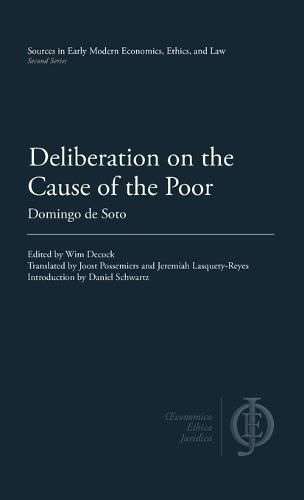
BOOK: Domingo DE SOTO, Deliberation on the Cause of the Poor (Transl. Joost POSSEMIERS, & Jeremiah LASQUETY-REYES, introd. Daniel SCHWARTZ) [Sources in Early Modern Economics, Ethics and Law, Second Series, ed. Wim DECOCK] (Grand Rapids: CLP Academic, 2022), 184 p., ISBN 978194901109, 29,95 USD


(image source: readings)

Abstract:
May beggars be excluded from public spaces? May vagabonds be denied access to foreign cities? Should assistance to the poor rely on private charity rather than public welfare institutions? These and similar questions are at the heart of Deliberation on the Cause of the Poor, a remarkable treatise on poor relief by Domingo de Soto (1495-1560), one of Spain’s most famous jurist-theologians. Confronted with the reform of poor laws in cities across Europe, Soto warns against the potentially dire consequences of restricting access to poor relief for the sake of managerial efficiency. Denouncing the abuse of power by corrupt public officials and the instrumentalization of the sacrament of confession, he argues against well-intended public measures that actually jeopardize the poor’s direct access to life-saving help and assistance. Soto draws on manifold arguments from the Bible, the church fathers, natural law, Roman law, and canon law to defend the legitimate poor’s right to beg for assistance, while recalling the vital importance of the virtue of mercy. Edited by Wim Decock. Translated by Joost Possemiers and Jeremiah Lasquety-Reyes. Introduction by Daniel Schwartz.

 Read more here.

CALL FOR PAPERS: The Problem of Piracy III - An Interdisciplinary Conference on Plunder by Sea across the World from Ancient to Modern - Tulane University, New Orleans - 15-16 June 2023 [deadline 15 JAN 2023]


JOURNAL: Le carte e la storia: rivista di storia delle istituzioni, 2022/1


(Source: https://www.rivisteweb.it/issn/1123-5624)

    • Gaetano Armao
    • La Sicilia e le sue «Costituzioni» (1812, 1848, 1860, 1946)

      • Guido Melis
      • La Repubblica alla prova. Norme e prassi delle istituzioni

        • Sergio Zamperetti
        • Uno «Stato per associazioni provinciali». Capoluoghi urbani e contadi nel dominio veneziano di terraferma

          • Francesco Antonio Genovese
          • Gli Uffici del Massimario e del Ruolo dalle origini all’unificazione nella Cassazione (1924-1941)

            • Elena Vigilante
            • L’Opera nazionale dopolavoro tra spinte totalitarie, retorica corporativa e amministrazione ordinaria

              • Massimiliano Paniga
              • L’Alto commissariato e le sue riviste: il «Notiziario dell’Amministrazione sanitaria» e gli «Annali della sanità pubblica»


20 October 2022

BOOK: Susan LONGFIELD KARR, Jus Gentium in Humanist Jurisprudence. On Justice and Right (Leiden: Brill, 2022). ISBN: 978-90-04-52366-1, €130.38


(Source: Brill)

ABOUT THE BOOK

Series: History of European Political and Constitutional Thought, Volume: 9

This book explores how the fathers of humanist jurisprudence contributed to the emergence of ius gentium as the common law not simply of Europe, but of all mankind, in the early sixteenth century. They did so by so thoroughly reinterpreting terms, idioms, and categories preserved within Justinian’s Digest that they fundamentally transformed them to address sources and limits of political and legal authority in the broader context of early-modern state formation.

In the process, they offered theories of universal jurisprudence grounded in the attributes and actions of man and states that anticipated some of the most salient features of modern sovereignty and rights. Theories that we tend to identify with post-Reformation political and legal thought, rather than the early Renaissance.


ABOUT THE AUTHOR

Susan Longfield Karr, Ph.D. (2008), University of Chicago, is an Assistant Professor of History at the University of Cincinnati, where she teaches courses on the European Renaissance, the intersections of political and legal thought, the history and development of rights, and Early Modern Europe.


TABLE OF CONTENTS

Acknowledgements

List of Figures

Introduction Historical Imagination, Collective Memory, and the Historicization of Roman Law

part 1
Guillaume Budé: Jus, Justice, and Dignity
1 Setting the Scene Justinian’s Digest and University-Based Jurisprudence
 1 Corpus iuris civilis: Composition and Transmission

 2 Law before Lawyers

 3 Reform, Revolution, and Rediscovery

 4 Modus docendi: The Methods of the Schoolmen and the Advent of the Studia humanitatis


2 Excavating, Restoring, and Redefining Jus at the Foundations of Humanist Jurisprudence
 1 A Humanist, Not a Lawyer

 2 The 1508 Annotationes: Answering—and Amplifying—the Call for Change

 3 Hidden in Plain View: Radical Departure, Traditional Scholarship

 4 Splitting Good from Fair: Accursius’ Error and Budé’s Entanglement

 5 The Proper Method for Studying and Interpreting the Law

 6 Jus as a Defining Characteristic of Justice and Man qua Man

 7 Jus Has Been Given to All Mankind

 8 Significance of Budé’s Re-interpretation of Jus and Jus Gentium


part 2
Ulrich Zasius: Jus, Jus Gentium, and Rights
3 Re-defining Jus to Restore Justitia Ulrich Zasius’ Methods in Word and in Action
 1 Humanist First, a Lawyer Second

 2 Combining Methods: Historicizing Law to Observe Justice

 3 In Praise of the Law: A True and Useful Science

 4 Theory Meets Practice: Zasius Explains His Methods

 5 Ordinary Lecture, Exceptional Interpretation

 6 ‘What Is Justice; What Is Jus?’

 7 The Historical Necessity for and the Moral Authority of Lawyers and Jurists

 8 ‘In What Manner Is Justice Divided?’

 9 Methods in Action: Ex fontibus ad initium


4 Breaking with Tradition Jus Gentium as a Source of Universal Rights and Obligations
 1 Disentangling Jus Gentium, Defining Natural Law

 2 Defining Natural Law and Jus Gentium

 3 The First Three Qualities of Natural Law: Instruction, Sociability, and Preservation

 4 Jus Gentium as the Fourth Quality of Natural Law

 5 Before and Beyond the Lectern: Pairing Zasius’ Lecture and Lucubrationes

 6 Elevating Jus Gentium

 7 Distinct, but Not Divided: The Double-Aspect of Jus Gentium

 8 Universal, but Not Unlimited: The Right to Resist and the Power to Punish

 9 Jus Gentium as a Cache of Universal Rights

 10 Jus Gentium as a Cache of Universal Obligations

 11 The Limits of Slavery

 12 The Trouble with Tyranny

 13 Implications of Zasius’ Re-interpretation of Jus Gentium


part 3
Andrea Alciati: Jus, Violence, and Imperium
5 Self-Evident Truths and Demonstrable Facts Power, Politics, and Persuasion
 1 Lawyer First, Humanist Second

 2 Law and Violence: Alciati’s Career in Context

 3 The Art of Justice, the Power of Speech, and the Necessity of Jurists


6 The Tenacity of Violence and the Parity of Right Alciati’s [Re-] Interpretation ofJus, Jus Gentium, and Natural Law
 1 Equality Through Enmity: War-Making as State-Making

 2 Changing the Subject: Alciati’s Radical Departure from His Humanist Peers

 3 The Trouble with Imperium: Alciati’s Novel Departure from His Scholastic Predecessors

 4 Jus as Necessity in Action

 5 Homicide, Commerce, and War: Meticulous Meditations on Proximate and Remote Cause

 6 Slavery as a Marker of Imperium

 7 Rulers and Brigands; Superior and Inferior Princes

 8 Universal Empire Rejected

 9 Imperium Interrupted

 10 Contests Among Equals: Dueling as an Analogy to War

 11 The Practical Significance of Alciati’s Novel Re-interpretation of Jus Gentium in Context

 12 Jus as a Marker of Equality in Humanist Jurisprudence


 Conclusion The Re-formation of Europe and the Turn to Jus Gentium

 Appendix: Select Emblems


Bibliography

Index


More information with the publisher.


JOURNAL: Quaderni Fiorentini per la Storia del Pensiero Giuridico Moderno, LI (2022)


(Source: https://www.centropgm.unifi.it/quaderni/51/index.htm)

Indice del volume

Modelli e dimensioni

La dimensione giuridica

Figure dell'esperienza

Letture

Discussioni

Su Paolo Grossi, Il diritto civile in Italia fra Moderno e postmoderno (dal monismo legalistico al pluralismo giuridico)

A proposito di...

Testimonianze

Abstracts

Ragguagli fiorentini


19 October 2022

REMINDER: Postdoc position in Legal History and Construction History (4 years - Full time) (DEADLINE: 26 October 2022)


(Source: CORE Blog)

This vacancy fits within the framework of the EOS research project “Construction History, Above and Beyond. What History Can Do for Construction History”, directed by professors Michiel Dehaene (UGent), Dave De ruysscher (VUB, Tilburg University), Rika Devos (ULB), Johan Lagae (UGent), Stephanie Van de Voorde (VUB) and Ine Wouters (VUB). In total, 3 PhD positions and 4 postdoc positions are included in this project (the fourth postdoc mandate will be opened later in 2023). An overview of the full project and all mandates involved can be consulted on: www.vub.be/arch/project/eos.


The EOS research project will set up a dialogue (in terms of sources, methodologies, concepts and cognitive interests) between Construction History and three other fields of history, namely Colonial History, Legal History and Planning History. As such, the project sets out to strengthen the historical dimension of Construction History, while simultaneously demonstrating its relevance and potential to other fields and disciplines. The project overall concentrates on selected aspects in 19th and 20th -century building knowledge and building practice in Belgium and its former colony, with particular attention for tacit knowledge, in order to voice crucial yet underrated actors, sources and types of knowledge.


The individual trajectory of each postdoc researcher is embedded in this larger team, operating in the 3 universities (ULB, UGent and VUB). Intensive exchange and shared outcomes among team members are crucial for the success of the project. The postdoc positions are each situated in one of the 3 fields of dialogue: (1) colonial history – construction history; (2) legal history – construction history and (3) planning history – construction history.


This specific vacancy is issued by the Université Libre de Bruxelles (ULB) and engages in the dialogue between legal history and construction history. It is co-supervised by profs. Rika Devos (ULB) and Dave De ruysscher (VUB, Tilburg University).


This postdoc study focusses on the normativity of ‘implicit’ and ‘practical’ knowledge building in Belgium, during the 19th and 20th centuries. This type of knowledge is often enforced through informal rules, in many segments of society. The field of Construction History holds promising opportunities to further disentangle normativity and informal rules, as they can be enforced in the case of harm orconstruction faults. The liability of architects, contractors and even workers was tested against ‘rules of the trade’, which were rules of implicit, practical knowledge. The sources that can be used range from instructional literature to case law, in which the liability of constructors is explored. These sources shed light not only on the appraisal of ‘rules of the trade’ but also on how legal practitioners categorized ‘practical knowledge’.


The post-doc study in the dialogue between Legal History and Construction History explores the types of normativity as found in instructional literature for construction professionals. As such, this research will link up not only with recent developments in Legal History, but also engage with the larger knowledge gaps identified in this project by assessing not only the relation between different types of knowledge engaged in normativity, but also the relations between the actors involved – both professional builders and professional legal actors – and the untapped sources to assess this normativity, including their technical and legal challenges. Legal practitioners and construction practitioners produce very different types of documents, from different viewpoints, in different ‘languages’. How do they interact and integrate the insights of the other field? How can they be understood by the other field and were these sources accessible and used? Do they reflect the standard of building? How and when does practical knowledge turn into a normative set of (implicit or explicit) rules or guidelines? These issues are tested through case studies in the archives of construction companies, such as the private archives of the Blaton archives and Entreprises Louis de Waele.


The successful candidate will be based alternatingly at ULB and VUB, to allow a dynamic interaction with the team members and a full insertion in both institutions.


More information: here

CONFERENCE: Pluralismo Giuridico: Intinerari Contmporanei

 The University of Florence will host a conference celebrating the 50 years of the Centro Studi per la Storia del Pensiero Giuridico Moderno and the Late Paolo Grossi, who passed away this year.

(Source: http://www.storiadeldiritto.org/home/pluralismo-giuridico-itinerari-contemporanei-20-21-ottobre-2022-universita-degli-studi-di-firenze)


18 October 2022

LAUNCH EVENT: EUTopia Connected Learning Community Legal History: Labour Migration: Prof. Cristiana BASTOS, "Across Empires: Plantation Labour in the Aftermath of Abolition" (TEAMS, 21 OCT 2022)

(image source: Prof. Bastos)
 

Prof. Cristiana Bastos (Lisboa, ERC Advanced Grantee) will hold this year's opening lecture for the EUTopia Connected Learning Community Legal History: Labour Migration. The topic is "Across empires: plantation labour in the aftermath of abolition".

Background reading can be found on Prof. Bastos' project website, and will be shared at registration.

The Connected Learning Community Legal History: Labour Migration brings together the VUB, UPF Barcelona, Ljubljana, Warwick, Nova Lisboa and CY Paris. Five to eight students per institution work together on the common theme of Labour Migration. 


The event will take place on Friday 21 October at 15:30 Brussels Time.

Registration is mandatory with dr. Elisabeth Bruyère (Elisabeth.bruyère@vub.be).

BOOK PRESENTATION: To the Uttermost Parts of the Earth by Martti Koskenniemi - 26 October 2022, 5 pm CET time - University of Catania [hybrid]


JOURNAL: História do Direito, nº 3, v. 4 (2022)


(Avaliable at: https://revistas.ufpr.br/historiadodireito/issue/view/3337)

História do Direito, the journal of the Brazilian Institute of Legal History, has published its most recent issue.

FERRAMENTAS

João Paulo Arrosi
10-18

EXPERIÊNCIAS

Renato Sedano Onofri
20-55
Gustavo César Machado Cabral, Rafael Cronje Mateus
56-79
Oscar Hernández Santiago
80-92
Filipe Nicoletti Ribeiro
93-123
Marco Sabbioneti
124-152
Priscila Petereit de Paola Gonçalves, Leonardo Seiichi Sasada Sato, Paulo Roberto dos Santos Corval
153-170

RESENHAS

Jean-Louis Halpérin
172-176

MEMÓRIA

Ezequiel Abásolo
178-180
Ricardo Marcelo Fonseca
181-184


SYMPOSIUM: ‘Le radici e le forme'. La capacità ordinante del diritto [in memoria di Paolo Grossi] - Pisa 4 novembre 2022


CONFERENCE: I cardini della modernità penale: dai codici Rocco alle stagioni dell’Italia repubblicana - Roma, 11-12 novembre 2022


(Source: Storia del diritto)

17 October 2022

REMINDER CFP: Heraldry and the Law - XXIInd Colloquium of the International Academy of Heraldry, Lund 16-19 August 2023 (deadline 22 November 2022)


Welcome to the XXIInd Colloquium of the International Academy of Heraldry, 16-19 August 2023. The theme of the colloquium is “Heraldry and the Law”. It is an interesting theme for several reasons. In some countries there are authorities that grant or registers heraldic arms, also to private individuals (e.g. England and Scotland). In other countries, heraldry is almost unregulated, which means non-profit organizations have taken on the task of developing good heraldic custom. In many countries there is some regulation of heraldry, such as e.g. in Sweden where public coats of arms are protected against use as trademarks. The legal regulation of heraldry in different countries, and its historical development, has so far not been studied and compared. At the colloquium, we will also discuss other aspects of the theme heraldry and the law, such as symbols of law.


Examples of subject areas:

 The authorities granting and registering arms, present and in history

 The legal protection of heraldic arms

 Inheritance of heraldic arms

 Right to bear heraldic arms

 Symbols of courts, associations of advocates etc.

 Symbols of law in heraldry


We need an abstract of approximately 400 words. We also need information about the applicant’s affiliation, a short CV, and contact details.

Proposals should be sent to Lund2023@heraldik.org at the latest 22nd November 2022.

Notification of acceptance will be sent at the latest early in 2023.

More information: https://heraldik.org/colloquium-lund-2023/

Café virtuel de APHG: Guillaume Calafat, Une mer jalouseée - Lundi 7 novembre 2022, 19:00 CET