Search

Showing posts sorted by date for query iustoria. Sort by relevance Show all posts

21 April 2026

DEADLINE EXTENDED: Iustoria 2026: In the Shadow of Empires (Belgrade: University of Belgrade, 11-13 MAY 2026) [DEADLINE 30 APR 2026]


Iustoria 2026: In the Shadow of Empires

The University of Belgrade Faculty of Law is now receiving paper proposals for the Sixth student conference on legal history – the Iustoria 2026, to be held on May 11th-13th, 2026, its topic being “In the Shadow of Empires”.

In 2026, we mark the 1,550th anniversary of the fall of the Western Roman Empire in 476 – an event that reshaped the map and destiny of Europe at the time. Nevertheless, this political collapse could not erase a thousand years of the development of Roman law, which later returned to Western Europe through the rediscovery of the Digest and the work of numerous schools that studied and applied Roman law, from the glossators to the pandectists. By contrast, in the Eastern Roman – Rhomaian – Byzantine Empire, Roman law, increasingly enriched with Greek and Christian components, continued to develop for another thousand years, exerting a significant influence on many neighbouring lands, above all the Slavic countries. In order to commemorate this important anniversary, we seek to invite discussion on the emergence, development, dissemination, and influence of the legal systems of empires and imperial polities – from the Roman Empire and other great empires of antiquity, through their successors in the medieval and modern periods, up to today’s informal empires that extend their influence through an order that formally proclaims the equality of peoples and democracy.

Research may focus on the legal organization of empires themselves from various perspectives – or on their relations with other states (including numerous issues of international law and the use of force), as well as on transplants from their laws into other legal systems, whether imposed or voluntarily adopted. It is also legitimate to pose the question – either at a theoretical level or through concrete case studies – which characteristics distinguish the law of an empire from the law of a small nation-state. Across different empires throughout history, we can find examples of both cosmopolitanism and discrimination, making it particularly interesting to consider whether an empire tends to view its inhabitants primarily as citizens endowed with rights or as subjects who chiefly owe it obligations, what is required to acquire citizenship, and how its legal system treats those who do not possess it. Whatever constitutes the principal basis of power of a given empire – whether military conquest, slavery, or “soft power” – will inevitably be reflected in its legal system, allowing us to trace the emergence and development of many specific legal institutions.

All students of undergraduate and post-graduate studies pertaining to law or other humanities are eligible to apply for the conference. The applications should contain basic personal information (name and surname, faculty, department, level and year of study), along with an extended abstract containing between 500 and 1000 words. Applications are accepted in either Serbian or English.

The applications should be e-mailed to iustoria@ius.bg.ac.rs before April 15th, 2026. The students will be informed by April 20th whether or not their application has been accepted. For any additional information you may enquire at the same e-mail address, and important news will also be published at the official Facebook page of the conference – https://www.facebook.com/iustoria

Just like on our previous conferences, apart from the presentations given by their colleagues, the students at the conference will have an opportunity to attend several lectures given by renowned experts – more details on this will be available in the final version of the programme.

The conference will be held in a hybrid format: both in-person and online participation will be possible. We'll do our best to secure accommodations either in student dormitories or with student host families for participants who don’t reside in Belgrade and who wish to participate in person. These arrangements will depend on the number of available spots. 

The final versions of the papers presented at the conference, with final changes and corrections submitted within a reasonable time after the conference, will be submitted for publication in the journal „Vesnik pravne istorije / Herald of Legal History“ (http://epub.ius.bg.ac.rs/index.php/Vesnik/index). The deadline for the submission of papers is July 15th 2026.

30 March 2026

CALL FOR PAPERS: Iustoria 2026: In the Shadow of Empires (Belgrade: University of Belgrade, 11-13 MAY 2026) [DEADLINE 15 APR 2026]


Iustoria 2026: In the Shadow of Empires

The University of Belgrade Faculty of Law is now receiving paper proposals for the Sixth student conference on legal history – the Iustoria 2026, to be held on May 11th-13th, 2026, its topic being “In the Shadow of Empires”.

In 2026, we mark the 1,550th anniversary of the fall of the Western Roman Empire in 476 – an event that reshaped the map and destiny of Europe at the time. Nevertheless, this political collapse could not erase a thousand years of the development of Roman law, which later returned to Western Europe through the rediscovery of the Digest and the work of numerous schools that studied and applied Roman law, from the glossators to the pandectists. By contrast, in the Eastern Roman – Rhomaian – Byzantine Empire, Roman law, increasingly enriched with Greek and Christian components, continued to develop for another thousand years, exerting a significant influence on many neighbouring lands, above all the Slavic countries. In order to commemorate this important anniversary, we seek to invite discussion on the emergence, development, dissemination, and influence of the legal systems of empires and imperial polities – from the Roman Empire and other great empires of antiquity, through their successors in the medieval and modern periods, up to today’s informal empires that extend their influence through an order that formally proclaims the equality of peoples and democracy.

Research may focus on the legal organization of empires themselves from various perspectives – or on their relations with other states (including numerous issues of international law and the use of force), as well as on transplants from their laws into other legal systems, whether imposed or voluntarily adopted. It is also legitimate to pose the question – either at a theoretical level or through concrete case studies – which characteristics distinguish the law of an empire from the law of a small nation-state. Across different empires throughout history, we can find examples of both cosmopolitanism and discrimination, making it particularly interesting to consider whether an empire tends to view its inhabitants primarily as citizens endowed with rights or as subjects who chiefly owe it obligations, what is required to acquire citizenship, and how its legal system treats those who do not possess it. Whatever constitutes the principal basis of power of a given empire – whether military conquest, slavery, or “soft power” – will inevitably be reflected in its legal system, allowing us to trace the emergence and development of many specific legal institutions.

All students of undergraduate and post-graduate studies pertaining to law or other humanities are eligible to apply for the conference. The applications should contain basic personal information (name and surname, faculty, department, level and year of study), along with an extended abstract containing between 500 and 1000 words. Applications are accepted in either Serbian or English.

The applications should be e-mailed to iustoria@ius.bg.ac.rs before April 15th, 2026. The students will be informed by April 20th whether or not their application has been accepted. For any additional information you may enquire at the same e-mail address, and important news will also be published at the official Facebook page of the conference – https://www.facebook.com/iustoria

Just like on our previous conferences, apart from the presentations given by their colleagues, the students at the conference will have an opportunity to attend several lectures given by renowned experts – more details on this will be available in the final version of the programme.

The conference will be held in a hybrid format: both in-person and online participation will be possible. We'll do our best to secure accommodations either in student dormitories or with student host families for participants who don’t reside in Belgrade and who wish to participate in person. These arrangements will depend on the number of available spots. 

The final versions of the papers presented at the conference, with final changes and corrections submitted within a reasonable time after the conference, will be submitted for publication in the journal „Vesnik pravne istorije / Herald of Legal History“ (http://epub.ius.bg.ac.rs/index.php/Vesnik/index). The deadline for the submission of papers is July 15th 2026.

14 April 2025

POSTPONED: Iustoria 2025 (21-23 OCT 2025) [DEADLINE 1 SEP 2025]

We received word that the Iustoria Conference 2025 has been postponed to 21-23 Oct 2025, with a new deadline for abstracts on 1 September 2025 (full paper submission 31 Dec 2025).

See initial call here on our blog.

06 February 2025

CALL FOR PAPERS: War and Peace (in legal history) [Sixth student conference on legal history/IUSTORIA 2025] (25-27 MAR 2025); DEADLINE 15 FEB 2025


(click on image to enlarge)

Iustoria 2025


Правни факултет Универзитета у Београду отвара позив за учешће на Шестој студентској конференцији из правне историје – Iustoria 2025, која ће се одржати од 25. до 27. марта 2025. године, са темом „Рат и мир (у правној историји)“.

У 2025. години навршиће се 80 година од завршетка Другог светског рата. Овај крвави сукоб донео је незапамћена разарања, патњу и огромне људске жртве (преко 70 милиона), али и пораз нацистичке Немачке, фашистичке Италије, империјалног Јапана и осталих чланица Сила осовине. Након његовог завршетка, Савезници, државе победнице, решиле су да успоставе систем међународног организовања, у оквиру нове Организације уједињених нација, како би се кроз вишестрану дипломатију, утврђене процедуре, као и механизме међусобног обуздавања све више блоковски супротстављених великих и регионалних сила, обезбедио трајни(ји) мир. Нажалост, многобројни регионални (често „прокси”) ратови, који су уследили у наредним деценијама, неки од којих трају и дан-данас, показали границе оваквог система.

Ратови су, наравно, тамни део људске историје, без кога се не може разумети ни правна историја. Већ први мировни уговор, склопљен пре 3300 година, између Хетитске државе и Египатског новог краљевства, показује да овакво прекидање непријатељстава често подразумева и значајне правне последице: утврђивање граница, размену талаца… Неки од мировних уговора су читави трактати, док други, рецимо онај којим је пре скоро 140 година окончан Српско-бугарски рат, садрже свега једну реченицу.

Вековима се један на други настављају два тока: обичаја ратовања – данас најчешће утврђени међународним конвенцијама – и мировне одредбе, које утврђују куда даље након завршетка истог ратовања. Темама рата и мира бавили су се многобројни научници, махом из области друштвено-хуманистичких наука, особито историјске и правне. Дело Хуга Гроција „О праву рата и мира” поставља корене међународног јавног права; „Вештачење о кривици за рат 1914.” Хермана Канторовича, три касније помера границе теоријскоправног разумевања одговорности држава у изазивању, отпочињању и вођењу рата.

Поред међународног права, међутим, питања рата и мира релевантна су и у многим гранама националних права. Правно уређење војних снага, њиховог регрутовања и накнаде релевантно је у свим правима, од римских легионара и античких плаћеника, преко бројних војничких земљишних поседа старог и средњег века, до питања служења војног рока и приговора савести у новом веку. Ту су и питања попут таквих може ли било ко да ступи у сваки род војске, какво оружје и опрему има право да носи, на који начин држава финансира војне подухвате, те каква ограничења поставља војницима и официрима, од могућности учешћа у политичком животу до тога да ли им је потребна дозвола да би се оженили. А, наравно, питање учешћа жена у ратовању (и улога које су им на бојном пољу доступне) представља широко поље тема за себе.

Казненоправни прописи садрже различите санкције за понашање војника и учесника у рату, од малих прекршаја војне дисциплине у мирно време, до тешких казни за издају или ратне злочине. У грађанском праву, могу се поставити бројна питања, од тога како ратно стање утиче на рокове и услове испуњења у миру уговорених облигација, преко тога ко је и на који начин одговоран за штету причињену ратним дејствима, до питања када ће се лице нестало у ратним сукобима сматрати умрлим, и шта ће бити последице ако се ипак врати живо. Још клинописни зборници садрже прописе о томе шта ће се десити ако се војникова супруга преуда мислећи да је он пао у борби, док су за време Другог светског рата били дозвољени чак и постхумни бракови! А велика смртност мушкараца у ратовима доводила је до многих правних мера, од обавезе старих германских краљева да се старају о удовицама и сирочићима својих ратника, до олакшавања борбе за женско право гласа после великих светских ратова ХХ века.

Подстичемо студенте да се баве свим темама у вези рата и мира, наравног, у оквиру правноисторијског контекста. Ратови и сукоби који и даље трају нису подобни за овакво проучавање, пошто се њихове последице (у најширем смислу) не могу још увек у потпуности докучити.

За учешће у конференцији могу се пријавити сви студенти основних и постдипломских студија правних факултета и других факултета друштвених наука. Пријаве треба да садрже основне личне податке (име и презиме, факултет, ниво, смер и годину студија) и проширени апстракт рада, дужине од 500 до 1000 речи. Могуће је излагање на српском или енглеском језику – охрабрујемо пријаве на енглеском ради лепше комуникације са учесницима из иностранства.

Пријаве се шаљу на адресу iustoria@ius.bg.ac.rs до 15. фебруара 2025. Студенти ће бити обавештени да ли је њихова пријава прихваћена до 20. фебруара. За све додатне информације можете се обратити на исту адресу, а крупније новости ћемо објављивати и на званичној Фејсбук страници конференције https://www.facebook.com/iustoria/

Као и на прошлим конференцијама, поред излагања својих колега, студенти ће на конференцији имати прилику да чују и неколико наставничких предавања од стране реномираних стручњака – више детаља ће бити у коначном програму.

Конференција ће се одржавати у хибридном формату, са могућношћу учешћа уживо или онлајн. Потрудићемо се да учесницима ван Београда који желе да учествују уживо обезбедимо смештај у студентском дому или у приватном аранжману код студената-домаћина из Београда, зависно од расположивости места. 

Коначне верзије радова излаганих на конференцији, уз финалне измене и исправке у разумном року после конференције, биће предате за објављивање у часопису „Весник правне историје / Herald of Legal History“ (http://epub.ius.bg.ac.rs/index.php/Vesnik/index). Рок за предају радова је 15. јул 2025. године.


   Iustoria 2025

The University of Belgrade Faculty of Law is now receiving paper proposals for the Sixth student conference on legal history – the Iustoria 2025, to be held on March 25th-27th, 2025, its topic being “War and peace (in legal history)”.

In 2025, we will mark 80 years since the end of World War II. This bloody conflict brought unprecedented destruction, suffering and enormous human casualties (over 70 million), as well as the defeat of Nazi Germany, Fascist Italy, Imperial Japan and other members of the Axis Powers. After its end, the Allies, the victorious states, decided to establish a system of international organising, within the framework of the new United Nations, in order to secure a (more) lasting peace through multilateral diplomacy, established procedures, and mechanisms for the mutual restraint of increasingly opposing blocs of great and regional powers. Unfortunately, the numerous regional (often “proxy”) wars that followed in the following decades, some of which continue to this day, have shown the limits of such a system.

Wars are, of course, a dark part of human history, without which legal history cannot be understood. The very first peace treaty, concluded 3300 years ago, between the Hittite state and the Egyptian New Kingdom, shows that such a cessation of hostilities often implies significant legal consequences: the establishment of borders, the exchange of hostages, etc. Some of the peace treaties are entire treatises, while others, for example the one that ended the Serbo-Bulgarian War almost 140 years ago, contain only a single sentence.

For centuries, two types of institutes have been developing one after the other: the customs of warfare – today most often established by international conventions – and peace provisions, which determine what to do next after ending a war. The topics of war and peace have been studied by numerous scholars, mainly from the fields of social sciences and humanities, especially history and law. Hugo Grotius's work "On the Law of War and Peace" lays the foundations of public international law; Hermann Kantorowicz’s "Study on the Question of Guilt for the War of 1914", written three centuries later pushes the boundaries of understanding of the responsibility of states in provoking and waging war, in the field of legal theory.

In addition to international law, however, issues of war and peace are also relevant in many branches of national law. The legal regulation of military forces, their recruitment and compensation is relevant in all laws, from Roman legionaries and ancient mercenaries, through the numerous military landholdings of the ancient and medieval eras, to the issue of military service and conscientious objection in the modern times. There are also questions such as whether anyone can join each branch of the military, what weapons and equipment they are entitled to carry, how the state finances military ventures, and what restrictions it places on soldiers and officers, from the possibility of participating in political life to whether they need permission to marry. And, of course, the question of women's participation in warfare (and the roles available to them on the battlefield) is a wide field of topics in itself.

Criminal law regulations contain various sanctions for the behaviour of soldiers and participants in war, from minor violations of military discipline in peacetime to severe penalties for treason or war crimes. In civil law, numerous questions can be raised, from how a state of war affects the terms and conditions for fulfilling obligations contracted in peacetime, to who is responsible and in what way for damage caused by war actions, to the question of when a person missing in wartime will be considered dead, and what the consequences will be if he nevertheless returns alive. Even cuneiform codes contain regulations on what will happen if a soldier's wife marries thinking that he fell in battle, while during World War II even posthumous marriages were allowed! The high mortality of men in wars led to many legal measures, from the obligation of ancient Germanic kings to care for the widows and orphans of their warriors, to facilitating the fight for women's suffrage after both of the World Wars.

We encourage students to deal with all topics related to war and peace, of course, within the legal and historical context. Wars and conflicts that are still ongoing are not suitable for this type of study, since their consequences (in the broadest sense) cannot be yet fully analysed nor understood.

All students of undergraduate and post-graduate studies pertaining to law or other humanities are eligible to apply for the conference. The applications should contain basic personal information (name and surname, faculty, department, level and year of study), along with an extended abstract containing between 500 and 1000 words. Applications are accepted in either Serbian or English.

The applications should be e-mailed to iustoria@ius.bg.ac.rs before the 15th of February, 2025. The students will be informed by the 20th of February whether or not their application has been accepted. For any additional information you may enquire at the same e-mail address, and important news will also be published at the official Facebook page of the conference – https://www.facebook.com/iustoria

Just like on our previous conferences, apart from the presentations given by their colleagues, the students at the conference will have an opportunity to attend several lectures given by renowned experts – more details on this will be available in the final version of the programme.

The conference will be held in a hybrid format: both in-person and online participation will be possible. We'll do our best to secure accommodations either in student dorms or with student host families for participants who don’t reside in Belgrade and who wish to participate in person. These arrangements will depend on the number of available spots. 

The final versions of the papers presented at the conference, with final changes and corrections submitted within a reasonable time after the conference, will be submitted for publication in the journal „Vesnik pravne istorije / Herald of Legal History“ (http://epub.ius.bg.ac.rs/index.php/Vesnik/index). The deadline for the submission of papers is July 15th 2025.

29 November 2023

CFP CONFERENCE: 'Iustoria 2024' - 25-27 March 2024, Faculty of Law, University of Belgrade [DEADLINE 15 january 2024]

 Iustoria 2024

The University of Belgrade Faculty of Law is now receiving paper proposals for the Fifth student conference on legal history – the Iustoria 2024, to be held on March 25th -27th , 2024, its topic being “Legal Transplants throughout History”.

In 2024, it will be 50 years since the publication of the book “Legal Transplants: An Approach to Comparative Law” by the famous Scottish-American legal historian, honorary doctor of the University of Belgrade, Alan Watson (1933-2018). On the occasion of this anniversary, we want to open numerous questions, both perpetual and modern. On the one hand, the phenomenon of borrowing and reception of foreign law has been known since antiquity, and the term “transplanting” was used even by Jeremy Bentham (1748-1832). On the other hand, Watson’s theory emphasised the importance of individuals and circumstances, even mere chance, in the choice of the law to be transplanted and the way of its adaptation, and thus caused controversies that continue to this day. Our goal is to gather the works of young authors who analyse legal transplants in different periods and legal systems, from the borrowing of individual institutions to entire codifications. We welcome papers that discuss the reception process, the factors that influenced the choice of a foreign model, the adaptation of the transplanted law to domestic conditions, the quality of the transplant, the specifics of its application in practice... We also accept papers that deal with the phenomenon of legal transplants from a theoretical point of view, especially if they rely on historical examples in their analysis.

All students of undergraduate and post-graduate studies pertaining to law or other humanities are eligible to apply for the conference. The applications should contain basic personal information (name and surname, faculty, department, level and year of study), along with an extended abstract containing anywhere between 500 and 1000 words. Applications are accepted in either Serbian or English.

The applications should be e-mailed to iustoria@ius.bg.ac.rs before the 15th of January, 2024. The students will be informed by the 25 th of January whether or not their application has been accepted. For any additional information you may enquire at the same e-mail address, and important news will also be published at the official Facebook page of the conference – https://www.facebook.com/iustoria

Just like on our previous conferences, apart from the presentations given by their colleagues, the students at the conference will have an opportunity to attend several lectures given by renowned experts – more details on this will be available in the final version of the programme.

The conference will be held in hybrid format: both in-person or online participation will be possible. We'll do our best to secure accommodations either in student dorms or with student host families for participants who don’t reside in Belgrade and who wish to participate in person. These arrangements will depend on the number of available spots.

The final versions of the papers presented at the conference, with final changes and corrections submitted within a reasonable time after the conference, will be submitted for publication in the journal „Vesnik pravne istorije / Herald of Legal History“ (http://epub.ius.bg.ac.rs/index.php/Vesnik/index).

02 February 2023

EXTENDED DEADLINE, CFP : Conference Iustoria 2023 - University of Belgrade, 23-25 March 2023 [NEW DEADLINE 20 FEB 2023]


The University of Belgrade Faculty of Law is now receiving paper proposals for the Fourth student conference on legal history – the Iustoria 2023, to be held on March 23rd -25th, 2023, its topic being “Law and Punishment”.

In 2023, it will be 150 years since corporal punishment was abolished in Serbian law, by the 1873 amendments of the Penal (Criminal) Code of 1860. To commemorate this anniversary, we wish to stimulate research related to punishment and sanctions in law. From the earliest legal history of Antiquity, all the way to the Modern Age, a large part of the law is concerned precisely with the sanctions for undesirable behaviour. Theory considers only that legal norm to be complete which prescribes a sanction in case of disobedience. First of all, a large array of subjects related to criminal law is available to our participants – on different types and subtypes of sanctions and manners of their execution, on the punishment for individual crimes and categories of crimes, as well on the purpose of punishment, which has had different aspects throughout the ages: retribution against the perpetrator, his reformation, special or general prevention, compensation for the victim… In various legal systems throughout history, different personal properties of the perpetrator and the victim could influence punishment: gender, age, belonging to a certain estate, class or caste, whether they were free persons or slaves, what their previous relationship used to be… One could also open the subjects of divine punishment, self-help and vendetta (blood feuds), talion and composition, as well as the private or public enforcement and execution of sanctions. Besides these central subjects related to criminal law, we also accept papers concerning other types of punitive norms, such as contractual penalties in the law of obligations, or the use of sanctions in international law.

All students of undergraduate and post-graduate studies pertaining to law or other humanities are eligible to apply for the conference. The applications should contain basic personal information (name and surname, faculty, department, level and year of study), along with an extended abstract containing anywhere between 500 and 1000 words. Applications are accepted in either Serbian or English.

The applications should be e-mailed to iustoria@ius.bg.ac.rs before the 20th of February, 2023. The students will be informed by the 25th of January whether or not their application has been accepted. A provisional programme for the conference will be announced by the 10th of February. For any additional information you may enquire at the same e-mail address, or consult the official Facebook page of the conference – https://www.facebook.com/iustoria. 

Just like on our previous conferences, apart from the presentations given by their colleagues, the students at the conference will have an opportunity to attend several lectures given by renowned experts – more details on this will be available in the final version of the programme. The conference will be held in hybrid format: both in-person or online participation will be possible. We'll do our best to secure accommodations either in student dorms or with student host families for participants who don’t reside in Belgrade and who wish to participate in person. These arrangements will depend on the number of available spots. The final versions of the papers presented at the conference, with final changes and corrections submitted within a reasonable time after the conference, will be submitted for publication in the journal „Vesnik pravne istorije / Herald of Legal History“ (http://epub.ius.bg.ac.rs/index.php/Vesnik/index).

13 January 2023

REMINDER CFP CONFERENCE: Iustoria 2023 - University of Belgrade, 23-25 March 2023 [DEADLINE JAN 15]


The University of Belgrade Faculty of Law is now receiving paper proposals for the Fourth student conference on legal history – the Iustoria 2023, to be held on March 23rd -25th, 2023, its topic being “Law and Punishment”.

In 2023, it will be 150 years since corporal punishment was abolished in Serbian law, by the 1873 amendments of the Penal (Criminal) Code of 1860. To commemorate this anniversary, we wish to stimulate research related to punishment and sanctions in law. From the earliest legal history of Antiquity, all the way to the Modern Age, a large part of the law is concerned precisely with the sanctions for undesirable behaviour. Theory considers only that legal norm to be complete which prescribes a sanction in case of disobedience. First of all, a large array of subjects related to criminal law is available to our participants – on different types and subtypes of sanctions and manners of their execution, on the punishment for individual crimes and categories of crimes, as well on the purpose of punishment, which has had different aspects throughout the ages: retribution against the perpetrator, his reformation, special or general prevention, compensation for the victim… In various legal systems throughout history, different personal properties of the perpetrator and the victim could influence punishment: gender, age, belonging to a certain estate, class or caste, whether they were free persons or slaves, what their previous relationship used to be… One could also open the subjects of divine punishment, self-help and vendetta (blood feuds), talion and composition, as well as the private or public enforcement and execution of sanctions. Besides these central subjects related to criminal law, we also accept papers concerning other types of punitive norms, such as contractual penalties in the law of obligations, or the use of sanctions in international law.

All students of undergraduate and post-graduate studies pertaining to law or other humanities are eligible to apply for the conference. The applications should contain basic personal information (name and surname, faculty, department, level and year of study), along with an extended abstract containing anywhere between 500 and 1000 words. Applications are accepted in either Serbian or English.

The applications should be e-mailed to iustoria@ius.bg.ac.rs before the 15th of January, 2023. The students will be informed by the 25th of January whether or not their application has been accepted. A provisional programme for the conference will be announced by the 10th of February. For any additional information you may enquire at the same e-mail address, or consult the official Facebook page of the conference – https://www.facebook.com/iustoria. 

Just like on our previous conferences, apart from the presentations given by their colleagues, the students at the conference will have an opportunity to attend several lectures given by renowned experts – more details on this will be available in the final version of the programme. The conference will be held in hybrid format: both in-person or online participation will be possible. We'll do our best to secure accommodations either in student dorms or with student host families for participants who don’t reside in Belgrade and who wish to participate in person. These arrangements will depend on the number of available spots. The final versions of the papers presented at the conference, with final changes and corrections submitted within a reasonable time after the conference, will be submitted for publication in the journal „Vesnik pravne istorije / Herald of Legal History“ (http://epub.ius.bg.ac.rs/index.php/Vesnik/index).

11 January 2023

CFP CONFERENCE: Iustoria 2023 - University of Belgrade, 23-25 March 2023 [DEADLINE JAN 15]


The University of Belgrade Faculty of Law is now receiving paper proposals for the Fourth student conference on legal history – the Iustoria 2023, to be held on March 23rd -25th, 2023, its topic being “Law and Punishment”.

In 2023, it will be 150 years since corporal punishment was abolished in Serbian law, by the 1873 amendments of the Penal (Criminal) Code of 1860. To commemorate this anniversary, we wish to stimulate research related to punishment and sanctions in law. From the earliest legal history of Antiquity, all the way to the Modern Age, a large part of the law is concerned precisely with the sanctions for undesirable behaviour. Theory considers only that legal norm to be complete which prescribes a sanction in case of disobedience. First of all, a large array of subjects related to criminal law is available to our participants – on different types and subtypes of sanctions and manners of their execution, on the punishment for individual crimes and categories of crimes, as well on the purpose of punishment, which has had different aspects throughout the ages: retribution against the perpetrator, his reformation, special or general prevention, compensation for the victim… In various legal systems throughout history, different personal properties of the perpetrator and the victim could influence punishment: gender, age, belonging to a certain estate, class or caste, whether they were free persons or slaves, what their previous relationship used to be… One could also open the subjects of divine punishment, self-help and vendetta (blood feuds), talion and composition, as well as the private or public enforcement and execution of sanctions. Besides these central subjects related to criminal law, we also accept papers concerning other types of punitive norms, such as contractual penalties in the law of obligations, or the use of sanctions in international law.

All students of undergraduate and post-graduate studies pertaining to law or other humanities are eligible to apply for the conference. The applications should contain basic personal information (name and surname, faculty, department, level and year of study), along with an extended abstract containing anywhere between 500 and 1000 words. Applications are accepted in either Serbian or English.

The applications should be e-mailed to iustoria@ius.bg.ac.rs before the 15th of January, 2023. The students will be informed by the 25th of January whether or not their application has been accepted. A provisional programme for the conference will be announced by the 10th of February. For any additional information you may enquire at the same e-mail address, or consult the official Facebook page of the conference – https://www.facebook.com/iustoria. 

Just like on our previous conferences, apart from the presentations given by their colleagues, the students at the conference will have an opportunity to attend several lectures given by renowned experts – more details on this will be available in the final version of the programme. The conference will be held in hybrid format: both in-person or online participation will be possible. We'll do our best to secure accommodations either in student dorms or with student host families for participants who don’t reside in Belgrade and who wish to participate in person. These arrangements will depend on the number of available spots. The final versions of the papers presented at the conference, with final changes and corrections submitted within a reasonable time after the conference, will be submitted for publication in the journal „Vesnik pravne istorije / Herald of Legal History“ (http://epub.ius.bg.ac.rs/index.php/Vesnik/index).

25 January 2022

CALL FOR PAPERS: Conference Iustoria 2022, 25th-27th March 2022 - Theme: "Law, Health and Medicine” - University of Belgrade, Faculty of Law (EXTENTED DEADLINE: 20 FEBRUARY 2022)

(Source: University of Belgrad)

We received notice that the deadline of the call of papers for the Conference Iustoria 2022: "Law, Health and Medicine” has been extended to February 20th, 2022.

The applications should be e-mailed to iustoria@ius.bg.ac.rs. 

See our original post for the call for papers and all the details.

23 December 2021

CALL FOR PAPERS: Conference Iustoria 2022, 25th-27th March 2022 - Theme: "Law, Health and Medicine” - University of Belgrade, Faculty of Law

(Source: University of Belgrade)

Conference: Iustoria 2022


The University of Belgrade Faculty of Law is now receiving paper proposals for the Third student conference on legal history – the Iustoria 2022, to be held on March 25th-27th, 2022, its topic being “Law, Health and Medicine”.


The current pandemic of COVID-19 opened up a new perspective of the relationship between law and medicine, and of the care bestowed on public health by the legal system. These issues, however, are far from being new: even in ancient Babylon, almost four millennia ago, we can find regulations dealing with doctors and their responsibility for the procedures they perform. As we move forward through the centuries, the number of subjects related to health and medicine in legal regulations and practice keeps rising. In many legal systems we find questions concerning fees for doctors, midwives, nurses, apothecaries and other specialists, but also the responsibility for the quality of their work and its consequences on the patients’ health; the professionalization of medicine and formalization of medical education raises questions on the requirements for practicing any activity related to health, regulations on the work of hospitals and medical practices, but also bans on unauthorized practice in this field, and felony status of quackery. The legality of certain medical procedures – from contraception and abortion to euthanasia – has varied through time, under the overreaching influence of religious and cultural norms; the same can be said of the use of corpses for medical research or testing drugs on patients. The development of the views on the role of the state, along with an increase of population in many countries, leads to regulations that deal with preventive healthcare, such as mandatory measures for the prevention and suppression of infectious diseases, disposal of bodies or maintaining hygiene in settlements. In cases of epidemics where a high number of people became infected or died, authorities often introduced more extreme measures, such as limiting the freedom of movement, at first ad hoc, and later on in an organized manner, under the regulations dealing with a state of emergency. The importance of medical expertise in court was also rising – most of all when it comes to violent crimes, but also for an increasing number of issues related to the accountability of a perpetrator, removal of legal capacity, determining paternity or the height of compensation in matters that include a medical component. We’re looking forward to applications on all of these and many other issues related to the main topic!


All students of undergraduate and post-graduate studies pertaining to law or other humanities are eligible to apply for the conference. The applications should contain basic personal information (name and surname, faculty, department, level and year of study), along with an extended abstract containing anywhere between 500 and 1000 words. Applications are accepted in either Serbian or English.

The applications should be e-mailed to iustoria@ius.bg.ac.rs before the 15th of January, 2022. The students will be informed by the 25th of January whether or not their application has been accepted. A provisional programme for the conference will be announced by the 1st of February. Drafts of the chosen papers need to be sent by the 15th of March. For any additional information you may enquire at the same e-mail address, or consult the official Facebook page of the conference – https://www.facebook.com/iustoria


Just like on our previous conferences, apart from the presentations given by their colleagues, the students at the conference will have an opportunity to attend several lectures given by renowned experts – more details on this will be available in the final version of the programme.

Given the fact that the situation with the COVID-19 pandemic is still uncertain, we will make a decision by the 25th of February whether the conference will be held live or online. If it is held live, we'll do our best to secure accommodations either in student dorms or with student host families for those participants who don’t reside in Belgrade. These arrangements will depend on the number of available spots. Also, even if the conference is held live, participation via video link will be possible for participants who are unable to come to Belgrade in person.

The final versions of the papers presented at the conference, with final changes and corrections submitted within a reasonable time after the conference, will be submitted for publication in the journal „Vesnik pravne istorije / Herald of Legal History“ (http://epub.ius.bg.ac.rs/index.php/Vesnik/index).


22 March 2021

CONFERENCE: Iustoria – International Student Conference on Legal History (25-27 March 2021, Online)


(Source: Iustoria)

The Iustoria conference 2021 (Theme: Law and Religion), organized by the University of Belgrade – Faculty of Law will proceed online this year. The conference is open to all interested listeners.

The full programme can be found here

More information about the conference here.

11 February 2021

REMINDER: Second Student Conference on Legal History – The Iustoria 2021 (Belgrade, 25-26 March 2021) (DEADLINE: 15 February 2021)

(Source: Iustoria)

We received notice from the team of the Iustoria conference at the University of Belgrade that it still possible to send in applications until 15 February 2021. The original post and all info about the conference can be found here

23 November 2020

CALL FOR PAPERS: Second Student Conference on Legal History – The Iustoria 2021 (Belgrade, 25-26 March 2021) (DEADLINE: 14 January 2021)


We received notice of a call for papers for the 2nd edition of the Iustoria conference at the University of Belgrade. Here the call:

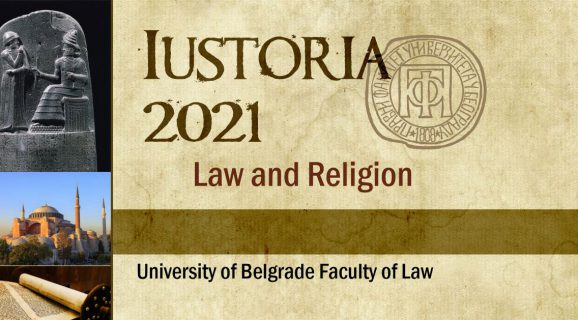
The University of Belgrade Faculty of Law is now receiving paper proposals for the Second student conference on legal history – the Iustoria 2021, to be held on the 25th and 26th of March, 2021, its topic being “Law and Religion”

The reason for the topic is the fact that this year marks the 100th anniversary of the adoption of the Vidovdan (St. Vitus’ Day) Constitution of the Kingdom of Serbs, Croats and Slovenes (1921), which, among many other changes, was the first in this region to introduce multi-confessionalism instead of one state religion. The question of the relationship between the state and the church and the position of different religious denominations in the modern state is certainly still relevant today; however, the connection between law and religion has lasted since time immemorial. The emergence of the first norms of primitive law is predominantly related to religious commandments and taboos. Most legal systems of the Antiquity have noticeable connections with religion – from irrational means of proof such as ordeals and oaths, through contractualformalism in the old ius civile, to special regulations on the position of the clergy. Monotheistic religions bring with them a different view of society and law, and many new topics, such as the relationship between secular and religious regulations, the influence of religious norms on everyday social relations (especially marital and family relations) or the punishment of crimes against religion. In all societies, one can speak to a greater or lesser extent about the issue of the legal position of members of other religions, but it is monotheism, together with numerous religious conflicts and schisms, that intensifies this issue. The colonial expansion of the Western powers also raises the question of the attitude of (Christian) colonizers towards the religions of the conquered population. And the modern age also brings states that separate themselves from religion – whether it is a matter of distancing in the form of secularism, or a conflict characteristic of communist states. We’re looking forward to applications on all of these and many other issues related to the main topic!

All students of graduate and post-graduate studies pertaining to law or other humanities are eligible to apply for the conference. The applications should contain basic personal information (name and surname, faculty, department, level and year of study), along with an extended abstract containing anywhere between 500 and 1000 words. Applications are accepted in either Serbian or English.

The applications should be e-mailed to iustoria@ius.bg.ac.rs before the 15th of January, 2021. The students will be informed by the 25th of January whether or not their application has been accepted. A provisional programme for the conference will be announced by the 1st of February. Drafts of the chosen papers need to be sent by the 15th of March. For any additional information you may enquire at the same e-mail address, or consult the official Facebook page of the conference – https://www.facebook.com/iustoria/

Just like on last year’s conference, apart from the presentations given by their colleagues, the students at the conference will have an opportunity to attend several lectures given by renowned experts – more details on this will be available in the final version of the programme.

Given the fact that the situation with the COVID-19 pandemic is still uncertain, we will make a decision by the 25th of February whether the conference will be held live or online. If it is held live, we’ll do our best to secure accomodations either in student dorms or with student host families for those participants who don’t reside in Belgrade. These arrangements will depend on the number of available spots.

The final versions of the papers presented at the conference, with final changes and corrections submitted within a reasonable time after the conference, will be submitted for publication in the journal „Vesnik pravne istorije / Herald of Legal History“.Herald of Legal History”.


More info here

06 April 2020

POSTPONED: First Student Conference on Legal History Iustoria (New Date: 14-15 October 2020, Belgrade) (NEW DEADLINE: 31 May 2020)


The Iustoria Student Conference on Legal History has been postponed until October 2020, as a result of the coronavirus epidemic. The organizers have also reopened the call for papers until end of May 2020. More information about the conference (theme: Law Codes and Women) can be found here.

12 December 2019

CALL FOR PAPERS: First Student Conference on Legal History Iustoria 2020 (Belgrade, 25-26 March 2020) (DEADLINE: 15 January 2020)


We learned that the University of Belgrade Faculty of Law is receiving paper proposal for its first student conference on legal history. Here the call:

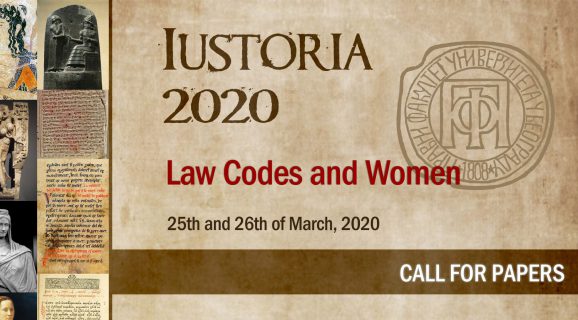
The University of Belgrade Faculty of Law is now receiving paper proposals for the First student conference on legal history – the Iustoria 2020, to be held on the 25th and 26th of March, 2020, its topic being “Law Codes and Women”.

The choice of this subject stems from an anniversary – this year marks the 175th anniversary of the Serbian Civil Code (1844), and one of the most heavily debated issues during its creation was precisely the regulation of the position of women: a woman’s right to inherit, her role in the family, the legal capacity of a married woman… Without a doubt, dilemmas such as these were present in the minds of other creators of civil codes pertaining to the 19th and the beginning of the 20th century – however, this is but a small portion of the issues that fall under the realm of this conference. What was the status of women as perpetrators – or victims – of crimes in criminal codes? What was the procedural status of women as parties in lawsuits or as witnesses? Did commercial codes contain special rules for women merchants? When we move further into the past, the very presence of norms that are concerned with the status of women in the legal codes of the Antiquity and the Middle Ages tells us a lot about their position in society, and many laws contain specific and original institutions that deserve scholarly attention. In recent history we could divert our attention to women as lawmakers, and analyse their influence on modern codes of law. We are looking forward to proposals related to these and many other issues pertaining to the main subject!

All students of graduate and post-graduate studies pertaining to law or other humanities are eligible to apply for the conference. The applications should contain basic personal information (name and surname, faculty, department, level and year of study), along with an abstract containing anywhere between 500 and 1000 words.

The applications should be e-mailed to iustoria@ius.bg.ac.rs before the 15th of January, 2020. The students will be informed by the 25th of January whether or not their application has been accepted. A provisional programme for the conference will be announced by the 1st of February. Drafts of the chosen papers need to be sent by the 15th of March. For any additional information you may enquire at the same e-mail address, or consult the official Facebook page of the conference – https://www.facebook.com/iustoria

Apart from the presentations given by their colleagues, the students at the conference will have an opportunity to attend several lectures given by renowned experts – more details on this will be available in the final version of the programme.

As a general rule, the participants who do not reside in Belgrade are expected to cover the travelling and accomodation expenses by themselves. Exceptionally, there is a possibility of securing accomodations either at the student dorms or with student host families for those students who are unable to finance their stay at Belgrade. These arrangements will depend on the number of available spots.

The final versions of the papers presented at the conference, with final changes and corrections submitted within a reasonable time after the conference, will be published in the first issue of the future student journal for legal history!

More info here