Search

Showing posts with label sociology of law. Show all posts

05 May 2026

BOOK: David SCHNEIDERMAN, A Sociology of International Investment Law. Themes from Max Weber [The History and Theory of International Law, eds. Anthony PAGDEN, Francesca IURLARO, Nehal BHUTA & Benjamin STRAUMANN] (Oxford: OUP, 2026), 240 p. ISBN 9780198982708, 105 GBP [OPEN ACCESS]


(image source: OUP)

Abstract:
A Sociology of International Investment Law applies methods associated with the sociologist Max Weber to illuminate aspects of international investment law - a regime made up of thousands of treaties that protect foreign investors from state action diminishing the value of their investments. By applying many of Weber's key themes associated with legal modernity - legitimacy, rationality, domination, bureaucracy, and charisma - the book conscripts tools of analysis that enable the testing of many of investment law's operating assumptions. A Sociology of International Investment Law Law is premised on the belief that theory informs practice and that enlisting aspects of Weber's work illuminates the contemporary practice of, and debates over, international investment law. Utilizing Weber's themes and methods, results in a deeper appreciation of the connections of international investment law has with classical social theory. The book also reveals how the field fails to measure up to many of the analytical challenges that Weber's sociological interventions provoke. This book offers an exploration of the commonalities, differences, and blind spots shared by this relatively new international legal field with one of the most influential theorists of modernity.

On the author:

David Schneiderman is Professor of Law and Political Science (courtesy) at the University of Toronto where he teaches courses on Canadian and US constitutional law, comparative constitutional law, and international investment law. He is a prolific author of articles, book chapters and books, including, Constitutional Review and International Investment Law: Deference or Defiance? 

Read more here.


12 May 2020

BOOK: Maxime SAINT-HILAIRE, Les positivismes juridiques au XXe siècle. Normativismes, sociologismes, réalismes [Dikè] (Laval: Presses universitaires de Laval, 2020), 100 p. ISBN 9782763748795, 24$

(image source: PU Laval)

Book abstract:
Qu’est-ce que le positivisme? Le positivisme juridique en est-il une déclinaison? Sinon, quels rapports celui-ci entretient-il avec celui-là? Du reste, faut-il parler « du » ou « des » positivismes juridiques? Quels sont les enjeux politiques de l’adoption de la position positiviste ou d’une position positiviste donnée par le juriste? En focalisant sur le xx e siècle où la pensée juridique a pour ainsi dire éclaté, ce livre ambitionne de répondre à ces questions par la thèse selon laquelle il n’a pas existé un, mais plusieurs positivismes juridiques, certains concevant le droit comme un fait, d’autres comme une norme; certains adoptant une position explicative ou descriptive, d’autres une position normative. Leur examen sera l’occasion d’une évaluation des tentatives d’étude du droit comme fait ainsi que d’une interrogation sur le rapport du droit à l’État. Se poseront alors la question du pluralisme juridique et de sa relation avec l’idéal de l’État de droit et celle de l’intérêt d’adopter une nouvelle grille de lecture de l’histoire de la philosophie du droit.
(source: PU Laval)

28 October 2019

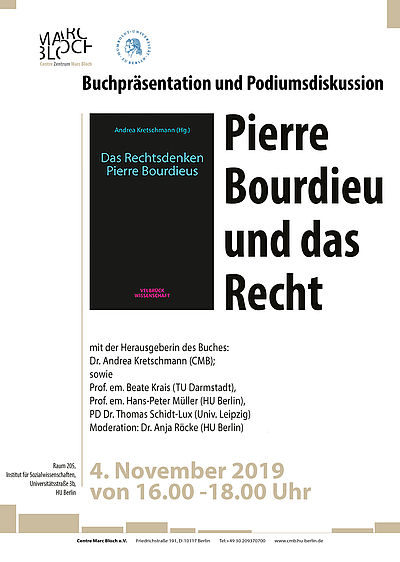
BOOK PRESENTATION: Andrea KRETSCHMANN (Hrsg.), Pierre Bourdieu und das Recht (Berlin: Institut für Sozialwissenschaften der HU Berlin, 4 NOV 2019)

(image source: Centre Marc Bloch)

Editor:
Andrea Kretschmann (Centre Marc Bloch) ist Wissenschaftliche Mitarbeiterin und Co-Leiterin des Forschungsschwerpunkts »Theorie und Praxis des Politischen« am deutschfranzösischen Forschungsinstitut Centre Marc Bloch (An-Institut der Humboldt-Universität zu Berlin). Ihre Forschungsschwerpunkte liegen im Bereich der Rechts- und Kriminalsoziologie und der soziologischen Theorie. 2016 erschien bei Velbrück Wissenschaft ihre Dissertationsschrift »Regulierung des Irregulären. Carework und die symbolische Qualität des Rechts«.
Round table participants:
Prof. em. Beate Krais (TU Darmstadt) Prof. em. Hans-Peter Müller ( HU Berlin) PD Dr. Thomas Schidt-Lux ( Univ. Leipzig) Moderation: Dr. Anja Röcke (HU Berlin)
Book abstract:
Pierre Bourdieu zählt zu den bedeutendsten und einflussreichsten Soziologen des 20. Jahrhunderts; gegenwärtig ist er der meistzitierte Sozialwissenschaftler der Nachkriegszeit. Innerhalb der Rechtssoziologie und der sozialwissenschaftlichen Rechtsforschung wird diese Bedeutung bislang zu wenig wahrgenommen, denn im Vergleich zu anderen soziologischen Klassikern wird Bourdieus Perspektive auf das Recht kaum rezipiert. Eine systematische, gerade auch kritische Auseinandersetzung mit seinem Rechtsdenken im Kontext seines übrigen Werks, aber auch im Kontext anderer Rechtstheorien, bildet vor diesem Hintergrund ein Forschungsdesiderat. Der Sammelband stößt daher eine vertiefte Auseinandersetzung mit Bourdieus Rechtsdenken an und lotet dessen Potenziale aus. Neben einschlägigen Texten Bourdieus, die erstmals in deutscher Sprache zugänglich gemacht werden, versammelt er sozialtheoretische und an Bourdieus Rechtsdenken angelehnte empirische Beiträge. Das Buch richtet sich an RechtssoziologInnen aus der Soziologie und der Rechtswissenschaft sowie an sozialwissenschaftlich orientierte RechtsforscherInnen anderer Disziplinen. Ebenso adressiert es SoziologInnen und SozialwissenschaftlerInnen, die sich mit Bourdieus Werk beschäftigen. 
(source: Centre Marc Bloch)
(more information with the publisher)

22 April 2015

COLLOQUIUM: "Critique sociale et critique sociologique du droit en Europe et aux Etats-Unis: le "Moment 1900" (Paris 29-30 May 2015)


WHAT Critique sociale et critique sociologique du droit en Europe et aux Etats-Unis: le "Moment 1900", colloquium

WHEN 29-30 May 2015

WHERE Paris, Université Paris 2 - Panthéon-Assas, Centre de Droit public comparé (CDPC EA n°7320)
all information here
Présentation
«Autour de 1900, la 'méthode juridique' a fait l'objet de vives controverses dans le monde occidental. De nombreuses approches critiques du droit ont dénoncé la cécité du formalisme juridique à l'égard des réalités individuelles et sociales. Elles furent entendues, elles ont changé nos méthodes de penser le droit et, aujourd'hui encore, elles interrogent nos théories et nos pratiques, nos doctrines et nos jurisprudences».

12 February 2015

JOURNAL: Traces. Journal of Humanities nr. 27/2, 2014: Thinking with Law


Tracés. Revue de Sciences Humaines (ENS Éditions) published its latest issue on "Thinking with law".

Presentation:
Confronted with lawyers’ long cherished postulate of the autonomy of law and and of its utter « isolation » from the social world, social scientists have often been deterred from investigating legal thought as such. On the other hand, law faculties – particularly French ones —have proved rather reluctant to take up insights from sociology, anthropology and history into their curriculums. However, the last two decades have been witness to significant changes. Setting foot on legal soil, an increasing number of adventurous social scientists have tackled issues regarding both the social uses of law and the technicalities of its machinery. This issue of Tracés gives a snapshot of this changing relationship between law and the social sciences, thereby hinting at promising new prospects for research. Several papers examine how critical thinking has profited from defining law not as a mere instrument of domination, but also as a resource for defining, analysing and occasionally opposing a given situation. Other papers show this shift of perspective to be contingent on a better command of legal operations — e.g. legal fictions or legal qualifications — by social scientists and on their specific understanding of legal reasoning. Getting a better grasp of law might therefore require two tasks: first, combining an attention to the political uses of law with an analysis of the lawyers’ paraphernalia of formal and technical devices; secondly, discriminating more acutely between different types of normativity, in other words offering a comparative history of legal concepts and legal evolution.
 Contents:
"Droit et sciences sociales : les espaces d’un rapprochement" (Guillaume Calafat, Arnaud Fossier & Pierre Thévenin)

"Comment la sociologie peut déplier le droit" (Arnaud Esquerre)

"Peut-on dépasser le droit civil ? Les controverses juridiques autour de la réparation des dommages de guerre (1914-1919)" (Guillaume Richard)

"Le code en tant qu’accomplissement pratique. Respécification ethnométhodologique et cas d’étude égyptien" (Baudouin Dupret)

"L’invention du droit en Occident. Une lecture d’Aldo Schiavone" (Thibaud Lanfranchi)

"Le droit au service de l’égalité ? Comparaison des sociologies du droit de la non-discrimination française et états-unienne" (Vincent-Arnaud Chappe)

"Gender and judging, ou le droit à l’épreuve des études de genre" (Arthur Vuattoux)

"Les droits de l’homme : un cas limite pour le positivisme juridique" (Anna Zielinska)

"Du droit comme discours et comme dispositif" (Sonia Desmoulins-Canselier)

"John Dewey et l’expérience du droit. La philosophie juridique à l’épreuve du pragmatisme " (Liora Israël et Jean Grosdidier)

"Gouvernement-manageur et citoyens-consommateurs. Le cas du Criminal Justice Act 1991" (Nicolas Lacey)

"Indisponibilité, service public, usage. Trois concepts fondamentaux pour le « commun » et les « biens communs" (Paolo Napoli)

"Le droit en situation. Entretien avec Pierre Lascoumes" (Guillaume Calafat/Arnaud Fossier)

More information (fulltext-acces to the introductory article, abstracts) on revues.org or cairn.info (fulltext for subscribers).