Search

Showing posts with label law & politics. Show all posts

19 November 2024

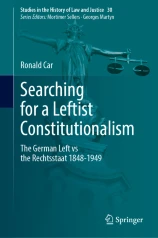
BOOK: Ronald CAR, Searching for a Leftist Constitutionalism. The German Left vs. the Rechtsstaat 1848-1949 [Studies in the History of Law and Justice, 30, eds. Mortimer SELLERS & Georges MARTYN] (Heidelberg: Springer, 2024), VI + 208 p. ISBN 978-3-031-62097-3, € 148,39


(image source: Springer)

Abstract:
Is there a viable leftist constitutionalism that we can juxtapose with liberal constitutionalism, or is there really no alternative? If the left is considered an a priori enemy of the principle of the rule of law, the equal chance condition proves illusory. Accordingly, those asking for changes to social institutions will deem constitutionalism undemocratic. Hence, in our times of silent de-constitutionalization at the global level and rising populism and democratic backsliding at the national level, this book offers a valuable opportunity to reconsider one of the founding principles of liberal constitutionalism, the Rechtsstaat. It re-examines the controversies that accompanied the affirmation of the concept in a long-term perspective, from 1848 to the post-World War II constitutional debates. Since 1848 the German left has challenged the dominant liberal view of legitimacy, mainly by adopting Marx’s critique of the ideology of law and the state. Thus, the left has had to challenge not only the established order, but also the mainstream political and legal culture generated by the liberal discourse on rights. In search of constitutional viability, the left has oscillated between two tendencies. On the one hand, it has denounced the discourse on rights as an ideological smokescreen used by the ruling class to keep us from paying more attention to the actual level of democracy within the parties, the governmental bodies and in everyday social relations. On the other hand, the left has attempted to adjust its platform to the mainstream idea of constitutional legitimacy by devising its own sozialer Rechtsstaat. However, the break-even point has proven hard to find. If the acceptance of liberal principles was seen as less than wholehearted, leftist constitutional proposals aroused suspicions of a coverup for an unconstitutional rule (Unrechtsstaat). On the other hand, when the left has accepted liberal constitutional principles in full, its potential to challenge the social status quo has ultimately proven to be disappointing. The controversy culminated in a desperate and largely unknown attempt to devise a constitutional compromise between Liberalism and Socialism in East Berlin in the wake of the Cold War. Although doomed to fail and devoid of democratic credibility, the debates of the East German constitutional commission in 1948 offer important insights into a century of experiences, trials and errors in constitution-making seen from the leftist perspective.

Read more here: DOI 10.1007/978-3-031-62098-0.


10 November 2020

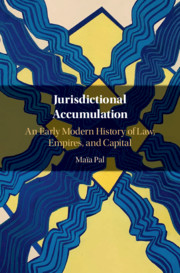
BOOK: Maia PAL, Jurisdictional Accumulation - An Early Modern History of Law, Empires, and Capital (Cambridge: Cambridge University Press, 2020). ISBN 9781108497206, 85.00 GBP.


(Source: CUP)

Cambridge University Press is publishing an early modern history of law, empires and capital.

ABOUT THE BOOK

The majority of European early modern empires – the Castilian, French, Dutch, and English/British – developed practices of jurisdictional accumulation, distinguished by the three categories of extensions, transports, and transplants of authority. This book is concerned with various diplomatic and colonial agents which enabled the transports and transplants of sovereign authority. Through historical analyses of ambassadors and consuls in the Mediterranean based on primary and secondary material, and on the empires' Atlantic imperial expansions and conquests, the book makes a major analytical contribution to historical sociology. As an interdisciplinary exercise in conceptual innovation based on a Political Marxist framework and its concept of social property relations, the book goes beyond common binaries in both conventional and critical histories. The new concept of jurisdictional accumulation brings ambassadors, consuls, merchants, and lawyers out of the shadows of empire and onto the main stage of the construction of modern international relations and international law.

ABOUT THE AUTHOR

Maïa Pal, Oxford Brookes University

Maïa Pal is Senior Lecturer in International Relations, Department of Social Sciences, Oxford Brookes University.

TABLE OF CONTENTS

1. Early Modern Extraterritoriality

2. Historical sociology, Marxism, and law

3. Social property relations

4. Ambassadors

5. Consuls

6. Colonial practices of jurisdictional accumulation

7. Analytical crossroads: Dominium, consuls, and extraterritoriality

8. Conclusion

Index.


More info here

BOOK: Emmanuelle CRONIER & Benjamin DERUELLE (Eds.), Argumenter en guerre. Discours de guerre, sur la guerre et dans la guerre de l'Antiquité à nos jours (Villeneuve d'Ascq: Presses Universitaires du Septentrion, 2019). ISBN: 102757424580, pp. 420, € 28,00


ABOUT THE BOOK

L'art de l’argumentation ne cède pas ses droits en situation de guerre. Au contraire, la préparation des conflits, la conduite des opérations et la reconstruction de la paix sont d’intenses moments de persuasion, de négociation et de confrontation dans lesquels l’art oratoire occupe toute sa place. Fruit d’une collaboration active entre historiens et juristes, cet ouvrage propose, au travers d’un parcours s’étendant de la guerre antique aux conflits contemporains, une réflexion riche, passionnante et novatrice sur les usages et les fonctions du discours en situation de conflit armé. Il nous transporte des plaines du Péloponnèse et de l’Italie romaine au Tribunal international, en passant par les guerres d’Attila et des ducs de Bourgogne, par les conflits religieux et de la monarchie absolue des temps modernes, ou encore par les guerres de sécessions et les deux conflits mondiaux. S’y découvrent alors les modalités et les enjeux de la parole en guerre, qu’il s’agisse de justifier ou de contester l’engagement, la violence ou les buts de guerres ; de convaincre les autorités politiques et l’opinion publique d’entrer dans le conflit ou les combattants de sacrifier leur vie ; ou encore d’implorer le pardon et de réparer des exactions, mais aussi de s’emparer de la gloire d’une victoire ou de repousser la honte d’une défaite.

ABOUT THE EDITORS

Emmanuelle Cronier est maîtresse de conférences en histoire contemporaine à l'Université de Picardie-Jules Verne et chercheuse au Centre d’Histoire des Sociétés, des Sciences et des Conflits (CHSSC, EA4289).

Benjamin Deruelle est professeur d'histoire moderne à l’Université du Québec à Montréal. Agrégé d’histoire et docteur de l’Université Paris 1 Panthéon-Sorbonne, il est chercheur à l’IRHIS (Institut de Recherches Historiques du Septentrion UMR 8529-CNRS-Université de Lille).

TABLE OF CONTENTS

Introduction

Emmanuelle Cronier & Benjamin Deruelle

Partie 1

Dire, justifier, contester la guerre

Justifier ou restreindre la violence de la guerre : arguments juridiques et arguments moraux dans l'Antiquité tardive

Hervé Huntzinger

Justifier et légitimer l’engagement : la guerre de Candie (1645-1669) et la France

François Pugnière

L’argumentation juridique dans les guerres de sécession

Emanuel Castellarin

Les arguments juridiques contemporains de l’intervention en guerre

Marie-Clotilde Runavot

Partie 2

Convaincre, adhérer, mobiliser

Quand les femmes parlent de la guerre : le dossier des apophtegmes laconiens

Jean-Manuel Roubineau

La guerre, ultima ratio des ducs de Bourgogne ? Argument guerrier et autorité du prince législateur (fin XIVe – début XVe siècle)

Jean-Baptiste Santamaria

L’argument de la guerre dans la négociation fiscale, le cas valdôtain au XVIIe siècle

Julien Alerini

Monarchie absolue et monarchie limitée face à la guerre : les stratégies argumentatives françaises et anglaises à la fin du XVIIe siècle

Solange Rameix

Illustrer ou persuader ? 

Schémas et dessins dans la réflexion militaire de la France des Lumières

Arnaud Guinier

Le théâtre de la guerre révolutionnaire : Cris, harangues et discours des généraux à l’armée des Pyrénées orientales (1793-1795)

Laurent Cuvelier

Partie 3

Argumenter au cœur du combat

Argumenter en plein combat : 

Formes et fonctions de l’exhortation au combat dans les batailles rangées romaines à la fin de la République

Xavier Lapray

Le contrôle de la parole dans la cité assiégée selon Énée le Tacticien (IVe siècle av. J.-C.)

Jonathan Andujar & Christian Bouchet

Argumenter en guerre civile : les partis de la guerre et de la paix au Conseil du roi pendant les premières guerres de Religion (1563-1570)

Antoine Rivault

Haranguer ses capitaines ? 

Le duc de Guise, chef de guerre et stratège de mots à Châlons-en-Champagne (26 mars 1585)

Xavier Le Person

Le Mercure François entre en guerre

Virginie Cerdeira

La déportation de civils en vue du travail forcé – le discours normatif de l’occupant allemand, d’une guerre à l’autre

Michel Erpelding

Partie 4

Mémoire, appropriation et droit

« Poure compaignon de guerre » ou « meschant homme » ? 

La représentation du soldat dans les lettres de rémission des ducs de Bourgogne (1386-1482)

Quentin Verreycken

L’affaire d’Hastenbeck, la relation de bataille en tant qu’instrument de diffamation

Antoine Roussel

L’œuvre de mémoire en Europe après la Seconde Guerre mondiale : l’appropriation de la Guerre par le Droit

Marion Larché

Conclusion

Émilie Dosquet

Les auteurs

Résumés

Index


More information with the publisher.

09 November 2020

BOOK: Joris VAN DEN TOL, Lobbying in Company - Economic Interests and Political Decision Making in the History of Dutch Brazil, 1621–1656 (Leiden-New York: Brill, 2020). ISBN 978-90-04-39795-8, 107.00 EUR


(Source: Brill)

Brill has published a new book on political lobbying and decision-making in Dutch Brazil.

ABOUT THE BOOK

In Lobbying in Company, Joris van den Tol argues that people made a difference in the Dutch West India Company colony in Brazil (1630–1654). Through a combination of petitions, personal relations, and public opinion, individuals were able to exercise influence on the decision-making process regarding Dutch Brazil. His thorough analysis of these different elements offers a new perspective on the Atlantic and the Dutch Republic in the seventeenth century as well as a better understanding of lobbying in the early modern period.

ABOUT THE AUTHOR

Joris van den Tol (Ph.D., Leiden 2018) is a visiting postdoctoral scholar at Harvard’s History Department on a NWO Rubicon fellowship. He has published on petitions in relation to the colonies in Brazil, New Netherland, and Taiwan and on smuggling.

TABLE OF CONTENTS

Introduction


1 Lobbying for the Creation of the WIC

1 The Dutch Republic

 1.1 The Cities

 1.2 Provincial States

 1.3 States General

 1.4 The Stadtholders

 1.5 Conflicting Powersbr/> 2 The West India Company

 2.1 Willem Usselincx

 2.2 The Layout of the WIC

3 Brazil

4 Conclusion


2 Lobbying in Brazil

1 1624/1630–1636: Ad Hoc Solutions

2 1637–1646: Consolidation and a Prince in the Tropics

 2.1 The Diet as a Colonial Tool

 2.2 The Brazilian Diet of 1640

 2.3 The 81 Petitions of August 1640

 2.4 Petitions for Regulations

3 Religious Affairs

 3.1 The Power of the Church

4 Slavery

 4.1 Access to Institutions for Non-European

5 The Possible Consequence of Top-Down Decision Making

 5.1 Johan Maurits’ Reaction

 5.2 The Reactions from the Council of Justice and the Ministers

6 Conclusion


3 Trading Regulations or Free Trade

1 The Opening Moves

2 Selecting the Playing Field

3 Making It Count

4 Making It Count Even More

5 The Role of the Amsterdam City Council

6 Delaying a Decision

7 Lobbying to and from the Colony

8 Conclusion


4 Petitioning the Public Sphere

1 What Is the Public Sphere?

2 The Dutch Public Sphere  2.1 Pamphlets and Dutch Brazil

3 Petitions and Public Opinion

 3.1 Printed Petitions

4 Multiple Signatures on Petitions

 4.1 Group Petitions to the States General

5 Managing Information of the Revolt in Brazil

6 Petitioning the Public Sphere on Brazil

7 Petitioning the Public Sphere on the Atlantic

 7.1 Other Forms of Signatures

8 Conclusion


5 Personal Connections and Direct Lobbying

1 Personal Connections and Societal Capital

2 Appointing a New High Government in Brazil

3 Background Issues

 3.1 Peace Negotiations in Münster

 3.2 A Frisian Chamber in the WIC

4 Information Control

5 Personal Relations

6 Conclusion


6 The Last Hope, 1652–1654

1 The Second Battle of Guarapes

2 Why Was Brazil Lost?

3 The Delegates from Brazil

4 Requesting a Resolution from the States General

5 A Delegation to Friesland

 5.1 The Report from the Friesland Commission

6 Accelerating the Admiralties

7 Seizing Momentum

8 Planning for the Future

9 It Is All about the Money

 9.1 It Is about the People

10 The Loss of Brazil

11 Conclusion


7 Lobbying for Money in the Aftermath of Dutch Brazil

1 Return to the Republic

2 Claiming Wages

3 Travel Pennies

4 Shared Features

5 The Printed Petition from the Army

6 Conclusion


8 Making the Company Work


Appendix A – Free Trade Exports from Brazil in 1637

Manuscript Sources

Secondary Literature and Published Sources

Index


More info here