Search

Showing posts with label investment law. Show all posts

02 March 2021

BOOK: Nicolas PERRONE, Investment Treaties and the Legal Imagination (Oxford: OUP, 2021). ISBN 9780198862147, 80.00 GBP


(Source: OUP)

Oxford University Press has published a new book on the history of international investment law.

ABOUT THE BOOK

Foreign investors have a privileged position under investment treaties. They enjoy strong rights, have no obligations, and can rely on a highly efficient enforcement mechanism: investor-state dispute settlement (ISDS). Unsurprisingly, this extraordinary status has made international investment law one of the most controversial areas of the global economic order.

This book sheds new light on the topic, by showing that foreign investor rights are not the result of unpredicted arbitral interpretations, but rather the outcome of a world-making project realized by a coalition of business leaders, bankers, and their lawyers in the 1950s and 1960s. Some initiatives that these figures planned for did not emerge, such as a multilateral investment convention, but they were successful in developing a legal imagination that gradually occupied the space of international investment law. They sought not only to set up a dispute settlement mechanism but also to create a platform to ground their vision of foreign investment relations. Tracing their normative project from the post-World War II period, this book shows that the legal imagination of these business leaders, bankers, and lawyers is remarkably similar to present ISDS practice. Common to both is what they protect, such as foreign investors' legitimate expectations, as well as what they silence or make invisible. Ultimate, this book argues that our canon of imagination, of adjustment and potential reform, remains closely associated with this world-making project of the 1950s and 1960s.

ABOUT THE AUTHOR

Nicolás M. Perrone, Research Associate Professor, Universidad Andres Bello, Viña del Mar, Chile

Nicolás M Perrone is a Research Associate Professor at Universidad Andrés Bello, Chile. He has previously taught at Durham University and Universidad Externado de Colombia. Nicolás has been Visiting Professor at Universidad Nacional de San Martín, the International University College of Turin, and Università del Piemonte Orientale, a faculty member of the Institute for Global Law and Policy (Harvard Law School) and a Visiting Lecturer at Xi'an Jiaotong School of Law. Nicolás has also consulted for the OECD, and worked as a legal fellow for UNCTAD.

TABLE OF CONTENTS

Introduction: A Legal Imagination

1:Foreign Investor Rights and Investment Relations

2:The Norm Entrepreneurs of the 1950s and 1960s

3:Competing Imaginaries and the 1970s

4:The Rise of Investment Treaties and ISDS in the 1990s and Since

5:ISDS in Action

6:Givings and ISDS

7:Local Communities and ISDS

Conclusion: Towards a New Legal Imagination


More info here

04 June 2020

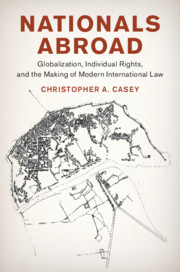
BOOK: Christopher A CASEY, Nationals Abroad: Globalization, Individual Rights, and the Making of Modern International Law (Cambridge: Cambridge University Press, 2020). ISBN 9781108489454, £ 29.99


(Source: CUP)

Cambridge University Press is publishing a new book on the history of international business interests and the creation of the international human rights regime in the late 19th and 20th century.

ABOUT THE BOOK

It is a fundamental term of the social contract that people trade allegiance for protection. In the nineteenth century, as millions of people made their way around the world, they entangled the world in web of allegiance that had enormous political consequences. Nationality was increasingly difficult to define. Just who was a national in a world where millions lived well beyond the borders of their sovereign state? As the nineteenth century gave way to the twentieth, jurists and policymakers began to think of ways to cut the web of obligation that had enabled world politics. They proposed to modernize international law to include subjects other than the state. Many of these experiments failed. But, by the mid-twentieth century, an international legal system predicated upon absolute universality and operated by intergovernmental organizations came to the fore. Under this system, individuals gradually became subjects of international law outside of their personal citizenship, culminating with the establishment of international courts of human rights after the Second World War.

ABOUT THE AUTHOR

Christopher A. Casey, University of California, Berkeley: Christopher A. Casey received his BA, MA, PhD, and JD at the University of California, Berkeley.

TABLE OF CONTENTS

Introduction
Part I .Mise en scène: The International Legal World, 1850-–1914:
1. The Walls of Gilgamesh
2. Making Nations, Breaking Nationality
Part II. Mise en scène: The International Legal World, 1919-–1939:
3. Sovereign Nations
4. Sovereign Persons
5. Sovereign Commerce
Part III. Mise en scène: The International Legal World, 1945-–Present:
6. Cosmopolitans and Capitalists
Conclusion

More info here

11 June 2019

BOOK: Prabhash RANJAN, India and Bilateral Investment Treaties: Refusal, Acceptance, Backlash. (Oxford: Oxford University Press, 2019). ISBN 9780199493746, $65.00


(Source: OUP)

Oxford University Press is publishing a book dealing with the history of bilateral investment treaties (BITs) in India.

ABOUT THE BOOK

Many countries have started contesting international investment treaties that allow foreign corporations to sue sovereign States for alleged treaty breaches at international arbitration fora. This contestation has taken the form of either countries terminating their investment treaties or walking out of the investor-State dispute settlement (ISDS) system. India has also jumped on the contestation bandwagon. As a consequence of being sued by more than 20 foreign investors, India terminated close to 60 investment treaties and adopted a new model bilateral investment treaty (BIT) purportedly to balance investment protection with the host State's right to regulate. This book studies critically India's approach towards BITs by tracing its origin, evolution, and the current state of play. The book does so by locating it in India's economic policy in general and policy towards foreign investment in particular. India's approach towards BITs and its policy towards foreign investment were consistent with each other in the periods of economic nationalism (1947-1990) and economic liberalism (1991-2010). However, post 2010, India's approach to BITs has become protectionist while India's foreign investment policy continues to be liberal. In order to balance investment protection with the State's right to regulate, India needs to evolve its BIT practice based on the twin framework of international rule of law and embedded liberalism.

ABOUT THE AUTHOR

Prabhash Ranjan, Assistant Professor, Faculty of Law, South Asian University

Prabhash Ranjan teaches at the Faculty of Law, South Asian University, New Delhi.

TABLE OF CONTENTS

Foreword 
Acknowledgements 
1. Introduction
Phase I: Refusal 
2. Economic Nationalism: Refusal to Bilateral Investment Treaties
Phase II: Acceptance 
3. Economic Liberalism: Embracing Bilateral Investment Treaties
4. India's BITs: Mapping the Acceptance I
5. Mapping the Acceptance II
Phase III: Backlash 
6. BITs Come Home to Roost but No Philip Morris Moment Yet!
7. Mapping the Backlash: Once Bitten Many Times Shy!
8. The 2016 Indian Model BIT: Making the BIT Unworkable for Investors
9. Conclusion
Annexure 
Index 
About the Author

More information here

22 January 2019

BOOK: Antonio R. PARRA, The History of ICSID, 2nd ed. (Oxford: Oxford University Press, 2018). ISBN 9780198834083, $38.95


(Source: OUP)

Oxford University Press has recently published the paperback version of “The History of ICSID”

ABOUT THE BOOK

Now available in paperback, the second edition of The History of ICSID details the history and development of the International Centre for Settlement of Investment Disputes (ICSID) and its constituent treaty, the Convention on the Settlement of Investment Disputes between States and Nationals of Other States.

Antonio Parra, the first Deputy Secretary-General of ICSID, traces the immediate origins of the Convention, in the years 1955 to 1962, and gives a stage-by-stage narrative of the drafting of the Convention between 1962 and 1965. He recounts details of bringing the Convention into force in 1966 and the elaboration of the initial versions of the Regulations and Rules of ICSID adopted at the first meetings of its Administrative Council in 1967. The four periods 1968 to 1988, 1989 to 1999, 2000 to 2010, and 2011 to 2015 are covered in separate chapters which examine the expansion of the Centre's activities and changes made to the Regulations and Rules over the years. There are also overviews of the conciliation and arbitration cases submitted to ICSID in the respective periods, followed by discussions of selected cases and key issues within them. A concluding chapter discusses some of the broad themes and findings of the book, examines how ICSID might meet several large new challenges facing it, and outlines several possible further changes of its rules and procedures
The book offers unique insight into the establishment and design of ICSID, as well as into how the institution evolved and its relationship with the World Bank over the 50 years since the establishment of ICSID. It is essential reading for those involved in this field.

ABOUT THE AUTHOR

Antonio R. Parra, Consultant with the Corporate Secretariat of the World Bank

Antonio R. Parra served as the first Deputy Secretary-General of the International Centre for Settlement of Investment Disputes (ICSID) from 1999 to 2005 and was Legal Adviser at ICSID from 1990 to 1999. His earlier positions include Senior Counsel, ICSID; Counsel, Office of the Senior Vice President and General Counsel, World Bank; Counsel, Policy and General Affairs, World Bank; Assistant Legal Counsel, OPEC Fund for International Development; and Research Staffer, OPEC Secretariat. At the World Bank's Legal Vice Presidency and ICSID, Mr Parra worked on the establishment of the Multilateral Investment Guarantee Agency and the preparation of the World Bank Guidelines on the Treatment of Foreign Direct Investment. He is an Honorary Secretary-General of the International Council for Commercial Arbitration (having been Secretary General from 2004 to 2010) and a Fellow of the Chartered Institute of Arbitrators.

TABLE OF CONTENTS

1. Introduction
2. Origins of the Convention
3. Broches's "Working Paper"
4. The Preliminary Draft of the Convention
5. Finalizing the Text of the Convention
6. Establishment and Launch of the Centre
7. ICSID's First Two Decades
8. Aspects of the Early Cases
9. ICSID from 1989 to 1999
10. ICSID from 2000 to 2010
11. "The Premier International Arbitration Facility in the World"
12. Conclusion

More information here.

05 December 2018

BOOK: Jean HO, State Responsibility for Breaches of Investment Contracts (Cambridge: Cambridge University Press, 2018). ISBN 9781108415842, £ 95.00


Cambridge University Press has published a book on the history of the law of state responsibility for breaches of investment contracts.

ABOUT THE BOOK

There is a wealth of material that shapes the law of State responsibility for breaches of investment contracts. First impressions of an unsettled or uncertain law have thus far gone unchallenged. But unchallenged first impressions point to the need for a detailed study that investigates and analyses the sources, the content, the characteristics, and the evolution of this law. The argument at the heart of this monograph is that the law of state responsibility for breaches of investment contracts has carved a unique and distinct trajectory from the traditional route for the creation of international law, developing principally from arbitral awards, and mimicking, to a considerable extent, the general international law on the protection of aliens and alien property. This book unveils the remarkable journey of the law of state responsibility for breaches of investment contracts, from its origins, to its formation, to its arrival at the cusp of maturity.

Carves out the special law on investment contract protection from the general law of state responsibility, enabling participants and observers of international investment law to apply a bespoke body of rules to contractual disputes between foreign investors and host states
Explores unknown origins of contractual protection in international law through original archival research, showing how history exerts an important influence on the modern practice of investment contract protection

Discusses the future of investment contract protection from legal and political developments providing alternative perspectives on the legitimacy and longevity of international investment law

ABOUT THE AUTHOR

Jean Ho, National University of Singapore
Jean Ho, FCIArb, is Assistant Professor of Law at the National University of Singapore, where she lectures and supervises on diverse aspects of international investment law. Prior to academia, Dr Ho practiced in investor-state dispute settlement. She is a Member of the Investment Treaty Forum of the British Institute of International and Comparative Law, and an Expert on the UNIDROIT Working Group on Land Agricultural Investment Contracts. Dr Ho is also a co-author of International Investment Law and Arbitration: Commentary, Awards and Other Materials (Cambridge, 2018).

TABLE OF CONTENTS

1. Power and principle in the origins of contractual protection
2. Arbitral awards and the generation of international law
3. State responsibility and the core standard of treatment
4. State responsibility and expropriation
5. State responsibility and internationalisation
6. The emerging international law on investment contract protection
7. The future of international investment contract claims.
More information here

05 April 2018

SSRN: PAPERS: Daniel HULSEBOSCH on "Protecting Foreign Expectations in the Early US" and "Being Seen like a State"

(image source: Famously Dead)

The Legal History Blog signalled two new papers by Daniel J. Hulsebosch (NYU School of Law):

From Imperial to International Law: Protecting Foreign Expectations in the Early United Statesand appears in UCLA Law Review Discourse 65 (2018): 4-18:
This Essay argues that several principles associated with modern international investment law and dispute resolution arose in the wake of the American Revolution, as the revolutionaries and Britons sought to restructure trade relations, previously regulated by imperial law, under new treaties and the law of nations. They negotiated such problems as the currency in which international debts would be paid; the ability of foreign creditors pursue domestic collection remedies; whether creditors had to exhaust those remedies before their nation could resort to international arbitration; and the form of state-state arbitration of private disputes. The specific setting of these negotiations — the aftermath of a colonial settler revolution — narrowed the compass of disagreement, compared to many later postcolonial negotiations. In addition, the negotiations assumed that the exhaustion of national remedies remained the standard method of resolving private debt disputes. Notwithstanding these important differences, the principles and institutions developed after an imperial civil war influenced the development of international investment law.
 The second is Being Seen Like a State: How Americans (and Britons) Built the Constitutional Infrastructure of a Developing Nation, which appears in the William & Mary Law Review 59 (2018): 1239-1319:
This Article develops the argument that the Federal Constitution of 1787 was conceptualized, drafted, and put into operation not only for American citizens but also for foreign audiences. In a world without supranational governing institutions, a constitution — at least, the Federal Constitution — might serve to promote peaceable international relations based on reciprocal trade and open credit. That at least was the Enlightenment-inflected hope. Did it work? If early Americans engaged in constitution-making in large part to demonstrate their capacity for self-government, self discipline, and commercial openness to foreign audiences, did anyone notice? Or was it all, regardless of diplomatic purposes and consistent with the conventional account of the American Founding, just an intramural affair? This Article argues that many foreigners did notice, not least because some of them had participated in the process of reform. Although no foreigners intervened directly in drafting or ratification, international demands, incentives, and reactions shaped the way that leading American Framers pursued constitution making. After a “foreign ratification debate” that stretched into the first years of the Washington Administration, Britain normalized diplomatic relations with the United States and substantial capital investment followed. In 1791, the British Board of Trade approvingly analyzed the Constitution in a report designed to guide the Privy Council as it drafted instructions for its first official envoy to the United States. Within fifteen years, Britons were the largest holders of foreign investment in the United States, including state and federal “domestic debt,” or the restructured wartime certificates and loans that had floated the Revolution. In sum, Britons ultimately financed much of the project of American independence, and contemporaries believed that these credit relations would reduce, without eliminating, the prospect of renewed war.

05 December 2014

WORKSHOP: International Investment Law and History (Frankfurt, 13-14 March 2015)


The MPI for Comparative Public Law and International Law, the Johann-Wolfgang Goethe-University Frankfurt and the University of Glasgow's School of Law co-organize a workshop on International Investment Law and History on 13 and 14 March 2015.

As in previous years, the workshop will bring together academics and practitioners and provide them with a forum for open and frank exchanges. If you are interested in participating, please contact Sabine Schimpf, Merton Centre for European Integration and International Economic Order, University of Frankfurt, RuW, Grüneburgplatz 1, 60323 Frankfurt am Main, Germany.

The program can be found here. Speakers include Jörg Kammerhofer, Stephan Schill, Jochen von Bernstorff, Christian Tams and others. Two panels address historical cases of investment law, going back to the 19th century.

Source: International Law Reporter.