Search

Showing posts with label Law of the Sea. Show all posts

04 May 2026

REMINDER CALL FOR PAPERS: International Conference: Contested Seas. War, Commerce, and the Making of the Law of the Sea (c. 1400–1800) (Ostend: VUB/VLIZ, 19-20 NOV 2026) [DEADLINE 15 MAY 2026]

(Image source: VUB-CORE blog)


International Conference:

Contested Seas: War, Commerce, and the Making of the Law of the Sea (c. 1400–1800)


19-20 November 2026, Ostend, Belgium

Vrije Universiteit Brussel (VUB), Campus Ostend / Flanders Marine Institute (VLIZ)

Conveners:

Stefano Cattelan & Frederik Dhondt
(Vrije Universiteit Brussel – Faculty of Law and Criminology, Research Group CORE)

Keynote speakers

Surabhi Ranganathan (Lauterpacht Centre, University of Cambridge)
Indravati Félicité (Friedrich-Alexander-Universität Erlangen-Nürnberg)


Concept and Rationale: The early modern law of the sea did not emerge as a coherent or pacified body of rules. Rather, it took shape as a fragmented and deeply contested legal regime. It was forged through recurrent warfare, commercial rivalry, and persistent struggles over jurisdiction and enforcement at sea. The pelagic arena was characterised by overlapping jurisdictions, uneven enforcement, and profound asymmetries of power (Benton, 2010). The freedom of the seas (‘Mare Liberum’) did not operate as a stable peacetime principle. It was repeatedly restricted, negotiated, and redefined in moments of conflict, particularly through disputes concerning maritime jurisdiction, economic warfare, neutral navigation, and prize-taking.

Hence, several methodological questions arise. Can we chart the deeper structures and long-term evolutions of the law of the sea and, at the same time, remain historically grounded and relevant to contemporary debates?

Recent scholarship has challenged the idea that the law of the sea gradually restrained violence at sea. Instead, norms were forged, tested, and transformed through concrete conflicts over sovereignty, jurisdiction, and neutral navigation (e.g. Steinberg, 2001; Benton, 2010; Schnakenbourg, 2015; Calafat, 2019; Cattelan, 2025). This perspective invites a rethinking of the law of the sea not as a dependent variable of early modern conflict, but as one of its crucial products. The present conference builds on this emerging insight and seeks to explore its broader implications across different regions, actors, and legal contexts.

This conference invites contributions that approach the law of the sea as a historically produced normative regime, examined as (1) a body of legal argument, a set of institutional (2) practices, and a (3) field of political struggle. It seeks to foster dialogue across legal history, international law and the histories of ideas, diplomacy, warfare, and empire, bringing together scholars attentive to different sources, actors and objects (doctrine, archives, institutions, legal reasoning, institutional practice, and material interests). The conference situates the law of the sea within broader processes of state formation, imperial competition, and global connectivity, including its interaction with commercial and maritime legal practices (Félicité, 2024).

This conference takes a broad analytical perspective, to seal a series of three encounters organised under the aegis of FWO Junior Fundamental Research Project G016122N. While earlier meetings in this series focused primarily on neutrality as a legal status, diplomatic strategy, and social practice —particularly from the perspective of small and medium powers— the present symposium shifts the analytical focus: recurrent conflicts over neutrality, belligerent rights, maritime jurisdiction, and enforcement mechanisms did not merely test existing norms. These instances were crucial to the historical formation of the law of the sea as a contested legal regime. In this sense, neutrality is approached as a formative force in the making of the law of the sea across judicial, diplomatic, and commercial arenas.

The conference aims to offer a synthetic reinterpretation of the relationship between mare liberum and mare clausum, peace and war, neutrality and coercion, situating the early modern law of the sea within the longer history of international law without assuming linear trajectories or teleological outcomes. It also invites reflection on the enduring legacies of early modern maritime practices for later codification efforts and contemporary debates on ocean governance in an increasingly polycentric world (Mawani, 2023; Ranganathan, 2016, 2020).

Finally, the conference welcomes contributions addressing different maritime regions and circuits, including —but not limited to— the Mediterranean, Atlantic, and Indian Ocean worlds, as well as interactions between different legal orders and actors (Anand, 1983; Khalilieh, 2019; Subrahmanyam, 2024; Po, 2018). We particularly welcome contributions on cross-cultural legal encounters and concrete sites of norm production, such as courts, diplomatic practices, commercial litigation, port regulations, and contractual arrangements.


Key Questions

The conference invites contributions addressing one or more of the following questions:

  • What kind of legal regime was the early modern law of the sea?
    How can it be understood as a historically contingent and contested normative order rather than a coherent or stabilised body of rules?
  • How did warfare shape the law of the sea?
    In what ways did recurring conflicts over maritime jurisdiction, belligerent rights, neutrality, blockade, contraband, and prize-taking contribute to the production and transformation of legal norms at sea?
  • How was the law of the sea articulated, applied, and contested in daily practice?
    What roles did courts, diplomatic channels, port authorities, consular institutions, and commercial actors play in the everyday functioning of this legal regime?
  • How did neutrality operate as a formative force within the law of the sea?
    How were legal boundaries between peace and war at sea shaped by disputes and agreements involving neutral navigation?
  • How did individuals and non-state actors exercise legal agency at sea?
    The mobilisation of multiple normative orders —public, commercial, and customary by merchants, shipmasters, insurers, chartered companies, or private entrepreneurs — to pursue commercial, political, or strategic objectives is central here.
  • How did different connected spaces and regions shape a distinct legal practice?
    How did practices take shape across and between different maritime regions and circuits, including interactions between European and extra-European legal orders?
  • What are the longer-term implications of early modern practices of the law of the sea?
    How did early modern solutions and conflicts inform later codification efforts and continue to resonate in contemporary debates on ocean governance?


Thematic Areas (Indicative)

The following thematic areas, which constitute the thematic translation of the questions highlighted above, articulate different dimensions of the early modern law of the sea as a contested legal regime produced through conflict, commerce, and legal practice. They are intended to be read as analytically connected rather than as parallel or autonomous agendas. They are indicative rather than exhaustive.


1. The sea as a legal and spatial order

Maritime jurisdiction; territorial waters; ports, straits, and littoral zones; sovereignty and access; legal pluralism at sea; competing claims to control, passage, and enforcement.

2. War, commerce, and neutrality in the law of the sea

Naval warfare and economic conflict; blockade, contraband, and continuous voyage; prize-taking and adjudication; neutrality as legal status, diplomatic strategy, and practical resource; coercion, enforcement, and asymmetries between belligerents and neutrals.

3. Institutions and practices producing the law of the sea

Courts (including admiralty and prize courts); diplomatic correspondence; consular jurisdictions; port authorities and regulatory regimes; chartered companies; litigation, arbitration, and everyday legal practice. Contributions grounded in specific sources or sites of norm production are particularly welcome.

4. Agency and normative pluralism within the law of the sea

The role of individuals and non-state actors —such as merchants, shipmasters, insurers, private entrepreneurs, and colonial intermediaries— in mobilising a plurality of normative orders, including the law of nations, domestic legislation, commercial and maritime law, urban statutes, customary norms, and private contracts.

5. The law of the sea across regions, empires, and legal encounters

Comparative and transregional perspectives; interactions between European and extra-European legal orders; cross-cultural legal encounters; circulation, translation, and contestation of norms governing maritime space in different oceanic worlds.

6. From early modern practice to modern/contemporary ocean governance

Long-term continuities and ruptures in the law of the sea; armed neutrality and collective enforcement; early modern legacies in later codification efforts and contemporary debates on ocean governance.


Disciplinary Scope: The conference welcomes contributions from legal history, the history of international law, maritime and naval history, diplomatic and political history, economic history, and international law scholarship with a historical or theoretical orientation. Interdisciplinary, critical, and transregional approaches are particularly encouraged. Early-career researchers are warmly invited to submit proposals.

Format: The conference is conceived as a focused, discussion-oriented event. Draft papers will be circulated in advance to facilitate in-depth exchange. Presentations will be kept at 20 minutes for each speaker in order to prioritise collective discussion and comparative discussion.

Submission Guidelines: please submit an abstract of no more than 350 words and a short biographical note of up to 150 words to: stefano.cattelan@vub.be.
Submission deadline: 15 May 2026
Notification of acceptance: 1 June 2026
Draft papers (for pre-circulation among participants): 20 October 2026


Publication: Following the conference, selected contributions will be submitted to a special issue in an international peer-reviewed journal (preferably open access).

Practical Information: The organisers aim to secure funding to cover organisational costs and, where possible, to offer limited support for travel and accommodation, particularly for early-career researchers and scholars without access to dedicated research funds. Further practical information will be communicated to accepted participants.


Indicative references:

Alimento, Antonella (ed.), War, Trade and Neutrality: Europe and the Mediterranean in the Seventeenth and Eighteen Centuries (Milano, 2011).

Id., and Stapelbroek, Koen (eds.), The Politics of Commercial Treaties in the Eighteenth Century (Cham, 2017).

Anand, Ram P., Origin and Development of the Law of the Sea. History of International Law Revisited (The Hague/Boston/London, 1983).

Benton, Lauren and Perl-Rosenthal, Nathan (eds.), A World at Sea: Maritime Practices and Global History (Philadelphia, 2020).

Benton, Lauren, A Search for Sovereignty. Law and Geography in European Empires, 1400-1900 (Cambridge, 2010).

Calafat, Guillaume, Une mer jalousée: contribution à l’histoire de la souveraineté (Méditerranée, XVIIe siècle) (Paris, 2019).

Cattelan, Stefano and Frederik Dhondt (eds.), Small Power Neutrality and the Law of the Sea in the Long Eighteenth Century (16501800). Law as Argument in the Pelagic Arena (Leiden/Boston, 2025).

Cattelan, Stefano and Louis Sicking. ‘The Coastal Seas in International Law: Contextualising Grotius’s De iure belli ac pacis’, Grotiana, 46(1) (2025), 43-65.

Cattelan, Stefano, Mare Clausum: The Formation of the Law of the Sea in Pre-modern State Practice and Legal Doctrine (c. 1350–1650) (Leiden/Boston, 2025).

Dhondt, Frederik, ‘“Arrestez et pillez contre toute sorte de droit”: Trade and the War of the Quadruple Alliance (1718-1720)’, Legatio: The Journal for Renaissance and Early Modern Diplomatic Studies, 1 (2017), 98-130.

Id., ‘Delenda est haec Carthago. The Ostend Company as a Problem of European Great Power Politics (1722-1727)’, Belgisch Tijdschrift voor Filologie en Geschiedenis/Revue Belge de Philologie et d’Histoire, 93 (2015), 397-437.

Félicité, Indravati, Le Saint-Empire face au monde. Contestations et redéfinitions de l’impérialité (XVe-XIXe siècle) (Paris, 2024).

Ford, John D., The Emergence of Privateering (Leiden/Boston, 2023).

Harding, Richard, Seapower and Naval Warfare, 1650–1830 (London, 2002).

Khalilieh, Hassan S., Islamic Law of the Sea: Freedom of Navigation and Passage Rights in Islamic Thought (Cambridge, 2019).

Mancke, Elizabeth, ‘Early Modern Expansion and the Politicization of Oceanic Space’, Geographical Review, 89(2), 225-36.

Mawani, Renisa, ‘The law of the sea’, in Peter D. Burdon and James Martel (eds.), The Routledge Handbook of Law and the Anthropocene (London, 2023), 115-29.

Müller, Leos, Neutrality in World History (New York, 2019).

Neff, Stephen C., The Rights and Duties of Neutrals: A General History (Manchester, 2000).

Po, Ronald C, The Blue Frontier: Maritime Vision and Power in the Qing Empire (Cambridge, 2018).

Ranganathan, Surabhi, ‘Decolonization and International Law: Putting the Ocean on the Map’, Journal of the History of International Law, 23(1) (2020), 161-83.

Id., ‘Global Commons’, European Journal of International Law, 27(3) (2016), 693-717.

Schnakenbourg, Éric, Entre la guerre et la paix: Neutralité et relations internationales, XVIIe–XVIIIe Siècles (Rennes, 2013).

Sicking, Louis, ‘The Pirate and the Admiral: Europeanisation and Globalisation of Maritime Conflict Management’, Journal of the History of International Law, 20(4) (2018), 429-70.

Stapelbroek, Koen (ed.), Trade and War: The Neutrality of Commerce in the Inter-State System (Helsinki, 2011).

Steinberg, Philip E., The Social Construction of the Ocean (Cambridge, 2001).

Strootman, Rolf, van den Eijnde, Floris, and van Wijk, Roy (eds.), Empires of the Sea. Maritime Power Networks in World History (Leiden, 2019).

Subrahmanyam, Sanjay, Across the Green Sea: Histories from the Western Indian Ocean, 1440–1640 (Austin, 2024).

Wani, Kentaro, Neutrality in International Law. From the Sixteenth Century to 1945 (London/New York, 2017).


25 February 2026

CALL FOR PAPERS: International Conference: Contested Seas. War, Commerce, and the Making of the Law of the Sea (c. 1400–1800) (Ostend: VUB/VLIZ, 19-20 NOV 2026) [DEADLINE 15 MAY 2026]

(Image source: VUB-CORE blog)

International Conference:

Contested Seas: War, Commerce, and the Making of the Law of the Sea (c. 1400–1800)


19-20 November 2026, Ostend, Belgium

Vrije Universiteit Brussel (VUB), Campus Ostend / Flanders Marine Institute (VLIZ)

Conveners:

Stefano Cattelan & Frederik Dhondt
(Vrije Universiteit Brussel – Faculty of Law and Criminology, Research Group CORE)

Keynote speakers

Surabhi Ranganathan (Lauterpacht Centre, University of Cambridge)
Indravati Félicité (Friedrich-Alexander-Universität Erlangen-Nürnberg)


Concept and Rationale: The early modern law of the sea did not emerge as a coherent or pacified body of rules. Rather, it took shape as a fragmented and deeply contested legal regime. It was forged through recurrent warfare, commercial rivalry, and persistent struggles over jurisdiction and enforcement at sea. The pelagic arena was characterised by overlapping jurisdictions, uneven enforcement, and profound asymmetries of power (Benton, 2010). The freedom of the seas (‘Mare Liberum’) did not operate as a stable peacetime principle. It was repeatedly restricted, negotiated, and redefined in moments of conflict, particularly through disputes concerning maritime jurisdiction, economic warfare, neutral navigation, and prize-taking.

Hence, several methodological questions arise. Can we chart the deeper structures and long-term evolutions of the law of the sea and, at the same time, remain historically grounded and relevant to contemporary debates?

Recent scholarship has challenged the idea that the law of the sea gradually restrained violence at sea. Instead, norms were forged, tested, and transformed through concrete conflicts over sovereignty, jurisdiction, and neutral navigation (e.g. Steinberg, 2001; Benton, 2010; Schnakenbourg, 2015; Calafat, 2019; Cattelan, 2025). This perspective invites a rethinking of the law of the sea not as a dependent variable of early modern conflict, but as one of its crucial products. The present conference builds on this emerging insight and seeks to explore its broader implications across different regions, actors, and legal contexts.

This conference invites contributions that approach the law of the sea as a historically produced normative regime, examined as (1) a body of legal argument, a set of institutional (2) practices, and a (3) field of political struggle. It seeks to foster dialogue across legal history, international law and the histories of ideas, diplomacy, warfare, and empire, bringing together scholars attentive to different sources, actors and objects (doctrine, archives, institutions, legal reasoning, institutional practice, and material interests). The conference situates the law of the sea within broader processes of state formation, imperial competition, and global connectivity, including its interaction with commercial and maritime legal practices (Félicité, 2024).

This conference takes a broad analytical perspective, to seal a series of three encounters organised under the aegis of FWO Junior Fundamental Research Project G016122N. While earlier meetings in this series focused primarily on neutrality as a legal status, diplomatic strategy, and social practice —particularly from the perspective of small and medium powers— the present symposium shifts the analytical focus: recurrent conflicts over neutrality, belligerent rights, maritime jurisdiction, and enforcement mechanisms did not merely test existing norms. These instances were crucial to the historical formation of the law of the sea as a contested legal regime. In this sense, neutrality is approached as a formative force in the making of the law of the sea across judicial, diplomatic, and commercial arenas.

The conference aims to offer a synthetic reinterpretation of the relationship between mare liberum and mare clausum, peace and war, neutrality and coercion, situating the early modern law of the sea within the longer history of international law without assuming linear trajectories or teleological outcomes. It also invites reflection on the enduring legacies of early modern maritime practices for later codification efforts and contemporary debates on ocean governance in an increasingly polycentric world (Mawani, 2023; Ranganathan, 2016, 2020).

Finally, the conference welcomes contributions addressing different maritime regions and circuits, including —but not limited to— the Mediterranean, Atlantic, and Indian Ocean worlds, as well as interactions between different legal orders and actors (Anand, 1983; Khalilieh, 2019; Subrahmanyam, 2024; Po, 2018). We particularly welcome contributions on cross-cultural legal encounters and concrete sites of norm production, such as courts, diplomatic practices, commercial litigation, port regulations, and contractual arrangements.


Key Questions

The conference invites contributions addressing one or more of the following questions:

  • What kind of legal regime was the early modern law of the sea?
    How can it be understood as a historically contingent and contested normative order rather than a coherent or stabilised body of rules?
  • How did warfare shape the law of the sea?
    In what ways did recurring conflicts over maritime jurisdiction, belligerent rights, neutrality, blockade, contraband, and prize-taking contribute to the production and transformation of legal norms at sea?
  • How was the law of the sea articulated, applied, and contested in daily practice?
    What roles did courts, diplomatic channels, port authorities, consular institutions, and commercial actors play in the everyday functioning of this legal regime?
  • How did neutrality operate as a formative force within the law of the sea?
    How were legal boundaries between peace and war at sea shaped by disputes and agreements involving neutral navigation?
  • How did individuals and non-state actors exercise legal agency at sea?
    The mobilisation of multiple normative orders —public, commercial, and customary by merchants, shipmasters, insurers, chartered companies, or private entrepreneurs — to pursue commercial, political, or strategic objectives is central here.
  • How did different connected spaces and regions shape a distinct legal practice?
    How did practices take shape across and between different maritime regions and circuits, including interactions between European and extra-European legal orders?
  • What are the longer-term implications of early modern practices of the law of the sea?
    How did early modern solutions and conflicts inform later codification efforts and continue to resonate in contemporary debates on ocean governance?


Thematic Areas (Indicative)

The following thematic areas, which constitute the thematic translation of the questions highlighted above, articulate different dimensions of the early modern law of the sea as a contested legal regime produced through conflict, commerce, and legal practice. They are intended to be read as analytically connected rather than as parallel or autonomous agendas. They are indicative rather than exhaustive.


1. The sea as a legal and spatial order

Maritime jurisdiction; territorial waters; ports, straits, and littoral zones; sovereignty and access; legal pluralism at sea; competing claims to control, passage, and enforcement.

2. War, commerce, and neutrality in the law of the sea

Naval warfare and economic conflict; blockade, contraband, and continuous voyage; prize-taking and adjudication; neutrality as legal status, diplomatic strategy, and practical resource; coercion, enforcement, and asymmetries between belligerents and neutrals.

3. Institutions and practices producing the law of the sea

Courts (including admiralty and prize courts); diplomatic correspondence; consular jurisdictions; port authorities and regulatory regimes; chartered companies; litigation, arbitration, and everyday legal practice. Contributions grounded in specific sources or sites of norm production are particularly welcome.

4. Agency and normative pluralism within the law of the sea

The role of individuals and non-state actors —such as merchants, shipmasters, insurers, private entrepreneurs, and colonial intermediaries— in mobilising a plurality of normative orders, including the law of nations, domestic legislation, commercial and maritime law, urban statutes, customary norms, and private contracts.

5. The law of the sea across regions, empires, and legal encounters

Comparative and transregional perspectives; interactions between European and extra-European legal orders; cross-cultural legal encounters; circulation, translation, and contestation of norms governing maritime space in different oceanic worlds.

6. From early modern practice to modern/contemporary ocean governance

Long-term continuities and ruptures in the law of the sea; armed neutrality and collective enforcement; early modern legacies in later codification efforts and contemporary debates on ocean governance.


Disciplinary Scope: The conference welcomes contributions from legal history, the history of international law, maritime and naval history, diplomatic and political history, economic history, and international law scholarship with a historical or theoretical orientation. Interdisciplinary, critical, and transregional approaches are particularly encouraged. Early-career researchers are warmly invited to submit proposals.

Format: The conference is conceived as a focused, discussion-oriented event. Draft papers will be circulated in advance to facilitate in-depth exchange. Presentations will be kept at 20 minutes for each speaker in order to prioritise collective discussion and comparative discussion.

Submission Guidelines: please submit an abstract of no more than 350 words and a short biographical note of up to 150 words to: stefano.cattelan@vub.be.
Submission deadline: 15 May 2026
Notification of acceptance: 1 June 2026
Draft papers (for pre-circulation among participants): 20 October 2026


Publication: Following the conference, selected contributions will be submitted to a special issue in an international peer-reviewed journal (preferably open access).

Practical Information: The organisers aim to secure funding to cover organisational costs and, where possible, to offer limited support for travel and accommodation, particularly for early-career researchers and scholars without access to dedicated research funds. Further practical information will be communicated to accepted participants.


Indicative references:

Alimento, Antonella (ed.), War, Trade and Neutrality: Europe and the Mediterranean in the Seventeenth and Eighteen Centuries (Milano, 2011).

Id., and Stapelbroek, Koen (eds.), The Politics of Commercial Treaties in the Eighteenth Century (Cham, 2017).

Anand, Ram P., Origin and Development of the Law of the Sea. History of International Law Revisited (The Hague/Boston/London, 1983).

Benton, Lauren and Perl-Rosenthal, Nathan (eds.), A World at Sea: Maritime Practices and Global History (Philadelphia, 2020).

Benton, Lauren, A Search for Sovereignty. Law and Geography in European Empires, 1400-1900 (Cambridge, 2010).

Calafat, Guillaume, Une mer jalousée: contribution à l’histoire de la souveraineté (Méditerranée, XVIIe siècle) (Paris, 2019).

Cattelan, Stefano and Frederik Dhondt (eds.), Small Power Neutrality and the Law of the Sea in the Long Eighteenth Century (16501800). Law as Argument in the Pelagic Arena (Leiden/Boston, 2025).

Cattelan, Stefano and Louis Sicking. ‘The Coastal Seas in International Law: Contextualising Grotius’s De iure belli ac pacis’, Grotiana, 46(1) (2025), 43-65.

Cattelan, Stefano, Mare Clausum: The Formation of the Law of the Sea in Pre-modern State Practice and Legal Doctrine (c. 1350–1650) (Leiden/Boston, 2025).

Dhondt, Frederik, ‘“Arrestez et pillez contre toute sorte de droit”: Trade and the War of the Quadruple Alliance (1718-1720)’, Legatio: The Journal for Renaissance and Early Modern Diplomatic Studies, 1 (2017), 98-130.

Id., ‘Delenda est haec Carthago. The Ostend Company as a Problem of European Great Power Politics (1722-1727)’, Belgisch Tijdschrift voor Filologie en Geschiedenis/Revue Belge de Philologie et d’Histoire, 93 (2015), 397-437.

Félicité, Indravati, Le Saint-Empire face au monde. Contestations et redéfinitions de l’impérialité (XVe-XIXe siècle) (Paris, 2024).

Ford, John D., The Emergence of Privateering (Leiden/Boston, 2023).

Harding, Richard, Seapower and Naval Warfare, 1650–1830 (London, 2002).

Khalilieh, Hassan S., Islamic Law of the Sea: Freedom of Navigation and Passage Rights in Islamic Thought (Cambridge, 2019).

Mancke, Elizabeth, ‘Early Modern Expansion and the Politicization of Oceanic Space’, Geographical Review, 89(2), 225-36.

Mawani, Renisa, ‘The law of the sea’, in Peter D. Burdon and James Martel (eds.), The Routledge Handbook of Law and the Anthropocene (London, 2023), 115-29.

Müller, Leos, Neutrality in World History (New York, 2019).

Neff, Stephen C., The Rights and Duties of Neutrals: A General History (Manchester, 2000).

Po, Ronald C, The Blue Frontier: Maritime Vision and Power in the Qing Empire (Cambridge, 2018).

Ranganathan, Surabhi, ‘Decolonization and International Law: Putting the Ocean on the Map’, Journal of the History of International Law, 23(1) (2020), 161-83.

Id., ‘Global Commons’, European Journal of International Law, 27(3) (2016), 693-717.

Schnakenbourg, Éric, Entre la guerre et la paix: Neutralité et relations internationales, XVIIe–XVIIIe Siècles (Rennes, 2013).

Sicking, Louis, ‘The Pirate and the Admiral: Europeanisation and Globalisation of Maritime Conflict Management’, Journal of the History of International Law, 20(4) (2018), 429-70.

Stapelbroek, Koen (ed.), Trade and War: The Neutrality of Commerce in the Inter-State System (Helsinki, 2011).

Steinberg, Philip E., The Social Construction of the Ocean (Cambridge, 2001).

Strootman, Rolf, van den Eijnde, Floris, and van Wijk, Roy (eds.), Empires of the Sea. Maritime Power Networks in World History (Leiden, 2019).

Subrahmanyam, Sanjay, Across the Green Sea: Histories from the Western Indian Ocean, 1440–1640 (Austin, 2024).

Wani, Kentaro, Neutrality in International Law. From the Sixteenth Century to 1945 (London/New York, 2017).


16 January 2026

WEBINAR: Stefano CATTELAN, Mare Clausum: The Formation of the Law of the Sea in Pre-modern State Practice and Legal Doctrine (c. 1350–1650) (Webinar: ESIL, 22 JAN 2026 [ONLINE]

(Image source: Brill)


The European Society of International Law Interest Group on the History of International Law is organising a new book talk on Dr Stefano Cattelan latest work ‘Mare Clausum: The Formation of the Law of the Sea in Pre-modern State Practice and Legal Doctrine (c. 1350–1650)’, published in De Gruyter Brill’s series on the Studies in the History of International Law.


Discussants:

  • Dr. Stefano Cattelan. Stefano joined the Brussels School of Governance in 2023 as an Adjunct Professor for the course Introduction to International Legal History and Theory (BA in International and European Law). He is also a Postdoctoral Researcher at the Vrije Universiteit Brussel (VUB), affiliated with the CORE (Contextual Research in Law) research group.
  • Dr. Guillaume Calafat. Guillaume is Associate Professor (maître de conférences) at the University of Paris I: Panthéon-Sorbonne, and a member of the Institut Universitaire de France. His research focuses on shipwrecks, slavery and the relationships between Southern Europe and Ottoman North Africa during the early modern period.
  • Dr. Mónica García-Salmones. Monica is Assistant Professor in Foundations of Law at Maastricht University, the Netherlands and Co-Director of the Maastricht Center for Law & Jurisprudence. Her work emphasises the history of science and economics in its relation to international legal theory, international law and philosophy of law, e.g. the bias of positivist legal theory in international law towards an economic conception of law during the 20th century and the substantive principles that structure contemporary global legal order.
  • Dr. Sze Hong Lam (Ocean). Ocean is a Postdoctoral Researcher at the NUS Centre for International Law. He recently completed his PhD at Leiden University in the Netherlands. He published on China’s encounter with International Law in the 19th century and the questions of ‘unequal treaties’.


Zoom references:

  • Time: 22 January 2026, 10:00 – 12:00 CEST.
  • Format: Zoom (https://nus-sg.zoom.us/j/85122455242?wd=V42R0kSfWUatzXCLN8vnBYhZs7tEAo.1)
  • Meeting ID: 851 2245 5242
  • Passcode: 792702


Further information can be found here

15 September 2025

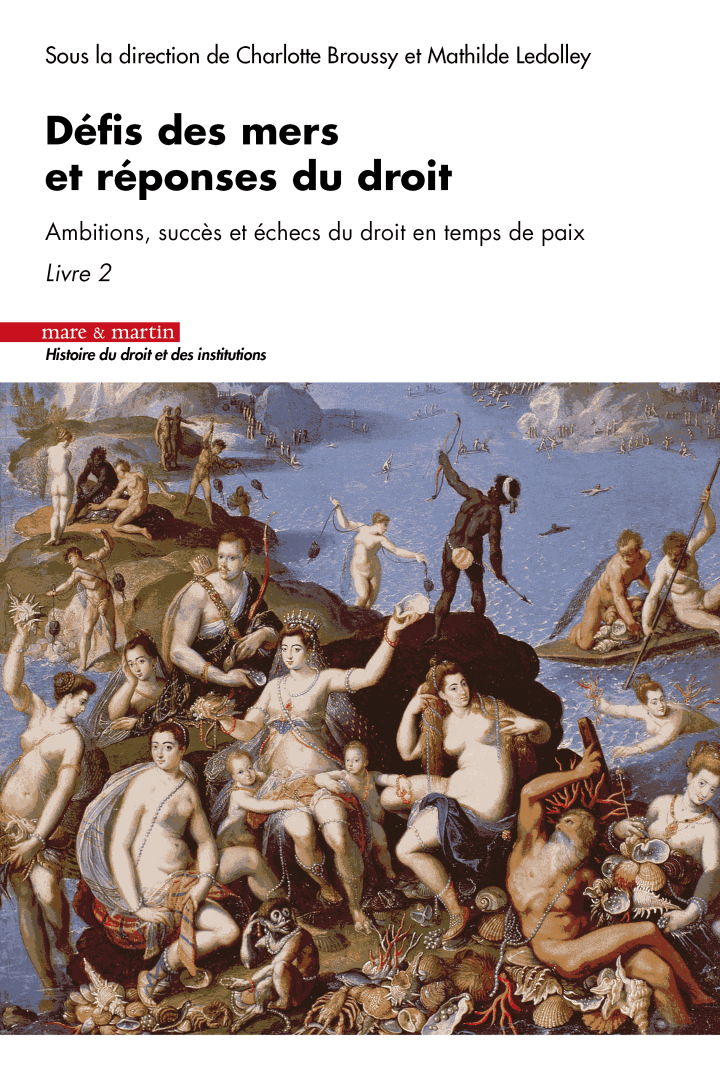
BOOK: Charlotte BROUSSY & Mathilde LEDOLLEY (dir.), Défis des mers et réponses du droit. Ambitions, succès et échecs du droit en temps de paix [Histoire du droit et des institutions] (Paris: Mare & Martin, 2025), 514 p. ISBN 978-2-38600-166-6, € 45


(image source: Mare & Martin)

  Abstract:

La mer dans son sens le plus commun est une « étendue d’eau salée qui occupe la plus grande partie de la surface terrestre ». Or, elle est aussi une voie de circulation ainsi qu’une zone exploitée par l’Homme. Lors de son utilisation, s’y confronte une multitude de questionnements juridiques, aussi techniques qu’originaux et pragmatiques. Ceux-ci donnent lieu à des réponses juridiques couronnées de succès ou, au contraire, qui ont échoué. Dans cette perspective, et dans la continuité d’une dynamique de recherche initiée par le Doyen Bernard Durand, cet ouvrage collectif entend montrer à quel point l’espace marin se caractérise par l’ambiguïté d’un ordre en perpétuel mouvement, voire d’un ordre en batailles. Là, la paix n’est pas tout à fait la paix et la guerre n’est pas tout à fait la guerre. Entre la guerre et la paix, il faut affronter cet espace de domination – humaine et économique – comme faire face aux défis – juridiques, humains et naturels.

On the editors:

Charlotte Broussy est Maître de conférences en Histoire du droit à l’université de Montpellier. Mathilde Ledolley est doctorante en Histoire du droit à l’université de Montpellier.


Read more here


06 June 2025

BOOK: Stefano CATTELAN & Frederik DHONDT (eds.), Small Power Neutrality and the Law of The Sea in the Long Eighteenth Century (ca. 1650–1800): Law as Argument in the Pelagic Arena [History of European Political and Constitutional Thought eds. Mark SOMOS, Erica BENNER & László KONTLER; 14] (Leiden/Boston: Brill, 2025), ISBN: 9789004728974 , € 126,00


(Image source: Brill)

Abstract: 

This volume by both younger and more established specialists of legal, maritime, diplomatic, and political history covers the nuanced interplay of neutrality and the law of the sea within Western, Central, and Eastern Europe, emphasising the opening up of the world in the early modern period (i.e. Africa, North America, and the Caribbean). The various faces of neutrality, both in law and politics, appear through commercial, administrative, and geopolitical practical cases and in the writings of famous legal writers. By linking up different sets of knowledge, a kaleidoscope of power configurations and arguments guides the reader through the labyrinth of trade, sea power, and negotiations.

Contributors: 

Stefano Cattelan, Frederik Dhondt, John Freeman, Nora Naguib Leerberg, Christian Pfister-Langanay, Leos Müller, Stephen C. Neff, and Victor Wilson.

On the editors: 

Stefano Cattelan is Postdoctoral Researcher at the Faculty of Law and Criminology of the Vrije Universiteit Brussel (Research Group CORE) and Adjunct Professor at the Brussels School of Governance. His research focuses on the history of international law and the law of the sea between the 16th and 18th centuries and has been funded by the Carlsberg Foundation and the Research Foundation Flanders (FWO).

Frederik Dhondt is Associate Professor at the Faculty of Law and Criminology of the Vrije Universiteit Brussel (Research Group CORE) and Voluntary Collaborator at the Ghent Legal History Institute and the Gustave Rolin Jaequemyns Institute of International Law (GRILI). His publications focus on the history of legal argumentation and diplomacy from the 18th century onwards, such as Balance of Power and Norm Hierarchy: Franco-British Diplomacy after the Peace of Utrecht (Brill, 2015).

03 September 2021

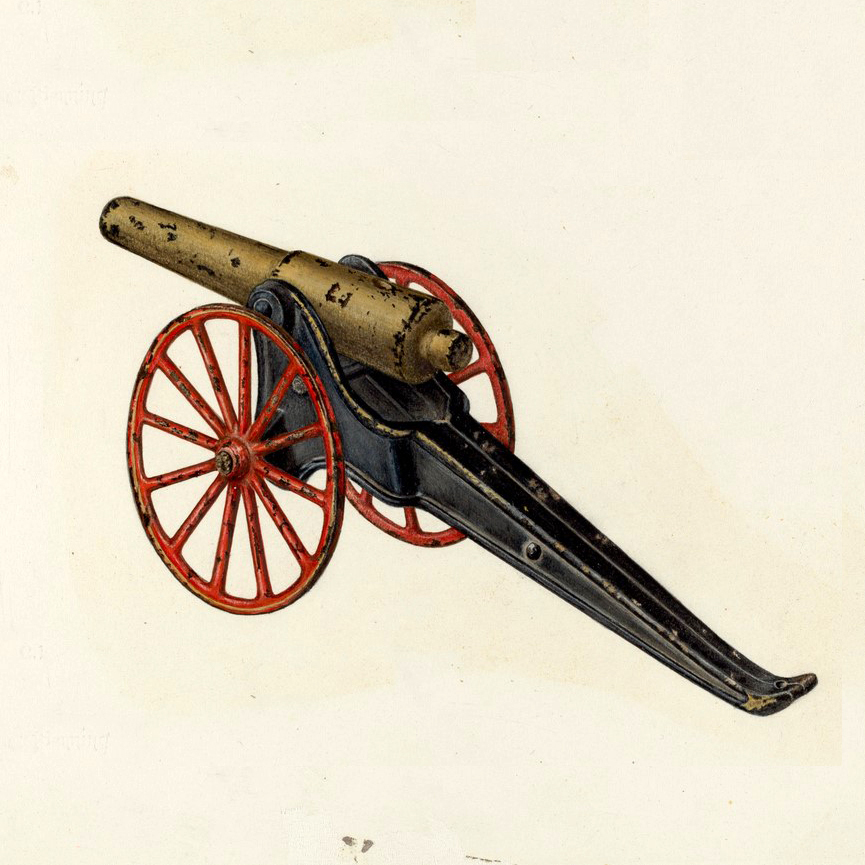
BLOG: Christian POGIES, The Cannon. A Tool for Delimiting Maritime Space (Legal History Insights, MPILHLT)


(image source: MPILHLT)

 First paragraph:

This is the story of the cannon as a tool to delimit maritime space in the history of the law of the sea. It is a story that spans from the 17th to the 20th century – it is a story about a state practice that became legal theory, technological progress and Western dominance in international law.

Read more here.

(source: ESILHIL Blog)

24 May 2021

BOOK: Antonio DEL VECCHIO, La legge nell'Oceano. Ugo Grozio e le origini dello spazio politico moderno (Bologna: Il Mulino, 2021). ISBN: 978-88-15-29134-9, pp. 200, € 20,00

(Source: Il Mulino)

ABOUT THE BOOK

Il nome del giurista olandese Ugo Grozio (1583-1645) è tradizionalmente associato alla ridefinizione in età moderna del diritto naturale, del diritto delle genti e della questione della guerra giusta. In stretto rapporto con questa attività, la sua riflessione giuridica e politica si è confrontata anche con la nuova configurazione dello spazio mondiale prodottasi in seguito alle scoperte geografiche e alla proiezione delle potenze europee sugli oceani e sugli altri continenti. Il libro mostra che il significato storico e teorico dell’opera groziana può cogliersi solo guardando al di là dei confini del Vecchio Continente. Riletti in questa chiave globale, testi come il "De iure praedae" e il "De iure belli ac pacis" appaiono indispensabili per affrontare genealogicamente problematiche tuttora decisive: le relazioni tra l’Europa e il resto del mondo, l’eredita  del dominio coloniale, le tensioni tra universalismo e particolarismo insite nell’ordine internazionale moderno.

ABOUT THE AUTHOR

Antonio Del Vecchio è professore a contratto presso il Dipartimento di Filologia Classica e Italianistica dell'Università di Bologna.

TABLE OF CONTENTS

Introduzione

I. Epoche e spazi

1. Miti e anti-miti

2. Un umanista nel tumulto

3. Tra due epoche

4. Tra due spazi

II. Diritto e «rivoluzione spaziale»

1. Uno sguardo esogeno

2. Conquista dei diritti e diritti di conquista

3. Capitani coraggiosi: diritti naturali e conflitti commerciali

III. Socialità, diritto, violenza

1. La costruzione del sistema giuridico

2. Diritto e desiderio di vita associata

3. Dominium e Imperium

4. La territorializzazione della guerra

IV. L’universale articolato

1. Uno spazio complesso

2. Acquisizione e movimento

3. Guerre e civiltà

4. Trattati diseguali e sovranità disomogenee

5. Qualche conclusione

Indice dei nomi


More information with the publisher.

29 May 2019

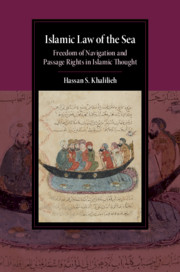
BOOK: Hassan Salih KHALILIEH, Islamic Law of the Sea Freedom of Navigation and Passage Rights in Islamic Thought (Cambridge: Cambridge University Press, 2019). ISBN 9781108481458, £ 75.00


(Source: CUP)

Cambridge University Press has published a new book on law of the sea from an Islamic legal historical perspective.

ABOUT THE BOOK 

The doctrine of modern law of the sea is commonly believed to have developed from Renaissance Europe. Often ignored though is the role of Islamic law of the sea and customary practices at that time. In this book, Hassan S. Khalilieh highlights Islamic legal doctrine regarding freedom of the seas and its implementation in practice. He proves that many of the fundamental principles of the pre-modern international law governing the legal status of the high seas and the territorial sea, though originating in the Mediterranean world, are not a necessarily European creation. Beginning with the commonality of the sea in the Qur'an and legal methods employed to insure the safety, security, and freedom of movement of Muslim and aliens by land and sea, Khalilieh then goes on to examine the concepts of the territorial sea and its security premises, as well as issues surrounding piracy and its legal implications as delineated in Islamic law.

ABOUT THE AUTHOR

Hassan S. KhaliliehUniversity of Haifa, Israel

Hassan S. Khalilieh is a senior lecturer in the departments of Maritime Civilizations and Multidisciplinary Studies and a senior research fellow in the Leon Recanati Institute for Maritime Studies, Leon H. Charney School of Marine Sciences at the University of Haifa, Israel. His publications include Islamic Maritime Law: An Introduction (1998) and Admiralty and Maritime Laws in the Mediterranean Sea (ca.800–1050): The Kitāb Akriyat al-Sufun and the Nomos Rhodion Nautikos (2006).

TABLE OF CONTENTS

Introduction
1. Freedom of the seas
2. Offshore sovereignty and the territorial sea
3. Piracy and its legal implications
Conclusion.

More information here

10 July 2018

BOOK: Renisa MAWANI, Across Oceans of Law: The Komagata Maru and Jurisdiction in the Time of Empire (Durham: Duke University Press, 2018). ISBN 978-0-8223-7035-2, $27.95


Next month, Duke University Press will publish a book which looks at an early 20th century case (the journey of the steamship Komagata Maru) in order to explore tensions between the common law and admiralty law.

ABOUT THE BOOK

In 1914 the British-built and Japanese-owned steamship Komagata Maru left Hong Kong for Vancouver carrying 376 Punjabi migrants. Chartered by railway contractor and purported rubber planter Gurdit Singh, the ship and its passengers were denied entry into Canada and two months later were deported to Calcutta. In Across Oceans of Law Renisa Mawani retells this well-known story of the Komagata Maru. Drawing on "oceans as method"—a mode of thinking and writing that repositions land and sea—Mawani examines the historical and conceptual stakes of situating histories of Indian migration within maritime worlds. Through close readings of the ship, the manifest, the trial, and the anticolonial writings of Singh and others, Mawani argues that the Komagata Maru's landing raised urgent questions regarding the jurisdictional tensions between the common law and admiralty law, and, ultimately, the legal status of the sea. By following the movements of a single ship and bringing oceans into sharper view, Mawani traces British imperial power through racial, temporal, and legal contests and offers a novel method of writing colonial legal history.

ABOUT THE AUTHOR

Renisa Mawani is Professor of Sociology at the University of British Columbia and author of Colonial Proximities: Crossracial Encounters and Juridical Truths in British Columbia, 1871–1921.

TABLE OF CONTENTS

List of Illustrations
Acknowledgments
Introduction. Currents and Countercurrents of Law and Radicalism
1. The Free Sea: A Juridical Space
2. The Ship as Legal Person
3. Land, Sea, and Subjecthood
4. Anticolonial Vernaculars of Indigeneity
5. The Fugitive Sojourns of Gurdit Singh
Epilogue. Race, Jurisdiction, and the Free Sea Reconsidered
Bibliography
Index

More information with the publisher. The book can be pre-ordered here