Search

Showing posts with label Law and sociology. Show all posts

29 October 2024

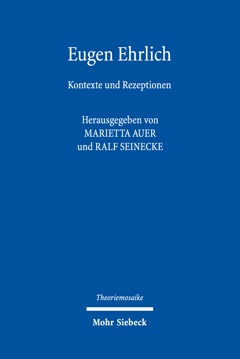
BOOK: Marietta AUER & Ralf SEINECKE (eds.), Eugen Ehrlich. Kontexte und Rezeptionen [Theoriemosaike] (Tübingen: Mohr Siebeck, 2024), 575 p., ISBN 978-3-16-162173-4

 Cover von 'undefined'

ABOUT THE BOOK:
 
2022 jährte sich Eugen Ehrlichs Todestag zum 100. Mal. Der Schöpfer des »lebenden Rechts« gilt heute als Begründer der Rechtssoziologie und als Vorvater des Rechtspluralismus. Zu Lebzeiten war er als führender Freirechtler verschrien. Seine Heimat, die Bukowina in der heutigen Westukraine und im damaligen östlichsten Winkel des Habsburger Reiches, ist ebenfalls sagenumwoben. Dieser Band widmet sich dem Leben und der Rechtswissenschaft Eugen Ehrlichs. Er beleuchtet seine frühe Zeit als Romanist und seine Auseinandersetzung mit der Historischen Rechtsschule, sein Verhältnis zu Hermann Kantorowicz und zur Soziologie des frühen 20. Jahrhunderts genauso wie zu seinen Rezeptionen im amerikanischen Rechtsrealismus, in der Rechtssoziologie und im Rechtspluralismus. Schließlich fragt der Band nach seiner Relevanz für die heutige Rechtsdogmatik und bietet eine Edition von sieben wiederentdeckten Aufsätzen Ehrlichs.
 
TABLE OF CONTENTS:
 
Eugen Ehrlich
Ralf Seinecke: Der Ehrlicheffekt - Sergiy Nezhurbida: Lebensspuren Eugen Ehrlichs

Kontexte
Hans-Peter Haferkamp: Eugen Ehrlich und die Historische Rechtsschule - Inge Hanewinkel/NikolausLinder: Romanistische Dissidenz: Die Geburt der Rechtssoziologie aus dem römischen Recht bei Eugen Ehrlich - Katharina Isabel Schmidt: "Ich bin nicht Gnaeus Flavius“: Eugen Ehrlichs Freirechtsbeitrag im Spiegel zeitgenössischer Kritik - Nils Jansen: Recht ohne Staat bei Eugen Ehrlich und Hermann Kantorowicz - Johannes Liebrecht: Das schwache Echo. Eugen Ehrlichs Rechtssoziologie und die Wende zur Wirklichkeit in der deutschsprachigen Rechtswissenschaft - Doris Schweitzer: Eugen Ehrlich und die (Rechts-)Soziologie im frühen 20. Jahrhundert - Jan Schröder: Eugen Ehrlichs methodologische Spätschriften von 1917/18

Rezeptionen
Stefan Vogl: Die scheinbare Rezeption Eugen Ehrlichs in der sociological jurisprudence Roscoe Pounds - Christian Boulanger: Ehrlich-Rezeption in der Rechtssoziologie der 1970er und 1980er Jahre: Eine digitale Spurensuche - Lena Foljanty: Unter ferner liefen. Zur schwachen Rezeption von Eugen Ehrlichs Lehre vom "lebenden Recht" in der Debatte um den Rechtspluralismus (1960er-1980er Jahre) - StefanMachura: Eugen Ehrlich und die heutige Rechtssoziologie - 10 Thesen - Thilo Kuntz: Eugen Ehrlichs Methodenkritik und die heutige Jurisprudenz

Edition
Vorbemerkung
Eugen Ehrlich: Ueber Facturenbeisätze, 1887 - Eugen Ehrlich: Die Zukunft des Römischen Rechtsunterrichts in Oesterreich, 1906 - Eugen Ehrlich: Die Bedeckung der Altersrente, 1911 - Eugen Ehrlich: Die Freirechtsbewegung, 1911 - Eugen Ehrlich: Das Schweizer Zivilgesetzbuch und das lebende Recht, 1920 - Eugen Ehrlich: Die letzten Europäer, 1920 - Eugen Ehrlich: Die Schweizer Währung, 1921
 
Read more here.

07 October 2020

BOOK: Sian BEYNON-JONES and Emily GRABHAM (Eds.), Law and Time (London: Routledge, 2020). ISBN 9780367665302, 36.99 GBP


(Source: Routledge)

Last year, Routledge published a new book on law and time which we had not yet reported on, and of which the paperback version has now been published

ABOUT THE BOOK

Research on law's relationship with time has flourished over the past decade. This edited collection aims to put law and time scholarship into wider context, advancing conversations on time and temporalities between socio-legal scholars, anthropologists, sociologists, geographers and historians. Through a diverse range of contributions, the collection explores how legal modalities of time emerge and have effects within wider clusters of social and political action. Themes include: law’s diverse roles in maintaining linear historicist models of time; law’s participation in the materialisation of times; and the unsteady effects of temporal pluralism and polytemporalities in law. De-naturalising the ‘time’ in law and time scholarship, this collection positions time as something that can be enacted and materialised as well as experienced, with distinct implications for questions of social justice.

ABOUT THE EDITORS

Siân M. Beynon-Jones is a Lecturer in Sociology at the University of York.

Emily Grabham is Professor of Law at Kent Law School, University of Kent.

TABLE OF CONTENTS

List of Contributors

Acknowledgements

Introduction, Emily Grabham and Siân M. Beynon-Jones


SOCIAL TIME: COURTS, LITIGATION AND PUBLIC AUTHORITY


1. The Long Sudden Death of Antonin Scalia, Carol J. Greenhouse

2. ‘No. I Won’t Go Back’: National Time, Trauma and Legacies of Symphysiotomy in Ireland, Máiréad Enright

3. Time-Spaces of Adjudication in the U.S. Subprime Mortgage Crisis, Philip Ashton

4. On delay and duration. Law’s Temporal Orders in Historical Child Sexual Abuse Cases, Sinéad Ring

POST/COLONIAL TIMES

5. ‘Give Us His Name’: Time, Law, and Language in a Settler Colony, Genevieve Renard Painter

6. Traditional Medicines, Law, and the (Dis)ordering of Temporalities, Emilie Cloatre

7. Making Land Liquid: On Time and Title Registration, Sarah Keenan

THE POLITICS OF LABOUR TIME

8. Regulating the 'Half-timer' in Colonial India: Factory Legislation, its Anomalies and Resistance, Maya John

9. Work-time Technology and Unpaid Labour in Paid Care Work: A Socio-legal Analysis of Employment Contracts and Electronic Monitoring, L.J.B. Hayes

TECHNOLOGIES AND INFRASTRUCTURES OF TIME

10. Standards in the Shadows for Everyone to See: The Supranational Regulation of Time and the Concern over Temporal Pluralism, Kevin Birth

11. Energy Governance, Risk, and Temporality: The Construction of Energy Time through Law and Regulation, Antti Silvast, Mikko Jalas and Jenny Rinkinen

TOPOLOGIES OF TIME

12. Doing Times, Doing Truths: The Legal Case File as a Folded Object, Irene van Oorschot

13. Topological Time, Law, and Subjectivity: A Description in Five Folds, Sameena Mulla

Index


More info here

28 September 2020

BOOK: Joseph E. DAVID, Kinship, Law and Politics: An Anatomy of Belonging (Cambridge: Cambridge University Press, 2020). ISBN 9781108499682, £ 85.00


(Source: CUP)

Cambridge University Press has published “Kinship, Law and Politics - An Anatomy of Belonging”.

ABOUT THE BOOK

Why are we so concerned with belonging? In what ways does our belonging constitute our identity? Is belonging a universal concept or a culturally dependent value? How does belonging situate and motivate us? Joseph E. David grapples with these questions through a genealogical analysis of ideas and concepts of belonging. His book transports readers to crucial historical moments in which perceptions of belonging have been formed, transformed, or dismantled. The cases presented here focus on the pivotal role played by belonging in kinship, law, and political order, stretching across cultural and religious contexts from eleventh-century Mediterranean religious legal debates to twentieth-century statist liberalism in Western societies. With his thorough inquiry into diverse discourses of belonging, David pushes past the politics of belonging and forces us to acknowledge just how wide-ranging and fluid notions of belonging can be.

ABOUT THE AUTHOR

Joseph E. David, Sapir Academic College, Israel

Joseph E. David is Professor of Law at Sapir Academic College, Israel and a Visiting Professor at the Program in Judaic Studies and Law School at the University of Yale. His research focuses on Jewish Studies, Law and Religion, Legal History and Comparative Jurisprudence, on which he has published extensively.

TABLE OF CONTENTS

Part I. Kinship:

1. Corporal union as performance of belonging

2. The making of kin belonging

Part II. Law:

3. Territorial belonging and the law

4. Religious identity and law

Part III. Politics:

5. The familial-political analogy

6. Liberal iconoclasm

7. Beyond the analogy: liberal alternatives

Bibliography.


More info here

18 September 2019

BOOK: Véronique CHAMPEIL-DESPLATS, ed., se mobiliser dans les facultés de Droit 1968-2018, Témoignages (Paris: Presses Universitaires de Paris Nanterre, 2019). ISBN 9782840163404, €10,00


(Source: LCDPU)

Presses Universitaires de Paris Nanterre has published a new book on the influence of May 1968 on law faculties in France.

ABOUT THE BOOK

Se mobiliser dans les facultés de droit: le mouvement de mai 68 a-t-il changé l'enseignement et la recherche en droit? Quelles vocations militantes a-t-il créées chez les étudiants des facultés de droit? L’ouvrage rassemble des témoignages de juristes – professeur.e.s aujourd’hui émérites et ancien.ne.s magistrat.e.s – ayant pris part aux mouvements étudiants de mai 1968, à Paris et à Nanterre. Leur fait écho le manifeste de doctorant.e.s de l’université de Nanterre mobilisé.e.s, cinquante ans plus tard, contre Parcoursup et la précarisation à l’Université. Même lieu, autre temps, autres combats?

TABLE OF CONTENTS

Pascal Beauvais, Florence Bellivier – Avant-propos
Les mobilisations des juristes : des facultés de droit à Paris et à Nanterre à la magistrature
Elsa Bourdier – Présentation ;
Jean-Pierre Deschamps – Nanterre. La plage sous les pavés ;
Antoine Lyon-Caen – Souvenirs d'un étudiant occupant ;
Simone Gaboriau – Il était une fois mai 68. De la vocation de juge à l'engagement syndical.
Mai 68 a-t-ilchangé l'enseigement et l'analyse du droit ?
Myriam Ahnich – Présentation ;
Danièle Lochak – Changer la pédagogie ;
Jacques Chevallier – Mai 68 et le droit administratif ;
Michel Troper – Garder ou ne pas garder l'agrégation ?
Épilogue
Collectif 68+ – Nanterre, mai-juin 2018. Se mobiliser contre Parcoursup.

More info here

04 September 2018

BOOK: Frédéric AUDREN, Emmanuelle CHEVREAU, and Raymond VERDIER, eds., Henri Lévy-Bruhl, Juriste sociologue (Paris: Librairie LGDJ, 2018). ISBN 978-2-84934-347-0, 36,00 €


(Source: Librairie LGDJ)

Librairie LGDJ had published a book on the life of the French lawyer and sociologist Henri Lévy-Bruhl

ABOUT THE BOOK

Figure respectée des facultés de droit, Henri Lévy-Bruhl (1887-1964) occupe une place singulière dans le champ juridique en raison de ses options méthodologiques et de son engagement socialiste. Traversant tout à la fois les territoires du droit romain, de l'histoire du droit commercial, de l'ethnologie juridique ou de la sociologie criminelle, son oeuvre abondante, construite d'une manière très cohérente, reste pourtant trop mal connue.

Ce livre, issu d'un colloque organisé en mars 2015, se propose d'explorer l'itinéraire et l'oeuvre de ce grand historien du droit, en tentant d'en restituer la richesse et d'évaluer autant que possible sa place et son action dans l'histoire des sciences juridiques et sociales.

Cet ouvrage est également une vaste bibliographie des écrits de Henri Lévy-Bruhl et constitue un indispensable instrument de travail pour les juristes et les historiens.

ABOUT THE EDITORS

Sous la direction de Emmanuelle Chevreau, Frédéric Audren et Raymond Verdier.
Emmanuelle Chevreau est professeur d'histoire du droit à l'Université Paris II Panthéon-Assas (Institut d'histoire du droit). Ses travaux sont principalement consacrés à l'histoire du droit romain.
Frédéric Audren est directeur de recherche au CNRS (Centre d'études européennes et École de droit de Sciences Po). Ses travaux portent sur l'histoire des savoirs juridiques et sur l'histoire des sciences sociales.

Raymond Verdier est directeur de recherche honoraire au CNRS. Il est le fondateur du Centre Droit et Cultures (Université Paris Nanterre) et de la revue Droit et Cultures.
Contributions de Frédéric Audren, Hélène Besnier, Gilles Condor, Emmanuelle Chevreau, Jean-Pierre Coriat, Nelly Convert, Catherine Fillon, Jean-François Gerkens, Stéphane Gerry-Vernières, Jean Hilaire, Michel Humbert, Frédéric Keck, Soazick Kerneis, Jean-Christophe Marcel, Joseph Mélèze-Modrzejewski, Mathieu Soula, Raymond Verdier, Nicolas Warembourg.

More information here