Search

Showing posts with label History and Philosophy. Show all posts

07 May 2021

BOOK: Dieter HÜNING et al. (Eds.), Auf dem Weg zur kritischen Rechtslehre? Naturrecht, Moralphilosophie und Eigentumstheorie in Kants "Naturrecht Feyerabend" (Leiden/New York: Brill, 2021). ISBN 978-90-04-43261-1, 103.00 EUR


(Source: Brill)

Brill is publishing a new edited collection on Kant’s philosophy of law.

ABOUT THE BOOK

In recent decades, Kant's philosophy of law has increasingly moved into the focus of moral-philosophical discussions. In this context, the "Naturrecht Feyerabend" is of particular importance. On the one hand, it is the only surviving transcription of the lectures on natural law that Kant gave twelve times between 1767 and 1788; on the other hand, it is based on his lectures in the summer semester of 1784 and thus provides important evidence of Kant's reflections during an important phase in the development of his moral philosophy. Despite this special significance, the text has received little attention in previous research. Dieter Hüning, Stefan Klingner and Gianluca Sadun Bordoni present here a volume that emphasizes this special significance. The ten contributions in the volume ask about the relationship of "Naturrecht Feyerabend" to the tradition of natural law as well as its relationship to critical moral philosophy and the late "Doctrine of Right". 


Contributors are: Manfred Baum, Franz Hespe, Philipp-Alexander Hirsch, Dieter Hüning, Stefan Klingner, Markus Kohl, Gabriel Rivero, Gianluca Sadun Bordoni, Michael Städtler, and Gideon Stiening. 

ABOUT THE EDITORS


Dieter Hüning ist außerplanmäßiger Professor an der Kant-Forschungsstelle der Universität Trier. Seine Forschungsschwerpunkt ist neben Kants Philosophie besonders die neuzeitliche Naturrechtslehre. Als Mitherausgeber veröffentlichte er mit Jens Eisfeld und Diethelm Klippel zuletzt Die zeitgenössischen Rezensionen zu Kants Rechtslehre (Berlin 2020). 

Stefan Klingner is Assistant Professor for Philosophy at the University of Goettingen. He has published books and essays on Kant's philosophy, e.g. as co-editor with Dieter Hüning: „jenen süßen Traum träumen“. Kants Friedensschrift zwischen objektiver Geltung und Utopie (Baden-Baden 2018). 

Stefan Klingner ist wissenschaftlicher Mitarbeiter am Philosophischen Seminar der Georg-August-Universität Göttingen. Er veröffentlichte mehrere Bücher und Aufsätze zur Philosophie Kants, etwa als Mitherausgeber mit Dieter Hüning: „jenen süßen Traum träumen“. Kants Friedensschrift zwischen objektiver Geltung und Utopie (Baden-Baden 2018). 

Gianluca Sadun Bordoni is Professor of Philosophy of Law at the University of Teramo.
Together with Norbert Hinske he published the critical edition of Kant, Naturrecht Feyerabend. 3 vol. (Stuttgart-Bad Cannstatt 2010-2014; bilingual edition: Lezioni sul diritto naturale, Milano 2016). 

Gianluca Sadun Bordoni ist Professor für Rechtsphilosophie an der Universität Teramo, Italien. Er veröffentlichte zusammen mit Norbert Hinske die kritische Ausgabe von Kant, Naturrecht Feyerabend. 3 Bde. (Stuttgart-Bad Cannstatt 2010-2014; zweisprachige Ausgabe: Lezioni sul diritto naturale, Milano 2016). 


More info here

16 February 2021

BOOK: Patricia OWENS & Katharina RIETZLER (eds.), Women's International Thought: A New History (Cambridge: Cambridge University Press, 2021)


(image source: CUP)


Book abstract:
Women's International Thought: A New History is the first cross-disciplinary history of women's international thought. Bringing together some of the foremost historians and scholars of international relations working today, this book recovers and analyses the path-breaking work of eighteen leading thinkers of international politics from the early to mid-twentieth century. Recovering and analyzing this important work, the essays offer revisionist accounts of IR's intellectual and disciplinary history and expand the locations, genres, and practices of international thinking. Systematically structured, and focusing in particular on Black diasporic, Anglo-American, and European historical women, it does more than 'add women' to the existing intellectual and disciplinary histories from which they were erased. Instead, it raises fundamental questions about which kinds of subjects and what kind of thinking constitutes international thought, opening new vistas to scholars and students of international history and theory, intellectual history and women's and gender studies.

 On the editors:

Patricia Owens, University of Oxford Patricia Owens is Professor of International Relations at the University of Oxford. Her previous publications include Economy of Force (2015), winner of BISA's Susan Strange Prize, Between War and Politics (2007) and co-editor of The Globalization of World Politics (2020). She is a former fellow of the Radcliffe Institute for Advanced Study and Proctor Fellow at Princeton University. Katharina Rietzler, University of Sussex Katharina Rietzler is Lecturer in American History at the University of Sussex. She is currently completing a book on American philanthropy, International Relations and the problem of the public, 1913–1954. Her work has appeared in journals such as Modern Intellectual History, Diplomatic History and the Journal of Global History. She is a former Mellon Fellow in American History at the University of Cambridge.

On the contributors:

Patricia Owens, Katharina Rietzler, Vivian M. May, Kimberley Hutchings, Helen M. Kinsella, Imaobong Umoren, Tamson Pietsch, Lucian Ashworth, Robbie Shilliam, Keisha N. Blain, Geoffrey Field, Glenda Sluga, Catia Confortini, Barbara Savage, Or Rosenboim, Andrew Jewett, Natasha Wheatley.

(source: CUP - ESILHIL) 


16 July 2020

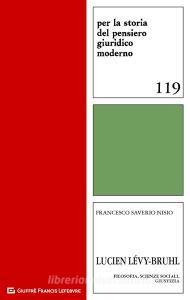
BOOK: Francesco Saverio NISIO, Lucien Levy-Bruhl. Filosofia, scienze sociali, giustizia (Milano: Giuffrè, 2019). ISBN: 8828807822, pp. VIII-796, € 80.00

Lucien Levy-Bruhl. Filosofia, scienze sociali, giustizia
(Source: Giuffrè)

ABOUT THE BOOK

Lucien Lévy-Bruhl (1857-1939), per trent'anni storico della filosofia moderna alla Sorbona e poi infaticabile uomo d'azione nel difendere l'esigenza morale dell'intelligenza dell'altro (all'epoca, il «primitivo») e l'attenzione ad un modo del pensiero, o «mentalità», al contempo concettuale ed affettiva, ha attraversato con perfetta lucidità non pochi ambiti delle scienze umane a cavallo fra Otto e Novecento (antichità classica, storia della filosofia, sociologia, antropologia, politica), imprimendo in ciascuno di essi il segno indelebile di un pensiero singolare ed inconfondibile, e non meno offrendo idee vivissime per l'estensione anche in ambiti ulteriori - tra i quali il giuridico - di prospettive di ricerca filosofica centrate sull'esperienza della «partecipazione». Oltre ad offrire il ritratto intellettuale del percorso molteplice di un filosofo impegnato nell'«aggiungere qualcosa alla conoscenza scientifica della natura umana utilizzando i dati dell'etnologia», in dialogo con Spinoza e Hume; nonché a sottolineare in maniera specifica ed inedita la riflessione sui temi del diritto e della giustizia nell'intera sua opera; il volume ricostruisce, anche, alcuni profili del rapporto che con Lévy-Bruhl hanno intessuto in forma diretta o mediata le culture giuridiche francese ed italiana nella seconda metà del Novecento, attraverso personalità di indubbia centralità ed animate da grande sensibilità antropologico-filosofica come Villey, Carbonnier, Capograssi, Grossi, Costa, Sacco. Corredato da un approfondito apparato bibliografico, il volume include una selezione di documenti di e su Lévy-Bruhl, dei quali alcuni inediti; nonché prime o nuove traduzioni di testi di Gilson, I. Meyerson, M. Blondel, Lévinas, Gurvitch ed altri.

ABOUT THE AUTHOR

Francesco Saverio Nisio è professore associato in filosofia del diritto presso il dipartimento di Giurisprudenza, Università degli Studi di Foggia.

TABLE OF CONTENTS

PDF version available here.


More information with the publisher.

30 June 2020

PODCAST: Michel Foucault, ou l'art de faire surgir la vérité (France Culture: Une vie, Une oeuvre)

(image source: France Culture)

Introduction:
Comment des valeurs, des réalités, ou des discours deviennent-ils vrais ? C'est à saisir cette naissance de la vérité que Michel Foucault s'est consacré. Comment a-t-il travaillé à faire surgir la vérité, selon cette manière de cerner l'espace où se produisent des effets de vérité, par-delà le jeu entre le vrai et le faux ? Non pas par un système de pensée, mais par une méthode confrontant plusieurs discours définis par leur historicité.
 The full podcast is here.

11 May 2020

BOOK: John TASIOULAS, The Cambridge Companion to the Philosophy of Law (Cambridge: Cambridge University Press, 2020). ISBN 9781107458222, £ 29.99


(Source: CUP)

CUP is publishing “The Cambridge Companion to the Philosophy of Law”.

ABOUT THE BOOK

What is the nature of law as a form of social order? What bearing do values like justice, human rights, and the rule of law have on law? Which values should law serve, and what limits must it respect in serving them? Are we always morally bound to obey the law? What are the philosophical problems that arise in specific areas of law, from criminal and tort law to contract law and public international law? The book provides an accessible, comprehensive, and high quality introduction to the major themes of legal philosophy written by a stellar international cast of contributors, including John Finnis, Martha Nussaum, Fred Schauer, Onora O'Neill and Antony Duff. The volume is an exceptional teaching tool that provides a critical introduction to cutting-edge work in the philosophy of law.

ABOUT THE EDITOR

John Tasioulas, King's College London
John Tasioulas is the inaugural Yeoh Chair of Politics, Philosophy and Law and Director of the Yeoh Tiong Lay Centre for Politics, Philosophy and Law, The Dickson Poon School of Law, King's College London.

TABLE OF CONTENTS

Introduction John Tasioulas
Part I. General Theory:
1. Methodology Grant Lamond
2. The nature of law John Finnis
3. Legal reasoning Martha Nussbaum
4. Law and living well Timothy Macklem
5. Social science and the philosophy of law Fred Schauer
Part II. Values:
6. The rule of law John Tasioulas
7. Justice without ethics: a twentieth century innovation? Onora O'Neill
8. Rights and human rights Jeremy Waldron
9. Authority and legitimacy Christoph Kletzer and Massimo Renzo
10. The ends and limits of law John Stanton-Ife
Part III. Special Theory:
11. Criminal law Antony Duff
12. Punishment Christopher Bennett
13. Contract Daniel Markovits
14. Tort law and its theory John Gardner
15. Causation and responsibility Richard Holton
16. Property law Larissa Katz
17. Constitutional law Mitchell Berman
18. Civil rights and liberties Sherif Girgis and Robert P. George
19. Equality and discrimination Sophia Moreau
20. International law Guglielmo Verdirame.

More info here

30 July 2014

CONFERENCE: "Understanding legal reasoning: a role for history and philosophy in modern private law"(Groningen, 11-12 September 2014)

WHAT: Conference on the theme "Understanding legal reasoning: a role for history and philosophy in modern private law"
WHERE: Congreszaal, Het Kasteel,
Melkweg 1, 9718 EP Groningen
WHEN: Thursday 11th September 2014 3:00-5:00 pm; Friday 12th September 2014 9.30 am -4.45 pm

The Groningen Centre for Law and Governance (GCL) and the Department of Private and Notarial Law of the Faculty of Law of the University of Groningen, will organize the conference Understanding Legal Reasoning, A Role for History and Philosophy in Modern Private Law on 11 and 12 September 2014.

all information here

Conference theme

The Connection of Private Law with History and Philosophy
The privileged flow of communication which used to link private lawyers to legal historians and philosophers is nowadays reduced to a trickle. Today, most private lawyers, influenced by a European trend in higher education which encourages specialisation at the expense of foundational subjects, ask themselves why historical and philosophical modules have not yet been removed from the academic curricula in favour of legal subjects perceived as more in line with current developments.
Yet, the European legal systems were developed by jurists who were well aware of the historical and theoretical roots of their science. For example, the Pandectists, the forefathers of the influential German civil code, developed German law largely on the basis of Roman law. Even the English common law contains clear examples of the fruitful relationship linking private law to history and philosophy. Thus, William Blackstone, the author of the Commentaries on the Laws of England – arguably the most systematic and certainly the most influential analysis of English law – and the first Vinerian Professor of English Law at Oxford University, was an excellent classical scholar.
Whereas the detachment of private law from historical and philosophical investigations has its roots in the eighteenth and nineteenth century, it is during the twentieth century that the fading interest for historical and philosophical studies in Europe becomes an indisputable fact. The demise of Roman law as a system of living law, the expansion of commercial law after the Second World War, the pressure on higher education institutions to produce as many lawyers as possible in the shortest possible time: these are just some of the factors which might have contributed to the decline of the productive cross-fertilisation. For their part, legal historians and philosophers bear their share of responsibility for the present situation: beyond the lively discussion concerning the cultural and legal roots European private law, there have been few attempts to include private lawyers in the modern theoretical and historical debates and to highlight the practical significance of foundational subjects for the enhancement of the legal skills.