
(Source: Iuris)
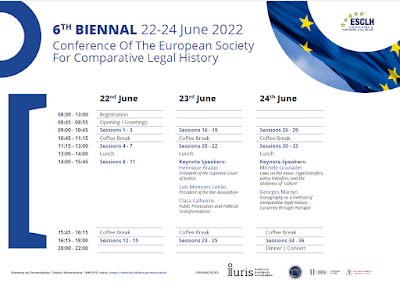
Program
Day 1 22 June
Session 1
PANEL: A Spasm of Change: Profession and Professionalization of Law in China, Japan and Ottoman Empire in the 19th and 20th Century Murat Burak Aydin | Max Planck Institute for European Legal History / Joseph Wang / Hiroki Kawamura
From British Extra-territoriality to Local Legal Actors in China, Japan and the Ottoman Empire: A Pluriversal Comparative Legal History Zülâl Muslu | Max-Planck Institute for Legal History
Session 2
PANEL: Women and legal professions in Finland, Sweden and Estonia Merike Ristikivi | University of Tartu / Mia Margareta Korpiola | University of Turku
Session 3
3.1 A cosmopolitan ‘judicial family’. European models and mixed courts in Egypt (1875-1949) Elisabetta Fusar Poli | Università degli Studi di Brescia
3.2 The Emergence and the Evolution of the Justice of the Peace in France, Belgium and the Netherlands Emanuel van Dongen | Utrecht University
3.3 Justice of the peace in countryside of the Duchy of Warsaw Piotr Pomianowski | University of Warsaw
Session 4
PANEL: Legal professions and the use of foreign literature: a comparative approach Heikki Pihlajamäki |University of Helsinki / Georges Martyn | University of Gent / Laura Beck Varela | Autonoma University Madrid / Airton Ribei- ro da Silva Jr. | University of Helsinki
Session 5
5.1 PANEL: Diversi sed non adversi. Professional expectations and legal careers from Italy to Europe (XIII-XIX cent.) Nicoletta Sarti / Maria Teresa Guerrini / Damigela Hoxha | University of Bologna
5.2 The Career Paths of Legally Qualified Hungarian Nobles during the 17th-18th-Centuries in a Comparative Perspective Zsuzsanna Peres | National University of Public Service – Budapest
Session 6
6.1 A Quest for Heritage and Comparative Law: The Role of the Louisiana Bar Association in the Frustrated 1908 Revision of the Civil Code Agustin Parise | Maastricht University
6.2. Law Reforms through the use of Foreign Models. How Legal Comparison concerned the Creation of the Latin-American Civil Codes Filippo Rossi | Università degli Studi di Milano
6.3. Quebec Jurists and the Civil Code of Louisiana: a Study of an Evolving Approach Asya Ostroukh | University of the West Indies, Barbados
6.4. Putting the Old Laws in Order: Method of Consolidation as Instrument for Systematization of Laws of the Russian Empire and Local Laws of Baltic Governorates in 19th Century Valdis Bluzma | Turiba University, Riga
6.3. Quebec Jurists and the Civil Code of Louisiana: a Study of an Evolving Approach Asya Ostroukh | University of the West Indies, Barbados
6.4. Putting the Old Laws in Order: Method of Consolidation as Instrument for Systematization of Laws of the Russian Empire and Local Laws of Baltic Governorates in 19th Century Valdis Bluzma | Turiba University, Riga
Session 7
7.1 PANEL: Facing Authoritarianism: Lawyers, Legal Method and the Demise of Democracy, 1918-1953 Cosmin Sebastian Cercel | University of Nottingham / Peter Curos | University of Oslo / David Fraser | University of Nottingham / Petra Gyöngyi / Simon Lavis Open University
Session 8
8.1 PANEL: History and the Shaping of Legal Professions (South America and Europe, late nineteenth and esarly twentieth centuries) Jean-Louis Halpérin | École Normal Supérieure, Paris / Fatiha Cherfouh- -Baïch | Université de Paris Descartes / Ricardo Sontag | Universidade Federal de Minas Gerais / Mariana de Moraes Silveira | Universidade Federal de Minas Gerais)
Session 9
9.1 The punishment of poverty under the social defense discourse: A Comparative Study between the Law of Vagrants and Thugs (Ley Relativa a Vagos y Malean-tes, 1933), in Spain, and the Law of Penal Contraventions (Lei de Contraven-ções Penais, 3688/41), in Brazil (Jonatan de Jesus Oliveira Alves | University of Valencia)
9.2. Legal Scholarship and Criminal Procedure in the Brazilian First Republic in a Comparative Perspective (1889-1930) Régis J. Nodari | Federal University of Minas Gerais
9.3. Law and the Birth of the Irish Free State in 1922 Thomas Mohr | University College Dublin
9.4. What does it mean to be interpreted as interpreter? A Hermeneutical Analysis of a 17th Century German Jurisprudent’s effect on 18th Century Criminal Case Law of a Hungarian Free Royal City András Biczó | University of Debrecen
Session 10
10.1 The Tramways Case of 1912 and the Birth of Constitutional Adjudication in Romania – between Legal Acculturation and Legal Cultural Autonomy Manuel Guțan | Lucian Blaga University of Sibiu
10.2 Between Erudition and Safety: Writing Practices of Judges and Lawyers and International References in Brazilian Administrative Law Investigated Through Bibliometric Data (1873-1930) Arthur Barreto | Università degli Studi di Firenze
10.3 Why Italians watch Karlsruhe and Germans watch themselves: On the role of constitutional reputation in scholarly uses of foreign law (1989-2012) Niels Graaf | University of Utrecht 10.4 Literary genres and legal practice: the accommodation of Portuguese literature in legal practice to the Brazilian courts in the 19th century Gregório Schroder Sliwka | Universidade Federal do Rio Grande do Sul (UFRGS) / Pontifícia Universidade Católica do Rio Grande do Sul (PUCRS)
Session 11
11.1 Limiting the Sovereign: the Comparison of the First Constitutional Elements in Britain and the Ottoman Empire Nurullah Gorgen | King's College London
11.2 Transformative constitutionalism –history in the making Andre Mukheibir / Joanna Botha | Nelson Mandela University
11.2 Transformative constitutionalism –history in the making Andre Mukheibir / Joanna Botha | Nelson Mandela University
11.3 Edmund Burke across the Atlantic: The reception and employment of his constitutional ideas by Joseph Story (1779-1845) and Bernardo Pereira de Vasconcelos (1795-1850) Rodrigo Couto Gondim Rocha
11.4 Constitutional Review in Estonia and Germany between the World Wars Marelle Leppik | University of Tartu / Hesi Siimets-Gross | University of Tartu
Session 12
12.1 Fides and pistis. The impact of different legal conceptions on case law in the Antiquity Nemes Szilvia | Eötvös Loránd University Budapest
12.2 The revision of Gaius’ iuris divisio in Second Scholastics’ legal thought and the methodological renovation of the definition of dominium and ius Ana Caldeira Fouto | University of Lisbon
12.3 Shaping a Mixed Jurisdiction: The Methods of Israeli Professors and Judges Nir Kedar | Sapir Academic College - Bar-Ilan University
Session 13
13.1 The Art of Dispute Resolution in Civil Matters: Venetian Lawyers in the Age of Ius Commune Claudia Passarella | University of Padova
13.2 The Office of Logothete in Medieval Serbia Andreja Katančević | University of Belgrade 13.3 Profession of judge in People’s Poland Marcin Łysko | University of Bialystok
Session 14
14.1 PANEL: Between Politics and Law: comparing legal discourses on procedural, commercial and international law (16th-20th Century) Charles Bartlett | Duke University / Pamela Alejandra Cacciavillani | University of Monterrey – UDEM / Elisabetta Fiocchi Malaspina | University of Zurich 14.2 Early Eighteenth Century Jurists and the Challenge of Defining the Legal Status of the Sea in the Age of Mercantilism Stefano Cattelan | Vrije Universiteit Brussel
Session 15
15.1 PANEL: Struggling with the Polish republican tradition and foreign impact: On judges in the protoliberal concepts of the Kingdom of Poland (1815-1830) Michał Gałędek | University of Gdańsk / Anna Tarnowska | Nicolaus Copernicus University
15.2 Her Stepdaughter: portrait of family law Markéta Štěpáníková | Masaryk University 15.3 Founding Mothers and Equal Wives Marianne Dahlén | Uppsala University
Day 2 23 June
Session 16
PANEL: Ars avvocandi or advocacy as a forensic art, a legal-historical analy-sis of the law in the Portuguese and Spanish legal systems (17th-20th centuries) Isabel Graes |Universidade de Lisboa / Susana Garcia-León | Universidad Complutense de Madrid / Pablo Abascal Monedero | Universidad Pablo de Olavide / João Nunes | Universidade de Lisboa
Session 17
PANEL: Non-legal professions and legal discourse on trade and empire Frederik Dhondt | Vrije Universiteit Brussel-Ghent University / Inge Van Hulle | University of Tilburg / Florenz Volkaert | Ghent University
Session 18
PANEL: Common law as the economic legal panacea? Comparatism and influence of the common law commercial doctrine on the nineteenth century civil codifications David Gilles | University of Sherbrooke / Peter Johnstone | UNT / Gwenael Guyon / Stéphane Baudens
Session 19
19.1 Law reporting in England and Continental Europe during the Early Modern Period: a Comparison reappraised Dolores Freda | Federico II University of Naples
19.2 Judging according to evidence or according to personal knowledge? Conrad Hornejus (1590-1649) and Heinrich Hahn (1605-1668) on the duties of the judges Paolo Astorri | University of Copenhagen
19.3 Attorneys of the High Court of Appeal: learning, living and litigating in 16th century Portugal Jorge Veiga Testos | University of Lisbon
19.4 Professional Qualification of Judges in 16th–17th Century Poland-Lithuania, France, England, and Castile Przemysław Gawron | Cardinal Stefan Wyszyński University Warsaw/ Jan Jerzy Sowa | University of Warsaw
19.2 Judging according to evidence or according to personal knowledge? Conrad Hornejus (1590-1649) and Heinrich Hahn (1605-1668) on the duties of the judges Paolo Astorri | University of Copenhagen
19.3 Attorneys of the High Court of Appeal: learning, living and litigating in 16th century Portugal Jorge Veiga Testos | University of Lisbon
19.4 Professional Qualification of Judges in 16th–17th Century Poland-Lithuania, France, England, and Castile Przemysław Gawron | Cardinal Stefan Wyszyński University Warsaw/ Jan Jerzy Sowa | University of Warsaw
Session 20
PANEL: The Role of Judiciary and Case Law in the Criminal Law Development (1870-1940) Aniceto Masferrer | University of Valencia / Ricardo Sontag | Federal University of Minas Gerais / Michele Pifferi | University of Ferrara / José Franco-Chasán | University of Valencia
Session 21
21.1 Between Scylla and Charybdis – Lawyers of the High Judge Conference in Hungary in 1861 Imre Képessy | Eötvös Loránd University Budapest - Széchenyi István University Győr
21.2 Judicial and law-making role of the industrial courts in 19th century Europe Federica Paletti | Università degli Studi di Brescia
21.3 Struggling with the Polish republican tradition and foreign impact: On judges in the protoliberal concepts of the Kingdom of Poland (1815-1830) Michał Gałędek | University of Gdańsk / Anna Tarnowska | Nicolaus Copernicus University
21.4 A historical-comparative study of legal education in Brazil, France and Germany in the 19th century Ariel Pesso | University of São Paulo
21.2 Judicial and law-making role of the industrial courts in 19th century Europe Federica Paletti | Università degli Studi di Brescia
21.3 Struggling with the Polish republican tradition and foreign impact: On judges in the protoliberal concepts of the Kingdom of Poland (1815-1830) Michał Gałędek | University of Gdańsk / Anna Tarnowska | Nicolaus Copernicus University
21.4 A historical-comparative study of legal education in Brazil, France and Germany in the 19th century Ariel Pesso | University of São Paulo
Session 22
22.1 The legal education at the Ottoman medreses and the European universities - the comparative view- [1450-1600] Murat ÇELİK | Ankara Yıldırım Beyazıt University
22.2 Secular legal hermeneutics within legal pedagogy in the formation of Anglo- -Muhammadan law in British India Geetanjali Srikantan | Tilburg University
22.3 A law student in Southern Europe: a comparative study between learning in the faculties of Law of Salamanca and Coimbra in the second half of the 18th Century Carlos Alves | ICS-UL - FCT - CHSC-UC
22.4 The localised nature of common law legal education: A tale of practical training for the professions Andra le Roux-Kemp | University of Lincoln
22.2 Secular legal hermeneutics within legal pedagogy in the formation of Anglo- -Muhammadan law in British India Geetanjali Srikantan | Tilburg University
22.3 A law student in Southern Europe: a comparative study between learning in the faculties of Law of Salamanca and Coimbra in the second half of the 18th Century Carlos Alves | ICS-UL - FCT - CHSC-UC
22.4 The localised nature of common law legal education: A tale of practical training for the professions Andra le Roux-Kemp | University of Lincoln
Session 23
PANEL: Law Professors, Professionalization, Legitimization and Resistance. Methods and circulations across Europe, the British Empire and the United States Annamaria Monti | Bocconi University / A. Likhovski | Tel Aviv University / D. Rabban | Texas University
Session 24
PANEL: Lawyers, judges and laymen: Oaths to the ruler and about professional ethics Martin Sunnqvist | University of Lund / Raffaella Bianchi Riva | University of Milan / Sari Nauman | University of Gothenburg
Session 25
25.1 «Todo es diferentisimo»: comparative analysis of the commercial law for professional merchants in 1569 Luisa Brunori | University of Lille
25.2 Joannes van der Linden, Abraham de Pinto and Judah Benjamin: Commercial Lawyers Calling Forth Pothier in their 19th Century Law Manuals Pim Oosterhuis | University of Maastricht
25.3 How to deal with the French Commercial Code? The methods of the legal professions in the nineteenth-century Polish territories Anna Klimaszewska | University of Gdańsk
25.4 The centralization of early modern cross-border insolvency procedures in the German territories Remko Mooi | University of Tilburg
25.2 Joannes van der Linden, Abraham de Pinto and Judah Benjamin: Commercial Lawyers Calling Forth Pothier in their 19th Century Law Manuals Pim Oosterhuis | University of Maastricht
25.3 How to deal with the French Commercial Code? The methods of the legal professions in the nineteenth-century Polish territories Anna Klimaszewska | University of Gdańsk
25.4 The centralization of early modern cross-border insolvency procedures in the German territories Remko Mooi | University of Tilburg
Day 3 24 June
Session 26
26.1 Civilisation in the age of legal technicians. Textual analysis of three colonial legal periodicals (1924-1960) Nathalie Tousignant | Université Saint-Louis Bruxelles
26.2 Making good professionals: Legal periodicals as long-life learning tools on Belgian colonial law Sebastiaan Vandenbogaerde | Ghent University/University of Antwerp
26.3 Trusteeship: Native Lands Trust legislation in Kenya and South Africa, 1936-38 Paul Swanepoel | University of KwaZulu Natal
26.2 Making good professionals: Legal periodicals as long-life learning tools on Belgian colonial law Sebastiaan Vandenbogaerde | Ghent University/University of Antwerp
26.3 Trusteeship: Native Lands Trust legislation in Kenya and South Africa, 1936-38 Paul Swanepoel | University of KwaZulu Natal
Session 27
27.1 The life in the scroll: medieval notaries as mediators in the trial, in wills and in deeds Alessandra Bassani | Università degli Studi di Milano
27.2 Three Concepts of Notaries in the Interwar Czechoslovakia Tomáš Gábriš | Trnava University Slovak Republic
27.3 Transactions mortis causa in the documents of Thomasinus de Savere, nota-rius iuratus and scriba communis in Dubrovnik (Ragusa) 1277-1286 Henrik-Riko Held | University of Zagreb
27.4 Adaptation, flexibility and indispensability: Notaries and the Inquisition in Italy and France (13th – 14th c.) Luca Fois | University of Padova
27.2 Three Concepts of Notaries in the Interwar Czechoslovakia Tomáš Gábriš | Trnava University Slovak Republic
27.3 Transactions mortis causa in the documents of Thomasinus de Savere, nota-rius iuratus and scriba communis in Dubrovnik (Ragusa) 1277-1286 Henrik-Riko Held | University of Zagreb
27.4 Adaptation, flexibility and indispensability: Notaries and the Inquisition in Italy and France (13th – 14th c.) Luca Fois | University of Padova
Session 28
28.1 Examining the legal hybridity in Ceylon; Weighing between Roman Dutch law and English common law tradition Punsara Amarasinghe | Scuola Superiore Universitaria Sant'Anna di Pisa
28.2 Analysis of the legal system of the British West Indies/Caribbean, 1700s-1800s – legal transplantation or a creation? Justine Collins | Max Planck Institute for European Legal History - Frankfurt Goethe University
28.3 Christian Japanese and the Jesuit sources: production and circulation of normativities in a global Empire, 1540’s – 1630’s Luisa Stella Coutinho | Max Planck Institute for European Legal History
28.2 Analysis of the legal system of the British West Indies/Caribbean, 1700s-1800s – legal transplantation or a creation? Justine Collins | Max Planck Institute for European Legal History - Frankfurt Goethe University
28.3 Christian Japanese and the Jesuit sources: production and circulation of normativities in a global Empire, 1540’s – 1630’s Luisa Stella Coutinho | Max Planck Institute for European Legal History
28.4 Alien structure and legal method: Possible approaches to ecclesiastical rules in secular courts Elena Silvestrova | Ss Cyril and Methodius Institute of Post-Graduate Studies
Session 29
29.1 Prologues and preambles in medieval Europe – The comparative context of the Norwegian Code of the Realm from 1274 Brage Thunestvedt Hatløy | University of Bergen
29.2 Judicial Review Over Executive Power in Estonia and Latvia During the Interwar Period in 20th Century Karin Visnapuu / Marju Luts-Sootak | University of Tartu
29.3 German, Russian and Estonian concepts of fundamental rights in the beginning of 20th century Hannes Vallikivi | University of Tartu / Marju Luts-Sootak | University of Tartu
29.2 Judicial Review Over Executive Power in Estonia and Latvia During the Interwar Period in 20th Century Karin Visnapuu / Marju Luts-Sootak | University of Tartu
29.3 German, Russian and Estonian concepts of fundamental rights in the beginning of 20th century Hannes Vallikivi | University of Tartu / Marju Luts-Sootak | University of Tartu
29.4 Land Law Adjudication in Pre-Petrine Russia and English Common Law Anna Taitslin | University of Canberra - Australian National University - University of New England
Session 30
30.1 Lawyers' "Fudge" as a tool of legal development Matthew Dyson | Oxford University
30.2 Case law, legal reasoning and strict liability: a civil law perspective Guido Rossi | University of Edinburgh
30.3 The emergence of a legal doctrine Mats Kumlien | Uppsala University
30.4 “Principles, general provisions, new forms of reasoning” Francesco Gambino | University of Macerata
30.2 Case law, legal reasoning and strict liability: a civil law perspective Guido Rossi | University of Edinburgh
30.3 The emergence of a legal doctrine Mats Kumlien | Uppsala University
30.4 “Principles, general provisions, new forms of reasoning” Francesco Gambino | University of Macerata
Session 31
31.1 The Emerging Concept of Cross Border Legal Practice in the Light of Contemporary International Law Uche Nnawulezi | Alex Ekwueme Federal University
31.2 The curious case of Swiss legal professionals and what can EU learn from them? Maria Lewandowicz | University of Gdańsk
31.3 Transnational Networks of international Lawyers and The Birth of a legal profession in Europe (1830-1873) Raphaël Cahen | Vrije Universiteit Brussel
31.2 The curious case of Swiss legal professionals and what can EU learn from them? Maria Lewandowicz | University of Gdańsk
31.3 Transnational Networks of international Lawyers and The Birth of a legal profession in Europe (1830-1873) Raphaël Cahen | Vrije Universiteit Brussel
Session 32
32.1 The method of civil law specialists across Europe in the XIXth century, notably in France, in Italy and in Belgium Elisabeth Bruyère | Ghent University
32.2 Did British Lawyers become American Statesmen in the Late 18th century? Judit Beke-Martos | Ruhr University Bochum
32.3 “Follow us as the shark does the emigrant ship” - the relationship between the method of remuneration of lawyers and the frequency of medical malpractice cases. XIXth century genesis of the phenomenon in the USA and the European example in this regard Marcin Michalak | University of Gdansk
32.2 Did British Lawyers become American Statesmen in the Late 18th century? Judit Beke-Martos | Ruhr University Bochum
32.3 “Follow us as the shark does the emigrant ship” - the relationship between the method of remuneration of lawyers and the frequency of medical malpractice cases. XIXth century genesis of the phenomenon in the USA and the European example in this regard Marcin Michalak | University of Gdansk
Session 33
33.1 Substantial Differences on the Development of Marine, Life and Fire Insurance Law Sinem Ogis
33.2 Recent regulation of the consular work in the Central European and in the Southern Pacific states (with special regards to Hungary, Australia and New Zealand) Endre Domaniczky | Madl Ferenc Institute for Comparative Law
33.3 A Global Story: The Origins and Evolution of Legal Counsel Isaac Amon
33.2 Recent regulation of the consular work in the Central European and in the Southern Pacific states (with special regards to Hungary, Australia and New Zealand) Endre Domaniczky | Madl Ferenc Institute for Comparative Law
33.3 A Global Story: The Origins and Evolution of Legal Counsel Isaac Amon
Session 34
PANEL: Legal Professionalization in the Nordic Countries in the 18th century Jørn Øyrehagen Sunde | University of Oslo / Per Nilsen | University of Lund / Helle Vogt | University Copenhagen
PANEL: Legal Professionalization in the Nordic Countries in the 18th century Jørn Øyrehagen Sunde | University of Oslo / Per Nilsen | University of Lund / Helle Vogt | University Copenhagen
Session 35
35.1 Is it necessary for the minister of justice to be a jurist? Gábor Bathó | Budapest Metropolitan University / National University of Public Service Budapest
35.2 Reason and Fairness? Questioning court-related linchpins of law and justice. Certainties throughout centuries Ulrike Muessig | University of Passau
35.3 Legal Interpretation in the Soviet Union and in the Germanic Legal System Countries after World War II: a common positivist heritage with separate development Sanita Osipova / Jānis Lazdiņš | University of Latvia
35.2 Reason and Fairness? Questioning court-related linchpins of law and justice. Certainties throughout centuries Ulrike Muessig | University of Passau
35.3 Legal Interpretation in the Soviet Union and in the Germanic Legal System Countries after World War II: a common positivist heritage with separate development Sanita Osipova / Jānis Lazdiņš | University of Latvia
Session 36
36.1 Teaching and legislation and the construction of public law in Portugal and Brazil in the nineteenth century: jurist-teachers, legislators and parallel dynamics in the context of luso-brazilian liberalism Sandro Alex de Souza Simões | University of Lisbon
36.2 Law as information. Writing legal history in the information age Adolfo Giuliani |Marie Curie Fellow - Centre of excellence in Law (Eurostorie), University of Helsinki
36.3 Educating legal professionals: history and methods in comparative perspective Rogelio Pérez Perdomo | Metropolitan University of Caracas
36.4 What influence does the internal legal culture in Western Europe, the United States and China have on the development of artificial intelligence? Cecil Yongo Abungu | Harvard Law School
36.1 Teaching and legislation and the construction of public law in Portugal and Brazil in the nineteenth century: jurist-teachers, legislators and parallel dynamics in the context of luso-brazilian liberalism Sandro Alex de Souza Simões | University of Lisbon
36.2 Law as information. Writing legal history in the information age Adolfo Giuliani |Marie Curie Fellow - Centre of excellence in Law (Eurostorie), University of Helsinki
36.3 Educating legal professionals: history and methods in comparative perspective Rogelio Pérez Perdomo | Metropolitan University of Caracas
36.4 What influence does the internal legal culture in Western Europe, the United States and China have on the development of artificial intelligence? Cecil Yongo Abungu | Harvard Law School


No comments:
Post a Comment