Search

30 September 2025

BOOK: Henri DE WAELE & Christian J. TAMS (eds.), Realising the Hope of Ages ? Novel Perspectives on the Permanent Court of International Justice [Studien zur Geschichte des Völkerrechts, eds. Jochen VON BERNSTORFF, Bardo FASSBENDER, Anne PETERS & Miloš VEC] (Baden-Baden: Nomos Verlag, 2025), 270 p. ISBN 9783756032983, € 89


(image source: Nomos)

Abstract:

The present volume fills important gaps in our understanding with regard to the Permanent Court of International Justice (1920–1946). It brings together an assembly of authors from different backgrounds to offer novel perspectives on a classic theme, casting previous assumptions into a new light – from ideas about its design and leading participants in its formation, to the role of particular judges in the development of its jurisdiction and advisory function.

On the editors:

Prof. Dr. Henri de Waele is Professor of International and European Law at Radboud University Nijmegen and the University of Antwerp. Prof. Dr. Christian J. Tams is Professor of International Law at the University of Glasgow and the University Paris I (Panthéon-Sorbonne).

Contributors:

Itai Apter | Dr. Michel Erpelding | Dr. Arthur Eyffinger | Dr. Karin Van Leeuwen | Prof. Dr. Lucas Lima | Dr. Momchil Milanov | Dr. Sean Morris | Dr. Antoine Ollivier | Prof. Dr. Christian J. Tams | Dr. Peter Tomka | Prof. Dr. Henri de Waele

Read more here.

ARTICLE: Guillaume GRÉGOIRE, "Le droit saisi par l’histoire de ses concepts. La démarche généalogique comme approche contextuelle des phénomènes juridiques" (Revue interdisciplinaire d'études juridiques XCIV (2025), nr 1, 31-65


(image source: cairn)

Abstract:

Au sein des sciences juridiques, le triptyque « droit – science – valeurs » relève de la quadrature du cercle. C’est pourtant l’hypothèse d’une possible ligne de crête que nous souhaiterions avancer, en proposant de poser et de penser l’idéal de neutralité axiologique du chercheur à l’intérieur du postulat d’une inévitable porosité du droit et de la science du droit aux valeurs – donc aussi aux conflits de valeur et aux relations de pouvoir qu’ils impliquent. Cette voie alternative emporte en l’occurrence un certain décalage méthodologique : depuis les normes, les décisions et les institutions vers les discours et les concepts du droit – et ce que ceux-ci révèlent en retour de ces normes, décisions et institutions, ainsi que du monde social dans lequel celles-ci s’insèrent et sur lequel elles agissent. En prenant au sérieux la part de conditionnement social et historique des sciences, il est en effet possible de développer au sein des disciplines juridiques une démarche généalogique en tant qu’élaboration et pratique d’une approche contextuelle du droit. Par l’historicisation des concepts cardinaux du droit et du savoir juridique, il s’agit de concourir à l’œuvre continue de dévoilement et de dénaturalisation des contraintes objectivées que s’impose (et s’imposera toujours) toute société.

Read more here: DOI 10.3917/riej.094.0031

29 September 2025

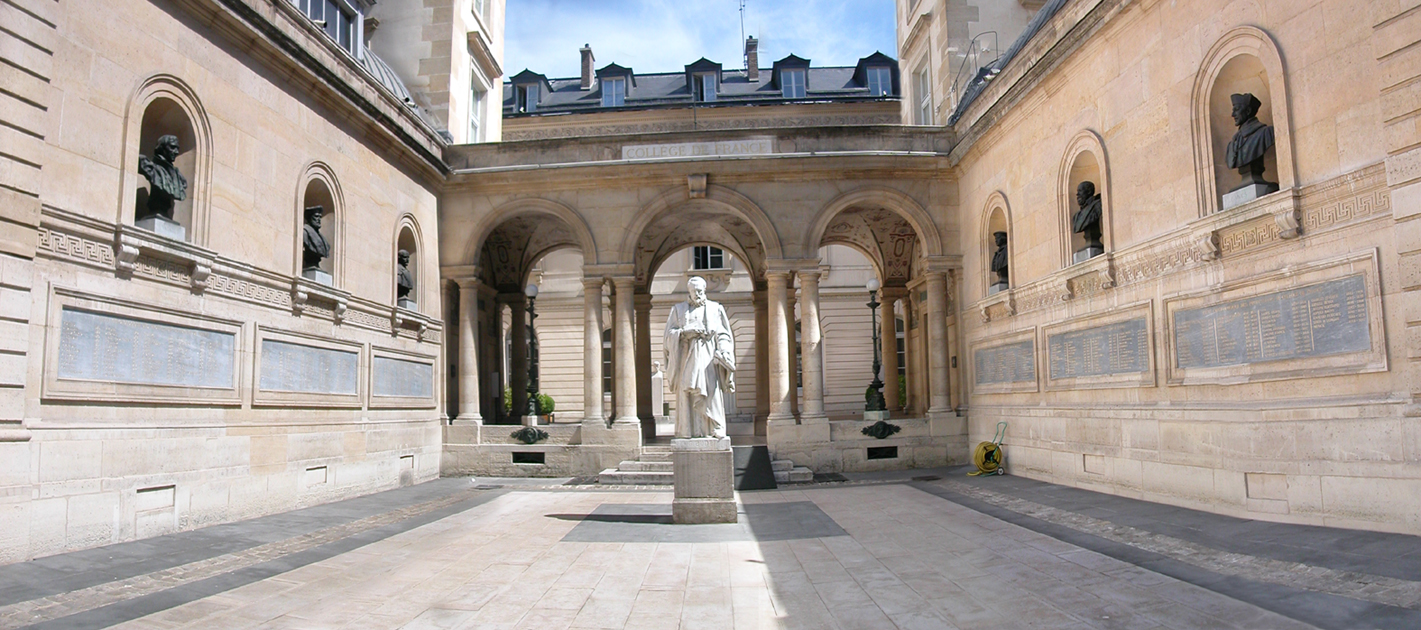
CALL FOR PAPERS: Reframing the Enlightenment. Intellectual and political disputes today’ [ISECS Conference 2026] (Paris: DHI Paris/Collège de France/Maison de la Recherche, 10-12 JUN 2026) [DEADLINE 26 OCT 2025]

(image source: Wikimedia Commons)
 

Abstract:

Early career scholars in particular are warmly invited to submit paper proposals for this interdisciplinary conference on the current debates surrounding the Enlightenment. The conference will focus on the question of how research into the historical Enlightenment and contemporary references to or critiques of the Enlightenment challenge each other.
Proposals for papers, including a half-page explanation of the topic, a short CV, and assignment to one of the three sections listed below, should be sent to the President of ISECS/SIEDS by 26 October 2025: daniel.fulda@germanistik.uni.halle.de. Travel and accommodation costs are expected to be covered by the organisers. The conference languages are English and French.

More information here

BOOK: Jean-Paul ANDRIEUX (dir.), Le droit par les sens [Histoire du droit et des institutions] (Paris: Mare & Martin, 2024), 312 p. ISBN 9782386000713


(image source: Mare & Martin)

Abstract:

Comment les sens définissent, évaluent et interrogent-ils le droit ? Le présent ouvrage collectif invite à rechercher et à découvrir le droit par les sens. À leur capacité de mettre en évidence des aspects inattendus du droit, les sens ajoutent, par une expérience originale et inédite, une modification singulière de notre rapport au droit. La distance habituellement induite par l’objet juridique s’efface avec la vue, le goût, le toucher, l’odorat ou l’ouïe, offrant soudain une proximité troublante. La justice, traditionnellement représentée les yeux bandés, n’illustre pas une conscience perceptive en échec. L’oeil de la loi, de la même manière, ne doit pas rester une image métaphorique solitaire. Les sens, au miroir du droit, révèlent, au-delà de représentations édifiantes, quelque chose de fondamental : ils signifient que le droit se vit dans une expérience sensorielle ininterrompue. Comme la bonne vue fait la meilleure publicité, le bon goût, la meilleure valeur, le toucher, la meilleure garantie, le bon sens fait le bon droit. Le droit par les sens propose ainsi, dans l’Antiquité, la Modernité et l’Actualité, quelques exemples éclai

On the editor:

Jean-Paul Andrieux est Professeur d’histoire du droit à l’université Paris-Panthéon-Assas et membre de l’Institut d’Histoire du droit Jean Gaudemet.

Read more here

26 September 2025

BOOK: Albert RIGAUDIÈRE, Identité, tradition, innovation dans les villes du Massif Central (XIIIe-XVe siècle) [Bibliothèque d'histoire médiévale, eds. Elisabeth CROUZET-PAVAN & Bruno DUMÉZIL, 41] (Paris: Classiques Garnier, 2025), 1083 p. ISBN 9782406179054, € 68


(image source: Classiques Garnier)

Abstract:

Circonscrit aux villes d’Auvergne et à leurs voisines, cet ouvrage démontre qu’en dépit d’un héritage conservateur et de pratiques institutionnelles figées, les trois derniers siècles du Moyen Âge apportent de profondes mutations, tout autant dans le domaine du politique que de la finance.

Read more here:  DOI 10.48611/isbn.978-2-406-17907-8

(source: HiD)

BOOK REVIEW: Ron HARRIS on An empire of laws: legal pluralism in British colonial policy by Christian R. Burset (Comparative Legal History, XIII (2025), nr. 1, June, pp. 146-149)

(Image source: Taylor&Francis)

Christian Burset’s first book, An Empire of Laws, is brilliant. It should be of particular interest to the readers of this journal, as it makes an important addition to the theoretical toolkit available to comparative legal historians. The book explores Britain’s legal policy at a crucial time in the history of the British Empire. During and following the Seven Years’ War (1756–63), Britain expanded its Empire. Hitherto, most of the British colonies were settled by British farmers and plantation and slave owners, which brought about an opportunity for the English common law to be received in the colonies. However, these new territories were formerly ruled by the Spanish, French, or Mughal Empires. Accordingly, the question arose as to whether the common law should be extended to these newly acquired colonies, notwithstanding that they were not settled by English immigrants in large numbers, or at all. Should the new colonial rulers maintain the pre-existing legal systems of these colonies? Alternatively, should a mixture of the differing legal systems be implemented? Thirteen years later, Britain lost many of its former settler colonies in the American War of Independence. At this juncture, much of the Empire was not comprised of British settlers, and imperial legal policy became a major issue. Burset makes a significant scholarly contribution by explaining the background and the issues at stake in this formative period, 1760-1780.

To read the full review, please click here. Online access is free for members of the European Society for Comparative Legal History. 
DOI: 10.1080/2049677X.2025.2500209

25 September 2025

VACANCIES: Five positions as doctoral research associates (m/f/d) available [Graduiertenkolleg Politik der Aufklärung] (Halle: Martin-Luther-Universität-Halle-Wittenberg; DEADLINE 26 OCT 2025)


(image source: Uni Halle)

Five positions as doctoral research associates (m/f/d) available
Research Associate (m-f-d)

The Interdisciplinary Centre for European Enlightenment Studies (IZEA) at Martin-Luther-University Halle-Wittenberg is offering 5 part time (65%) positions as part of the “Politics of the Enlightenment” Research Training Group (RTG 2999) as a

for a fixed term of up to 4 years, starting from 01.04.2026.

Remuneration will be determined based on job duties and responsibilities and will be aligned with the fulfillment of listed personal requirements, up to pay grade 13 under the TV-L (Tarifvertrag für den Öffentlichen Dienst der Länder – ‚German Public Service Pay Agreement for the Federal States‘).

Job Responsibilities:

  • Completion of a dissertation within the Research Training Group’s thematic spectrum.
  • Assistance with Research Training Group activities.
  • The research and training objectives of the Research Training Group are available here https://cloud.uni-halle.de/s/XZFiJKO3UaxHmrh

Requirements:

  • Very good academic university degree (master’s, state exam, or equivalent) in one of the areas of study involved in the Research Training Group (English studies, American studies, German studies, Romance studies, comparative literature, history, cultural history, philosophy, political science).
  • Openness to interdisciplinary cooperation.
  • Very good language skills in German and English. Further language skills are desirable.
  • Strong communicative and social skills.

We offer:

  • An open, motivating, interdisciplinary, and international research context with the opportunity to gain teaching experience.
  • A structured qualification program for university and non-university career paths including a one- to three-month (optional) internship.
  • 30 days of annual vacation plus additional days off on December 24 and 31.
  • A family-friendly, diversity-oriented, and intercultural work environment at a certified family-oriented university, including holiday childcare.

Application Requirements:

  • Exposé of your dissertation project of no more than 5 pages (additionally, a schedule and a summary of the planned structure). This should demonstrate a methodologically well-reflected research question that can be answered in the given timeframe and with interdisciplinary implications within the thematic framework of the Research Training Group.
  • Statement of purpose (with one suggestion for a topic and format for an event that could be organized within the Research Training Group, e.g., seminar, workshop)
  • CV
  • Your most recent final thesis on a relevant subject
  • Copies of all relevant transcripts
  • List of courses taught and publications, if applicable
  • Certificates of employment, if applicable
  • Letter of recommendation from a university lecturer

Applications from disabled persons, including those of equal status (as certified by the Bundesagentur für Arbeit / Federal Employment Agency), will be given preferential consideration if they are equally suitable and qualified. Women are strongly encouraged to apply. Applications from individuals of all nationalities are explicitly welcome. Applicants with a degree that was not obtained at a German university must submit a Statement of Comparability for Foreign Higher Education Qualifications from the Central Office for Foreign Education (ZAB) (https://www.kmk.org/zab/central-office-for-foreign-education) as proof of equivalence upon conclusion of the employment contract. You can find ways to apply for a financial grant for this under: https://www.anerkennung-in-deutschland.de/html/en/pro/recognition-grant.php.

If you have any questions, please contact Mr. Martin Dönike, Email: grk@polight.uni-halle.de.

Please send your application, including Reg. No.: 4-6767/25-D to Martin Luther University Halle-Wittenberg, Graduiertenkolleg “Politik der Aufklärung”, IZEA, Prof. Dr. Elisabeth Décultot, 06099 Halle (Saale) by 27.10.2025.

If possible, please send your application documents bey email (in a single PDF document) with the subject “Application Documents RTG Doctoral Candidate Position” and the Reg. No. to: graduiertenkolleg.pda@izea.uni-halle.de.

This job posting is subject to potential budgetary restrictions. Application costs will not be reimbursed by Martin Luther University. Application documents will only be returned if a sufficiently stamped envelope is enclosed. Electronic applications are welcome.

https://www.verwaltung.uni-halle.de/dezern3/Ausschr/25_4_6767_25_D_engl.pdf

CALL FOR PAPERS: French Historical Studies 2026 Conference: Liberties (Philadelphia (PA), 5-8 MAR 2026); DEADLINE 30 SEP 2025


 THEME: LIBERTIES

Society for French Historical Studies

71st Annual Conference

March 5-8, 2026

Philadelphia, Pennsylvania

Theme: Liberties

Call for Papers - DEADLINE EXTENDED TO SEPTEMBER 30!

[Version française ci-dessous]

The Society for French Historical Studies invites proposal submissions for the 2026 annual meeting, which will take place in Philadelphia, Pennsylvania. In the city where the Declaration of Independence was signed 250 years ago, the theme of this year's conference is "Liberties." Plenary speakers include François Furstenberg (Johns Hopkins University), Jennifer Johnson (Brown University), and Ashli White (University of Miami).  Conference sessions will take place at the Philadelphia Marriott Old City.

Proposals are due September 30, 2025. Please use this submission portal and feel free to reach out to sfhsphiladelphia@gmail.com with any questions that you may have.

We invite submissions on any aspect of French history, but we particularly welcome submissions that engage the conference’s theme. We are also open to papers and panels that speak to wider European and/or Francophone geographies, such as histories of empire or colonization, transnational histories, and more. 

 We seek a wide range of presentations, in English or French, including traditional panels, roundtables, or lightning sessions. We also seek proposals for creative or non-traditional sessions, as well as sessions on topics such as professional development or mentorship. 

We are committed to creating a welcoming and inclusive conference. We encourage scholars with expertise outside of French history and those unaffiliated with institutions of higher education to submit proposals.

To submit a proposal for a panel/session (typically consisting of three paper presenters, a chair, and an optional discussant), we will request via the submission portal as a single .doc or .pdf : 

  • Cover letter that briefly describes the presentation(s) and lists all panel participants and their contact information. 

  • Abstract (300 word maximum) and 1-page CV for each presenter. 

To submit a proposal for an individual paper, we will request via the submission portal as a single .doc or .pdf: 

  • Abstract (300 word maximum) and 1-page CV for presenter. 

  • 3-5 keywords (inclusive of geography, periodization, or theme) to help the programming committee in determining the appropriate panel in which the paper might be presented.

We cannot accept proposals for material that has already been presented or published, or that has been submitted for presentation in another forum. Participants must be members of the Society for French Historical Studies in good standing at the time of the conference and must pay conference fees.  Membership dues should be paid directly to Duke University Press: https://www.dukeupress.edu/society-for-french-historical-studies-sfhs.  

Questions? Please reach out to sfhsphiladelphia@gmail.com

On behalf of the program committee,


Megan Brown (President, Society for French Historical Studies, megan.brown@swarthmore.edu)

Jess Pearson (Program Committee Co-Chair)

Owen White (Program Committee Co-Chair)

2026

The Society for French Historical Studies

71e Conférence Annuelle

5-8 mars 2026

Philadelphie, Pennsylvanie

Thème : Libertés

Appel à contributions - date limite de soumission prolongée au 30 septembre 2025!

 La Society for French Historical Studies lance un appel à contributions pour son congrès annuel 2026, qui se tiendra à Philadelphie, en Pennsylvanie. En honneur à la ville où la Déclaration d'Indépendance a été signée il y a 250 ans, le thème de la conférence de cette année est « Libertés ». Parmi les conférenciers invités, nous aurons le plaisir d’accueillir François Furstenberg (Johns Hopkins University), Jennifer Johnson (Brown University), et Ashli White (University of Miami). La conférence aura lieu au Philadelphia Marriott Old City.

La date limite de soumission des propositions est le 30 septembre 2025. Veuillez utiliser ce portail de soumission et n'hésitez pas à nous contacter à l'adresse sfhsphiladelphia@gmail.com pour toute question.

Les contributions attendues peuvent concerner tout aspect de l'histoire de France, et plus particulièrement celles en relation avec le thème du colloque. Nous sommes ouverts aux communications et aux panels portant plus largement sur la francophonie et ses enjeux, notamment l'histoire des empires ou de la colonisation, les histoires transnationales, etc.

Nous recherchons un large éventail de présentations, en anglais ou en français, incluant des panels traditionnels, des tables rondes ou des présentations éclair. Nous recherchons également des propositions de sessions créatives ou non traditionnelles, ainsi que des sessions sur des sujets tels que le développement professionnel ou le mentorat.

Nous nous engageons à organiser un colloque accueillant et inclusif. Nous encourageons les chercheurs ayant une expertise en dehors de l'histoire de France et ceux qui ne sont pas affiliés à des établissements d'enseignement supérieur à soumettre des propositions.

Pour soumettre une proposition de panel/session (généralement composée de trois présentateurs, d'un président et d'un discutant facultatif), nous demanderons, via le portail de soumission, sous forme d'un seul fichier .doc ou .pdf :

  • Une lettre de motivation décrivant brièvement la ou les présentations et listant tous les participants au panel ainsi que leurs coordonnées.

  • Une proposition de communication (300 mots maximum) et un CV d'une page pour chaque présentateur.

Pour soumettre une proposition de communication individuelle, nous vous demanderons, via le portail de soumission, un seul fichier .doc ou .pdf :

  • Une proposition de communication (300 mots maximum) et un CV d'une page pour le présentateur.

  • 3 à 5 mots-clés (géographie, périodisation ou thème inclus) pour aider le comité de programmation à déterminer le panel approprié pour la présentation de la communication.

Nous ne pouvons accepter les propositions de communication ayant déjà été présentées ou publiées, ni celles soumises pour présentation dans un autre forum. Les participants doivent être membres en règle de la Society for French Historical Studies au moment du colloque et s'acquitter des frais d'adhésion. Les cotisations doivent être réglées directement à Duke University Press : https://www.dukeupress.edu/society-for-french-historical-studies-sfhs.

Des questions ? Veuillez contacter sfhsphiladelphia@gmail.com

Au nom du comité de programme,

Megan Brown (Présidente, Society for French Historical Studies, megan.brown@swarthmore.edu)

Jess Pearson (Program Committee Co-Chair)

Owen White (Program Committee Co-Chair)

BOOK: Andrzej DZIADZIO & Franciszek LONGCHAMPS DE BÉRIER (eds.), Five Centuries of Civil Procedure: The Polish Experience in a European Context (16th to 21st Centuries) [Legal History Library, eds. Dirk HEIRBAUT, Michelle MCKINLEY, Matthew C. MIROW & C.H. VAN RHEE, 76] (Leiden/Boston: Martinus Nijhoff/Brill, 2025), ISBN 978-90-04-73666-5


(image source: Brill)

Abstract:

The first codification of Polish court proceedings was made in 1523. Half a millennium later, the jurists in this volume have carefully analyzed the transformation of Polish civil procedure from then to the present day against the historical background of the development of modern European legal orders and institutions. This study is the result of the work of a research group established at the Jagiellonian University in Kraków, consisting of historical and modern jurists and scholars of civil procedure and private law.

Contributors:

Grzegorz J. Blicharz, Andrzej Dziadzio, Radosław Flejszar, Krzysztof Fokt, Kacper Górski, Jan Halberda, Vincent R. Johnson, Izabela Lewandowska-Malec, Martin Löhing, Franciszek Longchamps de Bérier, Dorota Malec, Maciej Mikuła, Andrzej Olaś, Grzegorz Smyk, Kamila Staudigl-Ciechowicz, and Abdoul Yatera.

On the editors:

 Andrzej Dziadzio, Ph.D. (1994), is Professor of Law and the Head of the Department of Common History of the State and the Law at the Faculty of Law and Administration of the Jagiellonian University in Kraków, Poland. Franciszek Longchamps de Bérier, Ph.D. (1997), is Professor of Law and the Head of the Department of Roman Law at the Faculty of Law and Administration of the Jagiellonian University in Kraków. He also teaches at the Faculty of Law and Administration of the University of Warsaw, Poland.

More information here: DOI 10.1163/9789004736672

24 September 2025

PUBLIC LECTURE and PHD SEMINAR: Prof. Lauren BENTON (Yale), "The Atrocity Paradox : from Limited to Extreme Violence in Empire" (Ottignies/Louvain-la-Neuve: UCLouvain, 15 OCT 2025) [DEADLINE 30 SEP 2025]

(image source: UCLouvain)

Abstract:

On the occasion of Prof. Lauren Benton’s (Yale University) visit and conference to the Louvain Lab for Law, History and Society (LHS) at UCLouvain on 15 October 2025, a doctoral research seminar will be held, open to all PhD candidates in law, history, and legal history in Belgium. This workshop will take the form of an encounter between Prof. Benton and early-career researchers, giving participants the opportunity to discuss their doctoral research on one of the following themes: History of law and justice, across all periods History of empires Global and comparative history Colonial history and the history of colonial law History of violence History of international law 

Each participant is invited to give a 10-minute presentation in English on their doctoral research, followed by a discussion with Prof. Benton. To take part in this workshop, please send your paper proposal (350-word abstract + CV) to quentin dot verreycken at uclouvain dot be no later than 30 September 2025. Lauren Benton is Barton M. Biggs Professor of History and Professor of Law at Yale University. Her research focuses primarily on the global history of empires and the history of international law. Her most recent book is They Called It Peace: Worlds of Imperial Violence (Princeton University Press, 2024).

Practical:

15/10/2025 2:00PM-5:00PM UCLouvain, campus Louvain-la-Neuve Salle Dabin, Thomas More Building Place Montesquieu 2, 1348 Louvain-la-Neuve

(more information here)

BOOK: Miloš VEC, Wolfgang Preiser (1903–1997) und sein „Institut für Geschichte des Völkerrechts“ an der Universität Frankfurt. Denkräume und Sozialwelten eines Völkerrechtshistorikers im 20. Jahrhundert [Studien zur Geschichte des Völkerrechts, eds. Jochen VON BERNSTORFF, Bardo FASSBENDER, Anne PETERS & Miloš VEC] (Baden-Baden: Nomos Verlag, 2025), 267 p. ISBN ISBN 978-3-7560-2319-6, € 89


(image source: Nomos)

Abstract:
Wolfgang Preiser (1903-1997), professor of criminal law and international law, founded the “Institute for the History of International Law” at the University of Frankfurt in 1955. This biography tells the story of Preiser's life and interprets his work, drawing on archival research and interviews. Preiser was particularly interested in the origins of international law. He retained a lifelong fascination for its earliest evidence in the Middle East. In his later work, Preiser devoted himself to non-European regions of the world and the manifestations there of what he recognized as international law. The study is therefore also a contribution to the concept of international law and the problems of its historical research beyond Eurocentrism.

 Read more here.


ARTICLE: François OST, "« Tant que la cité cultive la justice… » Les fresques du Bon et du Mauvais Gouvernement d’Ambrogio Lorenzetti" (Revue interdisciplinaire d'études juridiques XCIV (2025), nr. 1, 67-91)


(image source: Cairn)

Abstract:
Les fresques du Bon et du Mauvais Gouvernement d’Ambroggio Lorenzetti (Palazzo Pubblico, Sienne, 1338) sont, à juste titre, considérées comme le programme politique d’une commune libre, dans une Italie déchirée par les guerres qui opposent le parti de l’Empereur et celui du Pape, et tentée par le régime des potentats princiers. Après les avoir décrites dans le détail, je tente d’en discerner les sources théoriques qui remontent à Aristote et Cicéron. Je tente aussi de rendre justice à leur portée artistique remarquable : à la fois le plus vaste cycle politique du Moyen-Âge et la première grande peinture politique de la Renaissance. Passant ensuite au registre de la fiction, je suggère que le plaidoyer de ces fresques pour la liberté et la concorde ont encore beaucoup à nous dire aujourd’hui.

Read more here: DOI 10.3917/riej.094.0067.


23 September 2025

BOOK: Bruno RODRÍGUEZ-ROSADO, Rocío CARO GÁNDARA & Antonio LEGERÉN-MOLINA (eds.), Cause and Consideration: Exploring the Foundations of Contract Law (Oxford: Hart Publishing, 2025), pp. 293+xix, ISBN: 978-1509971398, £70.00

(Source: Hart Publishing)


ABOUT THE BOOK:

This book provides a comprehensive study of two parallel notions of civil and common law: cause and consideration. It does this in three ways; with historical, comparative, and functional perspectives. Aspects of cause and consideration are hotly contested by contract lawyers and this book will bring clarity by looking at the English and Continental positions. Key areas of focus include: enforceability, questions of legality and morality, contractual justice, and the correction of unjustified property displacements. Bringing together a team of experts, the book discusses (in some cases for the first time in English), complex questions of both academic and practical importance.


ABOUT THE EDITORS:

Bruno Rodríguez-Rosado is Professor of Law at the University of Málaga, Spain.

Rocio Caro is Professor of Law at the University of Málaga, Spain.

Antonio Legerén-Molina is a Professor of Law at the University of A Coruña, Spain.


ABOUT THE AUTHORS:

Gregor Albers, Francisco-Javier Andrés Santos, John Cartwright, Wojciech Dajczak, David Deroussin, Olivier Deshayes, Birke Häcker, David Ibbetson, Nils Jansen, Juan-Pablo Murga, João de Oliveira Geraldes, Francesco Patti, Rocío Caro, Antonio Legerén-Molina, Bruno Rodríguez-Rosado.


TABLE OF CONTENTS:

Part I. Origins and Historical Development

1. Roman Origins: Typicity of Contracts in Roman Law, FJ Andrés, University of Valladolid

2. Medieval Development, João de Oliveira Geraldes, University of Lisbon

3. The Rise and Fall of Consideration in English Law, D Ibbetson, University of Cambridge

4. The Cause in Modern Doctrine and Early Codifications, D Deroussin, University of Lyon

5. The Decline of Cause, W Dajczak, University of Poznan

Part II. National Reports

6. The Role of Consideration in English Law, J Cartwright, University of Oxford

7. The French Development, O Deshayes, University of Paris-Nanterre

8. The Use of Cause of Contract in Spanish Law, A Legerén-Molina, University of Coruña

9. Germany and its Rejection of the Cause, G Albers, University of Linz

10. The Italian Variant, F Patti, Bocconi University of Milan

Part III. Functions of Cause and Consideration

11. Cause, Consideration and the Enforceability of Promises, B Rodríguez-Rosado, University of

Málaga

12. Cause and the Control of Legality and Morality of Contracts, JP Murga, University of Seville

13. Cause, Consideration and Frustration of Contract, R Caro, University of Málaga

14. Cause, Consideration and Unjust Enrichment, B Häcker, University of Bonn

Part IV. Final Conclusions

15. Rethinking Cause and Consideration, N Jansen, University of Münster

ARTICLE: Robert SCHÜTZE, "‘Victorian’ Traditions: British International Law Scholarship, 1830–1914" (International and Comparative Law Quarterly LXXIV (2025), nr. 2, 409-435)


Abstract:

What are the philosophical and normative orientations of British international law scholarship during the Victorian era? This article explores and answers this question in three complementary steps. It begins with an analysis of the ‘public’ international law textbooks after 1830 to show that, instead of a single legal tradition, there coexisted three competing traditions during this period: a ‘naturalist’, an ‘historicist’ and a ‘voluntarist’ tradition. These three Victorian traditions will, in a second step, be studied in the context of ‘private’ international law—a discipline that developed and received its name during this period. A third section finally offers a detailed examination of the transformative work of Lassa Oppenheim, which straddled the Victorian nineteenth century and the ‘modern’ twentieth century. In revisiting the normative project(s) of Victorian international law, the article hopes to critique three prominent views in the contemporary academic literature. The first view holds that voluntarist State positivism exercised a dominant influence on British international law scholarship after 1830; a second view has claimed, relatedly, that during this period an idiosyncratic ‘English’ approach to international law emerged; and a third view has famously suggested that there was a ‘radical’ break in the discipline of international law around 1870.

Read the article here: DOI  10.1017/S0020589325100766.

22 September 2025

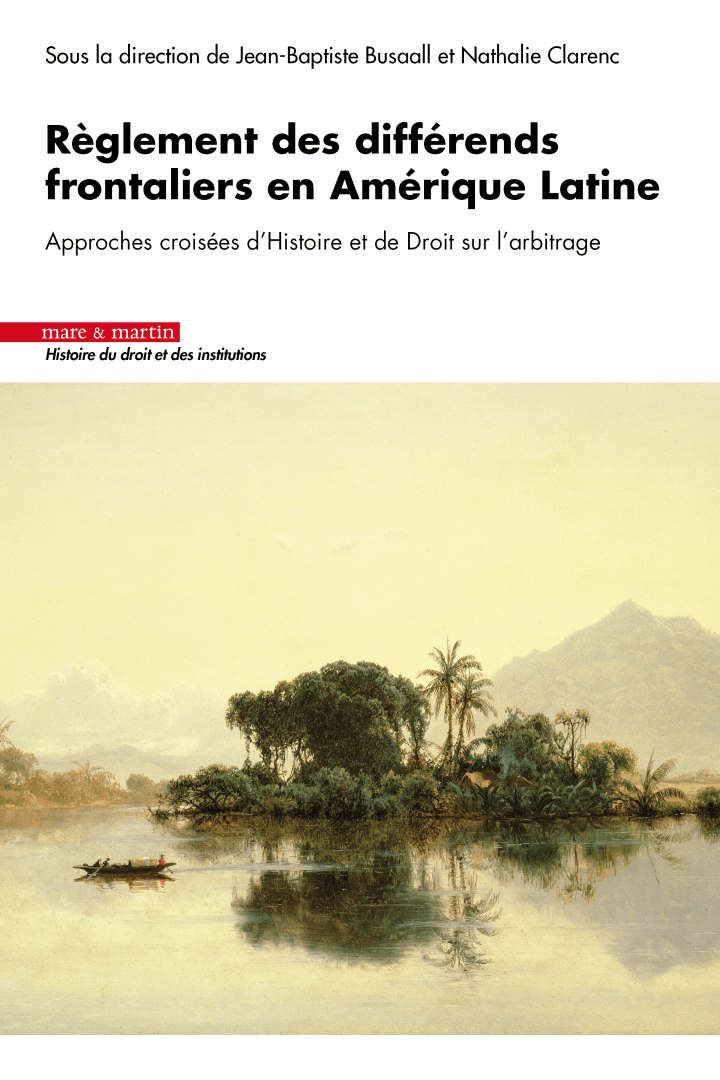
BOOK: Jean-Baptiste BUSAAL & Nathalie CLARENC (dir.), Règlement des différends frontaliers en Amérique Latine. Approches croisées d'Histoire et de Droit sur l'arbitrage [Histoire du droit et des institutions] (Paris: Mare & Martin, 2025), 212 p. ISBN 978-2-38600-061-4, € 27


(image source: Mare & Martin)

Abstract:
Aujourd’hui, le tracé des frontières litigieuses de l’Amérique latine se dessine à La Haye devant la Cour internationale de justice. Il occupe une grande partie de son activité judiciaire : 14 affaires furent introduites seulement depuis le début des années 2000. Mais la question est ancienne et la plupart des différends avaient déjà donné lieu à des procédures d’arbitrage entre le xixe et le début du xxe siècle. Cet ouvrage propose un recueil d’analyses de cas historiques et contemporains d’arbitrages de frontières dans l’espace des anciennes colonies ibériques de l’Époque moderne. L’approche est pluridisciplinaire, car elle allie histoire du droit et droit international. Les contributions des historiens du droit s’inscrivent dans le prolongement d’une historiographie récente qui a montré en quoi l’enjeu de l’intégrité territoriale est l’une des conséquences du double phénomène de construction institutionnelle des États et de la forge d’un discours national, voire nationaliste, au xixe siècle. Les auteurs internationalistes proposent une réflexion sur les modalités juridiques de règlement des disputes territoriales entre États, depuis les arbitrages du xixe siècle jusqu’aux procédures judiciaires du xxie siècle. L’analyse de cette évolution fournit des éclairages utiles sur le droit du contentieux international, et alimente la réflexion lancinante sur l’efficacité de la justice internationale : le règlement judiciaire pourra-t-il réussir là où les tentatives d’arbitrage ont échoué ?

On the editors:

Jean-Baptiste Busaall est Maître de conférences en histoire du droit à l’université Paris Cité. Nathalie Clarenc est Maître de conférences en droit public à l’université Paris Cité.

Read more here.

19 September 2025

BOOK: Andrzej DZIADZIO, Mateusz MATANIAK & Piotr MICHALIK,The French Civil Code in the Free City of Cracow (1815–1846) [Legal History Library, eds. Dirk HEIRBAUT, Michelle McKINLEY, MATTHEW C. MIROW & C.H. VAN RHEE, 73] (Leiden/Boston: Martinus Nijhoff/Brill, 2025), ISBN 978-90-04-68873-5


(image source: Brill)

On the authors:
Andrzej Dziadzio, Ph.D. (1994), Jagiellonian University, is Professor at the Law Faculty of that university, specialising in the constitutional and legal history of the Habsburg monarchy and Poland in the 18th and 19th century. Mateusz Mataniak, Ph.D. (2014), Jagiellonian University, is Senior Researcher at the Law Faculty of that university, specialising in the constitutional and legal history of the Free City of Cracow and the judiciary in Poland. Piotr Michalik, Ph.D. (2010), Jagiellonian University, is Senior Lecturer at the Law Faculty of that university and an attorney. He specialises in the constitutional and legal history of the Free City of Cracow and modern England.

On the book:

This book is a summary of the extensive research by the co-authors on the validity and application of the 1804 French Civil Code in the Free City of Cracow (1815-1846), the Polish constitutional city-state established at the Congress of Vienna. From the wealth of case-law and legal practice of the Cracovian Republic emerges a picture in which its inhabitants were consciously and consistently building the structure of a modern state. As far as was possible amid the realities of post-feudal society, this state was already based on the rule of law. One of the basic elements of this legal structure was precisely the Napoleonic Code, which established the framework for the private law of the Free City, and made it a very small, but important, part of European legal heritage.

Read more here: DOI 10.1163/9789004688742.


JOURNAL: Les despotismes de l'Autre (Special Issue Monde(S) 2025/1)


(image source: Cairn)

Abstract:
Ce numéro thématique consacré à la notion de « despotisme oriental » vise à articuler les enjeux de la géopolitique contemporaine avec les débats plus anciens concernant la nature de l’autoritarisme ainsi que ses origines culturelles et structurelles. Le « despotisme oriental » est un concept qui a évolué au fi l des siècles, de l’Antiquité au siècle des Lumières, De l’Esprit des lois de Montesquieu aux théories de Karl Marx sur le « mode de production asiatique », jusqu’à sa théorisation par le sinologue Karl Wittfogel (1957) pendant la Guerre froide. Ce concept constitue le fi l conducteur d’une réfl exion englobant diverses périodes historiques et aires culturelles, qui interroge la représentation des régimes autoritaires, les débats sur le concept de « totalitarisme », les discours orientalistes et les politiques hydrauliques. La portée, bien que très contestée, de la thèse de Wittfogel sur les facteurs écologiques et infrastructurels qui déterminent les systèmes politiques à travers le temps et l’espace ouvre de nombreuses pistes de réfl exion encore inexplorées. Pour cette raison, ce numéro rassemble des historiennes et des historiens s’intéressant aux structures et aux idées politiques, aux formes d’organisation sociales et économiques, à l’histoire des femmes et du genre et de l’environnement. Il couvre un vaste espace géographique incluant l’Europe, la Chine antique et contemporaine, la Russie et le monde musulman médiéval, dans le but de dépasser une perspective trop souvent eurocentrée. En examinant les usages et la pertinence de cette catégorie analytique, les contributions de ce numéro analysent, à travers diff érentes études de cas, à la fois la diff usion mais aussi la disqualification du concept de « despotisme oriental » ainsi que son utilisation dans diff érents débats théoriques et idéologiques. L’objectif est moins de remettre en cause sa validité épistémologique que de comprendre ce que son emploi révèle sur le rapport à l’altérité.

 Read more here.


BOOK REVIEW: Joshua GETZLER, on The making of modern property: reinventing Roman law in Europe and its peripheries 1789–1950 by Anna di Robilant (Comparative Legal History, XIII (2025), nr. 1, June, pp. 138-145)

(Image source: Taylor&Francis)


In this ambitious monograph Anna di Robilant describes how European jurists of the eighteenth and nineteenth centuries drew from the doctrines of Roman classical law and ius commune traditions in order to craft a new ‘Romanist-bourgeois’ form of property. She shows how a succession of gifted scholars steeped in Roman legal tradition produced a concept of property as dominium or absolute command, designed to secure the widest possible control of resources by individual owners. The hallmark of this dominium was the power to assign and dispose of assets as expressions of subjective right grounded in the free will of the autonomous owner. This juridical project of Romanist-bourgeois property joined to an ideological inheritance drawn from idealist philosophy (Kant, Hegel) and political economy (Smith, the Physiocrats), according to which a person’s interests were best expressed by choice of conduct in relation to external things and persons, yielding property and obligations as the basic legal building blocks of society. Each of these streams of liberal thought – the legal, the philosophical, and the economic – emphasized the benign operation and interaction of the wills of autonomous actors who could, within the guidance of a modernised legal order, constitute a cooperative society based on voluntary relations between equals. On di Robilant’s account, Romanist-bourgeois property as individualised dominium was not only projected as a positive contribution to freedom in a well-ordered society; it was also an act of creative destruction, aiming to clear away illiberal obstacles left over from the past. Romanist-bourgeois property would dissolve or displace the older feudal forms of holding that were associated with hierarchy, inequality, domination, and inefficiency, and permit the forces of capital and labour to interact with utmost freedom and rationality. Like modern economic analysts of the law today, Roman-bourgeois theory appealed to a lofty sense of autonomy, allied to a yen for efficiency and prosperity.


To read the full review, please click here. Online access is free for members of the European Society for Comparative Legal History. 

DOI: 10.1080/2049677X.2025.2500208


18 September 2025

CLOSING LECTURE: Prof. dr. Jean-Louis HALPÉRIN (Paris: École normale supérieure, 15 DEC 2025)


(click on image to enlarge)

Jean-Louis Halpérin
Professeur à l’École normale supérieure
ancien directeur du Centre de Théorie et d’Analyse du Droit
prononcera sa leçon de clôture

« Entre nouveau(x) et ancien(s) droits »

à l’occasion de son départ à la retraite,
le lundi 15 décembre 2025 à 16h00, à l’Amphithéâtre Daniel Cohen,
Campus Jourdan de l’Ecole normale supérieure – 48, boulevard Jourdan, 75014 Paris

La conférence sera suivie d’un cocktail.
Collègues, étudiant·e·s et ami·e·s sont chaleureusement convié·e·s
à partager ce moment.

contact@ctad.parisnanterre.fr


JOB: Postdoc position in history of ius commune (Poznan: Adam Mickiewicz University, DEADLINE: 13 October 2025)


The Centre for Ius Commune at Adam Mickiewicz University (Poznan, Poland) is seeking a Postdoctoral Researcher for the ERC Starting Grant project "PetrIUS: Petrification of ius commune through printed paratexts".

Between the 1460s and 1620s, printed editions of canon and civil law texts witnessed a constant development of marginal paratexts, such as glosses, summaries, cases or commentaries. They were added to authoritative legal sources because the printers were interested in improving the quality and attractiveness of new source editions. They often hired legal experts who offered them new tools, resources, and ideas. These were incorporated into printed books using new printing techniques. In consequence, the dynamic between improved new editions and advances in printing enterprise fueled the ongoing development of printed legal books. Various questions concerning the origin, transmission, and influence of paratexts are embedded in the interplay between sources and marginalia, manuscripts and printing, editors and printers, and books and their readers. PetrIUS has an innovative approach for shifting the focus from source (text) to marginalia (paratexts). PetrIUS aims to examine how print and its evolution helped to petrify – that is, consolidate – landmark achievements of late medieval ius commune. This is done by enabling some doctrinal accounts to be transferred into marginalia of source editions. The novelty brought about by print affected legal science and communication. PetrIUS will acknowledge how legal experts employed novel technical tools to transfer the heritage of medieval law into early modern source editions and how these processes affected patterns of scientific work and the transfer of knowledge in academia. To do so, PetrIUS will implement typical legal and book history tools as well as natural language processing techniques. The latter enables detailed comparisons between paratexts’ printed editions and their reception in the scholarly literature. The research will conclude with a legal theoretical study that assesses the early modern significance of paratexts by treating them as the media of law, that is, the means of legal communication.

The postdoctoral researcher will contribute to the implementation of the project by studying the printed paratexts of the corpus iuris civilis. Their work will focus primarily on two main work packages related to these printed paratexts: classification of types and functions of paratexts added to printed corpora iuris (WP1) and petrification of late medieval ius commune taking the form of printed paratexts in corpora iuris (WP5).


This is a full-time position for 45 months (including 6 months probation period) starting December 2025.

For more information on the call and on the project do not hesitate to contact the project PI, Piotr Alexandrowicz (piotr.alexandrowicz[at]amu.edu.pl).


More information on the call can be found here.


JOURNAL: Jus Gentium. Journal of International Legal History X (2025), nr. 2


Vol. 10, No. 2 | July 2025

ARTICLES
The Strongman Who Doubled as the Dove of Peace: Carlos Saavedra Lamas
Catalina Peñéñory

“Humiliated and Insulted”: What International Law Can Learn from Russian Literature
Alim Ulbashev

NOTE
The Praefatio to Leibniz’s Codex Iuris Gentium Diplomaticus: A Work Between Erudition and Theoretical Uncertainty
Carmelo Massimo de Iuliis

Codex Iuris Gentium Diplomaticus: Preface to the Reader
Gottfried Wilhelm Leibniz
Carmelo Massimo de Iuliis (transl.)

DOCUMENTS AND OTHER EVIDENCE OF STATE PRACTICE
The Martens Diaries: 1883-1884
F. F. Martens
William E. Butler (transl.)

REVIEW ARTICLES
Grotius in Fiction
William E. Butler

The Advisory Committee of Jurists
Mark W. Janis

Regionalism Triumphant: Cambridge International Legal History, Vols. VI and X
William E. Butler

The Grotian Census
William E. Butler

FROM THE LITERATURE

INDEXES
Index of Authors
Index of ‘From the Literature


More information here.

BOOK: Clémence FAUGÈRE, Le Contrôle juridique de l’imprimé. L’apprentissage de la Troisième République (1870-1906) [Littérature et censure, ed. Jean-Baptiste AMADIEU; vol. 10] (Paris: Classiques Garnier, 2025), 771 p. ISBN 978-2-406-18295-5, € 55


Abstract:

Après la proclamation de la Troisième République en 1870, les institutions étatiques adoptent un droit de l'imprimé qui garantit dans un premier temps l'autorité et la stabilité du régime puis affirme ses valeurs républicaines.

More information here: DOI 10.48611/isbn.978-2-406-18297-9.

17 September 2025

JOURNAL: Rechtsgeschichte - Legal History 33 (2025)


Journal of the Max Planck Institute for Legal History and Legal Theory. 

The most recent issue of Rechtsgeschichte – Legal History (Rg) opens with an essay in the Research section on multilingualism and law in late antiquity. Hartmut Leppin focuses on Syrian, Coptic and Hebrew sources, showing the rich legal pluralism of the Roman empire and how its openness to diverse languages was part of the decentralisation of the empire, even transcending its borders. Thorsten Keiser uses sources from the late middle ages, the early modern period and the modern era to trace the transformation of labour law from a right to discipline workers into the workers' right to social security. Thomas Weitin and Katharina Herget demonstrate possible applications of Digital Humanities in their study of the criminal cases collection Der Neue Pitaval (1842–1890). The Research section closes with Daniel Siemens’ contribution about the periodical Rechtsprechung zum Wiedergutmachungsrecht (1949–1981) and the tireless work of its editor Walter Schwarz to promote German jurisprudence on reparations. 

The Focus section looks at a central issue of labour law: the normative structures of industrial relations in the 19th and 20th centuries. The studies by Peter Collin, Johanna Wolf, Tim-Niklas Vesper and Matthias Ebbertz result from years of research at the Institute into normative labour relationships in the metal industry. This section also contains further contributions by Roman Köster, Eva-Maria Roelevink und Fabian Trinkaus. 

As always, the Critique section covers new publications from the colourful cornucopia of legal history, including: legal pluralism, Chinese legal history, legal history in Latin America, the history of private law, public law, and criminal law. The reviews in this section are authored by researchers at the Institute and from all over the world. This edition of the Rg also premiers a new section: following the Critique, under the heading Comptes rendus, you will find ten short presentations of select publications from members of the Institute. 

This year’s Rg is rounded off by two Marginalia. In the first, Ralf Seinecke asks: Was ist Recht? (What is Law?). In the second, Karla Escobar offers a look, based on the dissertation that she wrote at the Institute and published in Colombia in the form of a Graphic History, at the Indigenous Movement in Colombia around 1900. This graphic novel also provided the material for the image spread in the printed issue of this Rg edition. 

Rechtsgeschichte — Legal History 33 is now available, in print from the VittorioKlostermann publishing house and online in Open Access via the journal’s website.

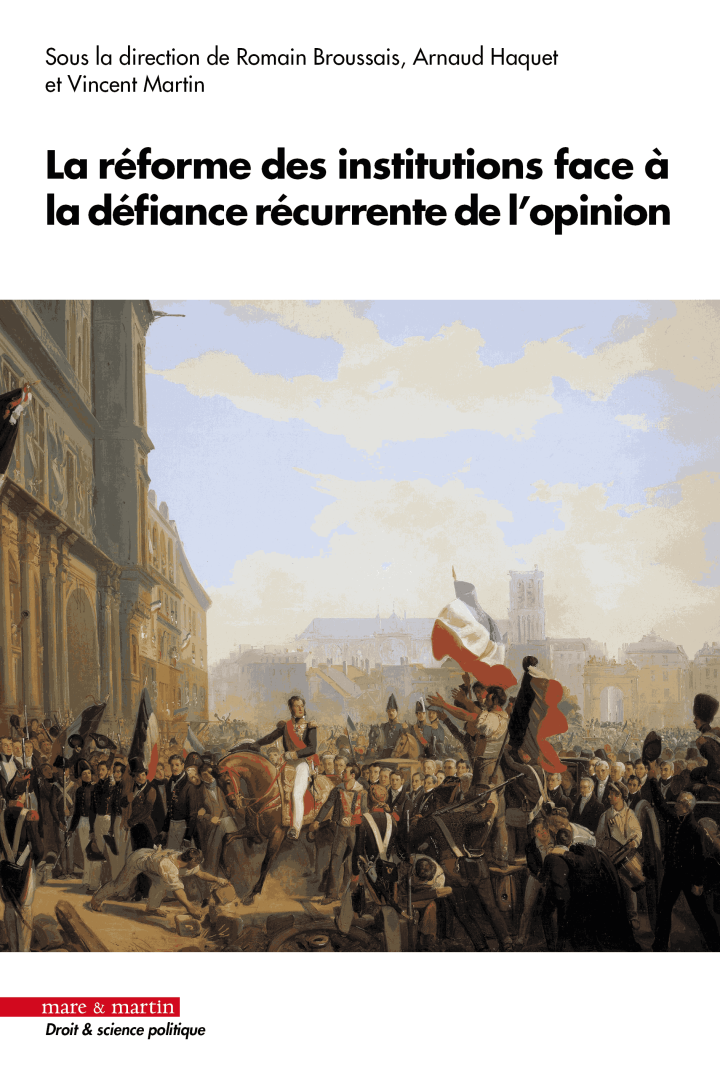
BOOK: Romain BROUSSAIS, Arnaud HAQUET & Vincent MARTIN (dir.), La réforme des institutions face à la défiance récurrente de l'opinion [Droit & science politique] (Paris: Mare & Martin, 2025), 330 p. ISBN 9782386001130, € 34


(image source: Mare&Martin)

Abstract:

Les institutions sont confrontées à la problématique de la confiance que leur portent les membres de la communauté politique. À la hauteur des attentes des gouvernés existe une exigence aiguë à l’égard des entités dépositaires de l’intérêt général. Ces attentes voisinent toujours de vives déceptions : il suffit que soient mises au jour des défaillances dans le fonctionnement des organes gouvernants ou qu’éclate en leur sein un scandale, pour qu’émerge un sentiment de méfiance. Cette question est particulièrement contemporaine, car plane sur notre société le sentiment d’une crise de confiance vis-à-vis des institutions, fort dangereuse pour la stabilité de la chose publique et pour la paix sociale. Face à ce défi, se pose la question de la réforme pour répondre aux maux et pour renouer les liens entre gouvernants et gouvernés. À l’aune des interrogations actuelles et des solutions passées, cet ouvrage entend contribuer à la réflexion sur cette question, à la lumière des travaux d’universitaires en droit, sous le prisme de l’histoire et de l’actualité. En explorant l’évolution des réformes de la justice et de l’administration, du Moyen Âge à nos jours, l’ouvrage met en lumière les solutions envisagées, leurs objectifs et leur concrétisation. Les enseignements tirés de ces expériences passées nourrissent ainsi la réflexion sur les réponses à apporter aux défis institutionnels de demain.

 Read more here.

16 September 2025

BOOK: Virginie LEMONNIER-LESAGE (dir.), Guy Coquille, sieur de Romenay, humaniste et juriste (1523-1603) [Colloques & Essais; 220] (Paris: Institut Francophone pour la Justice et la Démocratie, 2025), 174 p. ISBN 9782370324351, € 19


(image source: LGDJ)

Abstract:
Né le 11 novembre 1523 à Decize dans une famille de juristes – son grand-père maternel est lieutenant général au bailliage de Saint-Pierre-le-Moûtier –, Guy Coquille, sieur de Romenay, est formé au collège de Navarre à Paris avant d’aller étudier le droit civil à l’Université de Padoue. De retour à Paris, il fera son apprentissage pratique, pendant trois ans, auprès de son oncle Noël Bourgoing, conseiller au Parlement de Paris. Entre septembre 1548 et août 1550, Coquille étudie à l’Université d’Orléans où il obtient vraisemblablement le grade de licencié ès lois. Devenu avocat, il exerce à Paris jusqu’en 1553 avant de revenir à Decize et de s’installer définitivement à Nevers à partir de 1559. Guy Coquille exerce différentes charges de procureur fiscal ou bailli avant de se voir confier par le duc de Nevers, en mai 1571, la charge de procureur général et fiscal du duché. Parallèlement à sa carrière de juriste, Guy Coquille mène une carrière politique : conseiller de la ville dès 1560, il devient le premier échevin de Nevers entre 1568 et 1570. Il est élu député du tiers état du Nivernais aux États généraux qui se tiennent à Orléans en 1560 et 1561 et à Blois en 1576 et 1588. Gallican, monarchiste défenseur d’une monarchie tempérée, attaché aux corps intermédiaires et aux institutions locales, Guy Coquille laisse une œuvre doctrinale essentielle, consacrée à la fois au droit privé et au droit public. Auteur gallican, Coquille est aussi auteur coutumier. Défenseur des droits du duché de Nevers, il l’est aussi de ceux du roi catholique. Avocat humaniste, il est auteur de poésies. Autant de centres d’intérêt chez ce grand juriste qui permettent, à l’occasion du cinquième centenaire de sa naissance, de réunir autour de lui de nombreux spécialistes de différentes disciplines : historiens, historiens du droit, historiens des idées politiques, historiens des lettres et tous ceux qui s’intéressent à son œuvre, son environnement ou son influence. Actes du colloque des 29 et 30 juin 2023 organisé, au Château de Romenay, aux Archives départementales de la Nièvre et au Palais ducal de Nevers

On the editor:

Virginie Lemonnier-Lesage, Professeur en Histoire du droit et des institutions.

Read more here


15 September 2025

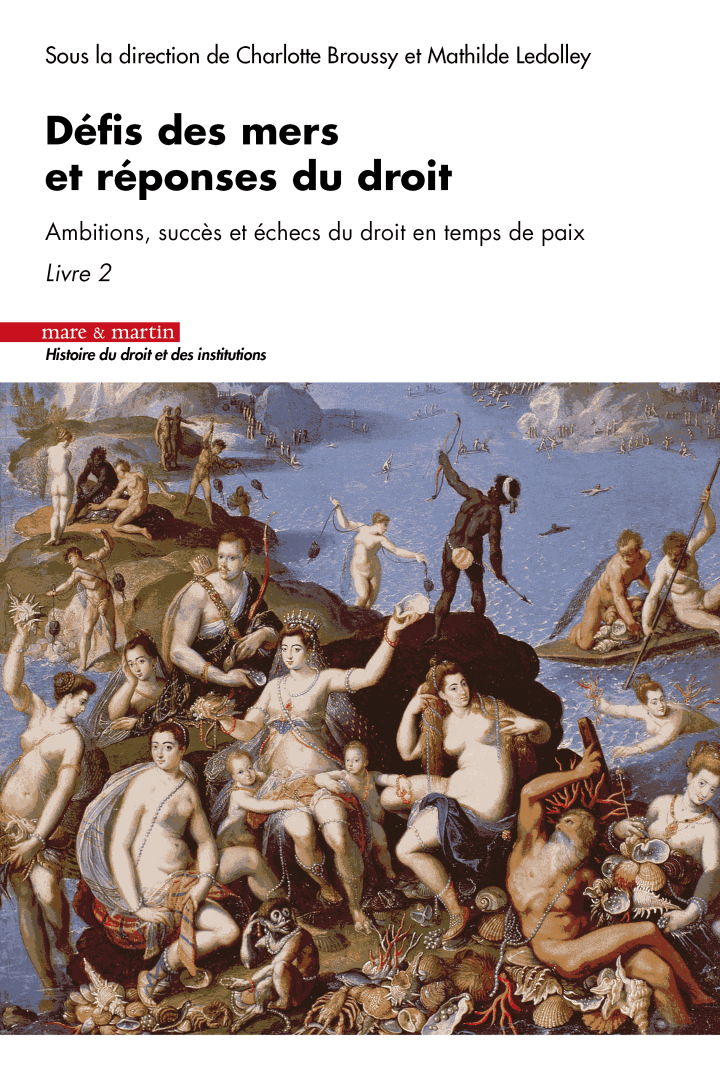
BOOK: Charlotte BROUSSY & Mathilde LEDOLLEY (dir.), Défis des mers et réponses du droit. Ambitions, succès et échecs du droit en temps de paix [Histoire du droit et des institutions] (Paris: Mare & Martin, 2025), 514 p. ISBN 978-2-38600-166-6, € 45


(image source: Mare & Martin)

  Abstract:

La mer dans son sens le plus commun est une « étendue d’eau salée qui occupe la plus grande partie de la surface terrestre ». Or, elle est aussi une voie de circulation ainsi qu’une zone exploitée par l’Homme. Lors de son utilisation, s’y confronte une multitude de questionnements juridiques, aussi techniques qu’originaux et pragmatiques. Ceux-ci donnent lieu à des réponses juridiques couronnées de succès ou, au contraire, qui ont échoué. Dans cette perspective, et dans la continuité d’une dynamique de recherche initiée par le Doyen Bernard Durand, cet ouvrage collectif entend montrer à quel point l’espace marin se caractérise par l’ambiguïté d’un ordre en perpétuel mouvement, voire d’un ordre en batailles. Là, la paix n’est pas tout à fait la paix et la guerre n’est pas tout à fait la guerre. Entre la guerre et la paix, il faut affronter cet espace de domination – humaine et économique – comme faire face aux défis – juridiques, humains et naturels.

On the editors:

Charlotte Broussy est Maître de conférences en Histoire du droit à l’université de Montpellier. Mathilde Ledolley est doctorante en Histoire du droit à l’université de Montpellier.


Read more here


12 September 2025

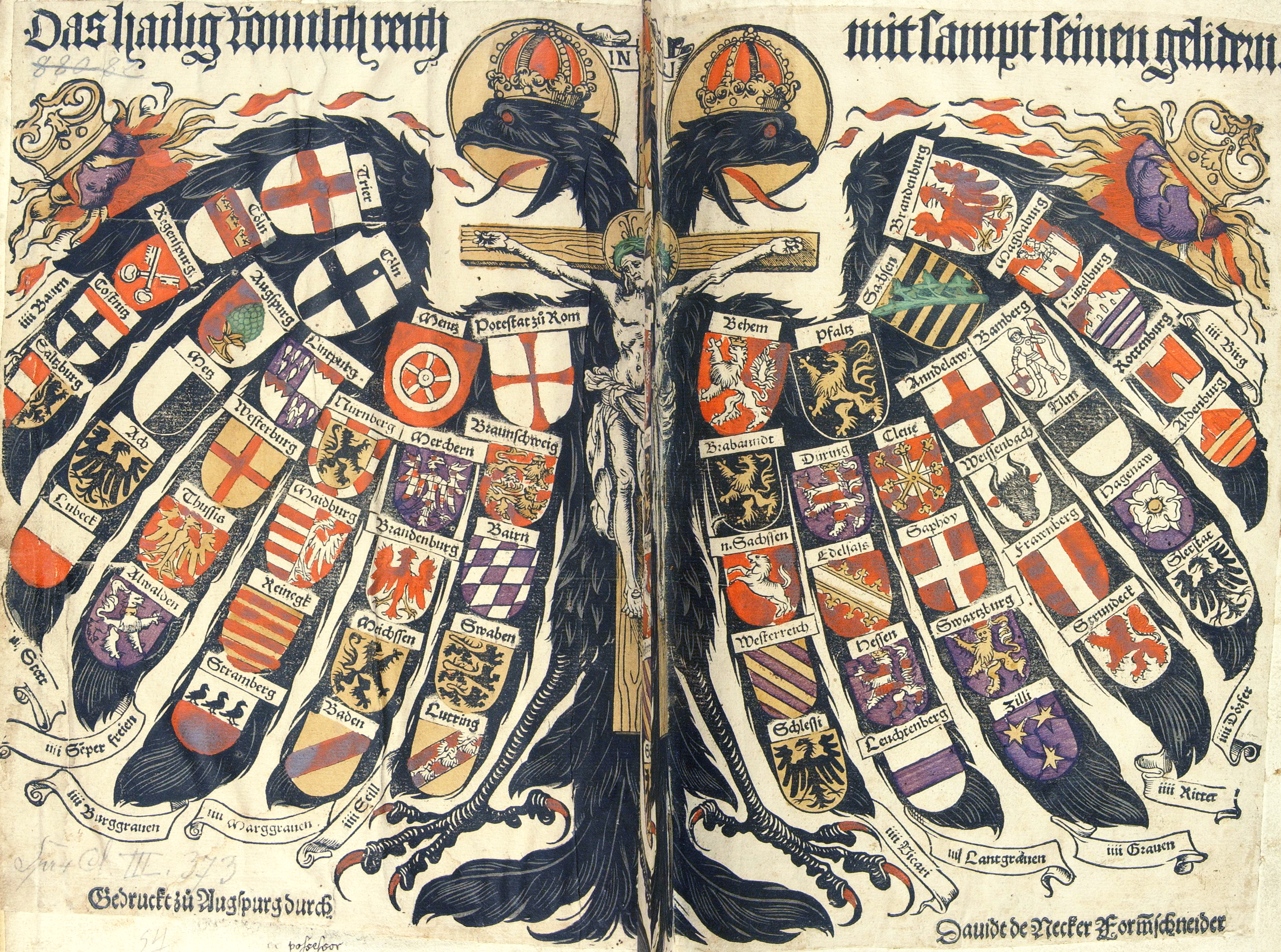
DATABASE: Les mots du Saint-Empire. Un glossaire (red. Falk BRETSCHNEIDER & Christophe DUHAMELLE) (Paris: EHESS) [ONLINE]

(image source: Les mots du Saint-Empire)


On the website:

Ce site, fruit du séminaire "Droit, espaces, appartenances" de l'EHESS, propose un glossaire dédié au Saint-Empire. Chaque notice offre une introduction concise aux réalités institutionnelles, tout en signalant les alternatives et les problèmes. Ce glossaire, évolutif et non contraignant, vise à faciliter l'accès aux travaux sur le Saint-Empire.

On the project:

L'une des difficultés auxquelles est confronté l'historien français lorsqu'il se consacre au Saint-Empire de l'époque moderne est de non seulement comprendre, mais également traduire les « termes techniques » souvent d'autant plus malaisés à rendre en français qu'ils correspondent à des réalités sui generis. Entre 2012 et 2020, le séminaire « Droit, espaces, appartenances : étaticités fractales à l'époque moderne » de l'EHESS (animé par Falk Bretschneider et Christophe Duhamelle) a consacré plusieurs séances au problème de la traduction. Cette réflexion collective a débouché sur le glossaire Les mots du Saint-Empire désormais disponible en ligne. La diversité des auteurs reflète le travail commun et les choix de traduction ont tous été discutés. Ils reposent sur la combinaison de plusieurs exigences : l'exactitude la plus grande, bien sûr ; mais aussi les usages reçus, quand ils existent (la consultation de traités français d'Ancien Régime abordant les institutions impériales permet parfois d'établir l'ancienneté de ces usages) ; le souci d'éviter l'anachronisme (qui conduit à préférer Saint-Empire à « Empire » tout court ou à « Ancien Empire » qui serait la traduction littérale de l'expression allemande la plus courante, Altes Reich) ; et enfin la volonté de se garder des traductions d'apparence trop ésotérique. Le dosage entre ces exigences s'est effectué de façon pragmatique – le seul principe étant de ne pas reprendre les termes allemands, solution de facilité qui limite l'accès des non-spécialistes aux travaux traitant du Saint-Empire. Le choix a également été fait d'un format uniforme des notices. Il ne s'agit pas uniquement d'un glossaire de traduction : en proposant des définitions précises retraçant le contexte historique, l'ensemble a également l'ambition de constituer une petite introduction aux réalités, surtout institutionnelles, du Saint-Empire – les renvois internes facilitent cette découverte. Mais il s'agit aussi d'un glossaire de traduction, qui signale donc lorsqu'il y a lieu les solutions alternatives et les problèmes que pose tel ou tel terme. Bien sûr, Les mots du Saint-Empire est un instrument qui ne se veut ni définitif (il sera complété au fur et à mesure par d'autres notices), ni prescriptif. Il souhaite modestement contribuer à l'émergence d'un consensus sur les solutions de traduction, et donc à rendre plus accessibles, y compris pour les non-spécialistes, les textes concernant le Saint-Empire. Il n'est pas le seul à le faire – et, pour ne citer qu'un exemple, on trouvera aussi des traductions possibles dans une entreprise d'une envergure bien plus grande, le Dictionnaire historique de la Suisse, disponible en ligne et en trois langues.. Nous souhaitons que le glossaire Les mots du Saint-Empire suscite l'intérêt du lectorat le plus large possible et qu'il contribue à rendre plus familier, en particulier chez les modernistes, le monde un peu particulier – mais en rien « incomparable » – du Saint-Empire romain de nation germanique. 

Read more here.