Search

Showing posts with label online seminar. Show all posts

16 February 2026

SEMINAR CYCLE: Webinaire Histoire du droit 2.0. Nouvelles sources, nouveaux supports de diffusion, nouvelles écritures


(image source: Facebook)

Abstract:

Notre webinaire est un moment d’échanges et de discussion qui propose de réunir ceux qui s’intéressent à l’histoire du droit, autour de projets ou de questions concernant les outils numériques et leur usage. Cette année, nous discuterons de modélisation, de bases de données, de livre numérique, d’expérimentation, d’IA et de podcasts.

Program:

Les jeudis de 17h à 19h de janvier à juin

Jeudi 22 janvier

Modélisation des données et représentations visuelles des résultats de recherches en histoire du droit

  • Nader Hakim, historien du droit, Université de Bordeaux – IRM.

Jeudi 26 février

Base de données et humanités numériques : cross-over autour du projet ERC ISTHisFrench

  • Xavier Prévost, historien du droit et
  • Anne-Lou Pichet, ingénieure en humanités numériques Université de Bordeaux – IRM. avec
  • Nathalie HernandezNicolas Marqué et Sébastien Poublanc, historienne et historiens, Université Toulouse Jean Jaurès – FRAMESPA.

Jeudi 26 mars

Publier un livre numérique en histoire du droit : “Lire le droit du Moyen âge”

  • Marta Cerrito, historienne du droit, Université de Palerme,
  • Emanuele Conte, historien du droit, Université Roma Tre/EHESS – LIER, et
  • Louis Genton, historien, Université Panthéon-Sorbonne – EHS.

Jeudi 2 avril

“Faux” documents : expérimenter les sources par la fiction

  • Aurélien Peter, historien, Université Panthéon-Sorbonne/Collège de France – IHMC, et
  • Baptiste Robaglia, historien du droit, Universités Panthéon-Assas/Bordeaux – IHD Jean Gaudemet/IRM.

Jeudi 21 mai

Développer un modèle d'exploitation des archives judiciaires avec des outils de haute technologie : le projet Parl-IA-ment(s)

  • Isabelle Brancourt et Olivier Descamps, historienne et historien du droit Université Panthéon-Assas – IHD Jean Gaudemet.

Jeudi 11 juin

Parler d’histoire du droit, l’apport du podcast

  • Thérence Carvalho, historien du droit, Université de Nantes – DCS, et
  • Paul Chauvin-Madeira, historien du droit, Université Sorbonne Paris Nord – IDPS

Read more here: DOI 10.58079/15ge8.


16 January 2026

WEBINAR: Stefano CATTELAN, Mare Clausum: The Formation of the Law of the Sea in Pre-modern State Practice and Legal Doctrine (c. 1350–1650) (Webinar: ESIL, 22 JAN 2026 [ONLINE]

(Image source: Brill)


The European Society of International Law Interest Group on the History of International Law is organising a new book talk on Dr Stefano Cattelan latest work ‘Mare Clausum: The Formation of the Law of the Sea in Pre-modern State Practice and Legal Doctrine (c. 1350–1650)’, published in De Gruyter Brill’s series on the Studies in the History of International Law.


Discussants:

  • Dr. Stefano Cattelan. Stefano joined the Brussels School of Governance in 2023 as an Adjunct Professor for the course Introduction to International Legal History and Theory (BA in International and European Law). He is also a Postdoctoral Researcher at the Vrije Universiteit Brussel (VUB), affiliated with the CORE (Contextual Research in Law) research group.
  • Dr. Guillaume Calafat. Guillaume is Associate Professor (maître de conférences) at the University of Paris I: Panthéon-Sorbonne, and a member of the Institut Universitaire de France. His research focuses on shipwrecks, slavery and the relationships between Southern Europe and Ottoman North Africa during the early modern period.
  • Dr. Mónica García-Salmones. Monica is Assistant Professor in Foundations of Law at Maastricht University, the Netherlands and Co-Director of the Maastricht Center for Law & Jurisprudence. Her work emphasises the history of science and economics in its relation to international legal theory, international law and philosophy of law, e.g. the bias of positivist legal theory in international law towards an economic conception of law during the 20th century and the substantive principles that structure contemporary global legal order.
  • Dr. Sze Hong Lam (Ocean). Ocean is a Postdoctoral Researcher at the NUS Centre for International Law. He recently completed his PhD at Leiden University in the Netherlands. He published on China’s encounter with International Law in the 19th century and the questions of ‘unequal treaties’.


Zoom references:

  • Time: 22 January 2026, 10:00 – 12:00 CEST.
  • Format: Zoom (https://nus-sg.zoom.us/j/85122455242?wd=V42R0kSfWUatzXCLN8vnBYhZs7tEAo.1)
  • Meeting ID: 851 2245 5242
  • Passcode: 792702


Further information can be found here

28 February 2025

SEMINAR: Justices de chanoines (1200-1500) (Aubervilliers: Campus Condorcet, 21 MAR 2025 h. 14-17) [ONLINE]


La table-ronde des Fasti ecclesiæ gallicanæ est consacrée cette année aux justices des chanoines (xiie-xve siècle). L’histoire des justices ecclésiastiques à la fin du Moyen Âge, qu’il s’agisse des officialités épiscopales et métropolitaines, des justices seigneuriales d’Église ou encore des justices monastiques et canoniales, a connu des renouvellements importants ces dernières décennies. La table-ronde entend éclairer les spécificités des justices des chapitres cathédraux, nées des justices épiscopales, en examinant, à travers plusieurs études de cas, leur fonctionnement et leur place au sein de la pluralité des justices urbaines.


Programme:

  • Élisabeth Lusset (CNRS – LaMOP) – Introduction
  • Thomas Lacomme (Université Jean Moulin Lyon 3 – CIHAM) – Le chapitre cathédral troyen et l’exemption de la juridiction épiscopale (xiie-xve siècle)
  • Monique Maillard-Luypaert (chercheuse associée à l’université Saint-Louis, Bruxelles) – Crime et châtiment au chapitre cathédral de Cambrai. L’affaire du chanoine Jean Reginaldi (1443-1449) : un cas exemplaire ?
  • Véronique Beaulande-Barraud et Lucas Flandre (Université Grenoble-Alpes) – Le procès d’un prêtre voleur en 1479 : l’exercice de la juridiction capitulaire sur l’Hôtel-Dieu de Reims

La table-ronde pourra être suivie en présentiel ou à distance.


Inscription préalable : fasti-journees(at)services.cnrs.fr

More information can be found here.

02 December 2024

ONLINE LECTURE SERIES: talks by Wim DECOCK, Tommaso BEGGIO - Czasopismo Prawno-Historyczne (CPH; Legal History Journal) (DEC 2024 - JAN 2025) [ONLINE]


Two lectures remain in the series of online lectures organized by Czasopismo Prawno-Historyczne (CPH; Legal History Journal). With the third lecture by Wim Decock, we will delve into the complex realm of the early modern period, exploring its entanglement of canon law, Roman law, and moral theology. In the concluding contribution by Tommaso Beggio, we will have an opportunity to follow the development of the idea of punishment by prison and the use (or misuse) of Roman law in the European legal tradition. Join us online via MS Teams! The series is organized by the Editorial Secretary of CPH, Piotr Alexandrowicz (piotr.alexandrowicz@amu.edu.pl) within the Institute for Advanced Studies in Social Sciences and Humanities at AMU.

After each open lecture, there will be a follow-up seminar for interested early career researchers (graduate students, PhD candidates, postdocs). If you would like to participate in one of these seminars, please contact the organizer.

Below you can find the list of the remaining lectures, for more information on the series, please visit the website.


Lecture 3:

Wim Decock: Usus theologicus pandectarum: on theologians’ use of Roman law

Date: December, 4th, 2024, 4:00 pm CEST

Link to the online meeting: https://bit.ly/legalhistory2-3

Chair: Wojciech Dajczak


Lecture 4

Tommaso Beggio: A return to ancient Roman models: some remarks on the development of the idea of prison as a punishment from a historical-comparative perspective

Date: January, 16th, 2025, 4:00 pm CEST

Link to the online meeting: https://bit.ly/legalhistory2-4

Chair: Maciej Jońca

17 October 2024

LECTURE: Carsun Chang’s Jefferson: A Lost Era of Transnational Sino-American Constitutional Imagination with Jedidiah Kroncke (Stanford: Stanford University, 22 OCT 2024) [ONLINE]

(Image source: Wikimedia)


We learned that the next seminar of the Law and History Workshop organized by the Stanford Center for Law and History will be held on October 22nd, from 12:45-2:00PM (Pacific) in Room 320D, Stanford Law School, and via Zoom. 

Jedidiah Kroncke, Associate Professor of Law at the University of Hong Kong, will present, "Carsun Chang’s Jefferson: A Lost Era of Transnational Sino-American Constitutional Imagination,"  will present in person but participants will be able to attend either in-person or online. That said, we hope very much that you choose to attend in person if at all possible.

To RSVP, click here. Those who confirm their attendance will receive a separate email containing the paper and link to the event after the RSVP deadline.


ABSTRACT  

This article recovers a lost era of Sino-American constitutional imagination surrounding the drafting of the 1946 Republic of China Constitution. It examines the transnational dynamics that led the Constitution’s initial drafter, Carsun Chang, to travel to the U.S. in 1945 to ostensibly study the ideas of Thomas Jefferson then ascendant in New Deal constitutional rhetoric.

Recovering this episode recontextualizes Chang’s life as one of China’s new generation of cosmopolitan intellectuals moving between its contentious post-dynastic politics and the institutions of the post-World War II international legal order. Chang’s invitation involved many little known but determinative turns, including the role of a subset of Truman Administration officials actively enamored with Jefferson’s own study of Confucianism.

Transnationalizing our understanding of the 1946 Constitution reveals how the geopolitics of the Chinese Civil War intersected with the attempted overseas projection of American constitutional values increasingly embedded in American internationalism. The fallout from the drafting process also illuminates the mid-20th century transition of America from a global symbol of constitutional revolution to a global symbol of racialized empire. Recapturing this era has implications for originalist-styled constitutional arguments made in contemporary Taiwan, as well as evaluating the international dimensions of Jefferson’s problematic domestic legacy.


More information can be found here.

02 April 2024

SEMINAR: Representing Justice: Aesthetics of Law and the Visual arts in Italy during the Fascist period (Stanford: Stanford Center for Law and History, 16 APR 2024 h. 12:45-2:00 PM Pacific), [IN PERSON AND ONLINE]


Professor Luigi Lacchè, Full Professor in Legal History at the University of Macerata, Department of Law and at the LUISS University, Dept. of Law, Rome, will present, "Representing Justice: Aesthetics of Law and the Visual arts in Italy during the Fascist period." Lacchè will present in-person but participants will be able to attend either in-person or online.


ABSTRACT 

The paper aims at presenting some outcomes of a work in progress (a book) on Italian criminal justice during the fascist era. Justice is not usually considered among the most important pillars of the fascist regime. Conversely, I think that it played an important function in term of repression, consolidation and innovation. In particular, it is useful to understand what it was that justice represented for fascism, what kind of innovations the regime introduced, and why it introduced them, and how it tried to model a particular shape and intrinsically fascist representation of justice. This theme is multifaceted, therefore it is impossible to offer here a complete picture. In this paper I can only select one of the research perspectives, namely, the representations of justice that involve images and the aesthetics of law also. The new fascist justice and legislation (Rocco’s codes above all) needed new spaces in which to celebrate and represent the "justice regime" in line with the directives and cultural and "aesthetic" politics of fascism. If architecture is one of the most recurrent metaphor-images of law, it is in fact central also to the semantic system of fascist law.


To RSVP, click here. Those who confirm their attendance will receive a separate email containing the paper and link to the event after the RSVP deadline.
More information can be found here.


25 January 2024

SEMINAR SERIES: Le spectacle des arcanes. Le travail de l’administration sur elle-même (images, discours, corpus) Première modernité, Europe et premières colonies (FEB-DEC 2024, h. 12:30-14) [ONLINE]


Dans un texte désormais célèbre, Denis Richet analysait le travail de la monarchie sur elle-même. Le wébinaire que nous proposons invite à suivre ses analyses, en décentrant le regard sur les acteurs institutionnels, individuels et collectifs, qui, dans l’exercice quotidien de la souveraineté au nom des autorités publiques, travaillent à façonner leurs propres charges, à discuter les ordres qu’ils reçoivent et à feindre l’antiquité de leurs propres pratiques instituées bien souvent récemment, au gré d’un coup politique, d’une disgrâce, d’un changement dynastique. Pour dessiner les contours scientifiques de cet objet de recherche original, les sources mobilisées au cours des séances seront autant des sources iconographiques que textuelles, en questionnant la notion de corpus d’enquête et son lien avec les questionnaires de recherche. La modernité est entendue de manière large, afin de prolonger, pour la première modernité, les analyses heuristiques de la lente montée en puissance des administrations expertes de la fin du Moyen Âge, institutions implantées dans les entourages souverains depuis plus d’un siècle lors du déclenchement des conflits civils et géopolitiques de forte intensité au second xvie siècle. La visée des séances est de parvenir à analyser les représentations du pouvoir qui se pense et se donne à voir à lui-même, à la société administrative et à la société politique dans ces discours de formes hybrides, véritables objets politiques dotés d’une efficacité politique et sociale, inscrits au cœur des stratégies de propagande et de communication politique. Cette approche permet également de restituer plus finement quel est le périmètre de la fraction de la société politique que nous proposons de nommer société administrative. Le wébinaire donne la parole à des collègues de disciplines diverses telles que l’histoire, les sciences du droit et les sciences politiques et sociales, la littérature, l’anthropologie, la philosophie et l’histoire des images. Les séances permettent de dresser les entrées d’un questionnaire de recherche en vue de l’organisation d’un colloque international à Bruxelles à l’automne 2025, premier point d’étape de la constitution d’un groupe de recherche transdisciplinaire en histoire et anthropologie culturelles du politique.

Inscription obligatoire (jeremie.ferrer-bartomeu@uliege.be). Les séances ne font pas l’objet d’un enregistrement mais d’un court résumé sur le carnet de recherche dédié (https://pouvoirs.hypotheses.org/).


PROGRAMME

  • 16 février 2024 - Jérémie Ferrer-Bartomeu, UCLouvain-ULiège/FNRS 
  • 21 mars 2024 - Florence Bistagne, Avignon Université
  • 26 avril 2024 - Nathanaël Valdman, EHESS
  • 17 mai 2024 - Géraldine Cazals, Université de Bordeaux 
  • 14 juin 2024 - Monique Weis, Université du Luxembourg 
  • 11 septembre 2024 - Maud Hagelstein, ULiège/FNRS
  • 20 septembre 2024 - Paul-Alexis Mellet, IHR/Université de Genève
  • 18 octobre 2024 - Géraud Poumarède, Université Bordeaux Montaigne 
  • 15 novembre 2024 - Guillaume Gaudin, Toulouse-II-Jean-Jaurès 
  • 13 décembre 2024 - Marjorie Meiss, Université de Lille


More information can be found here.


07 December 2023

SEMINAR: Heritage Restitution: Goals, Rules and Queries (8.12.2023, hybrid format)

 
(Image source: organizers)
The Coordination Board of the research platform „Hector. Heritage, Culture, Norms”, held at the Jagiellonian University in Krakow, invites you to participate in the fourth project seminar entitled “Heritage Restitution: Goals, Rules and Queries”.
The seminar will focus on various matters concerning law and procedure for restoring looted cultural property. Apart from covering the general spectrum of law-based actions, the participants will also delve into the most heated ongoing debates regarding processes of politically based returns of heritage (such as the Benin bronzes), the return of mummified human remains or the effects of territorial state succession on the cultural property (in cases such as the Crimean gold).

The guests will be:
Prof. Vincent R. Johnson (St. Mary's University School of Law, USA) with the paper
“Protecting and Transferring Cultural Assets”
Dr Andrzej Jakubowski (Institute of Law Studies of the Polish Academy of Science, Poland) with the paper
“State Succession to Responsibility for Cultural Wrongs”.

The event will be held in a hybrid format: on-site in the conference room at the JU Student Zone (Strefa Studencka UJ) (św. Anny Street 6 in Cracow) and via the MS TEAMS platform - on the 8th December 2023 (Friday) at 13:00 to 15:00.
If you are interested in taking part in this seminar, we would kindly ask you to fill in the registration form: https://forms.office.com/e/nEabYStpaT
The link allowing online participation will be sent the day before the event.

09 November 2023

SEMINAR: Private Law and Public Law: Friends or Enemies? (online, 14.11.2023)

 
(Image source: organizers)

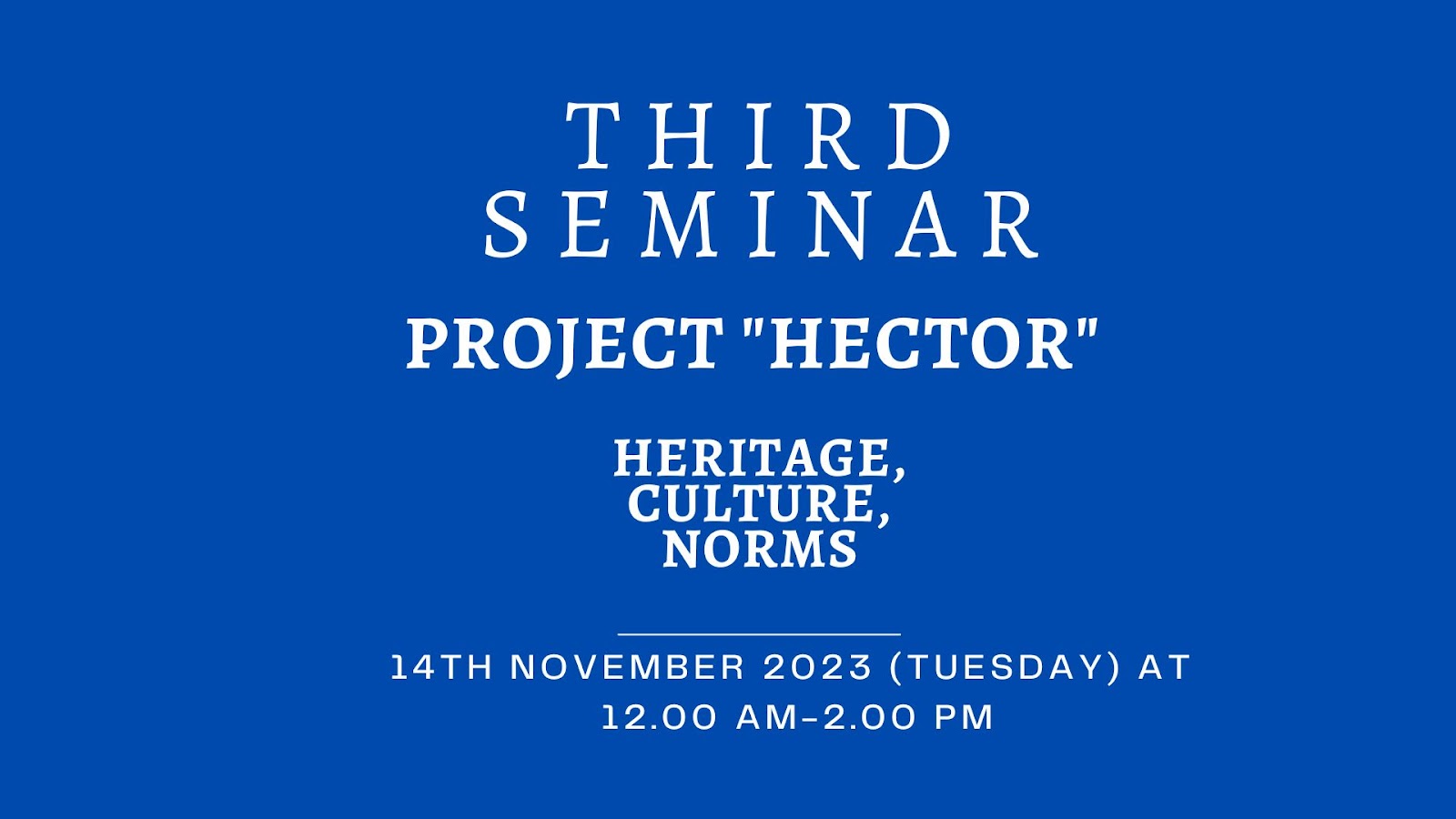
The Coordination Board of the research platform „Hector. Heritage, Culture, Norms”, held at the Jagiellonian University in Krakow, invites you to participate in the third project seminar entitled “Private Law and Public Law: Friends or Enemies?”.

During the event, our guests will explore ways in which private and public law complement each other and areas where they come into conflict. Moreover, they will elaborate on whether private and public law can form a harmonious union or whether these branches of law are completely incompatible. In the presentations, the speakers will present the results of their research from a legal-historical perspective.

The guests will be:

Prof. András Földi, University of Eötvös Loránd Budapest (Hungary) with the paper “Some Problems of ‘Ius Publicum’ in Roman Law with Special Regard to the Development of its Meaning”, and

Prof. Sören Koch, University of Bergen (Norway) with the paper “The Impact of German Legal Thought on the Evolution of Private and Public Law Distinctions in 19th Century Norwegian Legal Discourse”.

The event will be held in a hybrid format: on-site in the conference room at the JU Student Zone (Strefa Studencka UJ) (św. Anny Street 6 in Cracow) and via the MS TEAMS platform - on the 14th November 2023 (Tuesday) at 12:00 to 14:00.

If you are interested in taking part in this workshop, we would kindly ask you to fill in the registration form: https://forms.office.com/e/4ki60VuEtn

The link allowing online participation will be sent the day before the event.

14 November 2022

SEMINAR SERIES: Monumenta Germaniae Historica (November 2022 - April 2023), ONLINE


Auch diesen Herbst und Winter laden die MGH zu einem breiten Themensprektrum an Online-Vorträgen ein. In der Reihe „Vorträge zur Geschichte der Mittelalterforschung“ befassen sich am 24.11.22 Prof. Dr. Reinhard Blänkner mit Otto Brunner und am 23.3.23 Dr. Kerstin Thieler mit Percy Ernst Schramm.

Die Reihe „Zurück zu den Quellen“, in der Mitarbeiter/-innen der MGH und Editoren/-innen ihre Forschungsergebnisse vorstellen, wird am 26.1.23 mit einem Vortrag von Philipp T. Wollmann über litterae clausae in der Kanzlei Friedrichs II., am 23.2.23 mit einem Vortrag von Dr. Levi Roach über eine vernachlässigte Originalurkunde Ottos I. und am 20.4.23 mit einem Vortrag von Anna C. Nierhoff über die Rezeption der Bamberger Weltchroniken fortgesetzt.

Alle Vorträge finden donnerstags um 18 Uhr auf der Online-Plattform Zoom statt. Die Zugangsdaten erhalten Sie nach Anmeldung ca. 3 Tage vor der Veranstaltung. Um Ihre Anmeldung wird gebeten per E-Mail an annette.marquard-mois@mgh.de.


***

PROGRAMME


24. November 2022: Otto Brunner (1898-1982). Denkwege auf der Suche nach Ordnung

Otto Brunner gehört zu den einflussreichsten Historikern in der deutschsprachigen Gelehrtenwelt des 20. Jahrhunderts. Die Wirkung seines wissenschaftlichen Werks reicht über die Geschichtswissenschaft hinaus in die übrigens Geistes- und Sozialwissenschaften. Aufgrund seines intellektuellen Engagements für den Nationalsozialismus polarisiert sein Werk jedoch bis heute die fachhistorische Zunft. Jenseits apologetischer oder denunziatorischer Interpretationen ist daher nach Kontinuitäten, Brüchen und Transformationen in Brunners Werk zu fragen, in dessen Zentrum das Problem der „Ordnung“ in den vielfältigen Kontexten des 20. Jahrhunderts steht.

Prof. Dr. Reinhard Blänkner ist seit seiner Emeritierung Senior Scholar an der Fakultät für Kulturwissenschaften an der Europa-Universität Viadrina in Frankfurt (Oder). Aus seinen Forschungen über Otto Brunner sind mehrere Veröffentlichungen als Vorbereitung einer Monographie hervorgegangen, die Werk und Wirkung Brunners in interdisziplinäre Kontexte und in die politischen Rahmenbrüche des 20. Jahrhunderts stellen.


26. Januar 2023: Verschickte Friedrich II. geheime Botschaften? Überlegungen zur Verwendung von litterae clausae und cedulae interclusae im 13. Jahrhundert

Nach Paulius Rabikauskas enthielten verschlossen ausgefertigte Briefe – die sogenannten litterae clausae – vor allem Geheimes oder Privates. Diese Annahme lässt sich meist nur schwer überprüfen, denn es sind nur wenige litterae clausae im Original überliefert. Die meisten davon stammen aus der päpstlichen Kanzlei. Für diese konnten zuletzt Christoph Egger und Werner Maleczek die Bandbreite ihres Inhalts vom 13. bis zum 15. Jahrhundert aufzeigen. Für die kaiserliche Kanzlei Friedrichs II. lässt sich in den bisher erschienenen Bänden der Diplomata-Edition kein einziges verschlossen ausgeführtes Diplom nachweisen. Anders sieht es allerdings in der kopialen Überlieferung aus.

Mithilfe des erhaltenen Registerfragments und einiger Hinweise in der sogenannten Summa dictaminum des Petrus de Vinea wird der Verwendung von litterae clausae in der Kanzlei Friedrich II. nachgegangen, wobei vor allem Fragen nach deren Nutzung und Inhalt gestellt werden.

Philipp T. Wollmann studierte in Augsburg und München Geschichte, Kunst- und Kulturgeschichte und promoviert aktuell bei Martina Hartmann zur päpstlichen Delegationsgerichtsbarkeit in Bayern und Österreich. Seit Oktober 2019 ist er Mitarbeiter der MGH und unterstützt Karl Borchardt bei der MGH-Edition der nach Petrus de Vinea benannten Summa dictaminum.


23. Februar 2023: D O I. 161: Eine vernachlässigte Originalurkunde Ottos des Großen

2020 war ein Sensationsjahr für die ottonische Diplomatik. Neben der europaweit gefeierten Wiederentdeckung einer Originalurkunde Ottos II. (MGH D O II. 284) im Stadt- und Stiftsarchiv Aschaffenburg machte Laurent Morelle der Gelehrtenwelt auf zwei bisher übersehene ottonische Urkunden im Archiv des Herzogs von Arenberg aufmerksam. Während diese Neufunde (zurecht) großes Interesse genießen, besteht die Gefahr, dass ältere Entdeckungen übergangen werden. Levi Roach befasst sich mit einer solchen „vernachlässigten“ Originalurkunde, einer Zollurkunde für das Bistum Worms, in der MGH-Edition bezeichnet als D O I. 161. Auf dieses Original verwies Paul Kehr bereits 1931. Hartmut Hoffmann widmete ihm zwei Sätze und brachte es in Verbindung mit den berüchtigten Wormser Fälschungen. Eine eingehende Untersuchung lehrt jedoch, dass diese Urkunde noch nicht alle ihre Geheimnisse preisgegeben hat.

Levi Roach studierte in Cambridge und Heidelberg und promovierte 2011 in Cambridge. Seit 2012 lehrt er an der University of Exeter als Associate Professor für mittelalterliche Geschichte. Für sein aktuelles Forschungsprojekt über die Herrscherurkunden der Ottonenzeit erhielt er im August 2022 das MGH-Fellowship des Fördervereins Pro arte edendi – Freunde der MGH e.V.


23. März 2023: „Schramm drüber“? Der Mittelalterhistoriker Percy Ernst Schramm (1894-1970) und seine Beschäftigung mit der Zeit des Nationalsozialismus

Der Vortrag behandelt die ambivalente Auseinandersetzung des Mittelalterhistorikers Percy Ernst Schramm mit der Zeit des Nationalsozialismus. Unter anderem wegen seiner NSDAP-Mitgliedschaft aus dem Professorenamt temporär entlassen, widmete er sich nach seiner Wiedereinsetzung in starkem Maße der NS-Zeit und seiner Rehabilitation.

Das eigene Agieren und sowie die familiäre Verfolgungserfahrung in der NS-Zeit stehen dem gesellschaftlichen Engagement in der Aufklärung nach 1945 gegenüber. Insbesondere seine Themenwahl machte ihn, zumal da Mitte der sechziger Jahre eine breite Beschäftigung mit der NS-Zeit einsetzte, öffentlich angreifbar. Die Verleihung des Pour-le-Merité-Ordens durch Schramm an den Emigranten und ehemaligen Kollegen Ernst Panofsky in München führte im Nachgang zu einer lange vermiedenen Konfrontation mit seiner persönlichen NS-Geschichte.

Dr. Kerstin Thieler promovierte 2013 mit einer Studie zur politischen Gesinnungskontrolle durch lokalen NSDAP-Funktionäre in Göttingen bei Bernd Weisbrod. An der Universität zu Köln beschäftigt sie sich mit der erinnerungskulturellen Auseinandersetzung mit dem Nationalsozialismus, der Kölner Universitätsgeschichte im 20. Jahrhundert sowie der Kopplung von Elitenrekrutierung und Demokratisierung in der frühen Bundesrepublik.


20. April 2023: Auf verschlungenen Wegen – Eine Spurensuche zur Rezeption der Bamberger Weltchroniken

Die Werke von Frutolf von Michelsberg und seinen Fortsetzern, die an der Wende vom 11. zum 12. Jahrhundert entstanden sind, beeinflussten in erheblichem Maße die nachfolgenden Geschichtswerke. Die neuerdings unter dem Begriff der Bamberger Weltchronistik subsumierten Chroniken wurden im Laufe der Zeit wiederholt fortgesetzt, paraphrasiert, auszugsweise in andere Annalen oder Chroniken inkorporiert und in Form von Exzerpten weitertradiert. Diese mannigfaltigen, sich teils überlagernden Rezeptionsstränge stehen im Zentrum des Vortrags.

Anna Claudia Nierhoff studierte Geschichte mit Schwerpunkt Mittelalter sowie Antike und Orient an der Ludwig-Maximilians-Universität München. Seit 2021 ist sie wissenschaftliche Mitarbeiterin der MGH und promoviert bei Martina Hartmann zum Thema „Die Rezeption der Bamberger Weltchronistik. Studien zur Wirkungsgeschichte der Chroniken von Frutolf und seinen Fortsetzern“.


More information can be found here.

02 September 2022

REMINDER ONLINE SEMINAR: on Martti Koskenniemi's book "To the Uttermost Parts of the Earth: Legal Imagination and International Power, 1300-1870" (Cambridge University Press, 2021) - 6th September 2022 - organised by the Journal of the History of International Law (on ZOOM)


On 6 September 2022, the Journal of the History of International Law is organising an online evening symposium (CET 20.00h-22.00) to celebrate the publication of Martti Koskenniemi's book 'To the Uttermost Parts of the Earth: Legal Imagination and International Power, 1300-1870 (Cambridge University Press, 2021). The event will take place on Zoom.


This is the program:


Chair: Dr. Inge Van Hulle (Max Planck Institute for Legal History and Legal Theory)


20.00h: Welcome by Prof. Randall Lesaffer (KU Leuven/Tilburg University) 

20.05h: Presentation of book by Prof. Martti Koskenniemi (University of Helsinki)

20.30h: Comments by Prof. Koen Stapelbroek (James Cook University): 'Commerce, capitalism and the law of nations'

20.45h: Comments by Prof. Jennifer Pitts (University of Chicago): 'The struggle between statehood and civil society'

21.00h: Comments by Prof. Wim Decock (UCLouvain): 'Theology and the justification of sovereignty and property'

21.15h: Response by Prof. Martti Koskenniemi

21.30h: Open discussion and questions


Please register by sending an email to: vanhulle@lhlt.mpg.de

04 March 2022

SEMINAR SERIES: History and Law Encounters (March-May 2022; Università degli Studi di Brescia - ONLINE)

 (Image source: UNIBS social media channels)

The third cycle of the seminar series "History and Law Encounters. Lessons to think as a jurist", organised by the University of Brescia and held in presence at Brescia (Italy) and online via Microsoft Teams was presented. More information, the flyer and the indications for the virtual room can be found here.

The papers of the first cycle were published in 2021. More information can be found in the publisher's website.

***

La deposizione del testimone nel processo di diritto comune

  • ALESSANDRA BASSANI (Università degli Studi di Milano)
  • 15 marzo 2022, ore 12.00-13.30, Aula 5


Un altro modo di giudicare. Il processo romano-canonico e le Inquisizioni in Europa

  • VALERIO GIGLIOTTI (Università degli Studi di Torino)
  • 22 marzo 2022, ore 12.00-13.30, Aula 5


L’attrattiva della letteratura etico-giuridica pre-moderna: spunti di ricerca

  • MARIASOLE TESTUZZA (Università degli Studi di Catania)
  • 5 aprile 2022, ore 12.00-13.30, Aula 5


“Genti inutili et ociose”: riflessioni giuridiche attorno ai poveri fra Seicento e Settecento

  • FEDERICA PALETTI (Università degli Studi di Brescia)
  • 13 aprile 2022, ore 12.00-13.30, Aula 5


Perseguire il segreto: legislazione e politiche anti-settarie nel Regno di Napoli dall’Illuminismo alla Restaurazione

  • LUCA DI MAURO (Università degli Studi di Pisa)
  • 3 maggio 2022, ore 12.00-13.30, Aula 5


Il buon giudice Majetti e la crisi della giustizia legalistica

  • MONICA STRONATI (Università degli Studi di Macerata)
  • 10 maggio 2022, ore 14.00-15.30, Aula 5


Lavoro, sindacato, corporazione nel groviglio costituzionale fascista

  • GIOVANNI CAZZETTA (Università degli Studi di Firenze)
  • 24 maggio 2022, ore 14.00-15.30, Aula 5

29 November 2021

ONLINE SEMINAR: Critical Legal Theory Today. Lesson from the UK and Europe – with Costas Douzinas - 14 December 2021, 15:00 Buenos Aires (GMT -3)


Seminario Permanente del Grupo de Estudios Críticos en Política, Derecho y Sociedad (PoDeS) – 14 de diciembre de 2021, 15.00 hs, Buenos Aires (GMT-3) 

Inscripciones aquí.

22 September 2021

ONLINE LECTURE: Mette BIRKEDAL BRUUN, Privacy and the private as analytical categories in early modern studies (23 SEP 2021)


(image source: Latin American Privacy)

Abstract:

What do we gain by deploying the terms ‘privacy’ and ‘the private’ as analytical categories when we conduct historical research into the early modern period? This lecture pursues three questions:   The categories of privacy and the private do not belong to a specific scholarly field. Although often understood in a narrow sense associated with Law, privacy and the private are features of human life and thus relevant for a broad range of research fields, including a broad range of historical fields. However, no single field can begin to grasp the implications and manifestations of privacy and the private in a given context. How do we best approach notions and experiences of privacy in a way that honours its facetted character?   While Privacy Studies is a new field that is still defining its research focus and interdisciplinary framework, early modern studies adhere to well-established scholarly paradigms. What happens in this meeting between nascent and consolidated scholarly perspectives? How may they fruitfully benefit one another?   With their undeniably contemporary ring, the terms ‘privacy’ and ‘the private’ come with a heavy risk of anachronism which historians have been taught to dread. This risk must be taken seriously and dealt with in methodologically conscious ways least we lose our scholarly credibility. However, exactly the fact that privacy and the private are contemporary terms give them a particular potency as a challenge to historical studies. What – if anything – do historians contribute to contemporary discussions of the topical issue of privacy?

(source: Latin American Privacy)

10 September 2021

CALL FOR PAPERS: Diversity, dilemmas and discoveries: Histories of legal education (Open University Law School - Legal History Research Center, 15 OCT 2021); DEADLINE 8 OCT 2021

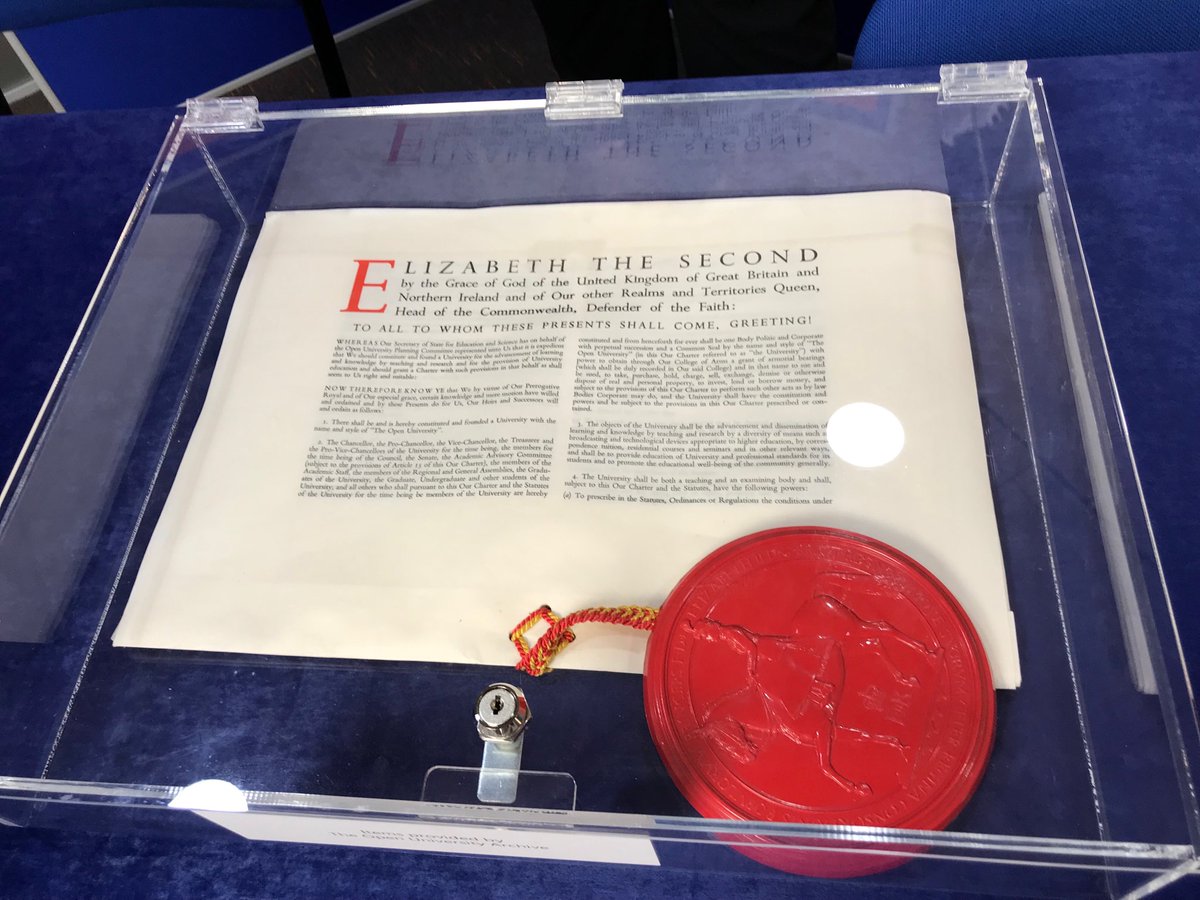
(image: the Royal Charter for the Open University; source: Wikimedia Commons)

Legal education is facing significant changes and challenges, from the effects of the Covid-19 pandemic to reviews and reforms of professional legal training and debates around the future of the legal professions. The core content and assumptions underpinning law degrees are being challenged by movements to decolonise and liberate our curricula. New technologies and changes to the professions mean that our students require different skills, while the growing proportion of law students who will never practise as lawyers pose fresh challenges and possibilities. This is therefore an opportune moment to consider how legal education has developed, and why.

This one-day online conference will explore histories of legal education in the common law world, as well as methodologies and approaches to researching them. We invite proposals for 15-minute papers on any aspect, and particularly welcome those which address the central theme of diversity, dilemmas and discoveries. Potential themes may include:

  • Legal education and the British empire 
  • The legal education of women, working class, and ethnic minority students 
  • Legal education beyond the law school 
  • Legal education within the law school 
  • Methodologies of legal education history.
Abstracts (not exceeding 300 words) should be submitted by email to OULS-legalhistory@open.ac.uk by Friday 8 October.

(source: OpenUniversity)


11 June 2021

ESCLH General Assembly + Seminar "Theology and Law: Recent Research and Publications on the Iberian School of Peace" (ONLINE, 29 JUN 2021)

(image source: HistoriaDomus)


 Dear members,


You're most cordially invited to the ESCLH General Assembly for 2021 and to a Seminar with exciting new research presented by our colleagues at the University of Lisbon (Tuesday, 29 June 2021, 17:00-19:00 hours CET/04:00-06:00 hours PM GMT). Please find the draft agenda as an attachment to this email. As you will see, the Assembly is again online, because of the limitations Covid sets us. Due to these limitations, as you know we decided to postpone the ESCLH Conference again, to 22-24 June 2022, in Lisbon, but are hosting the AGM at the same time as the 2021 conference would have been.


To get a taste of what Lisbon has to offer, academically at least, this year's General Assembly is preceded by a Seminar:

Theology and Law: recent research and publications on the Iberian school of peace

Speakers include, Profs Pedro Barbas Homem (Faculty of Law), Pedro Calafate (Department of Philosophy), Margarida Seixas (Faculty of Law) and Ana Fouto (Faculty of Law). They will be speaking about brand new research based on manuscripts at the Universities of Salamanca, Coimbra and Évora from Portuguese and Spanish legal theologians of XVI and XVII century.


In the invitation, but also here you find a registration link (https://www.aanmelder.nl/125842/subscribe), by which you can register for the Workshop and/or the General Assembly 2021.


Candidates for Secretary General

On the agenda is also the position of the Secretary General. The first term of Janwillem Oosterhuis as Secretary General (since 2016) is over. If you are interested in standing, please send an email to matthew.dyson@law.ox.ac.uk before Friday 11 June 2021. If there are any applications, you will be informed by 15 June of the list of elegible candidates. While Dr Oosterhuis is willing to stand again, all members are able to stand for all positions on the Executive Council when those positions are up for election.


Membership fee 2021

As you may have noticed, you have not yet received a reminder for your membership fee for 2021. As you can see in the agenda, we have found a new treasurer (with many thanks to Juan Canizares for his many years of work) and intend also to move to a new bank. However, while we work this out, we kindly ask you to pay your membership (€50 yearly) to the current account in Spain (Bank: Bankia. C/ Guardia Civil, 21. 46020, Valencia (Spain); IBAN: ES48 2038 6546 2360 0015 1293; Swift code: CAHMESMMXXX; Holder: European Society for Comparative Legal History) or use the PayPal account on the ESCLH Blog (http://esclh.blogspot.com/p/donate-to.html). When you have paid, please inform our new treasurer Judit Beke-Martos (treasureresclh@gmail.com) and me, the Secretary General (janwillem.oosterhuis@maastrichtuniversity.nl) of such.

17 May 2021

BOOK PRESENTATION: Coronations and Inaugurations in the 18th-19th Century Habsburg Monarchy (Standen & Landen/Anciens Pays & Assemblées d'États, 20 MAY 2021, 17:00 CET)

(poster; source: S&L/APAE)

Book abstract:
Across the medieval and early modern eras, new rulers were celebrated with increasingly elaborate coronations and inaugurations that symbolically conferred legitimacy and political power upon them. Many historians have considered rituals like these as irrelevant to understanding modern governance—an idea that this volume challenges through illuminating case studies focused on the eighteenth- and nineteenth-century Habsburg lands. Taking the formal elasticity of these events as the key to their lasting relevance, the contributors explore important questions around their political, legal, social, and cultural significance and their curious persistence as a historical phenomenon over time.

Table of contents here

(RSVP details here)
 

15 March 2021

ONLINE COLLOQUIUM: Sous le feu de la critique (Centre de Théorie et d'Analyse du Droit, Université Paris Nanterre/ENS/CNRS, 1 APR 2021)


(image source: univ-droit)

Abstract:
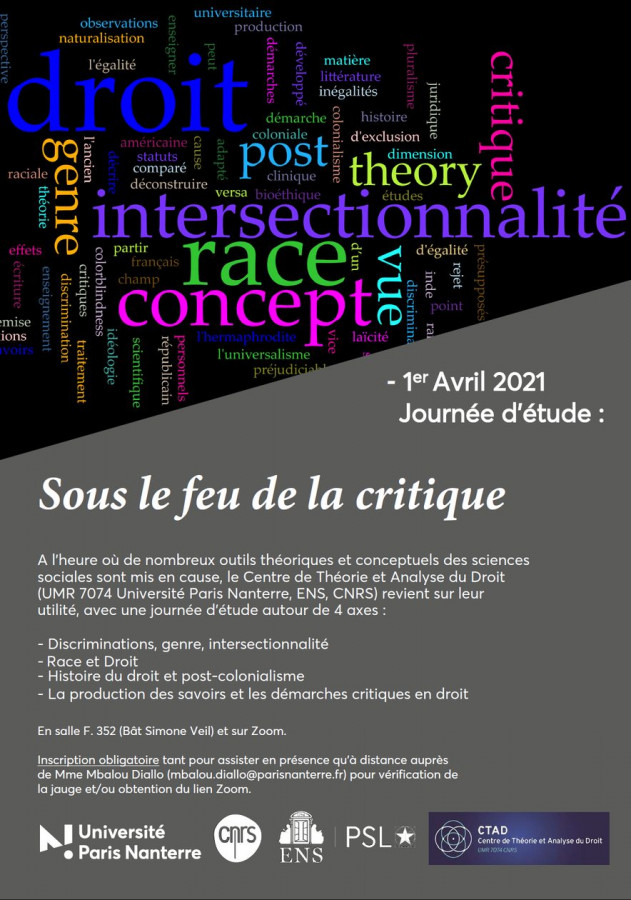
A l'heure où de nombreux outils théoriques et conceptuels des sciences sociales sont mis en cause, le Centre de Théorie et Analyse du Droit (UMR 7074 Université Paris Nanterre, ENS, CNRS) revient sur leur utilité, avec une journée d’étude autour de 4 axes :
- Discriminations, genre, intersectionnalité
- Race et Droit
- Histoire du droit et post-colonialisme
- La production des savoirs et les démarches critiques en droit

Programme:

9h30 : Introduction


Discriminations, Genre, intersectionnalité

10h00 : Décrire la dimension d'exclusion de l'universalisme républicain : une démarche scientifique
Elsa Fondimare, MCF, UPN

Déconstruire la naturalisation des inégalités avec le concept de genre. L'exemple du champ de la bioéthique
Laurie Marguet, MCF, UPEC

Le traitement de l'hermaphrodite dans la littérature juridique de l'Ancien Régime : droit, société et idéologie
Arnaud Paturet, CR, CNRS


Race et Droit

12h00 : Les effets préjudiciables du rejet du concept de race : le point de vue du droit comparé de l'égalité et de la non-discrimination (vidéo)
Tanya Hernandez, Prof Fordham Law School - USA

Laïcité et colorblindness : que peut nous enseigner la critique développée par la Critical Race Theoryaméricaine en matière d'égalité raciale ?
Stéphanie Hennette-Vauchez, PU, UPN, IUF

Raisonner à partir d’un concept de “race” en droit français
Lionel Zevounou, MCF, UPN, IUF


13h30 : Pause déjeuner


Histoire du droit et post-colonialisme

14h30 : Genèse d'un projet : pourquoi revisiter les liens entre l'Ecole de Salamanque et la traite négrière ?
Anne-Charlotte Martineau, CR, CNRS

La remise en cause des statuts personnels en Inde dans une perspective post-coloniale
Jean-Louis Halpérin

Droit et Race : une perspective brésilienne
Antonio Pele, Prof. PUC-Rio, Brésil

Perspective du Sud : la discipline du droit international face à la critique TWAIL
Laura Betancur, Assistant Professor, Universidad de los Andes (Colombie)


Production des savoirs et démarches critiques en droit

16h30 : Réflexions sur les présupposés d'une étude sur droit et écriture inclusive
Véronique Champeil-Desplats, PU, UPN

De la critique à la clinique et vice versa. Pour un enseignement universitaire adapté
Charlotte Girard, MCF HDR, UPN

Quelques observations sur la question du pluralisme épistémologique
Manon Altwegg-Boussac, PU, UPEC

18h00 : Fin

Practical:
En salle F. 352 (Bât Simone Veil) et sur Zoom
Inscription obligatoire tant pour assister en présence qu’à distance auprès de Mme Mbalou Diallo : mbalou.diallo@parisnanterre.fr - pour vérification de la jauge et/ou obtention du lien Zoom

(source: univ-droit


26 February 2021

ONLINE SEMINAR (Spring 2021): ESCLH Seminar Series: Reading circle on Comparative Legal History Methods


1)      Readings of Ugo Mattei’s articles on Legal Transplants and Taxonomies

Friday 12 March 2021, 10.00-11.00 (CET)

 Ugo Mattei, « Why The Wind Changed: Intellectual Leadership in Western Law », The American Journal of Comparative Law, 42:1 (1994), 195-218.

Ugo Mattei, « Three Patterns of Law: Taxonomy and Change in the World's Legal Systems », The American Journal of Comparative Law, 45:1 (1997), 5-44.

Zoom link: https://utu.zoom.us/j/69552029048 

Keynote: Dolores Freda (Napoli, Italy)

Discussant: Agustín Parise (Maastricht, The Netherlands)


2)      Readings of Glenn’s concept of common laws

Tuesday 30 March 2021, 13.00-14.00 (CET)


H. Patrick Glenn, On Common Laws, Oxford, OUP, 2007.


Keynote: Heikki Pihlajamäki (Helsinki, Finland)

Discussant: Judit Beke Martos (Bochum, Germany)


3)      Readings of Watson’s Theory of Legal Transplants

Monday 3 May 2021, 13.00-14.00 (CET)

 Alan Watson, Legal Transplants: An Approach to Comparative Law, Edinburgh, 1974; second edition Athens, 1993.


 Keynote: Anna Klimaszewska (Gdansk, Poland)

Discussant: Aniceto Masferrer (Valencia, Spain)

More informations on these sessions with Prof. Mia Korpiola (Turku)