Search

Showing posts with label privacy. Show all posts

07 July 2026

SYMPOSIUM: Privacy before Privacy Law: Law and Humanities in Dialogue for a Digital Age (Copenhagen: Faculty of Theology/Centre for Privacy Studies, 25-26 JUN 2026)


A symposium was held at Copenhagen University on 25 and 26 June. 

Day 1: Thursday 25th June

Location: Centre for Privacy Studies, University of Copenhagen, South Campus, Karen Blixens Plads, 16, 2300 København S, Room: 6B.1.62

8.30 – 9.00

REGISTRATION AND WELCOME COFFEE

Centre for Privacy Studies


9.00 – 9.30

OPENING REMARKS


Introducing the Centre for Privacy Studies

Mette Birkedal Bruun, University of Copenhagen


Introducing the Symposium 

Paolo Astorri & Patrick O’Callaghan


9.30 – 11.00

SESSION I — PRIVACY IN MEDIEVAL AND REINASSANCE IMAGINATIONS

Chair: Bastian Felter Vaucanson, University of Copenhagen

Privacy as a Condition of Cognitive Liberty in Petrarch’s Writings  

Patrick O’Callaghan, University College Cork

The Private Autonomous Mind: Female Strategies of Inward Agency in Shakespeare’s Roman tale The Rape of Lucrece

Anni Haahr Henriksen, Kaberghus, Copenhagen

The Violation of Privacy in Renaissance Texts: A Prefiguration of Modern Challenges

Daniela Carpi, University of Verona (Online))


Coffee Break

11.00 – 11.15


11.15 -12.30

SESSION II — PRIVACY AND THE REFORMATIONS

Chair: Søren Frank Jensen, University of Copenhagen


The Space of Interiority and its Regulation in Thomas Bartholin’s Orationes

Lars Cyril Nørgaard, University of Copenhagen

Privacy in Anglo-American Law: From the Reformation to the Enlightenment

Peter Winn, University of Washington


Lunch

12.30 – 13.30


13.30 – 14.45

SESSION III — PRIVACY BETWEEN JURISDICTION AND CORRESPONDANCE

Chair: Ulrike Müssig, University of Passau


Arcana and Curiositas: Ahasver Fritsch and the Boundaries of Knowledge in Early Modern Germany

Paolo Astorri, University of Copenhagen

‘His Dearest Property’: Private Papers and Secrets in 18th Century Common Law

TT Arvind, University of York


Coffee Break

14.45 – 15.15


15.15 -16.00


08.15-09.00

(CDT)

SESSION IV — TEMPORAL CROSSINGS: PRIVACY IN TRANSITION

Chair: Johannes Ljungberg, University of Linköping

Lockean Liberalism, Religious Liberty, and the Foundations of Intellectual Privacy

Marc J. Blitz, Oklahoma City University (Online)


16.00 -16.45

CONCLUDING DAY 1

Group Discussion


Wine Reception

Centre for Privacy Studies

17.00 – 18.00

Day 2: 26th June

Location: Centre for Privacy Studies, University of Copenhagen, South Campus, Karen Blixens Plads, 16, 2300 København S, Room: 6B.1.62

8.30 – 9.00

ARRIVALS AND WELCOME COFFEE


09.00 – 10.15

SESSION V — PRIVACY AND THE NINETEENTH-CENTURY IMAGINATION

Chair: Lars Cyril Nørgaard, University of Copenhagen


Privacy Spaces in Dutch Nineteenth-Century Society: From Sara Burgerhart to Major Frans

Bert-Jaap Koops, Tilburg University


Reserve and Revelation: Modern Conceptions of Privacy in the Novels of Jane Austen

Róisín á Costello, Trinity College Dublin


Coffee Break

10.15 – 10.45


10.45 – 12.00

SESSION VI: PRIVACY, PERSONALITY, AND MODERN LAW

Chair: Patrick O’ Callaghan, University College Cork

The Rise of the Right to Private Life: Between Civil Liability and Droit D’Auteur

Giovanni Chiodi, University of Milan Bicocca (Online)


Dignity Reconsidered: An Analysis of its Inviolability’s Instrumentalization Ulrike Müssig, University of Passau


Lunch

12.00 – 13.0


13.00 – 15.45

SESSION VII: TAKING STOCK

Chair: Natalie P. Koerner, University of Copenhagen


Privacy and Utopian Thinking

Bart Van Der Sloot, Tilburg University

Privacy Between Past and Present

Tamar Herzog, Harvard University

General Discussion

Moderated By Paolo Astorri & Patrick O’Callaghan


Guided Excursion

Regensen Kollegium and Trinitatis Kirke

Store Kannikestræde, 2 Copenhagen

16.00 17.30

For more information, contact dr. Paolo Astorri.

20 July 2022

SYMPOSIUM: ‘The Public and the Private in Early Modern Contexts: Comparative Perspectives’ (Copenhagen: Centre for Privacy Studies, University of Copenhagen, 1-2 September 2022)


Paolo Astorri (Centre for Privacy Studies) & Harald E. Braun (Liverpool)


Speakers:


José Luis Egio (Frankfurt, MPILHLT)

Tamar Herzog (Harvard)

Virpi Mäkinen (Helsinki)

Sarah Mortimer (Oxford)

Heikki Pihlajamäki (Helsinki)

Rudolf Schuessler (Bayeruth)


This International Symposium aims to facilitate the conversation about early modern notions and conceptualization of ‘the public’ and ‘the private’ and to connect cognate fields of historical study (e.g. the histories of law, theology, and political thought). The focus will be on the boundaries between ‘public’ and ‘private’, and the terms will be understood in the widest sense, for instance with reference to physical space or the wide range of relationships between the individual and the community (soul, body, household, city, state). Speakers will stroll across early modern cultures of belief and knowledge – touching upon Catholic and Protestant scholasticism and natural law theories, for instance - and attempt to develop comparisons. Speakers will address some of the following questions:


  • What was the impact of the first globalization on European and non-European notions of the public and the private? When, how, and why did European and non-European communities share and negotiate their respective notions of the private and the public?
  • In what ways do early modern conceptualizations of the private and the public reflect on notions of race or gender or and alterity?
  • Did processes of confessionalization, state formation, and secularization impact on notions and practices of the public and the private? What was the relationship between social, moral, political, and legal norms?
  • When and why did gatekeepers of the sacred — such as Catholic and Protestant lawyers and theologians — read, comment, and draw on one another’s ideas and concepts, and what were the outcomes?
  • In what ways did legal and theological thinking shape the boundaries between public and private, and what are the differences between cultural and confessional communities in this respect?
  • How did different notions of public authority impact on individual freedom? For instance, who defined the boundaries between the self and the soul, the household, and the community? What is the rationale behind these definitions? How could the early modern individual protect the private, inner space of conscience from public scrutiny?


Programme and location will be announced shortly.


Contact

Paolo Astorri (Centre for Privacy Studies), paolo.astorri@teol.ku.dk & Harald E. Braun (Liverpool) hbraun@liverpool.ac.uk


16 November 2021

BOOK LAUNCH: Early Modern Privacy. Sources and approaches - University of Copenhagen - 3 December 2021, 16:00-17:00 CET


(Source: KU)

The volume is part of the Brill Series: Intersections, Interdisciplinary Studies in Early Modern Culture

 Early Modern Privacy - Sources and Approaches editors: Michaël GreenLars Cyril Nørgaard, and Mette Birkedal Bruun

Privacy is often viewed as a modern phenomenon. Early Modern Privacy: Sources and Approaches challenges this view. This collection examines instances, experiences, and spaces of early modern privacy, and opens new avenues to understanding the structures and dynamics that shape early modern societies. Scholars of architectural history, art history, church history, economic history, gender history, history of law, history of literature, history of medicine, history of science, and social history detail how privacy and the private manifest within a wide array of sources, discourses, practices, and spatial programmes. In doing so, they tackle the methodological challenges of early modern privacy, in all its rich, historical specificity. 

Contributors include Ivana Bičak, Mette Birkedal Bruun, Maarten Delbeke, Willem Frijhoff, Michael Green, Mia Korpiola, Mathieu Laflamme, Natacha Klein Käfer, Hang Lin, Walter S. Melion, Hélène Merlin-Kajman, Lars Cyril Nørgaard, Anne Régent-Susini, Marian Rothstein, Thomas Max Safley, Valeria Viola, Lee Palmer Wandel, and Heide Wunder.


The volume is part of the Brill Series: Intersections, Interdisciplinary Studies in Early Modern Culture

Intersections is a peer-reviewed series on interdisciplinary topics in early modern studies. Contributions may come from any of the disciplines within the humanities, such as history, art history, literary history, book history, church history, social history, cultural history, and history of ideas. Each volume focuses on a single theme and consists of essays that explore new perspectives on the subject of study. The series aims to open up new areas of research on early modern culture and to address issues of interest to a wide range of disciplines. Editor: Karl A. E. Enenkel.

Please register via the following link: 

Registration

22 September 2021

ONLINE LECTURE: Mette BIRKEDAL BRUUN, Privacy and the private as analytical categories in early modern studies (23 SEP 2021)


(image source: Latin American Privacy)

Abstract:

What do we gain by deploying the terms ‘privacy’ and ‘the private’ as analytical categories when we conduct historical research into the early modern period? This lecture pursues three questions:   The categories of privacy and the private do not belong to a specific scholarly field. Although often understood in a narrow sense associated with Law, privacy and the private are features of human life and thus relevant for a broad range of research fields, including a broad range of historical fields. However, no single field can begin to grasp the implications and manifestations of privacy and the private in a given context. How do we best approach notions and experiences of privacy in a way that honours its facetted character?   While Privacy Studies is a new field that is still defining its research focus and interdisciplinary framework, early modern studies adhere to well-established scholarly paradigms. What happens in this meeting between nascent and consolidated scholarly perspectives? How may they fruitfully benefit one another?   With their undeniably contemporary ring, the terms ‘privacy’ and ‘the private’ come with a heavy risk of anachronism which historians have been taught to dread. This risk must be taken seriously and dealt with in methodologically conscious ways least we lose our scholarly credibility. However, exactly the fact that privacy and the private are contemporary terms give them a particular potency as a challenge to historical studies. What – if anything – do historians contribute to contemporary discussions of the topical issue of privacy?

(source: Latin American Privacy)

21 January 2020

CONFERENCE: Perspectives on Privacy in the Seventeenth-Century Netherlands (KNAW Huygens ING, Amsterdam, 31st January 2020)

The Danish National Research Foundation Centre for Privacy Studies at the University of Copenhagen (PRIVACY) in cooperation with the Huygens Institute in Amsterdam are delighted to invite you to a symposium dedicated to the notions of privacy in the seventeenth-century Netherlands.
A team of experts will tackle the problematics of defining what is private through a range of source material – egodocuments, legislation, political treatises and religious writings. Our goal is to explore how privacy was seen through the eyes of the contemporaries during the seventeenth century on the one hand, and on the other hand, to probe various methodologies that could help in analyzing this issue.
Centre for Privacy Studies was established through a grant from the Danish National Research Foundation in 2017. The PRIVACY research team examines how no­tions of privacy shape relations between individuals and society across diverse historical contexts.
PRIVACY focuses on the period 1500–1800 that sees critical changes in individuals’ relationship to society, based on eleven site-based case studies, among them Amsterdam, Copenhagen, Versailles and Westminster. It brings together the fields of Church History, Social History, History of Architecture, Legal History and History of Ideas in order to establish a collaborative interdisciplinary scholarly environment.
The Huygens Institute for the History of the Netherlands (Huygens ING) studies the history of science, Dutch history and literature. It also provides access to primary source material and text editions on which to base further analytical and interpretive research.
Huygens ING is the lead institute in CLARIAH, the Netherlands’ digital humanities infrastructure. It works with the International Institute of Social History (IISH) and the Meertens Institute in the KNAW Humanities Cluster.
To attend the seminar, please register with Ineke Huysman. The number of places is limited.
You can view and download the programme for the seminar here.

06 February 2019

JOB : Postdoctoral Fellowships and PhD positions at The Danish National Research Foundation Centre for Privacy Studies (DEADLINE: 15 April 2019)


We learned of 3-4 fully funded PhD scholarships and 3 fully-funded Postdoc positions at the University of Copenhagen (Centre for Privacy Studies – PRIVACY).

Centre for Privacy Studies (PRIVACY), funded by the Danish National Research Foundation and based in Copenhagen, advertises 3-4 fully funded PhD positions within the fields of Architectural History, Church History, Legal History and History. PRIVACY is established with a grant of 50 mio DKK (ca. 6.7 mio Euro) from the Danish National Research Foundation and based at the University of Copenhagen.   

PRIVACY was launched in the autumn of 2017 under the direction of Professor Mette Birkedal Bruun and runs for six years with the possibility of a four-year extension. It is hosted by the Department of Church His­tory at the Faculty of Theology, University of Copenhagen, in association with the Faculty of Law, Uni­versity of Copenhagen and the School of Architecture, Royal Danish Academy of Fine Arts, Schools of Ar­chitecture, Design and Conservations (KADK), Copenhagen. 

The PRIVACY research team currently consists of six postdocs and three PhD-students as well as affiliated and visiting scholars. 

The Centre   

PRIVACY is dedicated to interdisciplinary and collaborative research into notions of privacy in Early Mod­ern Europe. It focuses on eleven cases from Denmark, England, France, Germany and the Netherlands in the period 1500–1800. The collaborative programme is driven by an interdisciplinary vision of an inte­grated approach in which a team of scholars collaborate, challenge and inspire each other in a joint pursuit of the legislative, religious, social, cultural and architectural aspects of a shared set of cases. Shared re­sponsibility across academic hierarchies is a token of PRIVACY’s vision for interactive research education.   

The aim of PRIVACY is to develop 1) systematized historical knowledge of dynamics that shape, induce or curb privacy in society; 2) an interdisciplinary method equipped to grasp such dynamics; and 3) a strong and vibrant international research environment dedicated to high-profile historical research and equipped to incite a much broader investigation of privacy.   

PRIVACY’s scholarly potency stems from its site-based interdisci­plinary analysis. Across eleven cases the research team will trawl Early Modern material: let­ters, laws, political manuals, newspa­pers, sermons, vis­ual representations, architectural drawings, buildings, diaries, contracts, commu­nity records etc. for no­tions of privacy, analysing the deployment of words with the root ‘priv-ʼ: in privato, privy, Privat-(per­son/andacht etc.), privauté etc. as well as bounda­ries drawn in relation to, e.g., confidentiality, security, family, body, self. The research programme is based on a joint interdisciplinary focus on, e.g., legislative thresholds between home and com­munity; de­crees regarding individ­uals’ bodies, e.g., during epidemics, or the idea of the household’s (oeco­no­mia) impact on civic well-being (politia); ecclesiastical and politi­cal power over ‘hereti­cal’ mind­sets; and architectural demarcation of the household in the community and the individuals’ place in a household.  

PhD students funded by PRIVACY are required to formulate a PhD project within one of the PRIVACY cases and to join an additional case-team. For this round of recruitment, we invite applications focusing on the German cases as well as La Rochelle, Chatsworth, Glasgow and Arc-et-Senans. 

For further description of the project and the eleven cases, please visit the project homepage.   

The two offers can be found here (PhD) and here (postdoc)


19 December 2018

BOOK: Kevin MANTON, Population Registers and Privacy in Britain, 1936-1984 (London: Palgrave Macmillan, 2018). ISBN 978-3-030-02752-0, € 59.49


(Source: Palgrave)

Palgrave is publishing a new book on population registers and the law in Britain during the period 1936-1984

ABOUT THE BOOK

This book examines the fraught political relationship between British governments, which wanted information about peoples’ lives, and the people who desired privacy. To do this it looks at something that Britain only experienced in wartime, a centralized and up-to-date list of everyone in the country: a population register. The abolition of this wartime system is contrasted with later attempts to reintroduce registration, and the change in the political mind-set driving these later schemes to develop centralised webs of so-called objective data is examined. These policies were confronted by privacy campaigns, studied here, but it is shown how government responses succeeded in turning political debates about data into technical discussions about computerization; thus protecting its data, largely on paper, from oversight. This reformulation also shaped the 1984 Data Protection Act, which consequently did not protect privacy but rather increased government’s ability to gain knowledge of, and hence power over, the people.

TABLE OF CONTENTS

Kevin Manton teaches History and Politics at both the School of Oriental and African Studies and Birkbeck College, University of London, UK. He is the author of numerous articles on British history. 

More information here

06 June 2018

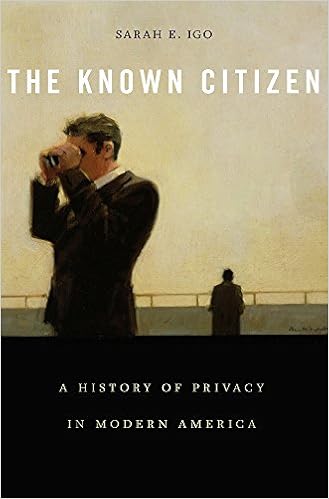
BOOK: Sarah E. IGO, The Known Citizen: A History of Privacy in Modern America (Cambridge (Mass.): Harvard UP, 2018), 592 p. ISBN 9780674737501, € 31,5

(image source: Blogger)

Book abstract:
Every day, Americans make decisions about their privacy: what to share and when, how much to expose and to whom. Securing the boundary between one’s private affairs and public identity has become a central task of citizenship. How did privacy come to loom so large in American life? Sarah Igo tracks this elusive social value across the twentieth century, as individuals questioned how they would, and should, be known by their own society. Privacy was not always a matter of public import. But beginning in the late nineteenth century, as corporate industry, social institutions, and the federal government swelled, increasing numbers of citizens believed their privacy to be endangered. Popular journalism and communication technologies, welfare bureaucracies and police tactics, market research and workplace testing, scientific inquiry and computer data banks, tell-all memoirs and social media all propelled privacy to the foreground of U.S. culture. Jurists and philosophers but also ordinary people weighed the perils, the possibilities, and the promise of being known. In the process, they redrew the borders of contemporary selfhood and citizenship. The Known Citizen reveals how privacy became the indispensable language for monitoring the ever-shifting line between our personal and social selves. Igo’s sweeping history, from the era of “instantaneous photography” to the age of big data, uncovers the surprising ways that debates over what should be kept out of the public eye have shaped U.S. politics and society. It offers the first wide-angle view of privacy as it has been lived and imagined by modern Americans.
Table of contents:
  • Introduction
  • 1. Technologies of Publicity
  • 2. Documents of Identity
  • 3. The Porous Psyche
  • 4. A Right to Be Let Alone
  • 5. Codes of Confidentiality and Consent
  • 6. The Record Prison
  • 7. The Ethic of Transparency
  • 8. Stories of One’s Self
  • Conclusion
  • Notes
  • Acknowledgments
  • Credits
  • Index
On the author:
Sarah E. Igo is Associate Professor of History and Director of American Studies at Vanderbilt University. 
 More information with the publisher.
(source: Legal History Blog)