Search

Showing posts with label Public Law. Show all posts

09 November 2023

SEMINAR: Private Law and Public Law: Friends or Enemies? (online, 14.11.2023)

 
(Image source: organizers)

The Coordination Board of the research platform „Hector. Heritage, Culture, Norms”, held at the Jagiellonian University in Krakow, invites you to participate in the third project seminar entitled “Private Law and Public Law: Friends or Enemies?”.

During the event, our guests will explore ways in which private and public law complement each other and areas where they come into conflict. Moreover, they will elaborate on whether private and public law can form a harmonious union or whether these branches of law are completely incompatible. In the presentations, the speakers will present the results of their research from a legal-historical perspective.

The guests will be:

Prof. András Földi, University of Eötvös Loránd Budapest (Hungary) with the paper “Some Problems of ‘Ius Publicum’ in Roman Law with Special Regard to the Development of its Meaning”, and

Prof. Sören Koch, University of Bergen (Norway) with the paper “The Impact of German Legal Thought on the Evolution of Private and Public Law Distinctions in 19th Century Norwegian Legal Discourse”.

The event will be held in a hybrid format: on-site in the conference room at the JU Student Zone (Strefa Studencka UJ) (św. Anny Street 6 in Cracow) and via the MS TEAMS platform - on the 14th November 2023 (Tuesday) at 12:00 to 14:00.

If you are interested in taking part in this workshop, we would kindly ask you to fill in the registration form: https://forms.office.com/e/4ki60VuEtn

The link allowing online participation will be sent the day before the event.

23 December 2021

BOOK: Christian BEHRENDT & Frédéric BOUHON, Introduction à la Théorie générale de l'Etat, 4e éd. [Collection de la Faculté de droit de l'Université de Liège] (Bruxelles: Larcier, 2020), € 145


(image source: Larcier)

Abstract: 

Comment naît un État ? Quels sont ses éléments constitutifs ? Qu’est-ce qu’il faut entendre par le terme « souveraineté » ? Et comment l’action étatique se réalise-t-elle en interne ? Quels sont les modes d’action de l’État sur la scène internationale et comment s’articule juridiquement la coopération internationale ? Partant de l’analyse de grands auteurs classiques – de Bodin à Kelsen, en passant par Hobbes, Montesquieu, Rousseau et Carré de Malberg – le présent Manuel tente de répondre à ces questions, en mettant l’accent sur l’étude de notions aussi fondamentales que celles de nationalité, séparation des Pouvoirs, démocratie, Constitution ou prohibition de la guerre. Les propos généraux, qui visent à dégager des principes applicables à tous les États, sont placés dans une perspective concrète : au fil des pages, les concepts sont illustrés par la description synthétique des institutions des principaux États européens, avec un regard ouvert sur d’autres pays et spécialement les États-Unis d’Amérique. Une large place est également réservée à l’examen des règles de base du droit international public et de l’Organisation des Nations Unies. Le lecteur trouvera par ailleurs un exposé succinct des institutions européennes. L'ensemble de la matière est réparti et structuré en 17 chapitres, qui prennent leur départ à la notion de « droit public » et mènent jusqu’à l’intégration inter- et supranationale de l’État contemporain. La matière, nouvellement mise à jour en 2020, inclut notamment, au niveau international, le processus du Brexit et l’adhésion de la Macédoine du Nord à l'OTAN. Bien qu’il puisse être consulté seul, le Manuel se trouve enrichi par la consultation parallèle du Recueil de textes de Théorie générale de l’État publié également chez Larcier.

 Table of contents:

Preface to the first edition
Mot des auteurs à la première édition
Chapitre 1er – Observations liminaires
Chapitre 2 – La distinction entre droit privé et droit public
Chapitre 3 – Peuple et Nation
Chapitre 4 – L’État : sa naissance, ses éléments constitutifs et sa disparition
Chapitre 5 – La souveraineté
Chapitre 6 – La division de la puissance de l’État : la notion de pouvoirs
Chapitre 7 – La pyramide des normes : les sources de droit internes et leur hiérarchisation
Chapitre 8 – La notion de Constitution
Chapitre 9 – La notion de loi
Chapitre 10 – Les régimes de gouvernement : Aperçu historique et général
Chapitre 11 – Les régimes de gouvernement : les caractéristiques de l’État occidental du 21e siècle
Chapitre 12 – L’organisation administrative de l’État
Chapitre 13 – Les relations d’État à État : le droit des gens (droit international public)
Chapitre 14 – La réception du droit international dans l’ordre juridique interne
Chapitre 15 – La coopération internationale : le droit des organisations internationales, avec une attention particulière pour l’Organisation des Nations Unies (ONU)
Chapitre 16 – L’intégration européenne : l’Union européenne et le Conseil de l’Europe
Chapitre 17 – En guise de conclusion
Bibliographie sélective
Table des décisions de justice
Table par verbos
Table onomastique

 (source: Larcier)

18 August 2021

ARTICLE. Santi ROMANO. Sobre os assim chamados "Staatsfragmente". REJUR -Revista Jurídica da UFERSA


No  presente  texto1,  o  juspublicista  italiano  Santi  Ro-mano  pretende  refutar  a  teoria  de  Georg  Jellinek acerca dos Staatsfragmente –frações territoriais do-tadas de algumas atribuições do Estado, mas não de todas. Romano, para tanto, descreve a teoria de Jelli-nek  e  aponta  algumas  de  suas  falhas,  sobretudo quanto aos três elementos ‘clássicos’ da estatalidade (povo, território, soberania). Para Jellinek, os Staats-fragmente teriam povo e território, mas não sobera-nia, enquanto que, para Romano, os outros dois ele-mentos  seriam  meros  reflexos:  sem  ela,  não    Es-tado.  Na  sequência,  compara  a  situação  dos  Staats-fragmente  com  as  frações   de  Comuni  e  com  as colônias.  Esses  entes  pertenceriam  respectivamente ao  Comune  e  ao  Estado,  sem  qualquer  individuali-dade. Romano conclui que as reflexões de Jellinek são estimulantes, mas, em última instância, têm falhas ló-gicas, são excessivamente abstratas e não devem ser adotadas pela teoria do direito público.

Santi Romano (Palermo, 1875 - Roma, 1947) was professor of public law at the La Sapienza University of Rome and president of the Italian Council of State. 

19 April 2019

VIDEO: MacCormick Fellow Seminar by Prof. Martin LOUGHLIN (LSE): the Modernist Tradition in UK Public Law (University of Edinburgh)

(image source: University of Edinburgh)

The University of Edinburgh shared the video of the MacCormick Fellow Seminar taught by Prof. Martin Loughlin (LSE) on "The Modernist Tradition in UK Public Law".

See also the MacCormick Fellow Conversation with Prof. Stephen Tierney, Prof. Neil Waker and Prof. Loughlin.

17 August 2016

CONFERENCE: Colloquium of the 2014 Class of the "Agrégation" in Public Law.: Neutrality. Tours: François Rabelais University Tours, 13-14 Oct 2016

 
 (image source: Twitter)

The 2014 class of the "agrégation" (a select competition between Law PhD-holders) for public law in France organises a colloquium on "neutrality" on 13 and 14 October in Tours.

Abstract:
 Le colloque de la promotion 2014 de l’agrégation de droit public, organisé par le major du concours François Brunet, professeur à l’université de Tours, réunira la plupart des membres du jury et des lauréats du concours, autour du thème La neutralité. Ces deux journées d’études seront l’occasion de débats et d’échanges croisés sur une notion aussi centrale que problématique.

Program:

Jeudi 13 octobre 2016 après-midi

14h Accueil par Nathalie Albert-Moretti, doyen de la Faculté de droit de Tours
Introduction, François Brunet

14h30-15h30 La neutralité du juriste

  • La neutralité comme idéologie - Xavier Souvignet
  • Neutralité et science du droit - Nicolas Chifflot
  • Neutralité et analyse critique du droit - Isabelle Boucobza
  • La lutte contre le syncrétisme méthodologique : Kelsen au XXIème siècle, Jean-François Lafaix
15h30-16h Débat (animé par Thomas Hochmann)

16h15-17h30 La neutralité de la justice

  • La neutralité du jury constitutionnaire de Sieyès - Arnaud Le Pillouer
  • La neutralité dans le procès administratif - Alexandre Ciaudo
  • La neutralité dans le procès constitutionnel - Mathieu Disant
  • La neutralité du juge constitutionnel à l’épreuve des portes étroites - Thomas Perroud
  • La neutralité de la Cour de Justice de l’Union européenne - Gaëlle Marti
17h30-18h Débat

Vendredi 14 octobre 2016 matin

9h30-10h45 La neutralité à l'international

  • Neutralité, guerre et paix - Muriel Ubeda-Saillard
  • La neutralité du Net et le droit international - Géraldine Giraudeau
Débat

11h-12h15 La neutralité du politique

  • La neutralité de l’impôt - Emmanuel de Crouy-Chanel
  • La neutralité de la commande publique - Etienne Muller
  • La neutralité du droit de l’Union européenne vis-à-vis du régime de la propriété dans les Etats membres - Vincent Correia
  • La neutralité politique en droit des collectivités territoriales - Julien Martin
Débat

Vendredi 14 octobre 2016 après-midi

14h-16h La neutralité en société

  • Sport et neutralité - Sylvain Niquege
  • La neutralité de l’État en matière religieuse selon la Convention européenne des droits de l’homme - Patrick Wachsmann
  • La neutralité de l’espace public - Arnaud Sée
Débat

29 June 2014

THESIS ABSTRACT: G. Richard, "Teaching Public Law in Paris during the Third Republic" (Paris Ouest/Sciences Po)

Nomodos signals the recent thesis defense by Guillaume Richard (Paris Ouest/Sciences Po), in December 2013. An English abstract is available:

Public law has been instrumental in organizing Law Schools in France since the late 19th century. However, the notion remains problematic: based on the example of the Law School of Paris, the purpose of this study is thus to examine its specific impact on legal teaching. The Parisian School of Law, by far the biggest and closest to political institutions, played a leading role in the reforms which led to a generalization of public law in Law Schools during the Third Republic. Its framework provides a good example of how legal scholars have specialized after the separation, in 1896, of the agrégation recruitment competition into different sections, one of them being for public law and one for private law. Far from being simple, these evolutions remain unstable. Public law scholars both wish to distinguish themselves from the dominating civilists, and to maintain the unity of legal science. Public law itself is not a homogeneous field of knowledge. A collection of disciplines (administrative law, international public law, constitutional law, financial legislation) rather than a coherent science, it is characterized by two trends: the first sees public law as a formalized and autonomous body of knowledge, able to comprehend facts through its distinctive logic; on the contrary, the second trend sees it simply as a part of political and economic sciences. Before the supremacy of the first trend imposed itself – rather late – in the first half of the 20th century, public law was considered a social knowledge, used to explain contemporary political events. 
Key-Words 
Public law ; Legal history ; Legal education ;Law Faculties ; Third Republic (France) ; Legal diploma.

29 April 2014

BOOK: Olivier Chaline (ed.), Parliaments and Enlightenment, Pessac, Maison des Sciences de l'homme, 2012


A book review on the edited volume Les parlements et les Lumières (Maison des Sciences de l'Homme, Pessac), under the direction of Olivier Chaline (Université Paris-Sorbonne), is available on recensio.net (Klaus Deinet, Francia:Recensio 2014:1).

As the title indicates, the work focuses on the attitudes of the judges and lawyers in the French parliaments, or regional supreme courts of the King. Enlightenment thinkers as Montesquieu or Malesherbes were members of this elite, as well as inveterately conservative counterparts. This volume parts from the idea that political or ideological opinions should be seen in their proper context, and not be read in teleological perspective, with the outcome in Revolutionary France in mind.

Abstract (Maison des Sciences de l'homme website):
Parlements et Lumières : l’association des deux notions peut sembler contre-nature, tant l’historiographie a longtemps vu dans les magistrats une catégorie hostile par principe aux Lumières, les bourreaux de Calas et de quelques autres comme les adversaires égoïstes d’une monarchie éclairée et réformatrice qu’ils finissent par perdre en descendant eux-mêmes à sa suite au tombeau. Seuls quelques avocats apparaissent sous un jour plus favorable, défendant l’innocence accablée par l’injustice des nantis ou prenant part à la Révolution.
Pourtant les progrès de la recherche nous conduisent à des vues beaucoup plus nuancées aussi bien sur les cours et les parlementaires que sur les Lumières elles-mêmes qui ne se limitent pas au seul combat philosophique. Dans ce volume collectif, il est question des gens de justice face aux idées nouvelles, des formes de leur adhésion à celles-ci et de la définition qu’ils ont essayé de donner d’un ordre du monde rénové. Réintroduire les parlementaires en tant que tels dans l’étude de la France des Lumières permettra de comprendre celle-ci plus exactement.

CONFERENCE: Inagural Conference of the International Society for Public Law (Florence, 26-28 June 2014)

  
 (image source: lets2014.eu)

The newly established International Society for Public Law (ICON•S) holds its first conference in Florence (Italy), from 26 to 28 June 2014. Since the conference will address issues of comparative law and links with political as well, it might be of interest to comparative legal historians.

Call (source: EJIL:Talk!)
On 26-28 June 2014, in Florence, the European University Institute and NYU-La Pietra will host the Inaugural Conference of the newly established International Society of Public Law (ICON•S).
We invite all our readers to submit proposals for either individual papers, or even more ambitiously, proposals for panels which, if selected, will be presented at the Inaugural Conference. Full details, modules for submitting proposals and for registering for the conference may be found at the society’s website. Registration for the Inaugural Conference includes the first annual membership fee in ICON•S and a free one-year online subscription to ICON, the International Journal of Constitutional Law.
  • Why create a new international learned society – are there not enough already?
  • Why public law – if we typically teach Constitutional Law, Administrative Law, or International Law (and now the much à la mode Global Law)?
  • And why does the word “comparative” not feature in the title of the new Society? Surely if we bring together constitutionalists from, say, Japan and Canada or administrative lawyers from Italy and Turkey – their common language will be Comparative Law?
The initiative to create an International Society of Public Law emerged from the Editorial Board of I•CON – the International Journal of Constitutional Law. For several years now I•CON has been, both by choice and pursuant to the cartographic reality of the field, much more than a journal of comparative constitutional Law. I•CON has expanded its interests, range of authors, readers, Editorial Board members and, above all, issues covered, to include not only discrete articles in fields such as Administrative Law, Global Constitutional Law, Global Administrative Law and the like, but also – and increasingly so – scholarship that reflects both legal reality and academic perception; scholarship which, in dealing with the challenges of public life and governance, combines elements from all of the above with a good dose of political theory and social science. That kind of remapping of the field is apparent also in EJIL. Its focus remains of course international law, but the meaning of international law today will often include many elements of the above.
True, in our classrooms we still teach ‘con. law’, ‘ad. law’ and ‘int’l law’ separately – with some justification: they retain their reality and heuristically, one has to start somewhere. But in litigation and jurisprudence, lawmaking, and academic reflection, the boundaries between these disciplines and the borders between the national and the transnational – and even global – have become porous, indeed so porous that at times one is actually dealing with an AltNeuland of public law.
I would say that about 20 per cent of the articles submitted to either EJIL and I•CON could be published in both. The boundaries between EJIL and I•CON are, unsurprisingly, equally porous.
We are certainly not announcing the death of, say, Constitutional Law or Administrative Law and the comparative variants of such. But, at a minimum, a full explication and understanding of today’s ‘constitutional’ cannot take place in isolation from other branches of public law or in a context that is exclusively national. The same is true for these other branches too, not least international law. Public law, as a field of knowledge that transcends these dichotomies, thus deserves our renewed intellectual attention. Our German colleagues, who have always had a more holistic approach to public law, may smile with some self-satisfaction.
In the same vein, the divide between law and political science has become porous too. Some of the finest insights on public law come from social scientists deeply cognizant of law; also, is there any legal scholarship that does not make at least some use of the theoretical and empirical understandings and methodologies external to the legal discipline, stricto sensu?
What then of ‘Comparative Law’? Are we announcing the death of the field? Perhaps not of the field, but of the word. The field is flourishing. It is possible to think of the field of Public Law in Chomskyan terms: there is a surface language, which differs from jurisdiction to jurisdiction, but there is also a deeper structure that is common to the phenomenon of public law. It is difficult to find a public law scholar whose work is not ‘comparative’ in some respects: informed by the theoretical discussion of X or Y in another jurisdiction; referring – often by way of contrast, sometimes by way of similarity – to a foreign leading case somewhere else, as in ‘this is the Marbury v. Madison of our legal system’; addressing universal themes of constitutional theory or design; or simply searching for a constitutional ‘best practice’ overseas. Like Monsieur Jourdain who discovered to his astonishment that he was speaking prose, we in the field of public law should not be surprised to discover that in one way or another, we are all comparativists. To limit our new Society to those scholars whose work is explicitly ‘comparative’ would be hugely constricting and would limit many valuable conversations that go well beyond the formally comparative.
The best example of this new cartography may be found in this very issue in our Symposium on the 50th Anniversary of Van Gend en Loos, some articles of which are published in EJIL and others in I•CON .
Learned societies have often been founded to validate the emergence, autonomy, or breakaway of an intellectual endeavour. By contrast, international learned societies are often driven by the realization of intellectual cross-fertilization that can stem from disciplinary ecumenism. ICON·S is both! We believe that there is a compelling case for the establishment of an International Society of Public Law predicated on these sensibilities – a new breakaway field, the content of which respects traditional categories yet rejects an excessive division of intellectual labour that no longer mirrors reality.
As mentioned, the Society will be officially launched at an Inaugural Conference which will take place in Florence, Italy, in June 2014. The European University Institute and NYU School of Law will sponsor this important event – so that we can spread our wings for the first time in the historic Villa Salviati, Villa La Pietra, Villa Schifanoia, the Badia Fiesolana, and the like.
An organizing Committee of both the Society and Conference, presided by Sabino Cassese, is in charge of the Programme and of the Society’s first steps, as is the usual practice with such ‘births’. Once it has taken off, the general membership will elect the officers of the Society who will take charge of its future direction.
The Conference will combine the best practices of the genre. There will be several plenary sessions with invited speakers, commentators and floor discussions on themes that define and reflect the scope of the new Society. But the heart of the event, we sincerely hope, will be the response to this ‘Call for Panels and Papers’. We are expecting a plethora of proposals for individual papers, panels and workshops. Please do not delay in submitting your own proposals.


02 January 2014

ARTICLE: Ramis-Barcelò on "Petrus Ramus on Law and Jurisprudence"

Rafael Ramis-Barcelò's "Petrus Ramus on Law and Jurisprudence" is now on the Journal on European History of Law, 2/2013, vol. 4, pp. 107-117.

Abstract
This article, understood as an overview, tries to study the influence of Petrus Ramus on Law and Jurisprudence, according to two main criteria:
the study of his writings (direct influence) and the study of the indirect influence on the historical development of the Legal and Political theory. The most relevant conclusions are that in Ramus’s scripts there are no major references to Law, but the most decisive influences are in the methodological
works. The influence of Ramus was deeper in Public Law and in Political Theory than in Private Law. Nevertheless, it was neither a definitive orientation for Civil Law nor for Jurisprudence because the dilemma between a Systema iuris and a casuistic practice of Roman Law of the 16th century was not solved.


30 April 2013

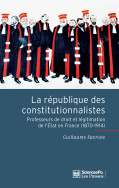
BOOK: Chr. Voilliot reviews G. Sacriste, La République des constitutionnalistes (Presses de Sciences Po, 2011)


The review section of the journal Histoire du XIXe siècle (online on recensio.net) features a discussion by Christophe Voilliot (Paris X-Naterre) of a recent Ph.D. by political scientist Guillaume Sacriste (Paris I) on the use of constitutional law in the legitimation of the French State during the Third Republic (1870-1914). This regime achieved some internal stability in France, after a constitutionally extremely turbulent succession of absolute monarchy, constitutional monarchy, republic, consulate, Empire, constitutional monarchy with intermediate revolutions (1830/1848) and Second Empire. Sacriste's work discusses the intellectual transmission and education infrastructure for the French political elite, and the operation of scientific networks, consecrating the emancipation of public law from the dominant civilist tradition.

Full text here.
Link to the book here.
You can find another review here

23 April 2013

BOOK: Supreme Courts in the Holy Roman Empire and their Communication Strategies [Bibliothek Altes Reich; 11]

(Holy Roman Emperor Emperor Charles VI by Auerbach, Wikimedia Commons)
 
In 2012, Anja Amend-Traut, Anette Baumann, Stephan Wendehorst and Steffen Wunderlich edited a collective work (in German) on the Reichshofrat (Imperial Aulic Council) and Reichskammergericht (Imperial Aulic Chamber), the two most important tribunals in the Holy Roman Empire, representing the Emperor as a feudal lord, on one hand, and the members of the Empire, on the other. A lot has been written on these institutions and their considerable archives. Yet, this volume offers a different perspective, looking at the courts and the early-modern juridification of Habsburg rule through the prism of communication and symbolic representation.

An extensive review in French by Claude Michaud (Orléans) is available on recensio.net, in the digital edition of Francia:Recensio (the book review section of the German Historical Institute in Paris' journal Francia).

08 February 2013

JOB: 1 Professor in the History of Private Law & 1 Professor in the History of Public Law (University of Leuven)


Vacancy for Senior Academic Staff “Legal History 1” (starting date 1 October 2013)
The Faculty of Law and the Research Unit for Roman Law and Legal History invite applications for a fulltime position as a member of the Senior Academic Staff in the field of legal history. The assignment consists of teaching in an academic context, scientific research and additional duties of an academic nature, along with those to the wider society.


ASSIGNMENT
Research
The assignment is comprised of research into legal history, with an emphasis on the history of European public law. The candidate can prove his interest in constitutional law and the construction of societies, criminal law, procedural law, international law or human rights. Preferably, the candidate should be adept in the comparative study of historical law, have a view on the Europeanisation of legal scholarship and see legal history as an integral part of legal thought.
The candidate will be expected to conduct research at an international level in an independent manner. Part of his/her assignment will be to develop – in cooperation with other members of the research unit – an international and competitive research programme, and to strive for excellent scientific results. The supervision of PhDs will also be part of his/her range of duties. The candidate is expected to add a proposal for a medium-term research programme to his/her application file.
Teaching
It is expected of the candidate that his/her teaching meet the requirements concerning the standard, orientation and academic character demanded of academic programmes of study. The commitment of the candidate to the quality of the academic programmes as a whole, is considered self-evident. Teaching assignments will include the education of large numbers of students. The candidate may be required to teach at the campuses of Leuven, Kortrijk, Brussels and Hasselt. Furthermore, he/she will organize seminars for smaller groups, will provide the individual supervision of master’s theses and will allot ample time to the education of PhD students.
Additional duties
It is expected of the candidate that he/she be willing to contribute to the services the university provides to the community, and that he/she should also be willing, in the long term, to accept policy functions at the faculty. The candidate will also be at the disposal of the government, the society and the press for the provision of scientific services and information.

REQUIREMENTS
The candidate must hold a doctoral degree and at least one degree that was awarded by a faculty of law. The candidate must clearly possess growth potential. His/her list of publications must also show a commitment to international research in the field of legal history. A thorough perspective on and the capacity to acquire external funding is a plus. Preferably, he/she should have experience with teaching in an academic context and possess demonstrable didactic skills. Moreover, he/she must have mastered the techniques necessary to test the knowledge and skills of large groups.
Experience with research-based education is an asset. Candidates who do not speak Dutch will be expected to have achieved sufficient mastery of the language after three years, so that they can provide education in Dutch properly. The candidate has to be prepared to acquaint himself/herself with new legal topics if necessary. The candidate also needs to have the social and executive skills that are necessary to work amicably and flexibly in the teams within the faculty, the research unit and the research group.

OFFER
We can offer you a dynamic and international research environment. The Research Unit for Roman Law and Legal History is part of the Faculty of Law. The Faculty has a large national and international network, which is comprised of both academics and legal professionals, at its disposal. The appointment will be made at one of the levels of the autonomous academic staff system (a tenured track with an evaluation after five years at the levels of assistant professor, associate professor or professor), depending on your qualifications.
KU Leuven pursues a policy of equal opportunity and diversity.

CONTACT
Prof. dr. Bernard Tilleman, Dean of the Faculty of Law, Bernard.tilleman@law.kuleuven.be
Prof. dr. Laurent Waelkens, Chairman of the Division for Roman Law and Legal History, laurent.waelkens@law.kuleuven.be

APPLICATION
Candidates are invited to apply online at http://www.kuleuven.be/personeel/jobsite/vacatures.htm
Should you experience any problems with the electronic registration, please contact valerie.vanderborght@kuleuven.be, tel. +32 (0)16 328 325.


Vacancy for Senior Academic Staff “Legal History 2” (starting date 1 October 2013)
The Faculty of Law and the Research Unit for Roman Law and Legal History invite applications for a fulltime position as a member of the Senior Academic Staff in the field of legal history. The assignment consists of teaching in an academic context, scientific research and additional duties of an academic nature, along with those to the wider society.
ASSIGNMENT
Research
Conducting research and teaching Dutch courses on legal history, with an emphasis on the history of European private law.
The candidate must be interested in the history of various branches of private law, such as the law of property, family law, the law of obligations, international private law or commercial law, but also in, for example, procedural law or the law of evidence. The candidate should have a demonstrable interest in the diverse European systems of private law, ranging from the common law to Eastern European legal history. Preferably, the candidate should be adept at the comparative study of legal history, have a view on the Europeanisation of legal scholarship and on the current research on “law without nations”, and should also view legal history as an integral part of legal thought. Concerning research into the field of legal history, it is expected of the candidate that he will conduct research at an international level in an independent manner. The research unit in Leuven prefers research on the foundations of law that is at the same time “legal history which heals” and which will contribute to the enduring resolution of conflicts in areas in which lawyers from Leuven university will operate. Part of the assignment of the candidate who is appointed will be to develop – in cooperation with other researchers – an international and competitive research programme, and to strive for excellent scientific results. The supervision of PhDs will also be part of the appointed candidate’s range of duties. The candidate is expected to add a proposition for a medium-term research programme to his/her application file.
Teaching
It is expected of the candidate that his/her teaching meet the requirements concerning the standard, orientation and academic character demanded of academic programmes of study. The commitment of the candidate to the quality of the academic programmes as a whole, is considered self-evident. Teaching assignments will include the education of large numbers of students. The candidate may be required to teach at the campuses of Leuven, Kortrijk, Brussels and Hasselt. Furthermore, he/she will organize seminars for smaller groups, will provide the individual supervision of master’s theses and will allot ample time to the education of PhD students.
Additional duties
It is expected of the candidate that he/she be willing to contribute to the services the university provides to the community, and that he/she should also be willing, in the long term, to accept policy functions at the faculty. The candidate will also be at the disposal of the government, the society and the press for the provision of scientific services and information.

REQUIREMENTS
The candidate must hold a doctoral degree and at least one degree that was awarded by a faculty of law. The candidate must clearly have growth potential. His/her list of publications must show a commitment to international research in the field of legal history. A thorough perspective on and the capacity to acquire external funding is a plus. Preferably, he/she should have experience with teaching in an academic context and possess demonstrable didactic skills. He/she must also have mastered the techniques necessary to test the knowledge and skills of large groups. Experience with research-based education is an asset. Candidates who do not speak Dutch will be expected to have achieved sufficient mastery of the language after three years, so that they can provide education in Dutch properly. The candidate is required to be dynamic and flexible, and to have the necessary executive, organizational and social skills. The candidate must also be willing to acquaint himself with new legal topics, if necessary. The candidate also needs to have the social and executive skills that are necessary to work amicably in the teams within the faculty, the research unit and the research group.

OFFER
We can offer you a dynamic and international research environment. The Research Unit for Roman Law and Legal History is part of the Faculty of Law. The Faculty has a large national and international network, which is comprised of both academics and legal professionals, at its disposal. The appointment will be made at one of the levels of the autonomous academic staff system (a tenured track with an evaluation after five years at the levels of assistant professor, associate professor or professor), depending on your qualifications.
KU Leuven pursues a policy of equal opportunity and diversity.

CONTACT
Prof. dr. Bernard Tilleman, Dean of the Faculty of Law, Bernard.tilleman@law.kuleuven.be
Prof. dr. Laurent Waelkens, Chairman of the Research Unit for Roman Law and Legal History, laurent.waelkens@law.kuleuven.be

APPLICATION
Candidates are invited to apply online at http://www.kuleuven.be/personeel/jobsite/vacatures.htm
Should you experience any problems with the electronic registration, please contact valerie.vanderborght@kuleuven.be, tel. +32 (0)16 328 325.