Search

Showing posts with label league of nations. Show all posts

14 July 2026

BOOK: Haakon A. IKONOMOU, Karin VAN LEEUWEN & Morten RASMUSSEN (eds.), The Cambridge Handbook of the League of Nations and International Law (Cambridge: Cambridge University Press, 2026), 558 p. ISBN 9781009655187


(image source: CUP)

Abstract:

Established in the wake of the First World War, the League of Nations fundamentally transformed international politics, global governance and multilateral cooperation in a multitude of fields from the economy, labour and social affairs to colonial, minority and security questions. This Handbook analyses the central role of law in the construction of a new international order under the League of Nations. Drawing from innovative research of recent years that analyses the League of Nations through the prism of ultimate success and failure, it offers twenty-one rich chapters that showcase an interdisciplinary, contextual and archive-based approach with brand new and unexplored case studies that address key topics of the legal history of the League, the International Labour Organization and the Permanent Court of International Justice. Finally, it offers a new historical synthesis of how to understand the role of international law in international organizations during the interwar period.

Read more here: DOI 10.1017/9781009655149

21 November 2025

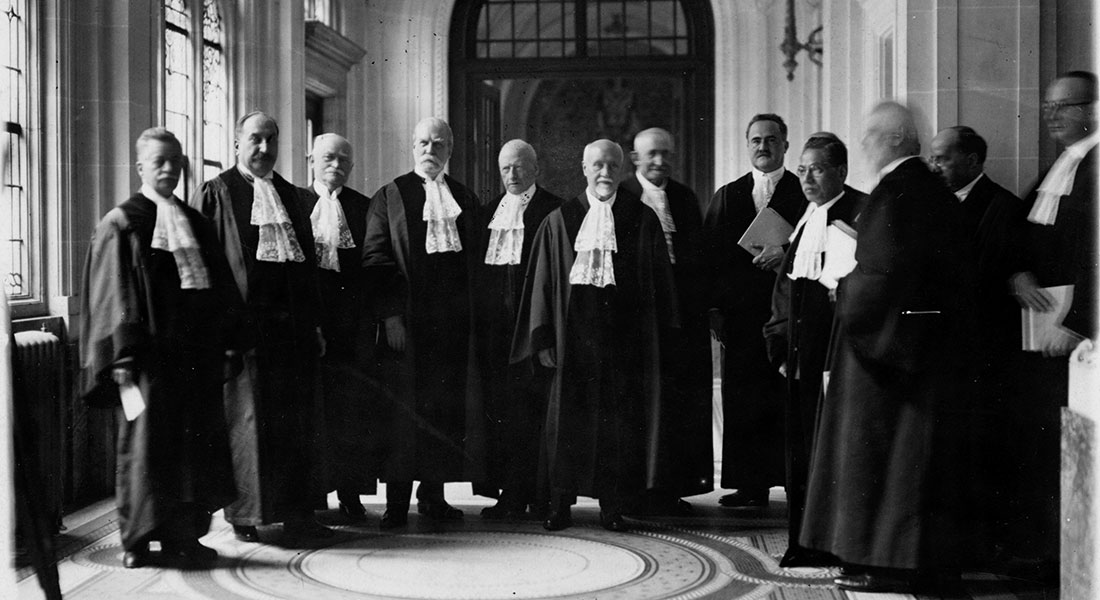
SEMINAR: The Global History of the Establishment of the Permanent Court of International Justice, 1919 to 1922 (Copenhagen: CEMES/INNER_LEAGUE ERC Project, 1-2 DEC 2025)


(image source: CEMES)

Abstract:

This seminar will discuss the draft book chapters of a new monograph on the establishment of the Permanent Court of International Justice (PCIJ). The book will tell the story of how the PCIJ was imagined, developed and established from the negotiations of the Covenant in Spring 1919 as part of the Peace Treaty negotiations over the famous negotiations of the court Statute by the Advisory Committee of Jurists in Spring of 1920 to the ultimate decision on the nature of the Court and the selection of judges by the League of Nations Council and Assembly in 1920-1921. The opening meeting of the PCIJ took place on 15 February 1922 and would fundamentally change the system of international law and its historical trajectory.

Program:


Monday 1 December 13.00-17.00

South Campus, 11b-2-29

Introduction (Haakon Ikomomou and Morten Rasmussen (University of Copenhagen)
The Negotiations of the League Covenant in Paris (Karin van Leeuwen (Maastricht University))
Latin America (Andrei Mamolea (Boston University, ONLINE)
Commentators: Associate Professor Megan Donaldson (University College London) and Professor Leonard Smith (Oberlin College)

Tuesday 2 December 10.00-16.00

South Campus, room 12-3-07

Scandinavia, the Netherlands and Switzerland (Karin van Leeuwen and Haakon Ikonomou)
The Advisory Committee (Morten Rasmussen)
The final decision of the Council and First Assembly and establishment of the PCIJ (Morten Rasmussen)
Commentators: Associate Professor Megan Donaldson


More information here

12 May 2025

SCHOLARSHIP: PhD scholarship in the ERC Consolidator Project INNER_LEAGUE (Copenhagen: University of Copenhagen, DEADLINE 15 MAY 2025)


(image source: University of Copenhagen)

The Saxo Institute, Faculty of Humanities, University of Copenhagen (UCPH), invites applications for a PhD scholarship in the ERC Consolidator Project INNER_LEAGUE, from 1 January 2026.

The scholarship is for 3 years starting on 1 January 2026 or as soon as possible thereafter.


Introduction
INNER_LEAGUE is a 5-year ERC Consolidator Project (2025-2030), headed by Haakon A. Ikonomou (PI). INNER_LEAGUE provides a comprehensive social-bureaucratic history of the League of Nations Secretariat. The project will investigate the inner life of the secretariat to (a) understand how it shaped the professional lives of the ca. 4000 people that worked there. And (b) how this global workplace shaped the lasting bureaucratic infrastructures of multilateralism it serviced.

To deliver on its undertaking, the project implements an approach combining social, institutional, and digital history across three work packages: (i) Communities(ii) Hierarchies, and (iii) Infrastructures.

To operationalize its approach, INNER_LEAGUE has several concrete objectives:
(1) To systematically uncover and analyze the emergence, endurance, change and impact of professional, educational, epistemic, social, and emotional communities within the League Secretariat.
(2) To examine the often-contested formation of hierarchies within the League Secretariat via state-of-the-art digital approaches.
(3) To investigate how processes of community building and hierarchization impacted upon the professional lives of the staff of the League Secretariat.
(4) To study and explain how, and under what material circumstances, these hierarchized communities of officials and staff built, maintained, operated, and passed on new infrastructures of multilateralism.

The project is hosted at the Saxo Institute, University of Copenhagen. The Saxo Institute at the Faculty of Humanities is dedicated to the study of human societies past and present, with degree programs ranging from History to Archeology, Ethnology, Classical Languages and Migration Studies.


PhD studies consist of research programmes at the highest international level that qualify students for independent research, knowledge dissemination and teaching. The main emphasis is on PhD students organising and conducting their own research project (under supervision). The programme culminates in the submission of a PhD thesis, which the student must defend in public. The programme is prescribed to 180 ECTS credits, corresponding to three years of full-time study.
A PhD degree opens a range of career opportunities in academia and elsewhere. As well as writing a thesis, PhD students work in active research environments in Denmark and abroad. They contribute to the academic environment, take research training courses, and convey the results of their research in teaching, at academic conferences and to the public.

Duties and Responsibilities
We are looking for a historian with experience and interest in the history of international organizations, international public administrations and/or multilateral diplomacy in the 20th (and 21st) century. Experience in working with IO-archives and proficiency in reading and writing in English and French is a distinct positive.

The PhD will focus on:

  • The employees who worked to prepare, maintain, and expand the League of Nations as a multifarious, multilateral diplomatic site. Inspired by New Diplomatic History, we want to unearth the diplomatic agency of the staff working in seemingly minor roles, and to understand them as engaged in the crucial, collective diplomatic task of ‘preparing sites’ for mutual understanding.
  • The evolution of the procedural, technical and communicative work of the secretariat that went into the League Assembly and the League Council as diplomatic sites.

The PhD is expected to complete a monograph (not article-based) thesis within the period of scholarship, to contribute to the project’s substantial collective prosopographical work (among other things with the aim of creating a new version of VisuaLeague), and to learn and grow as a scholar together with other INNER_LEAGUE project members.

Qualification requirements
Applicants must have a two-year master’s degree (120 ECTS) or equivalent (for instance 4+1 degrees as is customary in some countries) and, as minimum, have submitted a master’s thesis for which they have received pre-approval at the time of application.

The qualifications of applicants with non-Danish Master’s degrees will be assessed to ascertain whether they correspond or can be judged to be equivalent to the Danish level. For further information, please refer to the website of the Ministry of Education and Research: https://ufm.dk/en/education/admission-and-guidance.

Applicants must possess skills in written and spoken academic English at a high level. If deemed necessary, the department may request that applicants document their language skills.

For further information about the guidelines for PhD studies at UCPH, please refer to: 
https://phd.ku.dk/english/.

For further information about the structure of the PhD programme, please refer to:  https://phd.humanities.ku.dk/phd-programme/structure/.

Application 
All applications must be submitted online via the link “Apply now” at the bottom of this page. The application must be written in English, and include the following enclosures in Adobe PDF or Word format:

  1. Cover letter (max. 2 pages detailing your motivation and background for applying with the specific PhD project).
  2. CV   
  3. Project suggestion/reflection (max. 3 pages, Times New Roman, size 12, line spacing 1,15).
  4. Diploma and transcripts of records (bachelor’s and master’s degree)   
  5. Other information for consideration, e.g. list of publications, documentation of English language qualifications.

On the website of the PhD School you can find information about the enclosures to include with your electronic application: https://phd.humanities.ku.dk/how-to-obtain-a-phd-scholarship/admission-requirements/.

Applicants with a degree from a university where documents are not issued in English, or a Scandinavian language must provide a translation of their diploma and transcript of records verified by the issuing university. The documents must be translated into English, Danish, Norwegian or Swedish. In addition, you must enclose an official description of the grading scale in question (for instance diploma supplement).

Assessment criteria
The following criteria are applied when assessing PhD applications:

  • Research qualifications as reflected in the project description. 
  • Quality and feasibility of the project.  
  • Qualifications and knowledge in relevant disciplines. 
  • Performance (grades obtained) in graduate and post-graduate studies. 

The recruitment process
After the deadline for applications, the Head of Department considers advice from the appointment committee and then selects applicants for assessment. All applicants will be notified whether they have been shortlisted. After this, the Head of Department sets up an expert assessment committee to assess the shortlisted applications. The selected applicants will be informed who is serving on the committee. Each shortlisted applicant will be offered the opportunity to comment on the committee’s assessment of their application before the appointment is announced.

For further information about the recruitment process, please refer to the University of Copenhagen website: https://employment.ku.dk/faculty/recruitment-process/.

Enrolment
It is a prerequisite for employment that successful applicants enrol at the PhD School of the Faculty of Humanities at the University of Copenhagen.

For further information about the structure of the PhD programme, please refer to: https://phd.humanities.ku.dk/phd-programme/structure/.
For further information about the guidelines for PhD studies at UCPH, please refer to: https://phd.ku.dk/english/.

Salary and terms of employment
Terms of appointment and salary will be in accordance with an agreement between the Ministry of Finance and The Danish Confederation of Professional Associations (AC). The salary range starts at DKK 30,800,00 (EUR 4125) + a 17.1 % contribution to the pension scheme.

According to the agreement, the PhD Fellow is required to carry out tasks at the relevant department to an extent corresponding to 840 working hours (6 months) without additional pay. The work obligation can include teaching, for instance.

An equal opportunity workplace
University of Copenhagen wishes to reflect the diversity of society, and welcomes applications from all qualified candidates, regardless of their personal backgrounds. For more information on the diverse working place environment at the university and the university’s participation in the HRS4R, please see: https://employment.ku.dk/working-at-ucph/eu-charter-for-researchers/.

International applicant?
The University of Copenhagen offers a broad variety of services for international researchers and accompanying families, including support before and during your relocation and career counselling to expat partners. Please find more information about these services as well as information on entering and working in Denmark here: https://ism.ku.dk/.

Contact information
For further information about the structure and rules of the PhD programme, please contact the PhD Administration email: phd@hrsc.ku.dk

Information about the recruitment process is available from HR South, email: hr-soendre@adm.ku.dk 
Please refer to case number: 211-2141/25-2H

If you have any questions about the academic content, please contact Haakon A. Ikonomou, email ikonomou@hum.ku.dk

The deadline for applications is 15 August 2025 at 23:59 [CEST]

Any applications or additional material submitted after the deadline will not be considered. However, changes may be made to the submitted application right up until the deadline.

Part of the International Alliance of Research Universities (IARU), and among Europe’s top-ranking universities, the University of Copenhagen promotes research and teaching of the highest international standard. Rich in tradition and modern in outlook, the University gives students and staff the opportunity to cultivate their talent in an ambitious and informal environment. An effective organisation – with good working conditions and a collaborative work culture – creates the ideal framework for a successful academic career.

02 May 2025

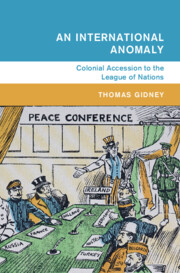
BOOK: Thomas GIDNEY, An International Anomaly. Colonial Accession to the League of Nations (Cambridge: Cambridge University Press, 2025), ISBN 9781009584432 [OPEN ACCESS]


(image source: CUP)

Abstract:
It is often assumed that only sovereign states can join the United Nations. But this was not always the case. At the founding of the United Nations, a loophole drafted by British statesmen in its predecessor organisation, the League of Nations, was carried forward, allowing colonies to accede as member-states. Colonies such as India, Ireland, Egypt, and many more were afforded a tokenistic representation at the League in Geneva during the interwar years, decades before their independence. Thomas Gidney unites three geographically distinct case studies to demonstrate the evolution of Britain's policy from a range of different viewpoints, exploring how this policy came into being, and why it was only exploited by the British Empire. He argues that this membership shaped colonial norms around sovereignty and international recognition in the interwar period and to the present day.

Table of contents:

Introduction
1. India's accession to the Imperial Conference
2. The formation of the League of Nations and Indian membership 'The anomaly among anomalies'
3. Inter Se and the League of Nations
4. Ireland's accession to the League of Nations
5. A membership obstructed: Egypt's delayed accession to the League of Nations

6. The demise of the League of Nations and the reemergence of colonial membership at the United Nations.

On the author:

Thomas Gidney is a a historian of international and colonial history and a Research Fellow at the Global Governance Centre, Graduate Institute Geneva. 

Read more: DOI 10.1017/9781009584432


14 April 2025

BOOK: Robert KOLB and Momchil MILANOV (eds.), The Cambridge History of International Law. Volume 10. International Law at the Time of the League of Nations (1920–1945) [The Cambridge History of International Law, ed. Randall LESAFFER] (Cambridge: Cambridge University Press, 2025), 630 p., ISBN 9781108487696, £120.00


Abstract:

Volume X of The Cambridge History of International Law offers a comprehensive and critical discussion of the history of international law in the interwar period to date. Bringing together scholars across various disciplines, the volume aims to go beyond the well-established cliché of the failure of the League of Nations and discusses the huge impact this period had on the post-WWII international legal order. It focuses on the League of Nations as an important milestone to be studied, analysed, and understood in its own right. Using a global perspective, the volume sheds light on the different branches of international law in this dynamic period, during which the discipline underwent a qualitative leap.


Table of contents:

Introduction

1. International Law at the time of the League of Nations Carlo Focarelli

2. The League of Nations and the Global Legal Order Leonard V. Smith

3. The scholarship of international law at the time of the League of Nations Asier Garrido-Muñoz

4. The League of Nations as an international organisation Philip Burton and Christian J. Tams

5. The League of Nations and the relationship between international law and municipal law Philip Burton and Jean d'Aspremont

6. Sovereignty, territory and jurisdiction Malgosia Fitzmaurice and Paul Gragl

7. The law of the sea at the time of the League of Nations Yoshifumi Tanaka

8. Colonies and mandates at the time of the League of Nations Giovanni Distefano and Aymeric Hêche

9. The use of force in the Interbellum: a look at the debate on the meaning of 'war' in the Covenant of the League of Nations and Briand-Kellogg Pact Agatha Verdebout

10. Law of armed conflict and neutrality Etienne Henry

11. Preventive diplomacy, peacekeeping and peace-making at the time of the League of Nations Ivan Ingravallo and Pavle Kilibarda

12. The law of State responsibility in the interwar years: a period of 'great advances' Paolo Palchetti

13. 'The beginning of something great'? International criminal law in the interwar period Sévane Garibian

14. Investment Tarcisio Gazzini

15. Trade integration and the League of Nations Petros C. Mavroidis

16. Minorities, refugees and human rights at the time of the League of Nations Momchil Milanov and León Castellanos-Jankiewicz

17. A period of reckoning: private international law during the time of the League of Nations Roxana Banu

18. Diplomatic law at the time of the League of Nations Giuseppe Puma

19. Dispute settlement, particularly adjudication and arbitration Gleider Hernández and Momchil Milanov

20. The League for nature: environmental law in the League of Nations Omer Aloni and Anna-Katharina Wöbse

21. Soviet approaches to international law during the interwar period Lauri Mälksoo

22. The Americas at the Time of the League of Nations Juan Pablo Scarfi.


More information here

11 March 2025

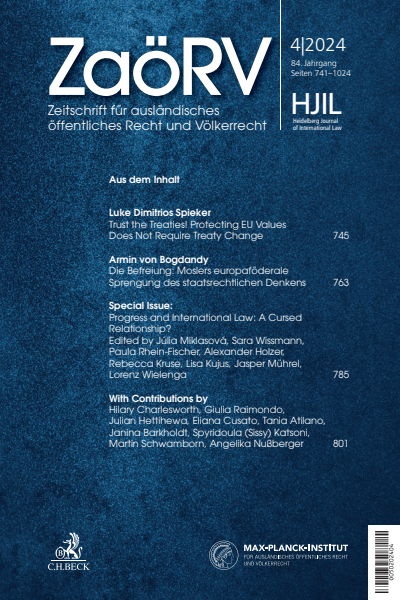
JOURNAL: Focus Section "Re-Reading Historic Articles in the ZaöRV", Zeitschrift für ausländisches öffentliches Recht und Völkerrecht/Heidelberg Journal of International Law LXXXIV (2024), nr. 4 [OPEN ACCESS]

(image source: Nomos)

Introducing the Anniversary Series (Robert Stendel)

Die Befreiung: Moslers europaföderale Sprengung des staatsrechtlichen Denkens (Armin von Bogdandy)

Abstract:

1951 befreite Hermann Mosler das deutsche juristische Denken transnatio- naler Phänomene aus den Fesseln des staatsrechtlichen Denkens. Medium der Befreiung war die Zeitschrift für ausländisches öffentliches Recht und Völ- kerrecht, Anlass der Vertrag zur Gründung der Europäischen Gemeinschaft für Kohle und Stahl (EGKS). Konkret legte Mosler einen Weg frei, das Gemeinschaftsrecht jenseits des staatsrechtlichen Dualismus von Landesrecht und Völkerrecht als eine neue und neuartige Rechtsordnung zu denken, und zwar in föderalen und verfassungsrechtlichen Kategorien. Er zeigt, dass der politische Wille zu einer völkervertraglich verfassten Föderation souveräner Staaten kein juristisches Paradoxon ist, sondern vielmehr ein Weg in eine bessere Zukunft. Voraussetzung ist allerdings staatsrechtliche Dogmen zu sprengen. So geht es zunächst geht es um die Fesseln, veranschaulicht an Aufsätzen, mit denen Carl Bilfinger in der ZaöRV das juristische Denken in der ersten Sattelzeit zu orientieren suchte. In deren Gegenlicht gewinnt Mos- lers Befreiung klare Konturen. Abschließend wird untersucht, welchen Fes- seln Mosler nicht entkam.

Outside of this section:

Constructing Youth as Progress: Tracing Shared Efforts of the League of Nations and the United Nations (Julian Hettihewa)

Abstract:

A more comprehensive understanding of progress and international law can be obtained if youth is included in the analysis. While youth is gaining increasing prominence in international law, it continues to be neglected by international legal scholarship. This is especially problematic in the context of progress and international law as youth is constructed by international law as progress. This article presents a historical account of youth’s construction as progress, focusing on the efforts of the League of Nations (LoN) and the United Nations (UN) to educate youth in order to promote peace, to prevent another world war. This contribution highlights the continuity of historical patterns and identifies the function of youth as progress as an instrument to conceal power-differentials. Furthermore, this article reveals structural commonalities between interna- tional law and youth. Both embody the Messianic announcement of something universally and inherently good, albeit always postponed: progress.

Visions of International Law in the Nineteenth Century: The Experience of the French Intervention in Mexico (Tania Tilano)

Abstract:

This article explores how Mexican liberal republicans engaged creatively with international law to contest the French Intervention (1862–1867). Their novel vision of enforcing international law through domestic criminal law went beyond mere appropriation; it was a projection of the future. Mexican republicans envisioned international law as a tool to mitigate the asymmetries between European powers and postcolonial nation-states like Mexico. The article demonstrates how postcolonial actors effectively deployed international law, showcasing its potential to contest hegemony on multiple levels: as a language, as a strategy, as an instrument, and as a symbol.

Book reviews:

  • Gaillet, Aurore: La Cour constitutionnelle fédérale allemande. Recon struire une démocracie par le droit (1945-1961) (Peter Huber)
  • Mahlmann, Matthias: Mind and Rights. The History, Ethics, Law and Psychology of Human Rights (Mónica Mazariegos Rodas)
  • Duve, Thomas and Herzog, Tamar (eds.): The Cambridge History of Latin American Law in Global Perspective (Juan C. Herrera)

Issue DOI: 10.17104/0044-2348-2024-4 (open access) 

28 January 2025

BOOK: Aurora ALMADA E SANTOS & Yvette SANTOS (eds.), The League of Nations Experience. Overlapping Readings (Berlin: DeGruyter Oldenbourg, 2025), ISBN 9783111063973


(image source: DeGuyter Oldenbourg)

Abstract:

As an early experiment in the creation of multilateral institutions, the League of Nations was entrusted by its members to maintain peace but also to be a standard-maker and a manager of contemporary problems and challenges requiring a global response. Nevertheless, after a while it became clear that its performance in addressing major conflicts did not live up to the expectations of guarantying collective security. In the functional areas, although the organization created precedents, it also showed limitations. Due to its complexity, increasingly the League of Nations has been studied not only from an institutional perspective but also from a more multidimensional and comparative point of view that allows to consider the presence and role of the organization in various scales and spaces, besides its relationship with a diversity of actors and themes. The League of Nations Experience: Overlapping Readings offers a multitude of interpretations, evincing some of the promising avenues through which the League of Nations continues to inspire academic research.

On the editors:

Aurora Almada e Santos and Yvette Santos, NOVA University Lisbon, Portugal. 

Read more here

24 January 2025

ARTICLE: Klaas DYKMANN, "The administrative culture(s) of the League of Nations Secretariat" (Administory VII (2022), nr. 1), 67-79


Abstract:

The chapter discusses the administrative culture(s) of the League of Nations Secretariat in the foundational years and asks what constituted the original administrative culture(s) of the League’s international civil service. The main argument is that decisions in the formative years of the League’s Secretariat led to an internationalised Western bureaucratic model, balancing autonomy and legitimacy concerns. While efficiency was essential, acquiring an international character for the secretariat seemed rather more desirable than mandatory. These factors had a decisive impact on the administrative culture in the League’s early years (and beyond).

Read the article (published in November 2024) in open access here: DOI  10.2478/adhi-2022-0017.

12 December 2024

BOOK: Laurence BADEL, Eckart CONZE & Axel DRÖBER (eds.), The Paris Peace Conference of 1919. The Challenge of a New World Order (New York: Berghahn Books, 2024), 338 p. ISBN 978-1-80539-807-3, 107 GBP


(image source: Berghahn)

Abstract:
For more than a century, the Paris Peace Conference of 1919 has remained an object of historical scrutiny. As an attempt to consolidate peace in the wake of World War I and to prevent future conflict, it was instrumental in shaping political and social dynamics both nationally and internationally. Yet, in spite of its implications for global conflict, little consideration has been given to the way the Paris Peace Conference constructed a new global order. In this illuminating and geographically wide-ranging reassessment, The Paris Peace Conference of 1919 reconsiders how this watershed event, its diplomatic negotiations and the peace treaties themselves gave rise to new dynamics of global power and politics. In doing so it highlights the way in which the forces of nationality and imperiality interacted with, and were reshaped by, the peace.

On the editors:

Laurence Badel is Professor of Contemporary History and International Relations at Paris 1 Panthéon-Sorbonne University. A specialist of European diplomatic practices, her research focus is two-pronged: the history of women in diplomacy and international relations and the history of diplomatic capitals. Her most recent publications are Écrire l'histoire des relations internationales. Genèses, concepts, perspectives XVIIIe-XXIesiècle (Armand Colin, 2024) and Diplomaties européennes: XIXe-XXIe siècle (Presses de Sciences Po, 2021), which won the Institut de France’s 2022 Prix Edouard Bonnefous. Eckart Conze is Professor of Modern and Contemporary History and Co-Director of the International Research and Documentation Centre for War Crimes Trials (ICWC) at the University of Marburg (Germany). He has held visiting professorships at the Universities of Toronto, Cambridge, Bologna, Utrecht and Jerusalem. Among his book publications is Die große Illusion. Versailles 1919 und die Neuordnung der Welt (Siedler, 2018). Axel Dröber is lecturer at Sorbonne Université. He studies nineteenth and twentieth-century Western European history, with a focus on the history of public security and the state monopoly on violence in post-revolutionary Europe. He published a book-length study on the National Guard during the Restoration and the July Monarchy in France (Nation, Militär und Gesellschaft, HeiUP,2022) and is currently working on the topic of migration and citizenship after the First World War.

Read more here


04 February 2022

ONLINE BOOK LAUNCH: P. SEAN MORRIS (ed.), The League of Nations and the Development of International Law- Transforming the Politics of International Law (Routledge, 2021/2022) (Helsinki, 16 FEB 2022)


(image source: Routledge)

The Erik Castren Institute of International Law at the University of Helsinki organises a digital book launch for two volumes published recently on the League of Nations:

- P. Sean Morris (ed.), The League of Nations and the Development of International Law. A New Intellectual History of the Advisory Committee of Jurists (ISBN 9780367897536)
- P. Sean Morris (ed.), Transforming the Politics of International Law. The Advisory Committee of Jurists and the Formation of the World Court in the League of Nations (ISBN 9780367897512)

This event takes place on 16 February at 4:00 PM Helsinki Time (= 17:00 CEST).

Event description:

Pro­gramme

Opening remarks
Martti Koskenniemi, Emeritus Professor of International Law at the University of Helsinki

Why these books, Why Now?
Sean Morris, Grant-funded researcher at the University of Helsinki

International Law and the Interwar: A Comment
Megan Donaldson, Lecturer of Public International law at the University College London

The Advisory Committee of Jurists
Karin van Leeuwen, Assistant Professor in European political history at Maastricht University,
Morten Rasmussen, Associate Professor at the SAXO Institute at the University of Copenhagen

Ricci Busatti and the Advisory Committee
Elisabetta Fiocchi Malaspina, Assistant Professor of Legal History at the Law Faculty of the University of Zurich

Discussion 

To attend the launch, please register via the e-form the latest by 15 January (6 pm EET).
The zoom link will be sent the latest the day before the event.

Book descriptions:

The League of Nations and the Development of International Law: A New Intellectual History of the Advisory Committee of Jurists examines the contributions to International Law of individual members of the Advisory Committee of Jurists in the League of Nations, and the broader national and discursive legal traditions of which they were representative. It adopts a biographical approach that complements existing legal narratives.
Pre-1914 visions of a liberal international order influenced the post-1919 world based on the rule of law in civilised nations. This volume focuses on leading legal personalities of this era. It discusses the scholarly work of the ACJ wise men, their biographical notes, and narrates their contribution as legal scholars and founding fathers of the sources of international law that culminated in their drafting of the statute of the Permanent Court of International Justice, the forerunner of the International Court of Justice. The book examines visions of world law in a liberal international order through social theory and constructivism, historical examination of key developments that influenced their career and their scholarly writings and international law as a science.

Transforming the Politics of International Law: The Advisory Committee of Jurists and the Formation of the World Court in the League of Nations examines the role of League of Nations committees, particularly the Advisory Committee of Jurists (ACJ) in shaping the statute of the Permanent Court of International Justice (PCIJ). The authors explore the contributions of individual jurists and unofficial members in shaping the League’s international legal machinery.
One of the guiding principles of the book is that the development of international law was a project of politics where the idea and notion of an international society must contend with the political visions of each state represented on the different legal committees in the League of Nations during the drafting of the Covenant. The book constitutes a major contribution to the literature in that it shows the inner workings of some of the legal committees of the League and how the political role of unofficial members was influential for the development of international law in the early twentieth century and how they influenced the political and legal process of the ACJ.

Both volumes can be purchased via the Routledge website. Receive a 20% discount using the code FLY21.

Fill out the form to register. 

(source: University of Helsinki


01 December 2021

SEMINAR: HiStories: The Digital Turn - Fostering Research on Multilateralism (Online, 9 December 2021)


We learned of an online seminar on the Total Digital Access to the League of Nations Archives project (LONTAD) next week.

Agenda

Join at the Commons for our next HiStories session! The Total Digital Access to the League of Nations Archives project (LONTAD) will transform research on multilateralism. The project, currently underway at the United Nations Library & Archives, is digitizing and providing online access to the entirety of the 15 million pages of these critical archives, which are inscribed on UNESCO’s Memory of the World Register.

Join us to learn about:
- The LONTAD project and some of the fascinating documents encountered
- The project’s new research platform and how to use it
- Why research about the League is crucial to understanding multilateralism
as practiced today
- The importance of democratizing access to materials on the League
- How creating digital archives is opening the door to the latest innovative
research methodologies that carry the potential to unlock new insights


Registration here

14 June 2021

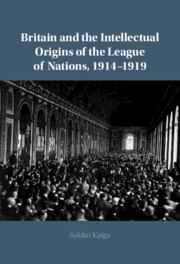
BOOK: Sakiko KAIGA, Britain and the Intellectual Origins of the League of Nations, 1914–1919 (Cambridge: CUP, 2021). ISBN 9781108489171, £ 75.00


(Source: CUP)

CUP has published a new book on the British origins of the League of Nations.

ABOUT THE BOOK

In this innovative account of the origins of the idea of the League of Nations, Sakiko Kaiga casts new light on the pro-League of Nations movement in Britain in the era of the First World War, revealing its unexpected consequences for the development of the first international organisation for peace. Combining international, social, intellectual history and international relations, she challenges two misunderstandings about the role of the movement: that their ideas about a league were utopian and that its peaceful ideal appealed to the war-weary public. Kaiga demonstrates how the original post-war plan consisted of both realistic and idealistic views of international relations, and shows how it evolved and changed in tandem with the war. She provides a comprehensive analysis of the unknown origins of the League of Nations and highlights the transformation of international society and of ideas about war prevention in the twentieth century to the present.

ABOUT THE AUTHOR

Sakiko KaigaUniversity of Tokyo
Sakiko Kaiga is a Research Fellow at the Institute of Social Science, University of Tokyo.

TABLE OF CONTENTS

Introduction

1. Precursors: Thinking about War and Peace before 1914

2. The Use of Force to Prevent War? The Bryce Group's Proposals for the Avoidance of War, 1914-15

3. Strategies for Winning Public Opinion: The Success and the Loss of the League of Nations Society, 1915-17

4. A Transnational Movement? The British and American Pro-League of Nations Groups, 1914-18

5. No Peace without Victory: The League of Victorious Allies, 1917-18

Conclusion.


More info here

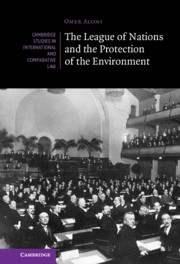
BOOK: Omer ALONI, The League of Nations and the Protection of the Environment (Cambridge: CUP, 2021). ISBN 9781108838191, 85.00 GBP


(Source: CUP)

CUP has published a new book on the League of Nations and environmental protection.

ABOUT THE BOOK

In the history of how the law has dealt with environmental issues over the last century or so, the 1920s and 30s and the key role of the League of Nations in particular remain underexplored by scholars. By delving into the League's archives, Omer Aloni uncovers the story of how the interwar world expressed similar concerns to those of our own time in relation to nature, environmental challenges and human development, and reveals a missing link in understanding the roots of our ecological crisis. Charting the environmental regime of the League, he sheds new light on its role as a centre of surprising environmental dilemmas, initiatives, and solutions. Through a number of fascinating case studies, the hidden interests, perceptions, motivations, hopes, agendas and concerns of the League are revealed for the first time. Combining legal thought, historical archival research and environmental studies, a fascinating period in legal-environmental history is brought to life.

ABOUT THE AUTHOR

Omer Aloni, Bar-Ilan University, Israel

Omer Aloni is Research and Postdoctoral Fellow in the Faculty of Social Sciences, University of Bar-Ilan, Ramat-Gan, Israel. He received his Ph.D. from Tel-Aviv University (Faculty of Law). He holds research affiliations with the University of Potsdam, the Rachel Carson Center for Environment and Society (LMU Munich) and the Max Planck Institute. He was awarded the Tallinn Prize by the European Society for Environmental History for the best research in 2018 and 2019.

TABLE OF CONTENTS

1. Fighting pollution made by humankind: the League of Nations and the endeavors of the convention against the pollution of the sea by oil

2. The League of Nations and the whaling dilemma

3. Sanitation, spreading diseases, and the environmental concerns: the League of Nations' campaign for rural hygiene

4. Raw materials, the timber crisis, and fears of deforestation during the interwar period

5. Evaluating the environmental regime of the League of Nations: comparative discussion

6. Conclusion.

More info here

15 February 2021

BOOK: Michael D. CALLAHAN, The League of Nations, International Terrorism, and British Foreign Policy, 1934–1938 (London: Palgrave, 2018). ISBN: 978-3-319-77199-1, € 103


(Source: Palgrave)

ABOUT THE BOOK

This book examines the League of Nations, state-supported terrorism, and British foreign policy after the rise of Hitler in the 1930s.  It argues that with strong leadership from Britain and France, the League made it possible for states to preserve the peace of Europe after terrorists aided by Italy and Hungary killed the King of Yugoslavia in 1934.  This achievement represents the League at its most effective and demonstrates that the organization could carry out its peacekeeping functions.  The League also made it possible to draft two international conventions to suppress and punish acts of terrorism.  While both conventions were examples of productive collaboration, in the end, few governments supported the League’s anti-terrorism project in itself.  Still, for Britain, Geneva served the cause of peace by helping states to settle their differences by mediation and concession while promoting international cooperation, a central conviction of British “appeasement” policy in the 1930s.

ABOUT THE AUTOR

Michael D. Callahan is Professor of History and Frances Willson Thompson Professor of Leadership Studies at Kettering University, USA.  He is author of Mandates and Empire: The League of Nations and Africa, 1914-1931 (1999/2008) and A Sacred Trust: The League of Nations and Africa, 1929-1946 (2004).  


More information and table of contents with the publisher.

29 January 2021

BOOK: Elisabetta TROLLARDO, Fascist Italy and the League of Nations, 1922-1935 (London: Palgrave, 2016). ISBN 978-1-349-95027-0, € 93

 
(Source: Palgrave)

ABOUT THE BOOK

This book analyses the relationship between Fascist Italy and the League of Nations in the interwar years. By uncovering the traces of those Italians working in the organization, this volume investigates Fascist Italy’s membership of the League, and explores the dynamics between nationalism and internationalism in Geneva. The relationship between Fascist Italy and the League of Nations was contradictory, shifting from active collaboration to open disagreement. Previous literature has not reflected this oscillation in policy, focusing disproportionally on the problems Italy caused for the League, such as the Ethiopian crisis. Yet Fascist Italy remained in the League for more than fifteen years, and was the third largest power within the institution. How did a Fascist dictatorship fit into an organization espousing principles of liberal internationalism? By using archival sources from four countries, Elisabetta Tollardo shows that Fascist Italy was much more concerned with, and involved in, the League than currently believed.

ABOUT THE AUTHOR

Elisabetta Tollardo received her doctorate in history from the University of Oxford, UK. Her dissertation was awarded the British International History Group Thesis Prize in 2015.


More information with the publisher.

25 January 2021

BOOK: Harumi GOTO-SHIBATA, The League of Nations and the East Asian Imperial Order, 1920–1946 (London: Palgrave, 2020). ISBN: 978-981-15-4967-0, € 93


(Source: Palgrave)

ABOUT THE BOOK

Well-grounded on abundant Japanese language sources which have been underused, this book uncovers the League of Nations’ works in East Asia in the inter-war period. By researching the field of social and other technical issues, namely, the trade in narcotics, the trafficking of women and the work in terms of improving health provision and providing economic advice to Nationalist China, it not only examines their long-term impacts on the international relations in the region but also argues that the League’s works challenged the existing imperial order of East and Southeast Asia. The book offers a key read for academics and students of international history and international relations, and others studying Japan or East Asia in the twentieth century. 

ABOUT THE AUTHOR

Harumi Goto-Shibata is Professor of International History at the Department of Advanced Social and International Studies, Graduate School of Arts and Sciences, University of Tokyo, Japan. Her prior publications include Japan and Britain in Shanghai, 1925-31 (Macmillan, St Antony’s series, 1995) as well as three single-authored books, and two co-edited books in Japanese.


More information and table of contents with the publisher.

16 June 2020

CALL FOR PAPERS: 'Britain, the League of Nations and the New International Order' (Online Conference 20-21 November 2020, University of Edinburgh) (DEADLINE: 20 August 2020)


The University of Edinburgh School of History, Classics & Archaeology has a Call for Papers for a conference on the League of Nations. Here the call:

November 2020 marks the centenary of the first meeting of the Assembly of the League of Nations in Geneva. The League was established by the Peace Conference at the end of the First World War to ‘promote international cooperation and to achieve international peace and security.’ The range of its activities was considerable and in recent years there has been renewed scholarly interest in the important work it undertook, which retains a relevance for modern policy makers.

Keynote speakers include:

Professor Glenda Sluga (University of Sydney)
Professor Peter Jackson (University of Glasgow)
Dr Madeleine Dungy (École Polytechnique Fédérale de Lausanne)

Due to the continuing uncertainties presented by COVID-19, the conference will be held entirely online, through Microsoft Teams. There is no registration fee, but all attendees must register their interest via this web form. We would welcome 20-minute papers on any of the following aspects of the work of the League, and its role in the shaping of the post-First World War international system:

The work of the League – mandates, minority protection, refugees, economics and finance, disarmament and peace-making
The British Foreign Office and Geneva – the League Council and Assembly, British priorities
The League and its operation – the international civil service, the League and international law
The social work of the League – health, trafficking, women’s rights and gender equality
The cultural impact and legacy of the League – the LNU, peace movements, the League and popular culture, global governance in the twentieth and twenty-first century.
ECRs and PhD students are particularly encouraged to submit papers for panels consisting of three 20-minute papers. Those wishing to present papers are invited to submit a 250-word abstract and one-page CV to Dr David Kaufman, (D.Kaufman@ed.ac.uk) by 20 August, 2020.

More info here

05 May 2020

BOOK: Haakon A. IKONOMOU & Karen GRAM-SKJOLDAGER (eds.), The League of Nations. Perspectives from the Present (Aarhus: University Press, 2019). ISBN: 9788771846201, 299 DKK, pp. 284


ABOUT THE BOOK

The League of Nations – Perspectives from the Present is an accessible and richly illustrated edited volume displaying a wide variety of cutting-edge research on the many ways the League of Nations shaped its times, and continues to shape our contemporary world. A series of bite-size studies, divided into three thematic parts, investigates how the League affected the world around it and the lives of the people who became part of this ‘first great experiment’ in international organisation. Recent research has reinterpreted the League as a laboratory of global economic, political and humanitarian governance. Expanding on this, the volume aims to show that the League is an ‘academic site’, where international history – as a discipline – has re-invented itself by integrating new approaches from social, cultural and media history. With an introduction by Director-General Michael Møller of the United Nations Organisation in Geneva, this work is a timely reminder of the fragile, varied and enduring history of multilateralism, on the centenary of the signing of the Treaty of Versailles.

ABOUT THE AUTHORS

Karen Gram-Skjoldager is Associate Professor at the Department of Culture and Society - History, 
Aarhus University.
Haakon Andreas Ikonomou is Associate Professor at the SAXO-Institute for Archaeology, Ethnology, Greek & Latin, History in Copenhagen.


TABLE OF CONTENTS

A pdf version of the table of contents is available here.


More information here.

18 September 2019

SYMPOSIUM: The League of Nations and International Law during the Interbellum (Brussels: Royal Flemish Academy of Belgium for the Arts and Sciences/VUB/KUL/Tilburg, 25-26 OCT 2019)

(image source: Wikimedia Commons)

Symposium presentation:
The Committee for Legal History of the Royal Flemish Academy of Belgium of the Arts and Sciences, the Research Group CORE (VUB) and the Research Unit Roman Law and Legal History of the University of Leuven organize a two-day symposium (“Contactforum”) at the Royal Academy on the League of Nations and International Law in the Interbellum on 25 and 26 October 2019. Established researchers from various disciplines (law, history, sociology) will address issues of sovereignty and jus ad bellum, international organisation, colonialism, workers’ rights, minorities, investment law, cultural heritage protection, public opinion and national scholarly traditions through the paradigm of the Versailles Peace Treaties and the nuanced and complex story of the League of Nations, which is often classified as a mere unsuccessful predecessor of the United Nations.

Program:
Friday, 25 October 2019 (Palace of Royal Flemish Academy of Belgium for Science and Arts)
13:00
: Welcome by Prof. dr. Dirk Heirbaut (UGent/Instituut voor Rechtsgeschiedenis; President of the Committee for Legal History)

13:10:  Welcome by Prof. dr. Randall Lesaffer (Tilburg/iHilt – KULeuven/Onderzoekseenheid Romeins Recht en Rechtsgeschiedenis) – Dr. Inge Van Hulle (Tilburg/iHilt) en Prof. dr. Frederik Dhondt (VUB/UAntwerpen)
13:30-14:45: Panel 1- Prof. dr. Giulio Bartolini (Roma Trè), “The League of Nations and Italian International Law scholars”
- Dr. Camilla Boisen (NYU Abu Dhabi) and Chris Allsobrook (Fort Hare University), “'The Development of Segregated Trusteeship in Africa and its Role in Decolonisation”
14:45-15:15: Coffee break
15:15-16:30: Panel 2- Prof. dr. Péter Kovács (ICC), “Historical and Legal Sources: The Protection of Minorities under the Auspices of the League of Nations”
- Dr. Martyn Housden (University Bradford), “Who were the most progressive: statesmen, international staff or nationality leaders? A discussion of the slow emergence of the international law of minority rights after the First World War.
16:30-17:00: Coffee Break
17:00-18:15: Panel 3- Dr. Vincent Genin (KULeuven/FWO), “Belgian Lawyers and the International Labour Organization (1920-1940)”
- Prof. dr. Agatha Verdebout (Université Catholique de Lille), “The Doctrinal Debates on the Concept of ‘War’ in the LN Covenant of the League of Nations and the Evolution of the Law on the Use of Force in the Interbellum”
18:15: Intermediate reflections by Prof. Dr. Frederik Dhondt.
19:30: Conferencedinner at the university foundation
21:00:
 Facultative social activities in the city centre of Brussels


Saturday, 
26 October 2019 (Palace of Royal Flemish Academy of Belgium for Science and Arts)

08:30
 Welcome

08:45-10:00: Panel 4- Dr. Megan Donaldson (Cambridge University), “Diplomacy by other means: international law, international lawyers, and the practice of codification”
- Dr. Sebastian Spitra (Universität Wien) , “The League of Nations and Cultural Heritage”
10:00-10:15: Coffee Break
10:15-12:00: Panel 5- Dr. Rose Parfitt (Kent University), “The Process of International League-al Reproduction”
- Prof. Dr. Morten Rasmussen (University of Kopenhagen) & Dr. Karin Van Leeuwen (Maastricht University), “Promoting the general interest in international law? Joost Adriaan van Hamel and the early years of the League of Nation’s Legal Section (1920-1925)”
- Dr. Klaas Dykmann (University of Roskilde), “Pan Americanism and its Imprint on the League of Nations”
12.00: Final Remarks (Prof. Dr. Randall Lesaffer)
Practical information:
 The congress
The congress takes place at Koninklijke Vlaamse Academie van België voor Wetenschappen en kunsten, Hertogsstraat 1, 1000 Brussel
For more information about the location and how to reach it, click here
The dinner

The Dinner takes place at universitaire stichting, Egmontstraat 11, 1000 Brussel

More information and registration here.


(source: ESILHIL Blog)