Search

Showing posts with label English common law. Show all posts

05 November 2020

BOOK: Yves MAUSEN (Ed.), La culture judiciaire anglaise au Moyen Âge - 1re partie (Paris: Mare & Martin, 2017). ISBN: 978-2-84934-277-0, pp. 270, € 31


(Source: Mare & Martin)

ABOUT THE BOOK

Le présent volume recueille les actes d’un colloque organisé à l’abbaye de Royaumont du 15 au 18 novembre 2012. Consacré à l’histoire de la procédure du common law, de ses origines médiévales à ses prolongements modernes, il contribue autant à faire un état des lieux de la recherche qu’à lui ouvrir des perspectives nouvelles. En adoptant une méthodologie comparative, il s’agit d’inscrire l’histoire du droit anglais dans le contexte du droit européen, pour mieux mettre à jour la tradition à partir de laquelle il se forme dans toute sa spécificité.  

Parmi les thèmes abordés, il y a des « cas d’école » techniques, comme l’action de trespass on the case, le precedent ou l’opinion evidence. Mais le lecteur trouvera aussi, de façon complémentaire, des considérations politiques et sociales sur le roi justicier, l’autorité judiciaire épiscopale ou encore les justiciables étrangers.


ABOUT THE EDITOR


Yves Mausen, professeur agrégé des Facultés de droit, est titulaire de la Chaire d’histoire du droit et de droit des religions à l’Université de Fribourg (Suisse). Il a été élève de l’Ecole normale supérieure et membre de l’Institut universitaire de France.


More information with the publisher.

24 July 2020

BOOK: Stephanie ELSKY, Custom, Common Law, and the Constitution of English Renaissance Literature (Oxford: Oxford University Press, 2020). ISBN 9780198861430, $70.00


(Source: OUP)

Oxford University Press is publishing a new book on the centrality of legal custom to early modern literature’s form and content in English law.

ABOUT THE BOOK

Custom, Common Law, and the Constitution of English Renaissance Literature argues that, ironically, custom was a supremely generative literary force for a range of Renaissance writers. Custom took on so much power because of its virtual synonymity with English common law, the increasingly dominant legal system that was also foundational to England's constitutionalist politics. The strange temporality assigned to legal custom, that is, its purported existence since 'time immemorial', furnished it with a unique and paradoxical capacity--to make new and foreign forms familiar. This volume shows that during a time when novelty was suspect, even insurrectionary, appeals to the widespread understanding of custom as a legal concept justified a startling array of fictive experiments.

This is the first book to reveal fully the relationship between Renaissance literature and legal custom. It shows how writers were able to reimagine moments of historical and cultural rupture as continuity by appealing to the powerful belief that English legal custom persisted in the face of conquests by foreign powers. Custom, Common Law, and the Constitution of English Renaissance Literature thus challenges scholarly narratives in which Renaissance art breaks with a past it looks back upon longingly and instead argues that the period viewed its literature as imbued with the aura of the past. In this way, through experiments in rhetoric and form, literature unfolds the processes whereby custom gains its formidable and flexible political power. Custom, a key concept of legal and constitutionalist thought, shaped sixteenth-century literature, while this literature, in turn, transformed custom into an evocative mythopoetic.

ABOUT THE AUTHOR

Stephanie Elsky, Assistant Professor, Rhodes College

Stephanie Elsky is Assistant Professor of English at Rhodes College. Her areas of research and teaching include law, politics, and literature; the reception of the classical past; gender; women's writing; and the global Renaissance. She has published essays in English Renaissance Literature, Law Culture and the Humanities, and Spenser Studies, and won the Louis Wilson Round Award for Best Essay in Studies in Philology in 2014. Her research has been supported by the American Council of Learned Societies, the Andrew W. Mellon Foundation, and the Volkswagen Foundation.

TABLE OF CONTENTS

Introduction: Custom and Renaissance Literature
1. Time Out of Mind: Custom and the Politics and Poetics of Duration
2. The Commonwealth of Custom in Thomas More's Utopia
3. Inventing Custom: Meter, Etymology, and Conquest in the Spenser-Harvey Letters and Spenser's A View of the Present State of Ireland
4. Performing Custom: Poetry and the Aporia of Constitutional Authorship in Sidney's Old Arcadia
5. Cultivating Custom: The Poetics of the Commonplace in Isabella Whitney's A Sweet Nosgay
6. Forgetting Custom? Narratio, Rebellion, and Revolution in Sir Thomas More and Shakespeare's Hamlet
Conclusion: Custom's Futures

More info here

22 July 2020

BOOK: Andrew RABIN (transl.), Old English Legal Writings - Wolfstan (Cambridge: Harvard University Press, 2020). ISBN 9780674247482, EUR 31.50


(Source: HUP)

Harvard University Press is publishing a new translation of the work of Archbishop Wulfstan of York (d. 1023).

ABOUT THE BOOK

Archbishop Wulfstan of York (d. 1023) was a powerful clergyman and the most influential political thinker of pre-Conquest England. An advocate for the rights and privileges of the Church, he authored the laws of King Aethelred and King Cnut in prose that combined the rhetorical flourishes of a master homilist with the language of law. Some works forged a distinctive style by adding rhythm and alliteration drawn from Old English poetry. In the midst of Viking invasions and cultural upheaval, Wulfstan articulated a complementary relationship between secular and ecclesiastical law that shaped the political world of eleventh-century England. He also pushed the clergy to return to the ideals of their profession.

Old English Legal Writings is the first publication to bring together Wulfstan’s works on law, church governance, and political reform. When read together, they reveal the scope and originality of his thought as it lays out the mutual obligations of the church, the state, and the common people. This volume presents new editions of the Old English texts alongside new English translations.

ABOUT THE AUTHOR

Andrew Rabin is a professor of English at the University of Louisville.

TABLE OF CONTENTS

Introduction
Wulfstan’s Life and Career
Political Tracts
Tracts on Ecclesiastical Governance
Royal Legislation
Appendix 1. Questionable Attributions
Appendix 2. Revisions and Reworkings
Editing Wulfstan
Acknowledgments
Political Tracts
The Laws of Edward and Guthrum
The Compilation on Status
On Sanctuary
Northumbrian Church Sanctuary
The Oath of the King
The Institutes of Polity (1)
The Institutes of Polity (2)
Tracts on Ecclesiastical Governance
On Episcopal Duties
On the Remedy of Souls
Instructions for Bishops
An Admonition to Bishops
The Canons of Edgar
Royal Legislation
5 Æthelred
6 Æthelred
7 Æthelred
7a Æthelred
8 Æthelred
9 Æthelred
10 Æthelred
Cnut’s Oxford Legislation of 1018
Cnut’s Proclamation of 1020
1 Cnut
2 Cnut
Appendix 1. Questionable Attributions
The Northumbrian Priests’ Law
The Obligations of Individuals and On Reeves
Appendix 2. Revisions and Reworkings
1 Æthelstan
1 Edmund
2 Edgar and 3 Edgar
Note on the Texts
Notes to the Texts
Notes to the Translations
Bibliography
Index

More info here

15 April 2020

BOOK: Erin SHELEY, Criminality and the English Common Law - Imagination in the 18th and 19th Centuries (Edinburgh: Edinburgh University Press, 2020). ISBN 9781474450102, £75.00


Edinburgh University Press is publishing a book on relationship between individual and cultural trauma, literary texts and English common law in the 18th-19th centuries.

ABOUT THE BOOK

A new framework for examining the relationship between individual and cultural trauma, literary texts and common law

  • Performs transformative interdisciplinary readings of a range of literary and legal texts across a 200-year period
  • Uncovers the connections between the individual and collective memories of law and crime that affected the development of the law itself
  • Draws on three case studies – adultery, child criminality and rape testimony – to demonstrate the impact of cultural narrative on legal development in the 18th and 19th centuries
Erin Sheley shows how the symbolic relationship between adultery and threatened English sovereignty created a quasi-criminal legal discourse surrounding the private wrong of adultery; how the literary ‘construction’ of childhood by 19th-century fairy tale writers affected the development of the juvenile justice system; and how evolving rules about rape victim 'character evidence' functioned as epistemological components of volatile national identity.

ABOUT THE AUTHOR

Erin Sheley is an Associate Professor at the University of Oklahoma College of Law. Her legal research considers how the law should account for subjectivity in measuring and punishing criminal and tort harm. Her work has appeared in such journals as the North Carolina Law Review, the Journal of Criminal Law and Criminology, the Wake Forest Law Review, and the Indiana Law Review. Her literary scholarship has appeared in the Byron Journal, the Southern Literary JournalLaw and Literature, and Law, Culture and the Humanities. She holds an A.B. and J.D. from Harvard University and a PhD in English from the George Washington University.

TABLE OF CONTENTS

Introduction: The Tolbooth Door
Part I: Adultery as Actus Reus
1. Adultery, Criminality, and the Myth of English Sovereignty
2. The Gothic Law of Marriage
Part II: Child Criminality as Mens Rea
3. ‘The Faerie Court’ of Child Punishment
Part III: The Rape Victim as Evidence
4. The Rape Novel and Reputation Evidence
5. Literary Rape Trials and the Trauma of National Identity
Coda: Leaving Midlothian
Bibliography

More info here

10 March 2020

BOOK: Ian WARD, English Legal Histories (Oxford: Hart Publishing, 2020). ISBN: 9781509912315, pp. 492, £75.00

Media of English Legal Histories
(Source: Hart Publishing)


ABOUT THE BOOK

English Legal Histories is an exciting and innovative approach to the study of English law. Written in an accessible style intended for students as well as a broader audience, it takes the reader beyond the narrower confines of legal doctrines and cases, and invites them to consider the myriad contexts within which English law has been shaped: the politics, the economics, the art, the poetry. Reaching from the Reformation through to the age of Reform, it tells stories, the 'histories', of English law. Histories of the constitution and government, of crime and contracts, tort and trespass, property and equity. Of the people who made that law, those who wrote it, and those who suffered it. For it is in the end a human story, of justice and injustice, of success and failure, good luck and bad. The law is full of statutes and instruments, cases and precedent, but its history is full of people and peculiarity. Which is what, of course, makes it so endlessly fascinating.

ABOUT THE AUTHOR

Ian Ward is Professor of Law at Newcastle University, and the author of a number of books on law, literature and history including 'Law and Literature: Possibilities and Perspectives' (Cambridge University Press, 1995), 'Shakespeare and the Legal Imagination' (Cambridge University Press, 1999), The English Constitution: Myths and Realities' (Hart Publishing, 2004), 'Law, Text, Terror' (Cambridge University Press, 2009) and most recently 'Law and the Brontes' (Palgrave, 2011).

TABLE OF CONTENTS

Part I - 1613
1. England in 1613
2. 1613: Constitutional Law
3. 1613: Criminal Law
4. 1613: Private Law
5. 1613: Property Law

Part II - 1765
6. England in 1765
7. 1765: Constitutional Law
8. 1765: Criminal Law
9. 1765: Private Law
10. 1765: Property Law

Part III - 1887
11. England in 1887
12. 1887: Constitutional Law
13. 1887: Criminal Law
14. 1887: Private Law
15. 1887: Property Law


More information here


22 November 2019

BOOK: Thomas J. MCSWEENEY, Priests of the Law Roman Law and the Making of the Common Law’s First Professionals (Oxford: Oxford University Press, 2019). ISBN 9780198845454, £70.00


(Source: OUP)

Oxford University Press is publishing a new book on the first legal professionals in the common law (focused on the 13th century).

ABOUT THE BOOK

Priests of the Law tells the story of the first people in the history of the common law to think of themselves as legal professionals. In the middle decades of the thirteenth century, a group of justices working in the English royal courts spent a great deal of time thinking and writing about what it meant to be a person who worked in the law courts. This book examines the justices who wrote the treatise known as Bracton. Written and re-written between the 1220s and the 1260s, Bracton is considered one of the great treatises of the early common law and is still occasionally cited by judges and lawyers when they want to make the case that a particular rule goes back to the beginning of the common law. This book looks to Bracton less for what it can tell us about the law of the thirteenth century, however, than for what it can tell us about the judges who wrote it.

The judges who wrote Bracton - Martin of Pattishall, William of Raleigh, and Henry of Bratton - were some of the first people to work full-time in England's royal courts, at a time when there was no recourse to an obvious model for the legal professional. They found one in an unexpected place: they sought to clothe themselves in the authority and prestige of the scholarly Roman-law tradition that was sweeping across Europe in the thirteenth century, modelling themselves on the jurists of Roman law who were teaching in European universities. In Bracton and other texts they produced, the justices of the royal courts worked hard to ensure that the nascent common-law tradition grew from Roman Law. Through their writing, this small group of people, working in the courts of an island realm, imagined themselves to be part of a broader European legal culture. They made the case that they were not merely servants of the king: they were priests of the law.

ABOUT THE AUTHOR

Thomas J. McSweeney, Professor of Law, William & Mary Law School
Thomas J. McSweeney is Professor of Law at William & Mary Law School. He earned his J.D. and Ph.D. in history at Cornell University.

TABLE OF CONTENTS

1: Setting the Stage
2: Law as Text
3: Thinking About Law
4: From Classroom to Courtroom
5: Cases and the Dialectic
6: The Genres of Authority
7: A New Plea Roll for a New Audience
8: An End or a Beginning?
Appendix: Writing the Note Book

More info here

29 May 2019

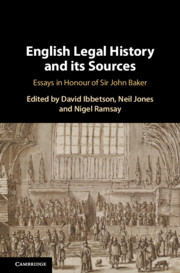
BOOK: D. J. (David J.) IBBETSON, Neil JONES, and Nigel RAMSAY, eds., English Legal History and its Sources Essays in Honour of Sir John Baker (Cambridge: Cambridge University Press, 2019). ISBN 9781108483063, £ 95.00


(Source: CUP)

Cambridge University Press has published an edited essay collection on various aspects of English legal history in honour of Sir John Baker.

ABOUT THE BOOK

This volume honours the work and writings of Professor Sir John Baker over the past fifty years, presenting a collection of essays by leading scholars on topics relating to the sources of English legal history, the study of which Sir John has so much advanced. The essays range from the twelfth century to the nineteenth, considering courts (central and local), the professions (both common law and civilian), legal doctrine, learning, practice, and language, and the cataloguing of legal manuscripts. The sources addressed include court records, reports of litigation (in print and in manuscript), abridgements, fee books and accounts, conveyances and legal images. The volume advances understanding of the history of the common law and its sources, and by bringing together essays on a range of topics, approaches and periods, underlines the richness of material available for the study of the history of English law and indicates avenues for future research.

ABOUT THE EDITORS

David IbbetsonUniversity of Cambridge
David Ibbetson has been Regius Professor of Civil Law in the University of Cambridge since 2000, and is Co-Director of the Centre for English Legal History at the University of Cambridge. He is the author of A Historical Introduction to the Law of Obligations (1999) and has published on a wide range of subjects in the legal history of England and elsewhere. He is a recipient of the American Society for Legal History's Surrency and Sutherland Prizes.

Neil JonesUniversity of Cambridge
Neil Jones is Reader in English Legal History at the University of Cambridge, Co-Director of the Centre for English Legal History at the University of Cambridge, and Literary Director of the Selden Society. He writes on the history of English law in the early-modern period, with a particular emphasis upon equity and the law of real property. He is a recipient of the Selden Society's David Yale Prize, and of the American Society for Legal History's Sutherland Prize.

Nigel RamsayUniversity College London
Nigel Ramsay is a former senior research fellow in the history departments of University College London and the University of Oxford and in the law department of the University of Exeter. He has written on medieval and Tudor legal history, religious history (especially monasticism), art history and heraldry. He is at present preparing an edition of the medieval records of the Court of Chivalry for the Selden Society.

TABLE OF CONTENTS

1. Year book men David J. Seip
2.Errores in Camera Scaccarii David Ibbetso
3. Law reporting in the seventeenth century W. H. Bryson
4. The law of contracts as reported in The Times, 1785-1820 James Oldham
5. Reading terminology in the sources for the early common law: seisin, simple and not so simple John Hudson
6. 'A photograph of English life'?: the trustworthiness of the thirteenth-century crown pleas rolls Henry Summerson
7. Law, lawyers and legal records: litigating and practising law in late medieval England Jonathan Rose
8. The fees they earned: the incomes of William Staunford and other Tudor lawyers Nigel Ramsa
9. The fifteenth-century accounts of the undersheriffs of Middlesex: an unlikely source for legal history Susanne Brand
10. Local courts in Eastern Sussex, 1263-1835 Christopher Whittick
11. Visualising legal history: the courts and legal profession in image Anthony Musson
12. The engraved facsimile by John Pine (1733) of the 'Canterbury' Magna Carta (1215) Simon Keynes
13. The abbess, the empress and the 'Constitutions of Clarendon' Elisabeth van Houts
14. The Tractatus de Antiquo Dominico Corone ascribed to Anger of Ripon Paul Brand
15. Another way of doing manuscript catalogues? Charles Donahue, Jr.
16. Common opinion in the fourteenth century: before the common learning, before the inns of court Ian Williams
17. Henry Sherfield's reading on wills (1624) and trusts in the form of a use upon a use N. G. Jones
18. Civilians in the common law courts, 1500-1700 R. H. Helmholz
19. The widow's apparel: paraphernalia and the courts Janet S. Loengard
20. 'The glorious uncertainty of the law': life at the Bar, 1810-1830 Michael Lobban

More info with CUP

13 March 2019

BOOK: John H. BAKER, Introduction to English legal history, 5th ed. (Oxford: Oxford University Press, 2019). ISBN 9780198812616, $65.00


(Source: OUP

Next month, Oxford University Press is publishing the fifth edition of J.H. Baker’s authoritative introduction to the history of the Englosh common law.

ABOUT THE BOOK

Fully revised and updated, this classic text provides the authoritative introduction to the history of the English common law. The book traces the development of the principal features of English legal institutions and doctrines from Anglo-Saxon times to the present and, combined with Baker and Milsom's Sources of Legal History, offers invaluable insights into the development of the common law of persons, obligations, and property. It is an essential reference point for all lawyers, historians and students seeking to understand the evolution of English law over a millennium.

The book provides an introduction to the main characteristics, institutions, and doctrines of English law over the longer term - particularly the evolution of the common law before the extensive statutory changes and regulatory regimes of the last two centuries. It explores how legal change was brought about in the common law and how judges and lawyers managed to square evolution with respect for inherited wisdom.

ABOUT THE AUTHOR

 John Baker, Professor of the Laws of England, University of Cambridge
Sir John Baker is the Downing Professor of the Laws of England and Fellow of St Catharine's College, Cambridge. He is an Honorary Bencher of the Inner Temple and was knighted for his services to legal history in 2003.

TABLE OF CONTENTS

Part one 
1. Law and Custom before 1066
2. The Common Law of England
3. The Superior Courts of Common Law
4. The Forms of Action
5. The Jury and Pleading
6. The Court of Chancery and Equity
7. The Conciliar Courts
8. The Ecclesiastical Courts
9. Judicial Review of Decisions
10. The Legal Profession
11. Legal Literature
12. Law Making
Part two 
13. Real Property: Feudal Tenure
14. Real Property: Uses and Fiscal Feudalism
15. Real Property: Inheritance and Estates
16. Real Property: Family Settlements
17. Other Interests in Land
18. Contract: Covenant and Debt
19. Contract: Assumpsit and Deceit
20. Contract: Some Later Developments
21. Quasi-Contract
22. Property in Chattels Personal
23. Negligence
24. Nuisance
25. Defamation
26. Economic Torts
27. Persons: Status and Liberty
28. Persons: Marriage and its Consequences
29. Pleas of the Crown: Criminal Procedure
30. Pleas of the Crown: The Substantive Criminal Law
Appendix I
Appendix II

More information here


10 December 2018

JOURNAL: Comparative Legal History VI (2018), No. 2

(image source: Routledge)

Contents:
Editorial (Heikki Pihlajamäki & Matthew Dyson)

Comparative cultures of accountability: the Scottish Exchequer and the Audit Chamber of Holland between 1477 and 1515 (Maurits den Hollander) (open access)
Abstract:
This comparative paper describes the spread of a new culture of probatory accountability in North-western Europe through the study of the Scottish Exchequer and the Audit Chamber of Holland between 1477 and 1515. It allows to re-evaluate persisting views of an inefficient and archaic Scottish Exchequer, as opposed to the ‘Weberian ideal’ of the Burgundian bureaucracy. Both institutions primarily had a fiscal goal, the auditing of accounts, while archival and judicial tasks supported this process. Through a study of the format of important series of these accounts as well as their marginalia, it has been revealed that by 1515 the daily practices surrounding the auditing process in Scotland and Holland showed important similarities. These cases serve to portray that through the auditors’ work, a new written culture of accountability spread among all governmental officials in either Scotland or Holland.

At the end, the creditors win: pre-insolvency proceedings in France, Belgium and the Netherlands (1807–c1910) (Dave De ruysscher) (open access)
Abstract:
In nineteenth-century France, Belgium and the Netherlands, laws imposing pre-insolvency proceedings had different goals. In a first stage, from around 1810 until about 1860, continuity of businesses in distress was not a policy consideration. Rather, legislators purported to give the creditors early control over the insolvent’s estate, which was most often liquidated. Debtor-in-possession features were mostly conceived of as a temporary reward for cooperation; lowered requirements for re-entry in the market after the winding-up of their business were another advantage for cooperating debtors. This was the same in the three aforementioned countries. In the 1870s and 1880s, the French and Belgian legislators created new pre-insolvency proceedings, which allowed debtors to keep their assets. In the Netherlands, fixed-term moratoriums prevented such an approach. Yet, also in Belgium and France, the exemption of secured creditors hampered the feasibility of compositions, and a goal of saving firms in financial peril.

The long reach of English law: a case of incidental transplantation of the English law concept of vicarious liability into Thailand’s Civil and Commercial Code (Adam Reekie & Srutchada Reekie)
Abstract:

Thailand’s Civil and Commercial Code, introduced in 1925, represents a voluntary major legal transplantation by which Thailand adopted a complete new code based on foreign models. This article traces the development of Section 425, which confers liability on employers vicariously for the wrongful acts of their employees, and reveals that the concepts present in the stated sources of the provision do not match those represented by the section in its final form. Rather, the concepts hint at another source, unstated and hitherto uncredited as a source of this part of the Code, the English law doctrine of vicarious liability. This conclusion sheds new light on the complex process of legal transplantation and legal reform in Thailand during the early twentieth century, challenging the orthodox view, and has wider implications for those considering the societal factors which guide and shape legal reform.

Techniques of empire by land law: the case of the Italian colonies (nineteenth and twentieth centuries) (Elisabetta Fiocchi Malaspina)
Abstract:
Land ownership and property registration played a special role in Italian colonialism, in which public and private interests mingled amidst the ambitions of colonising and economic exploitation. Through the legal system of land registration one can examine how European states, here in the context of Italy, used their colonies to adapt and experiment with the legal frameworks of land ownership. As will be shown in the article, what happened in the colonies might have been impossible to carry out in the European context. In the colonies the options varied between implementing a particular European land law used by a European state in its colonies, duly modified or updated, and a compromise between the already-existing land ownership structure and the European land law. The knowledge acquired by implementing different legal frameworks of landownership and land registration in the colonies conversely influenced the legal systems applied in continental Europe.
Book reviews:
System, order and international law: the early history of international legal thought from Macchiavelli to Hegel (Frederik Dhondt)

The causes of war, volume II: 1000 CE to 1400 CE (Jenny Benham)

Byzantine Legal Culture and the Roman Legal Tradition, 867-1056 (Barbara Biscotti)

Conceiving a nation, Scotland to AD 900 (Anthony Smart)

19 November 2018

BOOK: Margaret KEKEWICH, Sir John Fortescue and the Governance of England (London: Boydell & Brewer, 2018). ISBN 9781783273508, £60.00


(Source: Boydell & Brewer)

Boydell Press has published a book on Sir John Fortescue (1394-1479)

ABOUT THE BOOK

Sir John Fortescue was arguably the most important political thinker of fifteenth-century England. Rising from relative obscurity to become Chief Justice of the King's Bench he progressively assumed a political role as a partisan of the Lancastrian cause during the Wars of the Roses. As Chancellor-in-exile to Henry VI he wrote on the lawful succession and in praise of the common law of England. Ultimately making his peace with the Yorkists in 1471, he presented Edward IV with The Governance of England, a treatise that set the tone for debates about the extent of royal and parliamentary power for centuries to come. Demonstrating how England's traditional laws, customs and parliament could ensure that monarchs safeguarded the rights and property of their subjects, his views on these institutions continue to resonate with contemporary debates about England's relationship with Europe and the definition of national identity.

This book provides the first comprehensive biography of Fortescue. It reassesses his career and thought, challenging earlier views about his life, and discusses his work as a lawyer and political thinker in the light of modern scholarship.

ABOUT THE AUTHOR

MARGARET KEKEWICH is a former Senior Lecturer in History at the Open University.

TABLE OF CONTENTS

Introduction
c.1395-1442
1442-1461
1461-1479
The Apologist for Lamcaster
The Adviser to Princes
The Reception and Influence of Sir John Fortescue's Works
Conclusion
Appendices

More information here

08 November 2018

BOOK: Philippa BYRNE, Justice and Mercy: Moral Theology and the Exercise of Law in Twelfth-Century England (Manchester: Manchester University Press, 2018). ISBN 978-1-5261-2536-1, £90.00


Manchester University Press is publishing a new book on 12th century law in England

ABOUT THE BOOK

This book examines one of the most fundamental issues in twelfth-century English politics: justice. It demonstrates that during the foundational period for the common law, the question of judgement and judicial ethics was a topic of heated debate – a common problem with multiple different answers. How to be a judge, and how to judge well, was a concern shared by humble and high, keeping both kings and parish priests awake at night. Using theological texts, sermons, legal treatises and letter collections, the book explores how moralists attempted to provide guidance for uncertain judges. It argues that mercy was always the most difficult challenge for a judge, fitting uncomfortably within the law and of disputed value. Shining a new light on English legal history, Justice and mercy reveals the moral dilemmas created by the establishment of the common law.

ABOUT THE AUTHOR

Philippa Byrne is British Academy Postdoctoral Fellow at the University of Oxford

TABLE OF CONTENTS

Prologue: the vanishing adulteress
1 Introduction
2 The problem with mercy: theology
3 The problem with mercy: law
4 Twelfth-century models of justice and mercy
5 Who should be merciful?
6 Judgement in practice: the church
7 Histories of justice: the crown, persuasion and lordship
8 Love your enemies? Popular mercy in a vengeance culture
9 Conclusion
Index

More information here


12 September 2018

CONFERENCE: French Law vs Common Law, Acte II (Paris, 9 October 2018)


(Source: Hi-D)

Via Hi-D, we learned of the 2nd part of the French Law vs Common Law cycle de journées d’étude on which we reported before.

Colloque international organisé par l’Institut d’Histoire du Droit (IHD EA 2515) et l’Institut de l’Ouest : Droit et Europe (IODE UMR CNRS 6262 de l’Université de Rennes 1)
Mardi 9 octobre 2018

Ancienne bibliothèque de recherche

Faculté de droit, d’économie et de gestion de l’Université Paris Descartes

10, avenue Pierre Larousse
92240 Malakoff

Comité scientifique :
– M. Gwenaël GUYON, maître de conférences, Institut d’Histoire du Droit, Université Paris Descartes
– M. Sylvain SOLEIL, professeur, Institut de l’Ouest, Droit et Europe, Université de Rennes 1
– M. Arnaud VERGNE, professeur, directeur de l’Institut d’Histoire du Droit, Université Paris Descartes

Inscription par courriel à vincent.jung1@parisdescartes.fr

Programme complet à télécharger ICI

(Source: Hi-D)   

22 July 2018

SEMINAR: Foundations of the Common Law 1215-1914: Launch of the Online Library (London, 3 October 2018)


(Source: IALS)

We have learned of a seminar that will be held on the launch of a new “Foundations of the Common Law Library”, which aims to become the most comprehensive historical legal resource for the first 800 years of the whole common law world (1215-1914). The event is free but advance booking required.

Date
03 Oct 2018, 17:00 to 03 Oct 2018, 19:00
Institute
Institute of Advanced Legal Studies
Type
Seminar
Venue
Institute of Advanced Legal Studies, 17 Russell Square, London WC1B 5DR
Description
Title: Foundations of the Common Law 1215-1914: Launch of the Library
Speaker:
Graham Greenleaf AM,  Professor of Law & Information Systems, UNSW Australia; Founding Co-Director & Senior Researcher, Australasian Legal Information Institute (AustLII); Asia-Pacific Editor, Privacy Laws & Business International Report (PLBIR); Latest book: Asian Data Privacy Laws (OUP 2014; paperback 2017);  Next book: Greenleaf & Lindsay Public Rights: Copyright's Public Domains (Cambridge, publishing July 2018).

Description:
The free access Foundations of the Common Law Library is a funded research infrastructure project co-ordinated by AustLII, which will build on the CommonLII platform the most comprehensive historical legal resource for the first 800 years of the whole common law world (1215-1914). With the collaboration of ten free access international Legal Information Institutes, and other partners, it will include reported cases from superior courts in all common law jurisdictions, from the earliest decisions in each jurisdiction. Databases of other key materials (treatises, legislation, treaties etc) will also be added. Case law extracted from newspaper prior to formal law reporting will be included where possible. Citations for all documents added will expand greatly the LawCite automated citator’s coverage of the history of the whole of the common law world, linking the past and present of the common law.


This event is free but advanced booking is required.  All welcome.

More information here

20 February 2018

SSRN PAPER: Barry E. HAWK, English Competition Law Before 1800 (Fordham Legal Studies Research Paper)


(image source: Github)

Abstract:
English competition law before 1900 developed over the course of many centuries beginning in the medieval period. That development reflected changes in political conditions, economic theories, and broader cultural values. English competition law mirrored the historical movements in England from the medieval ideal of fair prices and just wages to 16th and 17th century nation state mercantilism to the 18th and 19th century Industrial Revolution, laissez faire capitalism and freedom of contract. The development of English competition law is rich in insights for modern antitrust issues like the adaptability of case law and legislation to changing economic conditions, the role of economic theories in the formulation of legal rules, and the role of political and social values in competition policy. Today the predominant if not exclusive emphasis on economics in the application of modern antitrust laws has resulted in a quasi-regulatory system far more technical, specialized and narrowly focused than the case making of generalist English common law judges. Modern antitrust law adapts well to changes in economic theories and conditions but it is less adaptable than English common law to shifts in political and social values. This lack of adaptability is viewed by most commentators as a beneficial insulation of decision-making from political or social influences. Proponents of non-economic policy concerns (like fear of concentration for political or social reasons), on the other hand, are forced to formulate their concerns in economic terms because of the prevailing view that only economics counts in antitrust. They would have had an easier task under the English common law.

Read the paper here.

(source: Law and Humanities Blog)

27 December 2015

BOOK PREVIEW: Wilfrid PREST (ed.), Blackstone's Commentaries on the Laws of England (Oxford: Oxford UP, forthcoming)

(image source: Wikimedia Commons)

The Legal History blog signalled a free preview to Simon Stern (Toronto)'s introduction to Book II of Blackstone's Commentaries on the Laws of England, to be published by Oxford University Press, under the editorship of Wilfrid Prest (Oxford).

Summary:
This draft excepts three of the six sections in the introduction to Book II, on the law of property ("Of the Rights of Things") in William Blackstone's Commentaries on the Laws of England. The volume forms part of the Oxford Edition of Blackstone, and is due out in 2016. The three sections excepted here cover the aims of Book II, its treatment of property (including intellectual property), and its influence. Blackstone is often praised in vague terms for his style, and the section on his influence also attempts to explain concretely some of the stylistic features that distinguish his writing. Besides an introduction, each volume in this edition includes the editorial changes that Blackstone made to successive editions of the Commentaries, explanatory footnotes, and tables of the cases, statutes, and legal texts that he cites. The introduction to each volume discusses the book’s aims, subject matter, publication, reception, sources, and influence.
The paper can be read here on SSRN.

(source: Legal History Blog)

29 March 2015

BOOK: "The Law Emprynted and Englysshed: the Printing Press as an Agent of Change in Law and Legal Culture 1475-1642", by David J Harvey


What impact did the printing press – a new means of communicating the written word – have on early modern English lawyers? This book examines the way in which law printing developed in the period from 1475 up until 1642 and the start of the English Civil War. It offers a new perspective on the purposes and structures of the regulation of the printing press and considers how and why lawyers used the new technology. It examines the way in which lawyers adapted to the use of printed works and the way in which the new technology increased the availability of texts and books for lawyers and the administrative community. It also considers the wider humanist context within which law printing developed. The story is set against the backdrop of revolutionary changes in English society and the move not only to print the law, but also increase its accessibility by making information available in English. The book will be of interest to lawyers and legal historians, print and book historians and the general reader.

all information here

04 February 2015

ARTICLE: "The Evolution of Corporate Law in Post-Colonial India: From Transplant to Autochthony", by Umakanth Varottil

Umakanth Varottil (National University of Singapore (NUS) - Faculty of Law), The Evolution of Corporate Law in Post-Colonial India: From Transplant to Autochthony

LEGAL HISTORY eJOURNAL
Vol. 19, No. 13: Feb 3, 2015
abstract

The essential thesis of this paper is that while Indian corporate law began as a legal transplant from England, it has been progressively decoupled from its source with subsequent amendments and reforms being focused either on finding solutions to local problems or borrowing from other jurisdictions. To that extent, decolonization has had a significant effect of radically altering the course of Indian corporate law. Current Indian corporate law not only represents a significant departure from its colonial origins, but the divergence between Indian law and English law as they have developed since independence has been increasing. While the Indian lawmaking process indulged in close cross-referencing of English legal provisions during the colonial period and immediately thereafter, the more contemporary legislative reforms pay scant regard to corporate law in the origin country that initially shaped Indian corporate law.