Search

Showing posts with label Historical sources. Show all posts

19 July 2024

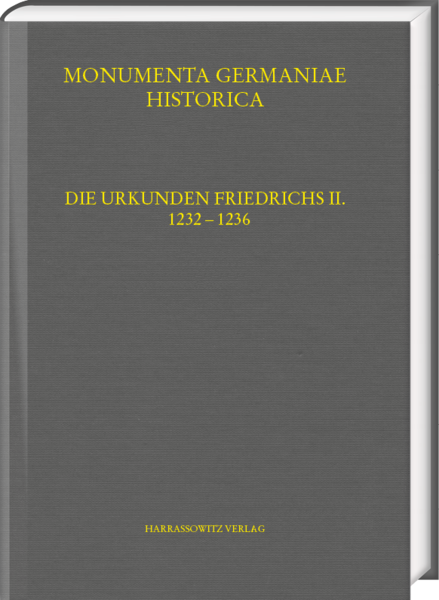
BOOK: Die Urkunden Friedrichs II., t. 7 (1232–1236) - eds. Christian FRIEDL, Katharina GUTERMUTH, Klaus HOFLINGER, Maximilian LANG, Katharina MEISTER, Joachim SPIEGEL (Wiesbaden: Harrassowitz Verlag, 2024). ISBN: 9783447119702

(Image source: Harrassowitz Verlag)


ABOUT THE BOOK

Der siebte Band der Urkunden Friedrichs II. beinhaltet die Privilegien und Mandate des Stauferkaisers von Anfang 1232 bis Mitte August 1236. Für diesen Zeitraum sind insgesamt 258 Urkunden zu verzeichnen, darüber hinaus sind zwei Nachtragsurkunden für den vierten Band enthalten.

Die erste Hälfte der 1230er Jahre ist sowohl von den Auseinandersetzungen mit den Städten der Lombardischen Liga geprägt, die Friedrich II. bis zu seinem Tod nie ganz unter seine Herrschaft zwingen konnte, als auch von dem Konflikt mit seinem Sohn, der ein ebenso spektakuläres wie rigoroses Ende nahm. Diese Zeit der kaiserlichen Rastlosigkeit führte den Staufer vom äußersten Süden des Reiches (Niederwerfung ungehorsamer Städte wie Messina) nach Norditalien (Durchsetzung seines imperialen Herrschaftsanspruches) und bis über die Alpen nach Deutschland, wo der Kaiser der Königsherrschaft seines Sohnes Heinrich (VII.) ohne jede Milde ein drastisches Ende setzte. Die Glanzstücke des Bandes wurden allesamt während seines Aufenthalts in Deutschland ausgestellt: Zu den wohl bekanntesten Urkunden zählen der für die deutsche Rechtsgeschichte überaus bedeutsame Mainzer Reichslandfrieden von 1235, der Bericht über die Translation der kurz zuvor heiliggesprochenen Elisabeth von Thüringen sowie Friedrichs II. modernes, weil tolerantes Urteil zum berühmten Fuldaer Judenmord. Die (nur vorübergehende) Zusammenarbeit mit dem Papsttum, die bereits mit der zweiten Exkommunikation 1239 durch Gregor IX. endete, spiegelt sich in den insgesamt elf Schreiben wider, die Friedrich II. in diesen Jahren an den summus pontifex der abendländischen Kirche richtete.


More information can be found here.

26 February 2021

SOURCE PUBLICATION: Adrien WYSSBROD & Arnaud BESSON (eds.), Les points de coutume neuchâtelois; Adrien WYSSBROD (ed.), Le coutumier Hory [Les sources du droit suisse, XXIe partie : Les sources du droit du canton de Neuchâtel, Tome 3 et 4] (St. Gallen: Fondation des sources du droit suisse, 2021) ISBN 978-3-7965-4211-4 and 978-3-7965-4212-1


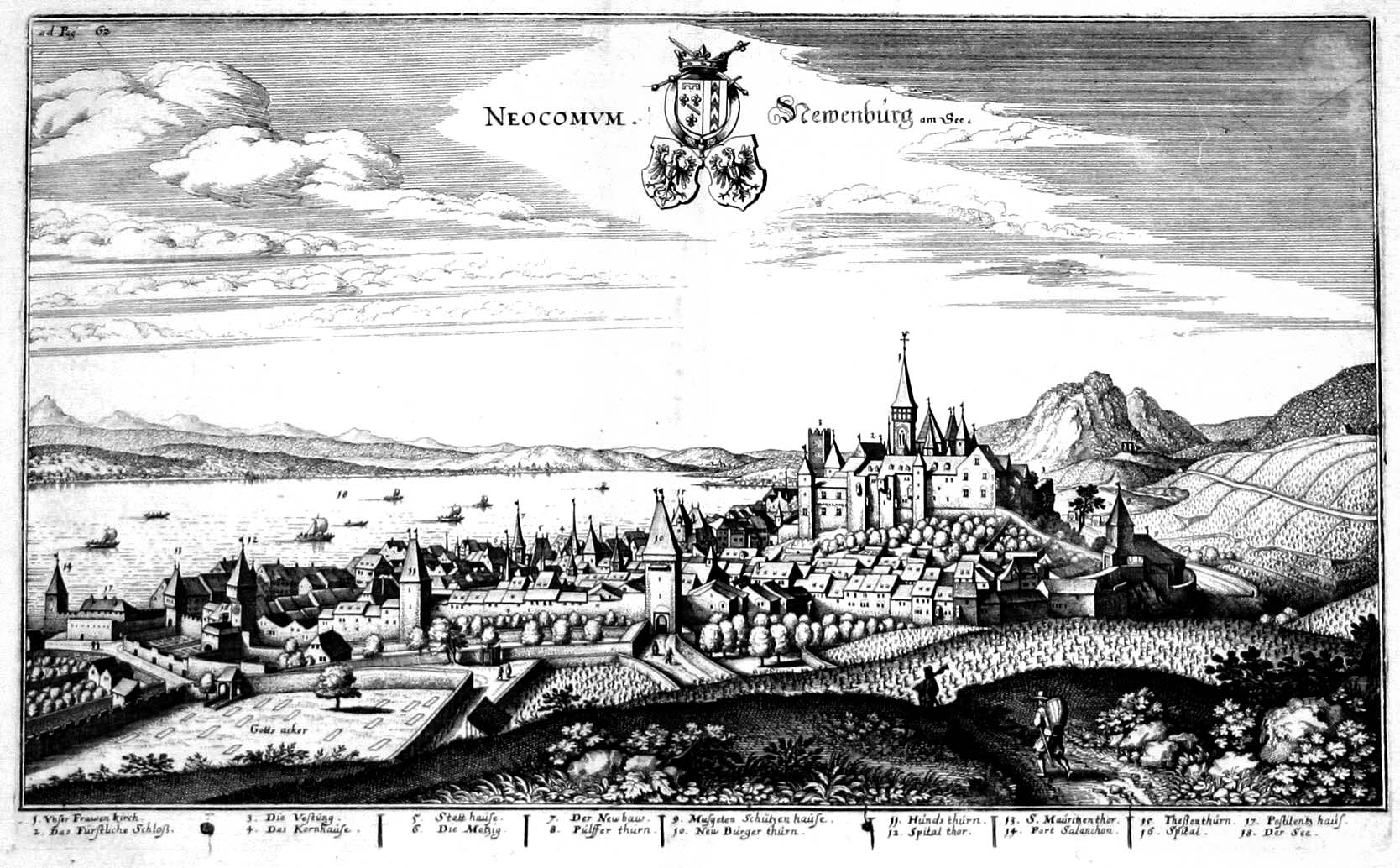
(image: Neuchâtel in 1645; source: Wikimedia Commons)

Abstract: 

Commandé au chancelier Jean Hory par les Orléans-Longueville au début du XVIIe siècle, le coutumier Hory constitue un projet très abouti de mise par écrit de la coutume neuchâteloise. En raison de la résistance du Petit Conseil, ce coutumier n’est jamais entré en vigueur. Il demeure toutefois un témoin privilégié du droit Neuchâtelois, ainsi qu’une ambitieuse tentative de systématisation de la coutume, voire un essai précoce de codification. (vol IV)

 Les points de coutumes constituent la principale source de la coutume neuchâteloise d’Ancien Régime. Ces déclarations renseignent également sur le fonctionnement de la justice et donnent des détails sur des affaires privées et sur les individus impliqués. Elles concernent essentiellement des affaires civiles et ont été rendues entre 1529 et 1846. Cette édition reproduit intégralement la totalité des déclarations connues et remplace ainsi l’édition partielle de Georges-Auguste Matile de 1836. (vol III)

Read more with the Foundation for the Publication of the Sources of Swiss Law. The books can either be ordered on paper, or be consulted online.

20 May 2020

SOURCE EDITION: Protokolle der Regierungen der Habsburgermonarchie (1867-1918) (Austrian Academy of Sciences)

(image source: Wikimedia Commons)

On the project:
Der Ministerrat war das zentrale Organ der Regierungstätigkeit. Seine Sitzungsprotokolle umfassen fast sechzig Jahre Regierungszeit. Als eine der wenigen bearbeitet verfügbaren Ressourcen legen sie einerseits das Innenleben der Regierungen der Monarchie offen — andererseits beinhalten sie Unmengen prosopographischer, politischer, administrativer, wirtschaftlicher, kultureller und sozialer Informationen. Sie sind eine herausragende historische Quelle. Der Justizpalastbrand von 1927 dezimierte die zwischen 1867 und 1918 entstandenen Protokolle. Trotzdem wurden sie von einzelnen Historikern für die Forschung genutzt. Zum Glück waren vor dem Brand von einigen Protokollen Abschriften für interessierte Stellen in Wien und Prag angefertigt worden. Der beschädigte Bestand war verfügbar, aber für die Öffentlichkeit schwer zugänglich. 1967 gründete Friedrich Engel-Janosi die Edition der österreichischen Ministerratsprotokolle in enger Kooperation mit ungarischen Historikern. Es ist eine textkritische und kommentierte Volltextedition der im Österreichischen Staatsarchiv befindlichen Originalquellen. Gegenstand sind erstens die Sitzungsprotokolle des seit 1848 bestehenden Ministerrates (1852−1861 Ministerkonferenz) des Kaisertums Österreich bis zum österreichisch-ungarischen Ausgleich 1867. Diese bilden die 1. Serie der Edition in dunkelblauen Buchdeckeln. Durch den österreichisch-ungarischen Ausgleich von 1867 wurde das Kaisertum Österreich in die österreichisch-ungarische Monarchie umgewandelt. Daher schließen sich zweitens die Protokolle des gemeinsamen Ministerrates der österreichisch-ungarischen Monarchie 1867−1918 an, die dunkelrote 2. Serie. In der 3. Serie werden die cisleithanischen (österreichischen) Ministerratsprotokolle 1867−1918 mit hellblauen Buchdeckeln ediert. Die 1. Serie wurde 1967 von einem Herausgeberkomitee begonnen, vom Österreichischen Ost- und Südosteuropa-Institut 1993 fortgesetzt und 2008 an der Österreichischen Akademie der Wissenschaften von der Kommission für die Geschichte der Habsburgermonarchie, dann 2013 vom Institut für Neuzeit- und Zeitgeschichtsforschung, nunmehr Institute for Habsburg and Balkan Studies, fertiggestellt. Sie umfasst einen Einleitungsband und 27 Textbände in sechs Abteilungen. Die Retrodigitalisierung der Bände ist abgeschlossen. Textdaten waren seit 2019 in wenig strukturiertem XML verfügbar. Diese Daten wurden für diese digitale Edition mithilfe von XSL-Transformationen vollständig neu bearbeitet, aufgewertet, mit Metadaten auf Protokollebene versehen sowie mit Angaben zu den teilnehmenden Personen, den Daten und, falls vorhanden, Links zu Onlineressourcen aus ANNO (AustriaN Newspapers Online) und ALEX (Historische Rechts- und Gesetzestexte Online) sowie mit internen Links zwischen Protokollen ergänzt. Die 2. Serie wird seit 1966 vom Institut für Geschichte der Ungarischen Akademie der Wissenschaften herausgegeben. Dieser Bestand kann auf fünf erschienene Bände verweisen; der Verlag der Österreichischen Akademie der Wissenschaften hat hiervon Digitalisate im PDF-Format angefertigt. Hier werden die Tagesordnungslisten aus den Inhaltsverzeichnissen dieser Bände mit den anderen Serien verknüpft (in Arbeit, voraussichtliche Fertigstellung: Sommer 2020). Als 3. Serie folgen die cisleithanischen (österreichischen) Ministerratsprotokolle 1867−1918. Sie werden am Institut für Neuzeit- und Zeitgeschichtsforschung, nunmehr Institute for Habsburg and Balkan Studies, der Österreichischen Akademie der Wissenschaften seit 2018 herausgegeben und in Buchform und als digitale Edition erarbeitet. Hierfür wird TEI-XML direkt aus Worddokumenten erstellt. Bei dieser Serie ist die Erschließungstiefe am größten, weil sie ‚born digital‘ sind; alle erwähnten Entitäten (Personen, Institutionen) sowie Literaturreferenzen werden mithilfe eigener Systeme erfasst und in den TEI-Dokumenten verlinkt. Details zur Geschichte der Edition finden sich im Einleitungsband der ersten Serie und in den Vorworten zu den einzelnen Bänden. Details zur Digitalisierung finden Sie unter Technische Umsetzung.
More information on the project website.

12 December 2019

BOOK: Peter Maxwell STUART, Steve MURDOCH & Leos MÜLLER (eds.), Unimpeded Sailing. A Critical Edition of Johann Gröning's Navigatio Libera (extended 1698 edition) [Brill Studies in Maritime History; 6] (Leiden/Boston: Martinus Nijhoff/Brill, 2019), ISBN 978-90-04-35269-8, 162 p. € 95


Book abstract:
The original Latin text of Johann Gröning’s Navigatio libera has never before been translated into any modern vernacular language. Gröning’s intention was to set out the position of neutral nations (in this case the Danes and Swedes), and their right to pursue trade during the wars of the great maritime powers (particularly the English and the Dutch). It specifically sought to engage with and refute the work of Hugo Grotius while taking cognisance of the critique of Gröning’s work by Samuel Pufendorf. The text serves as a bridge between 17th-century polemical discourse surrounding the ‘free sea’ versus ‘enclosed sea’ debate and later 18th-century legal literature on the rights of neutrals and the continuation of free trade in time of war.

On the editors:
Peter Maxwell-Stuart, Ph.D. (1994) is Reader in History at the University of St Andrews. He is widely published in the fields of Greek and Latin literature and history, and in the occult sciences of Mediaeval and early modern Europe. He is about to publish a translation of Gomez Pereira’s scientific treatise, Antoniana Margarita, and Martin Delrio’s chef d’oeuvre, Disquisitiones Magicae. Steve Murdoch, Ph.D. (1998) is Professor of History at the University of St Andrews. His major monographs include; Network North: Scottish Kin, Cultural and Covert Associations in Northern Europe, 1603-1746 (Brill, 2006) and most recently with Alexia Grosjean, Alexander Leslie and the Scottish Generals of the Thirty Years’ War, 1618-1648 (Pickering & Chatto, 2014). Among maritime scholars he is best known for his award winning monograph The Terror of the Seas? Scottish Maritime Warfare, 1513-1713 (Brill, 2010). Leos Müller, Ph.D. (1998), is Professor of History and Director of the Centre for Maritime Studies, Stockholm University. He has published on Swedish early-modern and maritime history, e.g. Consuls, Corsairs and Commerce. The Swedish Consular Service and Long-Distance Shipping, 1720–1815 (Uppsala University, 2004), together with Stefan Eklöf Amirell, and Persistent Piracy. Maritime Violence and State-formation in Global Historical Perspective, (Palgrave Macmillan, 2014).
(source: ESILHIL Blog)

29 May 2019

BOOK: D. J. (David J.) IBBETSON, Neil JONES, and Nigel RAMSAY, eds., English Legal History and its Sources Essays in Honour of Sir John Baker (Cambridge: Cambridge University Press, 2019). ISBN 9781108483063, £ 95.00


(Source: CUP)

Cambridge University Press has published an edited essay collection on various aspects of English legal history in honour of Sir John Baker.

ABOUT THE BOOK

This volume honours the work and writings of Professor Sir John Baker over the past fifty years, presenting a collection of essays by leading scholars on topics relating to the sources of English legal history, the study of which Sir John has so much advanced. The essays range from the twelfth century to the nineteenth, considering courts (central and local), the professions (both common law and civilian), legal doctrine, learning, practice, and language, and the cataloguing of legal manuscripts. The sources addressed include court records, reports of litigation (in print and in manuscript), abridgements, fee books and accounts, conveyances and legal images. The volume advances understanding of the history of the common law and its sources, and by bringing together essays on a range of topics, approaches and periods, underlines the richness of material available for the study of the history of English law and indicates avenues for future research.

ABOUT THE EDITORS

David IbbetsonUniversity of Cambridge
David Ibbetson has been Regius Professor of Civil Law in the University of Cambridge since 2000, and is Co-Director of the Centre for English Legal History at the University of Cambridge. He is the author of A Historical Introduction to the Law of Obligations (1999) and has published on a wide range of subjects in the legal history of England and elsewhere. He is a recipient of the American Society for Legal History's Surrency and Sutherland Prizes.

Neil JonesUniversity of Cambridge
Neil Jones is Reader in English Legal History at the University of Cambridge, Co-Director of the Centre for English Legal History at the University of Cambridge, and Literary Director of the Selden Society. He writes on the history of English law in the early-modern period, with a particular emphasis upon equity and the law of real property. He is a recipient of the Selden Society's David Yale Prize, and of the American Society for Legal History's Sutherland Prize.

Nigel RamsayUniversity College London
Nigel Ramsay is a former senior research fellow in the history departments of University College London and the University of Oxford and in the law department of the University of Exeter. He has written on medieval and Tudor legal history, religious history (especially monasticism), art history and heraldry. He is at present preparing an edition of the medieval records of the Court of Chivalry for the Selden Society.

TABLE OF CONTENTS

1. Year book men David J. Seip
2.Errores in Camera Scaccarii David Ibbetso
3. Law reporting in the seventeenth century W. H. Bryson
4. The law of contracts as reported in The Times, 1785-1820 James Oldham
5. Reading terminology in the sources for the early common law: seisin, simple and not so simple John Hudson
6. 'A photograph of English life'?: the trustworthiness of the thirteenth-century crown pleas rolls Henry Summerson
7. Law, lawyers and legal records: litigating and practising law in late medieval England Jonathan Rose
8. The fees they earned: the incomes of William Staunford and other Tudor lawyers Nigel Ramsa
9. The fifteenth-century accounts of the undersheriffs of Middlesex: an unlikely source for legal history Susanne Brand
10. Local courts in Eastern Sussex, 1263-1835 Christopher Whittick
11. Visualising legal history: the courts and legal profession in image Anthony Musson
12. The engraved facsimile by John Pine (1733) of the 'Canterbury' Magna Carta (1215) Simon Keynes
13. The abbess, the empress and the 'Constitutions of Clarendon' Elisabeth van Houts
14. The Tractatus de Antiquo Dominico Corone ascribed to Anger of Ripon Paul Brand
15. Another way of doing manuscript catalogues? Charles Donahue, Jr.
16. Common opinion in the fourteenth century: before the common learning, before the inns of court Ian Williams
17. Henry Sherfield's reading on wills (1624) and trusts in the form of a use upon a use N. G. Jones
18. Civilians in the common law courts, 1500-1700 R. H. Helmholz
19. The widow's apparel: paraphernalia and the courts Janet S. Loengard
20. 'The glorious uncertainty of the law': life at the Bar, 1810-1830 Michael Lobban

More info with CUP

20 September 2018

BOOK: Massimo PANEBIANCO, Introduzione alla codicistica del Jus Gentium Europaeum. Codice Lünig-Leibniz-Dumont [Jus Gentium Europaeum. Collana di studi comunitari; 18] (Napoli: Editoriale Scientifica, 2016), XII + 276 p. ISBN 978-88-6342-936-7, € 24

(image source: Editoriale Scientifica)

Book abstract:
L'Europa del '700 è una delle mille forme dell'Europa possibile: Europa dei codici, Europa codicistica, Europa della scrittura diplomatica. Si vedrà come il presente volume si ispira alle recenti tendenze dedicate allo studio geo-politico della "grande storia" del diritto internazionale, ai fini della descrizione degli spazi continentali di area vasta. Tale ricerca ha esaminato il periodo più alto della codificazione europea del diritto internazionale della prima metà del '700 e si è fondata su un moderno "codice triplo" risultante dalla combinazione di altrettanti classici della codificazione dello jus gentium europeo. Il cd. Codice "Lünig-Leibniz-Dumont" proviene dalla scuola austro-germanica del '700 europeo, contenente in tutto o in parte la storia internazionale dei singoli Stati europei nei rapporti fra di loro e con gli altri Stati del mondo dall'antico al moderno (Italia compresa). L'autore di questo libro si rivolge ai lettori, come al pubblico benevole di una sala concerti d'Europa del '700 e si augura che i tre codici diplomatici qui esaminati siano come un unico "concerto triplo". Anche tali codici sono "icone" della storia passata e servono a portare fino a noi la voce dei secoli, bene impressa nel loro testo.
More information here.
Rechtsgeschichte 28 (2018) contains a review by Elisabetta Fiocchi Malaspina (Zürich).

(source: ESILHIL Blog)

03 July 2018

BOOK: Maaike VAN BERKEL, Léon BUSKENS and Petra M. SIJPESTEIJN eds., Legal Documents as Sources for the History of Muslim Societies : Studies in Honour of Rudolph Peters [Studies in Islamic Law and Society] (Leiden - New York: Brill, 2017). ISBN 978-90-04-34372-6, €125.00


(Source: Brill)

Last year, Brill published a book on the use of legal documents for the study of the history of Muslim societies.

ABOUT THE BOOK

This volume is a tribute to the work of legal and social historian and Arabist Rudolph Peters (University of Amsterdam). Presenting case studies from different periods and areas of the Muslim world, the book examines the use of legal documents for the study of the history of Muslim societies. From examinations of the conceptual status of legal documents to comparative studies of the development of legal formulae and the socio-economic or political historical information documents contain, the aim is to approach legal documents as specialised texts belonging to a specific social domain, while simultaneously connecting them to other historical sources. It discusses the daily functioning of legal institutions, the reflections of regime changes on legal documentation, daily life, and the materiality of legal documents.

Contributors are Maaike van Berkel, Maurits H. van den Boogert, Léon Buskens, Khaled Fahmy, Aharon Layish, Sergio Carro Martín, Brinkley Messick, Toru Miura, Christian Müller, Petra M. Sijpesteijn, Mathieu Tillier, and Amalia Zomeño.

ABOUT THE EDITORS

Maaike van Berkel is professor of Medieval History at Radboud University. Her research focuses on the social and cultural history of medieval Muslim societies, with a particular interest in literacy, court culture and urban organization.

Léon Buskens holds a chair for Law and Culture in Muslim societies at Leiden University and is director of the Netherlands Institute in Morocco. His research focuses on Islamic law and society, and the anthropology of Muslim societies, with a particular interest in Morocco and Indonesia.

Petra Sijpesteijn is professor of Arabic at Leiden University. Her research concentrates on recovering the experience of Muslims and non-Muslims living under Islamic rule, using the vast stores of radically under-used documents surviving from the early Islamic world. 

TABLE OF CONTENTS

Introduction, Maaike van Berkel, Léon Buskens and Petra M. Sijpesteijn 
Notes on Contributors
Bibliography Rudolph Peters
Rudolph Peters and the History of Modern Egyptian Law, Khaled Fahmy

I. REGIME CHANGE AND LEGAL INSTITUTIONS
The Qadis’ Justice according to Papyrological Sources (Seventh–Tenth Centuries C.E.), Mathieu Tillier
Delegation of Judicial Power in Abbasid Egypt, Petra M. Sijpesteijn
The Mahdi’s Legal Opinion as an Instrument of Reform: Issues in Divorce, Inheritance, False Accusation of Unlawful Intercourse and Homicide,Aharon Layish

II. PRACTICES OF RECORDING AND VERIFYING
Identifying the ʿudūl in Fifteenth-Century Granada, Sergio Carro Martín and Amalia Zomeño
Crimes without Criminals? Legal Documents on Fourteenth-Century Injury and Homicide Cases from the Ḥaram Collection in Jerusalem, Christian Müller
From Trash to Treasure: Ethnographic Notes on Collecting Legal Documents in Morocco, Léon Buskens
Notes for a Local History of Falsehood, Brinkley Messick

III. DAILY LIFE
Waqf Documents on the Provision of Water in Mamluk Egypt, Maaike van Berkel
Ottoman amān: Western Ownership of Real Estate and the Politics of Law Prior to the
Land Code of 1876, Maurits H. van den Boogert
A Comparative Study of Contract Documents: Ottoman Syria, Qajar Iran, Central Asia, Qing China and Tokugawa Japan, Toru Miura 

More information here


11 March 2018

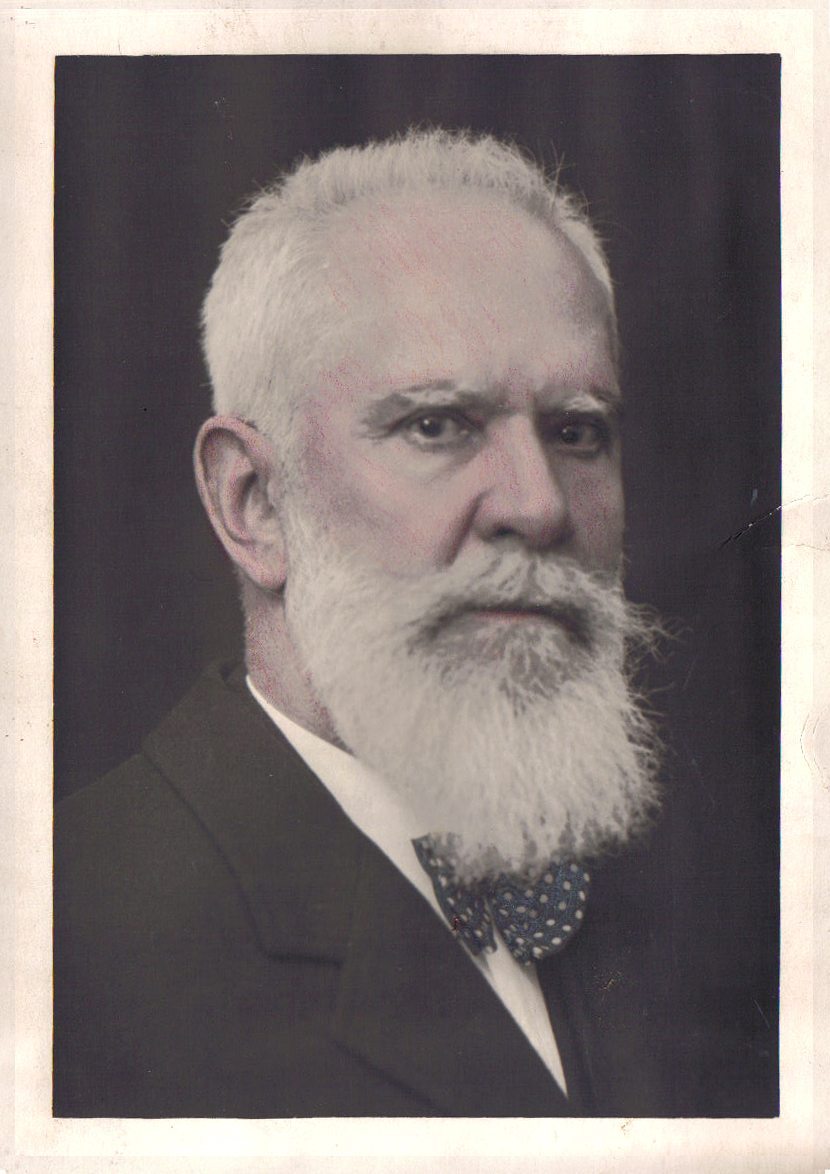
BOOK: Rafael ALTAMIRA, Spain. Sources and Development of Law (ed. Carlos PETIT) (Madrid: Universidad Carlos III, 2018) [Historia del Derecho 62], 217 p. ISBN 978-84-9148-581-0, Open Access.

(image source: juristasunam)

Abstract:
Edición del largo capítulo de Rafael Altamira sobre fuentes y evolución general del Derecho español, con énfasis en las instituciones jurídico-privadas,publicado, en lengua inglesa, en el volumen misceláneo A General Survey of Events, Sources, Persons, and Movements in Continental Legal, 1912. El estudio preliminar analiza las circunstancias de la obra, así como las relaciones entre el autor español y el responsable científico de la misma, Prof. John H. Wigmore (Northwestern University). Se recupera además la correspondencia cruzada entre ambos a propósito de esa publicación.
More information here.

27 May 2014

WORKSHOP: "Histoire et informatique: Textometry of the historical sources" (Rome, 2-6 June 2014)


WHAT: Histoire et informatique: Textometry of the historical sources, workshop 

WHERE: École française de Rome, salle de séminaire, Piazza Navona, 62, 00186 - Roma

WHEN: 2-6 June 2014

all information here