Search

Showing posts with label Digital Humanities. Show all posts

25 May 2026

FORMATION DOCTORALE : Ma thèse à l’ère de l’intelligence artificielle générative: enjeux, outils et pratiques situées [2e journée de formation commune de l’ED4 HiSTAR] (Louvain-la-Neuve, 5 JUN 2026)

(image source: UCLouvain)

ED4 HiSTAR
Journée de formation doctorale : en présentiel

Lieu : Louvain-la-Neuve
Date : vendredi 5 juin 2026

Inscription obligatoire avant le 22 mai 2026 à midi via le formulaire disponible sur le site HiSTAR:

Programme complet (PDF) :

Programme:

1e partie. Introduction théorique à l’IA, aperçu exploratoire de la diversité des applications possibles
9h45 – 12h15
Collège Erasme, salle polyvalente

Pascal Vangrunderbeeck — Conseiller pédagogique numérique et IA au Louvain Learning Lab
Comprendre l’effet Woaw des interfaces d’IAg et perspectives pour développer l’esprit critique

Nicolás Marín Bayona — UCLouvain
Voir sans regarder : analyse critique des dispositifs computationnels d’analyse d’image en Digital Art History

Camille Berny — UCLouvain
Analyser le risque ferroviaire dans les annales parlementaires avec l’IA : contraintes matérielles, protocoles de dépouillement et enjeux épistémologiques

12h15 – 13h30
Lunch

2e partie. Formation pratique
13h30 – 17h
Pool informatique Socrate 31-32

Jonathan Dedonder — Logisticien de recherches en sciences humaines, UCLouvain – IACCHOS
De l’outil au corpus : IA générative, art du prompting et posture épistémologique

Cet atelier propose une entrée à la fois pratique et critique dans l’usage de l’IA générative pour le traitement de corpus textuels. Il s’organise en trois temps : réflexion sur les enjeux liés à l’usage de l’IA dans la recherche (protection des données, acceptabilité disciplinaire, traçabilité méthodologique), panorama des outils disponibles et initiation au prompt engineering, suivis d’exercices pratiques et d’un retour réflexif collectif sur les enjeux épistémologiques liés à l’intégration de ces outils dans la recherche scientifique.

09 March 2026

DATABASE: ERC Consolidator Grant "Pamphlets and Patrons"

(image source: PaPa Uni Trier)

The ERC Consolidator Grant "Pamphlets and Patrons. How Courtiers Shaped the Public Sphere in Ancien Regime France" (PI: Damien Tricoire, Universität Trier), awarded in the 2020 call, launched a database. The database allows to identify actors based on their links with a legal profession (e.g. avocat, procureur), and much more.

Description:

Pamphlets and Patrons: How Courtiers shaped the Public Sphere in Ancien Régime France

Welcome to the Pamphlets and Patrons (PaPa) database! This database was created as part of a project funded by the European Research Council (ERC) (2021–2026), carried out at the Department of History of the University of Trier under the direction of Damien Tricoire. We provide data on French intellectual and political elites as well as on eighteenth-century prints.

The project explores how the public sphere, and particularly unauthorised political literature, was shaped by interdependencies and collaborations between aristocrats, authorities, authors and printers in the eighteenth century. It focuses on influential networks, in particular on the patron-client relationships linking members of the court nobility with writers.


Collaboration with the MPCE project (Mapping Print, Charting Enlightenment) 

The PaPa team collaborated intensively with Simon Burrows (Western Sydney University, Australia) and his MPCE project (Mapping Print, Charting Enlightenment).

This collaboration allowed the PaPa team to build upon the extensive data assembled by Simon Burrows and his team over nearly two decades. As a result, the database contains a large amount of information on printers, booksellers, translators, editors, and authors.

It also includes extensive data on books and their editions, such as information on print runs, inspections, confiscations, licensing applications and decisions, and the type of authorisation granted for publication.

Through this cooperation, Simon Burrows’ database, originally designed to measure the diffusion of prints by examining the book trade and evidence of book circulation created by policing institutions, now also includes data related to networks that influenced print culture. We have placed a special emphasis on entering data about relationships between persons, that is kinship, friendship, patronage, membership in societies, among others.

For a complete list of the sources used by the PaPa database, please consult the Sources section of this website.

For a full list of publications produced by the PaPa project, please see the Publications page of the project website.

For more information about the MPCE (Mapping Print, Charting Enlightenment) project, please consult Simon Burrows’ project project website.


How to use this database

Persons

You can explore individuals involved in print production, diffusion, and policing, as well as connected with the French court.

Users may browse:

  • individual persons or groups of persons (societies)

  • professional groups or economic sectors

  • types of occupations

Network visualisation tools allow users to explore connections between actors within the court and the world of print. You may combine the networks of different persons.

Works (books and editions)

Users can browse printed works:

  • by title

  • by genre

  • by author

  • by editor, translator, or other contributors

Book Policy and Policing

The database records actions taken regarding printed works and editions, including:

  • actions by printers or booksellers (such as print runs or applications for licenses)

  • actions by French authorities (such as inspections, confiscations and licensing decisions

Patronage and Protection

Users can explore how influential individuals gave resources (e. g. money) to writers, and how they recommended the authors to the authorities.


How to cite this database

Please use the following citation form to quote the database:

Damien Tricoire, Benoît Carré, Simon Dagenais, Nele Dentinger, Pamphlets and Patrons database, 2026, https://heurist.huma-num.fr/MPCE_Mapping_Print_Charting_Enlightenment/web/220687?ver=2, [date accessed].


License

Except where otherwise noted, all content on this site is licensed under a Creative Commons Attribution-Non-Commercial International 4.0 Licence  https://creativecommons.org/licenses/by-nc/4.0/  


Contributors

Such a work would not have been possible without the work of many researchers and research assistants.

We are grateful to the work done by Simon Burrows and his team from Leeds University and then in Western Sydney University, who added data for almost two decades. We are especially thankful to Hamish Graham, who entered data regarding censors as well as permissions tacites.

We would like to aknowledge the work done by researchers and research assistants on the Pamhlets and Patrons database:

  • Pamphlets and Patrons team: Damien Tricoire, Benoît Carré, Simon Dagenais, Nele Dentinger, Miranda Kam
  • Research assistants who gathered data in the Archives nationales (Paris): Benjamin Alvarez Araujo, Juliette Eyméoud and Julie Özcan
  • Student research assistants from the University of Trier who entered data into Heurist: Cassandra Dostert, Ivo Köth, Nils Rath, Luke Ströhla, Tom Strauch, Sarah Wieland, Felix Wójcik and Ian Wolff

We would like to acknowledge the work done by the Heurist team, who helped us in the conception of the database (especially Ian Johnson and Michael Falk), as well as the team members who helped us to conceive the website of our database (especially Ian Johnson and Brandon McKay).


About Heurist

Heurist is a free, flexible, open-source (on gitHub) data management application and website builder specifically designed for researchers in the Humanities. It was developed at the University of Sydney from 2005 - 2015, and since then as a non-profit project, under the direction of Dr Ian Johnson. Its design has been informed by the needs of hundreds of research projects. It is now maintained by the non-profit association , based in Paris.

Heurist is available as free, non-commercial web services available to researchers worldwide. Please visit HeuristNetwork.org to find a service in your region.

Heurist allows researchers to design, build, analyse, visualise, publish (via the web) and archive their own databases without coding or technical support, including the automatic generation of a 'vanilla' website which can be used as-is or customised extensively to fit a specific graphic design. Websites are edited through the Heurist website editor, stored as an integral part of the database and generated directly by the Heurist software. This allows for reliability and sustainability, and for optimal interaction with the data including images, and the use of Heurist's interface components (widgets such as facet searches, result lists, maps, timelines, custom reports and network diagrams) directly in the website.

The development team provides support to all Heurist users, including free email support and bug fixing for unfunded projects and consultancy services for database modelling, database construction, conversion of existing databases and websites, code development, website construction and training. Heurist is entirely non-profit; consultancy work provides the funding required to run the project.

See database here: Damien Tricoire, Benoît Carré, Simon Dagenais, Nele Dentinger, Pamphlets and Patrons database, 2026, https://heurist.huma-num.fr/MPCE_Mapping_Print_Charting_Enlightenment/web/220687?ver=2.

More information on the project on its website.

17 September 2025

JOURNAL: Rechtsgeschichte - Legal History 33 (2025)


Journal of the Max Planck Institute for Legal History and Legal Theory. 

The most recent issue of Rechtsgeschichte – Legal History (Rg) opens with an essay in the Research section on multilingualism and law in late antiquity. Hartmut Leppin focuses on Syrian, Coptic and Hebrew sources, showing the rich legal pluralism of the Roman empire and how its openness to diverse languages was part of the decentralisation of the empire, even transcending its borders. Thorsten Keiser uses sources from the late middle ages, the early modern period and the modern era to trace the transformation of labour law from a right to discipline workers into the workers' right to social security. Thomas Weitin and Katharina Herget demonstrate possible applications of Digital Humanities in their study of the criminal cases collection Der Neue Pitaval (1842–1890). The Research section closes with Daniel Siemens’ contribution about the periodical Rechtsprechung zum Wiedergutmachungsrecht (1949–1981) and the tireless work of its editor Walter Schwarz to promote German jurisprudence on reparations. 

The Focus section looks at a central issue of labour law: the normative structures of industrial relations in the 19th and 20th centuries. The studies by Peter Collin, Johanna Wolf, Tim-Niklas Vesper and Matthias Ebbertz result from years of research at the Institute into normative labour relationships in the metal industry. This section also contains further contributions by Roman Köster, Eva-Maria Roelevink und Fabian Trinkaus. 

As always, the Critique section covers new publications from the colourful cornucopia of legal history, including: legal pluralism, Chinese legal history, legal history in Latin America, the history of private law, public law, and criminal law. The reviews in this section are authored by researchers at the Institute and from all over the world. This edition of the Rg also premiers a new section: following the Critique, under the heading Comptes rendus, you will find ten short presentations of select publications from members of the Institute. 

This year’s Rg is rounded off by two Marginalia. In the first, Ralf Seinecke asks: Was ist Recht? (What is Law?). In the second, Karla Escobar offers a look, based on the dissertation that she wrote at the Institute and published in Colombia in the form of a Graphic History, at the Indigenous Movement in Colombia around 1900. This graphic novel also provided the material for the image spread in the printed issue of this Rg edition. 

Rechtsgeschichte — Legal History 33 is now available, in print from the VittorioKlostermann publishing house and online in Open Access via the journal’s website.

18 July 2025

ARTICLE: Niccolò RIDI & Thomas SCHULTZ, "Distantly Reading the Recueil des Cours: Authority and Authorities in the History of the Hague Academy of International Law" (European Journal of International Law XXXVI (2025), nr. 1 (Feb), 247-262


(image source: OUP)

First paragraph:

The Hague Academy recently turned 100 years old. What has its role been as a site of authority in international law? This study undertakes a large-scale quantitative analysis of its corpus of lectures to answer that question. We apply computational and scientometric methods and use citation data and network analysis techniques to analyse patterns and trends across the entire Recueil des cours de l’Academie de droit international de la Haye, thus ‘distantly reading’ them in the tradition of Franco Moretti.1

Read the article here: DOI 10.1093/ejil/chaf019

25 June 2024

ARTICLE: Jo GULDI, "The Revolution in Text Mining for Historical Analysis is Here" (The American Historical Review CXXIX (2024), No. 2 (June), 519-543


(image source: OUP)

Abstract:

We have known since Vico to think of written text and oral traditions as two systems of culture. Social historians have long treated the rise of literacy itself as an important index of modernity, although collectors of oral traditions have typically transcribed folk songs and oral stories into text. Modern historians track the appearance of different genres of writing, from parliamentary blue books to the newspaper to the novel to published transcripts of court cases, as an index of evolving institutions and markets. And knowledge of the way that these texts circulated—whether read aloud in the post office or debated on bulletin board systems on the early internet—is often a clue to important social structures. The knowledge accessible through text does not exhaust in any way the full repository of artifacts that historians use—which of course extends to the formats of texts; to visual and audio media, which may or may not combine graphics, video, or sound with text; to the record of the built and natural environment itself; and to demographic, price, and climate data sometimes measured in nontextual ways and stored in separate repositories. Despite innovation and a plurality of possible concerns, many of our points of entry into the past remain through text.

Read more here: DOI 10.1093/ahr/rhae163.


13 December 2023

DATABASE: The Proceedings of the Old Bailey, 1674-1913 (ninth edition)


(source: Youtube)

The Proceedings of the Old Bailey announce its ninth edition, or the "New Old Bailey Online" to explore 127 million words and 197 752 trials held at the "Old Baily, or Central Criminal Court in London".

The database can be consulted here.

02 February 2023

ARTICLE: Tobias HODEL, "Konsequenzen der Handschriftenerkennung und des maschinellen Lernens für die Geschichtswissenschaft. Anwendung, Einordnung und Methodenkritik" (Historische Zeitschrift CCCXVI (2023) nr. 1, 151-180


(image source: DeGruyter)

Abstract:

The ability to read historical manuscripts has been part of the auxiliary scientific method apparatus for centuries; automated handwritten text recognition thus corresponds to a potential facilitation of work that opens up new perspectives for history. In order to assess the technology and its potential, we will explain which factors are crucial for successful recognition and how the results can be further processed. By means of machine or deep learning, however, the method apparatus is also extended by a learning procedure that relies on large amounts of data and adopts valuations from the underlying data, which often leads to undesired side effects. Handwritten text recognition can thus be used to experience and critically evaluate a technology that is currently finding its way into various areas of science and our daily lives.

Read the article here (DOI 10.1515/hzhz-2023-0006).

29 April 2021

JOB: Senior Researcher position - KBR/VUB - FED-tWIN mandate (DEADLINE 15 MAY 2021)


(image source: VUB/twitter)

1 - Context

This function is part of the FEDtWIN program of the federal science policy, which aims to combine and mutually reinforce the expertise of a federal scientific institution and a university by financing a long-term research project. The "KBR Data Science Lab" project is a joint initiative of Frédéric Lemmers, head of the KBR Digitization Department and Ann Dooms, head of the Research group Digital Mathematics (DIMA) at the Department of Mathematics and Data Science (WIDS) of the Vrije Universiteit Brussel (VUB).


The objective of the KBR Data Science Lab is the development of applications that increase the value of the digitized and born-digital collections in the cultural heritage sector by means of data- and model-driven artificial intelligence (AI)/machine learning (ML). In particular, the function aims to improve/automate the digitization workflow on the one hand and developing innovative library services on the other.


About the VUB: 

For already 50 years, the Vrije Universiteit Brussel has stood for freedom, equality and connectedness. These values are strongly present on our campuses, in our students as well as our staff. At the VUB, you’ll find a diverse collection of personalities: pure innovators, but especially people who are 100% their authentic selves. With about 3,500 employees, we are the largest Flemish-speaking employer in Brussels, an international city with which we are all too happy to be affiliated and around which our four campuses are located. Our education and research are grounded in the principles of free research with an eye on human progress. We disapprove of every purely authoritative argument and guarantee the free formation of judgement that is necessary for this basic principle to be incorporated in the community. The VUB is autonomous and managed democratically. As such, we guarantee fundamental freedoms within our university, as well as the right of the university community to be involved in making and checking university policy.


The research group Digital Mathematics (DIMA) of the Department of Mathematics and Data Science (WIDS) specializes in the mathematical foundations of Data Science, i.e. digital data acquisition, representation, analysis, communication, security and forensics (in particular the mapping of special properties of thestudy of source material purely through mathematical calculations on its digital counterpart). We develop techniques in discrete mathematics (graphs, ...), harmonic analysis (wavelets, ...) for image processing and machine learning (deep learning, transfer learning, ),
GANs, ...). The research group has a strong track record in the application of mathematics in the cultural heritage sector.


About the KBR: 

The Royal Library of Belgium (KBR) is located at Mont des Arts in Brussels and is one of the ten federal scientific institutions. The Royal Library is the national scientific library. It collects all Belgian publications and plays an essential role in preserving the country's historical, scientific and literary memory. Providing scientific information as well as acquiring, preserving, managing and enhancing an important and extensive contemporary and historical cultural heritage are the absolute basic tasks of this institution. http://www.kbr.be/nl 

2 - Job Description

Teaching area/research area 

KBR Data Science Lab

Teaching

  • In the first five years of the mandate, the teaching task will be limited in accordance with the objective of the function.
  • The candidate will contribute to the Master programs in which the department provides education with a 6SP course on Data Science in the cultural heritage sector.
  • In addition, guest lectures and research-related workshops at both institutions and their partners are part of the duties.
  • The candidate will also supervise internships, Master's theses and PhDs.

Research

The Belgian government has invested considerably in the digitization of the collections of the Federal Scientific Institutions, for example the digitization of the Belgian press (1830-1950). Although the digitization of these valuable Belgian literary, cultural and historical heritage collections is an important step forward, the real potential of these sources for research is still insufficiently exploited. Without the help of advanced digital methods, it is simply impossible to extract additional value from this large quantity of mostly unstructured data.


The candidate, with his/her combined position, will change this by helping to set up the KBR Data Science Lab.


The FED-tWIN researcher is expected to conduct and supervise groundbreaking research (at Ma and PhD level) within DIMA as well as to acquire competitive research resources. He/she will initiate and coordinate several, also simultaneous ,research trajectories leading to the development of applications that increase the value of the digitized and born-digital collections in the cultural heritage sector using data- and model-driven artificial intelligence (AI)/machine learning (ML). In particular, the function aims on the one hand to improve/automate the digitization workflow (e.g. automatic quality assessment) and on the other hand to develop innovative library services (e.g. document recognition and processing, iconography) based on new mathematical concepts, theories and tools. 


Keywords:

  • mathematical data science
  • data- & knowledge-driven AI/ML
  • digitization workflows in libraries
  • information harvesting & iconography in libraries

Other

The candidate becomes a member of the Digitization Department at the KBR and the Department of Mathematics and Data Science at the VUB.


In addition to strengthening the collaboration and research lines between KBR and DIMA, he/she will also contribute to the operational and administrative tasks of the departments as well as to the valorisation of the research on the KBR collections, both within the (inter)national research community (R&D projects, ...) as well as to interested bodies and the general public (outreach).

3 - Job profile

  • As a formal minimum requirement, the applicant must hold a doctorate in Science - Mathematics, Computer Science or Engineering awarded on the basis of an original dissertation.


  • The doctorate may not have been defended more than 12 years ago (counting from the day of submitting the application). This period of 12 years is extended by one year for each absence due to pregnancy, parental or adoption leave, as well as any long term absence due to illness of the candidate or any long term absence due to illness of a first-degree family member.


  • Ideally, the candidate has:
    • at least one year postgraduate experience at the time of recruitment. The term is determined on the basis of the date mentioned on the diploma requested above.
    • competencies in creative thinking and the development of mathematical concepts and theories
    • a strong scientific file (ISI publications) with proven research expertise in
      • data science, particularly in data- and model-driven AI/ML
      • mathematical, statistical and computational models for image processing
      • digital document recognition, processing and quality assessment
    • experience in developing software algorithms (e.g. in Matlab, Python or C++)
    • good communication skills, both to fellow researchers and colleagues with a non-mathematical background as well as to the general public
    • an international network
    • experience with inter/multidisciplinary projects
    • experience in fundraising and project management
    • research valorization experience
    • demonstrable educational expertise
    • experience in supervising Ba, Ma and/or PhD students.


  • The candidate writes and speaks English fluently. Knowledge of Dutch on recruitment and experience with the library sector are a plus.


  • The candidate is expected to subscribe to the university’s vision of education. (The full text in relation to this is available on the university website.)


  • Every initial appointment is also dependent on the successful teaching of a trial lesson.


  • Language requirements:
    • KBR: This position is open to candidates who can be assigned to the Dutch language role, in application of the rules laid down by the laws on the use of languages in administrative matters.
    • VUB: Members of the academic staff who, as title-holders, are charged with teaching assignments, must be able to demonstrate the required knowledge of the language of instruction for the relevant course units. Example: When a course unit is taught in English, the candidate is required to have the appropriate certificate. More information about the regulations concerning the language proficiency you can find via https://jobs.vub.be/content/Regulations-concerning-language-proficiency/  

4 - Offer

We offer a full-time Senior Research position for an initial period of 5 years, renewable twice upon positive evaluation, with prospects for permanent employment at the end of this mandate. 


The position consists of two 50% contracts at the KBR (scientific personnel, level SW2, 19 hours/week) and VUB (ZAP, lecturer level) respectively.


The candidate should be willing to hold both half-time positions and should also apply for both positions. It is not possible to apply for only one of the two half-time positions. The candidate shall abide by the regulations of both institutions.

5 - Additional information

The planned starting date of the appointment is 01-10-2021. 


Applications need to be submitted at latest on 16-05-2021. 


For more information concerning these vacancy, you can contact: 

  • Ann Dooms (Ann.Dooms@vub.be) 
  • Frédéric Lemmers (frederic.lemmers@kbr.be) 

6 - Application

Applications can only be made ONLINE


Your application must include the following as a minimum:

  • A concise CV;
  • The academic dossier with all relevant elements;
  • Vision of education and research and a list of your five most important publications;
  • A brief statement of reasons for the candidature, including an explanation of the expansion of future research;
  • Degrees and diplomas.

05 April 2021

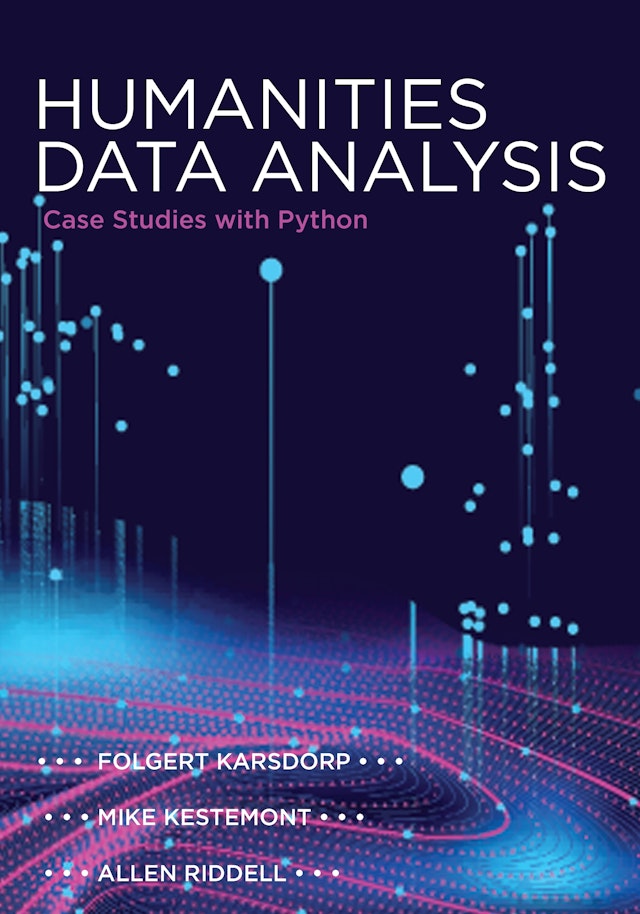
BOOK: Folgert KARSDORP, Mike KESTEMONT & Allen RIDDELL, Humanities Data Analysis: Case Studies with Python (Princeton: Princeton University press, 2021), 360 p. 9780691172361, 45 USD


(image source: Princeton)

Book abstract:

The use of quantitative methods in the humanities and related social sciences has increased considerably in recent years, allowing researchers to discover patterns in a vast range of source materials. Despite this growth, there are few resources addressed to students and scholars who wish to take advantage of these powerful tools. Humanities Data Analysis offers the first intermediate-level guide to quantitative data analysis for humanities students and scholars using the Python programming language. This practical textbook, which assumes a basic knowledge of Python, teaches readers the necessary skills for conducting humanities research in the rapidly developing digital environment.

The book begins with an overview of the place of data science in the humanities, and proceeds to cover data carpentry: the essential techniques for gathering, cleaning, representing, and transforming textual and tabular data. Then, drawing from real-world, publicly available data sets that cover a variety of scholarly domains, the book delves into detailed case studies. Focusing on textual data analysis, the authors explore such diverse topics as network analysis, genre theory, onomastics, literacy, author attribution, mapping, stylometry, topic modeling, and time series analysis. Exercises and resources for further reading are provided at the end of each chapter.

An ideal resource for humanities students and scholars aiming to take their Python skills to the next level, Humanities Data Analysis illustrates the benefits that quantitative methods can bring to complex research questions.

  • Appropriate for advanced undergraduates, graduate students, and scholars with a basic knowledge of Python
  • Applicable to many humanities disciplines, including history, literature, and sociology
  • Offers real-world case studies using publicly available data sets
  • Provides exercises at the end of each chapter for students to test acquired skills
  • Emphasizes visual storytelling via data visualizations

On the authors:  

Folgert Karsdorp is a postdoctoral researcher at the Meertens Institute of the Royal Netherlands Academy of Arts and Sciences. Mike Kestemont is assistant professor of literature at the University of Antwerp. Twitter @Mike_Kestemont Allen Riddell is assistant professor of information science at Indiana University.

(source: Princeton

26 February 2021

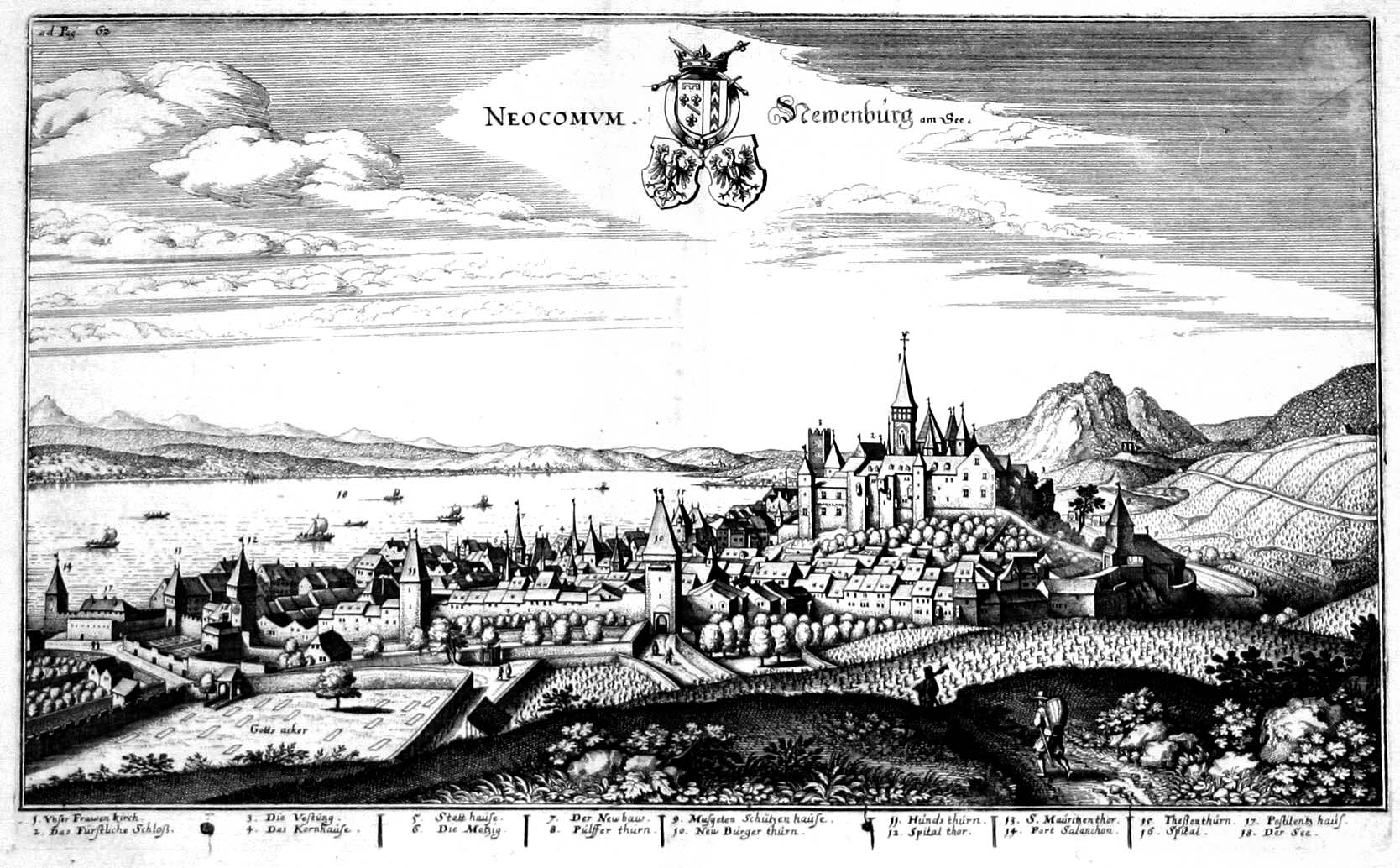
SOURCE PUBLICATION: Adrien WYSSBROD & Arnaud BESSON (eds.), Les points de coutume neuchâtelois; Adrien WYSSBROD (ed.), Le coutumier Hory [Les sources du droit suisse, XXIe partie : Les sources du droit du canton de Neuchâtel, Tome 3 et 4] (St. Gallen: Fondation des sources du droit suisse, 2021) ISBN 978-3-7965-4211-4 and 978-3-7965-4212-1


(image: Neuchâtel in 1645; source: Wikimedia Commons)

Abstract: 

Commandé au chancelier Jean Hory par les Orléans-Longueville au début du XVIIe siècle, le coutumier Hory constitue un projet très abouti de mise par écrit de la coutume neuchâteloise. En raison de la résistance du Petit Conseil, ce coutumier n’est jamais entré en vigueur. Il demeure toutefois un témoin privilégié du droit Neuchâtelois, ainsi qu’une ambitieuse tentative de systématisation de la coutume, voire un essai précoce de codification. (vol IV)

 Les points de coutumes constituent la principale source de la coutume neuchâteloise d’Ancien Régime. Ces déclarations renseignent également sur le fonctionnement de la justice et donnent des détails sur des affaires privées et sur les individus impliqués. Elles concernent essentiellement des affaires civiles et ont été rendues entre 1529 et 1846. Cette édition reproduit intégralement la totalité des déclarations connues et remplace ainsi l’édition partielle de Georges-Auguste Matile de 1836. (vol III)

Read more with the Foundation for the Publication of the Sources of Swiss Law. The books can either be ordered on paper, or be consulted online.

02 October 2020

ARTICLE: C. Annemieke ROMEIN, Max KEMMAN, Julie M. BIRKHOLZ, James BAKER, Michel DE GRUIJTER, Albert MEROÑO-PEÑUELA, Thorsten RIES, Ruben ROS & Stefania SCAGLIOLA, State of the Field: Digital History (History 2020 (May), 292-312

(image source: Wikimedia Commons)

Abstract:

Computing and the use of digital sources and resources is an everyday and essential practice in current academic scholarship. The present article gives a concise overview of approaches and methods within digital historical scholarship, focusing on the question ‘How have the digital humanities evolved and what has that evolution brought to historical scholarship?’ We begin by discussing techniques in which data are generated and machine searchable, such as OCR/HTR, born-digital archives, computer vision, scholarly editions and linked data. In the second section, we provide examples of how data is made more accessible through quantitative text and network analysis. The third section considers the need for hermeneutics and data-awareness in digital historical scholarship. The technologies described in this article have had varying degrees of effect on historical scholarship, usually in indirect ways. With this article we aim to take stock of the digital approaches and methods used in historical scholarship in order to provide starting points for scholars seeking to understand the digital turn in the field and how and when to implement such approaches in their work.

Read the full article in open access (DOI 10.1111/1468-229X.12969 

21 September 2020

ARTICLE: Annemieke ROMEIN, Sara VELDHOEN & Michel DE GRUIJTER, “The Datafication of Early Modern Ordinances”, [Digital Humanities in Society] DH Benelux Journal II (2020)


The journal Digital Humanities in Society has published “The Datafication of Early Modern Ordinances” by Annemieke Romein.

Abstract: The project Entangled Histories used early modern printed normative texts. The computer used to have significant problems being able to read Dutch Gothic print, which is used in the vast majority of the sources. Using the Handwritten Text Recognition suite Transkribus (v.1.07-v.1.10), we reprocessed the original scans that had poor quality OCR, obtaining a Character Error Rate (CER) much lower than our initial expectations of <5% CER. This result is a significant improvement that enables the searching through 75,000 pages of printed normative texts from the seventeen provinces, also known as the Low Countries. The books of ordinances are compilations; thus, segmentation is essential to retrace the individual norms. We have applied – and compared – four different methods: ABBYY, P2PaLA, NLE Document Recognition and a custom rule-based tool that combines lexical features with font recognition. Each text (norm) in the books concerns one or more topics or categories. A selection of normative texts was manually labelled with internationally used (hierarchical) categories. Using Annif, a tool for automatic subject indexing, the computer was trained to apply the categories by itself. Automatic metadata makes it easier to search relevant texts and allows further analysis. Text recognition, segmentation and categorisation of norms together constitute the datafication of the Early Modern Ordinances. Our experiments for automating these steps have resulted in a provisional process for datafication of this and similar collections


The full text can be found here (DOI 10.17613/80sx-m116)

31 August 2020

BLOGPOST: Simon BURROWS & Glenn ROE, "Digitizing the Enlightenment" (Oxford University Studies in the Enlightenment)

(image: Mme du Deffand; source: Wikimedia Commons)

First paragraph:

Simon Burrows and Glenn Roe are the editors of the July volume in the Oxford University Studies in the Enlightenment series, Digitizing Enlightenment: Digital Humanities and the Transformation of Eighteenth-Century Studies, which is the first book length survey of the impact of digital humanities on our understanding of a key historical period and paradigm. In this blog post, they explore how Digitizing Enlightenment began and developed, and how various datasets and projects have helped scholars to shed new light on the Enlightenment period.

(read more here

17 July 2020

CALL FOR PAPERS: Conference - Digital Methods and Resources in Legal History (Frankfurt, 4-5 March 2021) (DEADLINE: 20 September 2020)


We learned of a call for papers for the next conference on digital methods and resources in legal history at the Max Planck Institute for European Legal History.

Um eine Gelegenheit für den kritischen Austausch über digitale Methoden und Ressourcen in der Rechtsgeschichte zu schaffen, und um einen Überblick über das breite Spektrum jener Methoden und Ressourcen zu vermitteln, veranstaltet das Max-Planck-Institut für europäische Rechtsgeschichte am 4./5. März 2021 eine Konferenz "Digital Methods and Resources in Legal History". Wir laden dazu ein, Sammlungen, Datenbanken, Gazetteers und andere für die Rechtsgeschichte einschlägige Ressourcen vorzustellen, sowie zu diskutieren, wie solche digitalen Ansätze in konkreten rechtshistorischen Projekt-Kontexten eingesetzt wurden. Ausdrücklich laden wir auch zum Bericht über Erfahrungen ein, in denen digitale Mittel nicht befriedigend gefunden, erzeugt oder eingesetzt werden konnten. Der Call for Papers/Posters ist hier einzusehen, zusammen mit einer ausführlicheren Darstellung der Thematik und weiteren Informationen. Einreichungen sollten bis 20. September 2020 per E-Mail an dlh@rg.mpg.de erfolgen.

The full call can be found here

18 June 2020

DIGITAL SEMINAR: Marton Ribary (Surrey) and Barbara McGillivray (Alan Turing Institute & Cambridge): “The thing is mine”: Extracting the terminology of the Roman law of “ownership” from Justinian’s Digest (LIVESTREAM: 19 JUNE 2020: 16:30u GMT)


Through the website of the Instiute of Classical Studies of the School of Advanced Study in London, we learned about the Digital Classicist London Seminar 2020. 

Source: https://ics.sas.ac.uk/events/event/22545

Friday, Jun 19, 2020, 16:30 UK time
Institute of Classical Studies, University of London Online seminar, streamed live and archived at: https://youtu.be/cG8sRps1s6Q

Our paper investigates the evolution of the concept of “ownership” in Roman law using computational semantic methods. The work is based on a relational database of Justinian’s Digest (533 CE) arranging more than twenty thousand text units excerpted from hundreds of otherwise lost legal works in a Python environment and shared on GitHub (mribary/pyDigest). We present a thematic tree-map of Roman law based on hierarchical clustering of sections. We use computational methods for terminology extraction and distributional semantic word representations to show how the semantic landscape associated with “ownership” changed over time.


20 May 2020

SOURCE EDITION: Protokolle der Regierungen der Habsburgermonarchie (1867-1918) (Austrian Academy of Sciences)

(image source: Wikimedia Commons)

On the project:
Der Ministerrat war das zentrale Organ der Regierungstätigkeit. Seine Sitzungsprotokolle umfassen fast sechzig Jahre Regierungszeit. Als eine der wenigen bearbeitet verfügbaren Ressourcen legen sie einerseits das Innenleben der Regierungen der Monarchie offen — andererseits beinhalten sie Unmengen prosopographischer, politischer, administrativer, wirtschaftlicher, kultureller und sozialer Informationen. Sie sind eine herausragende historische Quelle. Der Justizpalastbrand von 1927 dezimierte die zwischen 1867 und 1918 entstandenen Protokolle. Trotzdem wurden sie von einzelnen Historikern für die Forschung genutzt. Zum Glück waren vor dem Brand von einigen Protokollen Abschriften für interessierte Stellen in Wien und Prag angefertigt worden. Der beschädigte Bestand war verfügbar, aber für die Öffentlichkeit schwer zugänglich. 1967 gründete Friedrich Engel-Janosi die Edition der österreichischen Ministerratsprotokolle in enger Kooperation mit ungarischen Historikern. Es ist eine textkritische und kommentierte Volltextedition der im Österreichischen Staatsarchiv befindlichen Originalquellen. Gegenstand sind erstens die Sitzungsprotokolle des seit 1848 bestehenden Ministerrates (1852−1861 Ministerkonferenz) des Kaisertums Österreich bis zum österreichisch-ungarischen Ausgleich 1867. Diese bilden die 1. Serie der Edition in dunkelblauen Buchdeckeln. Durch den österreichisch-ungarischen Ausgleich von 1867 wurde das Kaisertum Österreich in die österreichisch-ungarische Monarchie umgewandelt. Daher schließen sich zweitens die Protokolle des gemeinsamen Ministerrates der österreichisch-ungarischen Monarchie 1867−1918 an, die dunkelrote 2. Serie. In der 3. Serie werden die cisleithanischen (österreichischen) Ministerratsprotokolle 1867−1918 mit hellblauen Buchdeckeln ediert. Die 1. Serie wurde 1967 von einem Herausgeberkomitee begonnen, vom Österreichischen Ost- und Südosteuropa-Institut 1993 fortgesetzt und 2008 an der Österreichischen Akademie der Wissenschaften von der Kommission für die Geschichte der Habsburgermonarchie, dann 2013 vom Institut für Neuzeit- und Zeitgeschichtsforschung, nunmehr Institute for Habsburg and Balkan Studies, fertiggestellt. Sie umfasst einen Einleitungsband und 27 Textbände in sechs Abteilungen. Die Retrodigitalisierung der Bände ist abgeschlossen. Textdaten waren seit 2019 in wenig strukturiertem XML verfügbar. Diese Daten wurden für diese digitale Edition mithilfe von XSL-Transformationen vollständig neu bearbeitet, aufgewertet, mit Metadaten auf Protokollebene versehen sowie mit Angaben zu den teilnehmenden Personen, den Daten und, falls vorhanden, Links zu Onlineressourcen aus ANNO (AustriaN Newspapers Online) und ALEX (Historische Rechts- und Gesetzestexte Online) sowie mit internen Links zwischen Protokollen ergänzt. Die 2. Serie wird seit 1966 vom Institut für Geschichte der Ungarischen Akademie der Wissenschaften herausgegeben. Dieser Bestand kann auf fünf erschienene Bände verweisen; der Verlag der Österreichischen Akademie der Wissenschaften hat hiervon Digitalisate im PDF-Format angefertigt. Hier werden die Tagesordnungslisten aus den Inhaltsverzeichnissen dieser Bände mit den anderen Serien verknüpft (in Arbeit, voraussichtliche Fertigstellung: Sommer 2020). Als 3. Serie folgen die cisleithanischen (österreichischen) Ministerratsprotokolle 1867−1918. Sie werden am Institut für Neuzeit- und Zeitgeschichtsforschung, nunmehr Institute for Habsburg and Balkan Studies, der Österreichischen Akademie der Wissenschaften seit 2018 herausgegeben und in Buchform und als digitale Edition erarbeitet. Hierfür wird TEI-XML direkt aus Worddokumenten erstellt. Bei dieser Serie ist die Erschließungstiefe am größten, weil sie ‚born digital‘ sind; alle erwähnten Entitäten (Personen, Institutionen) sowie Literaturreferenzen werden mithilfe eigener Systeme erfasst und in den TEI-Dokumenten verlinkt. Details zur Geschichte der Edition finden sich im Einleitungsband der ersten Serie und in den Vorworten zu den einzelnen Bänden. Details zur Digitalisierung finden Sie unter Technische Umsetzung.
More information on the project website.

10 February 2020

CALL: Legal History on the Web

(image source: Wikimedia Commons)

The Legal History Blog issued a call from Duke University for further links in its Legal History on the Web Directory:
Second Call for Information about Legal History Websites/Multimedia Projects for “Legal History on the Web”Many of you may have had occasion to use “Legal History on the Web,” a gateway to online resources related to legal history that we started at Duke University in 2006.  This year we are undertaking a long-overdue update of the site, building on the platform first created by Mitch Fraas and revised by Ashton Merck, both working with and under the direction of Ed Balleisen.
We particularly invite suggestions for websites to include in a couple of new categories, as well as sites that engage with legal history outside the United States and the UK.
We are already well into the process of fixing broken links by updating URLs and revising annotations for existing websites where advisable.  If you know of any websites that require updates or that you think merit inclusion on “Legal History on the Web,” please send along the relevant information to Siobhan Barco, at siobhan.barco@duke.edu.
Please feel free to send along suggested text for annotations to any new links that you nominate for inclusion.  That suggested text needs to be short – just a few lines that encapsulate what the site has to offer legal historians (see current annotations for examples).Existing Categories:
Other Web Gateways to Legal HistoryLibrary Research Guides/General Reference ResourcesPrimary Source Databases/Web Archives (likely to be renamed in some way to convey expansive digital legal history projects that include GIS mapping or other kinds of digital analysis in addition to primary sources).Law & Popular Culture  (possibly to be discontinued unless we locate a sufficient number of relevant sites)ChronologiesJournalsPublishers with Legal History ListsBlogsWorkshops, Seminars, and Working GroupsScholarly Associations and NetworksGraduate Programs in Legal History/Law and SocietyReading ListsSyllabi  (sorely in need of updating – syllabi disappear more frequently than perhaps any other category on the site)FellowshipsGrantsPrizesJob Market for Legal History
New Categories:
  •   Companion Websites to Legal History Books
(See for example, Ed Balleisen’s Suckers & Swindlers in American History, a companion site to his Fraud: An American History from Barnum to Madoff, which includes an extensive bibliography, essay about sources and methods, essay about avenues for future research, compilations of fraud-related slang, and much else besides.)
  • Legal History Multimedia (e.g.) podcasts / documentaries)
Thanks for your crowd-sourcing help as we seek to refresh this resource for the legal history community.
(source: Legal History Blog)

28 January 2020

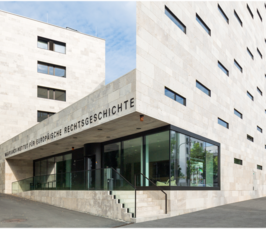
CONFERENCE: Digital Methods and Resources in Legal History (Frankfurt am Main: MPIeR, 19-20 MAR 2020)


(image source: academicpositions)


We invite researchers to participate in our conference on "Digital Methods and Resources in Legal History", which is intended to provide an opportunity for the critical discussion of digital methods and resources in legal history. We will have presentations of collections, databases, gazetteers and similar resources of relevance to legal history, and discuss how these and other resources, and digital methods in general, have been put to use in concrete project contexts. Interested researchers, whether from legal history, the digital humanities or other fields are welcome.

In the download documents section to the right, you can find the preliminary programme and the book of abstracts. While the call for papers is closed, it is also still accessible in the column to the right, as it also contains a more detailed statement on the conference's rationale.

Conference Dates and Venue: 19-20 March 2020
The venue is on the Campus Westend of the University of Frankfurt, and can be reached by bus (lines 36, 64, 75), underground (U1, U2,U3 or U8 to station Holzhausenstraße). You can find directions here andhere.

Registration, Accommodation and Administrative Issues
There is no conference fee. However, we kindly request that you register before 14 February 2020 by sending an informal mail to .
A contingent of rooms is reserved until 5 February 2020 at the Hotel Leonardo Royal in Frankfurt, who ask you to book your room with the keyword "MAX180320S", using the form available in the download documents section to the right (available in German only). Other hotels in the vicinity are the Hotel Liebig, the motel Frankfurt, the Hotel Mondial, or the Turm Hotel.
For all questions and comments, you are very welcome to contact us by sending e-mail to: 

Links: