Search

Showing posts with label advance article. Show all posts

15 June 2026

ADVANCE ARTICLE: Maya MARK, "Civil Disobedience in Defense of Democracy: Menachem Begin’s Struggle Against Emergency Laws in Israel, 1948–1954" (Law and History Review) [OPEN ACCESS]

(image source: CUP)

 Abstract:

This study uncovers a previously overlooked chapter in the historiography of civil disobedience: Menachem Begin’s resistance to Israeli emergency legislation between 1948 and 1954, which he argued undermined foundational democratic principles. It presents the first scholarly analysis of Begin’s resistance, contending that it constitutes a clear instance of civil disobedience, embodying its core tenets. At the heart of this historical case study lies a paradigmatic question: how can laws that erode foundational—yet abstract—democratic principles, such as the separation of powers, be effectively resisted, and can such resistance be accommodated within traditional frameworks of civil disobedience? Begin’s struggle brings these questions into sharp relief, illuminating longstanding critiques of the framework’s overly restrictive boundaries and underscoring the tension between theoretical frameworks and political reality. More broadly, the article engages central debates at the intersection of law, politics, and democratic thought. By examining the democratic convictions of a prominent right-wing leader, it contributes to historical scholarship on the role of conservative and right-wing movements in shaping democratic ideologies, while also providing a historical reference point for subsequent ideological transformations and radicalization processes within these movements. Finally, by illuminating the complexities inherent in opposing laws that erode core-yet abstract-democratic principles, this study resonates with contemporary debates on democratic backsliding, offering a historical lens through which civil disobedience has served as a principled response to such challenges.

Read more here: DOI 10.1017/S0738248026101539

11 June 2024

ADVANCE ARTICLES: Comparative Legal History XII (2024)


Articles

Early modern comparative contract law (Piotr Alexandrowicz)
DOI 10.1080/2049677X.2024.2349850
Abstract:

Contract law was one of the main subjects discussed in the early modern legal genre of differentiae iuris civilis et canonici (‘differences between civil and canon law’). Similar topics were covered in both late medieval and early modern differentiae – hence this genre offers a good opportunity for comparative historical research dedicated to selected topics of contract law (such as those discussed here: the actionability of bare agreements, stipulation for the benefit of a third party, overreaching in contract formation and the lease of a house to a scholar). An examination of the sources proves that the authors of early modern differentiae applied the comparative method in their works. This involved the presentation of sources and rationales from the two bodies of law, the interpretation of sources and arguments in favour of the solutions offered, references to the then-current legal literature and practice and most importantly the preferred method of reconciliation for conflicting laws.

Comparative nomogenetics: revisiting Wigmore’s oriental(ist) encounter and the taxonomy of his approach to global legal history (by Morad El Kadmiri) (OPEN ACCESS)
DOI 10.1080/2049677X.2024.2349851
Abstract:

John Henry Wigmore’s life experience as a Westerniser teaching Anglo-American Law in Japan from 1889 to 1892 is an example of legal orientalism. Engaging in the historical study of Japanese law despite diverging cultural paradigms between East and West paradoxically revealed striking similarities leading to the publication of the Materials for Study of Private Law in Old Japan in 1892. More than three decades after his return from Tokyo sparking a lasting fascination for foreign and comparative law, Wigmore published in 1928 A Panorama of the World’s Legal Systems. This case study offers insights on the relationship between legal history and comparative law that these publications respectively represent. The imprecise classification of A Panorama at a time when comparative law was at its infancy stage requires identifying a relevant taxonomy. Wigmore’s legacy is revisited with a focus on both its historical and comparative dimensions.

Parallels and patterns in the Italian (1901) and Hungarian (1903) legislation on migration (Balázs Pálvölgyi) [OPEN ACCESS]
DOI 10.1080/2049677X.2024.2349852
Abstract:

The second half of the nineteenth century was an era of mass labour migration in Europe, when the Atlantic route became of paramount importance alongside intra-continental mobility. From the last third of the century Italy and Hungary were among the most important emigrating countries. By this time changes in the regulation of migration had begun to take place with the development of stronger state control, which affected mobility and the relationship between emigrants and transporters. The question also arose as to whether and how the large emigrating states could ensure the loyalty of their emigrant citizens and control them en route and in the destination states. The regulatory process which began in the 1880s gradually moved from an administrative approach to the development of more comprehensive legal sources covering more and more aspects of emigration with the Hungarian government making use of foreign solutions, particularly the Italian Emigration Act of 1901. 


Book review essay

Three takes on comparative constitutional history (Ran Hirsch & Nicholas Slawnych)
DOI 10.1080/2049677X.2024.2349853
Abstract:

A review of The Gun, the Ship, and the Pen: Warfare, Constitutions, and the Making of the Modern World, by Linda Colley, New York, Liveright, 2021, 512 pp, $19.95 (pbk), ISBN 978-0871403162; Modern Constitutionalism: Origin and Manifestations. England – North America – France – Germany – Europe/European Union – Latin America, by Horst Dippel, Clark, Talbot Publishing, 2 vols, 2022, xxii + 546, x +547-1177 pp, $295.00 (hbk), ISBN 978-1616196769; The Story of Constitutions: Discovering the We in Us, by Wim Voermans, translated by Brendan Monaghan, Cambridge, Cambridge University Press, 2023, 388 pp, £22.99 (pbk), ISBN 978-1009385046 [published originally in Dutch as Wim Voermans, Het verhaal van de grondwet: zoeken naar wij, Amsterdam, Prometheus, 2019, 512 pp, €34.99 (hbk), ISBN 978-9044640014]

Book reviews

  • Arbeit und Familie in Nordwesteuropa im Spätmittelalter und in der Frühen Neuzeit / Travail et famille en Europe du Nord-Ouest au bas Moyen Âge et à l’époque moderne edited by Audrey Dauchy and Laila Scheuch, Frankfurt am Main, Vittorio Klostermann, 2023, 213 pp., € 69.00 (pbk), ISBN 978-3-465-04602-8) (Anna Bellavitis & Siglinde Clementi)
    DOI 10.1080/2049677X.2024.2349856
  • Intervention and state sovereignty in Central Europe, 1500–1780 by Patrick Milton, Oxford, Oxford University Press, 2022, 320 pp., £ 90,00 (hbk), ISBN 978-0192871183 (Stephan Wendehorst)
    DOI 10.1080/2049677X.2024.2349846
  • Le danze di Clio e Astrea. Fondamenti storici del diritto europeo by Aldo Andrea Cassi, Romano Ferrari Zumbini, Michele Rosboch, Giuseppe Speciale, Chiara Valsecchi, edited by Aldo Andrea Cassi, multimedia project by Alan Sandonà, Turin, Giappichelli, 2023, XVI + 558 pp, 49€, ISBN/EAN 979-12-211-0066-2 (Dante Fedele)
    DOI 10.1080/2049677X.2024.2349848
  • The jury: a very short introduction by Renée Lettow Lerner, New York, Oxford University Press, 2023, 160 pp., £8.99 (pbk), ISBN 978-0-190-92391-4 (Sylvain Soleil)
    DOI 10.1080/2049677X.2024.2349855
  • The ideal river: how control of nature shaped the international order by Joanne Yao, Manchester, Manchester University Press, 2022, 264 pp, £85.00 (hbk), ISBN 978-1526154385 (Jan-Henrik Meyer)
    DOI 10.1080/2049677X.2024.2349847
  • We, the King. Creating royal legislation in the sixteenth century Spanish New World (by Adrian Masters, Cambridge, Cambridge University Press, 2023, 342 pp., $110 (hbk), ISBN 978-1009315418) (Alejandro Agüero)
    DOI 10.1080/2049677X.2024.2349857
Read all articles and book reviews herehere.

05 December 2023

ADVANCE ARTICLE: Jean-Louis HALPÉRIN, "Doctrinal circulations in criminal law 1764-1914" (Comparative Legal History)


Abstract:

Although criminal law books were comparatively rare before the middle of the eighteenth century, Beccaria’s Dei delitti e delle pene (1764) triggered the development of an enormous literature devoted to penal issues (from philosophical foundations to debates related to prisons) in Europe until 1914. In one and a half centuries, more than 20,000 books were published on these issues, of which about half were published in German lands and the remainder in Italy, France, Great Britain/United Kingdom, Spain, Portugal, Belgium and the Netherlands. Both philosophers and sociologists participated to these intellectual exchanges. This paper tries to analyse different ways for measuring the circulation of these texts (translations, quotations especially in footnotes, catalogues of private and public libraries, correspondence and travels). Although the debates were clearly transnational, there were also obstacles in the diffusion of foreign books. After evaluating these linguistic or cultural obstacles and considering the changing contexts between the first and second halves of the nineteenth century, this article outlines three conclusions about the globalisation and non-globalisation of legal concepts during this period.

Read the article here: DOI 10.1080/2049677X.2023.2270387.

04 December 2023

ADVANCE ARTICLE: Mario CONETTI, "Banking Law in Italian Legal Consulting between the Fourteenth and the Fifteenth Centuries" (American Journal of Legal History)


(image source: OUP)

Abstract:

Banking operations in northern and central Italy between late fourteenth and early fifteenth century were very sophisticated and often gave rise to disputes involving the expertise only law professors could provide. To provide solutions which were at the same time viable and grounded in legal culture, lawyers went beyond merely practical considerations to work out legal institutions as a framework to banking activities. In doing so, they developed a proper banking law, a peculiar legal system.

Read more here: DOI 10.1093/ajlh/njad027.

29 November 2023

ADVANCE ARTICLE: Eric J. SCARFFE, "Justice Kennedy’s Jurisprudence of Dignity: From Sovereign Immunity to Gay Rights" (American Journal of Legal History)


(image source: OUP)

Abstract:

Although this article uses Obergefell v Hodges (2015) as its frame, it aims to bring out some distinctive features of Justice Kennedy’s jurisprudence of dignity more broadly. There are two reasons why such an investigation is important. The first is important to those interested in the legal case. Indeed, in Dobbs v Jackson Women’s Health (2022), the Court now argues that the relevant ‘test’ for determining whether a right is protected under the Due Process Clause is whether the right is found to be ‘deeply rooted’ in the nation’s history and tradition. This article aims to critique this decision, as well as originalist approaches to constitutional interpretation more broadly, and seeks to resurrect and reconstruct Kennedy’s jurisprudence of dignity that has undergirded (sometimes quietly) the expansion of civil rights protections to the LGBTQ+ community. The second reason this investigation is important is of interest to philosophers and legal historians. Dignity is a notoriously elusive concept, and much ink has been spilt trying to sort out the precise nature of its content and its boundaries. This article brings together the many (seemingly disparate) uses of dignity found across cases involving gay rights, abortion, and foreign sovereign immunity, and argues Kennedy effectively weaves these uses together in ways that may sharpen our understanding of dignity in both the philosophical and legal literatures.

Read the article here: DOI 10.1093/ajlh/njad026.

30 September 2021

ADVANCED ARTICLES: Historia et ius - Early release n. 20 num. 20 27/9/2021 (Open access)

(Source: Historia et ius)


Historia et ius - anticipazioni num. 20
27/9/2021
 
☛ Last articles published -  ultimi articoli pubblicati :
Early release n. 20 - Anticipazioni n. 20

Giacomo Alberto Donati, «Nolite thesaurizare vobis thesauros in terra»: un’introduzione alla disciplina giuridica del tesoro nell’utrumque ius (secoli XIII-XVII) 

Dario Luongo, Rileggendo gli scritti di Brugi sulla storia della giurisprudenza e delle università italiane 

Francesca Macino, Extra petita. Sugli effetti della clausola sola facti veritate inspecta nella dottrina tra XV e XVI secolo 

Maria Rosa Di Simone, Le donne e il crimen magiae. Il dibattito tedesco sulla prova dell'acqua tra XVI e XVII secolo 

Sabrina Di Maria, Cari e ‘vecchi’ boni mores. Primi spunti per una comparazione diacronica - PDF


The articles are available in PDF format here.

18 May 2021

ADVANCE ARTICLE: Lorren Eldridge, "Gone and forgotten: Vinogradoff's historical jurisprudence" (Legal Studies)

(image source: CUP)

 Abstract:

Sir Paul Vinogradoff was once well known for his historically contextualised approach to legal theory which held that legal ideas were the contingent products of social factors. Law was necessarily engaged with other subjects, and ‘historical jurisprudence’ could produce real insight into the nature of law – in part by placing theories such as analytical jurisprudence in context, evaluating and modifying theoretical models by reference to the contingent social facts of an era. This was part of the nineteenth-century turn to ‘science’ in history and a focus on methodology. Sir Henry Maine argued that legal history proved the insufficiency of analytic theories, but his method met with many criticisms, some of which Vinogradoff sought to address. However, Vinogradoff's insights have rarely been pursued or developed, with legal history favouring Maitland's more doctrinal approach, and legal theory rejecting historical jurisprudence – at least explicitly. Despite its imperfections, historical jurisprudence offers a rich and valuable way to understand law, including to evaluate analytical models such of those of HLA Hart, and as a methodology for dialogue between comparative and historical legal scholarship. It has, in fact, continued to do so without explicit recognition in the 100 years since Vinogradoff's death.

Read more here: DOI 10.1017/lst.2020.41.

30 March 2020

ADVANCE ARTICLE: Chris RILEY, "The Hermit and the Boa Constrictor: Jeremy Bentham, Henry Brougham, and the Accessibility of Justice" (American Journal of Legal History)

(image source: Oxford Journals)

Abstract:
This article examines the particularly complex relationship between Jeremy Bentham and Henry Brougham, with reference to the respective schemes that they devised in the late 1820s and early 1830s for achieving accessible justice through a new network of local courts across England and Wales. For a considerable part of the first few decades of the nineteenth century, Bentham and Brougham remained great friends and allies, but their disagreements gradually intensified, most notably following Brougham's six-hour law reform speech in the House of Commons on 7 February 1828, the printing of his Local Courts Bill on 7 June 1830, and the beginning of his Lord Chancellorship on 22 November of the same year. By analysing Bentham's highly detailed annotated copies of Brougham's law reform speech and Local Courts Bill—as well as Bentham's articles in the Westminster Review, and a substantial portion of his unpublished writings—it is shown how Bentham's complete loss of faith in Brougham as a reformer and as a legislator led him from describing Brougham as his own grandson to calling him an enemy of the people and a serpent. It is argued that the severity of Bentham's criticisms of the then Lord Chancellor in print, and the personal nature of the insults that he levelled towards him in manuscript, effectively dispel any suggestion that the two men were acting in concert on the issue of law reform in general, or on the matter of local courts in particular.
Read more with Oxford Journals.

06 March 2019

ADVANCE ARTICLE: Yifat MONNICKENDAM, "The Exposed Child: Transplanting Roman Law into Late Antique Jewish and Christian Legal Discourse " (American Journal of Legal History, 2019)

(image source: OUP)

Abstract:
In classical Roman law, a private act such as child exposure, child sale, or the pledging of children could not change the legal status of a child or turn a freeborn into a slave. In practice, however, decisions concerning the status of foundlings lay with their finders, who could readily enslave them. In the fourth century CE, in an attempt to minimize child exposure, Constantine legalized this practice, granting finders the official power to decide the legal status of foundlings: whether a child would be raised as a slave or adopted and raised as a freeborn citizen.Jews and Christians living under Roman rule addressed this question using Roman legislation alongside their own legal thought, practices, and traditions. In this paper, I survey the Jewish and Christian approaches to child exposure and demonstrate how Roman legislation was transplanted into two new legal contexts. While the Palestinian rabbis cited the Constantinian legislation, they molded it in the form of conversion, because Palestinian rabbinic halakha did not acknowledge legal adoption of children. The Christian writers, by contrast, at first sight appear to have ignored the question of status. They focused on defining exposure as murder, comparable to abortion and infanticide. A closer look, however, reveals that they replaced the question of civil status with one of religious status, describing the adoption of a foundling as baptism and inclusion in the growing Christian community.
Read more on Oxford Scholarship.

11 February 2019

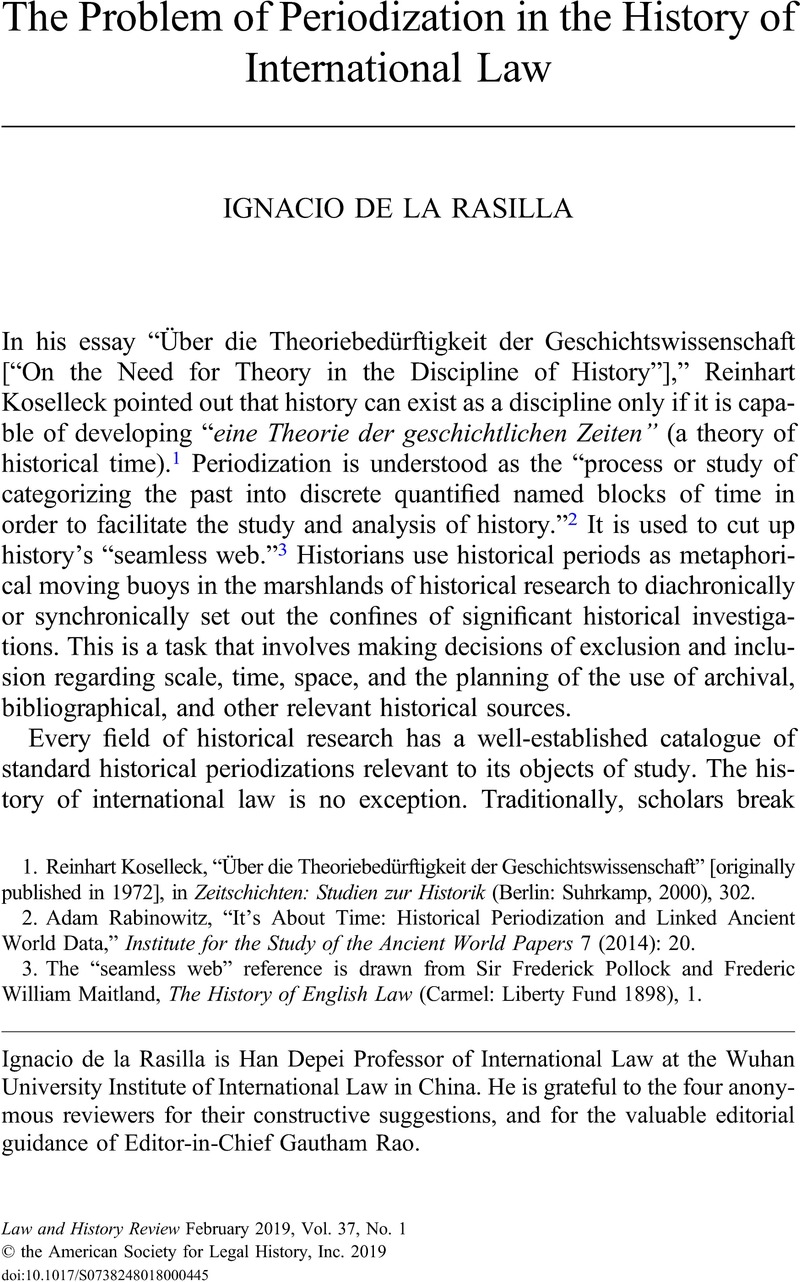
ADVANCE ARTICLE: Ignacio DE LA RASILLA DEL MORAL, "The Problem of Periodization in the History of International Law" (Law & History Review)

(image source: Cambridge Core)

Abstract:
"To illustrate the central if often overlooked role that periodization plays in the history of international law, this article proceeds in three parts. The first part critically discusses six approaches to periodization in the history of international law: the hegemonic, the Eurocentric universalist, the state-centric, the doctrinal, the institutional, and the normative. The second part studies how, in the wake of the recent “turn to history” in international legal scholarship, a new critical historiography has problematized the question of periodization because of the homogenizing effect and the “teleology of progress” to which periodization is interpreted as contributing. This part also shows that even despite a radical postmodern critique of periodization that distrusts “great meta-narratives,” alternative meta-narratives and ideological frameworks nonetheless structure other periodizations for contemporary historians of international law. The third part elaborates on the heuristic potential of a multiperspective approach to the question of periodization, and addresses the notion of “alternative periodization.” With examples from a new wave of literature on the history of international law, it illustrates its value as a launch pad for the “formation of new formerly unknown periods,” a task that can be considered “an essential part of historiographical innovation.”

Read the article on Cambridge Core (open access).

(source: Legal History Blog)

20 November 2018

ADVANCE ARTICLE: Edward CAVANAGH, "The Imperial Constitution of the Law Officers of the Crown: Legal Thought on War and Colonial Government, 1719-1774", Journal of Imperial and Commonwealth History, 29 OCT 2018

(image source: Duotrope)

Article abstract:
The rule of conquest came to receive different applications for different parts of the British Empire. How this happened, and who was responsible for it happening, are the interests of this article. Calling upon court reports, parliamentary records, and correspondence between various officeholders in the early Hanoverian government, attention will be drawn in particular to the attorney general and the solicitor general (the law officers of the crown) and the advice they offered upon the governance of colonies between 1719 and 1774. Focusing upon the conventions that pertain to war and conquest in Ireland, the Caribbean, India, and North America, this article reveals inconsistency in doctrine, but consistency in the procedures by which law officers of the crown acquired influence over proceedings in the houses of parliament and in the courts of common law and equity. Just as often in their formal capacities as in their informal capacities, the attorney general and the solicitor general were pivotal to the development of the imperial constitution, in constant response, as they were, to the peculiar demands of various colonies and plantations in the British Empire.
DOI 10.1080/03086534.2018.1539723

Read more here.

(source: ESILHIL Blog)

20 September 2018

ADVANCE ARTICLE: Justyna WUBS-MROZEWICZ, 'Neutrality before Grotius: A City, a State and Seven Salt Ships in the Baltic (1564-1567)', Journal of Early Modern History

(image source: Brill)

Abstract:
The article argues on the basis of a case from the 1560s in Danzig that prior to the formulation of the legal concept of neutrality by Hugo Grotius, there was a practice of neutrality. It was expressed in various terms and manners. This practice pertained to both cities and states, and the case discloses the first documented instance when the Netherlands explicitly strove for neutrality also by legal means. The choice for neutrality was rooted in political and economic interests and as such had advantages, but it was also fraught with difficulties. The analysis shows that the actual extent of neutrality depended on the acceptance (or lack thereof) of the warring parties. Also, by excluding the possibilities of the use of violence or economic means of pressure like blockades, neutrals were limited to diplomacy and law during conflicts. This lay the ground for the development of a legal concept of neutrality

More information with Brill.

04 July 2018

ADVANCE ARTICLE: J.G. ALLEN, "The Office of the Crown", Cambridge Law Journal 2018

(image source: Cambridge Core)

Abstract:
A troubling veil of mystery still shrouds the central institution of the British Constitution – the Crown. In this paper, I examine the modern utility of five historical doctrines: the doctrine of the “King's two bodies”; the doctrine that the Crown is a “corporation sole”; the doctrine that the King can “do no wrong”; the doctrine that (high) public offices are “emanations” of the Crown; and the doctrine that the Crown is “one and indivisible”. Using some insights from social ontology, the history of office in the Western legal tradition, and the sociology of role and status, I argue that the first four of these doctrines can be refashioned into a conception of the Crown as an office. An office is an enduring institutional entity to which individuals bear a relationship from time to time, but which is separate from any individual incumbent and is to be considered in legal analysis as a separate acting subject. Using the logic of office, official personality and official action, I distinguish between the Queen, the Crown, Her Majesty's Government and the Commonwealth and argue that together they provide a serviceable model of the modern British Constitution. The final doctrine, however, must be abandoned – the Crown is plural and divisible and this must be taken into account when using the Crown to reason about the UK's relationship to other constitutional orders.
On the author:
Alexander von Humboldt Post-Doctoral Fellow, Humboldt Universität zu Berlin Centre for British Studies; Adjunct Research Fellow, University of Tasmania Faculty of Law. This paper is based on my doctoral dissertation, for which I was supported as a Poynton Scholar by the Cambridge Australia Trust and as a Burke Scholar (in 2013) by the University of Tasmania. I would like to thank a number of people, with the usual disclaimer as to responsibility for error, for helping me in various ways, at various times and in various capacities: my supervisor T.R.S. Allan, Will Bateman, Edward Cavanagh, Daniel Clarry, Gino Dal Pont, David Dyzenhaus, Paul Finn, Evan Fox-Decent, Mark Elliott, Denis Galligan, Brendan Gogarty, Andrew Gold, Andrew Halpin, Harshan Kumarasingham, Tony Lawson and the members of the Cambridge Social Ontology Group, Ewan Smith and the Oxford Public Law Discussion Group, Lionel Smith and Michael Stokes.

More information on Cambridge Core.