Search

Showing posts with label Lawyers. Show all posts

13 November 2025

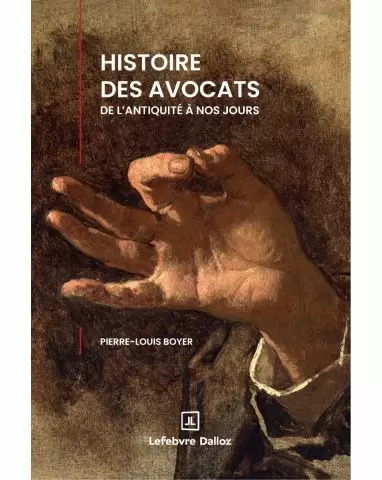
BOOK: Pierre-Louis BOYER, Histoire des avocats de l'antiquité à nos jours (Paris: Librairie Dalloz, 2025), ISBN 9782247245031, € 32


(image source: Dalloz)

Abstract:
Des logographes grecs du IVe siècle av. J.-C. aux bouleversements liés à l’Intelligence artificielle, cet ouvrage retrace l’histoire d’une profession en constante mutation, celle d’avocat. Pétri d’une déontologie aux principes pluriséculaires, l’avocat a toujours été un peu plus que le seul défenseur des parties. Si la protection et la représentation du justiciable est, certes, au coeur de sa fonction, il est aussi, comme auxiliaire de justice, un acteur essentiel de la société et un collaborateur de la paix sociale. Du patricien soutien de la Cité romaine aux avocats « 2.0 », l’avocat est à la fois une figure juridique, politique, intellectuelle et économique, parfois même religieuse, du monde judiciaire et de la vie publique. Il en est de même pour les structures auxquelles l’avocat a pu appartenir ou appartient encore, que l’on évoque le premier collège d’avocats sous l’Empire romain, les corporations médiévales ou les barreaux modernes : les Ordres, parfois éclatés, souvent différents, sont tout à la fois des phares, des corps constitués et hiérarchisés, des unités politiques et des secours pour les citoyens. Il n’est dès lors pas étonnant que les avocats, seuls ou unifiés, aient marqué les siècles : de Cicéron à Robert Badinter en passant par les grandes figures médiévales, les parlementaires du Grand Siècle ou encore les résistants de l’époque de Vichy, l’histoire est marquée par les avocats, et les avocats restent marqués par l’histoire. Ce livre, très richement illustré, principalement à destination des professionnels du droit, des universitaires et des étudiants, propose tant une relecture historique de l’avocature qu’une mise en lumière de l’évolution des pratiques et d’une déontologie qui se veut unifiée malgré les soubresauts de l’histoire, interrogeant aussi les évolutions en cours dans une approche plus prospective.
On the author:
Pierre-Louis Boyer est maître de conférences en histoire du droit et des institutions, habilité à diriger des recherches en Droit, ancien doyen de la faculté de Droit, des sciences économiques et de gestion de l’université du Mans et ancien avocat. Spécialisé en histoire des professions judiciaires et de la procédure, ainsi qu’en éthique et en philosophie du droit, il est membre des laboratoires Thémis-UM (Le Mans), IODE (CNRS – Rennes 1) et CREC (Académie de Coëtquidan).

Read more with the publisher

19 May 2025

BOOK: Jean-Philippe TONNEAU & Laurent WILLEMEZ (dir.), Pour une sociologie historique de la profession d'avocat. Bilan et nouvelles perspectives [Histoire] (Rennes: Presses universitaires de Rennes, 2025), 284 p. ISBN 9782753598263, € 25


(image source: PUR)

Abstract:

Les avocats constituent aujourd’hui une profession extrêmement visible dans la société française : occupant une place majeure dans les procès judiciaires, très présente dans le monde de l’entreprise où ses membres réalisent un important travail de conseil, jouant un rôle central dans la vie quotidienne de nombreux Français, la profession connaît un succès qui ne se dément pas. Convoitée, objet de nombreux fantasmes, mais aussi moquée et même parfois vilipendée, elle fait en tout cas beaucoup parler d’elle. Mais pendant longtemps, ce succès social ne s’est pas accompagné d’un intérêt réel dans la sociologie ou la science politique française. Ce livre a pour objectif de faire le point sur l’actualité de la recherche historique et sociologique concernant cette profession en mêlant analyses générales et études de cas empiriques et en multipliant les regards disciplinaires (histoire, sociologie, science politique).

Table of contents:

Articuler activité judiciaire et engagement politique selon les configurations historiques

  • Les coûts de l’engagement politique des avocats : cause lawyering et justice d’exception pendant la guerre d’Algérie
  • Les avocats communistes des origines à la fin des années 1950, acteurs et révélateurs du Parti communiste
  • Le Syndicat des avocats de France. D’une initiative communiste à son intégration professionnelle (1972-1981)
  • Enjeux et conceptions de l’enseignement du droit aux USA dans le Journal of Legal Education (1948-1968) : de la responsabilité des juristes
  • Les avocats et la construction politique des nouvelles institutions du travail. La profession face à la création des tribunaux du travail en Argentine

Les transformations d'un groupe professionnel

  • Sur quoi repose le système professionnel ? Une analyse de l’activité disciplinaire des barreaux
  • Les politiques de (dé)régulation de la profession d’avocat : enjeux et justifications de l’intervention des institutions européennes
  • La fin des avouées et avoués, et après… La reconfiguration du marché des causes d’appel en droit de la famille
  • L’alliance contemporaine des avocats et des conseils en propriété industrielle
  • Les engagements professionnels des avocats spécialisés dans le conseil aux entreprises
  • « Dans l’intérêt de mon client ! » L’avocat du majeur protégé, un porte-voix au service de l’institution ?
  • Pour une sociologie historique de la profession d’avocat. Bilan et nouvelles perspectives
Read more here.

08 April 2025

BOOK: Lutz KRELLER, Juristen im Unrecht. Die Biografien von Otto Palandt (1877-1951) und Heinrich Schönfelder (1902-1944) [Schriftenreihe der Vierteljahrshefte für Zeitgeschichte; 129] (Berlin/Boston: De Gruyter Oldenbourg, 2024), 160 p., ISBN: 9783111382296

 book: Juristen im Unrecht

About the book:

Der „Palandt", ein erstmals 1939 erschienener Kurzkommentar zum Bürgerlichen Gesetzbuch, und der „Schönfelder", eine ab 1932 publizierte Gesetzessammlung, begleiteten Generationen deutscher Juristen und Juristinnen. Doch wer waren die Namensgeber dieser beiden Standardwerke? Für welches Rechtsdenken und juristisches Selbstverständnis standen Otto Palandt (1877–1951) und Heinrich Schönfelder (1902–1944)? Wie verhielten sie sich zum NS-Staat, der Recht und Justiz pervertierte? Auf breiter Quellenbasis zeigt Lutz Kreller in seiner Studie, dass sich Palandt und Schönfelder aus Überzeugung in den Nationalsozialismus integrierten. An diesen beiden Biografien wird exemplarisch deutlich, wie leicht die Prinzipien der Unabhängigkeit von Recht und Justiz sowie die Gewaltenteilung 1933 zerstört und durch ein nationalsozialistisches Weltanschauungsrecht ersetzt werden konnten.

Table of contents:
 
Der „Palandt“ und der „Schönfelder“: Eine Einleitung

I. Der Jurist Otto Palandt (1877–1951)

1. 1877–1899: Sozialisation eines nichtelitären Bildungsbürgers

2. 1900–1918: Karriere(um)wege und Erster Weltkrieg als Zäsur

3. 1918/19–1932: Demokratie als Interim

4. 1933–1945: Chancen und Engagement

5. 1945–1951: Nach dem „Zusammenbruch“

II. Der Jurist Heinrich Schönfelder (1902–1944)

1. 1902–1922: Ursprünge einer völkischen Ideologisierung

2. 1922/23–1944: Ein weltanschauliches Kontinuum

Palandt, Schönfelder und der Nationalsozialismus: Eine Bilanz

Find more here.

31 May 2022

JOURNAL: Clio@Thémis XXII (2022) [Les juristes voyageurs. Ce que les circulations humaines font aux savoirs juridiques, eds. Laetitia GUERLAIN & Luisa BRUNORI


(Source: Clio@Themis

Clio@Thémis has published its latest issue on ‘Les juristes en voyageurs. Ce que les circulations humaines font aux savoirs juridiques (xvie-xxe siècle)’.

  • Laetitia Guerlain et Luisa Brunori

Penser ailleurs [Texte intégral]

Juristes voyageurs et innovation juridique (xvie-xxe siècle)

  • Anne-Charlotte Martineau

Le droit « façonné » par les pratiques coloniales ? [Texte intégral]

Les voyages des pères visiteurs au Brésil et les débats relatifs à l’esclavage (xvie siècle)

  • Antônio David et Carlos Zeron

Le jusnaturalisme en Europe et en outre-mer : Antonio Vieira face au droit naturel et à l’esclavage des Indiens de São Paulo (1694) [Texte intégral]

  • Margarita Serna Vallejo

Le Labyrintho de comercio terrestre y naval de Juan de Hevia Bolaño et le droit maritime [Texte intégral]

  • Marianne Vasara-Aaltonen

Swedish Lawyers’ Studies Abroad During the Seventeenth Century: A Mix of State-Building Process and Personal Ambitions [Texte intégral]

  • David Gilles

Livingston et Mignault : voyages civilistes et codificateurs en terres d’Amériques [Texte intégral]

  • Guillaume Richard

Parcourir l’espace national. Les voyages d’inspection des facultés de droit au xixe siècle [Texte intégral]

  • Raphaël Cahen

Laboulaye et Kachenovsky et la fabrique du droit international : voyages, réseaux, circulation des savoirs juridiques [Texte intégral]

  • Carlos Petit

« Los que pasan el Rhin, pierden la cabeza » [Texte intégral]

Privatistas españoles en universidades alemanas (1910-1936)

  • Annamaria Monti

Travel, correspondence and investigations in Italy and Latin America: insights from the papers of Mario Rotondi (1900-1984) [Texte intégral]

  • Eva Elizabeth Martínez Chávez

Movimiento de juristas, circulación del derecho: Republicanos españoles en América [Texte intégral]

  • Assaf Likhovski

The Many Exiles of Max Laserson [Texte intégral]

  • Michel Erpelding

Juristes internationalistes, juristes mixtes, Euro-Lawyers : l’apport de l’expérience semi-coloniale à l’émergence d’un droit supranational [Texte intégral]

  • Florence Renucci

Quand les voyages font la juriste de combat [Texte intégral]

De la cause des Africaines à l’influence du catholicisme sur le droit républicain


More info here

01 October 2021

SEMINAR: Les juristes en voyageurs. Ce que les circulations humaines font aux savoirs juridiques (XVIe-XXe siècle) (Université de Bordeaux, 7-8 octobre 2021)


We learned of a seminar on jurists as travellers at the Université de Bordeaux.

Jeudi 7 octobre


14h-14h30

o             Mot d’accueil

Xavier Prévost, professeur d’histoire du droit, université de Bordeaux, IUF

o             Propos introductifs

Luisa Brunori, chargée de recherche au CNRS, Université de Lille et Laetitia Guerlain, professeure d’histoire du droit, université de Bordeaux, IUF


14h30-15h Les voyages de Laboulaye (1811-1883) et Kachenovsky (1827-1872) et la fondation du droit international

Raphaël Cahen, chercheur et professeur invité à La Vrije Universiteit Brussel (VUB)


15h-15h30 Daunou en Europe : l'expérience d'un aller et d'un retour

Hugo Beuvant, enseignant-chercheur contractuel de l'Université Rennes 1


15h30-16h - pause


16h-16h30 Juan Francisco de Montemayor et Córdoba de Cuenca et les pirates de L'île de la Tortue

Oscar Cruz Barney, professeur d’histoire du droit, Instituto de Investigaciones Jurídicas, UNAM, México


16h30-17h Frère Bernat Boïl : juriste voyageur et premier vicaire de l’Amérique

Dra. Ana Brisa Oropeza Chávez, Université Anáhuac Veracruz-México et Dr. Alfredo de Jesús Dal Molin Flores, Université fédérale do Rio Grande do Sul-Brésil


17h-17h30 Le jusnaturalisme en Europe et en outre-mer : Antonio Vieira face au droit naturel et à l'esclavage des indiens de São Paulo (1694)

Antônio David et Carlos Zeron, Université de São Paulo


Vendredi 8 octobre


9h-9h30 The many exiles of Max Laserson

Assaf Likhovski, professeur d’histoire du droit, Tel-Aviv University Faculty of Law


9h30-10h Défendre la cause des Africaines, utiliser l'arme du droit. Le féminisme d'exportation de Sœur Marie-André du Sacré Cœur

Florence Renucci, directrice de recherche au CNRS, IMAF/ Aix-Marseille Université


10h-10h30 Juristes internationalistes, juristes mixtes, Euro-Lawyers : l’apport de l’expérience coloniale à l’émergence d’un droit supranational

Michel Erpelding, docteur en droit public (Université Paris 1 Panthéon-Sorbonne), chercheur post-doctoral à l’Université du Luxembourg


10h30-11h - pause


11h-11h30 Viaggi, corrispondenze, inchieste, tra Italia e America Latina. Spunti dalle carte di Mario Rotondi (1900-1984)

Annamaria Monti, professeure d’histoire du droit, Università Bocconi, Milano


11h30-12h La controverse sur l’esclavage volontaire au Brésil : les opinions des missionnaires jésuites et la réponse de Luis de Molina

Anne-Charlotte Martineau, chargée de recherche au CNRS, CTAD


12h-12h30 Inter-tradition travel within one country. Comparative experiences of Polish lawyers on an example of Alfred Ohanowicz

Jan Rudnicki, PhD (Dr habil.), Chair of European Legal Tradition, Faculty of Law and Administration, University of Warsaw


12h30-14h30 – pause déjeuner


14h30-15h Moreau de Lislet, Bouvier et Mignault, voyages civilistes dans les Amériques

David Gilles, professeur à la faculté de droit de l’Université de Sherbrooke


15h-15h30 Parcourir l’espace scientifique national. Les voyages de l’inspection générale des facultés de droit au XIXe siècle

 Guillaume Richard, professeur d’histoire du droit à l’Université de Paris, Institut d’histoire du droit


15h30-16h - pause


-              16h-16h30 El derecho marítimo y el Labyrintho de comercio terrestre y naval de Juan de Hevia Bolaño

Margarita Serna Vallejo, professeure d'histoire du droit à l'Université de Cantabria


-              16h30-17h Movimiento de juristas, circulación del derecho. Republicanos españoles en América

Eva Elizabeth Martínez Chávez, Universidad Pedagógica Nacional, México


-              17h-17h30 Swedish Lawyers' Studies Abroad During the 17th Century: A Mix of State-building Process and Personal Ambitions

Marianne Vasara-Aaltonen, University Lecturer, University of Helsinki

23 April 2021

BOOK: Marcus PAYK and Kim C. PRIEMEL, Crafting the International Order - Practitioners and Practices of International Law since c.1800 (Oxford: OUP, 2021). ISBN 9780198863830, 99.00 USD


(Source: OUP)

OUP is publishing a new edited collection on how lawyers have shaped international politics over the last 300 years.

ABOUT THE BOOK

This volume sheds light on how lawyers have made sense of, engaged in, and shaped international politics over the past three hundred years. Chapters show how politicians and administrators, diplomats and military men, have considered their tasks in legal terms, and how the field of international relations has been filled with the distinctly legal vocabulary of laws, regulations, treaties, agreements, and conventions.

Leading experts in the field provide insights into what it means when concrete decisions are taken, negotiations led, or controversies articulated and resolved by legal professionals. They also inquire into how the often-criticised gaps between juristic standards and everyday realities can be explained by looking at the very medium of law. Rather than sorting people and problems into binary categories such as 'law' and 'politics' or 'theory' and 'practice', the case studies in this volume reflect on these dichotomies and dissolve them into the messy realities of conflicts and interactions which take place in historically contingent situations, and in which international lawyers assume varying personas.

ABOUT THE EDITORS

Marcus M. Payk is professor of modern history at Helmut Schmidt University in Hamburg, Germany. He has a special interest in international history, legal history, German and European history, and has published widely in these fields. His research has been supported by various grants and scholarships both in Europe and the United States.


Kim Christian Priemel is professor of contemporary European history at the University of Oslo. He specializes in legal history, social and economic history, and media history. He has authored and edited several books and has published in the Journal of Modern History, the Journal of Contemporary History, and Central European History.

TABLE OF CONTENTS

1. Introduction: Thinking Law, Talking Law, Doing Law: How Lawyers Craft(ed) the International Order, Marcus M. Payk and Kim Christian Priemel

2. Shaping a New Profession: Japanese Encounters with International Law, c. 1600-1900, Andrew Cobbing

3. Legal Practitioners: Nineteenth Century International Jurisdiction and the Ambiguous Role of the Members of the Mixed Commissions, Fabian Klose

4. Legal Advice, the Foreign Office, and Britain's Neutrality Policy, 1870-1914, Gabriela A. Frei

5. The First R2P: US Legal Advisers and the Right to Protect Citizens in the Early Twentieth Century Americas, Benjamin A. Coates

6. Hammarskjöld at The Hague: Sweden and the Peace Conference of 1907, Michael Jonas

7. The Draughtsmen: International Lawyers and the Crafting of the Paris Peace Treaties, 1919-20, Marcus M. Payk

8. Legal Legwork: How Exiled Jurists Negotiated Recognition and Legitimacy in Wartime London 1939-45, Julia Eichenberg

9. Changing Hats. Nuremberg's Visible College and the Politics of Internationalism, 1941-49, Kim Christian Priemel

10. Fluid Boundaries in the Divisible College: The International Law Association and the Indus Waters Dispute in the 1950s, Katharina Rietzler

11. Agents of Constitutionalism: The Quest for a Constitutional Breakthrough in European Law, 1945-1964, Morten Rasmussen


More info here

28 January 2021

BOOK: Tibor VARADY, People in Spite of History - Stories Found in an Attorney Archive in the Banat Region (Budapest: CEU Press, 2021). ISBN 978-963-386-407-4, 75.00 EUR


(Source: CEU Press)

The Central European University Press is publishing a book on documents of three generations of lawyers from a local family of lawyers in early 20th century Serbia.

ABOUT THE BOOK

Three generations of a family of lawyers have run a firm founded in 1893 in the small city of Becskerek (today in Serbian Zrenjanin), first part of the Austro-Hungarian Habsburg monarchy, then Hungary, then Yugoslavia, then for a while under German occupation, then again part of Yugoslavia and finally Serbia. In the Banat district of the province of Vojvodina, the multiplicity of languages and religions and changes of place-names was a matter of course.

What is practically unprecedented, all files, folders, and documents of the law office have survived. They concern marriages, divorces, births, and testaments, as well as expulsions, emigrations, incarcerations and releases of these largely rural and small-town dwellers. Mundane cases reflect times through war, peace, revolution, and counter-revolution, through serfdom and freedom, through comfort and poverty. The files also show everyday lives shaped in spite of history. Tibor Várady transforms them into affecting and vivid vignettes, selecting and commenting without sentimentality but with empathy. The law office of the three generations of the Várady family demonstrates that the legal profession permits and in difficult times even requires its members to defend the ordinary men and women against the powers of state and society. 

TABLE OF CONTENTS

FOREWORD by Richard Buxbaum
What is This Book about?
I. ON THE RELEVANCE OF HISTORY

II. THREE BECSKEREK STORIES -- Featuring Local Jews and Germans in the Leading Roles
An anacrusis
1.The Eckstein Case
2. Socks on the Chandelier, Lives by a Thread
3. The Freund/Baráth Document

III. HUNGARIAN STORIES OF BANAT - People and Formulae
1. An Early Attempt to Topple the Soviet Power in Hungary
2. The Case of István Bakai with Various Armies
3. Is There a Window to Shoot From?

IV. A STORY FROM THE BORDER OF BANAT
From Goose-down Business and Border Trespassing to Concentration Camp

V. DIVORCES, NEAR DIVORCES, AND SHAM DIVORCES
1. A Near Divorce
2. Divorces and Sham Divorces in the Wake of World War Two
3. A Husband Who Very Seldom Visits Pubs and Only in the People's Interest

VI. LEGENDS CHECKED IN LEGAL FILES
1. The Messinger
2. Dueling in Becskerek

VII. THE DEVELOPMENT OF THE ECONOMIC SITUATION – Lawsuits in the Years of the First Five-Year Plan
Some Perspective in Introduction
1. Corn or Corn Flour
2. Even if the Money is Made Available, I Cannot Transfer It
3. Cooperative Denial
4. A Calf-Killing Against the People’s Interests
5. Mafia-type Activity in the Years of the First Five-Year Plan

VIII. EXPLOITING FASCISM AND ANTI-FASCISM IN DISPUTES BETWEEN NEIGHBOURS AND CHURCHES

1 Fascism for Household Use in Becskerek
2 A Cynical Anti-People Smile (From Behind the Window)

VI. LEGENDS CHECKED IN LEGAL FILES

  1.      The Messinger
  2.      Duels in Becskerek

VII. THE DEVELOPMENT OF THE ECONOMIC SITUATION – Lawsuits in the Years of the First Five Year plan

  1. Some Perspective in Introduction
    1. Corn or Cornflour
    2. Even if the Money is Made Available, I cannot Transfer if
    3. Cooperative Denial
    4. A Calf-Killing Against the People’s Interests
    5. Mafia-type Activity in the Years of the First Five-year Plan

VIII. EXPLOITING FASCISM AND ANTI-FASCISM IN DISPUTES BETWEEN NEIGHBOURS AND CHURCHES

1        Fascism for Household Use in Becskerek - Jemrics néni a.k.a. Adolf Fichtner    
2        A cynical anti-people smile (from behind the window)


More info here

07 April 2020

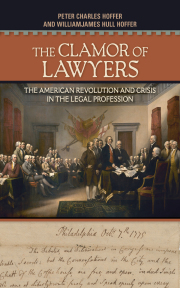
BOOK: Peter Charles HOFFER & Williamjames HULL HOFFER, The Clamor of Lawyers: The American Revolution and Crisis in the Legal Profession (Ithaca: Cornell UP, 2018), 204 p. ISBN 9781501726088; OPEN ACCESS

(image source: ProjectMuse)

Book abstract:
The Clamor of Lawyers explores a series of extended public pronouncements that British North American colonial lawyers crafted between 1761 and 1776. Most, though not all, were composed outside of the courtroom and detached from on-going litigation. While they have been studied as political theory, these writings and speeches are rarely viewed as the work of active lawyers, despite the fact that key protagonists in the story of American independence were members of the bar with extensive practices. The American Revolution was, in fact, a lawyers’ revolution. Peter Charles Hoffer and Williamjames Hull Hoffer broaden our understanding of the role that lawyers played in framing and resolving the British imperial crisis. The revolutionary lawyers, including John Adams’s idol James Otis, Jr., Pennsylvania’s John Dickinson, and Virginians Thomas Jefferson and Patrick Henry, along with Adams and others, deployed the skills of their profession to further the public welfare in challenging times. They were the framers of the American Revolution and the governments that followed. Loyalist lawyers and lawyers for the crown also participated in this public discourse, but because they lost out in the end, their arguments are often slighted or ignored in popular accounts. This division within the colonial legal profession is central to understanding the American Republic that resulted from the Revolution.
(source: ProjectMuse)

11 March 2020

BOOK: Kate BRADLEY, Lawyers for the Poor: Legal Advice, Voluntary Action and Citizenship in England, 1890–1990 (Manchester: Manchester University Press, 2019). ISBN 978-1-5261-3605-3, £80.00


Manchester University Press has published a new book on Legal advice, voluntary action and citizenship in England (1890–1990).

ABOUT THE BOOK

From the 1890s onwards, social reformers, volunteer lawyers, and politicians increasingly came to see access to affordable or free legal advice as a critical part of helping working-class people uphold their rights with landlords, employers, and retailers - and, from the 1940s, with the welfare state. Whilst a state scheme was launched in 1949, it was never fully implemented and help from a lawyer remained out of the reach of many people. Lawyers for the poor is the first full-length study of the development of voluntary action and mutual schemes to make the law more accessible, and the pressure put on the legal profession and governments to bring in further reforms. It offers new insights of the role of access to the law in shaping ideas about citizenship and civil rights in the twentieth century.

ABOUT THE AUTHOR

Kate Bradley is Senior Lecturer in Social History and Social Policy at the University of Kent

TABLE OF CONTENTS

List of abbreviations
Preface
Acknowledgements
Introduction
1 Making free legal aid and advice the business of state and profession
2 The Poor Man's Lawyer
3 The political law
4 The trade unions and legal services
5 Technology, access and education
6 Advice services in the post-war welfare state
Conclusion
Select Bibliography
Index

More info here

22 February 2019

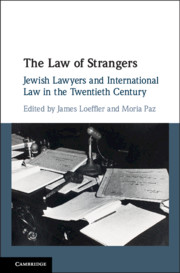
BOOK: James LOEFFLER & Moria Paz (eds.), The Law of Strangers Jewish Lawyers and International Law in the Twentieth Century (Cambridge: Cambridge UP, Sep 2019, ISBN 9781107140417, 110 USD

(image source: CUP)

Book abstract:
From the Nuremberg Trials to contemporary human rights, Jews have long played prominent roles in the making of international law. But the actual ties between Jewish heritage and legal thought remain a subject of mystery and conjecture even among specialists. This volume of biographical studies takes a unique interdisciplinary approach, pairing historians and legal scholars to explore how their Jewish identities and experiences shaped their legal thought and activism. Using newly-discovered sources and sophisticated interpretative methods, this book offers an alternative history of twentieth-century international legal profession – and a new model to the emerging field of international legal biography.
Table of contents:
1. Introduction: The Law of Strangers James Loeffler and Moria Paz
Part I: Hersch Zvi Lauterpacht
2. The “Natural Right of the Jewish People”: Zionism, International Law, and the Paradox of Hersch Lauterpacht James Loeffler
3. A Closet Positivist: Lauterpacht between Law and Diplomacy Martti Koskeniemmi
Part II: Hans Kelsen
4. Assimilation through Law: Hans Kelsen and the Jewish Experience Eliav Lieblich
5. Philosophy beyond Historicism: Reflections on Hans Kelsen and the Jewish Experience Leora Batnitzky
Part III: Louis Henkin
6. Louis Henkin, Human Rights, and American-Jewish Constitutional Patriotism, Samuel Moyn
7. Louis Henkin and the Genealogy of Jewish/American Liberalism William Forbath
Part IV: Egon Schwelb
8. Egon Schwelb and the Human Rights Legal Activism within Borders Mira Siegelberg
9. “Emotional Restraint” as Legalist Internationalism: Egon Schwelb's Liberalism after the Fall Umut Özsu
Part V: René Cassin
10. A Most Inglorious Right: René Cassin, Freedom of Movement, Jews and Palestinians Moria Paz
11. There's No Place Like Home: Domicile, René Cassin, and the Aporias of Modern International Law Nathaniel Berman Part VI: Shabtai Rosenne
12. Shabtai Rosenne: The Transformation of Sefton Rowson Rotem Giladi
13. Shabtai Rosenne: A Personal Aspect Philippe Sands
Part VII: Julius Stone
14. Enablement and Constraint: Julius Stone and the Contradictions of the Sociological Path to International Law Jacqueline Mowbray
15. An Axionormative Dissenter: Reflections on Julius Stone David N. Myers
Index.

More information with the publisher.

12 September 2018

SEMINAR SERIES: La neutralité des juristes (Paris, 27 September 2018, 10 January, 21 February, 28 March, 16 May 2019)


(Source: Hi-D)

Via Hi-D, we learned of a seminar series on “la neutralité des juristes” during the academic year 2018-2019.

Séminaire organisé par Fatiha Cherfouh (Université Paris-Descartes), Guillaume Richard (Université Paris-Descartes), Lionel Zevounou (Université Paris-Nanterre)

Présentation et Programme des 5 séances entre le 27 septembre 2018 et le 16 mai 2019.

Lorsqu’elle parle de dogmatique, la théorie analytique du droit développée en France renvoie à un discours dont la caractéristique est de ne pas distinguer les points de vue descriptifs et normatifs. De nombreux travaux ont, dans ce sillage, cherché à montrer que la doctrine contemporaine était, à bien des égards, un discours de pouvoir, voire un discours au service du pouvoir. Le séminaire entend discuter une hypothèse différente. Il cherchera à comprendre de quelle manière le style doctrinal contemporain s’est institué dès la fin du XIXe siècle, non pas en se fondant sur un quelconque critère théorique d’identification du discours dogmatique, mais en se pensant toujours lui-même comme un savoir, sans nécessairement avoir besoin de recourir à la distinction entre « dogmatique » et « science du droit », ni entre science du droit et droit. La théorie analytique du droit ne peut prétendre détenir le monopole de la représentation de la science du droit et il conviendra de dresser le panorama des différentes manières de se représenter une telle « science du droit », telle qu’elle est invoquée dans le discours juridique contemporain depuis le xixe siècle. Au-delà de cette question, il faut penser l’élaboration et la définition des frontières proposées par les juristes pour leur science.

Plusieurs travaux de philosophie et sociologie des sciences ont souligné l’évolution du concept de « science » à travers les siècles et les contextes. Parmi d’autres, les travaux de Merton, Gieryn ou d’autres ont démontré le caractère mouvant des frontières entre science et non-science. Les perspectives ouvertes par Michel Foucault ont également souligné combien la science se détachait et s’autonomisait à partir d’un substrat plus large, en fixant des critères d’inclusion et d’exclusion qui déterminent le discours scientifique admissible et la définition de la « science » dans un contexte donné. Les conceptions développées par Bruno Latour ont également orienté le regard sur les procédures suivies par les scientifiques et qui construisent la légitimité scientifique de telle ou telle pratique ou au contraire l’excluent du champ scientifique. Il ne faut pas, méthodologiquement, concevoir la science comme un savoir homogène reposant sur un critère sublimé (falsification, correspondance empirique, etc.) faisant la part entre le monde de la science et celui de la non-science, mais s’attacher au contraire à analyser les conditions de fixation de ces critères à un moment donné, à partir des pratiques mêmes des scientifiques ou de ceux qui se revendiquent comme tels.

Cette perspective permet de relier la manière dont les juristes ont ressenti le besoin de définir leur discipline selon un certain « modèle » de science, qui a influencé la manière de faire la doctrine. Le point de départ sera une analyse de la notion de neutralité du discours juridique, souvent mise en avant dans le discours juridique contemporain, soit pour considérer que la dogmatique juridique se doit de développer un discours distinct du discours politique et appuyé sur des considérations rationnelles ou scientifiques, soit pour reprocher à cette même dogmatique juridique de s’abriter derrière le paravent de la neutralité pour développer un discours éminemment politique. Pourtant, le regard rétrospectif sur la première moitié du xxe siècle montre que l’application de cette catégorie n’y est alors pas aussi simple. Le séminaire se proposera donc de revenir sur l’apparition de cette notion lorsqu’elle est appliquée au discours des juristes, à partir d’une discussion de ce concept largement tributaire dans son emploi des écrits de Max Weber. Le séminaire s’attachera ensuite à plusieurs études de cas portant sur la période contemporaine, afin de tester la pertinence d’appliquer les catégories de classement utilisées par l’épistémologie juridique contemporaine (positivisme, jusnaturalisme, discours prescriptif, etc.) à des périodes plus anciennes, antérieures aux années 1950, et d’analyser la définition de la science juridique et de son autonomie construite par le discours juridique.

Le séminaire, divisé en 5 séances réunira juristes ou historiens du droit, philosophes, sociologues.
Le séminaire se déroule sur deux sites universitaires : l’Université Paris Nanterre (RER A, Nanterre-Université) et la Faculté de droit de l’Université Paris Descartes (Métro ligne 13, Porte de Vanves ou Malakoff-Plateau de Vanves). À l’Université Paris Nanterre, les manifestations se dérouleront dans la salle 352 du bâtiment Simone Veil, 200, avenue de la République, 92000 Nanterre. L’entrée est libre sous réserve des places disponibles.

15 February 2018

CFP: Conference Lay Advocacy in the Premodern World, University of Turku (Finland), 28-30 May 2018 (deadline 16 March 2018)


(image source: University of Turku)

In Europe, both secular and ecclesiastical courts developed towards professionalization, and bar associations were established since the thirteenth century. In England, barristers obtained a monopoly on representing clients at court over the centuries. On the Continent, courts and bar associations regulated advocacy. Licensing was practiced especially in superior tribunals even before the rise of the liberal professions in the nineteenth century.

Professionalization tendencies went hand in hand with the ejecting of lay advocates from courts in many countries. For example, lay advocates (Winkelschreiber) were forbidden to appear in courts in the Austrian Empire in 1857. Issued legislation went as far as to threaten lay advocates with fines and short prison spells. Several other European countries followed with restrictions, and European-style regulation of advocacy was adopted in a number of American and Asian countries in the nineteenth and twentieth centuries.

But yet, especially in more peripheral regions, laymen with legal skills could have considerable space of action in courtrooms and outside of them. They could act in court on behalf of others, counsel people with legal problems, draft legal documents, and so on. Such legal literacy as human capital and an intangible knowledge asset provided a way for social mobility in the community. This could create tensions. The position of the intermediary was a position of power, also open to abuse. Self-learned advocates and legal literates could be criticized from both sides: for incompetence by the lawyer elite and for despotism, greed and partiality by the clientele.


Papers could discuss e.g.:
-              how “professional” and “lay” advocacy was defined
-              who acted as lay advocates
-              how lay advocates learned their trade
-              what kind of cases lay advocates handled (did they e.g. differ from those handled by professional advocates)
-              who turned to lay advocates (was the clientele of lay and professional advocates the same?)
-              whether advocacy proved a channel for social mobility
-              how lay advocacy was perceived by the legal profession
-              attitudes towards lay advocates (criticism, praise, etc.)
-              attempts to forbid or regulate lay advocacy
-              lay and professional advocacy as parallel phenomena

Confirmed plenary lectures will be given by Prof. Sir John Baker (University of Cambridge), Prof. Jane Burbank (New York University) and Prof. Kjell Åke Modéer (Lund University).

Deadline for paper proposals with abstracts (max. 400 words) is 16 March 2018. For more information, please contact Professor Mia Korpiola (mia.korpiola[at]utu.fi).

22 December 2017

CALL FOR PAPERS: First Women Lawyers in Great Britain and the Empire (29 Jun 2018) DEADLINE 23 APR 2018

First Women Lawyers in Great Britain and the Empire Symposium
29 June 2018: “The Road to 1919”
Call for Papers


The Sex Disqualification (Removal) Act 1919 heralded women’s long awaited entry to the legal profession.  What do we actually know about that journey?  How much of that struggle has been recorded?  Where is it recorded?  The ‘First Women Lawyers in Great Britain and the Empire’ Symposia seek to unite academics and researchers in this area and explore the journey of those first women lawyers. 

The 2018 meeting will celebrate the centenary of the vote and examine its effect on the passing of the Sex Disqualification (Removal) Act 1919. It will explore the extent to which it gave impetus to women such as Helena Normanton to make renewed attempts to join the legal profession in 1918.

The ‘First Women Lawyers Symposia’ has run successfully for three years and has drawn papers from England, Scotland, Estonia, Canada and Australia.  The 2018 symposium will be held on Friday 29th June 2018, venue TBC.  Submissions are welcomed from those researching in this area, including anyone with knowledge that will place the struggle for entry to the legal profession in England and Wales in an international context.  Closing date for submission of abstracts: 23 April 2018

The timetable for the following symposia are as follows:
2019 Celebrations:
Symposium:
Thursday February 7 2019 to be held at Middle Temple (continuing the theme of the road to 1919 and a celebration of the Act which received Royal Assent on 23 December 1919),
Celebration Dinner at Middle Temple Hall: Saturday 11 January 2020 (centenary of the first women Bar students’ first dinner)
June 2020 Symposium: ‘Legacy’
June 2021 Symposium: ‘The other women lawyers that history has, at best forgotten, at worst ignored’

17 November 2022 Celebration of the 1922 Call night at Middle Temple.

See also on
twitter: @1919lawpioneers
Contact dr. Judith Bourne (St Mary's University, Twickenham)

16 October 2015

LECTURE: Edmond Picard, a Belgian Socialist Bourgeois (Mons: Mundaneum, 29 Oct 2015)

 
(image source: Wikimedia Commons)


The Mundaneum in Mons (European Capital of Culture 2015) organises a lecture by dr. Paul Aron (Université libre de Bruxelles) on the enigmatic figure of Edmond Picard, editor of the famous Pandectes Belges.

Summary:
Dans le cadre du cycle "Le Mundaneum,un réseau de la connaissance"

Une conférence autour de la personnalité d'Edmond Picard, avocat,
homme politique et intellectuel, celui par qui Paul Otlet et
Henri La Fontaine ont pu se rencontrer ...

Edmond Picard s’est distingué dans de nombreux domaines. Avocat et homme de lettres, il a marqué la vie intellectuelle et politique de son temps. C’est d’ailleurs dans son cabinet, où Henri La Fontaine travaillait comme secrétaire, que se déroula la première rencontre entre Otlet et La Fontaine. Leur travail autour des Pandectes belges (recueil de législation et jurisprudence) pour Picard sera le point de départ de leur réflexion commune sur la bibliographie.

Figure représentative de la Belgique à la fin 19ème siècle, Edmond Picard faisait partie de ce réseau d’échange d’idées et de savoirs en Belgique.
On the author:

Paul Aron (BE) est docteur en philosophie et lettres à l’ULB, directeur de recherche au FNRS, et professeur de littérature et théorie littéraire à l’ULB. Il est l'auteur avec Cécile Vanderplegen-Diagre de Edmond Picard (1836-1924). Un bourgeois socialiste belge à la fin du dix-neuvième siècle. Essai d’histoire culturelle, (2013).
Practical information:
Voir la webinvitation
INFOS ET RESERVATION : 0032 65 31 53 43 ou info@mundaneum.be
On the Mundaneum:
The origins of the Mundaneum go back to the late nineteenth century. Created by two young Belgian jurists, Paul Otlet (1868-1944), the father of documentation, and Henri La Fontaine (1854-1943), Nobel Peace Prize, the project aimed at gathering all the world’s knowledge to file it using the Universal Decimal Classification (UDC) system that they had created.
An international institutions bureau dedicated to knowledge and fraternity, the Mundaneum became, in the 20th century, a universal centre of documentation. Its collections are made up of thousands of books, newspapers, journals, documents, posters, glass plates, postcards and other bibliographic cards that were put together and kept in various buildings in Brussels, including the Palais du Cinquantenaire.
A grandiose project then took shape, that of a World City for which Le Corbusier made scale models and plans. The aim of the World City was to gather, at world level, the great institutions of intellectual work: libraries, museums and universities. Ultimately, this project will never be realised. Purely utopian, the Mundaneum project soon faced the scale of the technical development of its era.
Along with the private archives of the founders, the documentary heritage kept to date contains books, newspapers, journals, documents, posters, glass plates, postcards, the Universal Bibliographic Repertory, the International Newspaper Museum and archive funds on three main themes: pacifism, anarchism and feminism.
Today, the Mundaneum is located in Mons, and since 1998, it has its own exhibition space staged by François Schuiten and Benoît Peeters. In this place hovering between past and present, exhibitions and conferences linked to this exceptional heritage are organised on a regular basis. Celebrations around the hundredth anniversary of Henri La Fontaine’s Nobel Peace Prize are planned in 2013 while 2012 the beginning of a collaboration with Google, which recognises its origins in the Mundaneum, a paper Google (Le Monde, 2009).


18 November 2014

BOOK: "Discurso sobre el discurso. Oralidad y escritura en la cultura jurídica de la España liberal" by Carlos Petit


Dr. Carlos Petit, Discurso sobre el discurso. Oralidad y escritura en la cultura jurídica de la España liberal
Lección inaugural curso académico 2000-2001, Universidad de Huelva, 2014, Universidad Carlos III de Madrid publications

All information here

Abstract
Este estudio pone de relieve los componentes orales que recorren la cultura jurídica de la España isabelina - aunque, con alta probabilidad, muchas de las hipótesis aquí lanzadas son perfectamente aplicables a otras tradiciones americanas y europeas. Con el abogado-orador como modelo de jurista perfecto y piedra de toque de la referida cultura, se analizan sucesivamente las prácticas universitarias (lecciones, discursos de apertura, oposiciones a cátedra), la profesión forense (saberes, bibliotecas, gestos...) con atención particular a la literatura sobre elocuencia y, en fin, la actividad parlamentaria y legislativa. Se pretende así observar desde nuevas perspectivas los textos del momento 'liberal'