Search

Showing posts with label customary law. Show all posts

18 April 2025

BOOK: Esther LIBERMAN CUENCA, The Making of Urban Customary Law in Medieval and Reformation England (Oxford: Oxford University Press, 2025), 288 p. ISBN : 978-0-19891-677-2, GBP 99,00.

(Image source: Oxford University Press)


Abstract:

Drawing on a quantitative analysis of hundreds of printed and archival sources from 77 towns, The Making of Urban Customary Law in Medieval England is the first cross-regional investigation into the history of urban customs since Mary Bateson’s seminal, two-volume work Borough Customs (1904-1906). In contrast to English common law and church law, which both had long institutional and academic traditions devoted to training men in their legal philosophies, customary law constituted local practices that acquired the force of law over time. Urban customary law regulated political officeholding, trade, property holding, and even moral behaviour in English towns.

The Making of Urban Customary Law argues that urban customs, which governed the lives of people in English towns, were crucial to the development of a distinct, bourgeois identity in England-an evolution that this new study tracks from the early twelfth to the late sixteenth centuries. In the years following the Black Death, and especially during the Reformation period, this law became more concerned with defining political authority, maintaining morality, and articulating a consensus about the “common good” for townspeople.

This book makes two principal claims: First, customary law advanced the business interests of an urban oligarchy. These were urban (male) elites who drafted laws and obtained privileges to enhance their wealth and assert their political independence from local lords, and often made claims about the legitimacy of their privileges or laws by rooted them in history or some kind of ancestral past. These lawmakers also made considerable efforts to establish their identities as morally upright and even-handed patriarchs. In so doing, urban customary law played a central role in the development of a distinct bourgeois identity in medieval and Reformation England. Second, this law lent particular meanings to the “common good” in towns, as it helped these lawmakers articulate policies that cohered to their vision of an ideal civic community.


On the author

Esther Liberman Cuenca received her PhD in History from Fordham University and is Assistant Professor of History at the University of Houston-Victoria in Victoria, Texas. She is an editor of the undergraduate textbook, Law, Justice, and Society in the Medieval World: An Introduction through Film (Fordham Press, 2025), and her essays have appeared in Urban History, The Paris Review, Continuity and Change, and Historical Reflections/Réflexions Historiques. She has received fellowships and awards from the Mellon Foundation, Medieval Academy of America, and American Philosophical Society. In 2022/23, she was a Member at the Institute for Advanced Study in Princeton.


Table of Contents

Introduction
1: The Making of Urban Charters and Custumals
2: The Authorship and Transmission of Urban Custumals
3: Customary Time and Urban Memory
4: Custom, Community, and the Common Good
5: Unenfranchisement: The Gendered and Classed Boundaries of Custom
6: Oath-Taking and the Performance of Urban Customary Law

More information can be found here.


13 December 2023

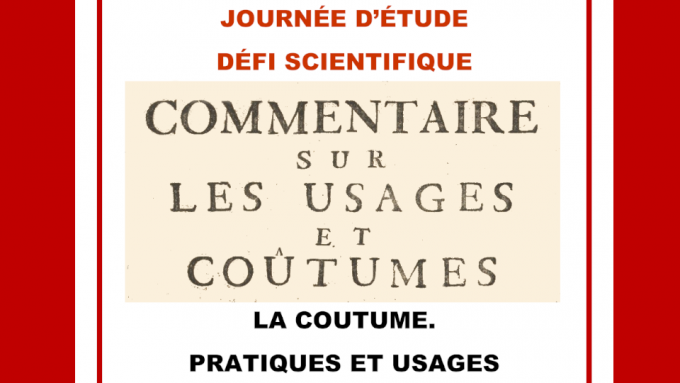
CONFERENCE: La coutume. Pratiques et usages (Rennes: Université de Rennes, 14 DEC 2023)


 (image source: univ-droit)

Abstract:

La journée d'étude « La coutume. Pratiques et usages » invite à s'interroger sur la vie et l'actualité de la coutume. La mise par écrit de la coutume lui fait perdre son caractère oral et sa qualité d'adaptation à la vie des individus. La pratique du droit peut toutefois avoir une destinée différente de celle de la coutume rédigée. Dès lors, la pratique de la coutume peut révéler une autre appréciation du texte coutumier, ce qui pose les questions d'interprétation et d'utilisation de cette source juridique. L'activité notariale sous l'Ancien Régime peut révéler des adaptations concrètes de la coutume, tout comme le maintien des usages ruraux aux XIXe et XXe siècles qui peuvent illustrer la vitalité de la coutume.

On the organiser:

            Luc Guéraud, Professeur d'histoire du droit, Université de Rennes

Program:

Le fait et le droit : Justice et coutume au Moyen Age central
L'écart entre coutumier et pratique. L'exemple du droit médiéval de l'orphelin
  • Colombe POULNAIS, Université de Rennes
L'usufruit au profit du survivant dans les contrats d'acquêts lorrains du XVIIIe siècle : maintien d'un ancien douaire réciproque ou don mutuel entre époux prohibé ?
La codification des usages locaux en Gironde : méthodes et enjeux
Les usages ruraux en droit positif
La conception de la coutume en droit positif : l'exemple des courses de taureaux

More information here.


27 December 2022

BOOK TALK ANNOUNCEMENT: Ada Kuskowski, Vernacular Law: Writing and the Reinvention of Customary Law in Medieval France - 20 January 2023, 12:30--2 pm (on Zoom)


Where does law come from? In the Middle Ages, there were generally two answers: legislation and custom. Later history would see custom largely pushed out of the realm of the legal, notably because of the advent of the legislative state and philosophies of legal positivism (with some exceptions). During the Middle Ages, however, legislation was piecemeal and record-keeping nascent. Large swathes of legal life were governed not by fiat but by custom. 

What custom meant, however, went through a radical shift during the period. Between the twelfth and thirteenth centuries, custom went from being a largely oral and performed practice to one that was also conceptualized in writing. Based on French lawbooks known as coutumiers, Ada Kuskowski traces the repercussions of this transformation – in the form of custom from unwritten to written and in the language of law from elite Latin to common vernacular – on the cultural world of law. Vernacular Law offers a fresh understanding of the formation of customary law as a new field of knowledge. Instead of a fossilized and somewhat inaccurate presentation of legal practice, this book shows authors combining ideas, experience and critical thought in order to transform disparate individual customs and practices into a new medium that presented them as a cohesive 'customary law.' Medieval customary law, commonly seen a community norm repeated by rote, emerges also as a product of individual craft and a law of dynamic innovation. 


Registration Link: https://law.stanford.edu/event/sclh-presents-ada-kuskowski-and-vernacular-law-writing-and-the-reinvention-of-customary-law-in-medieval-france/


12 October 2022

CALL FOR CONTRIBUTIONS : International Databasa on Customary Law Project


We received a message from Professor Sylvain Soleil (Univ Rennes 1) regarding the International Databasa on Customary Law Project.

Dear colleagues, Dear friends,

Today we are officially launching the International Database on Customary Law project, which is funded by the French Institute for Studies and Research on Law and Justice. This IDDLR project consists of :

1/ to provide the public with free online access to the maximum number of customary sets published in the world to date

2/ to accompany this online access with a vast epistemological, international and interdisciplinary reflection on the phenomena that are at work when customs, which are by nature evolving and oral, are put in writing, and therefore fixed, controllable and partly distorted

3/ to bring together researchers from all over the world around this dual documentary and scientific challenge

Summary :

Anthropologists and legal historians agree on the fact that all the civilisations of the world have, yesterday, the day before yesterday, or today, adopted a traditional legal system that has been classified as "customs". Several tens of thousands of customary systems have thus developed on earth, some of which continue to be applied on the fringes of or in addition to the modern legal system: in Asia, Oceania, Africa, North America and Latin America. By their very nature, these systems should only be known experimentally, since they have most often developed orally, thanks on the one hand to precepts shared by communities and their leaders, and on the other hand to imitations of foreign norms and judicial precedents which, in settling disputes, modify, if not the rule, at least its interpretation. However, the development of writing has captured the traditional, oral and customary phenomenon for various political, legal or sociological reasons. This, on the one hand, makes it possible not only to know the content of ancient and current customs, to exploit them, to study them and to compare them. On the other hand, it has profoundly modified the very concept of customs: they are now fixed and formalised by written signs.

For more info on the project as well as expressions of interest, kindly reach out to Professor Soleil.

07 February 2022

CALL FOR PAPERS: Ius commune and local testamentary succession laws and customs (c. 1400-1620) Cracow (Poland), 12-13 January 2023 (DEADLINE: 15 December 2022)


The Laboratory of Source Editions at the Faculty of Law and Administration of Jagiellonian University in Cracow and the Research Unit Roman Law and Legal History of KU Leuven are happy to invite you to an international workshop on ius commune and local testamentary succession laws (c. 1400-1620), which will take place at the Jagiellonian University in Cracow on 12-13 January 2023. The aim of the workshop is to bring together experts of both legal and social history of different European jurisdictions to reflect on the role of the law of last wills for the understanding of family and societal relationships, as well as on the impact of ius commune and university-trained jurists on the development of the law of testamentary succession.

Next to the organisation of a few keynote lectures, we launch an open call for papers and especially encourage interested scholars to submit proposals for papers on the following topics, always with a focus on the fifteenth, sixteenth and/or early seventeenth centuries: • the codification and homologation of local testamentary succession laws and customs; • the impact of Roman or canon law (ius commune) on local testamentary law; • the role of university-trained scholars for legal practice with respect to last wills, for instance through (but not limited to) their consilia; • the law of testamentary succession in the academic debate, and references to local legal practice; • the link between the aforementioned topics and the socio-political understanding of family and societal relationships.

We invite submissions for paper proposals on any of the aforementioned topics by both senior and junior legal and social historians. Proposals should consist of a (provisional) title, an abstract of 200-400 words, and a short cv, indicating at least the applicant’s name, current position, academic affiliation, contact details and (if applicable) related publications on the topic. Accepted papers will be granted a 35 minutesslot (25 minutes presentation, 10 minutes discussion). The conference will be held in English.

Please send your abstract and short cv by 31 March 2022 using a submission form: https://forms.office.com/r/5nT5x2eJn8XXX. For practical reasons, a maximum of fifteen applicants will be selected. All applicants will be notified by email within 4 weeks from this date. Participation will be definitive after payment of a workshop fee of 50 EUR.

Successful applicants are expected to submit a paper (8,000-12,000 words) in English for inclusion in a thematic volume to be published with an international publisher. A first version of the full paper will be due prior to the conference, by 15 December 2022. It should be an original contribution, not presented or published elsewhere. After the conference, the authors can finalize their text. Final (pre-peer review) versions of the papers are due by 15 April 2023. Consequently, all submitted papers will be subject to a process of peer-review; inclusion in the book depends on a positive evaluation by the peer-reviewers.

The conference regulations will soon be announced on the event website: https://pwz.wpia.uj.edu.pl/celsa/event. For any further questions, do not hesitate to contact the organizers (kamil.sorka@uj.edu.pl).

We are looking forward to a stimulating and intellectually enriching workshop! On behalf of the organizing committee Maciej Mikuła (Jagiellonian University) Wouter Druwé (KU Leuven) Kamil Sorka (Jagiellonian University)

13 February 2019

CALL FOR PAPERS: Revue Noesis (DEADLINE: 1 June 2019)


The revue Noesis (the journal of the Centre de Recherches en Histoire des Idées de l’Université de Nice) has launched a call for contributions for a double-volume on “the philosophy of customary law ”. Here the call :

For more than 20 years, the peer-reviewed journal Noesis has been at the forefront of French contemporary philosophy. Affiliated to the Center for Research in the History of Ideas (CRHI) of the University of Nice Sophia Antipolis, Noesis publishes two special editions a year, collecting paper around a topic chosen by its scientific committee. The Philosophy of Customary Law will be the name of the Spring 2020 double issue. It follows the organization of a conference on the “Philosophy of Customary Law” in May 2018.

The call

Far from considering the phrase « customary law » as a self-evident truth, papers will aim at identifying and trying to solve the many tensions created by the juxtaposition of two separate but parallel forms of social regulation: law and custom. What matters then is to investigate the ambiguity behind the very idea of customary law. Does it point out one more sort of law, or does it designate an autonomous kind of law, with its own features and not reducible to the law?

Answering these questions requires without any doubts an enquiry about the peculiar dynamics of customary law, grounded on both empiricist and theoretical perspectives. To know whether it is a form among others of law or it is specific enough to be called a genus of law, it is crucial to define its principles. If this law is called customary it is because custom is key to it as a source of law. Understanding the specific features of customary law means therefore striving to understand what role custom plays to shape the very nature of customary law.

It will be necessary to investigate the way the main role assigned to customs determines the very existence of specific institutions and peculiar criteria of the bigger law frame that regulates the individual. Any legal system that includes custom as its element must establish spatial, temporal and logical frame of custom proofs. Nevertheless, Anglo-Saxon Common law and its peculiar principles mustn’t overshadow any attempt to grasp the principles and the peculiarities of customary law; and we will be particularly sensitive to the way the customary law settles in pluralist contexts, where different customary laws can be concurrent. In these conditions the interaction between law and custom takes the shape of a normative conflict more than of a coherent customary law.

Exploring the limits and the fictions of customary procedures adopted by the Common Law could be the first step of both a new deployment of the customary law potential and an enquiry about its foundations. Indeed, it would be of extreme interest to study the different forms of customary law in eras where the Common Law model is spreading at different levels and domains, especially in international law, and where customary law is adopted in de-colonized regions where the law system is marked by a strong plurality of contexts.

Peculiar stakes of these contexts force to investigate both the limits and the flexibility of customary law. Do evolutions of scales and domains concern the essence of customary law, if this nature exists? Or are they only variations of a single nature beyond the peculiarities of each embodiment? It will also be necessary – among other issues – to address the specific effectiveness of customary law, and to determine if it lays on the same constraint as the law; and if it is supported by peculiar institutions and applications. The question of the role of the sanction is in this respect essential.

In the wake of these reflections it is necessary to note that custom is reduced to the status of simple source of the law in every law called customary, and is therefore deprived of every autonomous form of normative power. It is not custom that is not acknowledged as custom according to the processes required and in the name of the institutions and criteria defined by law. In this case, custom is not anything more than one of the many possible sources of law, and concurring with them; it has not a primary juridical existence.

This is the reason why John Austin could so easily disqualify custom self-sufficiency, arguing – with Hobbes and against the historical school – that the very nature of law prevents custom to be effective on its own besides the implicit or explicit, direct or indirect acknowledgement by the sovereign. One of the main ambitions of this collective publication would be indeed to question Austin’s position. This could in turn allow to address the issue of the substantial or accessory priority of the phrase « customary law ». Beyond this lies the very issue of the autonomy of custom as a social regulation tool.

In order to do that, one could be tempted to consider what disappears of custom and what does not, in customary law, so as to really understand its very nature. This brings us to discuss the specific subject of the codification of custom, the cornerstone of customary law. This codification is neverde facto a neutral act, and it will be more relevant to point out from every point of view all the implicit tensions of the codification, which standardize and stabilize power balances or social and economic struggles. One of the axes of the study, already well known in social science but overlooked by philosophy, would be that of interaction between formal law and custom in de- colonized countries.

Legal codification is one of these moments when powers and knowledge meet with most intensity. The “historical school” of law maintained the necessity of combining law studies with humanities, and we can now include social sciences such as economy, anthropology and sociology. We will therefore investigate which place these disciplines can or should have within the codification and definition of custom; we will also enquiry about their legitimacy, methods and approaches.

The question arises of which place one should give to specific case studies in this volume. It is clear that they must be crucial while studying customary law as a theoretical object; but no discourse should be limited to a series of descriptions of different customary laws.

The following, non-exhaustive list of questions should allow to prefigure various leads:
Does « customary law » locution show a specific mode of social regulation between the juridical and the customary? Is custom a source of law? Or could be considered as an object beyond or before it? Does a specific form of customary law exist despite its different expressions? Does a model of customary law exist – such as the international law?

Which transformations does custom endure when integrated with the « customary law »? Which philosophical implications does codification of custom produce within customary law? Which are the stakes of the very existence of customary law in pluralist and decolonized contexts? What are the relationships between customary law on one side and moral or juridical standards such as human rights on the other? What is the place of customary law within social change dynamics?

Which interactions and which concerns exist about humanities, social sciences and law with respect to custom? Which are the links of customary law with localities, territories, their history and their social displaying? How different disciplines of social and human sciences allow to reflect upon these phenomena and their conflict with law’s peculiar formality?

Submissions
The committee and the editors will make their selection from a set of complete papers only.
Proposals will not be reviewed.

Papers may be as long as 35.000 characters / 7.500 words. This does not include: the main title, abstracts, footnotes, the author’s presentation etc. Only the main text counts in the total of words.
Papers may be written in French, English and Italian only. They should be sent to the following email addresses altogether, by June 1st, 2019.
noesis@listes.unice.fr edoardo.frezet@gmail.com marc.goetzmann@unice.fr luke.mason@bcu.ac.uk
To ensure an unbiased selection, the document must be anonymous. It must be modifiable, therefore .doc files are preferable. Please include in your email a separate document that states your name, affiliation, topics of interests. We should provide an answer by August 1st, 2019.

Then, selected papers might need some modifications. The final versions of the papers will be dueby September 15, 2019.

(Source: Hi-D)

25 August 2018

BLOG: The Bibliothèque nationale de France's Gallica and Retronews on criminal legal history and customary law


The very active digital pillar of the Bibliothèque nationale de France, Gallica, has recently acquired the company of Retronews, a website dedicated to millions of pages of news.

The scientific staff attached to both databases brings the richness of these stocks to the audience through blogs.

Two posts have been added, one on customary law (Gallica), and one on punishments before the French Revolution (Retronews).

01 December 2017

VACANCY: PhD Studentships in Mediaeval History and Law (St Andrews, ERC Advanced Grant Civil Law, Common Law, Customary Law: Consonance, Divergence and Transformation in Western Europe from the late eleventh to the thirteenth centuries) (DEADLINE 15 JAN 2018)

(image source: University of St Andrews)

The project ‘Civil Law, Common Law, Customary Law: Consonance, Divergence and Transformation in Western Europe from the late eleventh to the thirteenth centuries’ invites applications for two PhD studentships, for applicants to start PhDs at the University of St Andrews in September 2018. Each student will examine the development of land law within a chosen region of western Europe in the period 1050-1250. Preference may be given to candidates working on France, Catalonia, or Italy, but applications to work on other areas will be considered too.

For further information on the project, see here.

Applicants should have completed a taught-postgraduate degree (or equivalent) by September 2018.

The studentships are fully funded covering stipend and fees for UK and EU resident students. Non-EU students can also be considered for further University scholarships for international fees.

Applicants should apply for a PhD place via the University of St Andrews standard application process (see here for more information). In addition, they should submit a research outline of a maximum of 500 words directly to Professor John Hudson by email to jghh@st-andrews.ac.uk.
The deadline for applications is 15 January 2018.

(source: rechtshistorische Courant, UGent)