Search

Showing posts with label Law and Images. Show all posts

01 December 2023

BOOK: Valérie HAEYAERT, Lady Justice. An Anatomy of Allegory [Edinburgh Studies in Law, Justice and the Visual, eds. Peter GOODRICH & Desmond MANDERSON; vol. 1] (Edinburgh: Edinburgh University Press, 2023), 208 p. ISBN 9781474487481, 90 GBP

(image source: Edinburgh UP)

Abstract:

Lady Justice: An Anatomy of Allegory leaves conventional readings of this pivotal figure in European legal history far behind. Hayaert's study brings together an analysis of thousands of images from the period 1400 – 1600, many of them previously overlooked, including artwork, frontispieces, legal texts, sculptures and statues in public spaces and in court buildings scattered across six countries. Lady Justice is taken apart and considered afresh - organ by organ, limb by limb, digit by digit, making a case for a treatment of allegory in all its complexity, ambiguity and affective force.

Table of contents:

Introduction

Periodization; Terminus ante quem; Justitia and her siblings: the four cardinal virtues; Justitia’s avatars: an art of gestural ethics; Lady Justice’s polyonomy; Images in movement; Justicia and Vengeance; Before the Law; Sources; The two faces of Justice; Allegory as a medium for judicial reform; Interpretative plurality; Precellence’ of women?An ethics of affects?

Chapter One: Images of Justice

Ekphrasis: Gregor Bersman; Ekphrastic epigrams of Justice; Goddess Justitia and the paradoxes of icones symbolicae; The Divine nature of Justice; A Judicial Ekphrasis; Bersman’s emblemology: The Leipzig context; Justitia quadrata; Justice as Puritas; The Lorica Iustitiae; Books, Scales and Cornucopia; The Sword: Alienum Opus Facio; Bodily synecdoches; Conclusion; Appendix: Translation of Gregor Bersman’s Imago Justitiae

Chapter Two: The paradoxes of Lady Justice’s blindfold

The allegory as a composite body; A phenomenological approach to allegory; Early modern lawyers and their interpretation of the blindfold; Clarity and ecstasy; Is the blindfold an attribute? Clear-sighted Justice in Greek and Roman Antiquity; Sebastian Brandt and the fool blindfolding Justice; An astute interpretation by Pierre Ayrault; Jacob de Cater’s emblematic verses; (Extra) Sensory Perception; The diaphanous blindfold; In praise of blindness; Continuing objections to the portrait of a blindfolded justice; Sculpting Justice: The co-existence of a clear-sighted and blindfolded Justice; The polysemy of the blindfold; André de Nesmond’s Remonstrance; The Eye of the Law; Conclusion

Chapter Three: Lady Justice’s Fingers: Gesture and Meaning

Gestural expressivity; The extended middle-finger as part of a mnemonic technique; Transitory Hieroglyphics; The horn gesture as apotropaic; Deictic index and judicial action; Gripping and handling; Hidden or discarded scales; Power-grip and precision-handling; The power-grip pattern as a visual rhetoric for a firm metrological order; Holding the scales: an archetype of honest weighing; The watchful eye combined with precision-handling; Conclusion

Chapter Four: Lady Justice’s Posture: Sitting, Standing or Walking?

Judicial temperament; Sitting Judges; The Legal Status of the Sitting Judge; Sedendo et Dormiendo? The Judge as "Throne-Sharer of Dike"; Lady Justice’s Throne; Standing Justices- The Myth of Astraea; Astraea as an Allegorical Body in Motion; Astraea as Justitia Victrix; The Departure of Astraea from Earth; Astraea, The Diva Fugax; The Countless Returns of the Goddess Astraea; Astraea before the Peasants; Seditious Lady Justice; Walking Justices; Fountains of Justice: Spatial Location and Communal Function; Reformed Cities: A New Vision of Justice; Divine Justice and Earthly Rulers; Lady Justice on the Forum; Conclusion: In the Orbit of Dame Justice

Chapter Five: Lady Justice and the Judge’s Body: Maimed Hands, Bare Knee

The Effigy of the Amputated Judge; A case study: Lady Justice standing in front of the penitent judge; The Maimed Hands of the Bailiff; The Missing Hands: A Shaming Ritual? A Double Effigy of Justice; Marten de Vos’ Adorodokia; Clemency; Knee Gestures; The Knee as ‘Seat of Clemency’; Lady Justice’s knee-gesture as an index of clemency; Justus Oldenkop’s frontispiece as a judicial manifesto; The Bare Knee as a Sign of Virtue in General; George Reverdy’s Allegory of Injustice; Nudity; Justitia meretrix: Lady Justice as a courtesan;Vanquishing Nudes; Conclusion

Chapter Six: Justitia’s Body Movements: A Sensual Lesson in Symbolic Fascinatio

A fascinating introduction; Triangle; Justitia’s Spatial Apparatus; Mechanical Justice; Kisses; The erotic kiss;The kiss in theology; The kiss in law; The kiss in politics; The kiss in economy; Polyglot and mystical kisses; Conclusion

Chapter Seven: Lady Justice’s Fragility

The technology of inflicting death; Bruegel’s Justitia; Sleeping Justice; Justitia’s dispassion in the stage-management of capital punishment; The two swords of Lady Justice; Justice assaulted; Justice raped; Justice shackled and disheveled; The Michelfeldt Tapestry; Justitia inter arma; Justitia Vulnerata;Oppressed Justice; Justitia at the Crossroads

Epilogue: Why has Lady Justice survived until now?

 On the author:

Valérie Hayaert is Research Fellow at the Criminal Justice Centre of the University of Warwick. She is author of Mens emblematica et humanisme juridique (Librairie Droz, 2008), co-editor with Mara R. Wade of Emblematica: Essays in Word and Image Volume 1 (Librairie Droz, 2017) and co-editor with Peter Goodrich of Genealogies of Legal Vision (Routledge, 2015).

Read more here


13 July 2022

JOURNAL: Special Issue Image et Droit. Les manuscrits juridiques enluminés (eds. Maria Alessandra BILOTTA & Serge DAUCHY) (Clio@Thémis. Revue électronique d'histoire du droit) 21 (2021) (OPEN ACCESS)


(image source: Clio@thémis)

Image et Droit. Les manuscrits juridiques enluminés (Martie Alessandra Bilotta & Serge Dauchy)

Illuminated English Law Books (Anthony Musson)

Abstract:

Illuminated books of the English legal tradition follow distinct iconographic patterns depending on the nature of the legal material included. The article explores correlations and dissonance between image and text as well as the symbolism associated with the imagery (in both initials and the margins) and its connection to political, legal and social discourses. It evaluates what the images reveal about key concepts of medieval law and justice, including kingship and good governance, the role of parliament and the church in endorsing these, as well as how these aspects might be undermined (or paradoxically confirmed) by medieval society’s penchant for role reversal, transgression and misrule.

Per gli esordi della decorazione del Digesto in epoca medievale : le iniziali miniate del ms. 941 della Biblioteca Universitaria di Padova (Gianluca del Monaco)

Abstract:

The Digestum vetus 941 of the Biblioteca Universitaria di Padova, dating back to the first half of the twelfth century, is well known to the studies among the witnesses of the earliest manuscript tradition of the work. However, the fine penwork initials adorning the manuscript have not been equally investigated, except for a few recent insights. The article explores the uncommon iconographies of some initials and analyses the style of the miniatures, advancing possible connections with the contemporary book illumination close to the milieu of Matilda of Canossa.

L’acquisizione del dominio tramite occupazione. Il rapporto testo-immagine nelle illustrazioni del libro 41, tit. 1 del Digesto e del libro 2, tit. 1 delle Istituzioni di Giustiniano nei manoscritti della BnF (xiii-xiv secolo) (Viviana Persi)

Abstract:

In this paper, I will analyse the legal aspect of the miniatures that illustrate book 41.1 of the Digest and the second book of Justinian's Institutions as a group of manuscripts dating from the thirteenth and fourteenth century and currently kept in the Bibliothèque nationale de France. These two Books are closely related to each other and present similar iconographies : the acquisition of ownership “naturali ratione” through the occupation of the res nullius, where wildlife and aquatic fauna – ferae bestiae, volucres et pisces – constituted an important example of res nullius in Roman and Justinian law. Hunting and fishing determined the acquisition of these assets and it is precisely these activities that illustrate books 41.1 of the Digest and 2.1 of the Institutions. Naturally, these activities have undergone changes over time, both of a technical and normative nature. I will try to show how these images depict, reflect and clarify the changes in the acquisition of the res nullius.

El poder a través de la imagen. La representación de los reyes de la Corona de Aragón en el Libro de privilegios de la villa de Alzira (Valencia) c. 1380-1391 (Nuria Ramón-Marqués)

Abstract:

This study intends to delve into the use of the image that the monarchy will use in the Kingdom of Valencia as an enhancing element of the accompanying text. For this, after the bibliographic review, a detailed analysis of the miniatures that appear in the Book of Privileges of the city of Alzira is carried out, considering it as the first manuscript made in a Valencian miniature workshop. From the study of artistic techniques and procedures, we will formulate stylistic connections that allow us to see the intervention of various illuminators working in Valencia in this period.

La imagen regia como símbolo legitimador: el Libro de los Privilegios de Toledo y la miniatura castellana a principios del siglo xiv (Jaime Moraleda Moraleda)

Abstract:

The illuminated decoration of the Hispanic medieval codex allows the study of the connection between materiality and use. The rich production during the alfonsí period in Castile maintained the characteristics of the French tradition from the end of the 13th century, without forgetting the aesthetic permeability from other variants of Italian influence. The Book of Privileges of Toledo, from the early 14th century, as a compilation legal document, collects the royal image represented in its vignettes and confirms the importance of royal iconography as a legitimizing symbol, an essential value in the origin of the codex.

Justice in the miniatures of Brunetto Latini's art of rhetoric: Columbia Library, Plimpton MS 281 (Tina Montenegro)

Abstract:

This article presents the miniatures in the art of rhetoric of a fifteenth-century French manuscript, Plimpton MS 281 (Columbia University, Rare Book and Manuscript Library). The text is Brunetto Latini’s Tresor, a thirteenth-century compilation written in Old French on the art of government. The iconography of Plimpton MS 281 seems to be new with regard to the art of rhetoric and to be intended for a legal milieu. By studying the images from the point of view of the history of the text, the aim is to understand what might have caused a change in the iconography of the art of rhetoric.

Les manuscrits juridiques bolonais parmi les transferts artistiques au Trecento : de l’iconographie des ermites de saint Augustin au Bon gouvernement d’Ambrogio Lorenzetti (Bertrand Cosnet)

Abstract:

The challenge of this contribution is to identify the role played by the legal manuscripts illuminated in 14th century Italian art. The decorative programmes of these manuscripts, too often underestimated, are doubly interesting because they allow, on the one hand, to identify the dynamics of the processes of circulation and iconographic transfer, particularly fertile in Trecento, and, on the other hand, to reconstruct the richness of the visual culture of Italian lawyers in the 14th century. The article focuses mainly on the iconography of virtues, which experienced considerable growth in the 14th century in the context of communal regimes and mendicant orders, of which several legal manuscripts provide decisive clues to the process of invention and circulation. Particular attention is paid to three manuscripts produced in Bologna, namely the Digestum vetus preserved at the Bibliothèque nationale de France in Paris (Ms. Lat. 14339), the Novella sive commentarius in decretales epistolas Gregorii IX located at the Biblioteca Ambrosiana in Milan (Ms. B 42 inf), and the Digestum novum preserved at the Biblioteca Nacional de España in Madrid (Ms. M 197).

Un manoscritto giuridico miniato tra la Badia Fiorentina ed il Portogallo del xv secolo: il codice Conventi Soppressi A 4 2554 della Biblioteca Nazionale Centrale di Firenze  (Sofia Orsino)

Abstract:

A fifteenth-century Latin manuscript, kept at the Biblioteca Nazionale Centrale in Florence and coming from the Benedictine monastery of Santa Maria (also known as Badia Fiorentina), contains the Repertorium iuris by Giovanni Nicola de Milis and seems to be the result of influences and contacts between Italy and Portugal. This article questions the enigmatic relationship between text and decoration; also, on the basis of an analysis of the illumination, combined with a codicological and palaeographical study, it reconstructs the context of production and the arrival of the codex in the Florentine monastery.

Varia

Foreign Law Without Borders in the Early Vast America. Spanish Legal Literature in 19th Century North America (Angela Ballone)

Abstract:

By studying some case studies, this article shows how the works of some Spanish jurists from the 17th and 18th centuries were used in the 19th century, both in Britain and also overseas in the British Atlantic (from Washington to California, passing through Florida), to solve judicial conflicts about land and exploitation. The reader will see to what extent some unexpected sources of law were intertwined into the daily practice of North American courts. Such entanglements are at the very heart of the comparative analysis of the field of legal history.

Read the full issue here

22 November 2021

JOURNAL: Clio@Themis (Vol. 21, 2021)


(Source: Clio@Themis)

Clio@Themis has published its latest issue, a thematic issue entitled ‘Dossier : Image et Droit. Les manuscrits juridiques enluminés’.

Dossier : Image et Droit. Les manuscrits juridiques enluminés

Maria Alessandra Bilotta and Serge Dauchy

Introduction

Image et Droit. Les manuscrits juridiques enluminés

Anthony Musson

Illuminated English Law Books

Gianluca del Monaco

Per gli esordi della decorazione del Digesto in epoca medievale : le iniziali miniate del ms. 941 della Biblioteca Universitaria di Padova

Viviana Persi

L’acquisizione del dominio tramite occupazione. Il rapporto testo-immagine nelle illustrazioni del libro 41, tit. 1 del Digesto e del libro 2, tit. 1 delle Istituzioni di Giustiniano nei manoscritti della BnF (xiii-xiv secolo)

Nuria Ramón-Marqués

El poder a través de la imagen. La representación de los reyes de la Corona de Aragón en el Libro de privilegios de la villa de Alzira (Valencia) c. 1380-1391

Jaime Moraleda Moraleda

La imagen regia como símbolo legitimador: el Libro de los Privilegios de Toledo y la miniatura castellana a principios del siglo xiv

Tina Montenegro

Justice in the miniatures of Brunetto Latini's art of rhetoric: Columbia Library, Plimpton MS 281

Bertrand Cosnet

Les manuscrits juridiques bolonais parmi les transferts artistiques au Trecento : de l’iconographie des ermites de saint Augustin au Bon gouvernement d’Ambrogio Lorenzetti

Sofia Orsino

Un manoscritto giuridico miniato tra la Badia Fiorentina ed il Portogallo del xv secolo: il codice Conventi Soppressi A 4 2554 della Biblioteca Nazionale Centrale di Firenze

Varia

Angela Ballone

Foreign Law Without Borders in the Early Vast America. Spanish Legal Literature in 19th Century North America.


The issue can be found here

01 October 2021

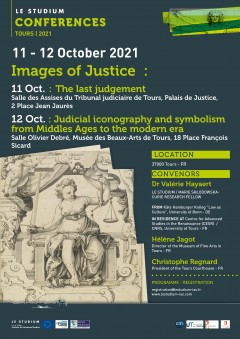
CONFERENCE: Images of Justice (Orléans, 11-12 October 2021)

(image source: Le Studium)


We learned of a conference about judicial images and imaginary.


Conference description

In the last three decades, beginning in 1994 with a major work by Robert Jacob, there has been a renascence of writing of images of Justice, judicial iconography and courthouse architecture.

In 2016 and 2018, following two major exhibitions held in Bruges and Mechelen to which I contributed, I was able to weave a more reflective understanding of what happens when a viewer encounters an embodied image of justice, whether this artifact is a painting, a sculpture, or an object, trapped into a meaningful  judicial ritual (eg. shaming practices, "amende honorable", executions in effigy).

These investigations were born out of a fruitful dialogue between curators, legal professionals and researchers. An image of justice is no longer imagined as an immobile artwork, or an opportunity for religious or historical narrative out of its primary judicial context but as an imaging process involving several functions (didactic, persuasive, mnemonic, deontological roles). In Europe, most of our contemporary courthouses are symbolically silent. A reflective evaluation of the functions of judicial images in the "longue durée" is a useful ally to revive the foundational principles of fair trial and due process.

Bringing together researchers and legal professionals, as well as curators and heritage specialists, this event also wishes to connect participants to the ways in which a figure of Christian Judgment has been constantly reinvented throughout the centuries. The idea is to look at artworks 'in situ' from a legal and societal perspective, explaining their key role as symbols.


Convenors

  • Dr Valérie Hayaert, LE STUDIUM / Marie Skłodowska-Curie Research Fellow; from Käte Hamburger Kolleg "Law as Culture", University of Bonn - DE and in residence at Centre for Advanced Studies in the Renaissance (CESR)  / CNRS, University of Tours - FR
  • Hélène Jagot, Director of the Museum of Fine Arts in Tours - FR
  • Christophe Regnard, President of the Tours Courthouse - FR

***

Monday 11th october 2021
 Last Judgment (salle d'Assises du Tribunal Judiciaire de Tours)
Chairman - Antoine Garapon (Sciences-Po Paris)

08.30 Welcome of the participants

09.00 Official opening by Sophie Gabillet (General Secretary of LE STUDIUM) & Christophe Regnard (President of the Tours Courthouse)

09.45 Valérie Hayaert - Regards sur le décor allégorique de la salle

10.00 Georges-Elia Sarfati (Professeur d'université (linguistique) et professeur d'études bibliques à l'Institut universitaire Elie Wiesel (Paris)) - Significations et portée de l'expression "le jour de Yahwé" dans la Bible hébraïque

10.45. Robert Jacob (directeur de recherche au CNRS et professeur d’histoire du droit à l’Université de Liège)


Chairman - Olivier Beaud (Paris II, Assas)

13.45 Christophe Bouton (Professeur de Philosophie à l’Université Bordeaux III-Montaigne) - Le tribunal de l'histoire - Le thème du jugement dernier dans les philosophies de l'histoire

14.30 Frédéric Gros (Professeur de pensée politique à l’IEP de Paris, Sciences-Po et chercheur au CEVIPOF) 

15.30 Noëlle Herrenchmidt (journaliste reporter) : « 45 années de dessins d’audience aux côtés d’Antoine Garapon »

16.15 Antoine Garapon 

17.30 Tribute to Antoine Garapon at the Basilique Saint-Martin (visit of the crypt and tribute on the square in front of the basilica: capacity of 60 to 70 people..

Sacha Philip (Émile Cohl school, Lyon) will sketch the speakers during the debates and will make an illustrated report of the day, in the tradition of courtroom drawings. The illustrations will be produced and filmed during the day, with occasional projections on a large screen.


Tuesday 12th october 2021
Judicial iconography and symbolism from Middle Ages to the Modern era (salle Olivier Debré du Palais des beaux-arts de Tours)
Chairman - Robert Jacob (CNRS, Université de Liège)

08.30 Welcome of the participants

09.00 Offiicial opening by the director, Hélène Jagot, and the curator, Elsa Gomez (medieval and Renaissance paintings)

09.15 Valérie Hayaert - Deux tableautins (tavolette) encadrant le rituel d'exécution à Bologne (vers 1350) conservés au Musée des Beaux-Arts de Tours: l'image narcotique-salvifique dans le rite judiciaire.

10.00 Carolin Behrmann (Université de Berlin)

11.00 Dominic-Alain Boariu (Université de Fribourg, Suisse) - Autour du procès de Giuseppe Fieschi (1835) et son exécution ; Respondent: Raphaël Cahen (POLEN, Orléans) 

11.45 Pierre Henri Biger & Samuel Devisme: La Justice sur un éventail : une allégorie critique de la politique judiciaire de Louis XIV ?


Chairman : Harold Epineuse (Institut des Hautes Études sur la Justice)

13.45 Manuela Bragagnolo (Max Planck Institute for Legal History and Legal Theory, Francfort)  - Physiognomy and Law at the Early Modern Period ; Respondent: Concetta Pennuto (CESR, Tours)

14.45 Adrien Pitor & Nicolas Lyon-Caen - Assister à la scène judiciaire. Le public dans le Palais de Paris au XVIIIe siècle

15.15 Xavier Rousseaux (Université de Louvain) « La spectacularité des peines dans les Pays-Bas (rituels de pèlerinage ou de pardon, amendes honorables, ex-votos) au 15e-17e siècles. »

16.00 Stéphane Moure (MCF à la faculté de Droit de Tours) -  « La nouvelle architecture judiciaire. Remarques sur un langage symbolique. »

16.45 Jean-Paul Jean (Président de chambre honoraire à la Cour de cassation et secrétaire général de l’AHJUCAF (Cours de cassation du réseau francophone) - « Le N’Kisi Kongo comme symbole de justice ».


Detailed information can be found at the following page

25 November 2016

SEMINAR: "Les images comme fondement de la mémoire urbaine dans l’Europe médiévale" (Lisbon, November 28 2016)


WHAT Les images comme fondement de la mémoire urbaine dans l’Europe médiévale: l'illustration et la décoration des Statuts et des Coutumes dans le Midi de la France, l’Italie communale et la Péninsule Ibérique à la fin du Moyen Âge (XIIIe – XVe siècles), Seminar


WHEN November 28, 17:30-19:00

WHERE IEM (Instituto de Estudos Medievais | FCSH/UNL) de l’Universidade Nova de Lisbonne FCSH/NOVA, Edifício ID, Sala 2.21 (Piso 2)

Sources importantes pour l’histoire urbaine, le Statuts et les Coutumes des villes médiévales sont également un élément important dans la construction de la mémoire des villes au Moyen Age. Une mémoire reconstruite en fonction des développements sociaux et politiques dont les textes et les images sont le miroir. Travail conscient et planifié, conçu par les villes elles-mêmes, les Statuts et les Coutumes non seulement décrivent et racontent l’histoire des villes, mais aussi contribuent à la création, par l’écriture, d’une mémoire commune, et jouent un rôle fondamental dans le développement d’une conscience urbaine. Les images contribuent également à la création de cette prise de conscience. Cette intervention vise à analyser et comparer la décoration et l’illustration des Statuts et des Coutumes du Midi de la France, de l’Italie communale et de la Péninsule ibérique, pour montrer les similitudes et les différences dans la structure visuelle de ce message mémorial pour mieux comprendre la logique qui régit la structuration des pratiques de l’illustration et de la décoration de la loi écrite dans les sociétés de Europe méridionale à la fin du Moyen Âge.
Le Séminaire sera tenu par Mme Maria Alessandra Bilotta (IEM-FCSH-UNL)